Financial and Managerial Accounting, 9th Edition
16-1
CHAPTER 16
PROCESS COSTING AND ANALYSIS
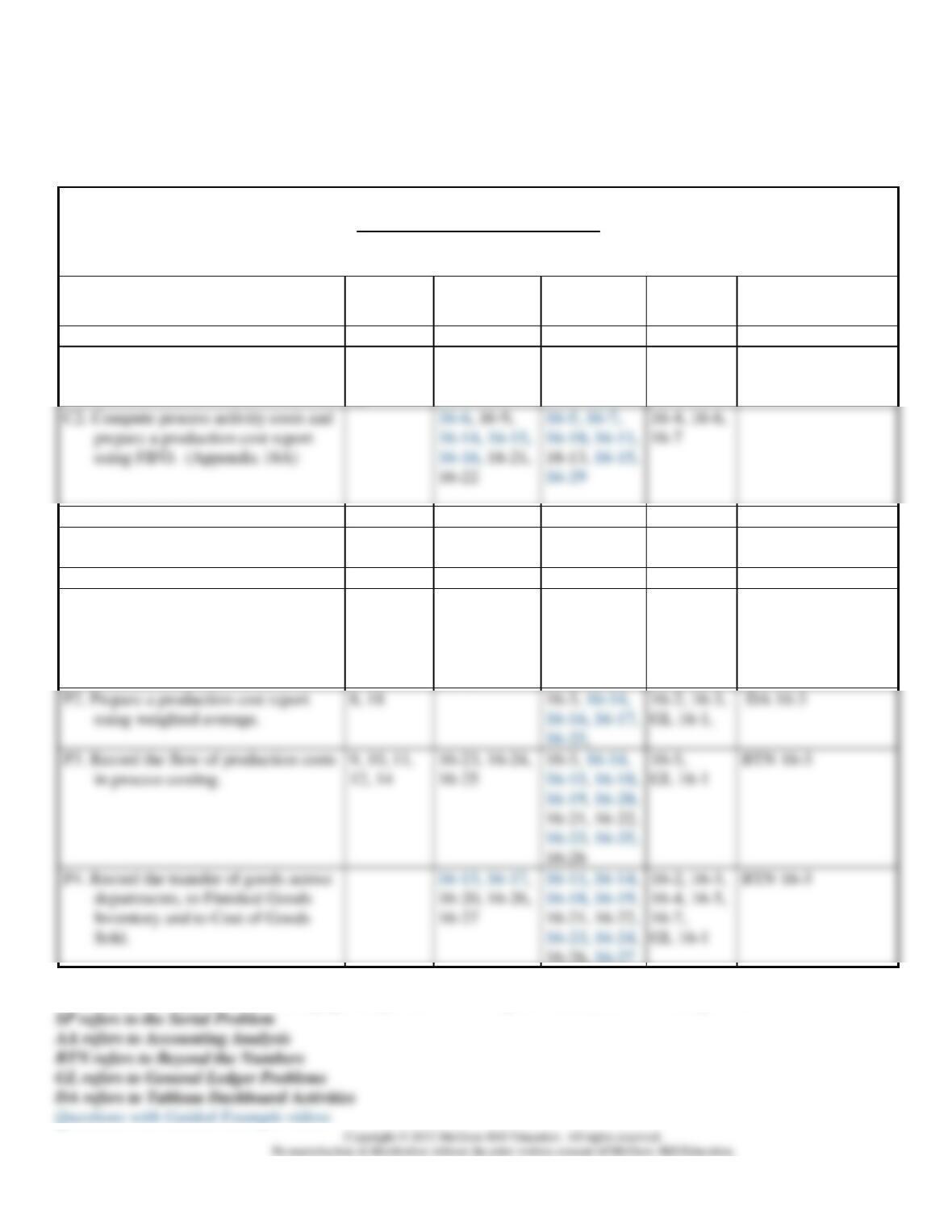
Related Assignment Materials
Student Learning Objectives
Discussion
Questions
Quick
Studies*
Exercises*
Problems*
AA, BTN, DA
Conceptual objectives:
C1. Explain process costing and contrast
it with job order costing.
1, 2, 3, 5, 7,
15, 16, 17,
18
16-1, 16-2,
16-3
16-1, 16-2,
16-3
BTN 16-1, BTN 16-2,
BTN 16-3
16-16, 16-21,
16-13, 16-15,
Analytical objectives:
A1. Explain and illustrate a hybrid
costing system.
19
16-28, 16-29
16-30
AA 16-1, AA 16-2,
AA 16-3, BTN 16-4
Procedural objectives:
P1. Compute process activity costs using
weighted average.
4, 5, 6, 13
16-4, 16-5,
16-7, 16-8,
16-10, 16-11,
16-12, 16-18,
16-19
16-3, 16-4,
16-6, 16-8,
16-9, 16-12,
16-13, 16-15,
16-26
16-1, SP,
DA 16-1, DA 16-2
using weighted average.
16-16, 16-17,
GL 16-1,
16-21, 16-22,
Sold.
16-23, 16-24,
GL 16-1
*See additional information on next page that pertains to these quick studies, exercises and problems.
Financial and Managerial Accounting, 9th Edition
16-2
Additional Information on Related Assignment Material
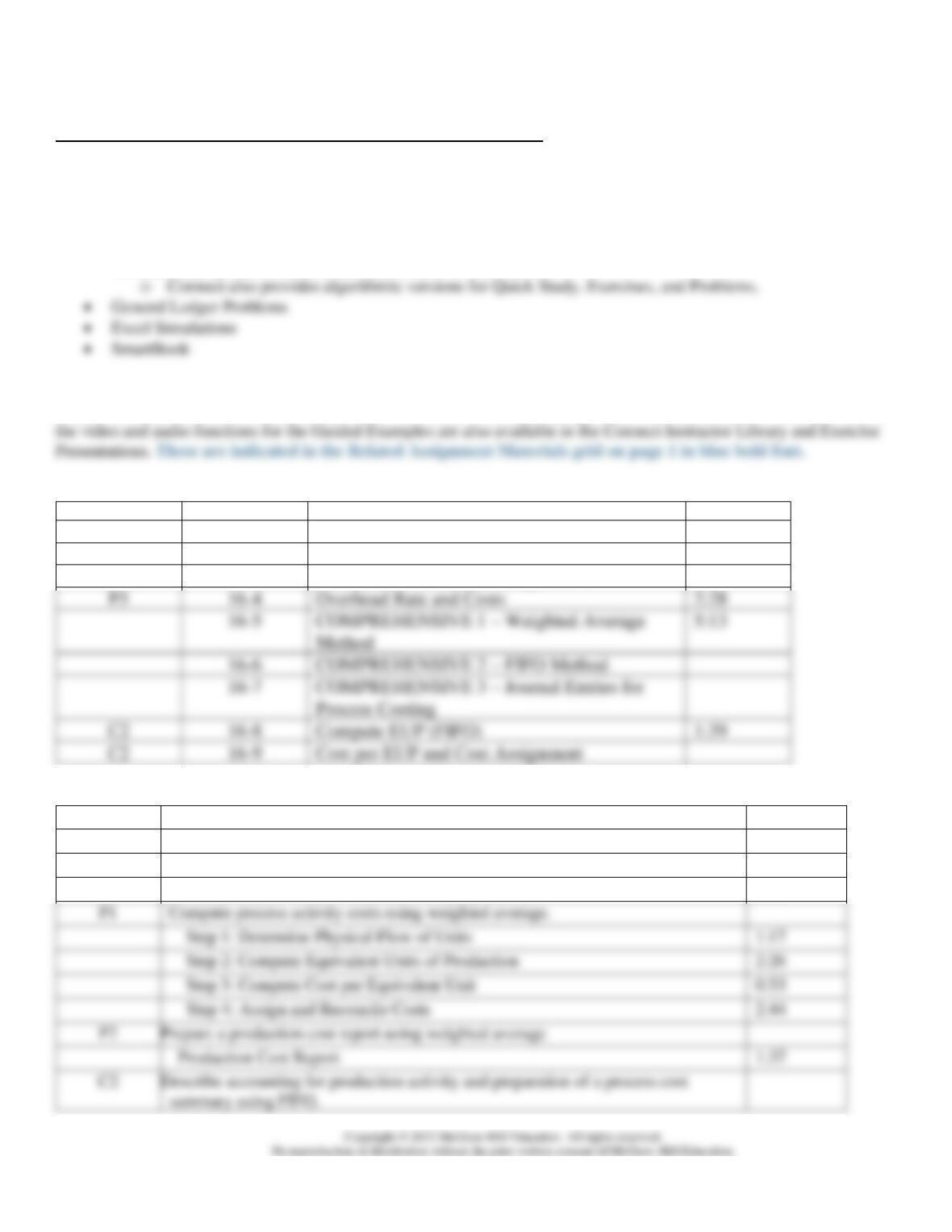
See Chapter 1 of the Instructor’s Resource Manual for more information on materials for this text available in
Connect.
Connect
Available on the instructor’s course-specific website, Connect:
• All numerical Quick Studies, all Exercises and Problems Set A.
Hints/Guided Examples
Please note that the Guided Examples are labeled as “Hints” in Connect assignments. The animated PowerPoints without
Need-to-Know Videos
LO
Need–to-Know
Title
Time
C1
16-1
Job Order vs. Process Costing Systems
0:46
P1
16-2
Compute EUP (Weighted Average)
3:11
P1
16-3
Cost per EUP and Cost Assignment
1:43
P3
16-4
Overhead Rate and Costs
2:28
Method
16-6
COMPREHENSIVE 2 – FIFO Method
Process Costing
16-8
Compute EUP (FIFO)
1:39
C2
16-9
Cost per EUP and Cost Assignment
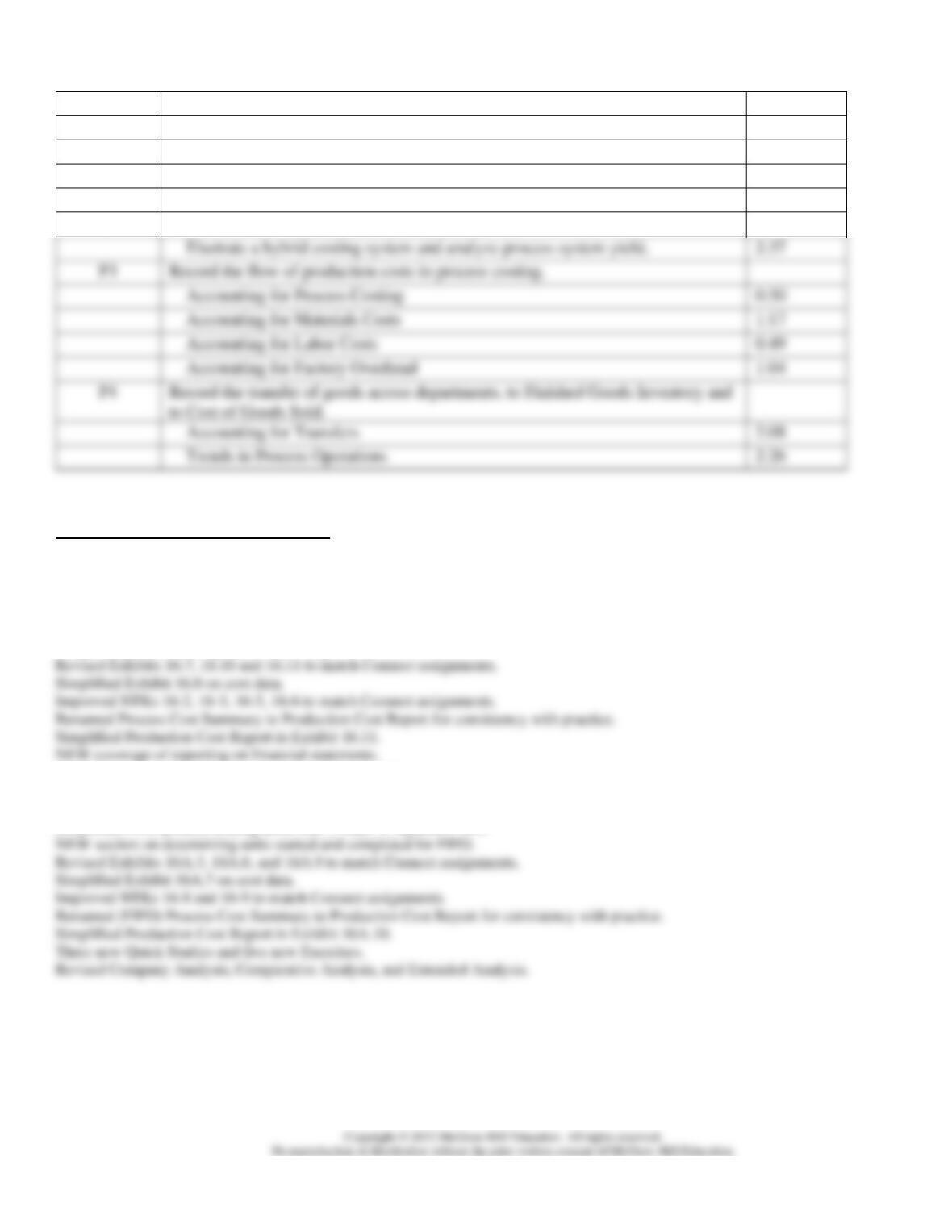
Concept Overview Videos
LO
Title
Time
C1
Explain process costing and contrast it with job order costing.
Process Operations
1:26
Comparing Process and Job Order Costing Systems
1:12
Compute process activity costs using weighted average.
Step 1: Determine Physical Flow of Units
1:17
Step 2: Compute Equivalent Units of Production
2:26
Step 3: Compute Cost per Equivalent Unit
0:53
2:44
1:37
Financial and Managerial Accounting, 9th Edition
16-3
FIFO Method of Process Costing
0:41
FIFO Method Step 1
1:42
FIFO Method Step 2
3:45
FIFO Method Step 3
0:42
FIFO Method Step 4
3:23
A1
Explain and illustrate a hybrid costing system.
Illustrate a hybrid costing system and analyze process system yield.
2:37
Record the flow of production costs in process costing.
Accounting for Process Costing
0:50
Accounting for Materials Costs
1:17
Accounting for Labor Costs
0:49
Accounting for Factory Overhead
1:04
Accounting for Transfers
2:08
Trends in Process Operations
2:26
Synopsis of Chapter Revisions
UPDATED Opener – Azucar Ice Cream Company.
Streamlined learning objectives.
Modernized Exhibit 16.1.
NEW Exhibit 16.2 is simple overview of GenX operations.
Moved coverage of EUP to step 2 of process costing demo.
Simplified process costing demo into 4-steps.
NEW discussion of computing cost per completed unit.
NEW Analytics Insight on machine learning at Hershey.
Revised hybrid costing systems and added manufacturing yield to Decision Analysis.
Simplified FIFO process costing demo into 4-steps in Appendix 16A.
Financial and Managerial Accounting, 9th Edition
16-4
Chapter Outline
I. Process Operations⎯is mass production of similar products in a continuous flow of sequential
processes. Use a standardized process to make large volumes of similar products.
A. Organization of Process Operations
1. Each process is identified as a separate production department, workstation
B. Comparing Process and Job Order Costing Systems
1. Both use materials, labor and overhead and aim to compute cost per unit of product.
2. Cost object:
a. Job order system: job or job lot.
High standardization
C. Transferring Costs across Departments ⎯overall objective is to determine the total cost per unit of a
product or service.
1. In process costing, manufacturing costs are transferred across work in process inventor
accounts.
II. Process Costing Demonstration – this section uses the weighted-average method to demonstrate the
four-step process costing system. The weighted-average method combines units and costs across
two periods in computing equivalent units and cost per equivalent unit.
A. Step 1: Determine Physical Flow of Units
1. A physical unit flow reconciliation proves that: 1) beginning units in process plus those started
2. The following totals should agree:
a. Units in beginning work in process + units started during the period = the number of units to
Financial and Managerial Accounting, 9th Edition
16-5
B. Step 2: Compute Equivalent Units of Production (EUP) – number of whole units that could have
been started and completed given the costs incurred in the period.
1. Must convert the physical units worked on to equivalent units based on the amount of each input
(direct materials, direct labor, and overhead) that has been used.
2. Equivalent Units⎯Direct Materials⎯add together the results of a two-step calculation:
a. Units completed and transferred out during the period times 100% (since the units have all
C. Step 3: Compute Cost per Equivalent Unit of Production – uses equivalent units of production from
step 2 along with cost data, to compute cost per equivalent unit.
1. Cost per Equivalent Unit for Direct Materials⎯The materials costs in beginning work in
process inventory plus the direct materials costs added during the period are divided by the
D. Step 4: Assign and Reconcile Costs – uses EUP from step 2 and cost per EUP from step 2 to assign
costs to the units completed and transferred out and to the units in ending work in process.
1. The following totals should agree:
a. Cost of beginning work in process inventory plus cost incurrent during the period equal
total costs to account for.
E. Using Process Cost Information –
1. Control costs – department’s equivalent cost per unit can be compared to prior months and if
changed a lot, corrective action can be taken.
Financial and Managerial Accounting, 9th Edition
16-6
F. Production Cost Report
1. Primary managerial accounting report. Also called a production report.
2. A separate report is prepared for each process or production department.
d. Cost Assignment of total costs among units worked on in the period.
IV. Accounting for Process Costing
A. Accounting for Production Costs
1. Materials, labor and overhead costs flow through the manufacturing processes as shown in
B. Materials Costs
1. Raw materials purchased on credit are recorded by debiting Raw Materials Inventory and
crediting Accounts Payable.
Materials Inventory.
C. Labor Costs
1. Direct labor costs used in production are recorded by debiting each department’s Work in
Process Inventory account and crediting Factory Payroll Payable.
2. Indirect labor costs are recorded by debiting Factory Overhead and crediting Factory Payroll
Payable
D. Factory Overhead
1. Overhead costs other than indirect materials and indirect labor are recorded by debiting Factory
Overhead and crediting the related accounts.
V. Accounting for Transfers
A. Transfers across Departments – the transfer of partially completed units from one department to the
next includes a debit to Work in Process Inventory – Department 2, and a credit to Work in Process
Inventory – Department 1.
Financial and Managerial Accounting, 9th Edition
16-7
D. Sales and the Transfer to Cost of Goods Sold – record cost of goods sold by debiting Cost of Goods
Sold and crediting Finished Goods Inventory. To record the sale on credit,
debit Accounts Receivable and credit Sales.
V. Trends in Process Operations include the following:
Process Design; Just in Time Production; Robotics and Automation; Continuous Processing; Services,
and Customer Orientation.
VI. Decision Analysis—Hybrid Costing System
A. Contains features of both job order and process operations.
B. A hybrid system of processes requires a hybrid costing system.
VII. Appendix 16A – FIFO method of process costing
A. The objectives, concepts, and journal entries (but not amounts) are the same as for the weighted
average method.
B. FIFO method computes equivalent units and cost per equivalent unit based only on production
activity in the current period.
C. The computation of equivalent units differs.
D. Step 1: Determine physical flow of units.
accounted for.
E. Step 2: Compute Equivalent Units of Production (EUP)
1. EUP is the number of whole units that could have been started and completed given the costs
incurred in the period.
2. EUP for Direct Materials⎯add together the results of a three-step calculation:
a. Units in beginning work in process inventory times the percent of materials added during
Financial and Managerial Accounting, 9th Edition
16-8
3. EUP for Conversion Costs⎯add together the results of a three-step calculation:
a. Units in beginning work in process inventory times the percent of conversion costs added
F. Step 3: Compute Cost per Equivalent Unit
1. Costs assigned to the department during the period divided by the equivalent units of production
G. Step 4: Assign and Reconcile Costs
2. The following totals should agree:
a. Costs of beginning work in process inventory plus costs incurred during the period (i.e.,
3. Sources of amounts used in cost reconciliation:
a. Cost of the completed beginning inventory units equals beginning balance of the Work in
Process Inventory plus the following costs to complete the beginning inventory:
i. Direct material cost assigned: (EUP to complete beginning work in process
Financial and Managerial Accounting, 9th Edition
16-9
Chapter 16 Alternate Demo Problem
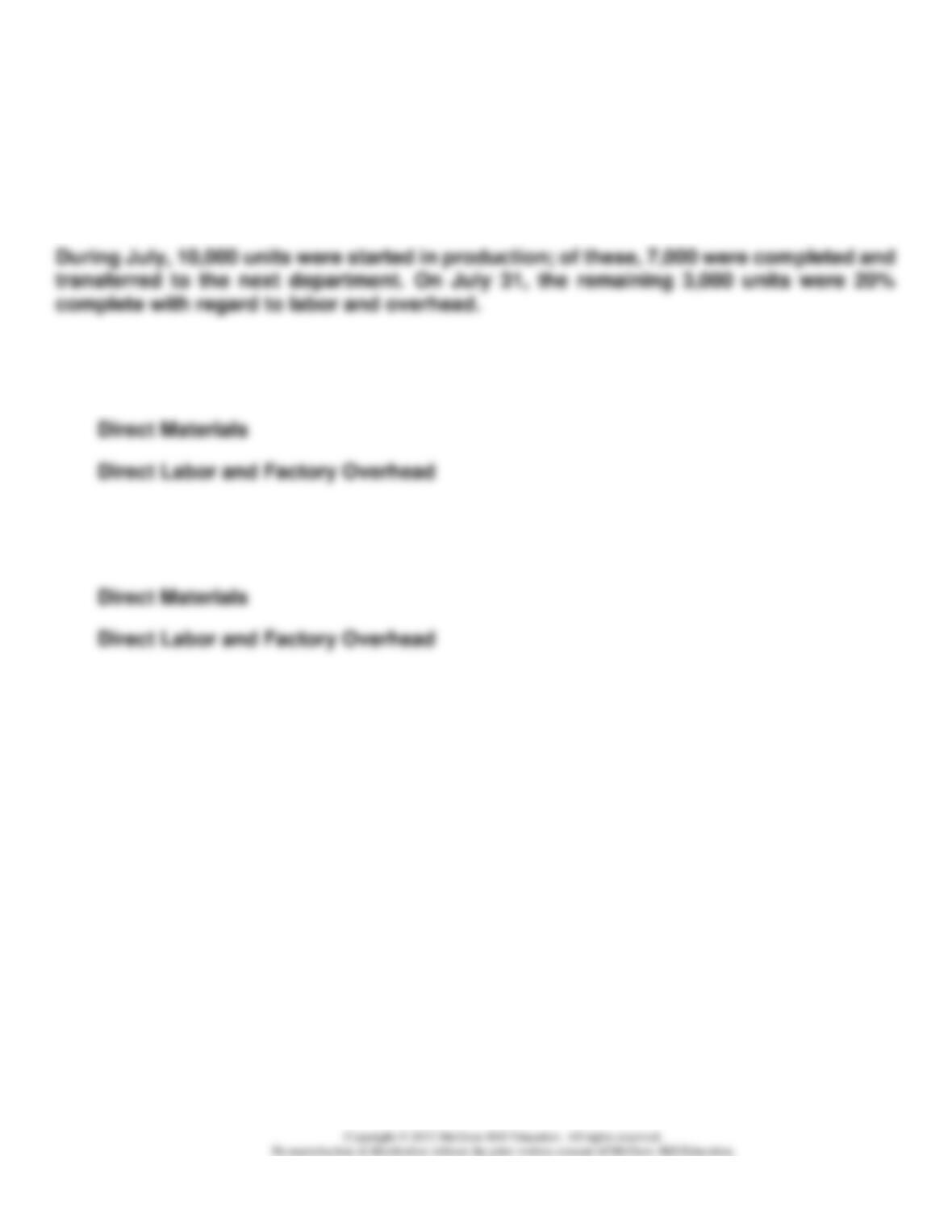
The Malbim Company uses a process costing system. Materials are added at the
beginning of the process. On July 1 there are 400 units in the beginning inventory that
are 100% complete as to materials. With regard to labor and overhead, however, the
units in beginning inventory (July 1) are only 75% complete.
Required:
Using the Weighted Average method, calculate the equivalent units of
Using the FIFO method, calculate the equivalent units of
Financial and Managerial Accounting, 9th Edition
16–10
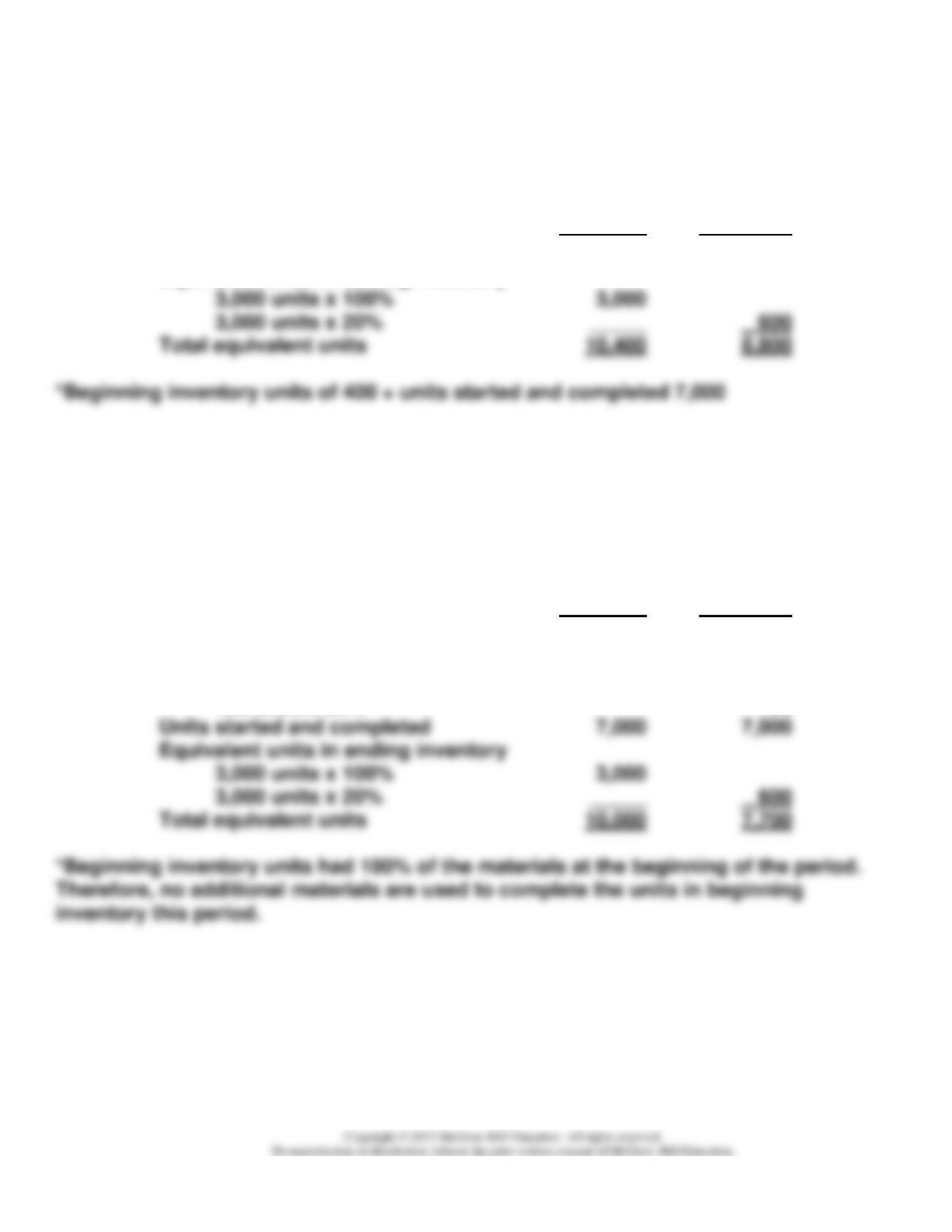
Chapter 16 Solution: Alternate Demo Problem
Weighted-average Method
Direct
Materials
Direct Labor
and Factory
Overhead
Units completed this period*
7,400
7,400
Equivalent units in ending inventory
3,000 units x 100%
3,000
3,000 units x 20%
Total equivalent units
8,800
Chapter 20 Solution: Alternate Demo Problem
FIFO Method
Direct
Materials
Direct Labor
and Factory
Overhead
Equivalent units needed to complete
beginning inventory:
400 units x 0%*
0
400 units x 25%
100
7,000
7,000
Equivalent units in ending inventory
3,000 units x 100%
3,000
3,000 units x 20%
Total equivalent units
7,700