Financial and Managerial Accounting, 8e
16-1
CHAPTER 16
PROCESS COSTING AND ANALYSIS
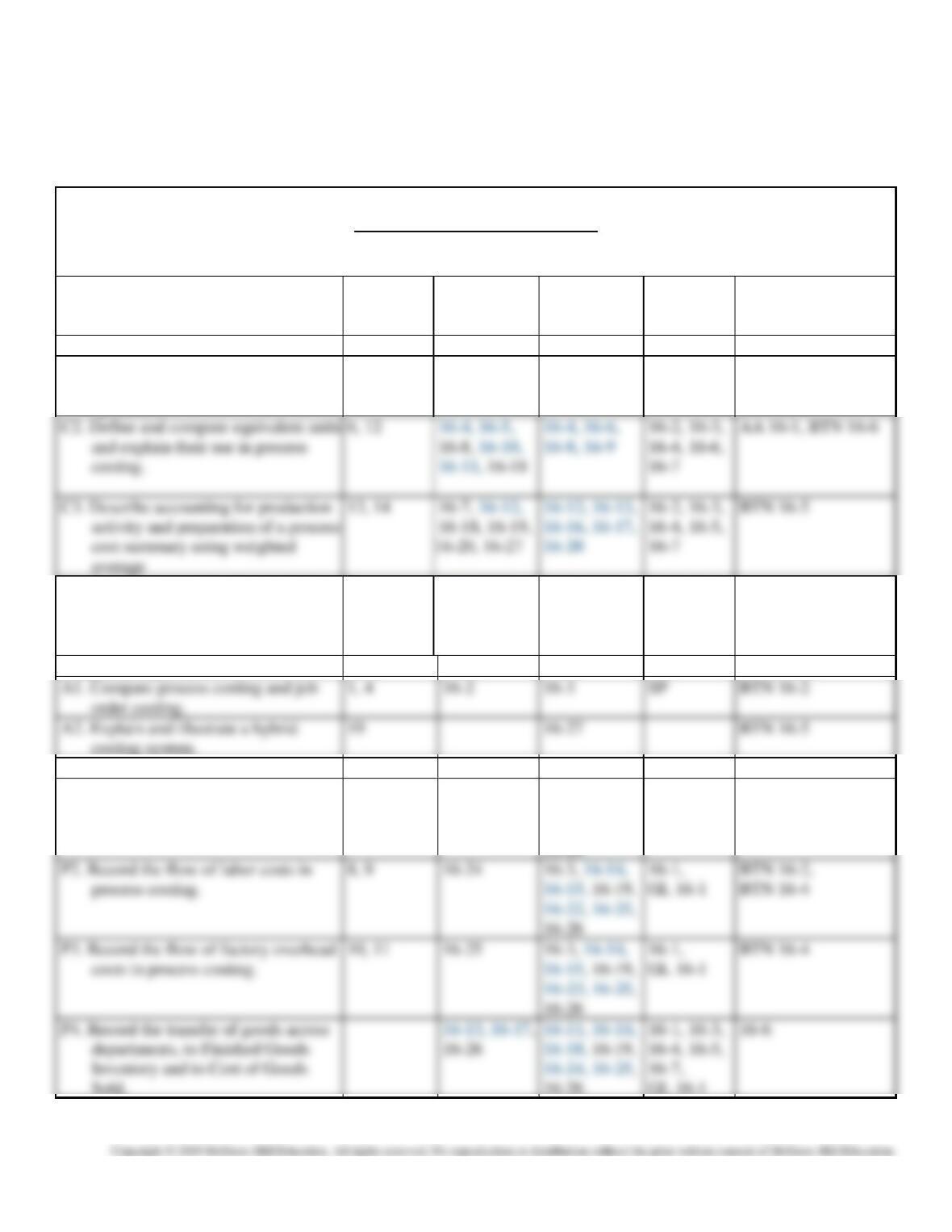
Related Assignment Materials
Student Learning Objectives
Discussion
Questions
Quick
Studies*
Exercises*
Problems*
AA and
BTN
Conceptual objectives:
C1. Explain process operations and the
way they differ from job order
operations.
2, 3, 5, 15,
16, 17, 18
16-1, 16-3
16-1, 16-2,
16-3
SP
AA 16-2, AA 16-3,
BTN 16-2, BTN 16-3,
BTN 16-4
and explain their use in process
costing.
16-8, 16-9
16-4, 16-6,
16-7
activity and preparation of a process
cost summary using weighted
average
16-18, 16-19,
16-20, 16-27
16-16, 16-17,
16-4, 16-5,
16-7
C4. Describe accounting for production
activity and preparation of a process
cost summary using FIFO.
(Appendix 16A)
7
16-6, 16-9,
16-14, 16-15,
16-16, 16-21,
16-22
16-5, 16-7,
16-10, 16-11,
16-13, 16-18
16-5, 16-6,
16-7
Analytical objectives:
A1. Compare process costing and job
order costing.
1, 4
16-2
16-3
SP
BTN 16-2
A2. Explain and illustrate a hybrid
costing system.
19
16-27
BTN 16-5
Procedural objectives:
P1. Record the flow of materials costs in
process costing.
5
16-23, 16-25
16-3, 16-14,
16-15, 16-19,
16-21, 16-25,
16-26
16-1,
GL 16-1
BTN 16-1, BTN 16-2,
BTN 16-4
16-26
GL 16-1
BTN 16-4
costs in process costing.
16-15, 16-19,
16-23, 16-25,
16-26
GL 16-1
Sold.
16-26
GL 16-1
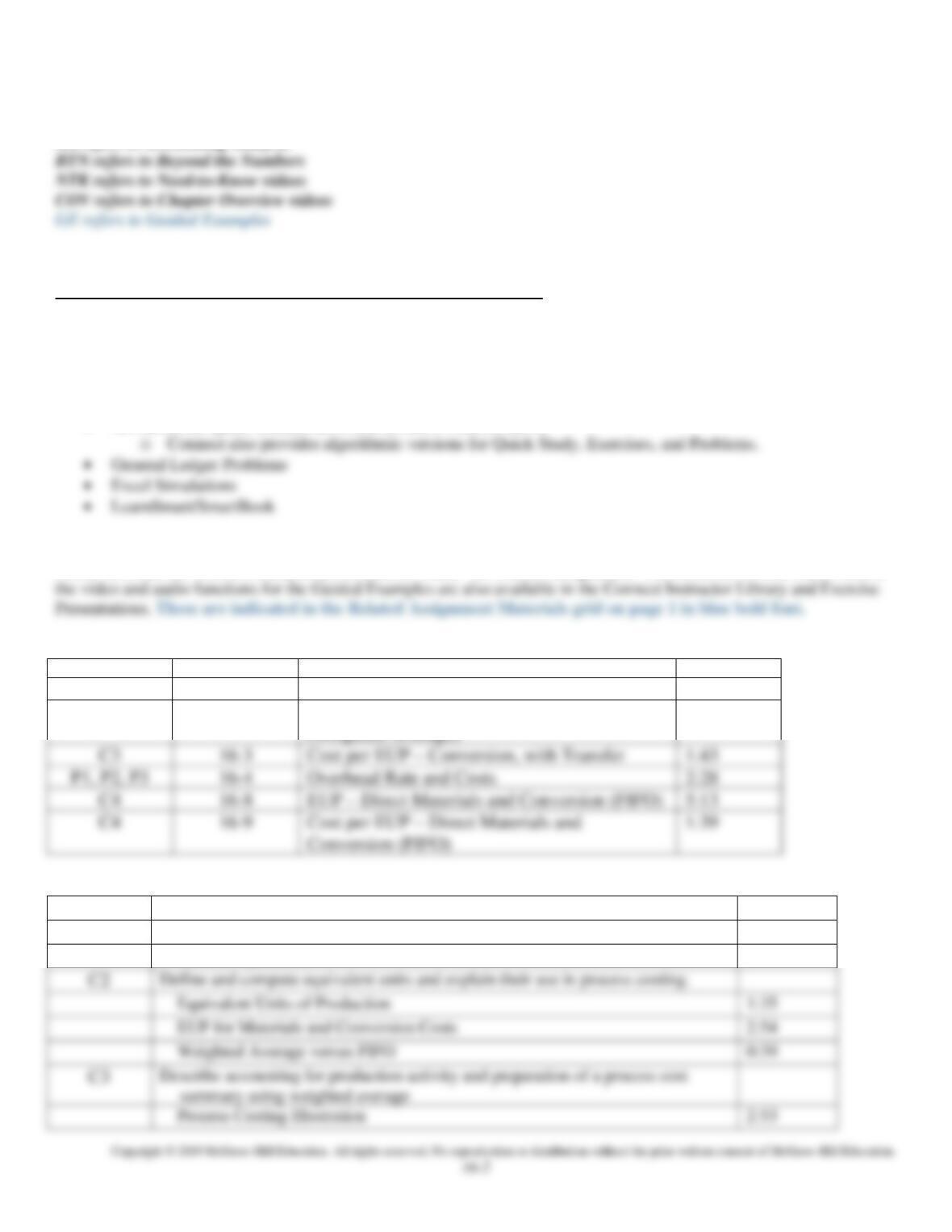
C2
Define and compute equivalent units and explain their use in process costing.
Equivalent Units of Production
EUP for Materials and Conversion Costs
Weighted Average versus FIFO
Process Costing Illustration
Financial and Managerial Accounting, 8e
*See additional information on next page that pertains to these quick studies, exercises and problems.
SP refers to the Serial Problem
AA refers to Accounting Analysis
Additional Information on Related Assignment Material
See Chapter 1 of the Instructor’s Resource Manual for more information on materials for this text available in
Connect.
Connect
Available on the instructor’s course-specific website, Connect:
• All numerical Quick Studies, all Exercises and Problems Set A.
Hints/Guided Examples
Please note that the Guided Examples are labeled as “Hints” in Connect assignments. The animated PowerPoints without
Need-to-Know Videos
LO
Need–to-Know
Title
Time
C1, A1
16-1
Job Order vs. Process Costing Systems
0:46
C2
16-2
EUP – Direct Materials and Conversion
(Weighted Average)
3:11
16-3
Cost per EUP – Conversion, with Transfer
1:43
16-4
Overhead Rate and Costs
2:28
16-8
EUP – Direct Materials and Conversion (FIFO)
5:13
C4
16-9
Cost per EUP – Direct Materials and
Conversion (FIFO)
1:39
Concept Overview Videos
LO
Title
Time
C1
Explain process operations and the way they differ from job order operations.
Process Operations
1:55
Financial and Managerial Accounting, 8e
16-3
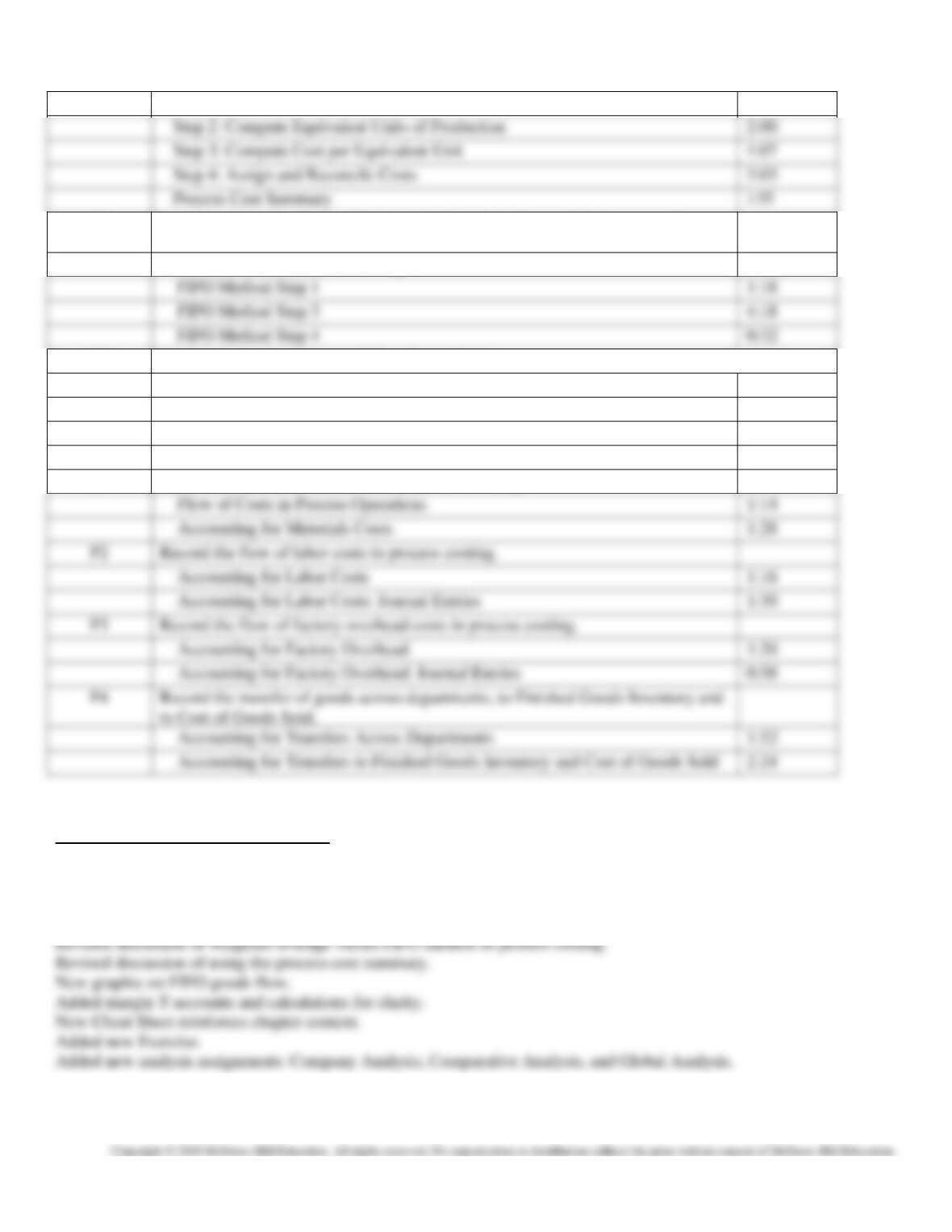
Step 1: Determine Physical Flow of Units
0:57
Step 2: Compute Equivalent Units of Production
2:00
Step 3: Compute Cost per Equivalent Unit
1:07
Step 4: Assign and Reconcile Costs
3:03
Process Cost Summary
1:55
C4
Describe accounting for production activity and preparation of a process cost
summary using FIFO.
FIFO Method of Process Costing
1:29
FIFO Method Step 1
1:18
FIFO Method Step 3
4:18
FIFO Method Step 4
0:32
A1
Compare process costing and job order costing.
Comparing Process and Job Order Costing Systems
1:24
Transferring Costs Across Departments
1:13
A2
Explain and illustrate a hybrid costing system.
Hybrid Costing System
2:30
P1
Record the flow of materials costs in process costing.
Flow of Costs in Process Operations
1:14
Accounting for Materials Costs
1:28
Record the flow of labor costs in process costing.
Accounting for Labor Costs
1:16
Accounting for Labor Costs: Journal Entries
1:30
Record the flow of factory overhead costs in process costing.
Accounting for Factory Overhead
1:20
Accounting for Factory Overhead: Journal Entries
0:58
to Cost of Goods Sold.
Accounting for Transfers Across Departments
1:52
Accounting for Transfers to Finished Goods Inventory and Cost of Goods Sold
2:24
Synopsis of Chapter Revisions
NEW opener—Azucar Ice Cream and entrepreneurial assignment.
Revised discussion comparing process and job order costing systems.
Added cost flow graphic.
New margin graphic illustrating EUP.
Financial and Managerial Accounting, 8e
16-4
Chapter Outline
I. Process Operations⎯Also called process manufacturing or process production, is mass production
of products in a continuous flow of steps
A. Organization of Process Operations
1. Each process is identified as a separate production department, work station or work center
B. Comparing Process and Job Order Costing Systems
1. Both use direct materials, direct labor and overhead and aim to compute cost per unit.
2. Focus of job order operations is on the individual job. Features of job order systems:
a. Custom orders
3. Focus of process operations is on the process itself and on the standardized units produced.
Features of process production systems:
a. Repetitive operations
C. Transferring Costs across Departments ⎯overall objective is to determine the total cost per unit of
a product or service.
1. In process costing, manufacturing costs are transferred across work in process inventor
II. Equivalent Units of Production⎯used to determine the cost per unit processed by each department.
A. Equivalent Units of Production (EUP) are the number of units that could have been started and
completed given the costs incurred during the period. For example, 100 units that are 60%
processed had the same costs that would be incurred to both start and finish 60 units.
B. EUP for Materials and Conversion Costs (Direct Labor and Factory Overhead)
1. The addition of direct material costs at the beginning of a process (i.e., which steps involve
2. Equivalent units must then be separately determined for:
Financial and Managerial Accounting, 8e
16-5
C. Weighted Average vs. FIFO
1. Weighted Average method combines the units and costs across two periods when computing
equivalent units
III. Process Costing Illustration⎯a four-step process. Weighted Average Method.
A. Step 1: Determine Physical Flow of Units
1. Reconciles the physical units started in a period with physical units completed in that period.
2. The following totals should agree:
B. Step 2: Compute Equivalent Units of Production (EUP)
1. Must convert the physical units worked on to equivalent units based on the amount of each
input (direct materials, direct labor, and overhead) that has been used.
2. Under the Weighted Average method, the computation of equivalent units of production does
3. Equivalent Units⎯Direct Materials⎯add together the results of a two-step calculation:
a. Units completed and transferred out during the period X 100% (since the units have all
C. Step 3: Compute Cost per Equivalent Unit
1. Cost per Equivalent Unit for Direct Materials⎯The materials costs in the beginning
inventory and the direct materials costs added during the period are combined and then
equivalent unit for conversion costs for the period.
Financial and Managerial Accounting, 8e
16-6
D. Step 4: Assign and Reconcile Costs
1. Similar in concept to the reconciliation of the physical flow of units (except that dollars are
used instead of units).
2. The following totals should agree:
3. Sources of amounts used in cost reconciliation:
a. Cost assigned to units completed during the period equals:
i. Direct material cost assigned during the period (equivalent units in units completed for
E. Process Cost Summary
1. Primary managerial accounting report. Also called a production report.
2. A separate Process Cost Summary is prepared for each process or production department
3. Three sections:
c. Costs charged to production, including direct materials and conversion costs incurred
IV. Accounting and Reporting for Process Accounting
A. Direct and Indirect Costs
1. Materials and labor that can be traced to a specific process are assigned to those processes as
direct costs.
Financial and Managerial Accounting, 8e
16-7
C. Accounting for Labor Costs
1. Assign costs of direct labor used in production by debiting each department’s separate Work
in Process Inventory account and crediting Factory Payroll Payable
D. Accounting for Factory Overhead⎯Same steps as Job Order Costing, except performed now for
each individual department (or process).
1. Record other factory overhead items incurred by debiting Factory Overhead and crediting the
related accounts.
E. Accounting for Transfers Across Production Departments
1. Units and costs are transferred out of one department’s Work in Process account and
transferred into the next processing department’s Work in Process account.
H. Summary of Cost Flows⎯as shown in Exhibit 16.14, the flow of costs through accounts reflects
the flow of manufacturing activities and products in the factory.
V. Trends in Process Operations include the following:
Process Design; Just in Time Production; Robotics and Automation; Continuous Processing;
Services, Customer Orientation and Yield.
VI. Decision Analysis—Hybrid Costing System
A. Contains features of both job order and process operations
1. Materials Costs are often applied to specific jobs as in a job order cost system.
Financial and Managerial Accounting, 8e
16-8
VII. Appendix 16A – FIFO method of process costing
A. The objectives, concepts, and journal entries (but not amounts) are the same as for the weighted
average method.
D. Step 2: Compute Equivalent Units of Production (EUP)
1. Focus is on what was done during the period.
2. Equivalent Units⎯Direct Materials⎯add together the results of a three-step calculation:
a. Units in beginning inventory X the percent of materials added during the period.
c. Units in ending inventory X the percent of materials added during the period.
3. Equivalent Units⎯Conversion Costs⎯add together the results of a three-step calculation:
a. Units in beginning inventory X the percent of conversion costs added during the period.
E. Step 3: Compute Cost per Equivalent Unit
1. Costs assigned to the department during the period divided by the equivalent units of
F. Step 4: Assign and Reconcile Costs
1. Similar in concept to the reconciliation of the physical flow of units (except that dollars are
Financial and Managerial Accounting, 8e
16-9
3. Sources of amounts used in cost reconciliation:
a. Cost of the completed beginning inventory units equals beginning balance of the Work in
Process Inventory plus the following costs to complete the beginning inventory:
i. Direct material cost assigned: (EU to complete beginning inventory for direct
b. Cost assigned to units started and completed during the
i. Direct material cost assigned: (EU for units started and finished for materials X
Financial and Managerial Accounting, 8e
16–10
Chapter 16 Alternate Demo Problem
The Malbim Company uses a process costing system. Materials are added at the
beginning of the process. On July 1 there are 400 units in the beginning inventory that
are 100% complete as to materials. With regard to labor and overhead, however, the
units in beginning inventory (July 1) are only 75% complete.
Required:
Using the Weighted Average method, calculate the equivalent units of
Using the FIFO method, calculate the equivalent units of
Financial and Managerial Accounting, 8e
Chapter 16 Solution: Alternate Demo Problem
Weighted-average Method
Direct
Materials
Direct Labor
and Factory
Overhead
Units completed this period*
7,400
7,400
3,000
8,800
Chapter 19 Solution: Alternate Demo Problem
FIFO Method
Direct
Materials
Direct Labor
and Factory
Overhead
Equivalent units needed to complete
beginning inventory:
Units started and completed
7,000
7,000
3,000
7,700