Financial and Managerial Accounting, 9th Edition
15-1
CHAPTER 15
JOB ORDER COSTING
Related Assignment Materials
Student Learning Objectives
Questions
Quick
Studies*
Exercises*
Problems*
AA, BTN, DA
Conceptual objectives:
C2. Explain job cost sheets and how
3, 4
C1. Describe important features of job
10, 13
15-1, 15-2,
15-1, 15-2,
15-1
BTN 15–3, BTN 15-4,
Analytical objectives:
A1 Apply job order costing in pricing
services.
12, 14, 15
15-22, 15–23,
15–24
15-28, 15–29,
15-30, 15–31
AA 15-1, AA 15–2,
AA 15-3
Procedural objectives:
P1. Describe and record the flow of
materials costs in job order
costing.
5, 6
15-6, 15–10,
15–16
15-12, 15–14,
15–17
15–16, 15–17,
15-18, 15–19,
15–20, 15–21,
15-5, 15–6,
15-7, 15–8,
15–9, 15–10,
15-11, 15–13,
15-12, 15–16,
15–2, 15-3,
15-4, 15-6,
SP, GL 15-1
DA 15-1, DA 15-2,
DA 15-3, AA 15-3
P4. Close overapplied and
underapplied factory overhead.
9
15–15, 15–18,
15-19, 15-20,
15–21
15-11, 15-12,
15-18, 15–25,
15-26, 15–27
15–2, 15-3
15-4, 15–5,
15-6, GL 15-1
DA 15-3
*See additional information on next page that pertains to these quick studies, exercises, and problems.
SP refers to the Serial Problem
AA refers to Accounting Analysis
Describe and record the flow of overhead costs in job order costing.
Set Predetermined Overhead Rate and Apply Estimated Overhead
1:39
Apply Estimated Overhead – Illustration
1:25
Record Actual Overhead
2:05
Cost Flows to Financial Statements
0:49
Financial and Managerial Accounting, 9th Edition
Additional Information on Related Assignment Material
See Chapter 1 of the Instructor’s Resource Manual for more information on materials for this text available in
Connect.
Connect
Available on the instructor’s course-specific website, Connect:
• All numerical Quick Studies, all Exercises and Problems Set A.
Hints/Guided Examples
Please note that the Guided Examples are labeled as “Hints” in Connect assignments. The animated PowerPoints without
Need-to-Know Videos
LO
Need–to-Know
Title
Time
C1
15-1
Job Cost Sheet
1:01
P1
15-2
Recording Direct Materials
1:04
P2
15-3
Recording Direct Labor
0:53
P3
15-4
Recording Applied Overhead
1:51
P3
15-5
Recording Actual Overhead
1:30
P4
15-6
Closing Factory Overhead
1:56
Cost of Goods Manufactured
Concept Overview Videos
LO
Title
Time
C1
Explain job order costing and job cost sheets.
Job Order Production
1:25
Production Activities in Job Order Costing
1:14
Cost Flows
1:01
Job Cost Sheet
0:41
Apply job order costing in pricing services.
Pricing for Services
1:48
P1
Materials Cost Flows and Documents
1:00
Materials Cost Flows – Journal Entries
0:48
P2
Describe and record the flow of labor costs in job order costing.
Labor Cost Flows and Documents
0:41
Labor Cost Flows – Journal Entries
0:41
Financial and Managerial Accounting, 9th Edition
15-3
Accounting for Cost Flows
0:58
Schedule of Cost of Goods Manufactured
0:31
Financial Statements
0:24
Determine adjustments for overapplied and underapplied factory overhead.
Adjust Underapplied or Overapplied Overhead
1:18
Adjust Underapplied or Overapplied Overhead – Illustration
0:51
Job Order Costing of Services
0:53
Synopsis of Chapter Revision
NEW Opener – Wallace Detroit Guitars and Entrepreneurial assignment.
Combined C1 and C2 LOs.
Simplified job order costing example from five jobs to three jobs; revised Exhibits 15.2, 15.3, 15.5, 15.6, 15.7, 15.9, 15.10, 15.13,
15.14, 15.16, and 15.17
Revised NTK 15-1, 15–2 and 15–3.
NEW systematic way to apply estimated overhead costs.
Financial and Managerial Accounting, 9th Edition
15-4
Chapter Outline
I. Job Order Costing
A. Cost accounting system
1. Accumulates manufacturing costs and assigns them to products and services.
3. Two basic types of cost accounting systems are job order costing and process costing.
a. Job Order Production—producing products or providing services customized for specific
customers (special orders).
ii. Covered in Chapter 20.
B. Production Activities in Job Order Costing—an overview of job order production activity and cost
flows is shown in Exhibit 15.2.
1. Cost Flows:
a. Because they are product costs, manufacturing costs flow through inventory accounts
(Raw Materials Inventory, Work in Process Inventory, Finished Goods Inventory) until
c. Accumulated job costs are kept in the Work in Process Inventory while goods are being
produced.
2. Job Cost Sheet—separate record maintained for each job used to record costs.
a. Classifies costs as direct materials, direct labor, or overhead.
b. Used by managers to monitor costs incurred to date and to predict and control costs to
complete each job.
II. Materials and Labor Costs
A. Materials Cost Flows and Documents
1. Receiving report—Source document used to record the quantity and cost of items received.
2. Materials ledger cards —perpetual records that are updated each time materials are purchased
and each time materials are issued for use in production.
C. Materials Use (Requisition)
Financial and Managerial Accounting, 9th Edition
1. Materials Requisition⎯document identifying the type and quantity of material needed in
D. Labor Cost Flows and Documents
1. Time tickets – used by employees to how much time employees spend on each job.
Used to determine total labor costs for pay period. Used to assign (direct) labor costs
III. Overhead Costs
A. Overhead costs include indirect materials, indirect labor and other overhead that can’t be
cost-effectively traced to individual jobs. The accounting for overhead follows a 4-
B. Step 1: Set Predetermined Overhead Rate
1. Requires an estimate of total overhead cost and an allocation factory such as total
direct labor or machine hours.
C. Step 2: Apply Estimated Overhead to Jobs
1. Predetermined overhead rate times actual activity where the activity is the allocation
base such as direct labor cost or machine hours.
D. Step 3: Record Actual Overhead
1. Actual factory overhead costs include indirect materials, indirect labor, supplies,
utilities, adjusting entries for depreciation on factory assets, etc.
2. Record Indirect Materials Used – Factory Overhead Ledger—accumulates indirect
E. Cost Flows to Financial Statements
Financial and Managerial Accounting, 9th Edition
15-6
1. Direct materials used, direct labor4 used, and factory overhead applied flow through
Work in Process Inventory and Finished Goods Inventory balance sheet accounts.
the balance sheet to the income statement as cost of goods sold.
F. Accounting for Cost Flows – summary journal entries are used to record cost flows as
follows:
1. Into (debit) Raw Materials Inventory as acquired.
2. From (credit) Raw Materials Inventory to (debit) Work In Process Inventory (direct
materials) and (debit) Factory Overhead (indirect materials) as good are requisitioned.
Direct material costs also accumulated on Job Cost Sheets.
6. From (credit) Work In Process Inventory to (debit) Finished Goods Inventory as jobs
are completed. Full cost from Job Cost Sheets.
7. From (credit) Finished Goods Inventory to (debit) Cost of Goods Sold as goods are
sold.
8. Any under or over applied factory overhead cost is accounted for in an adjustment to
Cost of Goods Sold and Factory Overhead
G. Schedule of Cost of Goods Manufactured
H. Closing Overhead
1. Factory Overhead Account
a. The debit side shows the actual amount of factory overhead incurred during
the period based on bills received.
2. Close Underapplied and Overapplied Overhead
a. When actual overhead is more than applied overhead, the remaining debit
I. Job Order Costing of Services
1. Job order costing also applies to service companies, but has some important
differences:
Financial and Managerial Accounting, 9th Edition
15-7
a. Most service firms do not have raw materials inventory or finished goods
inventory. They will have inventories of supplies and can have services in
process inventory.
III. Decision Analysis—Pricing for Services
A. Service providers also use job order costing.
B. Procedure to determine:
1. Determine direct labor costs
Financial and Managerial Accounting, 9th Edition
15-8
Chapter 15 Alternate Demo Problem
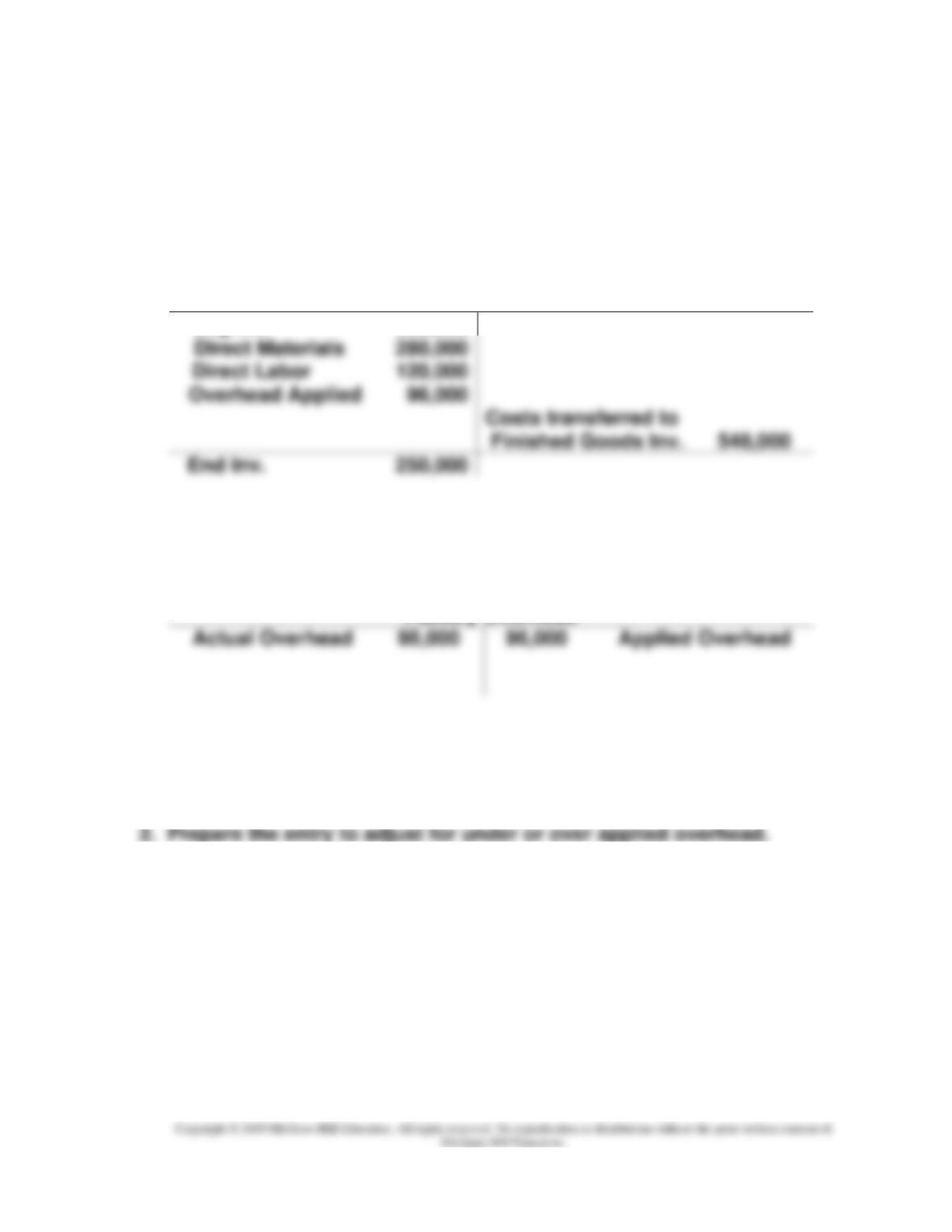
The following information is the Work in Process and Factory Overhead
Accounts for Superior Company:
Work in Process Inventory
Beg Inv. 302,000
Finished Goods Inv. 548,000
Factory Overhead
Required:
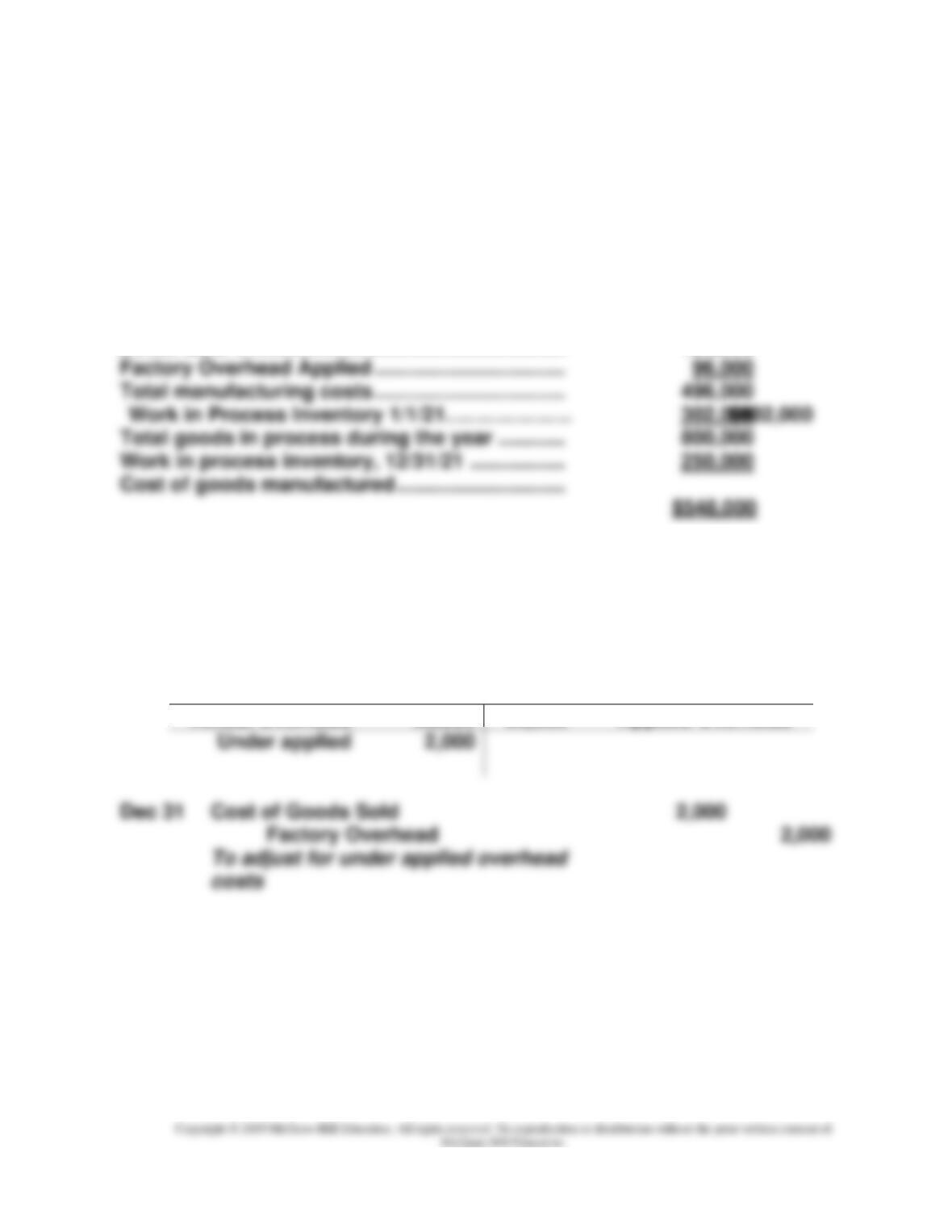
1. Prepare a manufacturing statement for Superior Company for 2021.
Financial and Managerial Accounting, 9th Edition
15-8
Chapter 15 Solution: Alternate Demo Problem
SUPERIOR MANUFACTURING COMPANY
Manufacturing Statement
For Year Ended December 31, 2021
Direct materials used ……………………………………
$280,000
Direct labor …………………………………………………..
120,000
Total manufacturing costs …………………………….
Work in Process Inventory 1/1/21……………….
Total goods in process during the year …………
Adjusting entry for under or over-applied overhead
Factory Overhead
Actual Overhead 98,000
96,000 Applied Overhead
Dec 31
Cost of Goods Sold