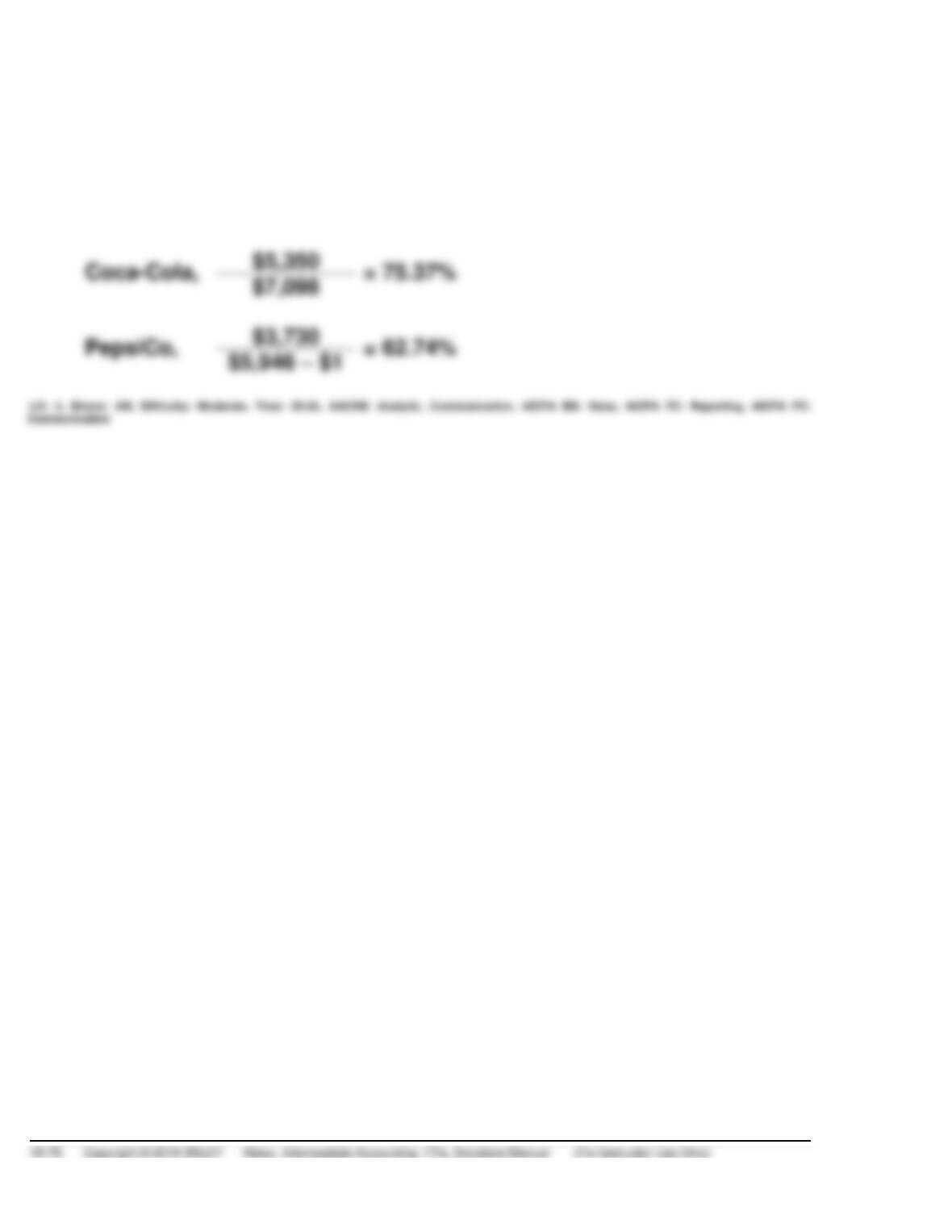
COMPARATIVE ANALYSIS CASE (Continued)
During 2017, PepsiCo earned a higher return on its stockholders’
equity.
(g) Payout ratios for 2017.
FINANCIAL STATEMENT ANALYSIS CASES
CASE 1
(a) Management might purchase treasury stock to provide to stockholders
a tax-efficient method for receiving cash from the corporation. In
addition, it might have to repurchase shares to have them available to
issue to employees exercising options to purchase stock, or
(b) Earnings per share is calculated by dividing net income less preferred
dividends by the weighted–average number of shares outstanding
during the year.
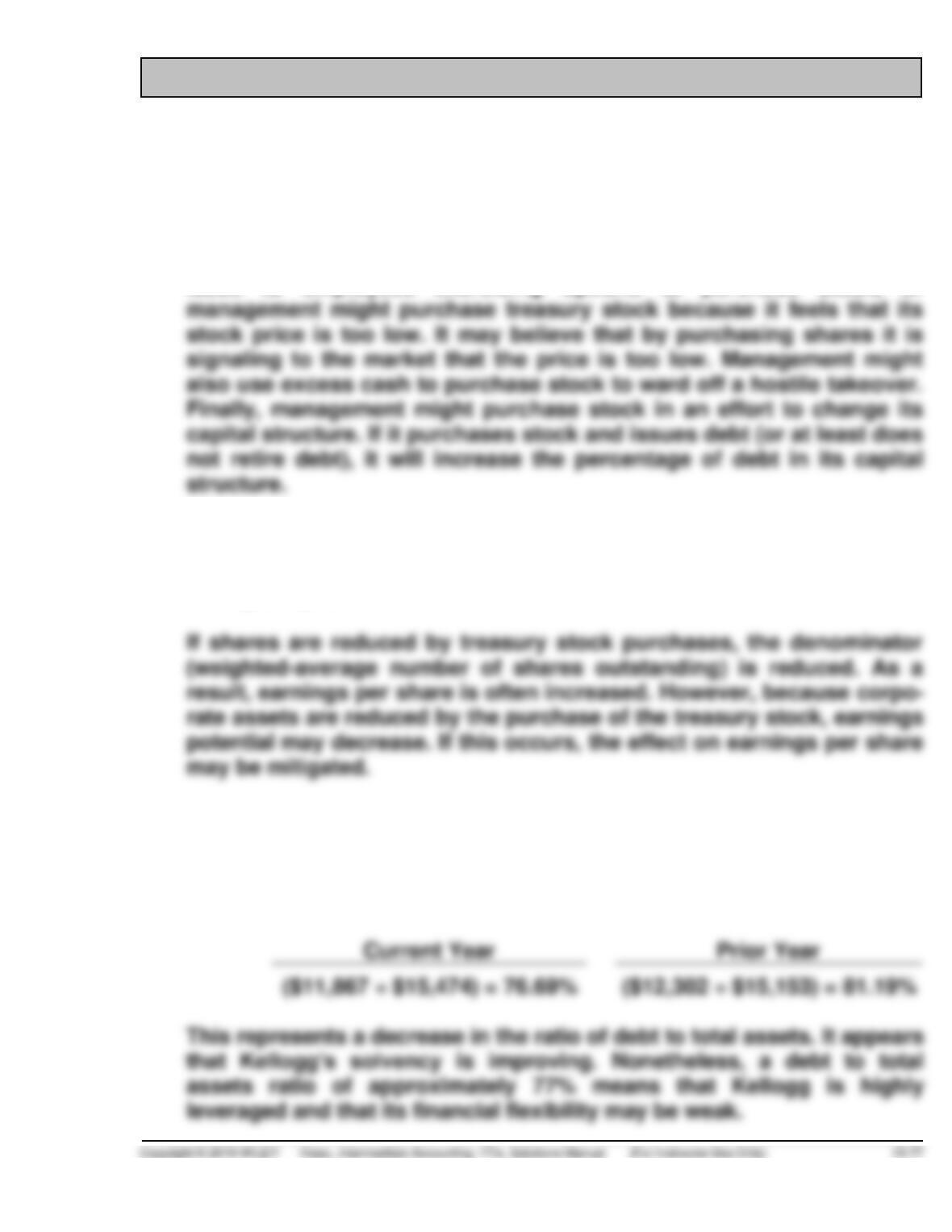
(c) One measure of solvency is the ratio of debt divided by total assets.
This ratio shows how many dollars of assets are backing up each dollar
of debt, should the company become financially troubled. For the
current and prior year, this can be calculated as follows:
FINANCIAL STATEMENT ANALYSIS CASES (Continued)
CASE 2
(a) The date of record marks the time when ownership of the outstanding
shares is determined for dividend purposes. This in turn identifies
ACCOUNTING, ANALYSIS, AND PRINCIPLES
Accounting
January 15, 2020
Retained Earnings ($1.05 X 60,000) ………………………….
63,000
Cash ………………………………………………………………
63,000
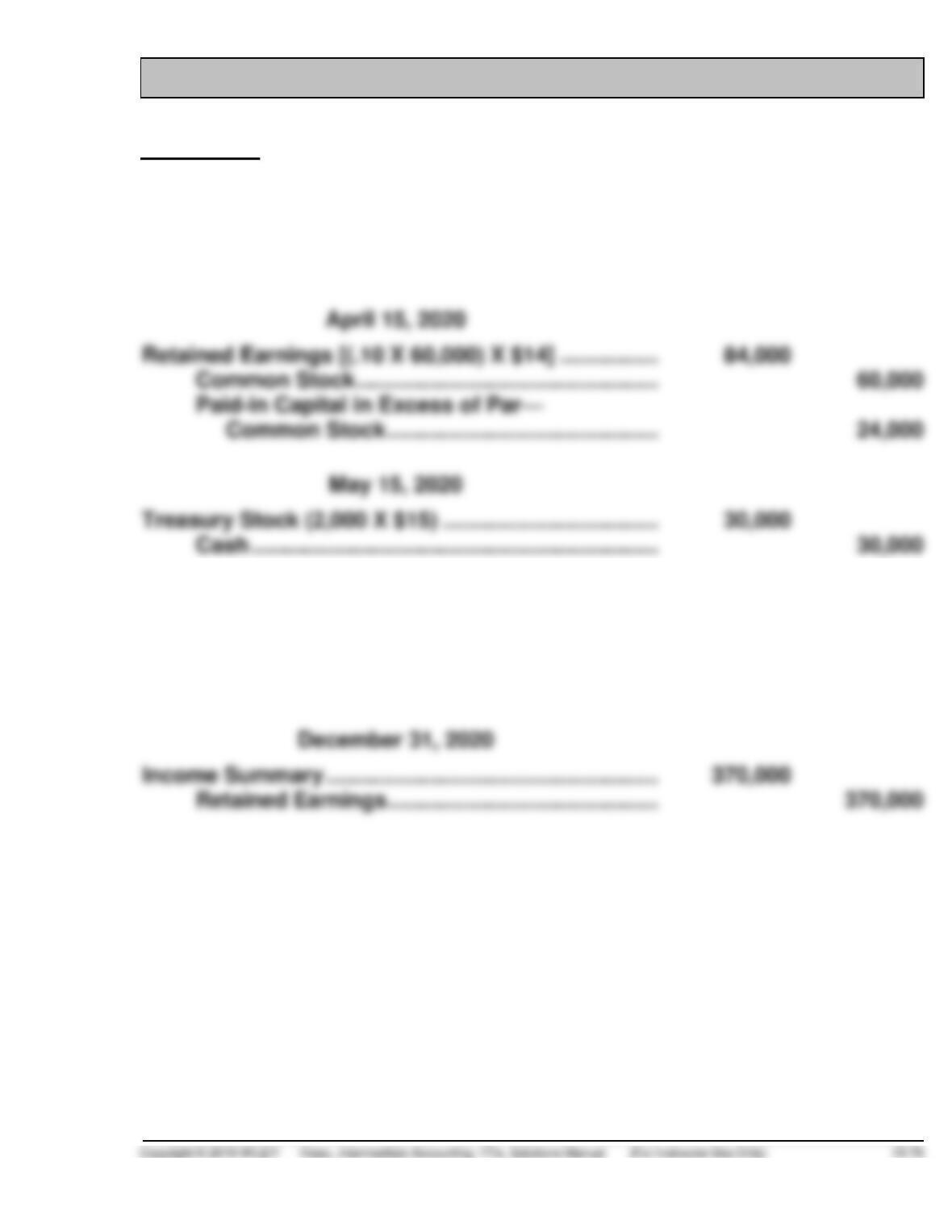
Retained Earnings [(.10 X 60,000) X $14] ………………….
84,000
Common Stock ……………………………………………….
60,000
Treasury Stock (2,000 X $15) …………………………………..
30,000
Cash ………………………………………………………………
30,000
November 15, 2020
Cash ($18 X 1,000) ………………………………………………….
18,000
Paid-in Capital from Treasury Stock …………………
3,000
Treasury Stock ……………………………………………….
15,000
December 31, 2020
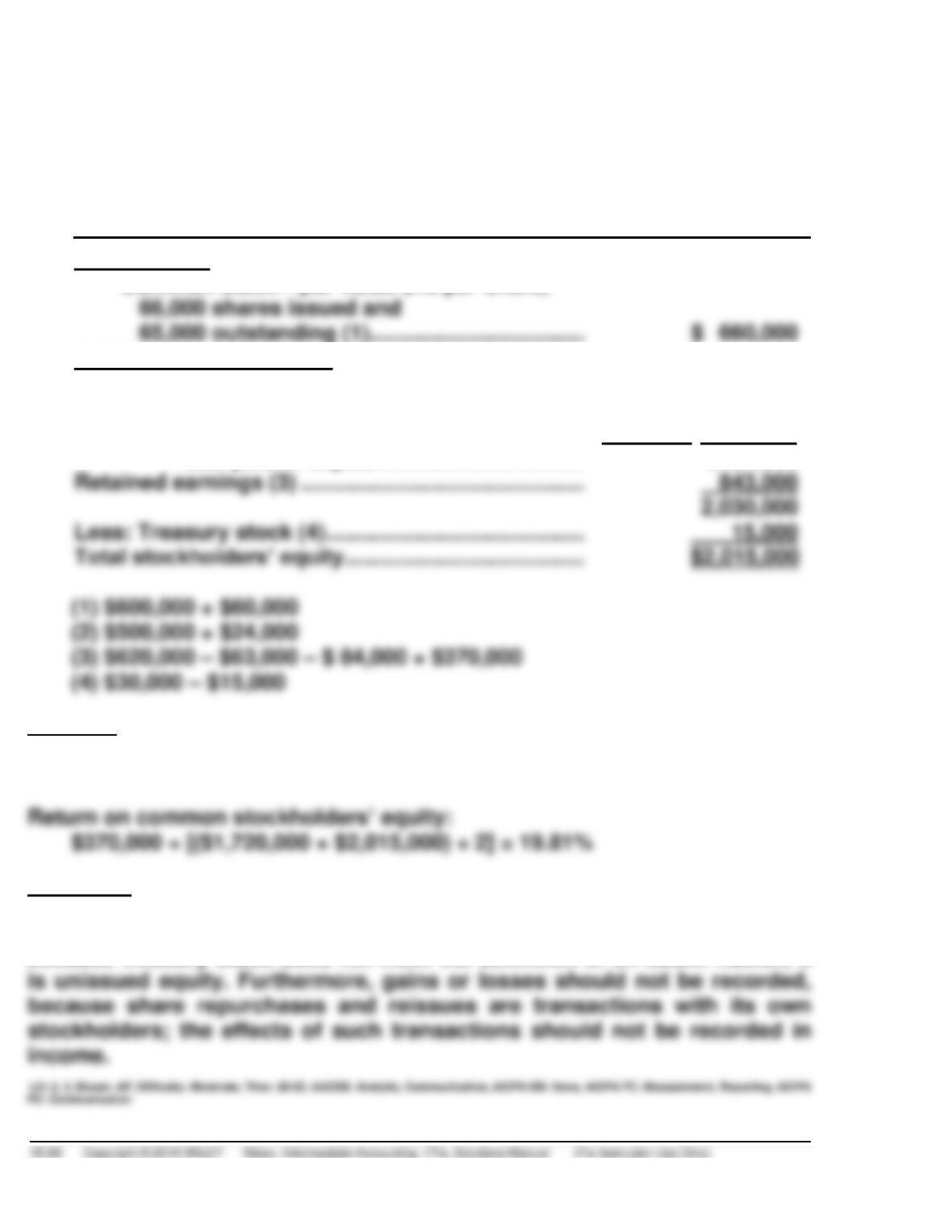
Income Summary ……………………………………………………
Retained Earnings …………………………………………..
ACCOUNTING, ANALYSIS, AND PRINCIPLES (Continued)
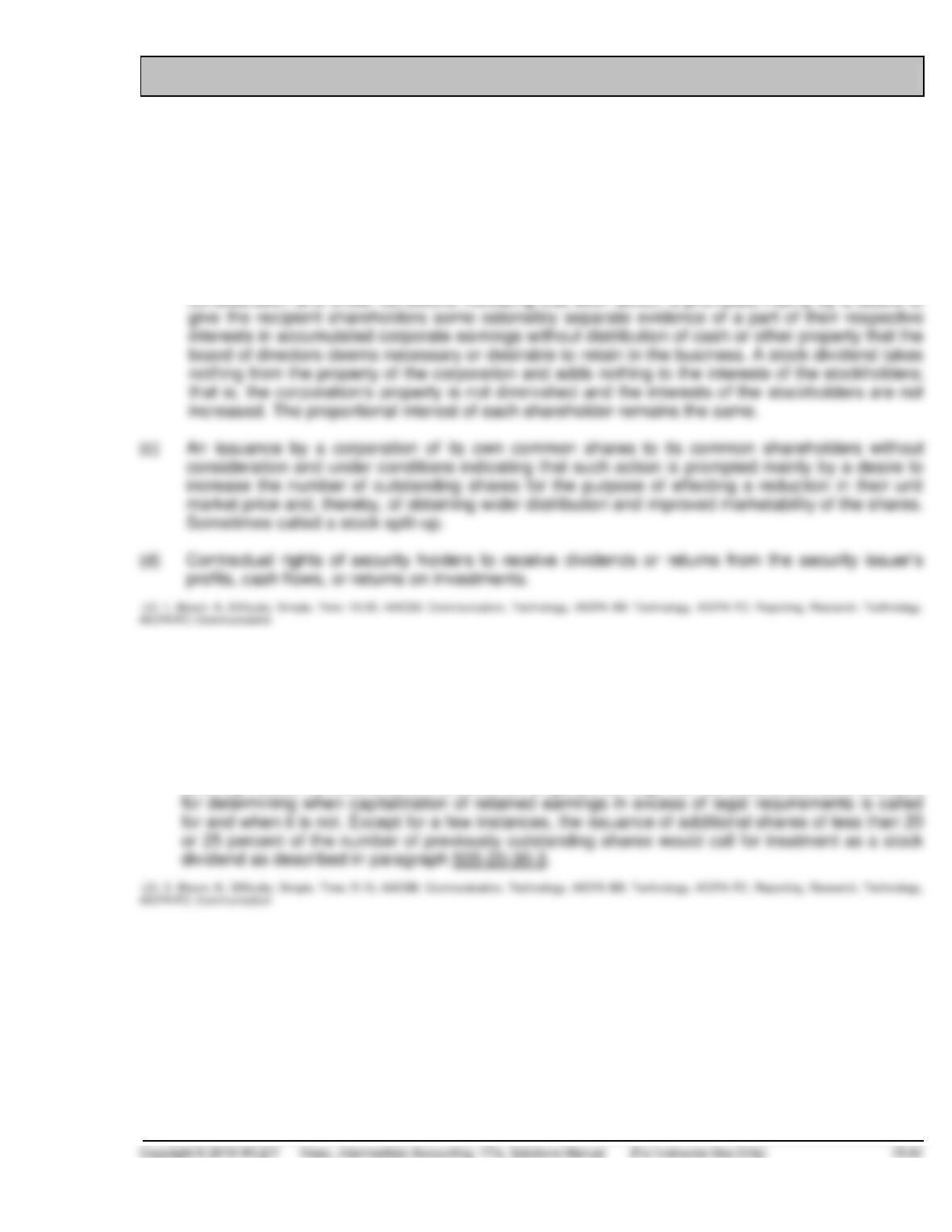
The ending balances are indicated in the following partial balance sheet:
AGASSI CORPORATION
Balance Sheet
December 31, 2020
Capital stock
Common stock—par value $10 per share,
Additional paid-in capital
In excess of par—
common (2) ……………………………………………. $524,000
From treasury stock ………………………………….. 3,000 527,000
Total paid-in capital …………………………... 1,187,000
Analysis
Payout ratio: $63,000 ÷ $ 370,000 = 17.03%
Principles
Treasury stock sold above or below cost does not result in gains or losses
because treasury stock does not meet the definition of an asset. Rather, it
CODIFICATION EXERCISES
CE15.1
Master Glossary
(a) A security that is convertible into another security based on a conversion rate. For example,
convertible preferred stock that is convertible into common stock on a two-for-one basis (two
shares of common for each share of preferred).
(b) An issuance by a corporation of its own common shares to its common shareholders without
CE15.2
According to FASB ASC 505-20–25-3 (Stock Dividends and Stock Splits):
25-3 The point at which the relative size of the additional shares issued becomes large enough to
materially influence the unit market price of the stock will vary with individual entities and under
differing market conditions and, therefore, no single percentage can be established as a standard
CE15.3
According to FASB ASC 340-10-S99-1 (Deferred Costs and Other Assets—SEC Materials):
Specific incremental costs directly attributable to a proposed or actual offering of securities may prop–
CE15.4
According to FASB ASC 505-30–25-7 (Treasury Stock—Recognition):
25-7 After an entity’s repurchase of its own outstanding common stock, sometimes it may either retire
the repurchased shares and issue additional common shares, or, as an alternative, resell the
repurchased shares. In either case, the price received may differ from the amount paid to
CODIFICATION RESEARCH CASE
(b) (FASB ASC 505-10–20.—Glossary)
1. Security—is defined as evidence of debt or ownership or a related
(c) FASB ASC 505-10–50-3. An entity shall explain, in summary form within
its financial statements, the pertinent rights and privileges of the
various securities outstanding. Examples of information that shall be
IFRS CONCEPTS AND APPLICATION
IFRS15.1
The primary IFRS reporting standards related to stockholders’ equity are
IFRS15.2
Key similarities between IFRS and GAAP for transactions related to
stockholders’ equity pertain to (1) issuance of shares, (2) purchase of
Major differences relate to terminology used, introduction of items such as
revaluation surplus, and presentation of stockholders equity information.
In addition, the accounting for treasury stock retirements differs between
IFRS and GAAP. Under GAAP, a company has the option of charging the
IFRS15.3
It is likely that the statement of stockholders’ equity and its presentation
IFRS15.4
No, Mary should not make that conclusion. While IFRS allows unrealized
losses on available-for-sale debt investments to be reported under
IFRS15.5
Authorized ordinary shares—the total number of shares authorized by the
country of incorporation for issuance.
IFRS15.6
The answers are summarized in the table below:
Account Classification
(a) Share Capital—Ordinary Share capital
IFRS15.7
Cash ………………………………………………………………………. 4,500
IFRS15.8
WILCO CORPORATION
Equity
December 31, 2020
Share Capital—Ordinary, $5 par value ………………………. $ 510,000
IFRS15.9
Cash ………………………………………………………………………. 13,500
Share Capital—Preference (100 X $50) ………………. 5,000
Share Premium—Preference ($8,100 − $5,000) …… 3,100
IFRS15.10
(a) $1,000,000 X .06 = $60,000; $60,000 X 3 = $180,000. The cumulative
dividend is disclosed in a note to the equity section; it is not reported
as a liability.
IFRS15.11
TELLER CORPORATION
Partial Statement of Financial Position
December 31, 2020
Equity
Share capital—preference, cumulative,
par value $50 per share; authorized
IFRS15.12
(a) IAS 1 addresses disclosure of information about capital structure.
(b) An entity shall disclose the following, either in the statement of
financial position or the statement of changes in equity, or in the notes:
(a) For each class of share capital:
(i) the number of shares authorized;
(b) A description of the nature and purpose of each reserve within
equity (para. 79).
An entity shall present, either in the statement of changes in equity or in
the notes, the amount of dividends recognized as distributions to owners
during the period, and the related amount per share (para. 107).
IFRS15.12 (Continued)
IAS 8 requires retrospective adjustments to effect changes in accounting
policies, to the extent practicable, except when the transition provisions in
another IFRS require otherwise. IAS 8 also requires restatements to correct
errors to be made retrospectively, to the extent practicable. Retrospective
IFRS15.13
(a) M&S’s does not have any preference shares.
(d) The cash dividends caused M&S’s Retained Earnings to decrease by
£377.5 million.
(e) Return on ordinary shareholders’ equity: