15–39. (30 min.) Transfer Pricing With Imperfect Markets—RI Evaluation, Normal
Costing: Oxford Company.
a. RI for Thames Division.
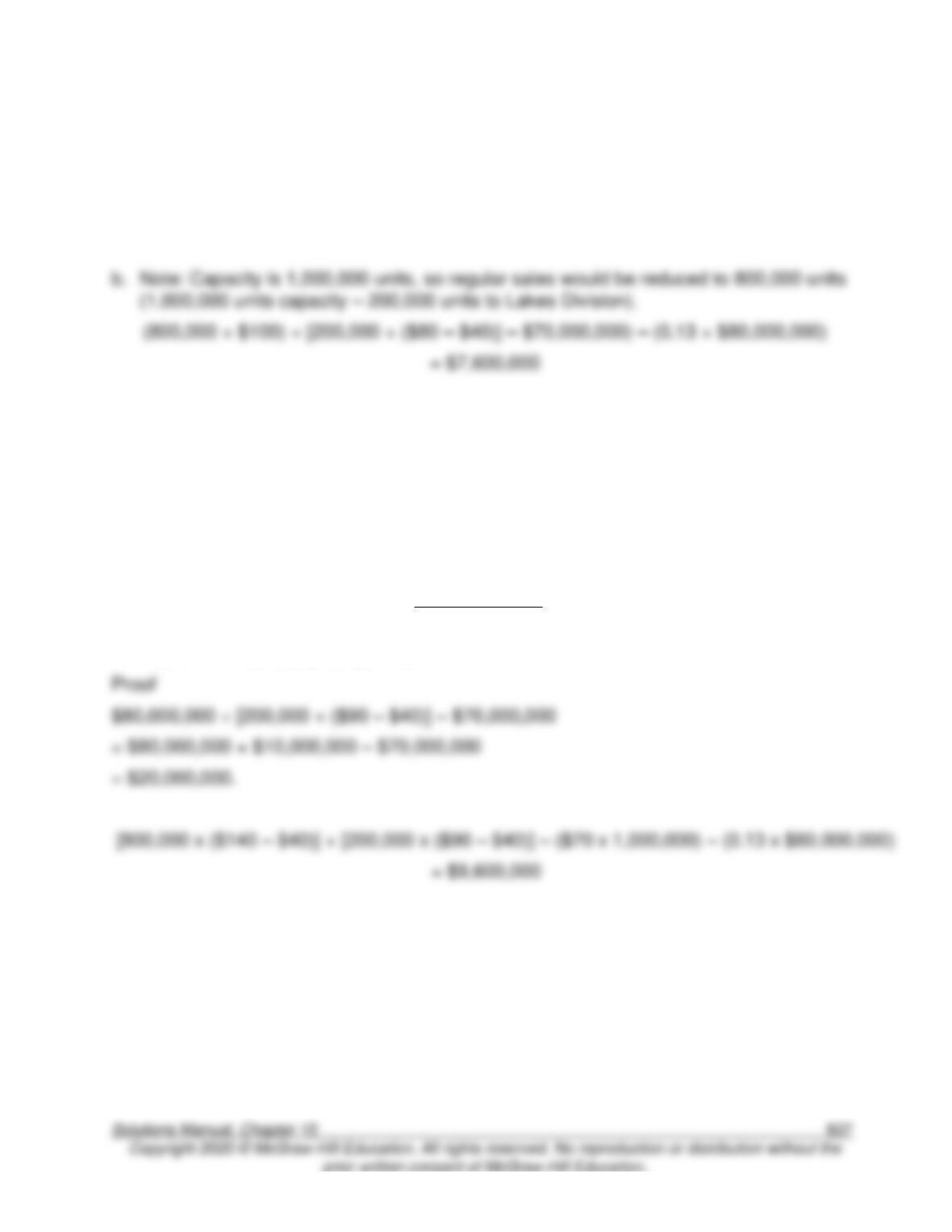
[900,000 × ($140 – $40)] – ($70 × 1,000,000) – (0.13 × $80,000,000) = $9,600,000
c. Because the investments will not change, we can determine the price by setting the
two incomes equal:
(800,000 × $100) + [200,000 × (TP – $40)] – $70,000,000 = $20,000,000
$80,000,000 + 200,000 TP – $8,000,000 – $70,000,000 = $20,000,000
200,000 TP = $18,000,000
TP
=
$18,000,000
=
$90.00
200,000 units
where TP = transfer price per unit.
15–40. (50 min.) Evaluate Profit Impact of Alternative Transfer Decisions: Amazon
Beverages.
(All calculations are in $000.)
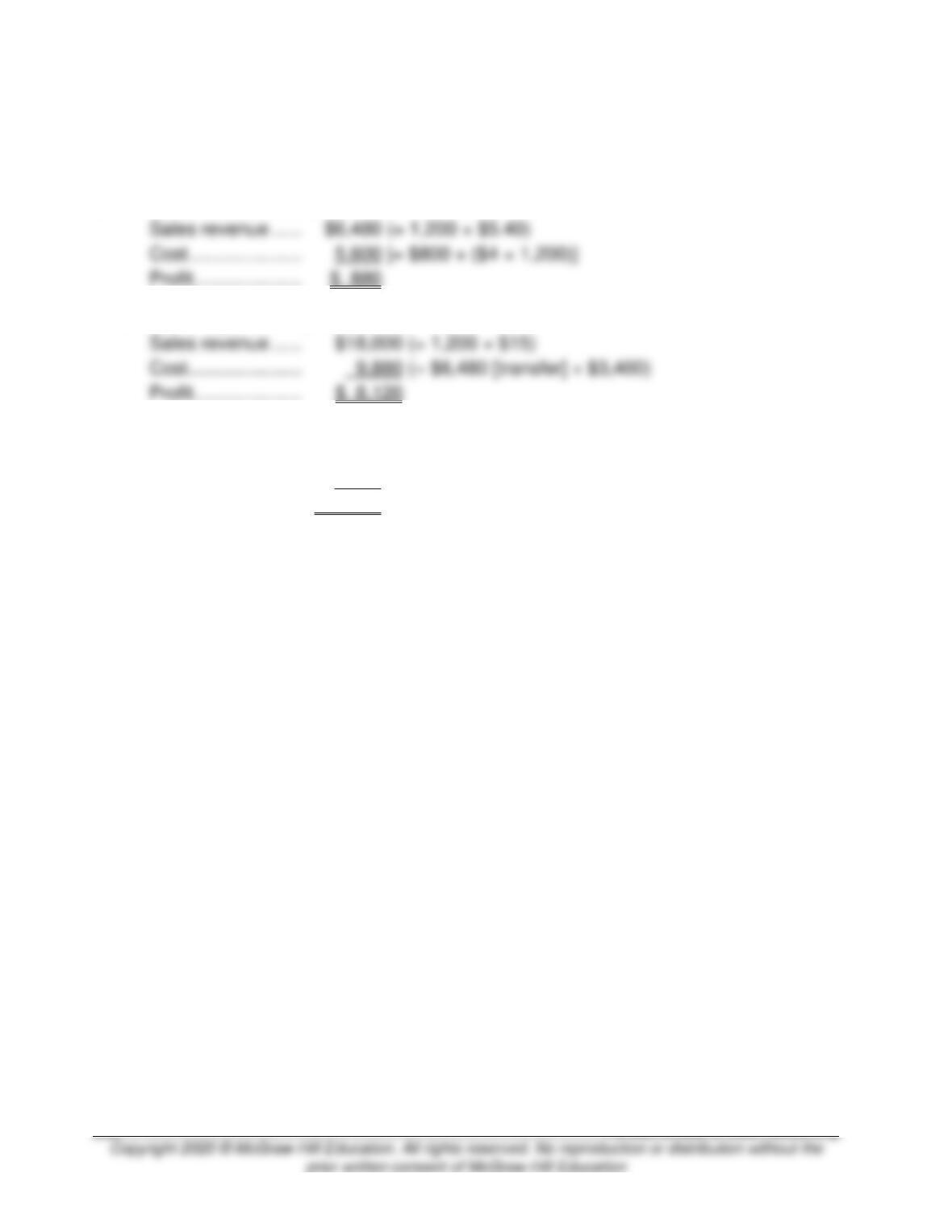
a. 1. The Container Division profits
Sales revenue ……
(= 1,200 × $5.40)
Cost………………….
[= $800 + ($4 × 1,200)]
2. The Mixing Division profits
Sales revenue ……
$18,000
(= 1,200 × $15)
Cost………………….
(= $6,480 [transfer] + $3,400)
Profit …………………
$ 8,120
3. The corporation profits
Sales revenue ….
$18,000
(= 1,200 × $15)
Cost………………..
9,000
(= $5,600 + $3,400)
Profit ……………….
$ 9,000
15–40. (continued)
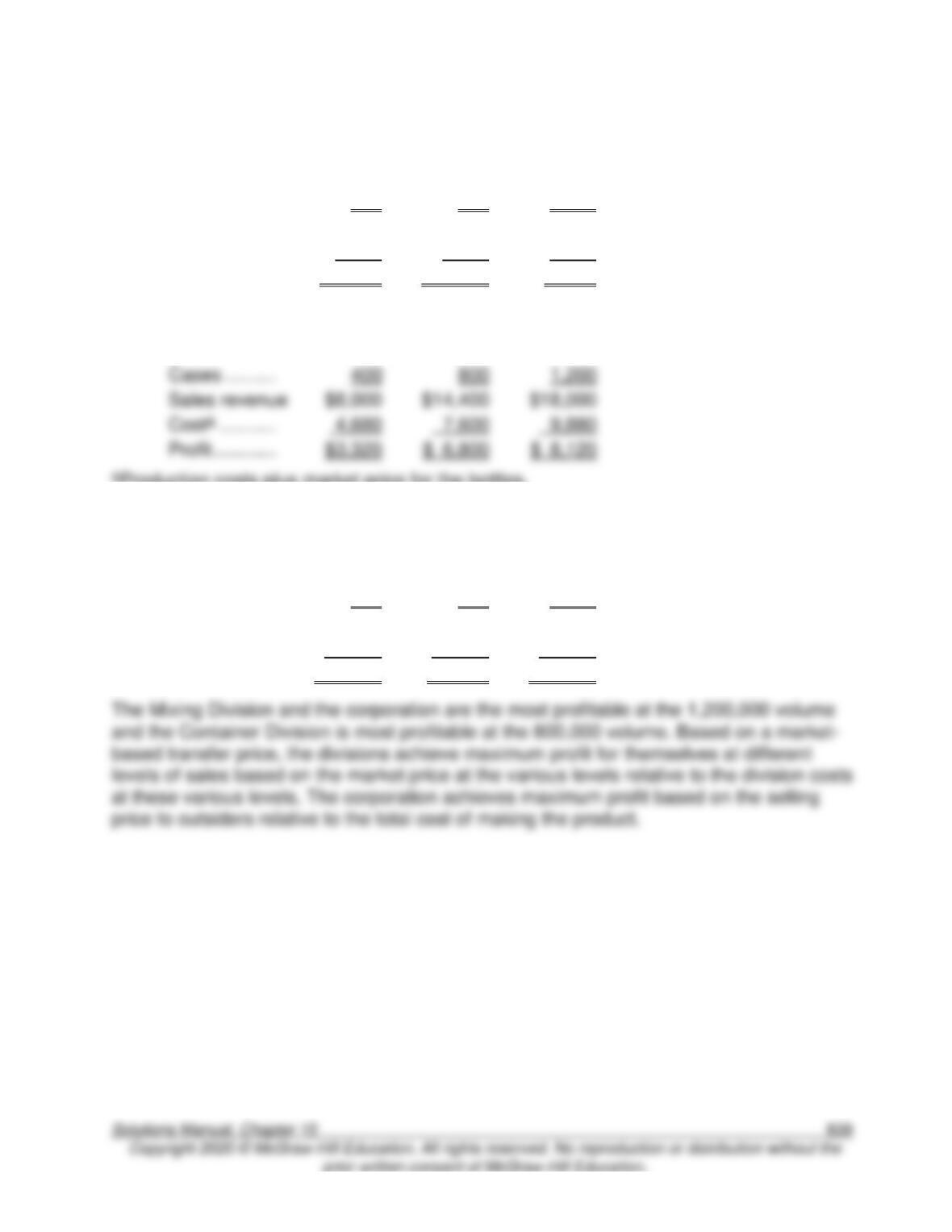
b. 1. No
Container Division Volumes
Cases ……….
400
800
1,200
Sales revenue
$ 2,880
$ 5,000
$6,480
Cost ………….
2,400
4,000
5,600
Profit …………
$ 480
$ 1,000
$ 880
2. Yes
Mixing Division Volumes
Cases ……….
Sales revenue
$8,000
7,600
Profit …………
$3,320
3. Yes
Corporation Volumes
Cases ……….
400
800
1,200
Sales revenue
$8,000
$14,400
$18,000
Cost ………….
4,200
6,600
9,000
Profit …………
$ 3,800
$ 7,800
$ 9,000
15–41. (40 min.) International Transfer Prices: Skane Shipping, Ltd.
All revenues and costs are in millions of dollars.
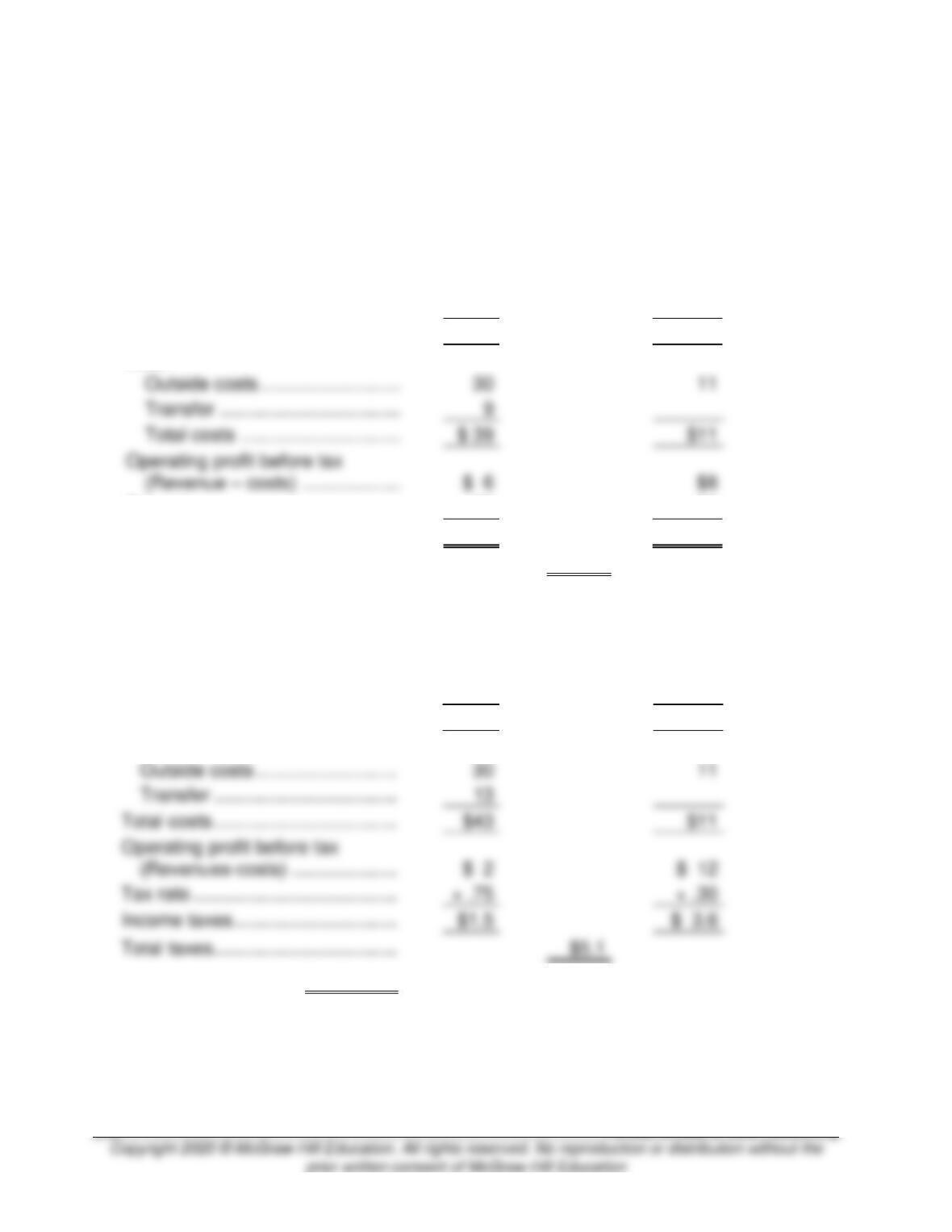
• Malaysian basis for transfer price:
Item
Shipping
Company
Dock
Facility
Sales revenue:
Outside sales revenue ………….
$ 45
$ 10
Transfer price ………………………
9
Total revenue ………………………
$ 45
$ 19
Less:
Transfer ……………………………..
Total costs ………………………….
$ 39
$11
Operating profit before tax
Tax rate …………………………………
× .75
× .30
Income taxes ………………………….
$4.5
$2.4
Total taxes ……………………………..
$6.9
• Sweden basis for transfer price:
Item
Shipping
Company
Dock
Facility
Outside sales revenue ……………..
$ 45
$10
Transfer price …………………………
13
Total revenue …………………………
$ 45
$ 23
Less:
Outside costs ………………………
11
Transfer ……………………………..
Total costs ……………………………..
Operating profit before tax
(Revenues-costs) ………………..
Tax rate …………………………………
× .75
Income taxes ………………………….
$1.5
$ 3.6
Total taxes ……………………………..
$5.1
The difference in taxes is $1,800,000 ($6,900,000 – $5,100,000).
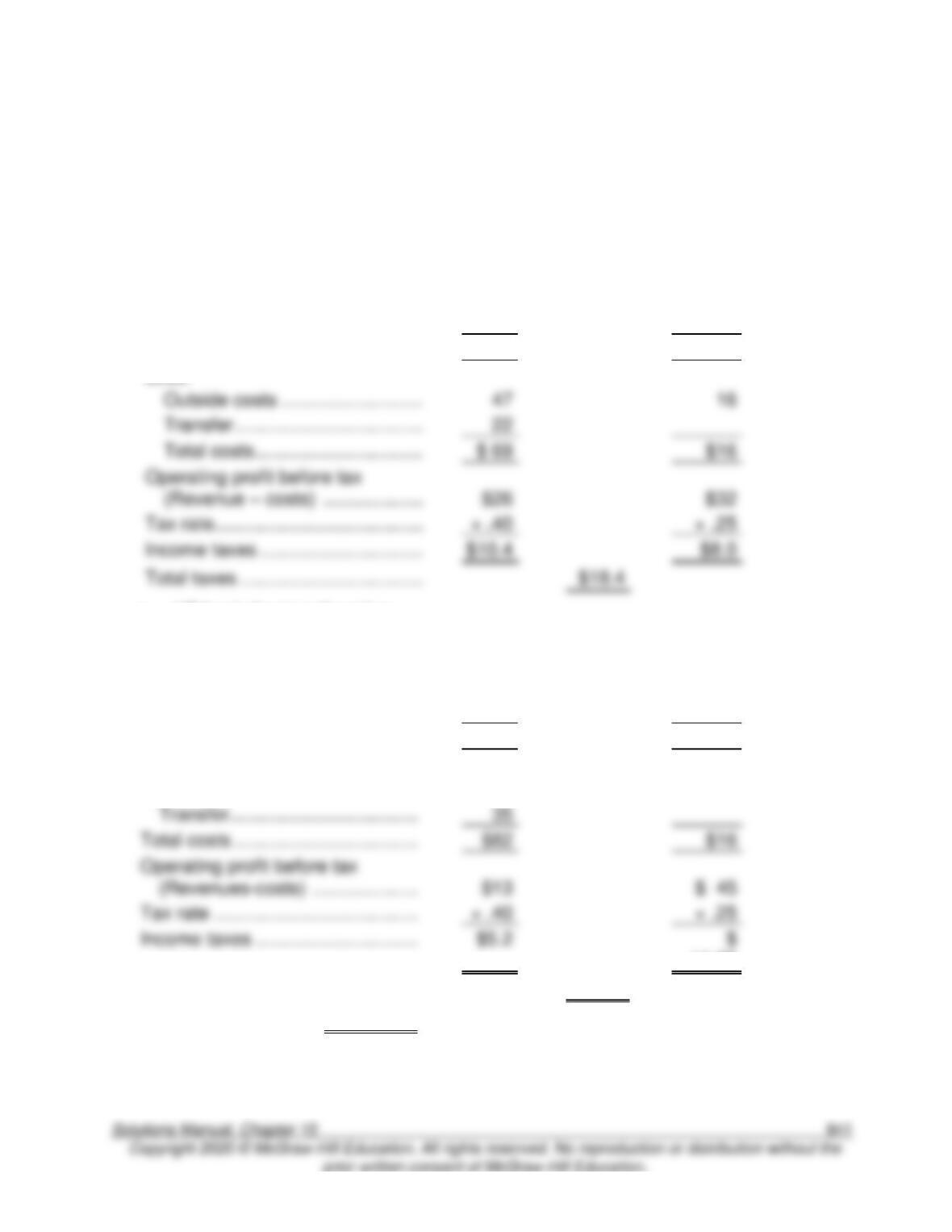
15–42. (40 min.) International Transfer Prices: Badger Air.
All revenues and costs are in millions of dollars.
• Philippine basis for transfer price:
Item
Cargo
Division
Maintenance
Division
Sales revenue:
Outside sales revenue …………..
$ 95
$ 26
Transfer price ………………………
22
Total revenue ………………………
$ 95
$ 48
Less:
Outside costs ………………………
Transfer ………………………………
Total costs …………………………..
Operating profit before tax
Tax rate ………………………………….
× .40
× .25
Income taxes ………………………….
$8.0
Total taxes ……………………………..
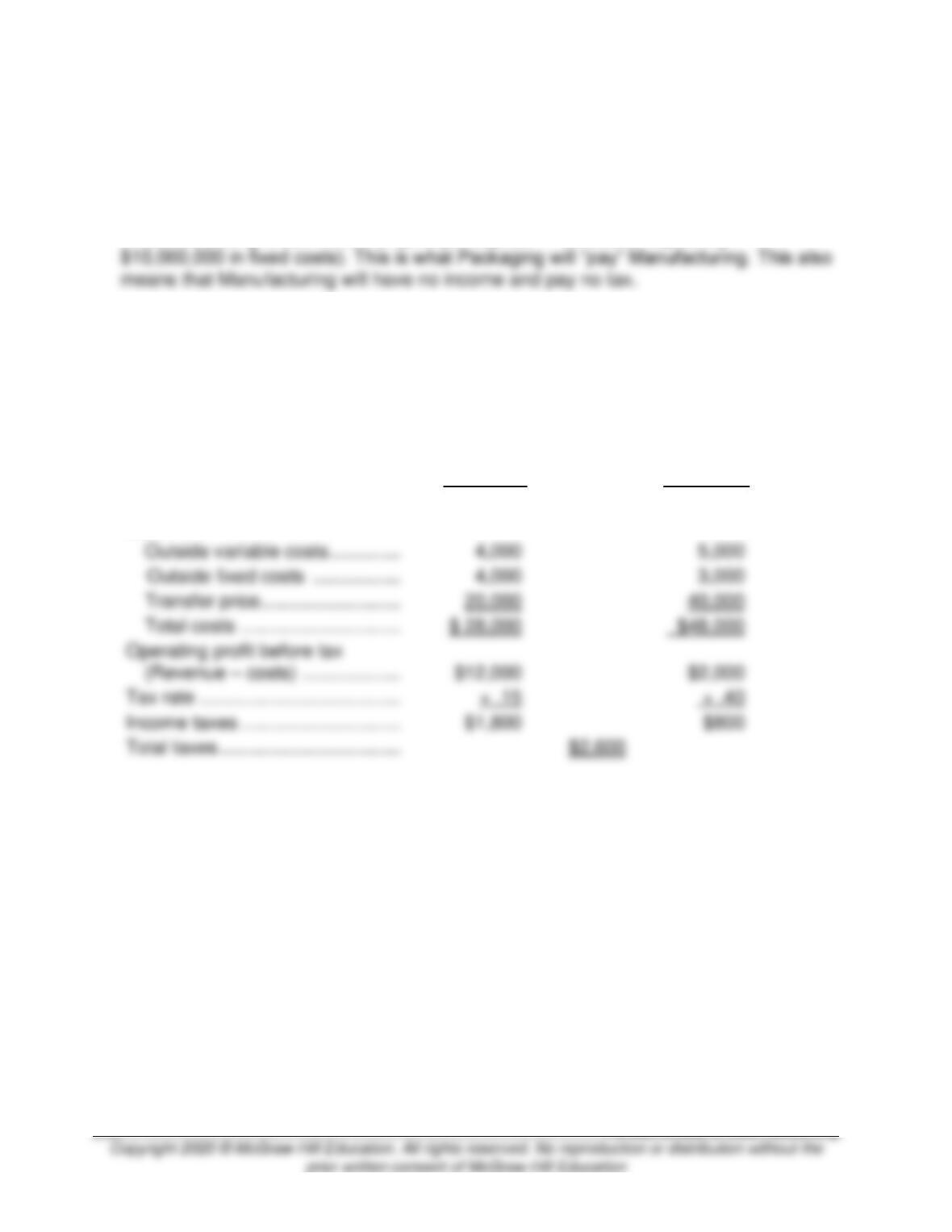
• US basis for transfer price:
Item
Cargo
Division
Maintenance
Division
Outside sales revenue ……………..
$ 95
$26
Transfer price………………………….
35
Total revenue ………………………….
$ 95
$ 61
Less:
Outside costs ………………………
47
16
Transfer …………………………..….
Total costs ……………………………..
$16
Operating profit before tax
Tax rate …………………………………
× .25
Income taxes ………………………….
11.25
Total taxes ……………………………..
$16.45
The difference in taxes is $1,950,000 ($18,400,000 – $16,450,000).
15–43. (40 min.) International Transfer Prices: GB Pharmaceuticals.
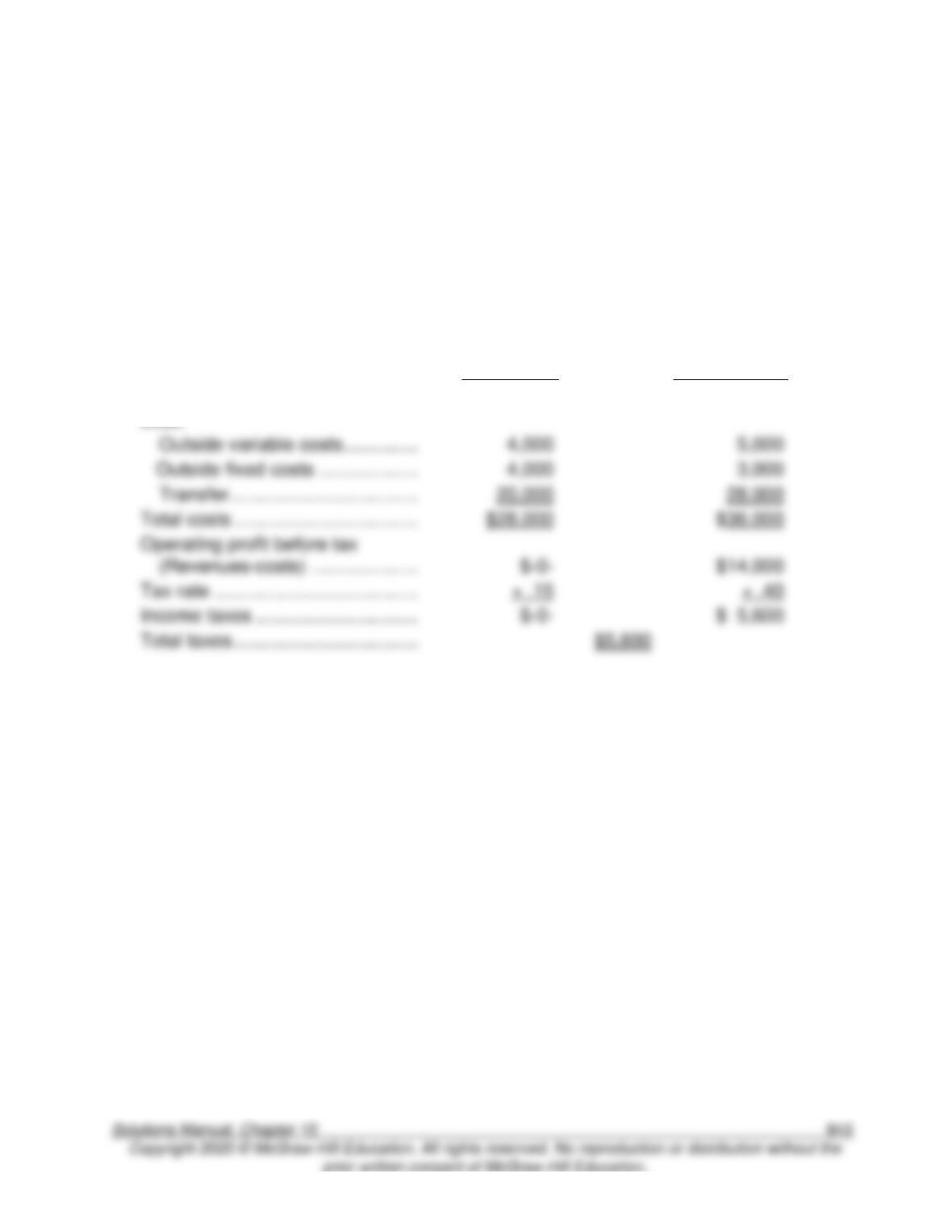
a. Before we calculate income, it will help to note two things. First, we will do the analysis
in terms of bottles, which each contain ten pills. The annual production is 100,000
bottles (= 1,000,000 capsules ÷ 10 capsules per bottle). Second, the total annual cost
in Manufacturing is $20 million (= [$10 per capsule × 1,000,000 capsules] +
All revenues and costs are in thousands of dollars.
• Transfer (market) price is $400 per bottle:
Item
Packaging
Division
Distribution
Division
Sales revenue:
Outside sales revenue ………….
$ 50,000
Transfer price ………………………
$40,000
Total revenue ………………………
$40,000
$50,000
Less:
Outside variable costs …………..
Transfer price ………………………
Total costs ………………………….
Tax rate …………………………………
Income taxes ………………………….
Total taxes ……………………………..
•
15–43. (continued)
b. Before we calculate income, note that the average cost in packaging is $280 per bottle.
The variable costs are $240 (= $200 transferred in from Manufacturing + 40 incurred in
Packaging). The average fixed costs in Packaging are $40 per bottle (= $4,000,000
fixed costs ÷ 100,000 bottles.
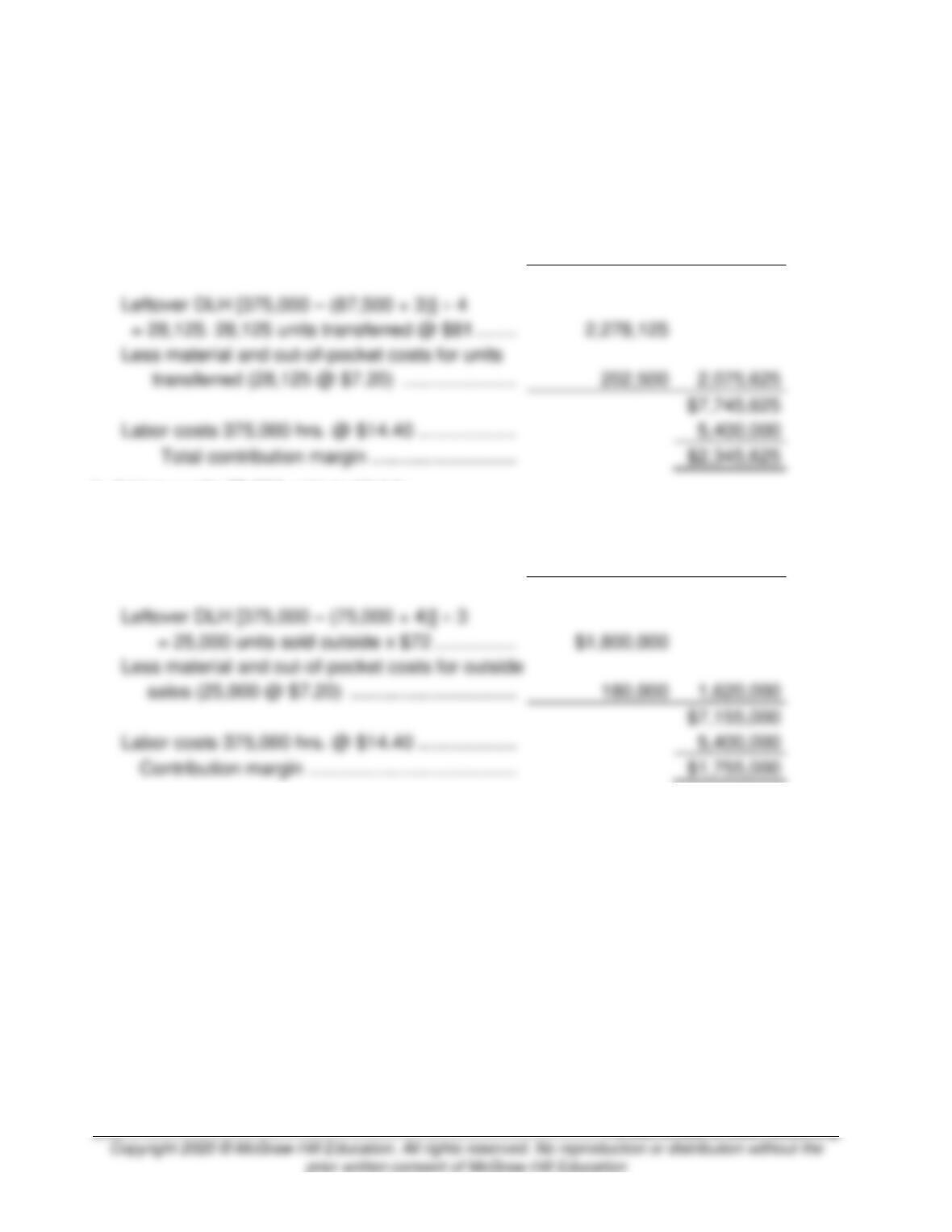
All revenues and costs are in thousands of dollars.
• Transfer (Packaging) cost is $280 per bottle.
Item
Packaging
Division
Distribution
Division
Outside sales revenue ……………..
$ 0
$50,000
Transfer price………………………….
28,000
Total revenue ………………………….
$ 28,000
$50,000
Less:
Transfer …………………………..….
Tax rate …………………………………
Income taxes ………………………….
$ 5,600
15–44.
(60 min.) Analyze Transfer Pricing Data: Elsinore Electronics.
a. If Home sells 87,500 units to outside
Outside sales revenue 87,500 @ $72.00 ………..
$6,300,000
Less material and out-of-pocket costs for outside
sales (87,500 @ $7.20) …………………………..
630,000
$5,670,000
Less material and out-of-pocket costs for units
Labor costs 375,000 hrs. @ $14.40 ……………….
b. If Home sells 75,000 units to Mobile
Units transferred 75,000 @ $81 …………………….
$6,075,000
Less material and out-of-pocket costs for units
transferred (75,000 @ $7.20) ………………….
540,000
5,535,000
Less material and out-of-pocket costs for outside
Labor costs 375,000 hrs. @ $14.40 ……………….
Contribution margin ………………………………….
15–44. (continued)
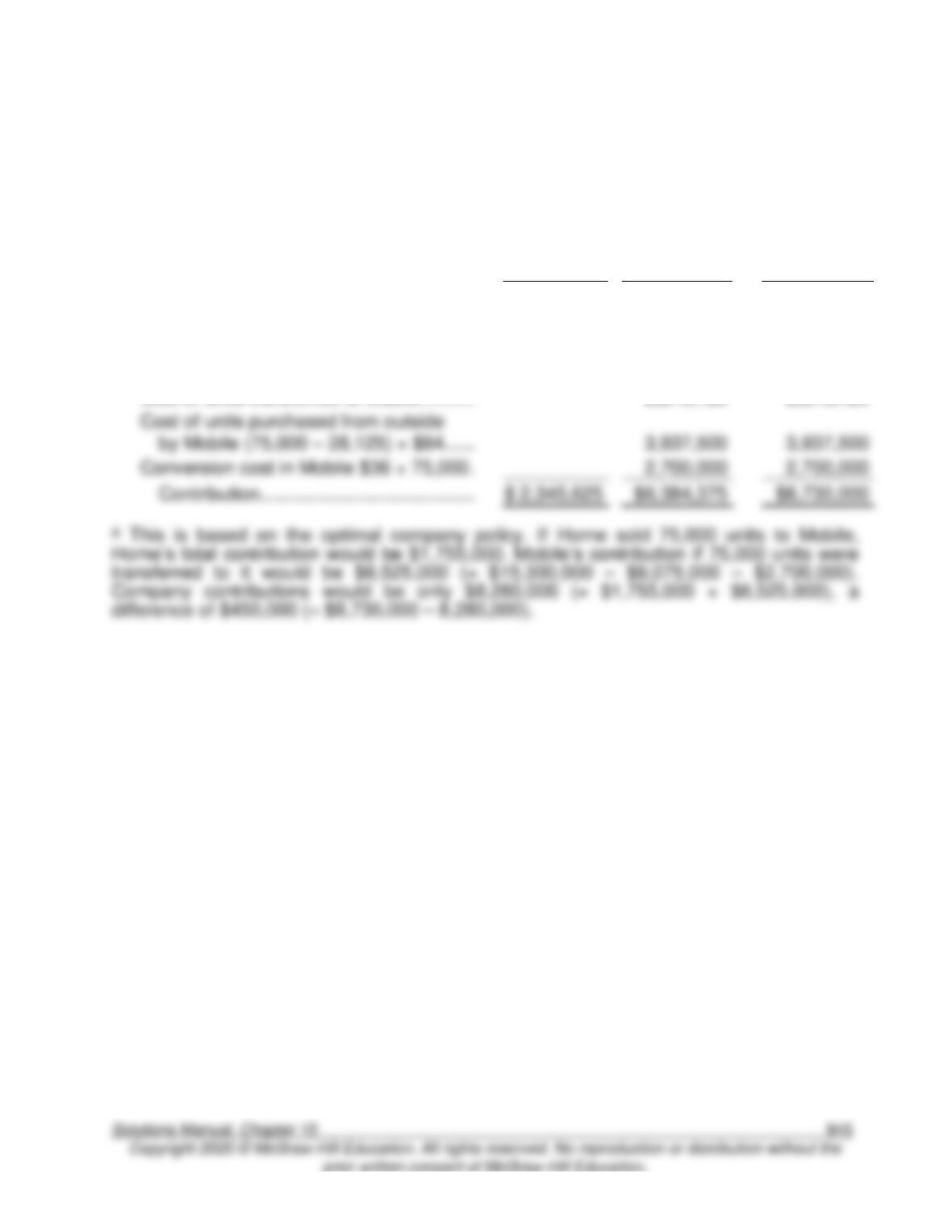
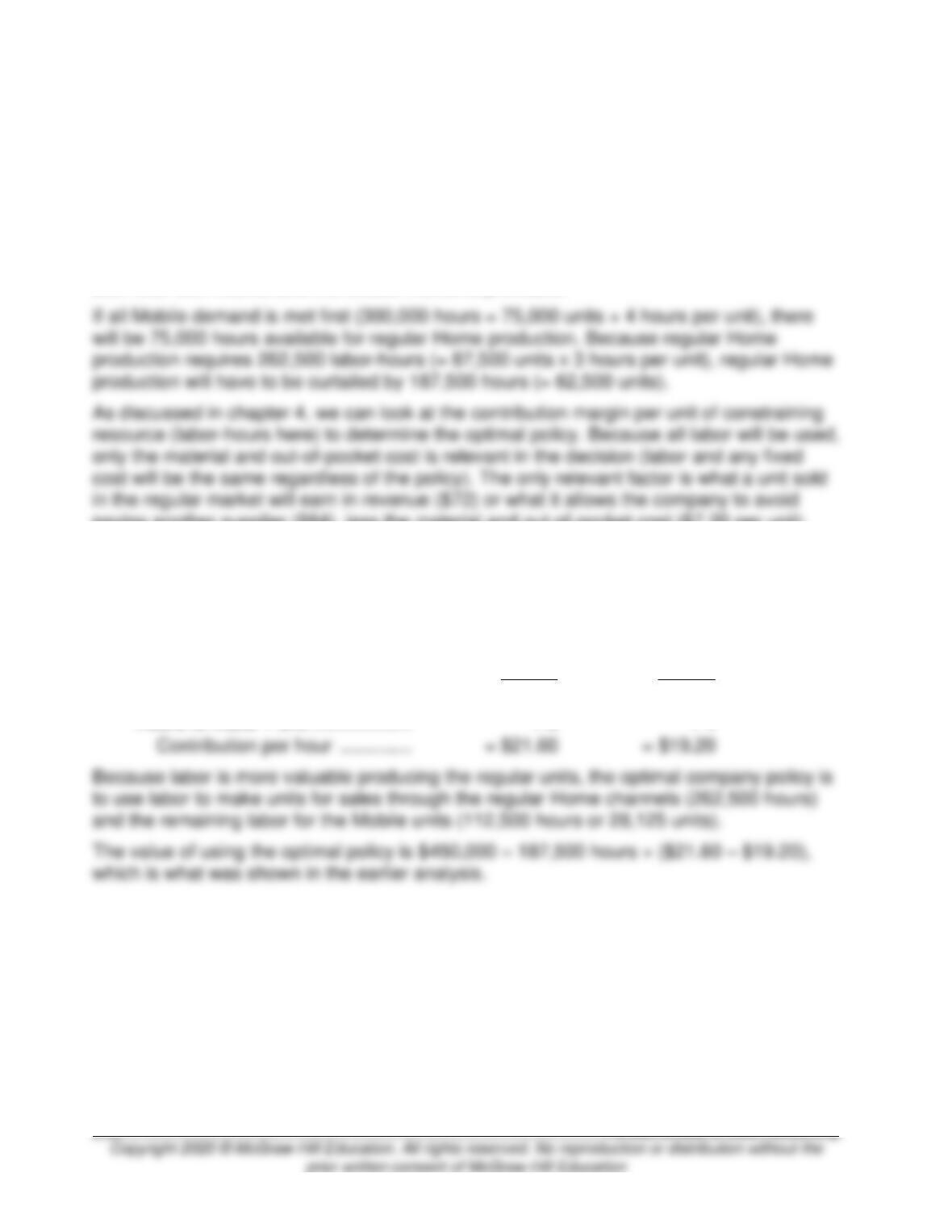
c. and d.a
Home
Mobile
Company
Sales by Home to outside (87,500 × $72)
$6,300,000
$6,300,000
Sales by Home to Mobile (28,125 × $81)
2,278,125
2,278,125
Sales by Mobile to outside (75,000 × $204)
$15,300,000
15,300,000
Total sales ……………………………………….
$8,578,125
$15,300,000
$23,878,125
Cost of materials, etc. in Home
(115,625 units × $7.20) ………………..
832,500
832,500
Cost of labor in Home ………………………..
5,400,000
5,400,000
Cost of units transferred to Mobile ……….
2,278,125
Conversion cost in Mobile $36 × 75,000 .
2,700,000
Contribution …………………………………..
$ 2,345,625
15–44 (continued)
Alternative approach.
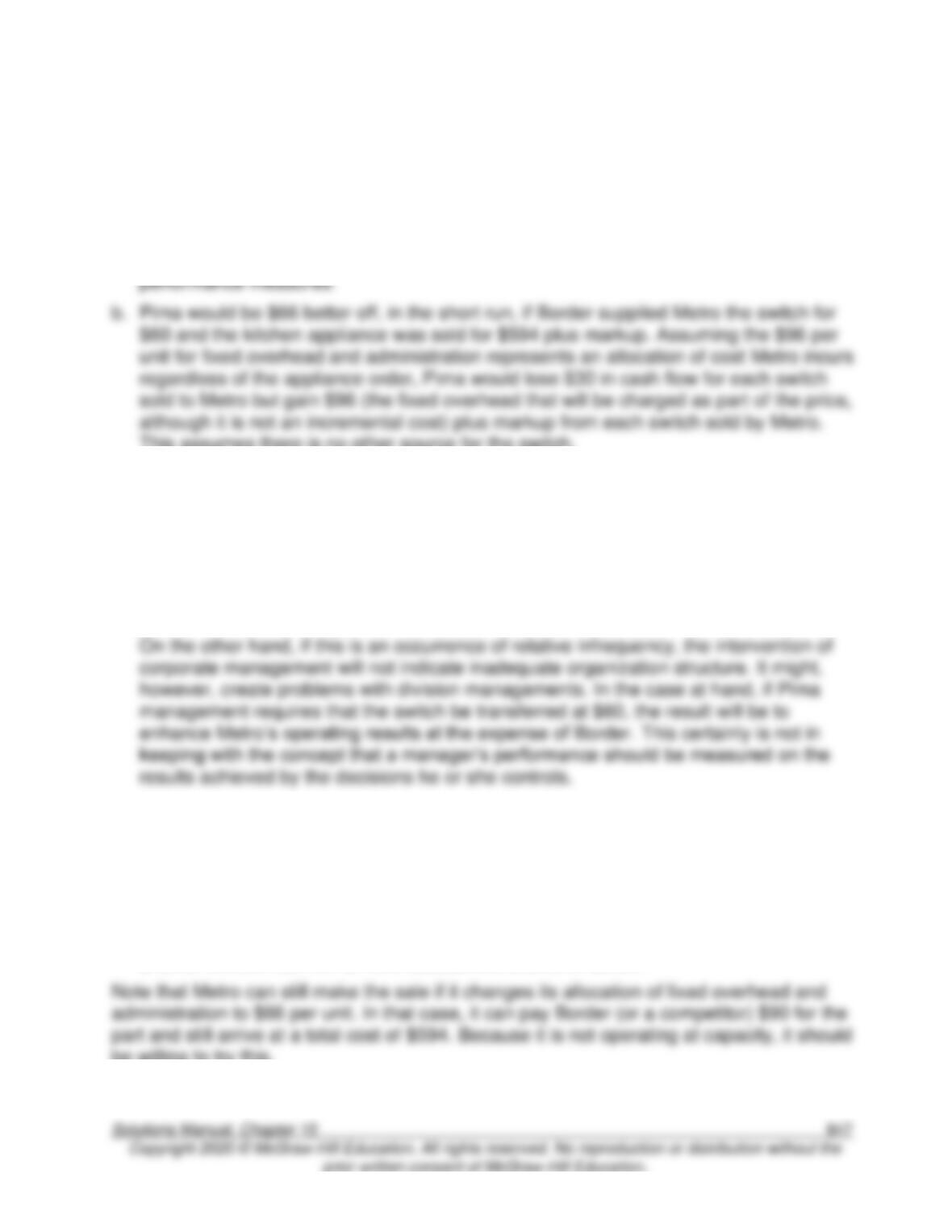
The following is an alternative approach to determining the optimal company policy that
uses the concepts of chapter 4.
The scarce resource in this company is labor-hours. Regardless of the production plan,
the company will use 375,000 labor-hours (the maximum) because Home production for
both their own market and the Mobile market is profitable.
paying another supplier ($84), less the material and out-of-pocket cost ($7.20 per unit).
The value of a labor-hour used in the two alternatives is:
Used in Regular
Home Units
Used in Units
Transferred to
Mobile
Value of 1 unit …………………………
$72.00
$84.00
Material and out-of-pocket cost …
7.20
7.20
Contribution per unit
$64.80
$76.80
Hours to make 1 unit ……………….
Contribution per hour …………..
15–45. (40 min.) Transfer Pricing—Performance Evaluation Issues: Pima
Corporation.
a. Border would not supply Metro with the thermal switch for the $60 per unit price.
Border is operating at capacity and would lose $30 ($90 – $60) for each switch sold to
Metro. The management performance of Border is measured by return on investment
and dollar profits; selling to Metro at $60 per unit would adversely affect those
This assumes there is no other source for the switch.
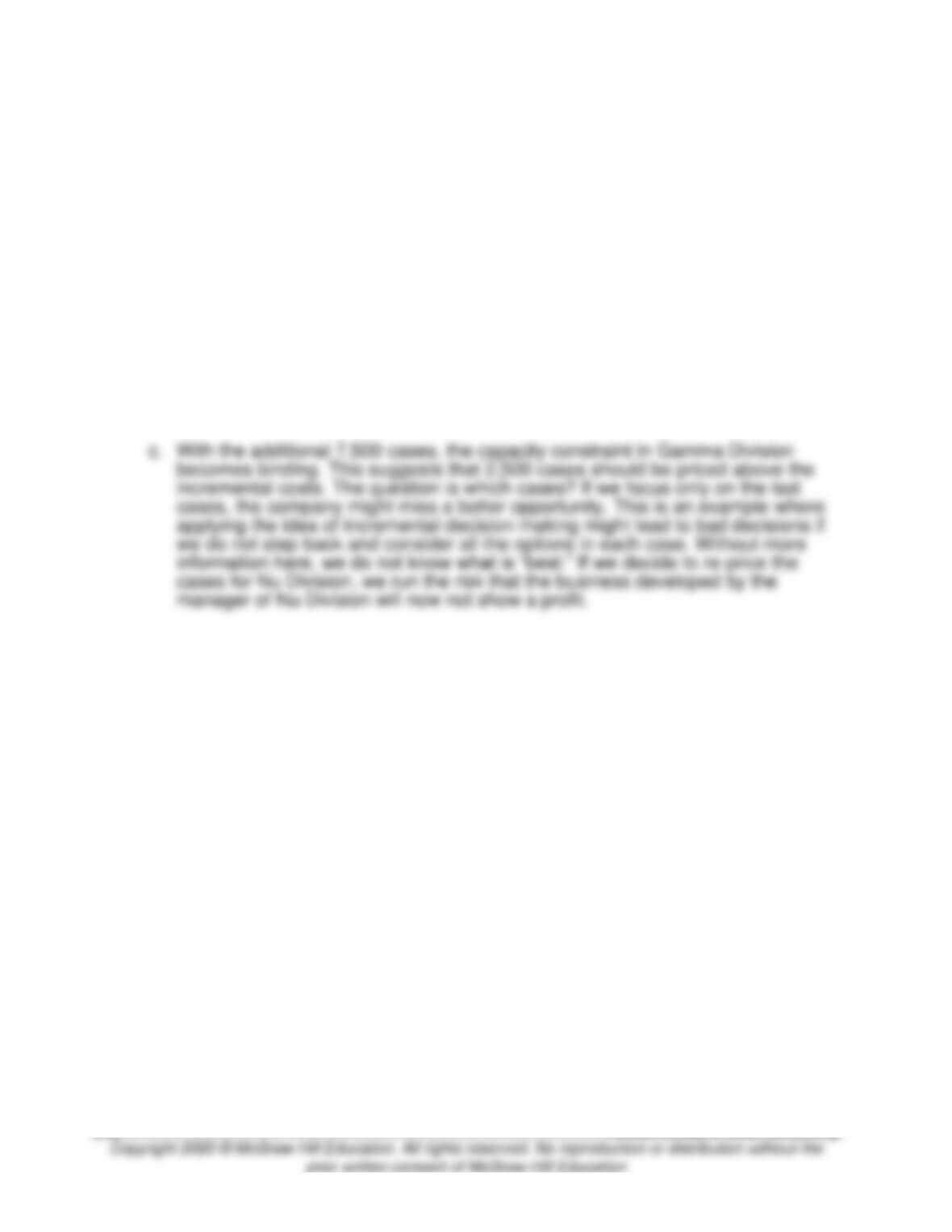
c. In the short run there is an advantage to Pima of transferring the switch at the $60
price and, thus, selling the kitchen appliance for $594 plus markup. In order to make
this happen, Pima will have to overrule the decision of the Border management.
This action would be counter to the purposes of decentralized decision making. If such
action were necessary on a regular basis the decentralized decision making inherent in
the divisionalized organization would be a sham. Then the organization structure is
inappropriate for the situation.
In this case, it appears that Border and Metro serve different markets and do not
represent closely related operating units. Border operates at capacity, Metro does not;
no mention is made of any other interdivisional business. Therefore, the Pima
controller should recommend that each division should be free to act in accordance
with its best interests. The company is better served in the long run if Border is
permitted to continue dealing with its regular customers at the market price. If Metro is
having difficulties, the solution does not lie with temporary help at the expense of
another division but with a more substantive course of action.
be willing to try this.
CMA adapted.
15–46. (30 min.) Evaluate Transfer Price System: Weaver, Inc.
The purpose of this problem is to illustrate possible problems that can arise when
applying static rules, such as determining the optimal transfer price in a series of
decisions over time.
a. $10. Gamma is operating below capacity. Therefore, the optimal transfer price is
the incremental cost, or $10 per carton.
b. The manager of Gamma Division is unlikely to be satisfied with this policy as he
or she will see an increase in activity with no increase in profit and will argue
that the policy is not “fair.” You might respond by noting that the purpose of the
system is designed to promote good decision making and that he or she is not
being punished for the increased activity; the impact on profits is zero.