Chapter 15 Preparing Adjusting Entries and a Trial Balance • 423
Study
Guide
15
Name Perfect
Score
Your
Score
Identifying Accounting Terms 17 Pts.
Identifying Accounting Concepts and Practices 20 Pts.
Analyzing Adjustments 12 Pts.
Total 49 Pts.
Part One—Identifying Accounting Terms
Directions: Select the one term in Column I that best fits each definition in
Column II. Print the letter identifying your choice in the Answers column.
Answers
1.
2.
3.
9.
10.
11.
12.
Column I
A. accrued interest income
B. accrued revenue
C. accumulated
depreciation
I. depreciation expense
J. ending inventory
K. marginal tax rate
L. plant assets
Column II
1. A trial balance prepared before adjusting entries are posted.
(p. 441)
2. The amount of inventory on hand at the beginning of a
fiscal period. (p. 446)
3. The actual count of merchandise at the end of a fiscal
period. (p. 446)
or obsolescence. (p. 450)
9. The portion of a plant asset’s cost that is transferred to an
expense account in each fiscal period during that asset’s
useful life. (p. 450)
10. An estimate of the amount that will be received for an asset
at the time of its disposal. (p. 450)
11. The period of time over which an asset contributes to the
earnings of a business. (p. 450)
12. Recording an equal amount of depreciation expense for a
plant asset in each year of its useful life. (p. 451)
P
E
J
I
M
Q
N
Part Two—Identifying Accounting Concepts and Practices
Directions: Place a T for True or an F for False in the Answers column to show whether
each of the following statements is true or false.
1. Businesses must use a 12-month period, or fiscal year, ending on December 31 for
reporting their financial performance. (p. 440)
2. The adjusting entry for Merchandise Inventory is unique to a merchandising business.
(p. 440)
3. The first step in preparing adjusting entries is to prepare an unadjusted trial balance.
(p. 441)
9. If ending inventory is less than the account balance of Merchandise Inventory, the
inventory adjustment will include a credit to Income Summary. (p. 447)
10. The adjusting entry for accrued revenue increases a revenue account (a credit) and
increases a receivable account (a debit). (p. 447)
11. Estimates of the cost, salvage value, and useful life of a plant asset are used to calculate
its annual depreciation. (p. 450)
12. Functional depreciation occurs when a plant asset becomes inadequate or obsolete.
(p. 450)
13. The annual straight-line depreciation of equipment costing $4,000.00 with a salvage value
of $500.00 and a useful life of 5 years would be $700.00. (p. 451)
14. The adjustment for Accumulated Depreciation—Store Equipment includes a credit to
Depreciation Expense—Store Equipment. (p. 452)
15. The annual straight-line depreciation of land costing $40,000.00 with a salvage value of
$10,000.00 and a useful life of 20 years would be $1,500.00. (p. 452)
Answers
1.
2.
3.
9.
10.
11.
12.
13.
14.
15.
F
T
T
F
T
F
T
F
T
F
Chapter 15 Preparing Adjusting Entries and a Trial Balance • 425
Name Date Class
Part Three—Analyzing Adjustments
Directions: For each of the following items, select the choice that best completes
the statement. Print the letter identifying your choice in the Answers column.
1. The amount in the Supplies—Office account on an unadjusted trial balance represents
the value of supplies (A) at the beginning of a fiscal period (B) used during a fiscal
period (C) at the beginning of a fiscal period plus office supplies bought during the
fiscal period (D) bought during a fiscal period. (p. 442)
2. The two accounts used to adjust the Office Supplies account are (A) Supplies and Purchases
(B) Supplies—Office and Income Summary (C) Supplies—Office and Supplies Expense—
Office (D) Supplies Expense—Office and Income Summary. (p. 442)
3. The portion of the insurance premiums that has expired during a fiscal period is classified
as (A) a liability (B) an asset (C) an expense (D) capital. (p. 444)
6. The two accounts used to adjust the Merchandise Inventory account are (A) Merchandise Inventory
and Supplies (B) Merchandise Inventory and Purchases (C) Merchandise Inventory and Income
Summary (D) Merchandise Inventory and Sales. (pp. 446–447)
7. A credit to Income Summary in the Merchandise Inventory adjustment represents the (A)
decrease in Merchandise Inventory (B) increase in Merchandise Inventory (C) beginning
Merchandise Inventory (D) ending Merchandise Inventory. (p. 447)
8. Recording revenue in the accounting period in which the revenue is earned is an application
of the accounting concept (A) Realization of Revenue (B) Consistent Reporting (C)
Historical Cost (D) Adequate Disclosure. (p. 447)
9. The two accounts used to adjust for interest income earned on notes receivable are (A)
Interest Receivable and Interest Income (B) Accounts Receivable and Interest Income (C)
Interest Receivable and Sales (D) Accounts Receivable and Sales. (p. 448)
10. After recording the adjustment for accumulated depreciation, the book value of plant assets
(A) remains unchanged, (B) increases, (C) decreases, (D) cannot be determined. (pp. 451–452)
Answers
1.
2.
3.
6.
7.
8.
9.
10.
C
C
C
C
B
A
A
C
426 • Working Papers
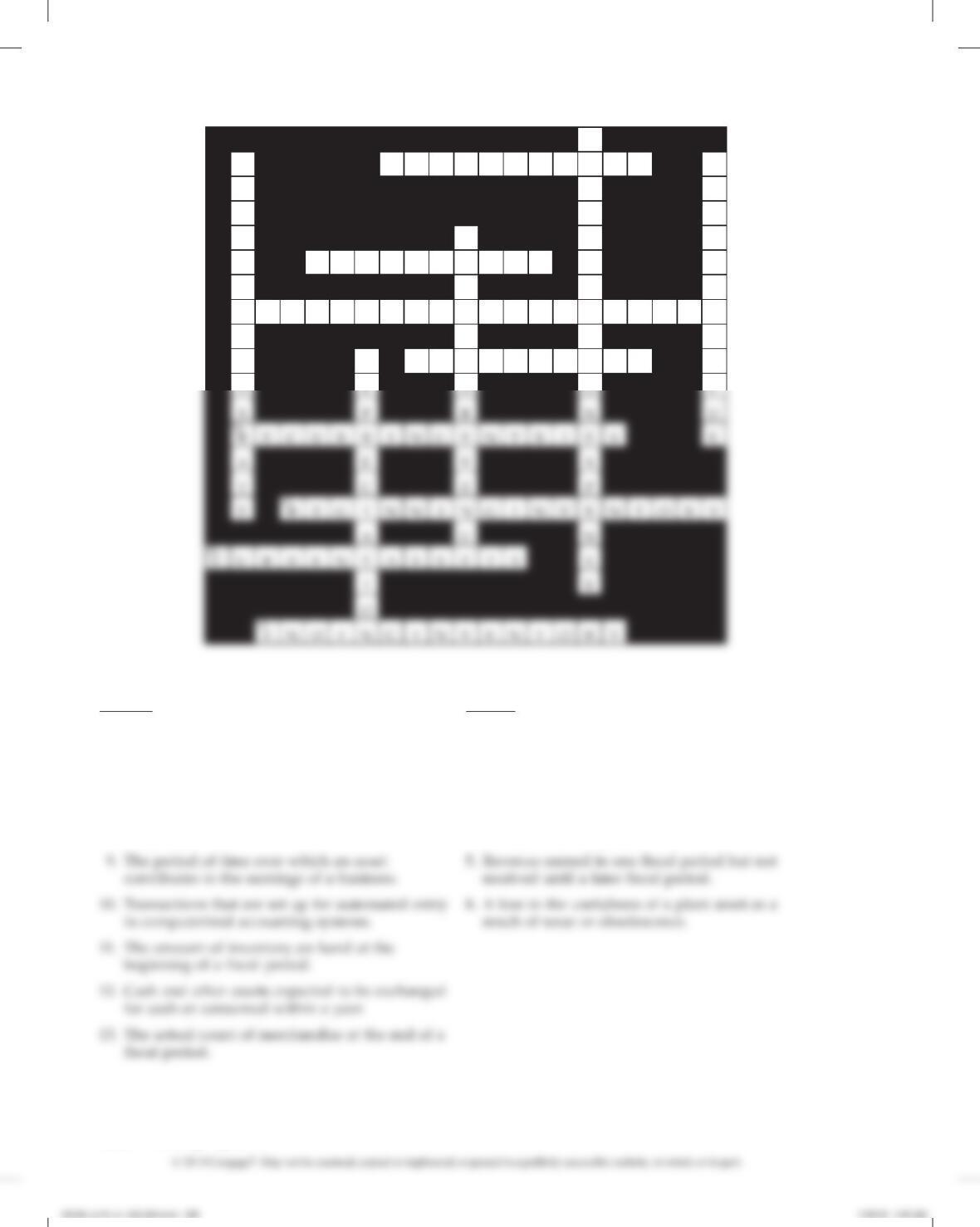
Across
3. Physical assets that will be used for a number
of years in the operation of a business.
6. Each tax rate and taxable income amount on
one line of a tax table.
7. A trial balance prepared after adjusting entries
are posted.
Down
1. The portion of a plant asset’s cost that is
transferred to an expense account in each fiscal
period during that asset’s useful life.
2. The tax rate associated with a tax bracket.
4. The amount that will be received for an asset at
the time of its disposal.
2
7
89
1
4
5
6
3
TE
2
7
89
1
4
5
6
3
M
A
R
G
ITAXBRAC
C
A
KET
N
L
AD JUSTEDTR
U
EFULLI
FESU
IALBA
T
I
C
E
R
P
ETSSSATNALP
D
LAN
D
CE
V
A
G
A
V
L
A
S
T
Chapter 15 Preparing Adjusting Entries and a Trial Balance • 427
Name Date Class
15-1 WORK TOGETHER, p. 445
Journalizing the adjusting entries for supplies and prepaid insurance
(Note: Working papers for 15-1 ON YOUR OWN begin on p. 439.)
1., 2.
ACCOUNT TITLE DEBIT CREDIT
Cash 24 1 9 4 34
Petty Cash 2 5 0 00
Accounts Receivable 38 5 1 8 56
Merchandise Inventory 94 8 4 5 31
Supplies—Office 3 1 0 8 08
Store Equipment 22 4 6 1 95
Accumulated Depreciation—Store Equipment 8 5 6 4 00
Accounts Payable 4 4 6 2 21
Sales Tax Payable 4 9 5 90
Employee Income Tax Payable—Federal 5 9 4 00
Social Security Tax Payable 1 2 6 6 80
Medicare Tax Payable 2 9 6 27
Health Insurance Premiums Payable 2 8 8 04
Retirement Benefits Payable 2 9 1 17
(Note: Trial balance is continued on the next page.)
Southside Electric
Unadjusted Trial Balance
December 31, 20–
Allowance for Uncollectible Accounts
Accumulated Depreciation—Office Equipment
4 4 8 3 62
4 8 67
2 3 9 5 00
428 • Working Papers
15-1 WORK TOGETHER (continued)
ACCOUNT TITLE DEBIT CREDIT
Income Summary
Sales 532 3 7 1 75
Sales Discount 2 1 8 10
Sales Returns and Allowances 1 4 8 48
Miscellaneous Expense 2 3 8 2 80
Payroll Taxes Expense 12 7 9 7 20
Rent Expense 5 7 1 4 03
Salary Expense 115 3 6 4 38
Supplies Expense—Office
TE
Insurance Expense
Southside Electric
Unadjusted Trial Balance
December 31, 20–
Chapter 15 Preparing Adjusting Entries and a Trial Balance • 429
Name Date Class
15-1, 15-2, 15-3, and 15-4 WORK TOGETHER, pp. 445, 449, 454, and 462
15-1 Journalizing the adjusting entries for supplies and prepaid insurance
15-2 Journalizing the adjusting entries for merchandise inventory and interest
GENERAL JOURNAL PAGE 15
DATE ACCOUNT TITLE DOC.
NO.
POST.
REF. DEBIT CREDIT
1Adjusting Entries 1
220–
Dec. 31 Uncollectible Accounts Expense 3 4 1 5 00 2
3Allowance for Uncollectible Accounts 3 4 1 5 00 3
10 10
11 11
12 12
13 13
14 14
15 15
15-2
15-4
6165
1135
31 Merchandise Inventory 1140 1 6 2 5 94
Income Summary 3150 1 6 2 5 94
31 Interest Receivable 1175 6 9 33
Interest Income 7110 6 9 33
31 Depreciation Expense—Office Equipment 6120 2 1 5 0 00
Accum. Depreciation—Office Equipment 1210 2 1 5 0 00
430 • Working Papers
15-3 WORK TOGETHER, p. 454
1.
Original Cost $
Estimated Salvage Value
Estimated Total Depreciation Expense $
2.
Original Cost $
Depreciation: Year 1 $
Year 2
TE
950.00
150.00
800.00
950.00
160.00
160.00 320.00
Chapter 15 Preparing Adjusting Entries and a Trial Balance • 431
Name Date Class
15-4 WORK TOGETHER, p. 462
GENERAL LEDGER
ACCOUNT Allowance for Uncollectible Accounts ACCOUNT NO. 1135
DATE ITEM POST.
REF. DEBIT CREDIT
BALANCE
DEBIT CREDIT
20–
Dec. 1 Balance ✔4 8 67
ACCOUNT Supplies—Office ACCOUNT NO. 1145
DATE ITEM POST.
REF. DEBIT CREDIT
BALANCE
DEBIT CREDIT
20–
Dec. 1 Balance ✔3 1 0 8 08
ACCOUNT Prepaid Insurance ACCOUNT NO. 1160
DATE ITEM POST.
REF. DEBIT CREDIT
BALANCE
DEBIT CREDIT
20–
Dec. 1 Balance ✔11 2 0 0 00
1., 4.
31 G15 3 4 1 5 00 3 4 6 3 67
31 G15 2 5 6 0 08 5 4 8 00
31 G15 9 6 0 0 00 1 6 0 0 00
432 • Working Papers
15-4 WORK TOGETHER (continued)
ACCOUNT Accumulated Depreciation—Office Equipment ACCOUNT NO. 1210
DATE ITEM POST.
REF. DEBIT CREDIT
BALANCE
DEBIT CREDIT
20–
Dec. 1 Balance ✔2 3 9 5 00
ACCOUNT Federal Income Tax Payable ACCOUNT NO. 2170
DATE ITEM POST.
REF. DEBIT CREDIT
BALANCE
DEBIT CREDIT
ACCOUNT Depreciation Expense—Office Equipment ACCOUNT NO. 6120
DATE ITEM POST.
REF. DEBIT CREDIT
BALANCE
DEBIT CREDIT
TE
31 G15 2 1 5 0 00 4 5 4 5 00
20–
Dec. 31 G15 6 4 6 9 20 6 4 6 9 20
20–
Dec. 31 G15 2 1 5 0 00 2 1 5 0 00
Chapter 15 Preparing Adjusting Entries and a Trial Balance • 433
Name Date Class
15-4 WORK TOGETHER (continued)
ACCOUNT Insurance Expense ACCOUNT NO. 6130
DATE ITEM POST.
REF. DEBIT CREDIT
BALANCE
DEBIT CREDIT
ACCOUNT Supplies Expense—Store ACCOUNT NO. 6160
DATE ITEM POST.
REF. DEBIT CREDIT
BALANCE
DEBIT CREDIT
ACCOUNT Federal Income Tax Expense ACCOUNT NO. 6205
DATE ITEM POST.
REF. DEBIT CREDIT
BALANCE
DEBIT CREDIT
20–
Dec. 1 Balance ✔32 0 0 0 00
20–
Dec. 31 G15 9 6 0 0 00 9 6 0 0 00
20–
Dec. 31 G15 3 8 4 3 62 3 8 4 3 62
31 G15 6 4 6 9 20 38 4 6 9 20
434 • Working Papers
15-4 WORK TOGETHER (continued)
3.
Total of income statement credit accounts …………………………. $
Less total of income statement debit accounts
excluding federal income tax …………………………………………..
Net Income before
Federal Income
Tax
–Of the Amount
Over =
Net Income
Subject to
Marginal Tax Rate
×Marginal
Tax Rate =Marginal
Income Tax
$ – $ = $ × = $
TE
395,360.48
536,948.17
141,587.69 100,000.00 41,587.69 39% 16,219.20
Chapter 15 Preparing Adjusting Entries and a Trial Balance • 435
Name Date Class
15-4 WORK TOGETHER (continued)
2., 5., 6.
ACCOUNT TITLE DEBIT CREDIT
Cash 24 1 9 4 34
Petty Cash 2 5 0 00
Accounts Receivable 38 5 1 8 56
Allowance for Uncollectible Accounts
Notes Receivable 8 0 0 0 00
Interest Receivable
Office Equipment 6 9 4 8 88
Accumulated Depreciation—Office Equipment
Store Equipment 22 4 6 1 95
Accumulated Depreciation—Store Equipment
Accounts Payable 4 4 6 2 21
Sales Tax Payable 4 9 5 90
Employee Income Tax Payable—Federal 5 9 4 00
Social Security Tax Payable 1 2 6 6 80
Medicare Tax Payable 2 9 6 27
(Note: Trial balance is continued on the next page.)
Southside Electric
Adjusted Trial Balance
December 31, 20–
6 9 33
16 0 0 4 00
3 4 6 3 67
4 5 4 5 00
436 • Working Papers
15-4 WORK TOGETHER (concluded)
ACCOUNT TITLE DEBIT CREDIT
Income Summary
Sales 532 3 7 1 75
Sales Discount 2 1 8 10
Sales Returns and Allowances 1 4 8 48
Purchases 223 1 7 4 88
Depreciation Expense—Store Equipment
Insurance Expense
Miscellaneous Expense 2 3 8 2 80
Payroll Taxes Expense 12 7 9 7 20
Rent Expense 5 7 1 4 03
TE
7 4 4 0 00
9 6 0 0 00
1 6 2 5 94
Southside Electric
Adjusted Trial Balance
December 31, 20–
Name Date Class
15-1 ON YOUR OWN, p. 445
Journalizing the adjusting entries for supplies and prepaid insurance
1., 2.
ACCOUNT TITLE DEBIT CREDIT
Prepaid Insurance 12 8 0 0 00
Notes Receivable 7 5 0 0 00
Interest Receivable
Office Equipment 15 4 9 5 28
Accumulated Depreciation—Office Equipment 6 1 4 9 00
Store Equipment 28 4 9 1 48
Accounts Payable 8 4 9 1 04
Sales Tax Payable 4 9 1 5 22
Employee Income Tax Payable—Federal 7 4 3 00
Dividends Payable 2 5 0 0 00
Capital Stock 50 0 0 0 00
Retained Earnings 103 8 0 7 14
Dividends 10 0 0 0 00
(Note: Trial balance is continued on the next page.)
Idaho Adventures
Unadjusted Trial Balance
December 31, 20–
Accumulated Depreciation—Store Equipment
12 4 9 5 00
438 • Working Papers
15-1 ON YOUR OWN (continued)
ACCOUNT TITLE DEBIT CREDIT
Income Summary
Sales 768 1 9 4 26
Sales Discount 2 4 8 7 16
Depreciation Expense—Office Equipment
Depreciation Expense—Store Equipment
Insurance Expense
Miscellaneous Expense 6 8 4 7 14
Payroll Taxes Expense 12 9 7 7 15
Rent Expense 34 8 0 0 00
Salary Expense 144 1 9 1 15
Supplies Expense—Office
Supplies Expense—Store
TE
Idaho Adventures
Unadjusted Trial Balance
December 31, 20–
Chapter 15 Preparing Adjusting Entries and a Trial Balance • 439
Name Date Class
15-1, 15-2, 15-3, and 15-4 ON YOUR OWN, pp. 445, 449, 454, and 462
15-1 Journalizing the adjusting entries for supplies and prepaid insurance
15-2 Journalizing the adjusting entries for merchandise inventory and interest
GENERAL JOURNAL PAGE 18
DATE ACCOUNT TITLE DOC.
NO.
POST.
REF. DEBIT CREDIT
1Adjusting Entries 1
220–
Dec. 31 Uncollectible Accounts Expense 4 2 2 5 00 2
3Allowance for Uncollectible Accounts 4 2 2 5 00 3
10 10
11 11
12 12
13 13
14 14
15 15
15-2
6165
1135
31 Income Summary 3150 7 0 2 8 21
Merchandise Inventory 1140 7 0 2 8 21
31 Interest Receivable 1175 1 3 8 75
Interest Income 7110 1 3 8 75
31 Depreciation Expense—Office Equipment 6120 4 8 9 0 00
Accum. Depreciation—Office Equipment 1210 4 8 9 0 00
15-4
440 • Working Papers
15-3 ON YOUR OWN, p. 454
1.
Original Cost $
Estimated Salvage Value
Estimated Total Depreciation Expense $
2.
Original Cost $
Depreciation: Year 1 $
Year 2
Book Value $
TE
3,750.00
500.00
3,250.00
3,750.00
406.25
406.25 812.50
2,937.50
Chapter 15 Preparing Adjusting Entries and a Trial Balance • 441
Name Date Class
15-4 ON YOUR OWN, p. 462
GENERAL LEDGER
1., 4.
ACCOUNT Allowance for Uncollectible Accounts ACCOUNT NO. 1135
DATE ITEM POST.
REF. DEBIT CREDIT
BALANCE
DEBIT CREDIT
20–
Dec. 1 Balance ✔2 0 8 50
ACCOUNT Supplies—Office ACCOUNT NO. 1145
DATE ITEM POST.
REF. DEBIT CREDIT
BALANCE
DEBIT CREDIT
20–
Dec. 1 Balance ✔4 1 4 8 12
ACCOUNT Prepaid Insurance ACCOUNT NO. 1160
DATE ITEM POST.
REF. DEBIT CREDIT
BALANCE
DEBIT CREDIT
20–
Dec. 1 Balance ✔12 8 0 0 00
31 G18 4 2 2 5 00 4 0 1 6 50
31 G18 3 4 6 4 12 6 8 4 00
31 G18 10 4 0 0 00 2 4 0 0 00
442 • Working Papers
15-4 ON YOUR OWN (continued)
ACCOUNT Accumulated Depreciation—Office Equipment ACCOUNT NO. 1210
DATE ITEM POST.
REF. DEBIT CREDIT
BALANCE
DEBIT CREDIT
20–
Dec. 1 Balance ✔6 1 4 9 00
ACCOUNT Federal Income Tax Payable ACCOUNT NO. 2170
DATE ITEM POST.
REF. DEBIT CREDIT
BALANCE
DEBIT CREDIT
ACCOUNT Depreciation Expense—Office Equipment ACCOUNT NO. 6120
DATE ITEM POST.
REF. DEBIT CREDIT
BALANCE
DEBIT CREDIT
TE
31 G18 4 8 9 0 00 11 0 3 9 00
20–
Dec. 31 G18 1 0 8 8 59 1 0 8 8 59
20–
Dec. 31 G18 4 8 9 0 00 4 8 9 0 00