489
CHAPTER 15
CAPITAL INVESTMENT ANALYSIS
CLASS DISCUSSION QUESTIONS
1. The principal objections to the use of the
average rate of return method are its failure
to consider the expected cash flows from the
proposals and the timing of these flows.
4. The cash payback period ignores the cash
flows that occur after the cash payback peri-
od, while the net present value method in-
cludes all cash flows in the analysis. The
cash payback period also ignores the time
value of money, which is included by the net
present value method.
two methods from being equal.
6. The cash payback period ignores cash flows
occurring after the payback period, which
will often include large residual values.
7. The majority of the cash flows of a new mo-
tion picture are earned within two years of
release. Thus, the time value of money
9. The net present values indicate that both
projects are desirable, but not necessarily
equal in desirability. The present value index
can be used to compare the two projects.
method assumes that the cash received
from the proposal during its useful life will be
reinvested at the rate of return used to com-
pute the present value of the proposal. This
assumption may not always be reasonable.
11. The computations for the internal rate of
return method are more complex than those
12. Allowable deductions for depreciation.
13. The life of the proposal with the longer life
can be adjusted to a time period that is
equal to the life of the proposal with the
shorter life.
14. The major advantages of leasing are that it
16. Monsanto indicated that it recognized that
the market was demanding higher product
quality that could be achieved only with a
Monsanto indicated the following considera-
tions in making its investment:
a. After-tax cash flows
491
EXERCISES
E15–1
Testing Diagnostic
Equipment Software
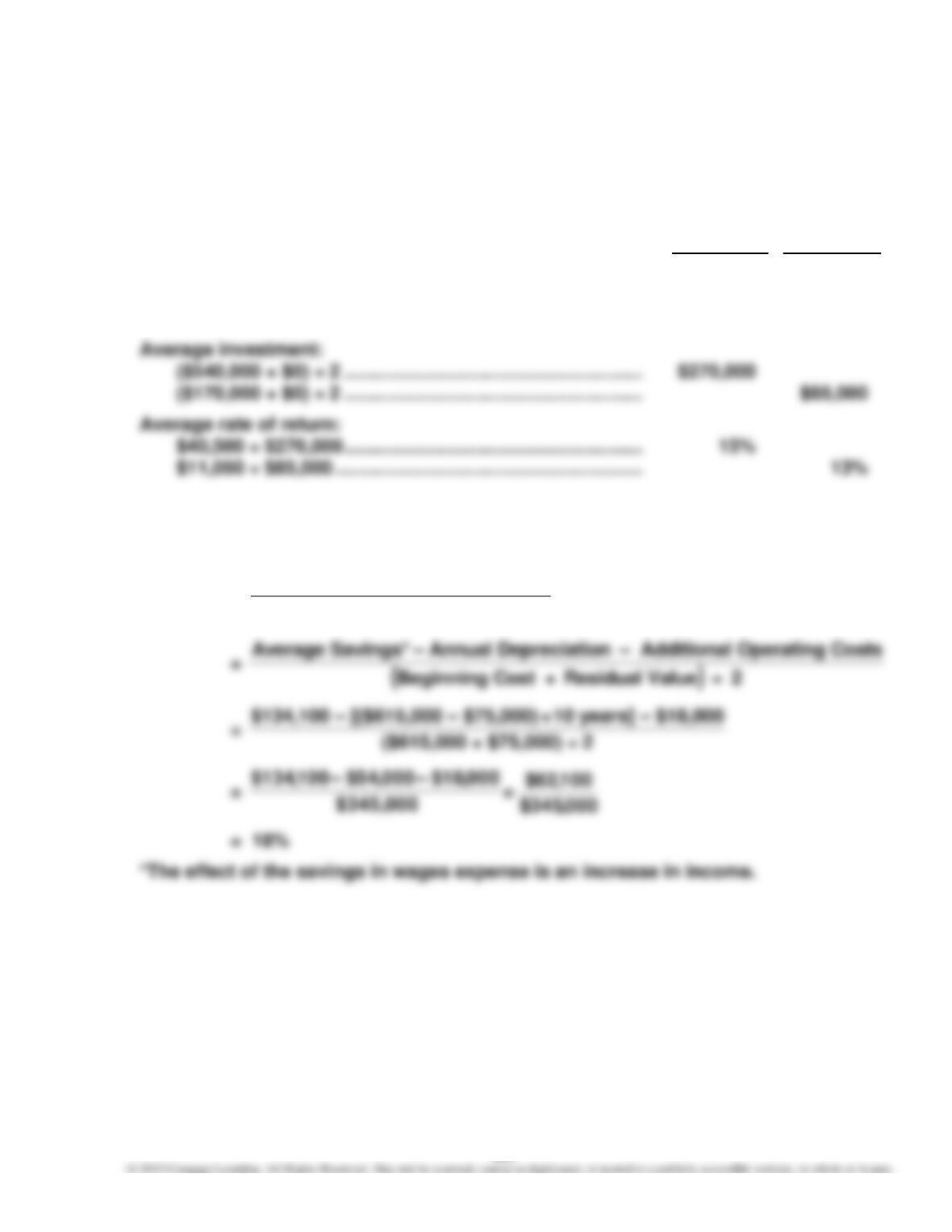
Estimated average annual income:
$243,000 ÷ 6 years…………………………………………………. $40,500
$88,400 ÷ 8 years ………………………………………………….. $11,050
E15–2
Return of
Rate
Average
=
Investment Average
Income Annual AverageEstimated
492
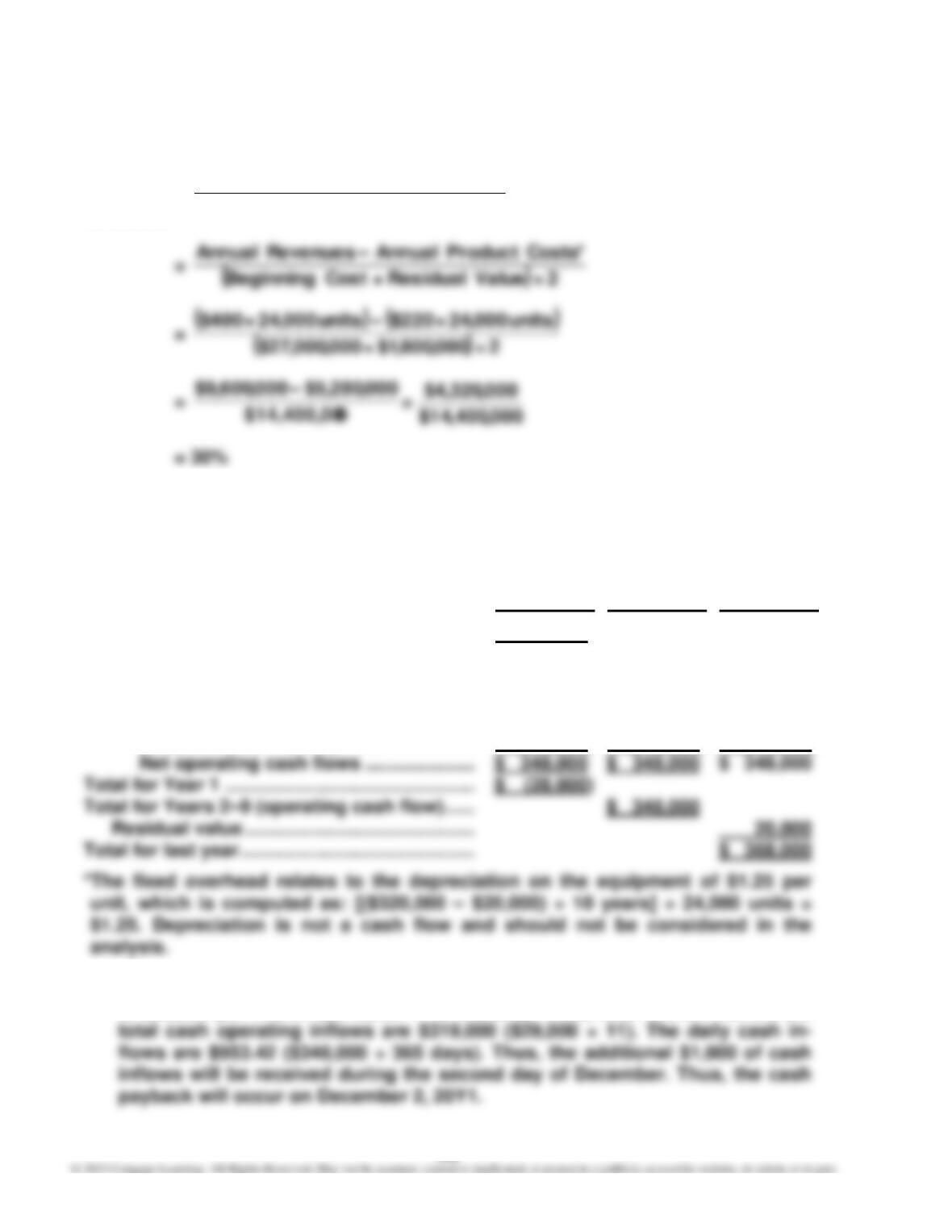
E15–3
Return of
Rate
Average
=
Investment Average
Income AnnualAverageEstimated
*The depreciation of the equipment is included in the factory overhead cost per
unit.
E15–4
a. Year 1 Years 2–9 Last Year
Initial investment ……………………………………… $ (320,000)
Operating cash flows:
Annual revenues (120,000 units × $9) …… $1,080,000 $1,080,000 $1,080,000
Selling expenses (15% × $1,080,000) …….. (162,000) (162,000) (162,000)
Cost to manufacture
(120,000 units × $4.75)*……………………. (570,000) (570,000) (570,000)
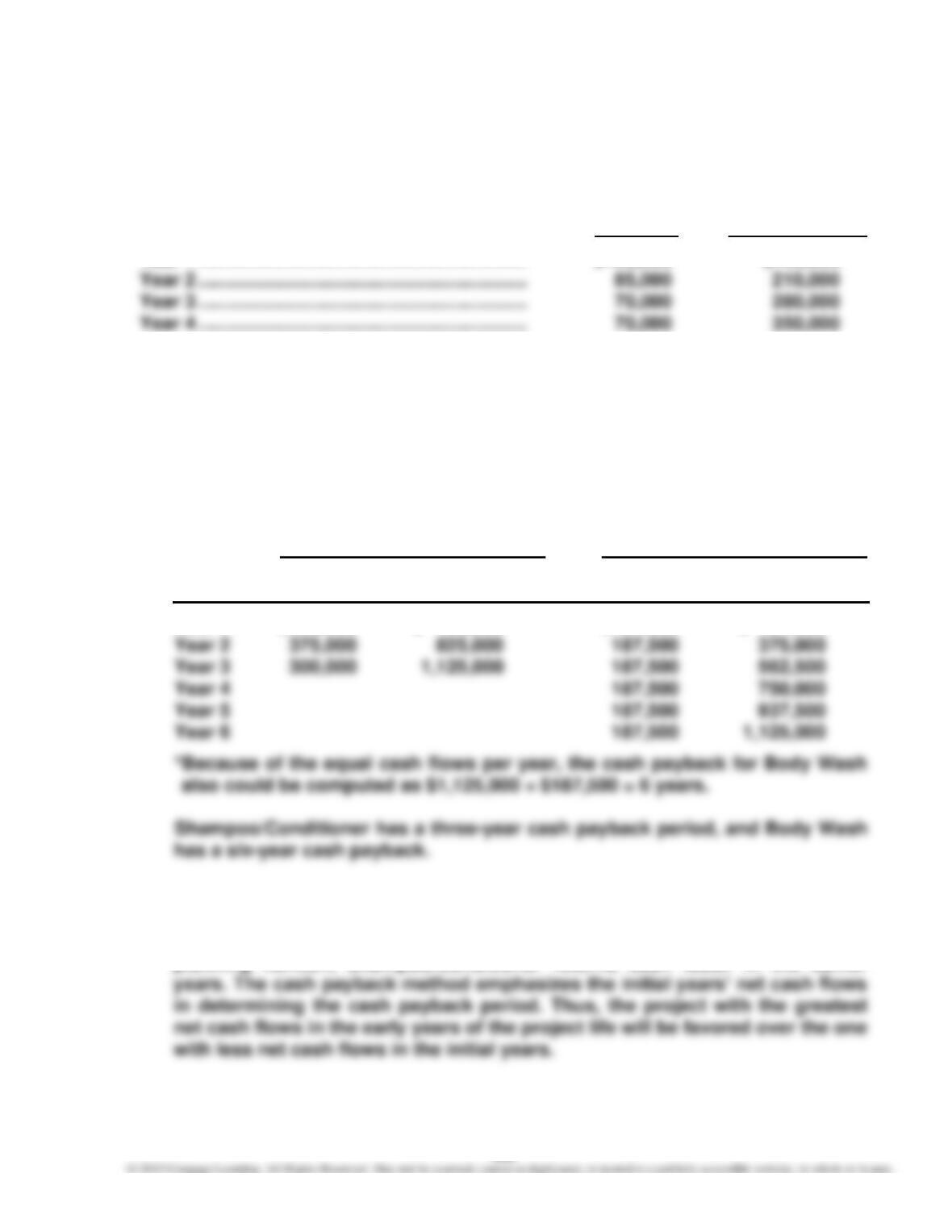
b. December 2, 20Y1. Operating cash flows for the first year are $348,000, which
is $29,000 per month ($348,000 ÷ 12 months). Thus, after eleven month, the
493
E15–5
Location 1: $350,000 ÷ $70,000 = 5-year cash payback period.
Location 2: 4-year cash payback period, as indicated below.
Net Cash Cumulative
Flows Net Cash Flows
Year 1 ……………………………………………………… $125,000 $125,000
E15–6
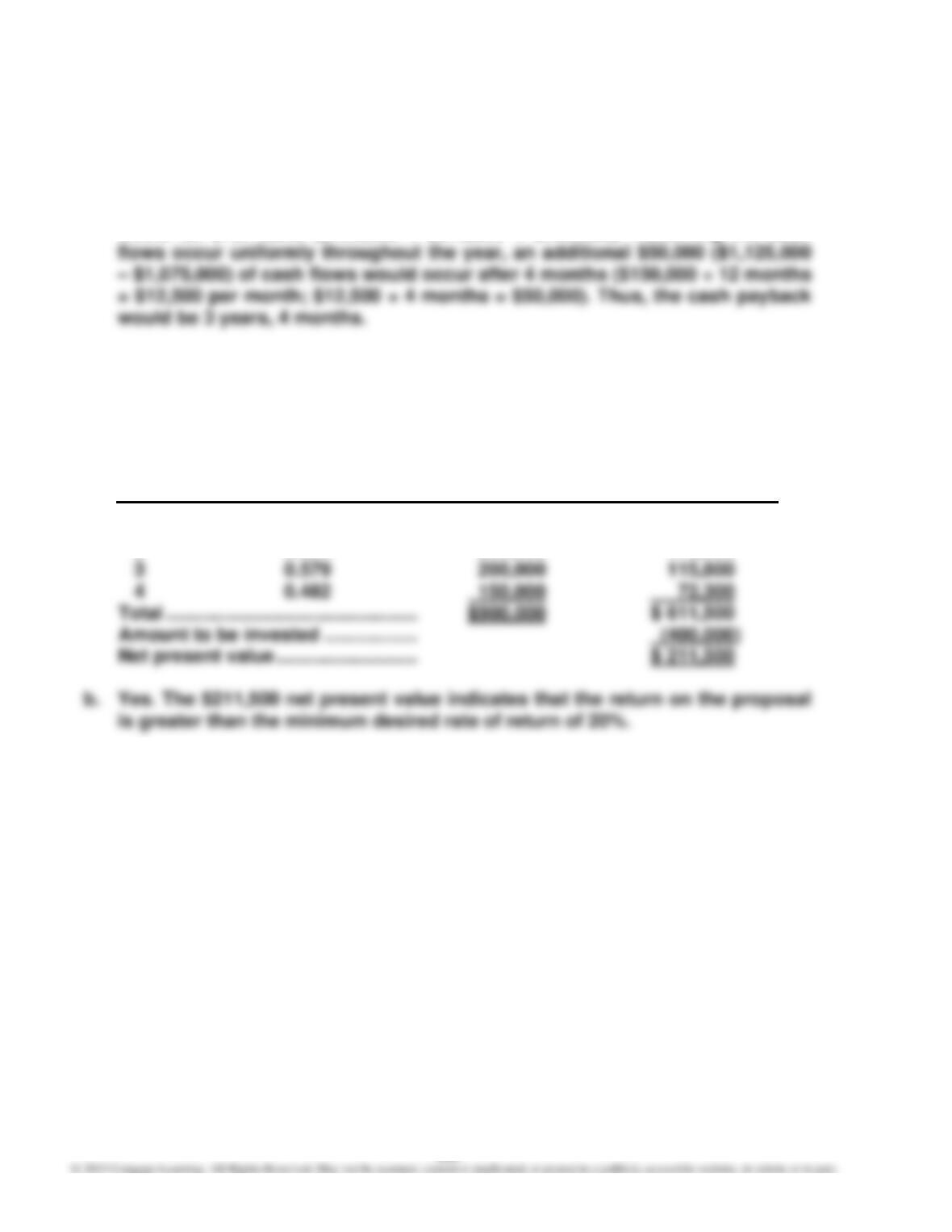
a. The Shampoo/Conditioner product line is recommended, based on its shorter
cash payback period. The cash payback period for both products can be de-
termined using the following schedule:
Initial investment: $1,125,000
Shampoo/Conditioner Body Wash*
Net Cash Cumulative Net Net Cash Cumulative Net
Flows Cash Flows Flows Cash Flows
Year 1 $450,000 $ 450,000 $187,500 $ 187,500
b. The cash payback periods are different between the two product lines be-
cause Shampoo/Conditioner earns cash faster than does Body Wash. Even
though both products earn the same total net cash flow over the eight-year
planning horizon, Shampoo/Conditioner returns cash faster in the earlier
494
E15–6, Concluded
c. The cash payback would be 3 years, 4 months, determined as follows:
At the end of Year 3, the cumulative net cash flows for Shampoo/Conditioner
would be $1,075,000 ($450,000 + $375,000 + $250,000). Assuming the cash
E15–7
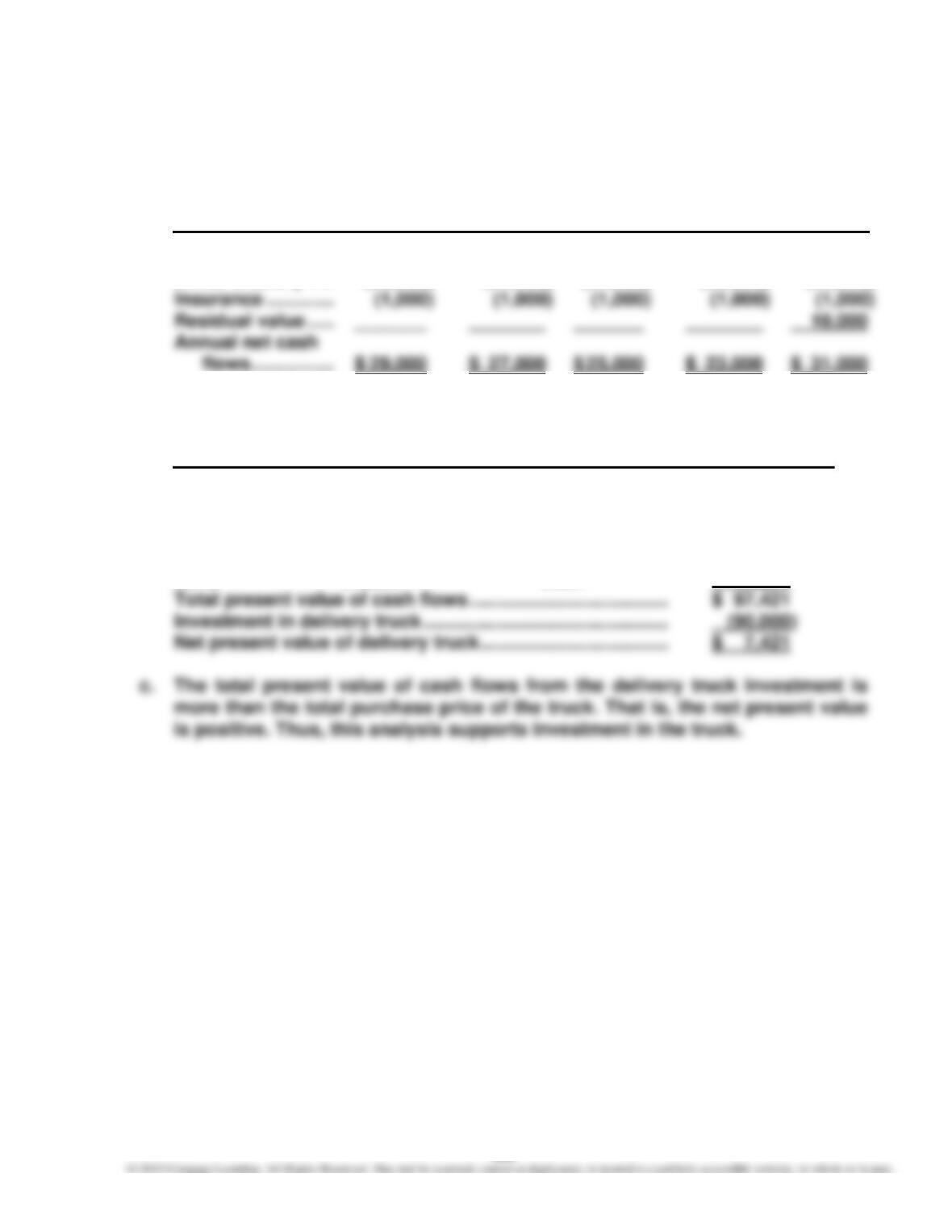
a.
Present Value Net Cash Present Value of
Year of $1 at 20% Flows Net Cash Flows
1 0.833 $300,000 $ 249,900
2 0.694 250,000 173,500
495
E15–8
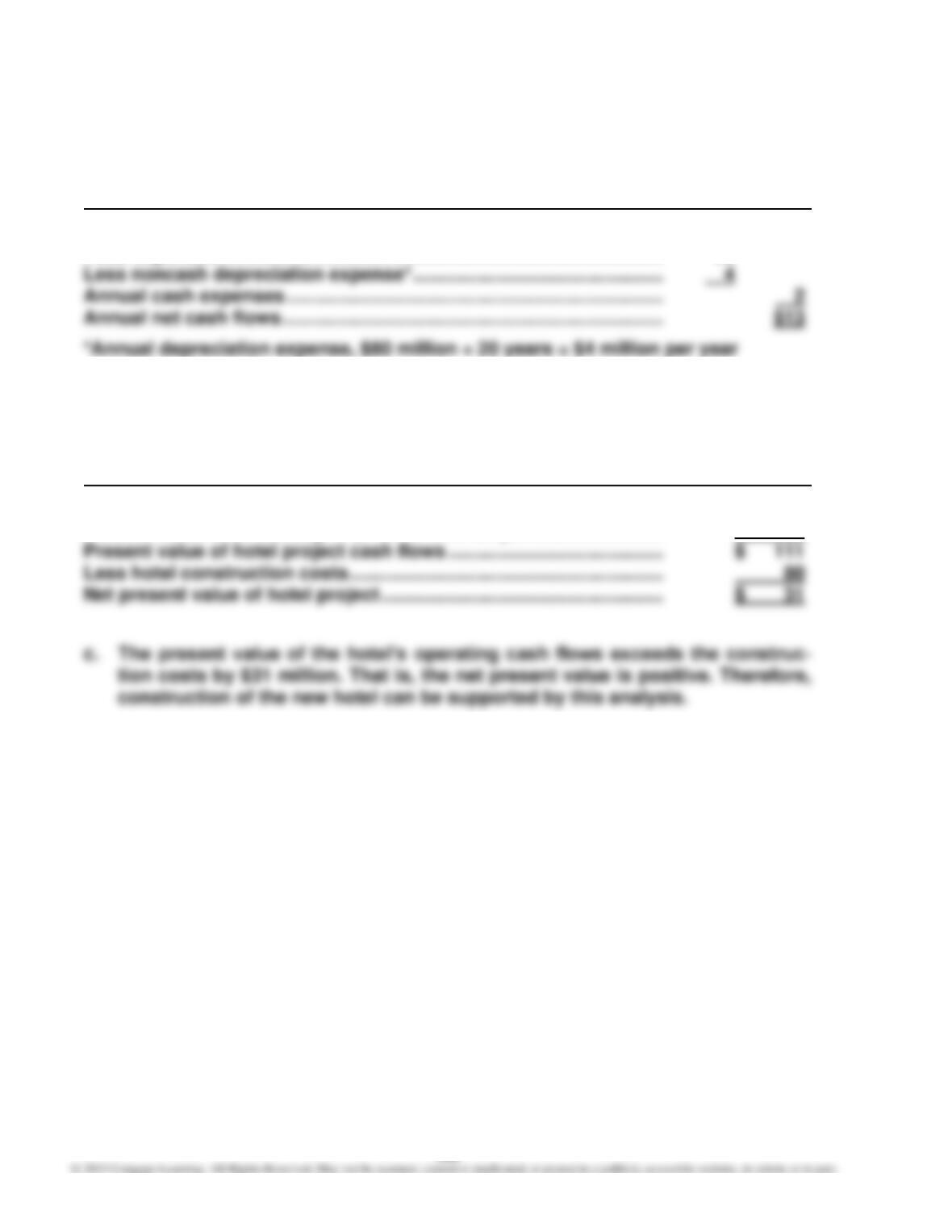
a.
20Y4 20Y5 20Y6 20Y7 20Y8
Revenues …………. $ 60,000 $ 60,000 $ 60,000 $ 60,000 $ 60,000
Driver’s salary ….. (30,000) (32,000) (34,000) (36,000) (38,000)
b.
Net Cash Flows Present Value of Present Value of
Year [from part (a)] $1 at 12% Net Cash Flows
20Y4 $29,000 0.893 $ 25,897
20Y5 27,000 0.797 21,519
20Y6 25,000 0.712 17,800
20Y7 23,000 0.636 14,628
20Y8 31,000 0.567 17,577
496
E15–9
a.
(in millions)
Annual revenues ………………………………………………………………………. $15
Total expenses …………………………………………………………………………. $6
b.
(in millions,
except present
value factor)
Annual net cash flow ……………………………………………………….……….. $ 13
Present value of an annuity of $1 at 10% for 20 periods ……………… × 8.5136
497
E15–10
a. Cash inflows:
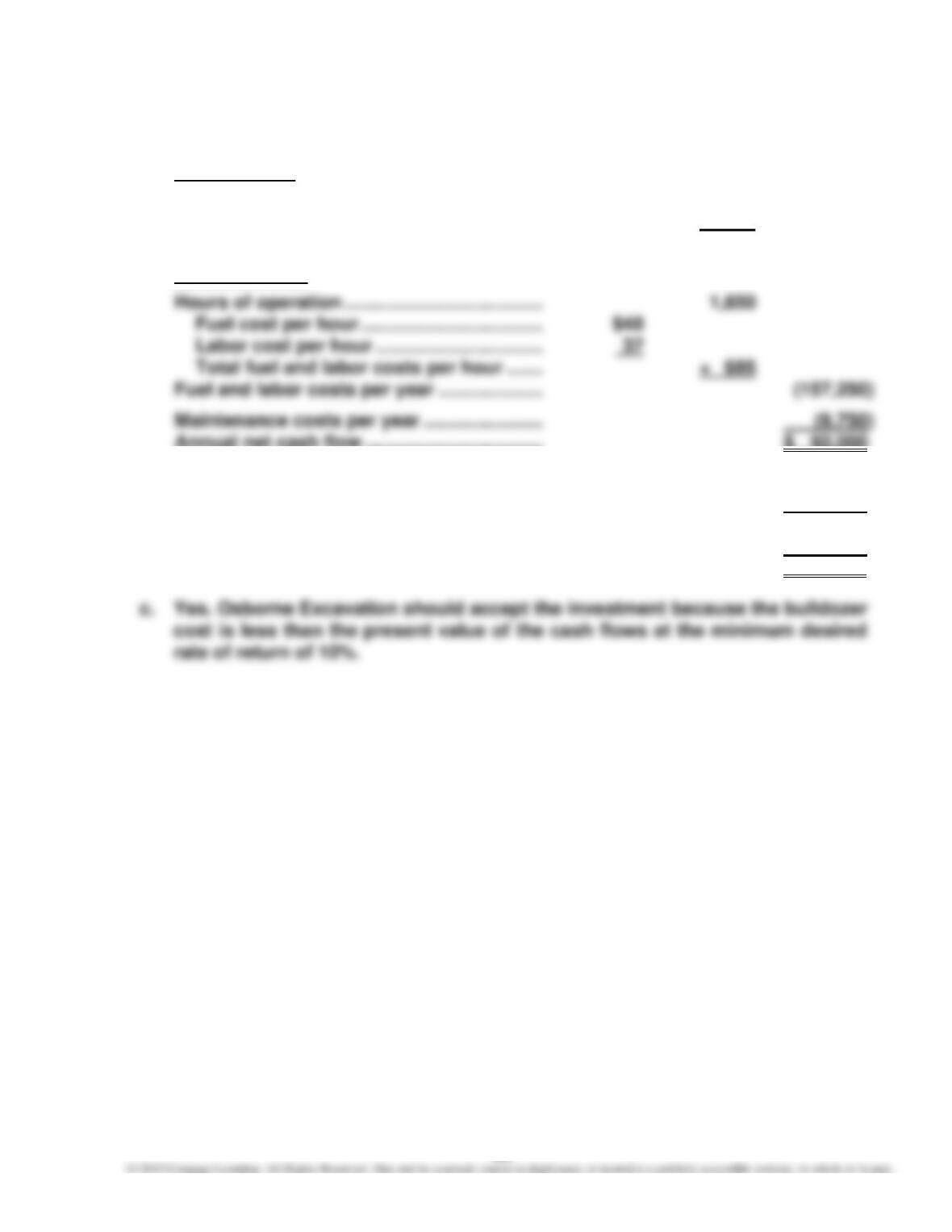
Hours of operation ……………………………….. 1,850
Revenue per hour …………………………………. × $140
Revenue per year …………………………………. $ 259,000
Cash outflows:
Annual net cash flow ……………………………. $ 92,000
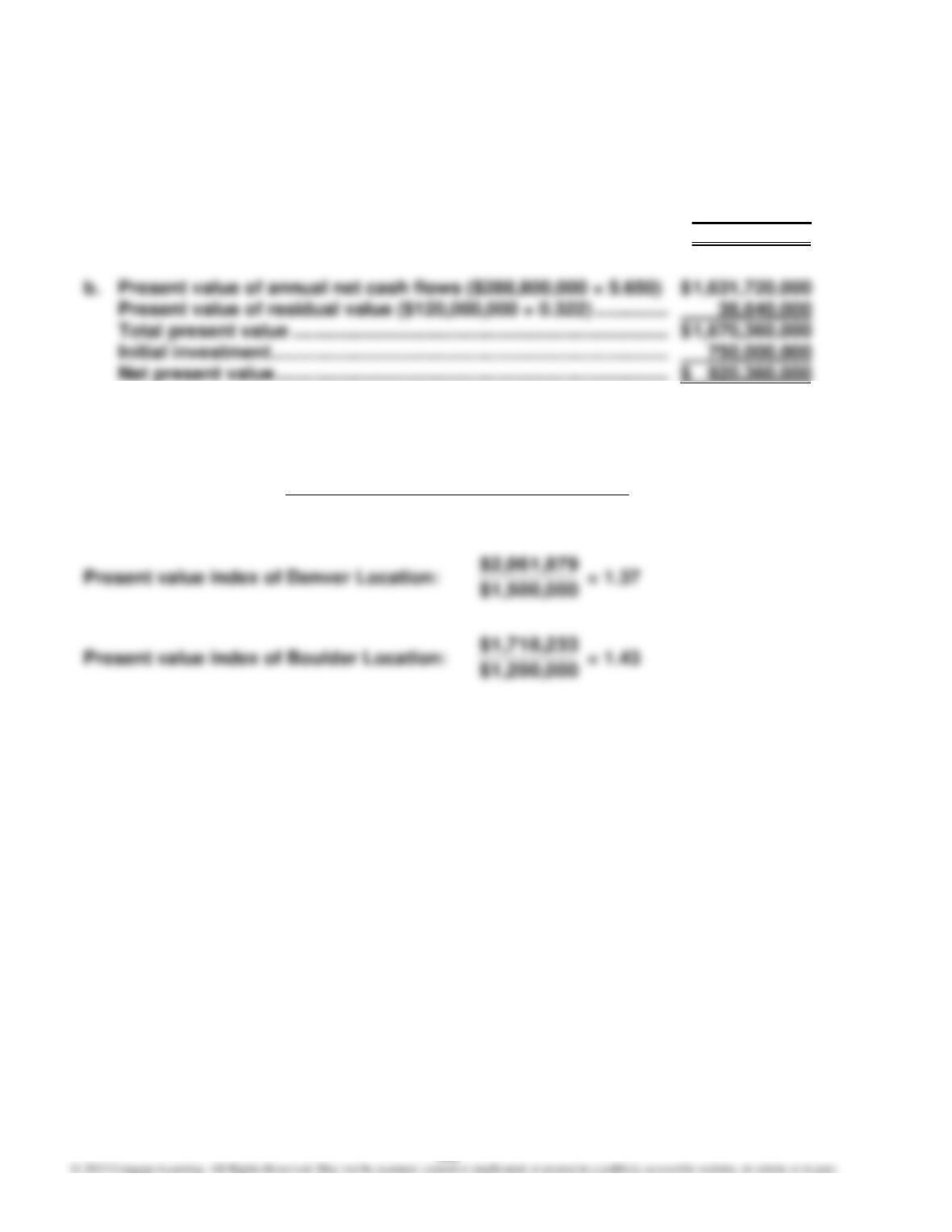
b. Annual net cash flow (at the end of each of five years) ………………. $ 92,000
Present value of annuity of $1 at 10% for five periods (Exhibit 2) .. × 3.791
Present value of annual net cash flows …………………………………….. $ 348,772
Less amount to be invested ……………………………………………………… (315,000)
Net present value …………………………………………………………………….. $ 33,772
498
E15–11
a. Revenues (3,600 × 300 days × $450) …………………………………….. $ 486,000,000
Less: Variable expenses (3,600 × 300 days × $90) ……………….. (97,200,000)
Fixed expenses (other than depreciation) ………………….. (100,000,000)
Annual net cash flows …………………………………………………………. $ 288,800,000
E15–12
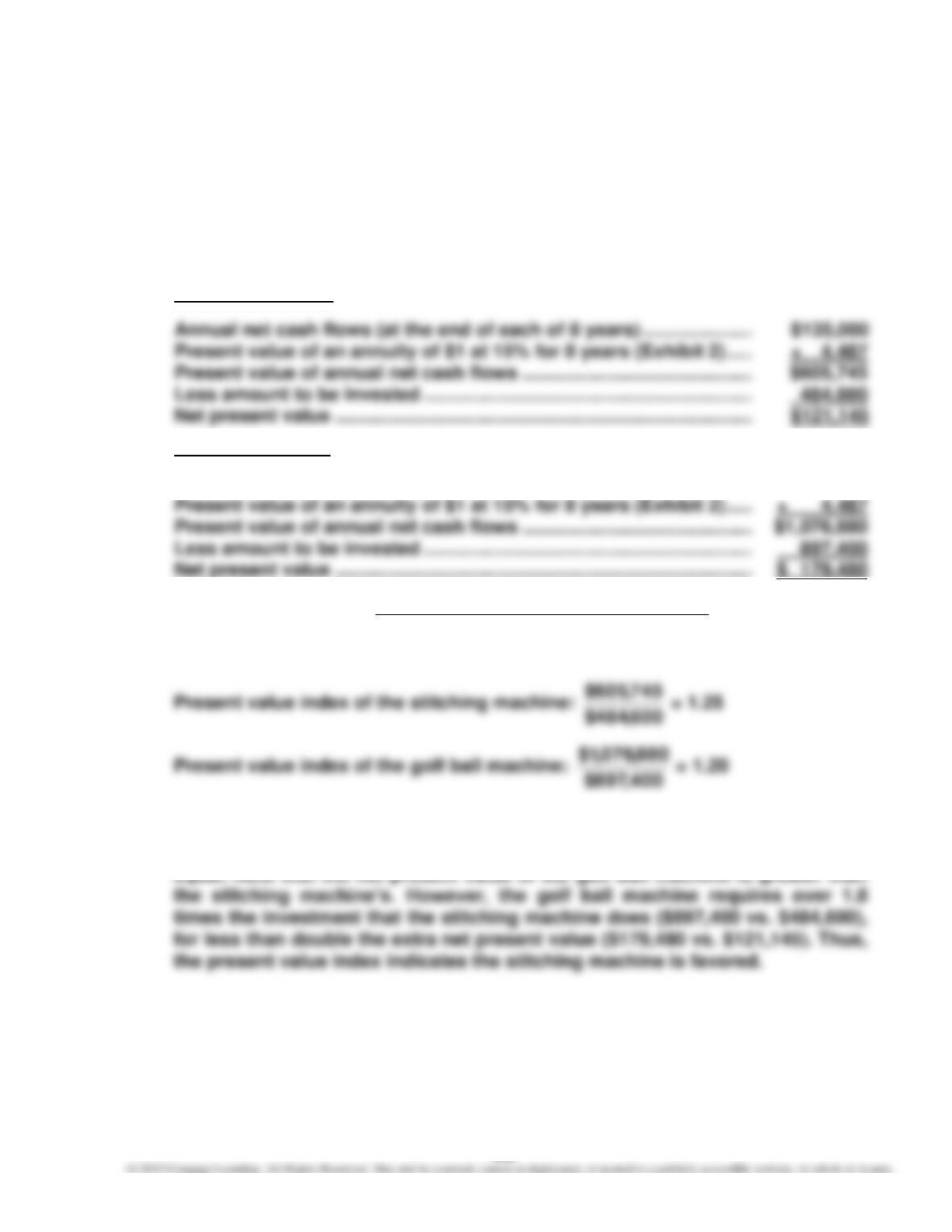
Present Value Index =
Invested BetoAmount
Flows CashNetof ValuePresent Total
499
E15–13
a. Annual net cash flows by machine:
Stitching: $135,000 = 7,500 hours × 60 incremental baseballs × $0.30
Golf Ball: $240,000 = 6,000 hrs. × $40 labor cost saved per hour
Stitching Machine
Golf Ball Machine
Annual net cash flows (at the end of each of 8 years) ………………… $ 240,000
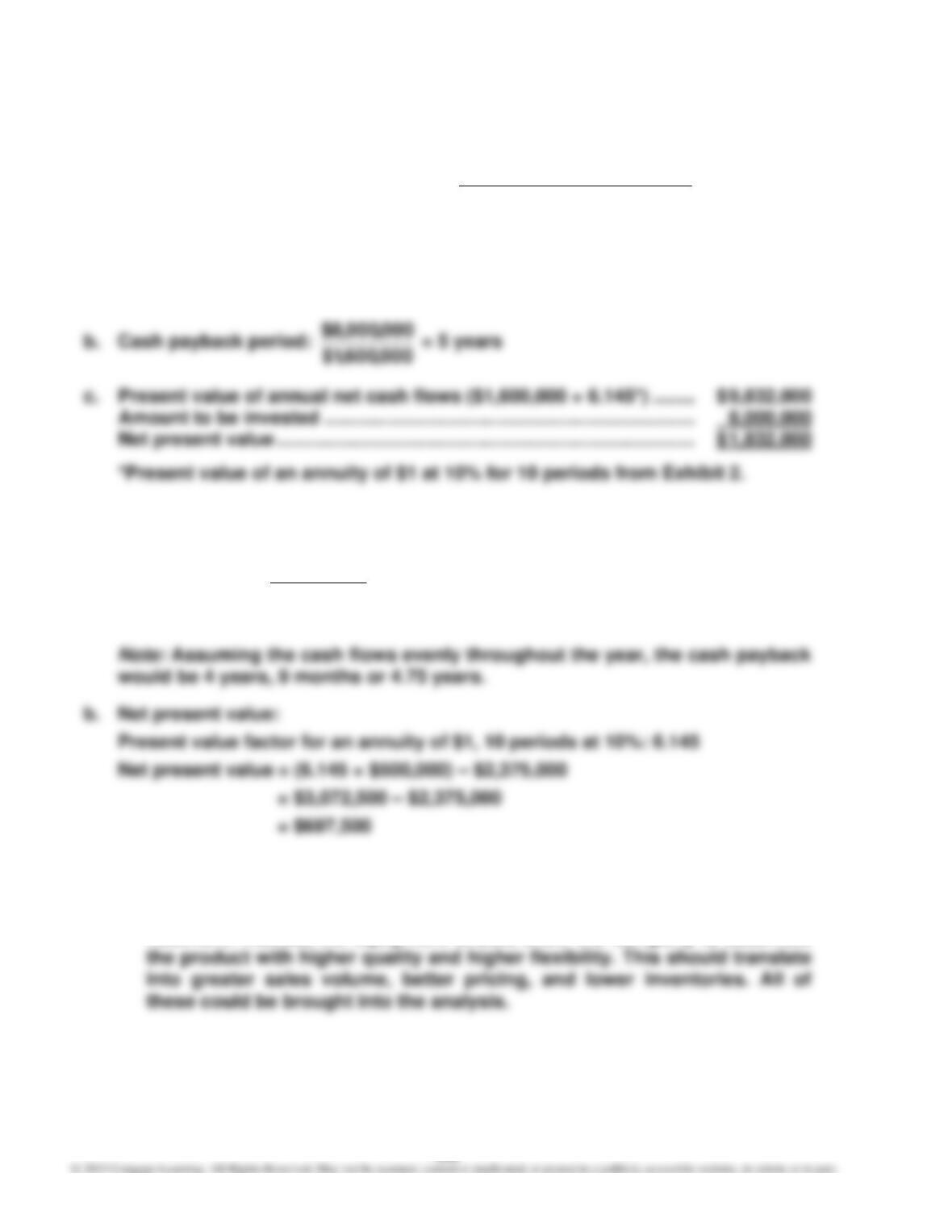
b. Present Value Index =
Invested Be to Amount
Flows Cash Net of ValuePresent Total
c. The present value index indicates that the stitching machine would be the
preferred investment, assuming that all other qualitative considerations are
500
E15–14
a. Average rate of return on investment:
2/)000,000,2$+000,000,8($
*000,800$
= 16%
*The annual earnings are equal to the cash flows less the annual depreciation
expense, shown as follows:
$1,600,000 – ($8,000,000 ÷ 10 years) = $800,000
E15–15
a. Payback period:
$500,000
$2,375,000
= 4.75 years
c. Some critical elements that are missing from this analysis are:
• The manager is viewing the acquisition of automated assembly equipment
as a labor-saving device. This is probably a limited way to view the in-
vestment. Instead, the equipment should allow the company to assemble
501
E15–15, Concluded
• The cost of the automated assembly equipment does not stop with the
initial purchase price and installation costs. The equipment will require the
company to hire engineers and support personnel to keep the machines
running, to program the software, and to debug new programs. The opera-
E15–16
a.
Periods 6 for $1 of Annuity
an for Factor luePresent Va
=
Flows Cash Net Annual
Invested Be to Amount
E15–17
Periods 10 for $1 of Annuity
an for Factor luePresent Va
=
Flows Cash Net Annual
Invested Be to Amount
502
E15–18
a. Delivery Truck
Cash received from additional delivery (90,000 bags × $0.35) …….. $31,500
Cash used for operating expenses (24,000 miles × $0.55) ………….. 13,200
Net cash flows for delivery truck ………………………………………………. $ 18,300
Internal Rate of Return = 12% (from text Exhibit 2 for 5 periods)
Bagging Machine
Direct labor savings (2.5 hrs. per day × $20 per hr. × 240 days per yr.) = $12,000
Internal Rate of Return = 20% (from text Exhibit 2 for 5 periods)
b. To: Management
Re: Investment Recommendation
An internal rate of return analysis was performed for the delivery truck and
bagging machine investments. The internal rate of return for the bagging
503
E15–19
a. Present value of annual net cash flows ($620,000 × 5.650*) ………… $ 3,503,000
Amount to be invested ……………………………………………………………… 3,810,000
Net present value …………………………………………………………………….. $ (307,000)
*Present value of an annuity of $1 at 12% for 10 periods from text Exhibit 2.
b. The rate of return is less than 12% because there is a negative net present
value.
E15–20
With an expected useful life of eight years, the cash payback period could not be
greater than eight years. This would indicate that the cost of the initial investment
would not be recovered during the useful life of the asset. However, there would
504
E15–21
Office Building
Present Value Net Cash Present Value of
Year of $1 at 15% Flows Net Cash Flows
1 0.870 $ 950,000 $ 826,500
2 0.756 600,000 453,600
Condominium Complex
Present Value Net Cash Present Value of
Year of $1 at 15% Flows Net Cash Flows
1 0.870 $1,200,000 $ 1,044,000
The net present value of both projects is positive; thus, both proposals are ac-
ceptable. However, the net present value of the condominium complex exceeds
that of the office building. Thus, the condominium complex should be preferred if
there is enough investment money for only one of the projects.
Note to Instructors: Since the investment amount is the same, the net present
value can be compared to determine preference. That is, the present value index
will show the same preference ordering, as shown below.
505
E15–22
a.
Blending Equipment
Equal annual cash flows for Years 1–4 …………………………. $ 18,000
Present value of a $1 annuity at 12% for four periods ……. × 3.037
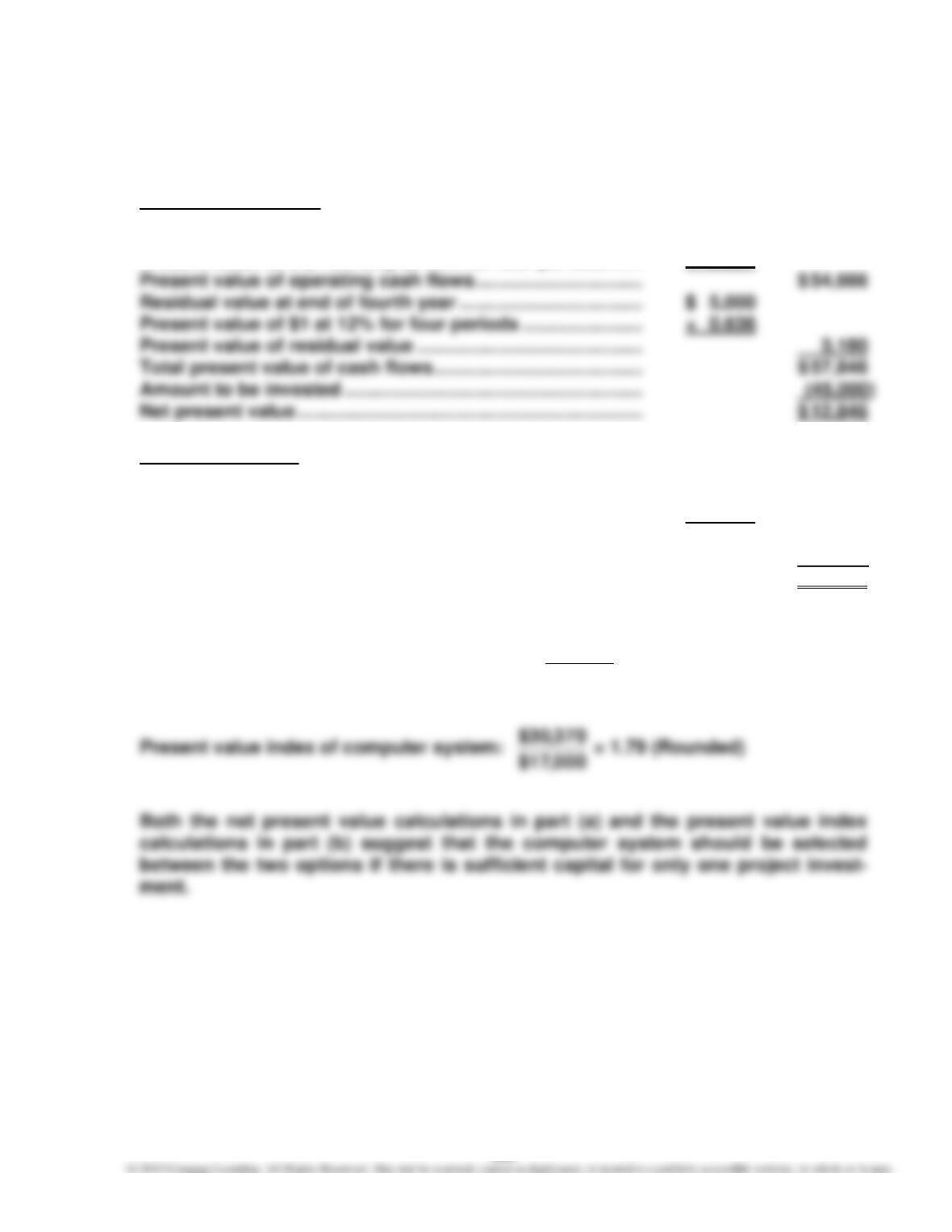
Computer System
Equal annual cash flows for Years 1–4 …………………………. $ 10,000
Present value of a $1 annuity at 12% for four periods ……. × 3.037
Present value of cash flows …………………………………………. $ 30,370
Amount to be invested ………………………………………………… (17,000)
Net present value ………………………………………………………… $ 13,370
b.
Present value index of blending equipment:
000,45$
846,57$
= 1.29 (Rounded)