15–47. (40 min.) Evaluate Transfer Price System: Western States Supply.
a. Northwest division management’s attitude at the present time should be positive to
each of these prices in decreasing order (obviously preferring a higher to lower price)
because Northwest has unused capacity. Northwest division management
performance is evaluated based on return on investment (ROI) and each of these
prices exceed variable costs, which will increase Northwest’s ROI.
At a time when all existing capacity is being used, Northwest division management
would want the intracompany transfer price to generate the same amount of profit as
outside business in order to maximize division ROI.
c. No, the management of Western States Supply should not become involved in this
controversy. The company is organized on a highly decentralized basis which top
management must believe will maximize long-term profits. Imposing corporate
restrictions will adversely affect the current management evaluation system because
CMA adapted.
15–48. (30 min.) Transfer Prices and Tax Regulations—Ethical Issues: Gage
Corporation.
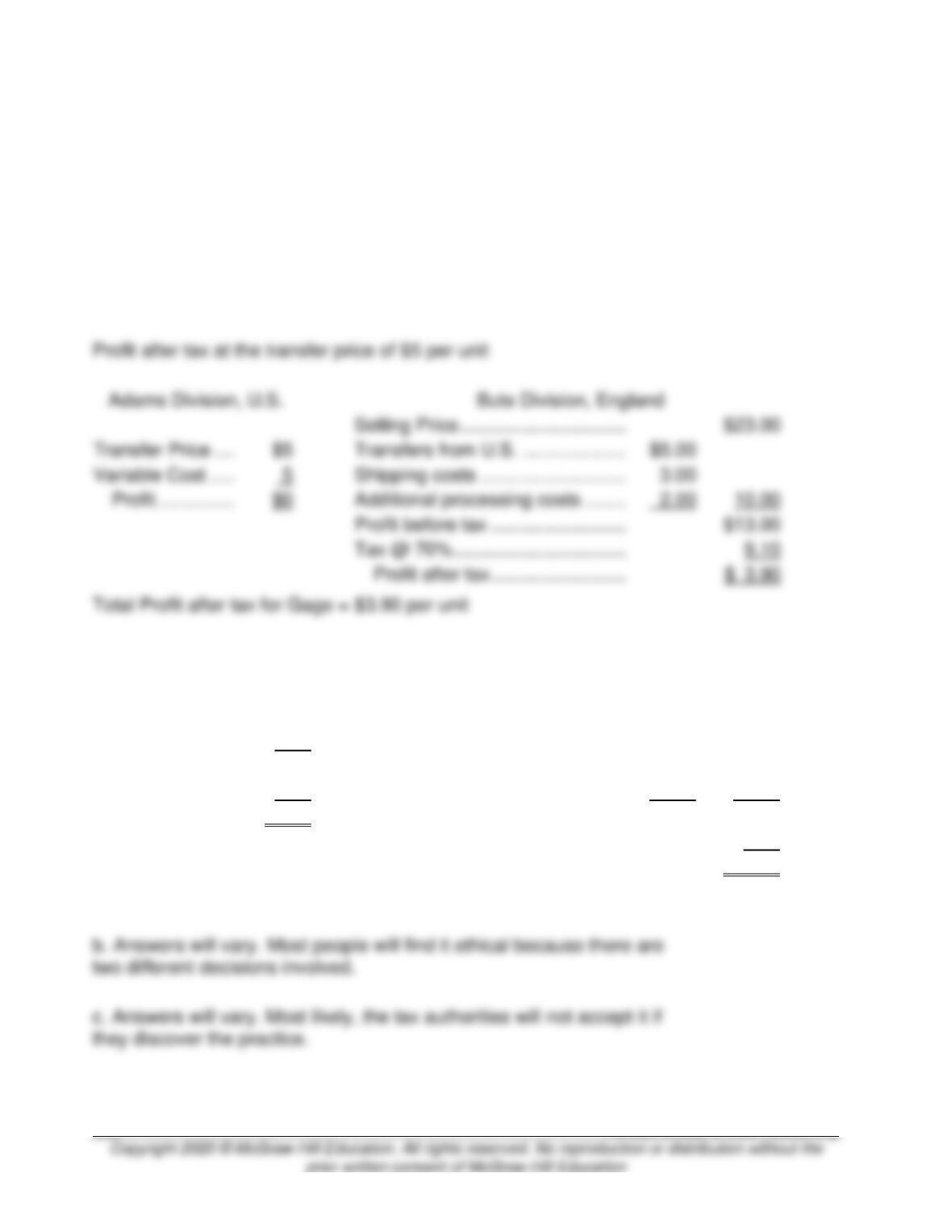
a. The transfer price economically optimal for Gage Corporation is $12 per unit. As
illustrated below, this is due to the difference in tax rates between the U.S. and
England. It would thus be advantageous to Gage to charge as high a transfer price as
possible so as to generate income in the U.S. and avoid the higher tax rate of 70% in
England.
Adams Division, U.S.
Selling Price …………………………..
Transfer Price ….
Transfers from U.S. ………………..
Variable Cost …..
Shipping costs ……………………….
Additional processing costs ……..
Profit before tax ……………………..
Tax @ 70% …………………………...
Profit after tax at the transfer price of $12 per unit
Adams Division, U.S.
Bute Division, England
Transfer Price …
$12.00
Selling Price …………………………
$23.00
Variable Cost ….
5.00
Transfers from U.S. ………………
$12.00
Profit …………..
$7.00
Shipping costs ……………………..
3.00
Tax @ 40% …….
2.80
Additional processing costs ……
2.00
17.00
Profit after tax …
$4.20
Profit before tax ……………………
$ 6.00
Tax @ 70% ………………………….
4.20
Profit after tax ……………………
$ 1.80
Total profit after tax for Gage Corporation = $4.20 + $1.80 = $6 per unit
15–49. (40 min.) Segment Reporting: Midwest Entertainment.
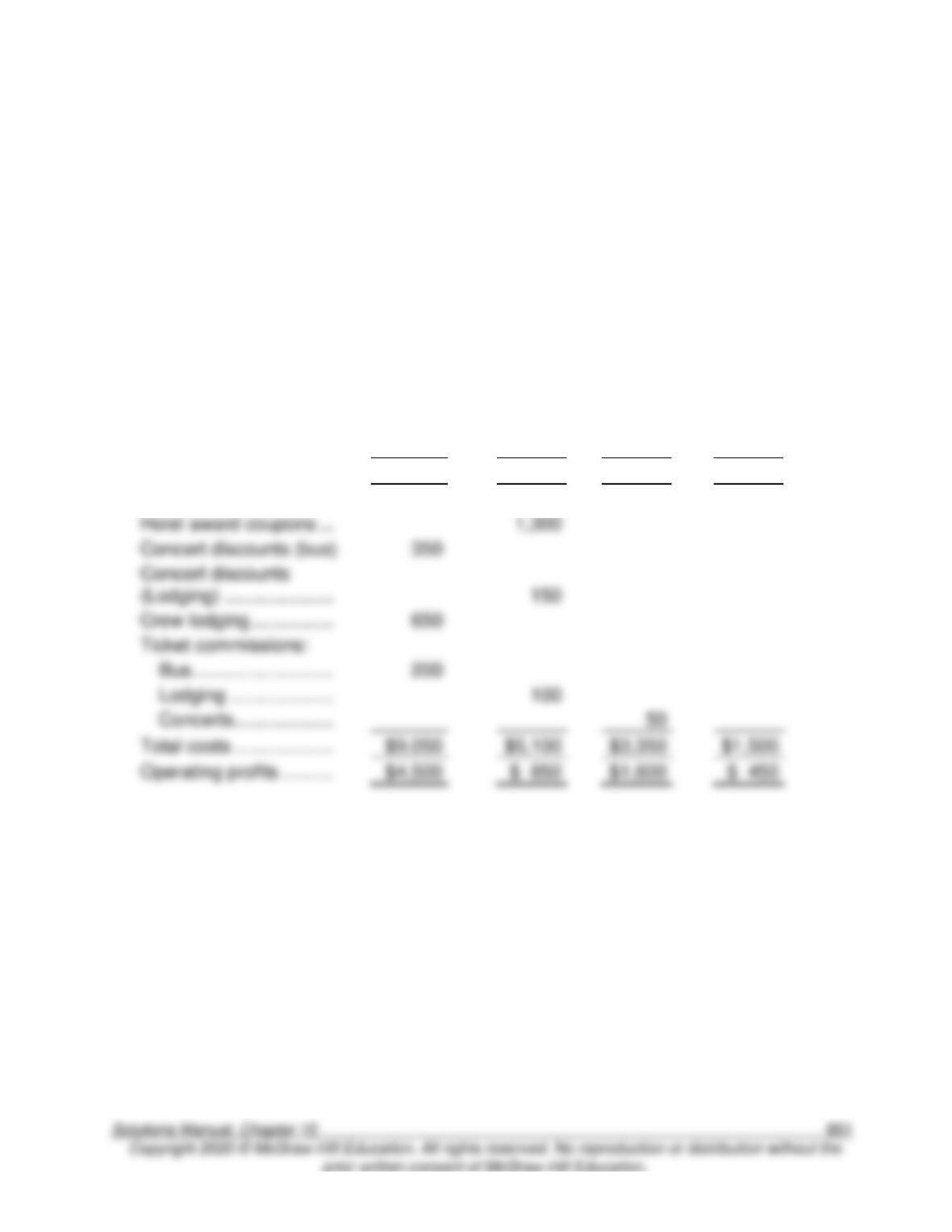
a. ($ thousands)
Bus
Charters
Lodging
Concerts
Ticket
Services
Outside revenue ……….
$12,250
$5,300
$4,450
$1,600
Hotel award coupons …
1,300
Concert discounts (bus)
350
Concert discounts
(Lodging) …………………
150
Crew lodging …………….
650
Ticket commissions:
Bus ………………………
200
Lodging ………………..
100
Concerts ……………….
50
Total revenues ………….
$13,550
$5,950
$4,950
$1,950
Outside costs ……………
$7,850
$3,550
$3,300
$1,500
Hotel award coupons …
Concert discounts (bus)
Concert discounts
Crew lodging …………….
Ticket commissions:
Bus ………………………
Lodging ………………..
100
Concerts ……………….
Total costs ……………….
$9,050
$5,100
$3,350
$1,500
Operating profits ……….
$ 850
$1,600
$ 450
15–49. (continued)
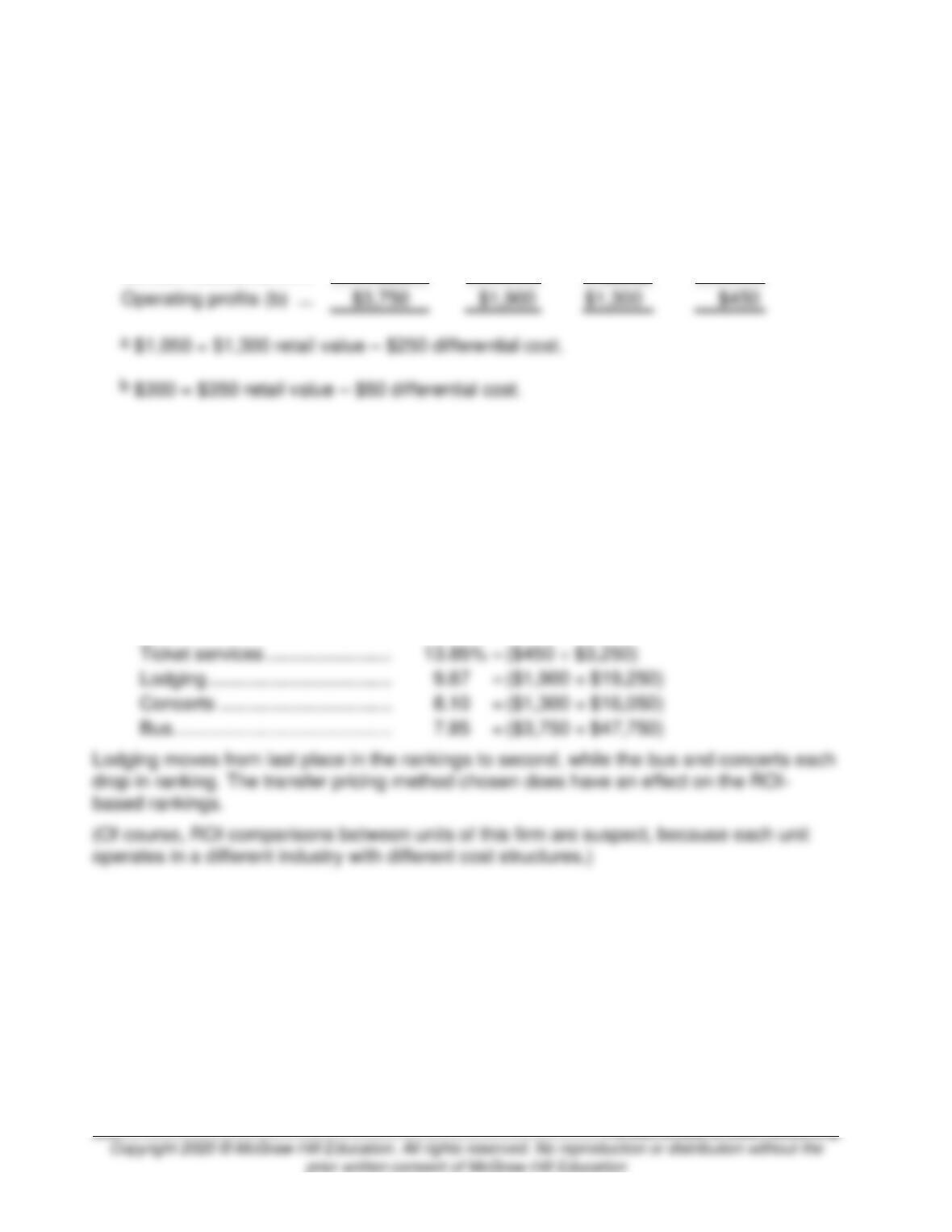
b. Adjust the operating profits in requirement a for the changed transfer prices.
Bus Charters
Lodging
Concerts
Ticket
Services
Operating profits (a) …
$4,500
$850
$1,600
$450
Hotel awards ……………
(1,050)a
1,050
Concert discounts ……..
300b
(300)
Operating profits (b) …
$3,750
$1,900
$1,300
$450
c. Divide the operating profits in requirements a and b by division assets, which are given
in the problem. The following rankings result:
For (a):
Ticket services ……………………
13.85%
=
($450 ÷ $3,250)
Concerts …………………………...
9.97
=
($1,600 ÷ $16,050)
Bus……………………………………
9.42
=
($4,500 ÷ $47,750)
Lodging …………………………..…
4.42
=
($850 ÷ $19,250)
For (b):
Ticket services ……………………
=
($450 ÷ $3,250)
Lodging …………………………..…
9.87
=
($1,900 ÷ $19,250)
Concerts …………………………...
8.10
=
($1,300 ÷ $16,050)
Bus……………………………………
7.85
=
($3,750 ÷ $47,750)
15–50. (30 min.) Segment Report: Ferntree Enterprises.
Value of coupons issued by Winery Division: $400,000
Value of coupons issued by Restaurant Division: $800,000
The key to this problem is to remember that total firm profits will not change as a result
of the segment reporting or the transfer prices used. Therefore, we can calculate the
segment profit for the Restaurant Division as:
$2,600,000 (= $12,000,000 Corporate Profit – $9,400,000 Winery Division Profit).
15–51. (20 min.) Two-Part Transfer Prices: Mathes Corporation.
a.
Mathes should transfer at the Landfill’s variable cost of receiving and processing the
material. Because the Landfill has excess capacity after satisfying all market demand that
exists for its services, accepting loads from plants does not cause it to forgo any “profits”
from outside businesses. If plants pay variable costs, the Landfill is indifferent between
accepting and rejecting the business. However, because there are substantial fixed costs
of running the Landfill, it is in the company’s best interest to motivate maximum utilization
of the existing capacity. The plants will have the greatest motivation to use the internal
Landfill rather than outside parties when the “price” is set at variable cost.
b.
Based on budgeted Landfill Costs:
Other Variable Costs ………………………………
$40 per ton 4 tons
$160
Preparation Costs ………………………………….
$200 per load 1 load
200
Total Variable Costs of Landfill Operations
$360
15–52. (20 min.) Budget versus Actual Costs: Mathes Corporation.
15–53. (20 min.) Two-Part Transfer Prices: CHS.
a.
This is a complicated problem, because of the requirement for a new server that would not
exist without the demands of Optics. (It is made less complicated by the fact that Health
Services leases the machine.) There is excess capacity on the machine, so the optimal
transfer-pricing rule is to use incremental cost. The incremental costs consist of two parts.
The additional cost of the lease and the additional cost of the support person do not
depend on the time used by Optics. This should be charged as a fixed fee. The other
Therefore, the optimal transfer price consists of two parts:
Fixed:
Variable cost ……………………….
b.
Fixed fee ……………………………..
$21,000
Variable costs ……………………….
(1,000 hours × $1)
1,000
Total transfer costs ………………
$22,000
Average hourly cost……………….
($22,000 ÷ 1,000 hours)
$22.00 per hour
15–53. (continued)
c.
Fixed fee ………………………….
$21,000
Variable costs …………………..
(100 hours × $1)
100
Total transfer costs ………….
$21,100
Average hourly cost …………..
($21,100 ÷ 100 hours)
$211.00 per hour
15–54. (20 min.) Two-Part Transfer Prices: CHS.
a.
Solutions to Integrative Cases
15–55. Custom Freight Systems (A): Transfer Pricing.
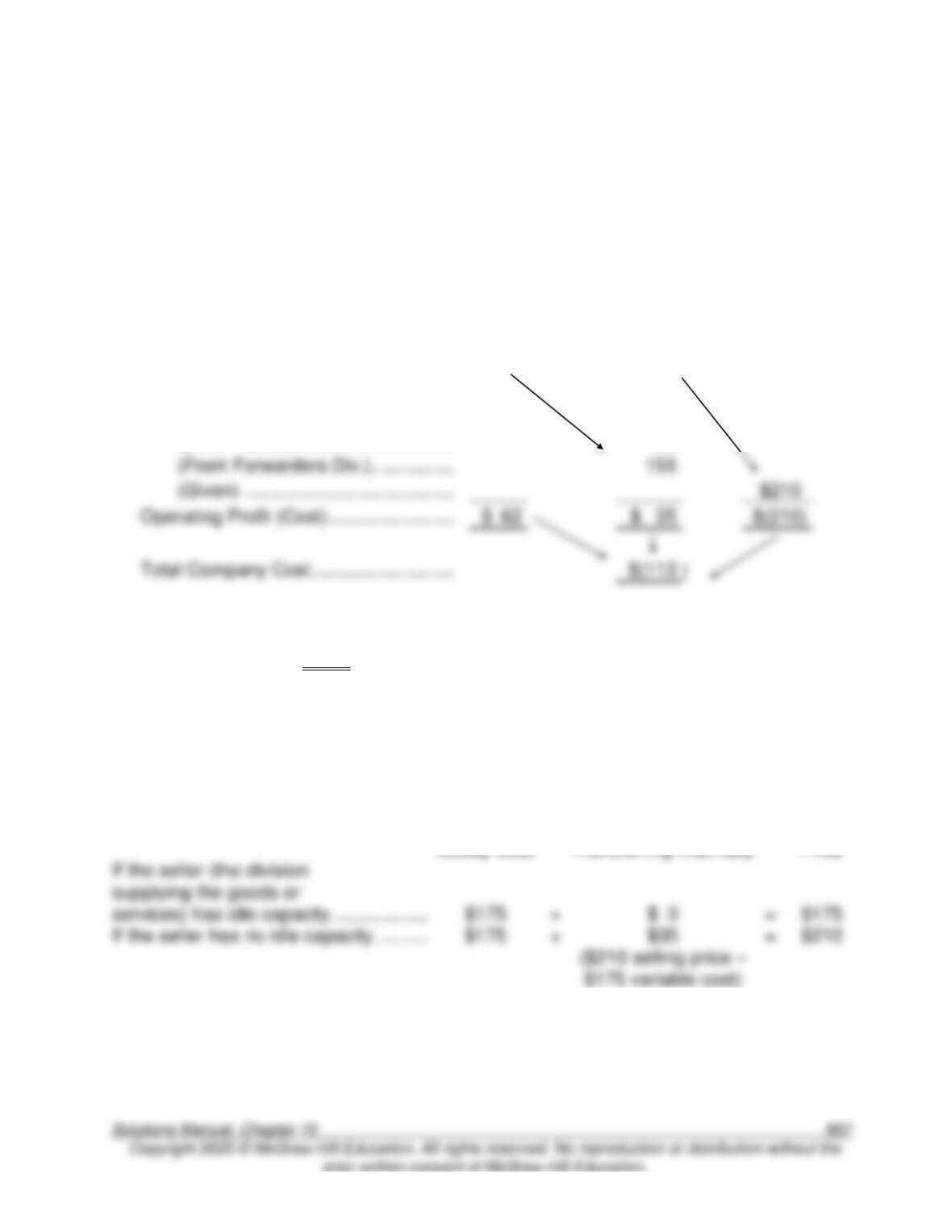
a. The Logistics division should accept the bid from Forwarders division. Custom Freight
Systems is $72 (= $185 – $113) better off if the Logistics division uses the Forwarders
division for this contract. See detail calculations below.
Option I: Purchase Internally
Air Cargo
Division
Forwarders
Division
Logistics
Division
Sales revenue ……………………………….
$155
$ 210
–0–
Variable Costs ………………………………
($155 × 60%) ………………………….
93
($175 – $155) ………………………..
20
(From Forwarders Div.) …………….
(Given) ………………………………….
Operating Profit (Cost) ……………………
Total Company Cost ………………………
)
Option II: Purchase externally (United Systems)
Total Company Cost = $(185)
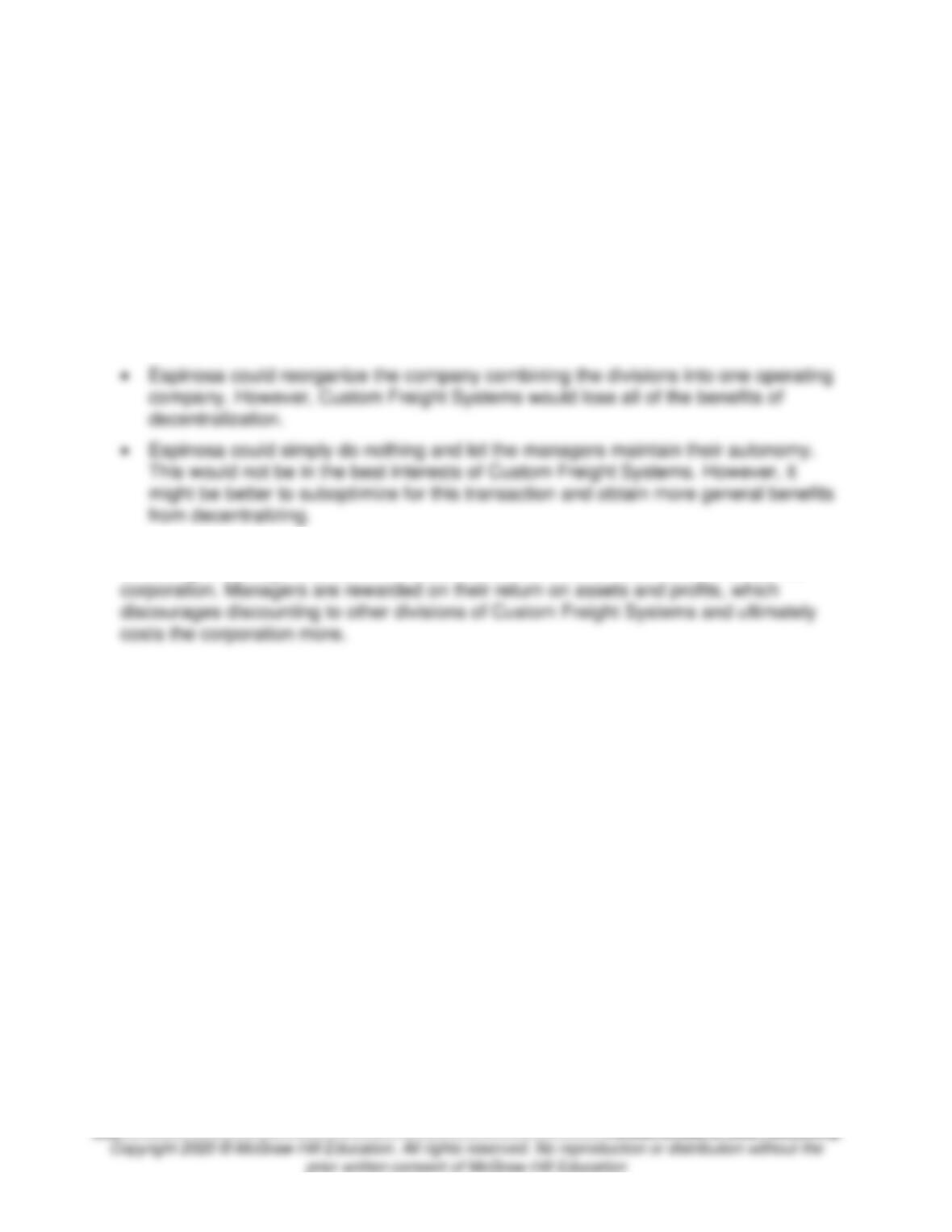
b. If we assume it is optimal for the transfer to be made internally, then the question
arises as to the appropriate transfer price. The economic transfer pricing rule for
making transfers to maximize a company’s profits is to transfer at the differential outlay
cost to the selling division plus the opportunity cost to the company of making the
internal transfers.
Differential
If the seller has no idle capacity ……….
+
Opportunity Cost of
=
Transfer
15–55. (continued)
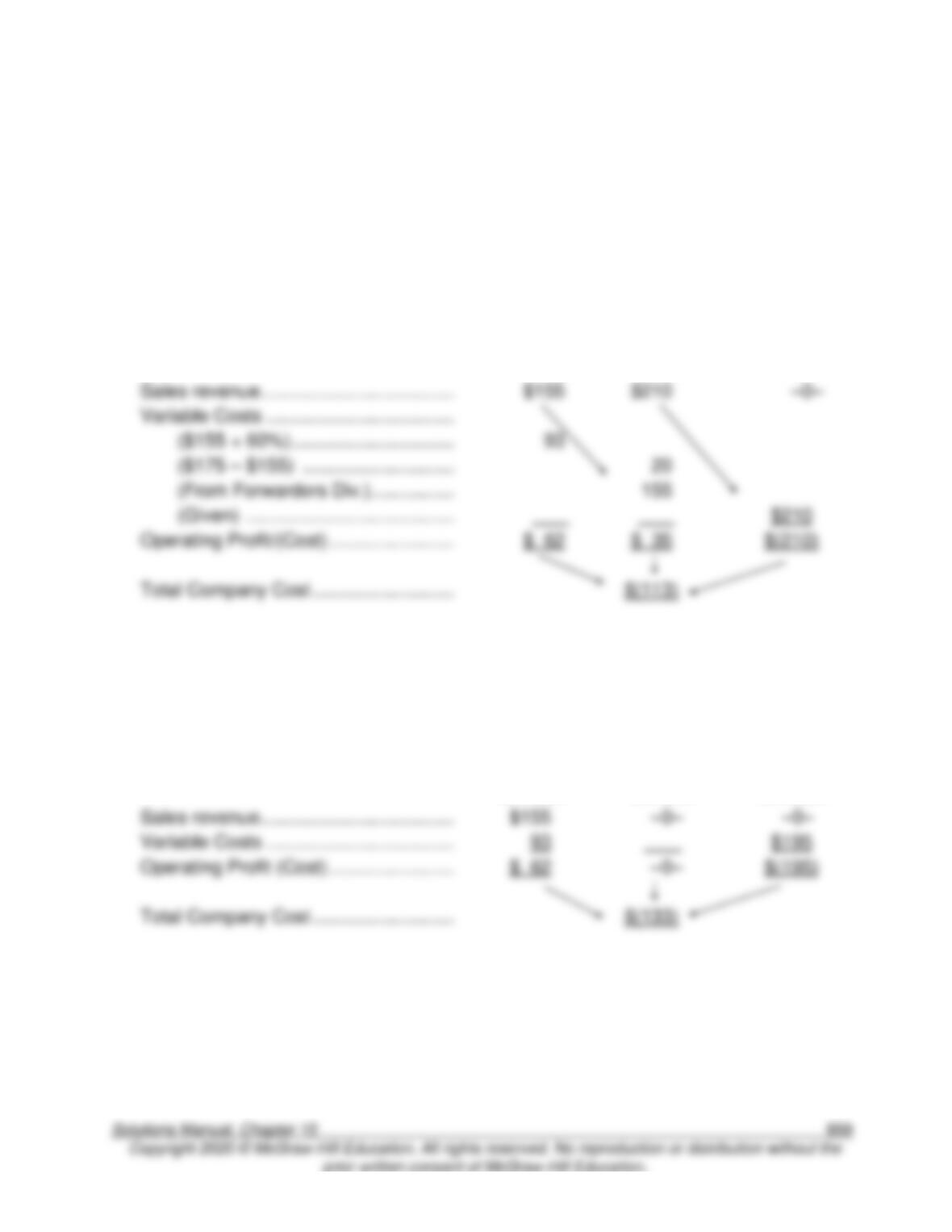
c. Espinosa has many alternatives to intervention or to forcing the manager of the
Forwarders division to lower his price below $210. Each has advantages and
disadvantages.
• Espinosa must trade off the benefits of intervention on this particular transaction
against the impact of intervention on decentralization as a policy. Too much
intervention by Espinosa will eliminate the benefits of decentralization.
• Tell the Logistics and Forwarders divisions that the transfer price will be between
differential cost ($113) and the lowest outside market price ($185) and allow them
to negotiate the profit.
d. The reward system at Custom Freight Systems creates an environment that
encourages managers to act in the best interests of their division rather than for the
15–56. (30 min.) Custom Freight Systems (B): Transfer Pricing.
Similar to Case A, the Logistics division should accept the bid from the Forwarders
division. However, if we eliminate the Forwarders Division from the bidding process, the
bid from World should be accepted. Emphasize that even though World’s bid is $10 per
hundred pounds higher than United’s, the overall cost to Custom Freight Systems is lower
because other divisions of Customer Freight Systems are included in the bid. See detailed
calculations below.
Option I: (from 15–55) Purchase internally
Air Cargo
Division
Forwarders
Division
Logistics
Division
Option II: (from 15–55) Purchase externally (United Systems)
Total Company Cost = $(185)
Option III: Purchase Externally (World Services)
Air Cargo
Division
Forwarders
Division
Logistics
Division