Chapter 15
Job Order Costing and Analysis
QUESTIONS
1. Factory overhead is not identified with specific units (jobs) or batches (job lots).
Therefore, to assign costs, estimates of the relation between factory overhead cost
and job or job lot are necessary. Since managers need timely cost information, we
need to estimate a predetermined overhead rate to use in applying estimated
overhead to jobs. This estimated amount also helps job order companies determine
prices on a timely basis.
2. Several other factors (allocation bases) are possible and reasonable. These common
factors often include direct materials or machine hours.
3. The job order cost sheet captures information on cost and quantity of direct material
and direct labor, and on the amount of factory overhead applied to the respective job
or job lot. Management and employees use this information to monitor costs during
production and to estimate total cost of production.
4. Each job is assigned a subsidiary ledger account. This account serves as the
“posting account” (accumulates all increases and decreases) during production for
direct material, direct labor, and applied factory overhead. The collection of job cost
sheets for all of the jobs in process make up a subsidiary ledger controlled by the
Work in Process Inventory account in the general ledger.
7. The time ticket is used to record how much time an employee spends on each job.
Time tickets are also used to determine the amount of overhead to charge to jobs
when overhead is based on direct labor.
8. Debits (increases) to factory overhead are the recording of actual overhead costs,
such as indirect materials, indirect labor, factory rent, and factory insurance. Credits
(decreases) represent the allocation of factory overhead to jobs or job lots. Factory
overhead is also debited when overhead is overapplied at the end of the accounting
period. Factory overhead is also credited when overhead is underapplied at the end
of the accounting period.
9. Assuming that the overapplied or underapplied overhead is immaterial, it is closed to
the Cost of Goods Sold account.
10. This production run should be accounted for as a job lot (batch). Although individual
iPhones could be viewed as individual jobs, the costs of tracking this detailed
information would outweigh the benefits. Determining the cost of the batch should
provide management and employees with sufficient information about this product
for all decision making purposes.
11. A predetermined factory overhead rate must be calculated for at least two reasons:
(1) Not all costs are known in advance, yet estimated overhead costs must be applied
to products during the current period. (2) A predetermined rate is used to spread
indirect costs to products and/or services throughout an accounting period, where
overhead costs are not incurred uniformly throughout the period and production may
not be uniform throughout the period. For instance, property taxes on the factory
building of $20,000 may be paid in July, but some of that $20,000 must be allocated to
all items produced during the year, January through December. A predetermined rate
is necessary, because we must estimate the rate at the beginning of the year, based
on estimated costs and activity, before the period begins.
QUICK STUDIES
Quick Study 15-1 (5 minutes)
Quick Study 15-2 (10 minutes)
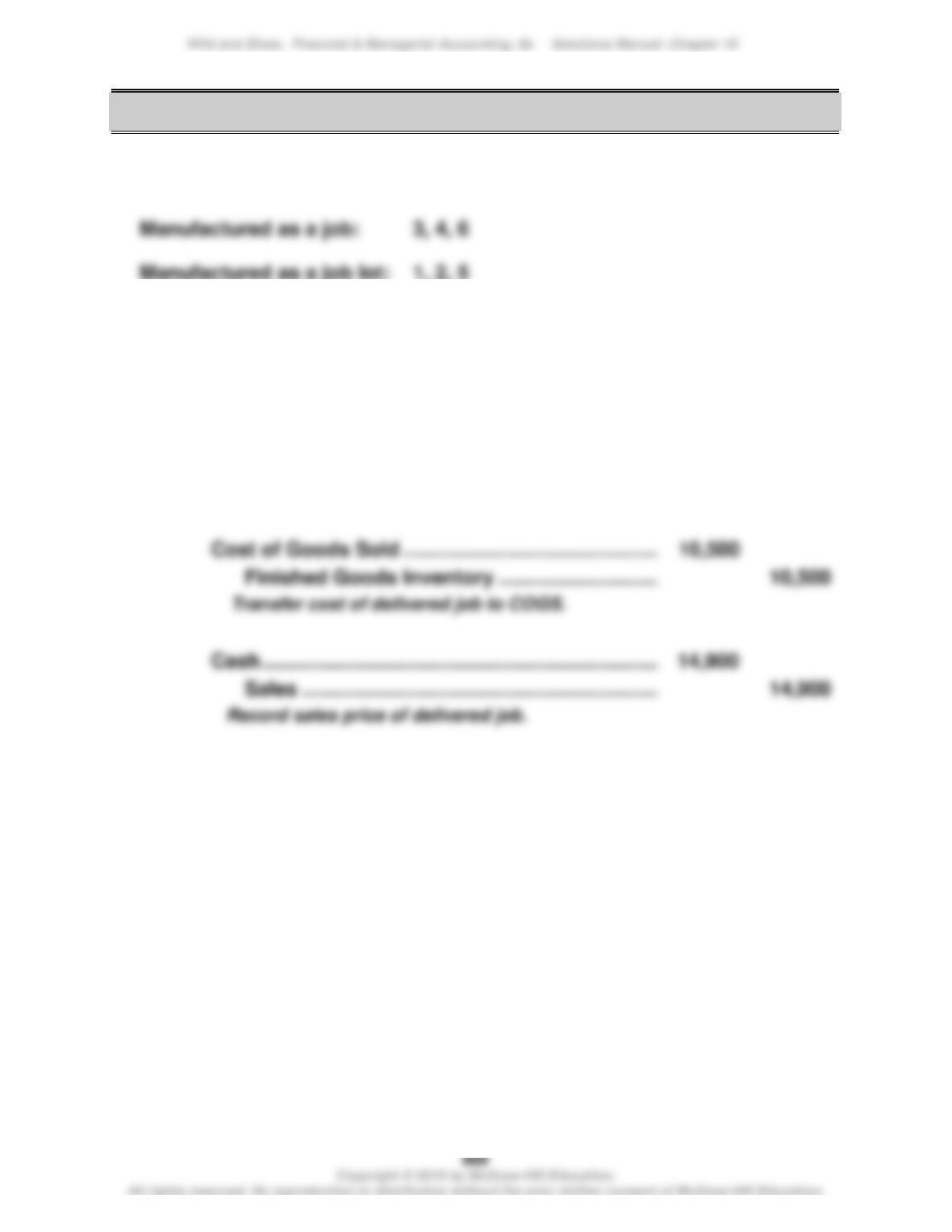
Finished Goods Inventory ……………………………………..
10,500
Work in Process Inventory …………………………..
10,500
Transfer cost of completed job to Fin. Goods.
10,500
Finished Goods Inventory …………………………..
10,500
14,900
Sales ……………………………………………………….
14,900
Quick Study 15-3 (10 minutes)
a. Job b. Process c. Process d. Job e. Job
Quick Study 15-4 (15 minutes)
Raw Materials Inventory ………………………………………..
50,000
Cash ………………………………………………………………..
50,000
Record raw material purchases.
Factory Overhead ………………………………………………….
12,000
Raw Materials Inventory …………………………………..
12,000
Record indirect materials used in production.
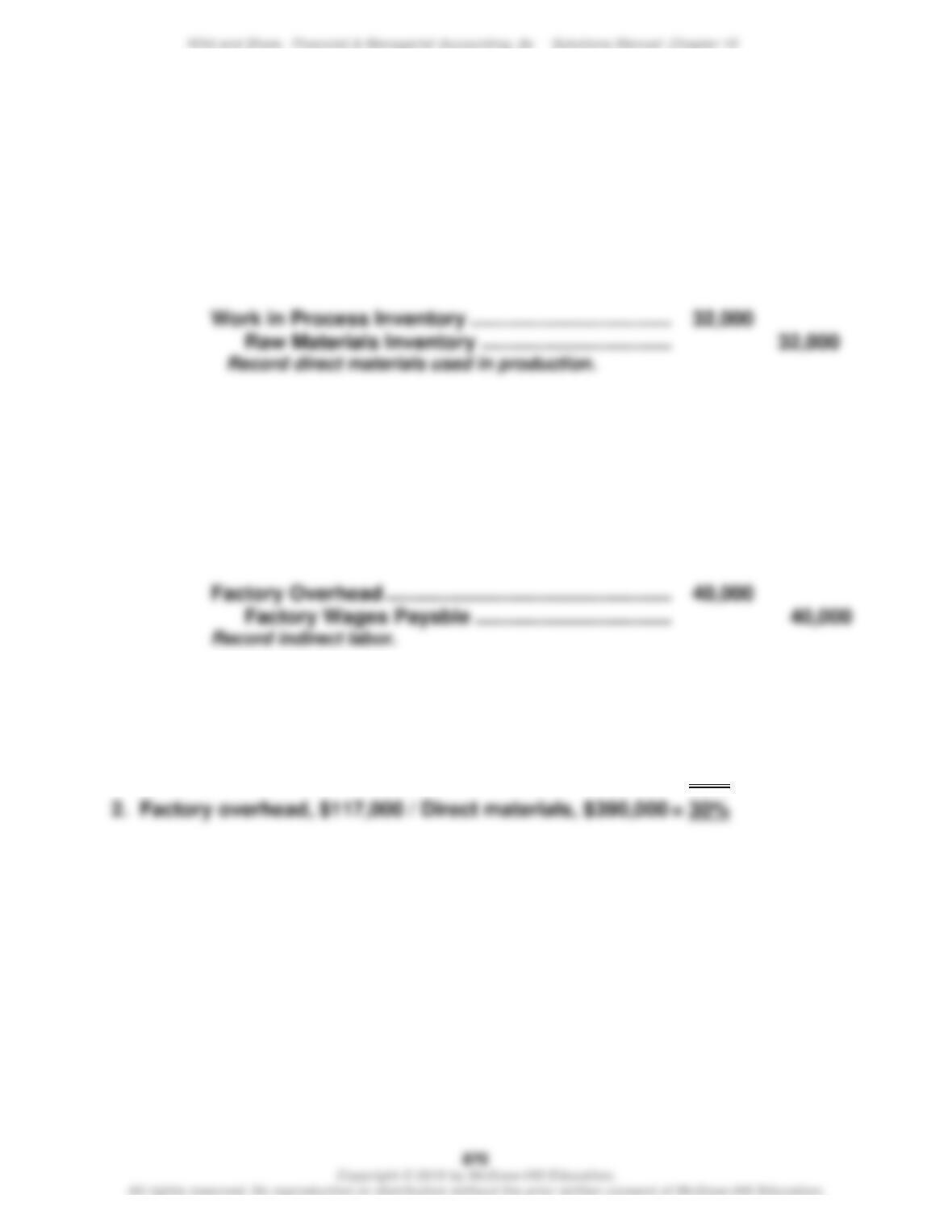
32,000
Raw Materials Inventory …………………………………..
32,000
Record direct materials used in production.
Quick Study 15-5 (10 minutes)
Work in Process Inventory …………………………………….
140,000
Factory Wages Payable ……………………………………
140,000
Record direct labor.
Factory Overhead ………………………………………………….
40,000
Factory Wages Payable ……………………………………
Record indirect labor.
Quick Study 15-6 (10 minutes)
1. Factory overhead, $117,000 / Direct labor, $468,000 = 25%
Quick Study 15-7 (10 minutes)
Amount applied to Job 65A = 13 x $400 = $5,200
Quick Study 15-8 (5 minutes)
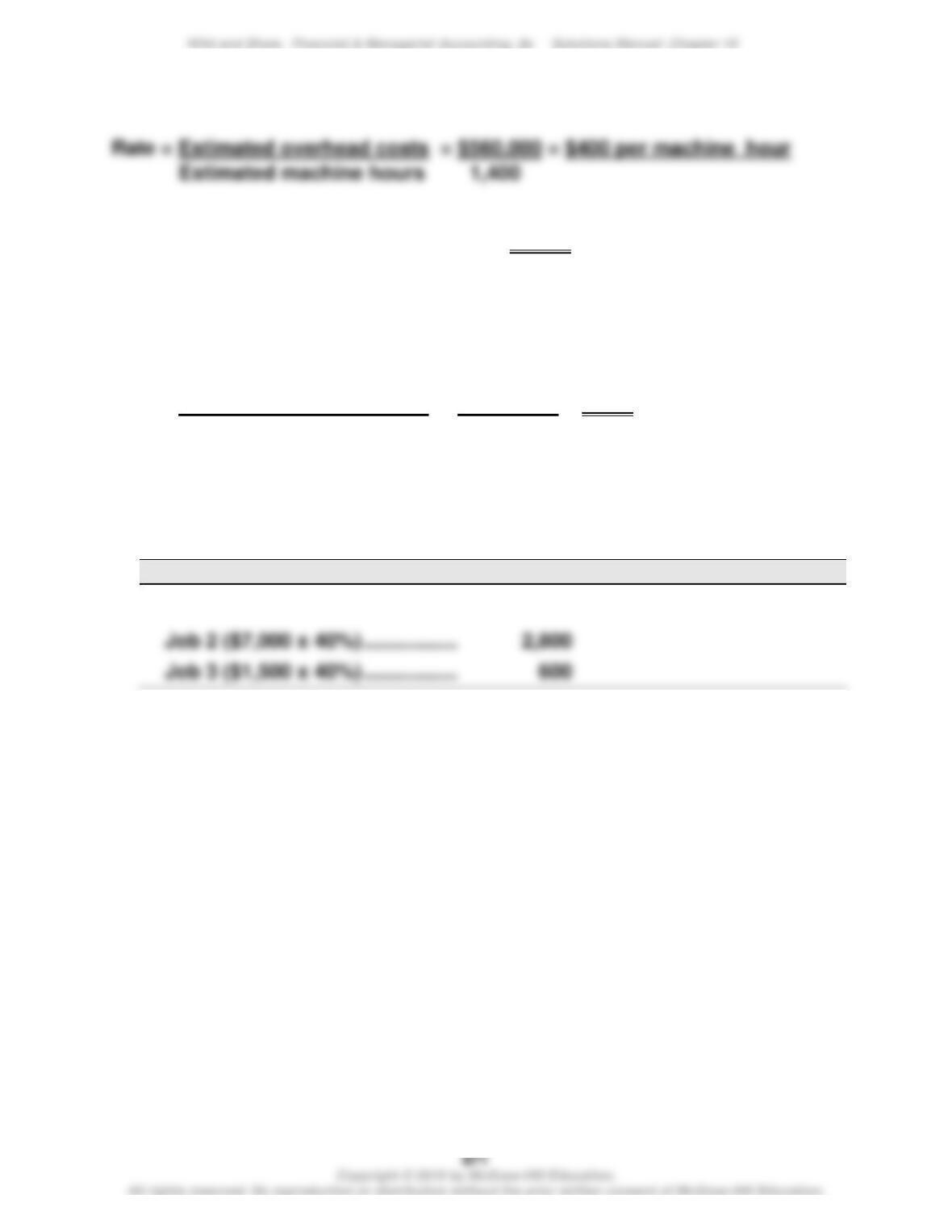
Rate = Estimated overhead costs = $1,170,000 = 130%
Estimated direct materials $900,000
Quick Study 15-9 (10 minutes)
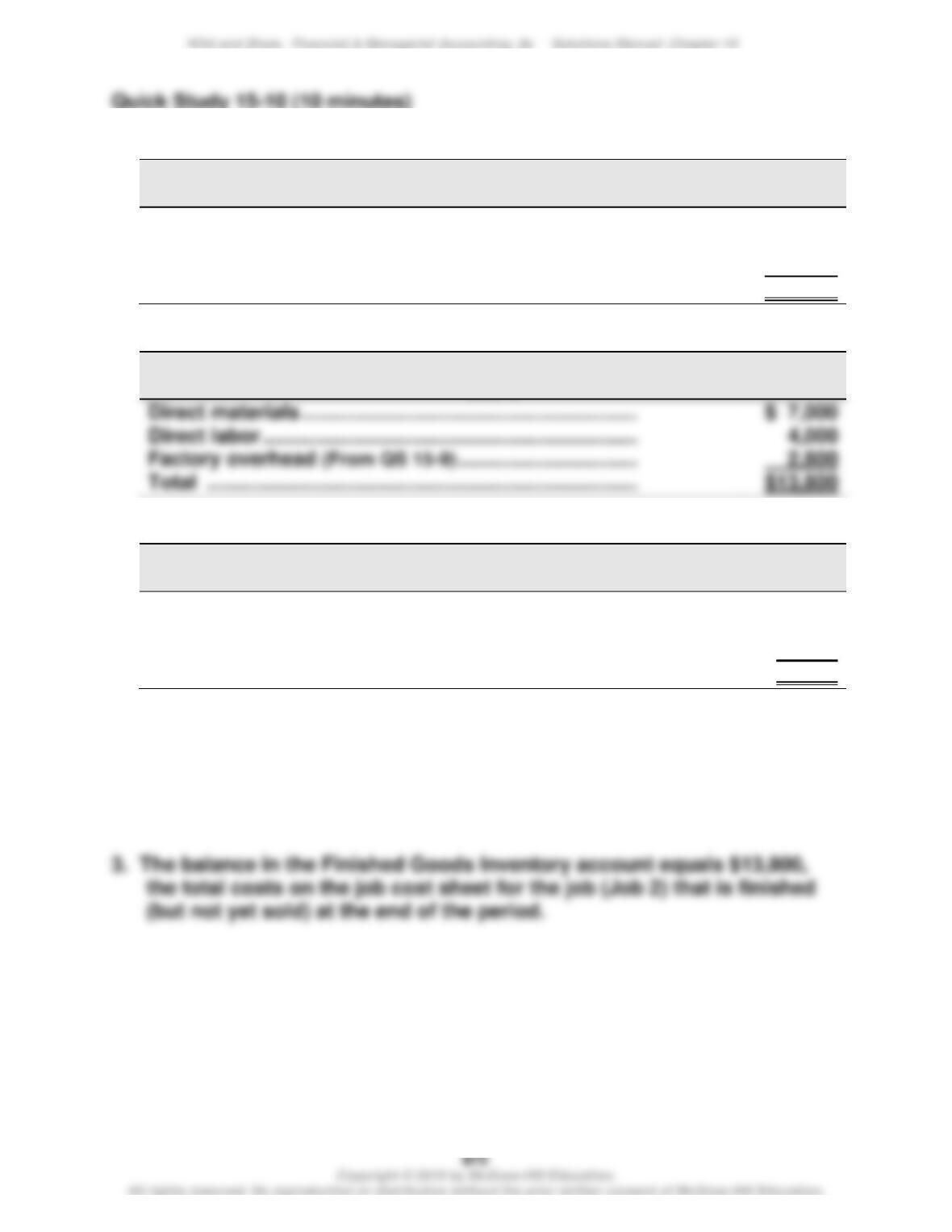
Overhead Applied
Job 1 ($5,000 x 40%) …………………
$2,000
1.
JOB COST SHEET
Job 1
Direct materials ……………………………………………………….
Direct labor …………………………………………………………………….
$ 5,000
9,000
Factory overhead (From QS 15-9) …………………………..
2,000
Total ……………………………………………………………………………..
$16,000
JOB COST SHEET
Job 2
Direct materials ……………………………………………………….
Direct labor …………………………………………………………………….
$ 7,000
4,000
Factory overhead (From QS 15-9) …………………………..
2,800
Total ……………………………………………………………………………..
$13,800
JOB COST SHEET
Job 3
Direct materials ……………………………………………………….
Direct labor …………………………………………………………………….
$1,500
3,000
Factory overhead (From QS 15-9) …………………………..
600
Total ……………………………………………………………………………..
$5,100
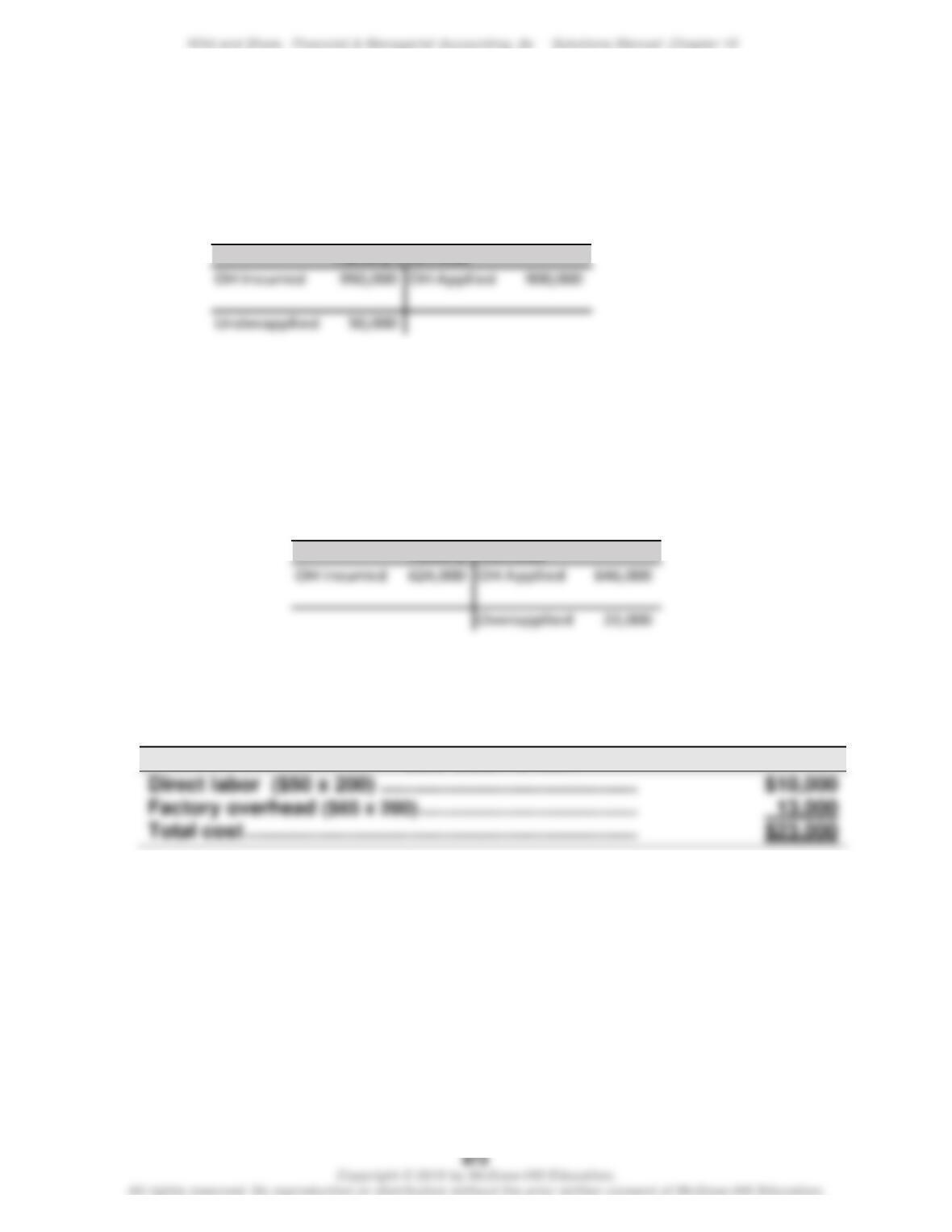
2. The balance in the Work in the Process Inventory account equals
$21,100, the sum of the total costs on the job cost sheets for the jobs
that remain unfinished at the end of the period (Job 1 and Job 3).
Quick Study 15-11 (15 minutes)
Cost of Goods Sold ……………………………………………….
50,000
Factory Overhead* ……………………………………………
50,000
Assign underapplied overhead.
Quick Study 15–12 (5 minutes)
Factory Overhead ………………………………………………….
22,000
Cost of Goods Sold* …………………………………………
22,000
Assign overapplied overhead.
Quick Study 15-13 (10 minutes)
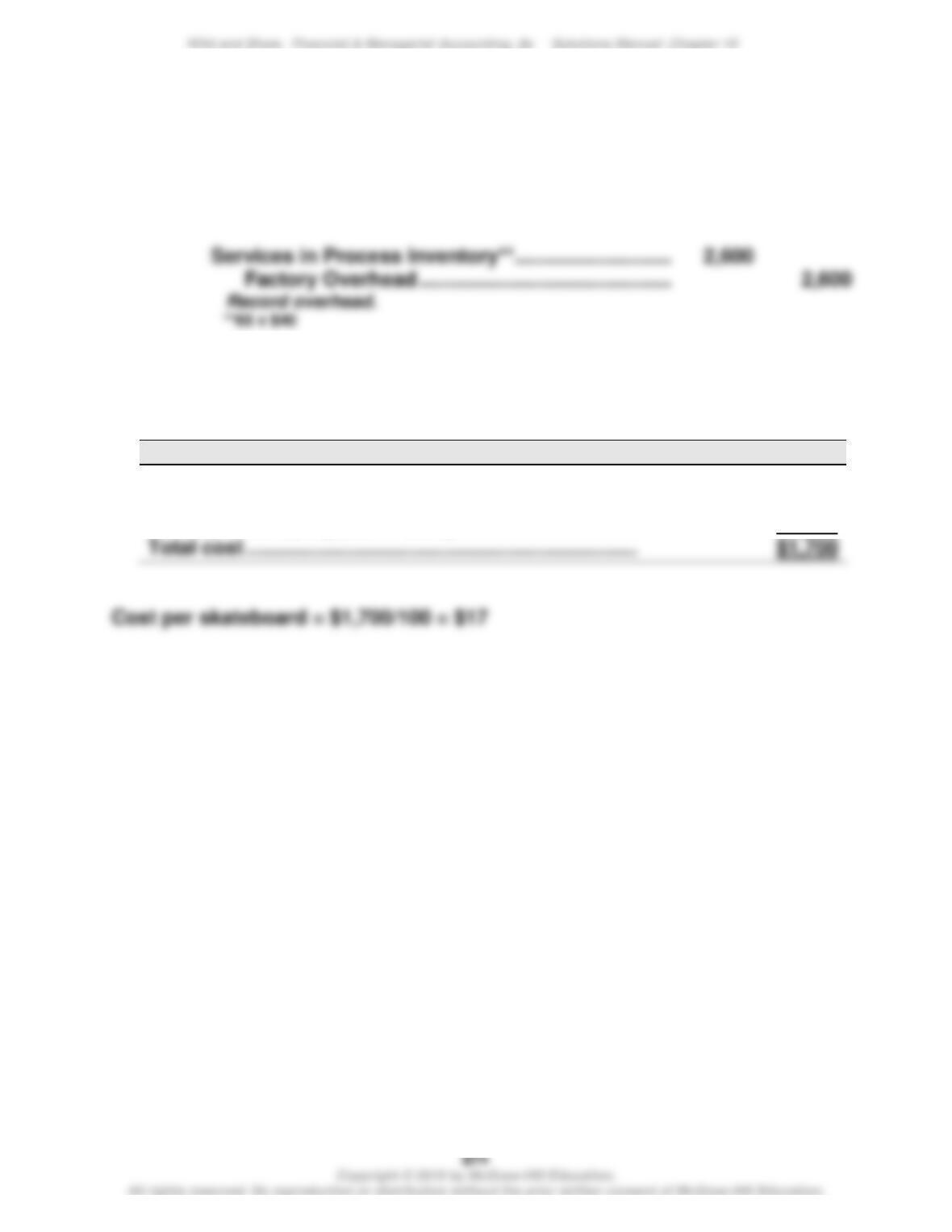
JOB COST SHEET
Direct labor ($50 x 200) ………………………………………………….
Factory overhead ($65 x 200) ……………………………………………
Quick Study 15-14 (10 minutes)
Services in Process Inventory* …………………………..
3,250
Service Wages Payable …………………………………….
3,250
Record direct labor.
*65 x $50
Services in Process Inventory** …………………………..
2,600
Factory Overhead …………………………………………….
Record overhead.
Quick Study 15-15 (5 minutes)
JOB COST SHEET
Direct materials ……………………………………………………….
Direct labor …………………………………………………………………..
$ 600
200
Factory overhead ($600 x 150%) …………………………..
900
EXERCISES
Exercise 15-1 (10 minutes)
2.
D
4.
E
Exercise 15-2 (15 minutes)
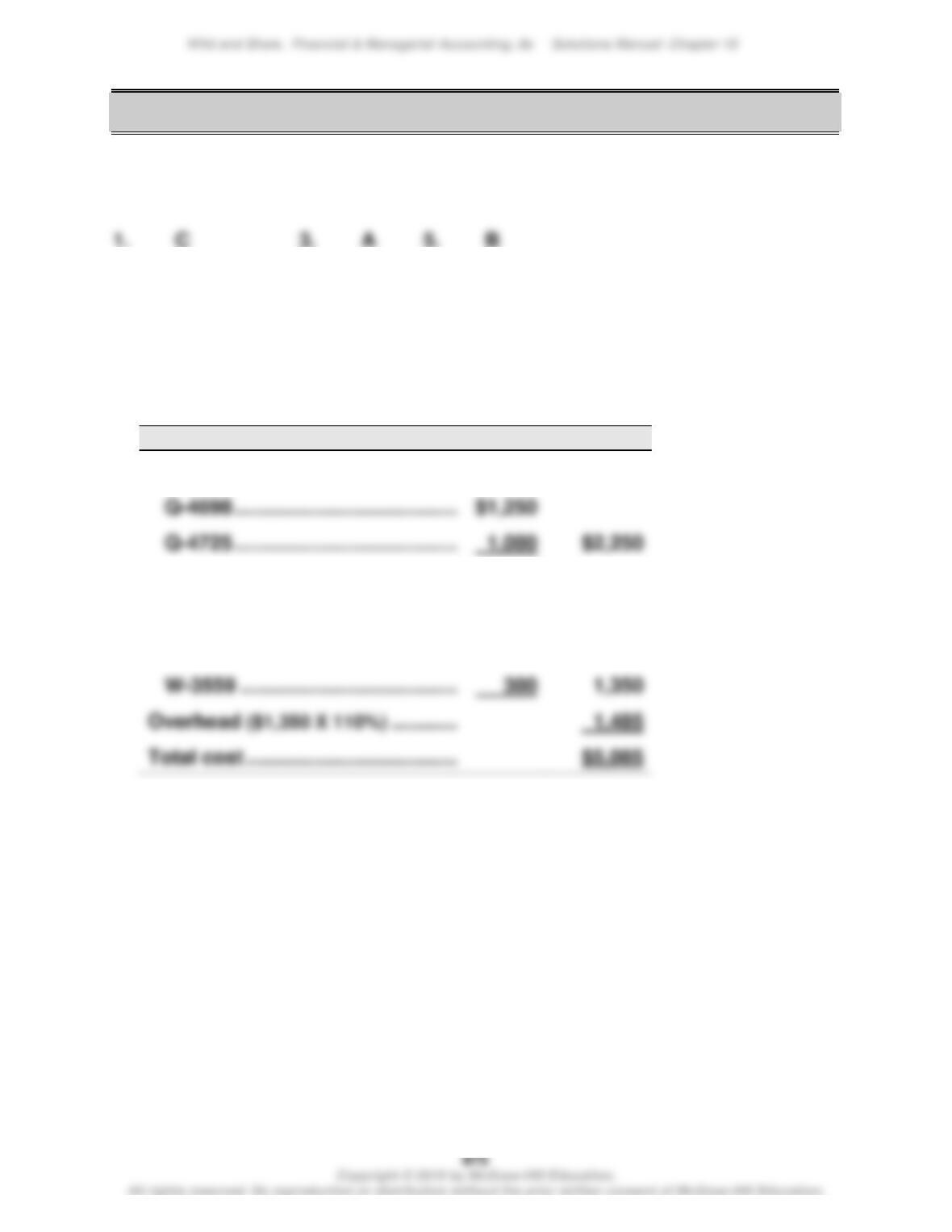
JOB COST SHEET: Job 9-1005
Direct materials
Q-4725 ……………………………………..
Direct labor
W-3393 …………………………..………..
600
W-3479 …………………………..………..
450
Overhead ($1,350 X 110%) …………….
Total cost ……………………………………
Exercise 15-3 (25 minutes)
1. The cost of direct materials requisitioned in the month equals the total
direct materials costs accumulated on the three jobs less the amount of
direct materials cost assigned to Job 102 in May:
Job 102 ……………………………………………………
$15,000
Less prior costs ……………………………………….
(6,000)
$ 9,000
Job 103 ……………………………………………………
33,000
Job 104 ……………………………………………………
27,000
Total materials used (requisitioned) ………….
$69,000
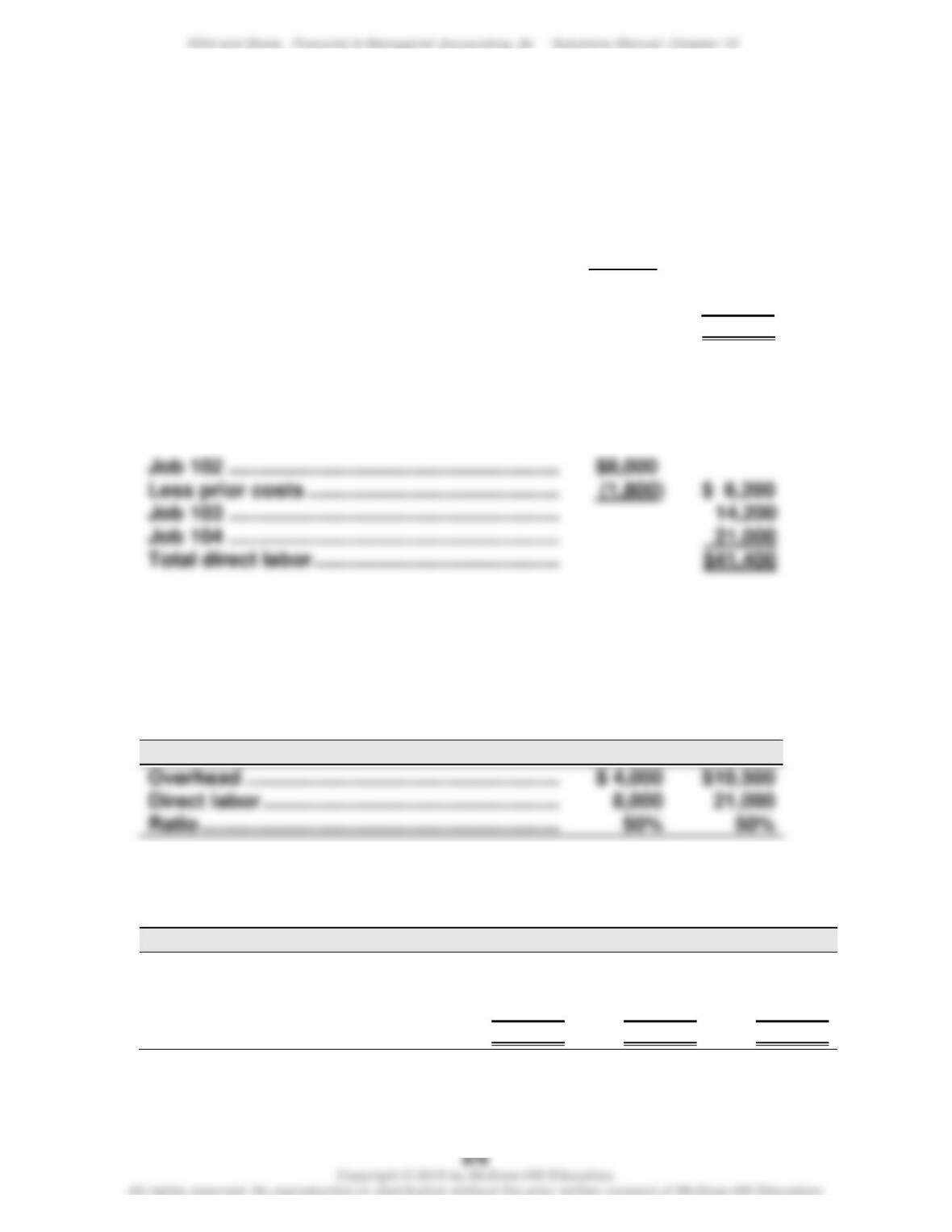
2. Direct labor cost incurred in the month equals the total direct labor
costs accumulated on the three jobs less the amount of direct labor cost
assigned to Job 102 in May:
Job 102 ……………………………………………………….
Less prior costs ……………………………………………
Job 103 ……………………………………………………….
Job 104 ……………………………………………………….
$41,400
3. The predetermined overhead rate equals the ratio of the amount of
overhead assigned to jobs divided by the amount of direct labor cost
assigned to them. Since the same rate is used for all jobs started and
completed within a month, the ratio for any one job equals the rate that
was applied. This table shows the ratio for jobs 102 and 104:
Job 102
Job 104
Overhead ……………………………………………………..
Direct labor …………………………………………………..
21,000
50%
50%
4. The cost transferred to finished goods in June equals the total costs of
the two completed jobs for the month, which are Jobs 102 and 103:
Job 102
Job 103
Total
Direct materials …………………………..
$15,000
$33,000
$48,000
Direct labor …………………………..
8,000
14,200
22,200
Overhead ……………………………………
4,000
7,100
11,100
Total transferred cost ………………….
$27,000
$54,300
$81,300
Exercise 15-4 (15 minutes)
1.
Raw Materials Inventory …………………………………………
76,200
Accounts Payable …………………………………………….
76,200
Record materials purchases.
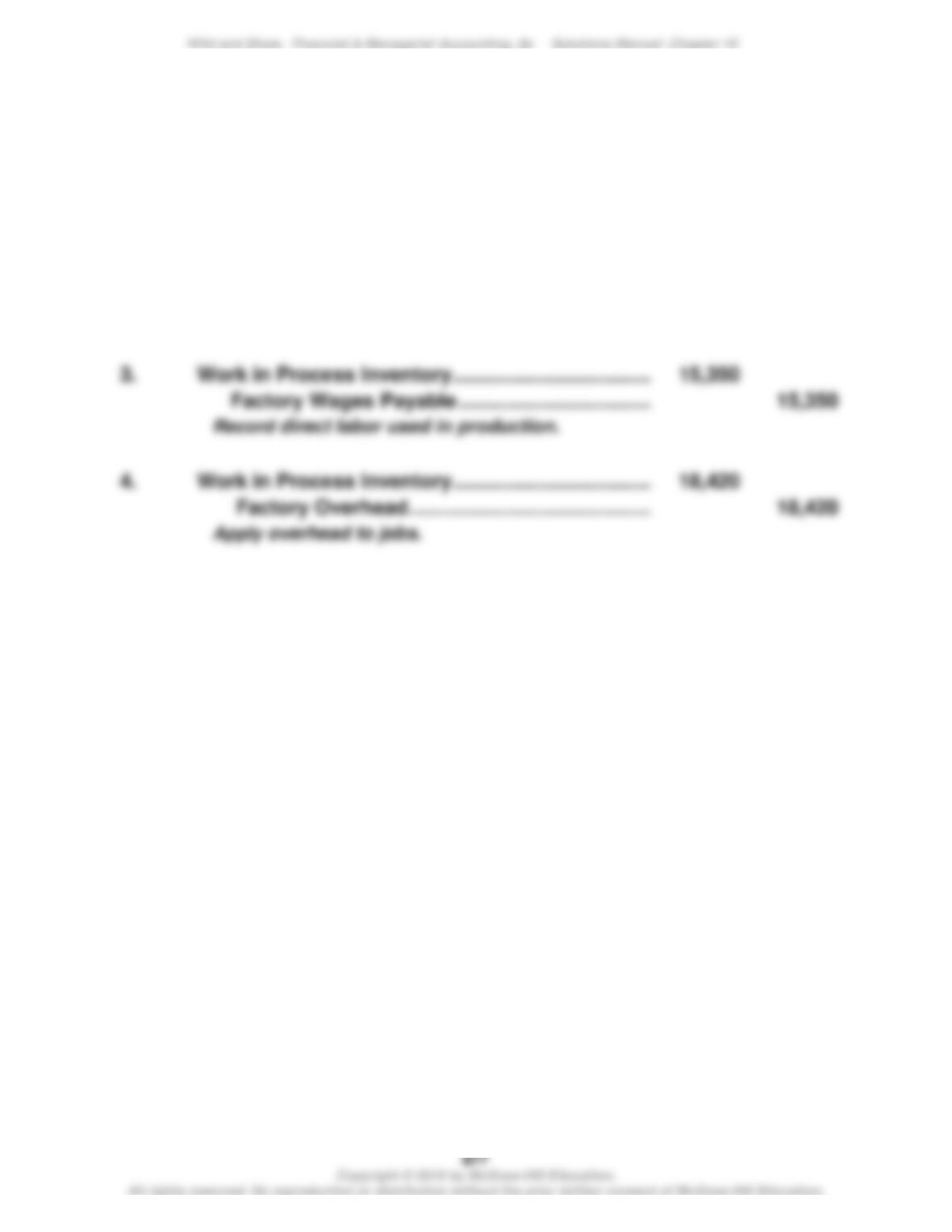
2.
Work in Process Inventory ……………………………………..
48,000
Raw Materials Inventory ……………………………………
48,000
Assign costs of direct materials used.
Work in Process Inventory ……………………………………..
15,350
15,350
Record direct labor used in production.
4.
Work in Process Inventory ……………………………………..
18,420
18,420
Apply overhead to jobs.
Exercise 15-5 (20 minutes)
1.
a.
Work in Process Inventory ……………………………………..
9,500
Raw Materials Inventory ……………………………………
9,500
Record direct materials used.
b.
Work in Process Inventory ……………………………………..
8,000
Factory Wages Payable …………………………..………..
8,000
Record direct labor used.
c.
Work in Process Inventory ……………………………………..
6,400
Factory Overhead ……………………………………………..
6,400
Apply overhead at 80% of direct labor cost.
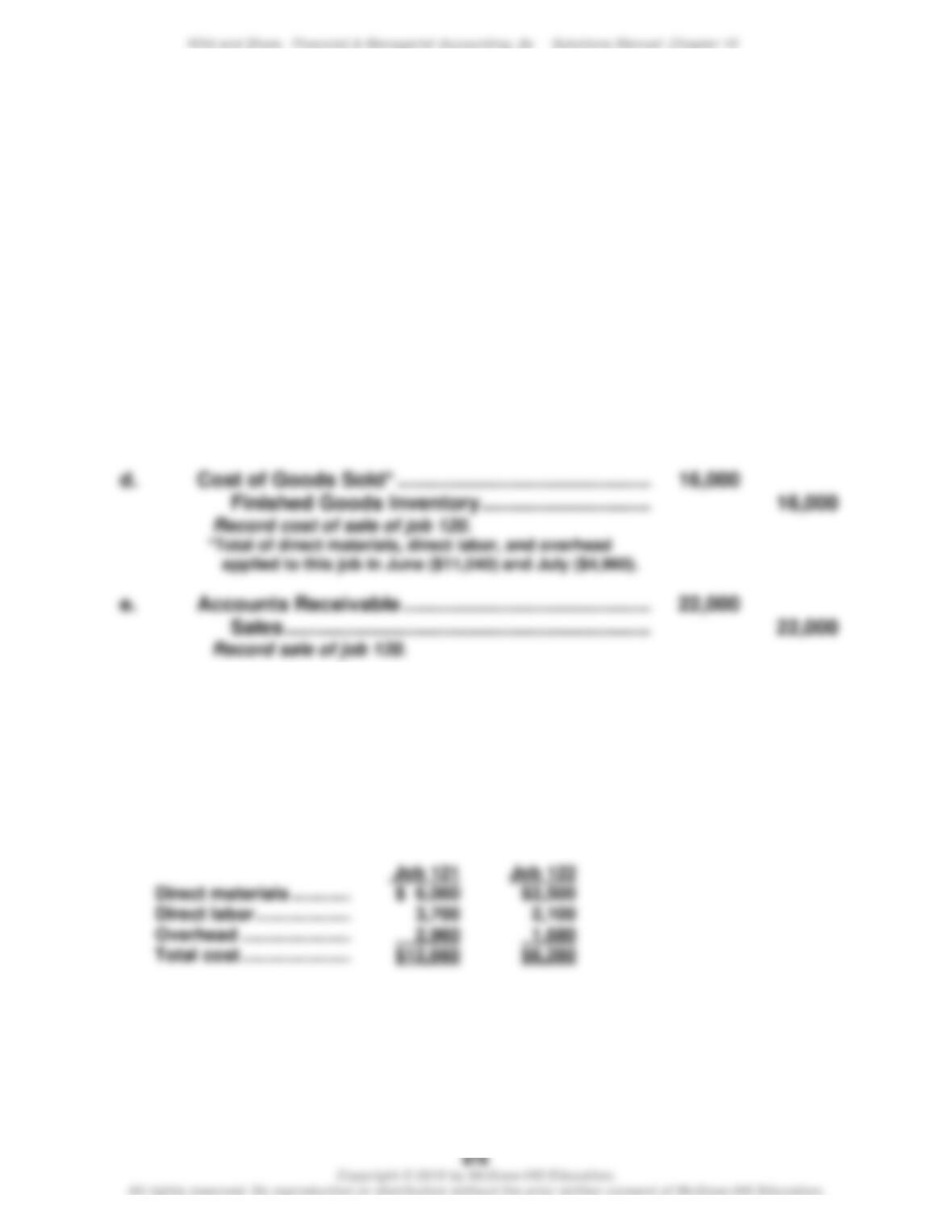
d.
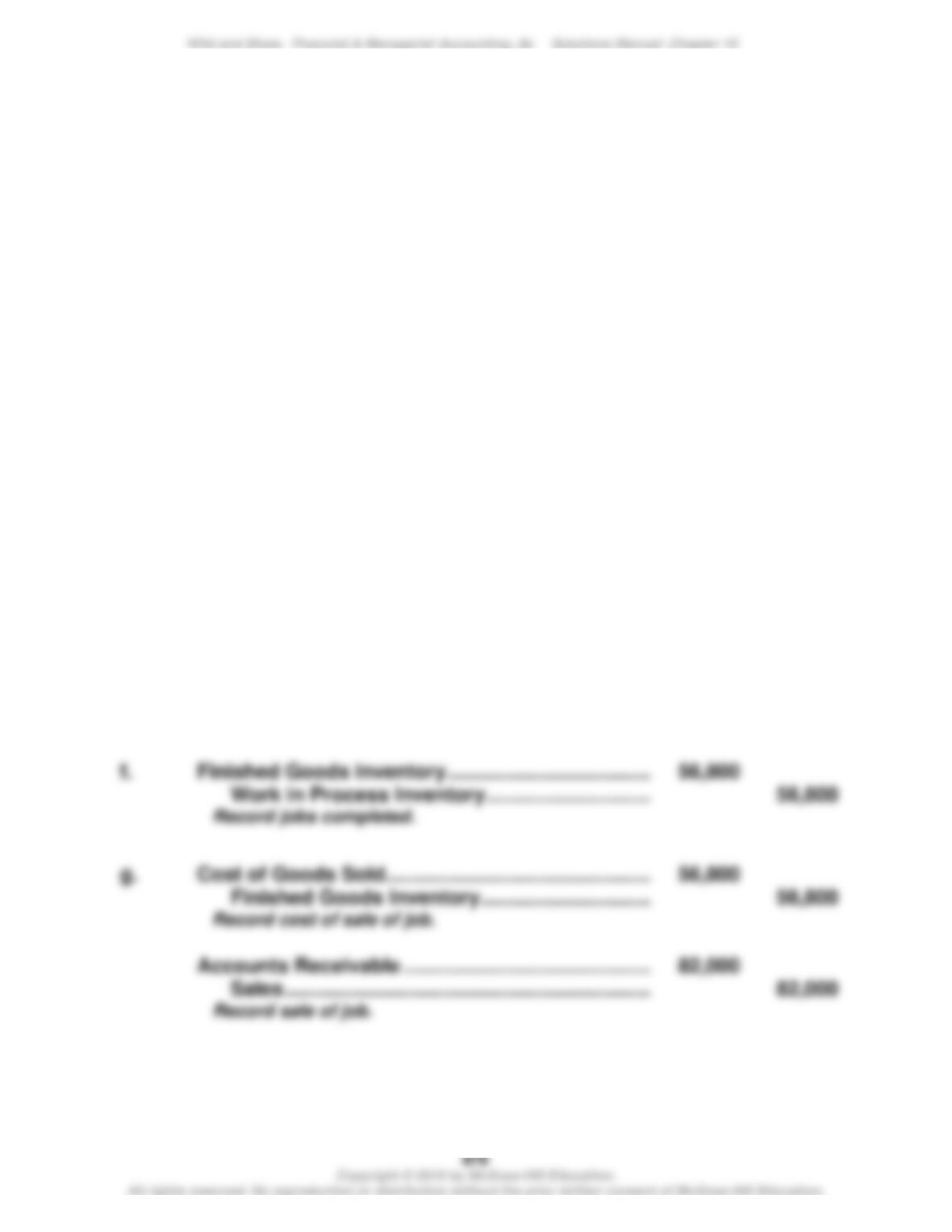
Finished Goods Inventory …………………………..
Accounts Receivable ……………………………………………..
Sales ………………………………………………………………..
2. The balance in Work in Process Inventory at the end of July ($6,280)
equals the total cost reported on the job cost sheet for Job 122, the
only job still in process at the end of the month. The balance in
Finished Goods Inventory ($12,660) equals the total cost reported on
the job cost sheet for Job 121, the only job finished but not sold by the
end of the month.
Exercise 15-6 (25 minutes)
a.
Raw Materials Inventory …………………………………………
90,000
Accounts Payable …………………………………………….
90,000
Record materials purchases.
b.
Work in Process Inventory ……………………………………..
36,500
Raw Materials Inventory ……………………………………
36,500
Assign costs of direct materials used.
Factory Overhead …………………………………………………..
19,200
Raw Materials Inventory ……………………………………
19,200
Record indirect materials.
c.
Work in Process Inventory ……………………………………..
38,000
Factory Overhead ………………………………………………….
Cash ………………………………………………………………..
12,000
50,000
Record payroll costs paid.
d.
Factory Overhead …………………………………………………..
11,475
Cash ………………………………………………………………..
11,475
Record other factory overhead paid.
e.
Work in Process Inventory ……………………………………..
47,500
Factory Overhead ……………………………………………..
47,500
Apply overhead to jobs at the rate of 125% of
direct labor cost.
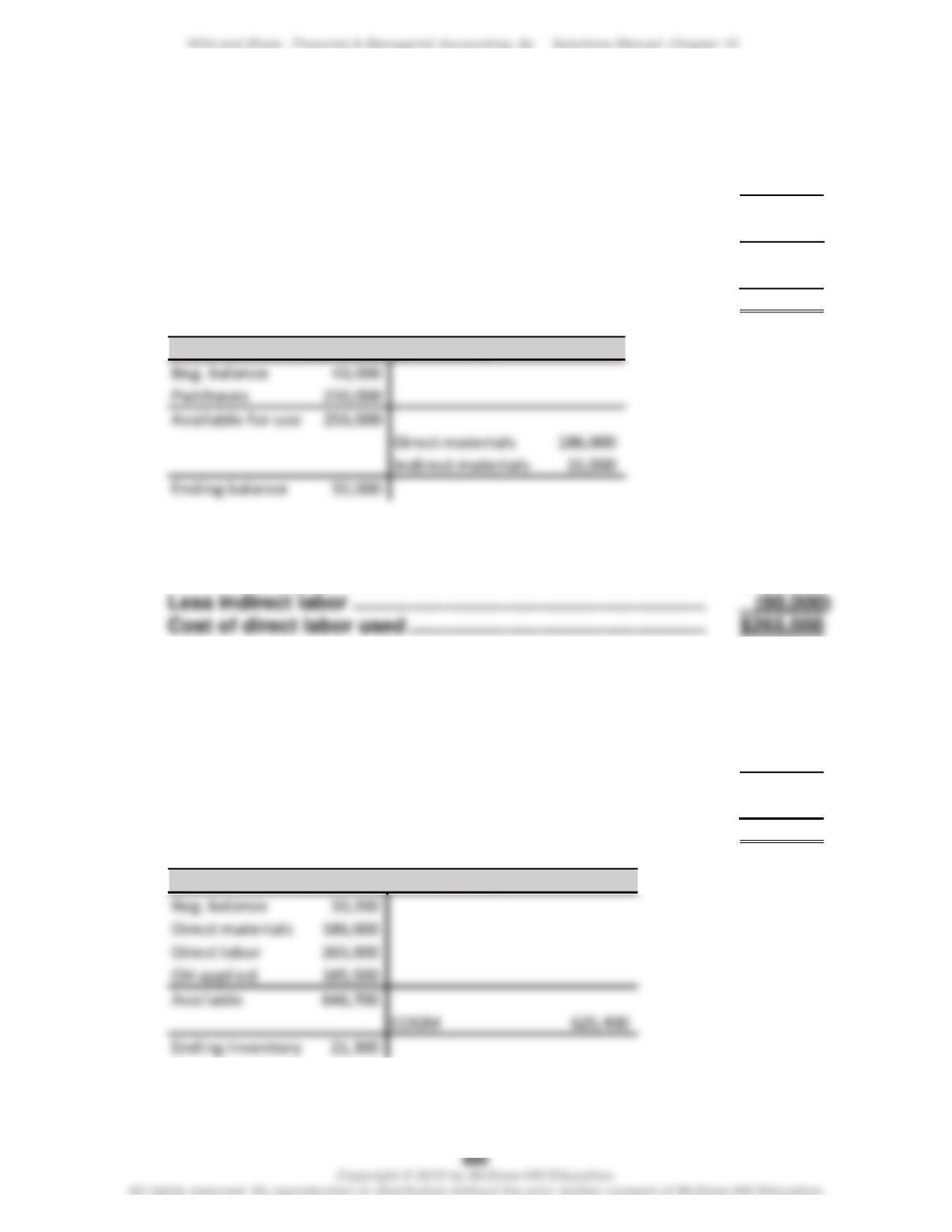
Finished Goods Inventory ………………………………………
56,800
Work in Process Inventory …………………………..
56,800
g.
56,800
Finished Goods Inventory …………………………..
56,800
Accounts Receivable ……………………………………………..
82,000
Sales ………………………………………………………………..
82,000
Exercise 15-7 (30 minutes)
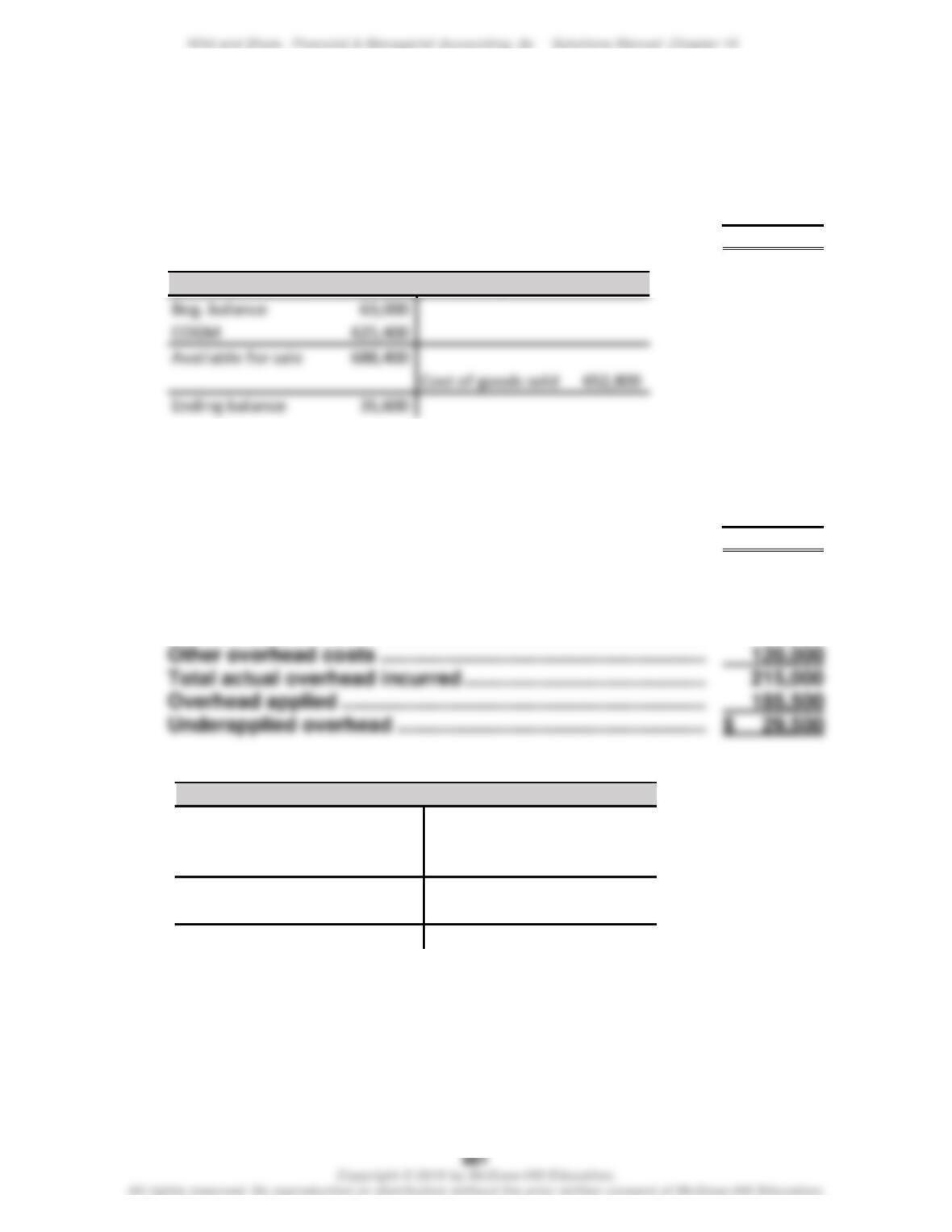
1.
Cost of direct materials used
Beginning raw materials inventory……………………………………………
$ 43,000
Plus purchases ………………………………………………………………………..
210,000
Raw materials available ……………………………………………………….
253,000
Less ending raw materials inventory ………………………………………..
(52,000)
Total raw materials used ……………………………………………………….
201,000
Less indirect materials used …………………………………………………….
(15,000)
Cost of direct materials used ……………………………………………………
$186,000
2.
Cost of direct labor used
Total factory payroll ……………………………………………………….
$345,000
Less indirect labor ……………………………………………………….
(80,000)
Cost of direct labor used ……………………………………………………….
$265,000
3.
Cost of goods manufactured
Beginning work in process inventory ……………………………………….
$ 10,200
Plus direct materials ……………………………………………………….
186,000
Plus direct labor ………………………………………………………………………
265,000
Plus overhead applied (70% of direct labor cost) …………………………
185,500
Total cost of work in process ……………………………………………………
646,700
Less ending work in process inventory …………………………..
(21,300)
Cost of goods manufactured ……………………………………………………
$625,400
Work in Process Inventory
Raw Materials Inventory
Exercise 15–7 (continued)
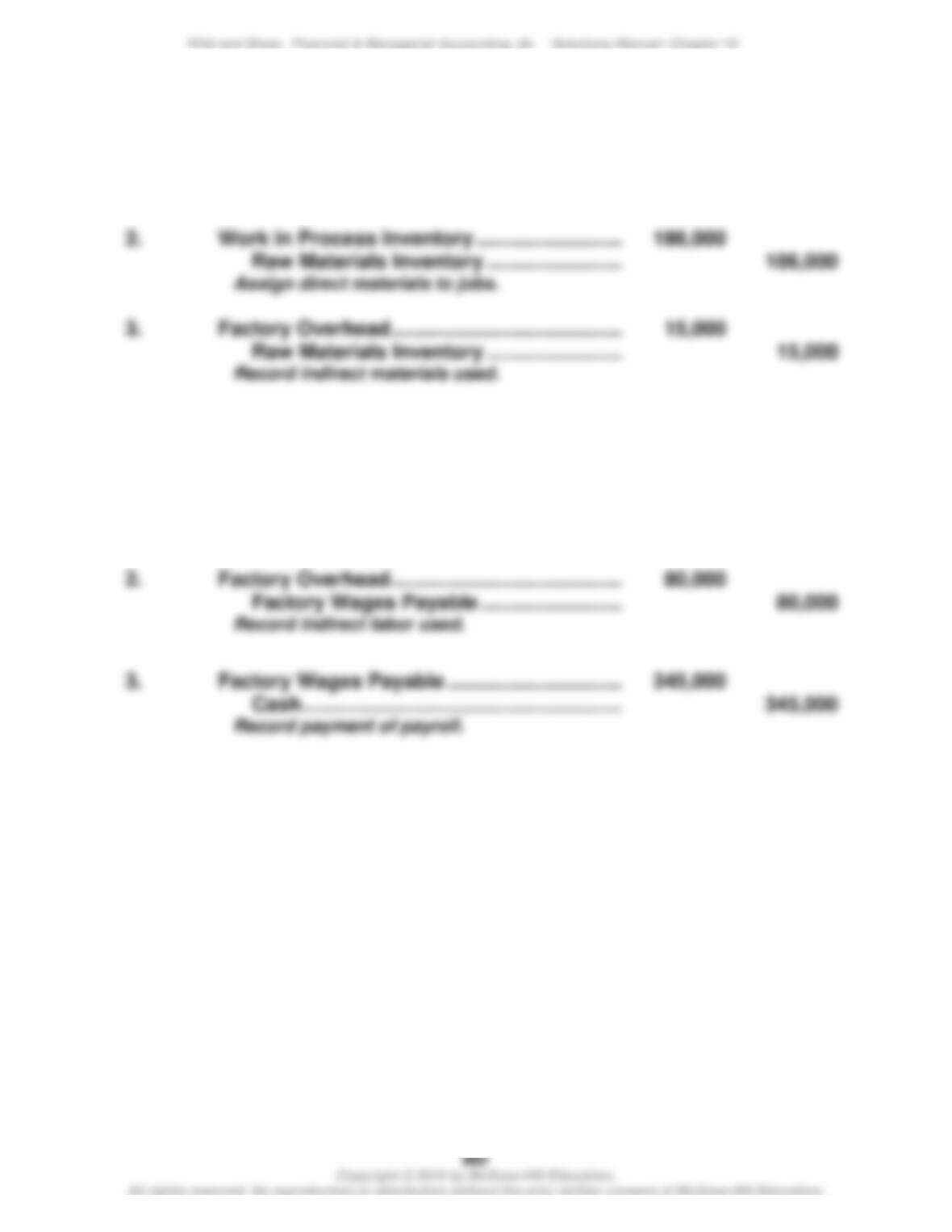
4.
Cost of goods sold
Beginning finished goods inventory …………………………………………
$ 63,000
Plus cost of goods manufactured …………………………………………….
625,400
Less ending finished goods inventory…………………………..
(35,600)
Cost of goods sold ……………………………………………………….
$ 652,800
Finished Goods Inventory
5.
Gross profit
Sales ……………………………………………………………………………………
$1,400,000
Cost of goods sold ……………………………………………………….
(652,800)
Gross profit ……………………………………………………………………………..
$ 747,200
6.
Actual overhead incurred
Indirect materials ……………………………………………………………………..
$ 15,000
Indirect labor ……………………………………………………….…………………..
80,000
Other overhead costs ……………………………………………………….
Total actual overhead incurred …………………………………………………
215,000
Overhead applied …………………………………………………………………….
Underapplied overhead ……………………………………………………….
$ 29,500
Indirect materials 15,000
Indirect labor 80,000
Other overhead 120,000
Total actual OH 215,000
OH applied 185,500
Underapplied OH 29,500
Factory Overhead
Exercise 15-8 (10 minutes)
1.
Raw Materials Inventory …………………………..
210,000
Cash ……………………………………………………….
210,000
Record materials purchases.
2.
Work in Process Inventory …………………………..
186,000
Raw Materials Inventory …………………………..
186,000
Assign direct materials to jobs.
3.
Factory Overhead …………………………………………………..
Raw Materials Inventory …………………………..
Record indirect materials used.
Exercise 15-9 (10 minutes)
1.
Work in Process Inventory …………………………..
265,000
Factory Wages Payable …………………………..
265,000
Record direct labor used.
2.
Factory Overhead …………………………………………………..
Factory Wages Payable …………………………..
Record indirect labor used.
3.
Factory Wages Payable …………………………..
Cash ……………………………………………………….
Exercise 15-10 (10 minutes)
1.
Factory Overhead …………………………………………………..
120,000
Other Accounts ………………………………………………..
120,000
Record other factory overhead.
2.
Work in Process Inventory …………………………..
185,500
Factory Overhead …………………………..…………………
185,500
Apply overhead to jobs.
Computed as: 70% Predetermined overhead rate x
direct labor of $265,000
Exercise 15–11 (15 minutes)
1.
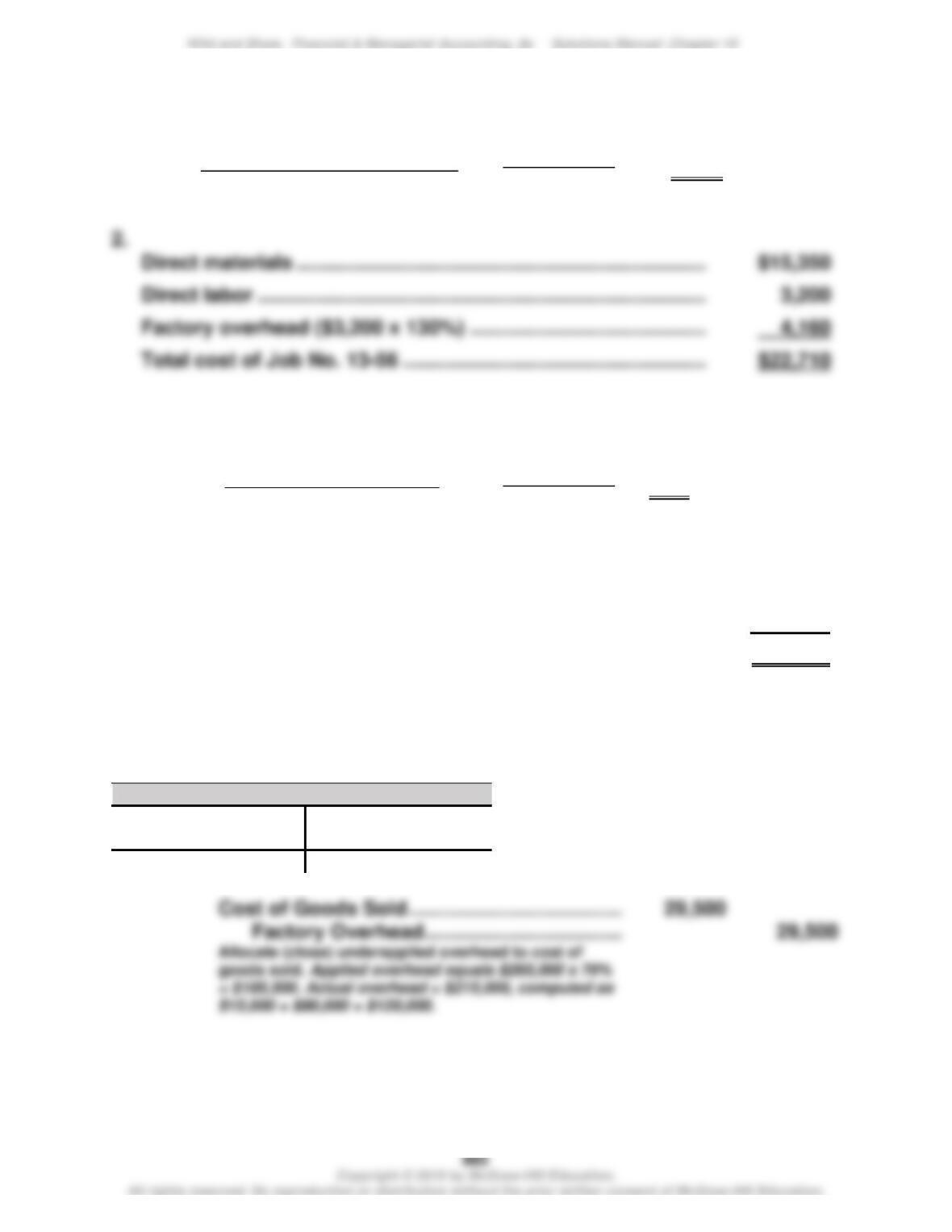
Rate = = = 130%
Direct materials ……………………………………………………………………….
Direct labor ……………………………………………………………………………..
Total cost of Job No. 13-56 ………………………………………………………
Exercise 15–12 (20 minutes)
1. Rate = = = 40%
2.
Total cost of job in process (given) ………………………………………………
$ 50,000
Less materials cost of job in process (given) …………………………..
(30,000)
Less overhead applied (30,000 x 40%) …………………………………………..
(12,000)
Direct labor cost …………………………………………………………………………..
$ 8,000
Exercise 15-13 (10 minutes)
Actual OH 215,000 OH applied 185,500
Underapplied 29,500
Factory Overhead
Cost of Goods Sold ………………………………………………..
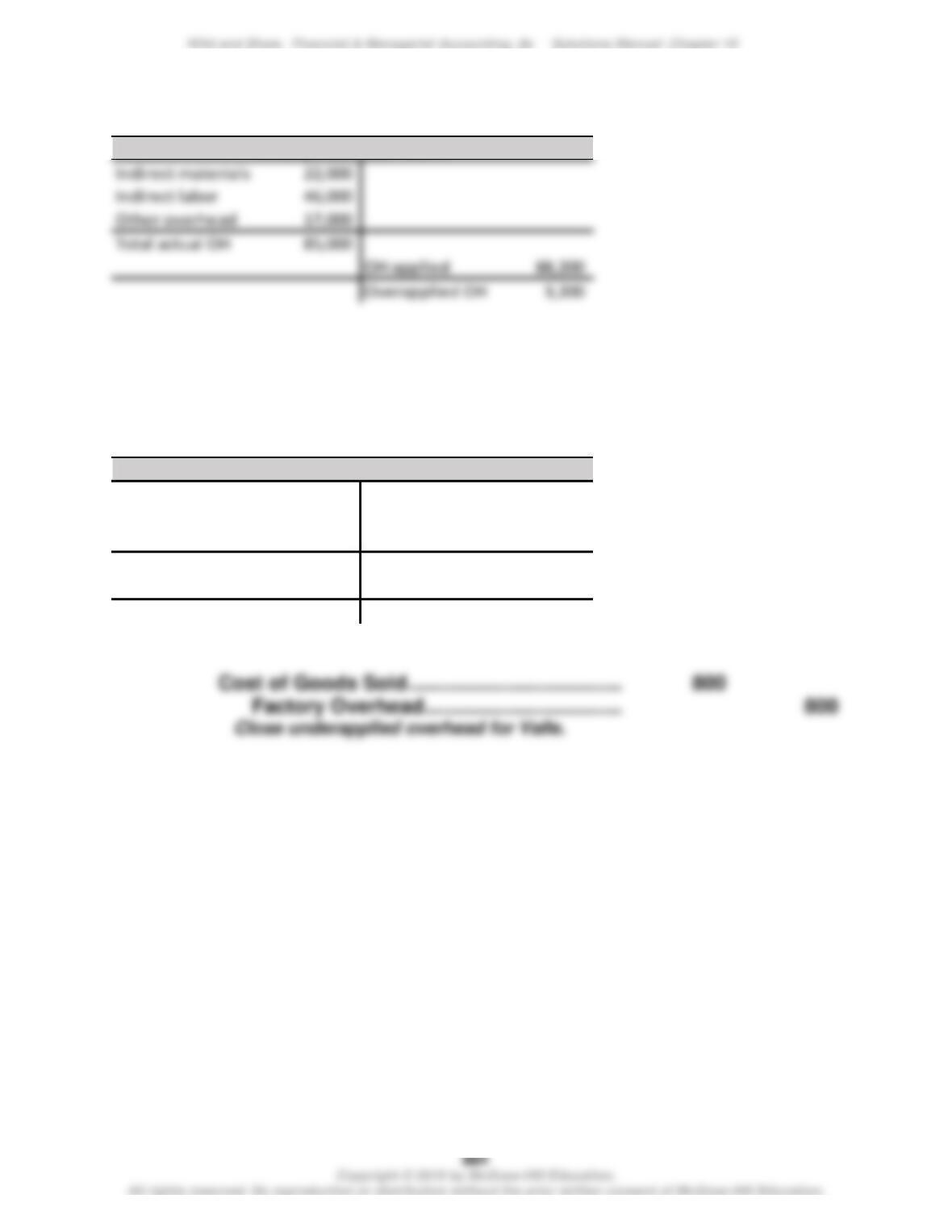
Estimated overhead costs
Estimated direct labor
$747,500
$575,000
$600,000
$1,500,000
Overhead costs
Direct material costs
Exercise 15-14 (15 minutes)
Factory Overhead – Storm
Factory Overhead …………………………………………………..
3,200
Cost of Goods Sold …………………………………………..
3,200
Close overapplied overhead for Storm.
Indirect materials 12,500
Indirect labor 46,500
Other overhead 47,000
Total actual OH 106,000
OH applied 105,200
Underapplied OH 800
Factory Overhead – Valle
Factory Overhead …………………………..…………………
Exercise 15-15 (35 minutes)
1.
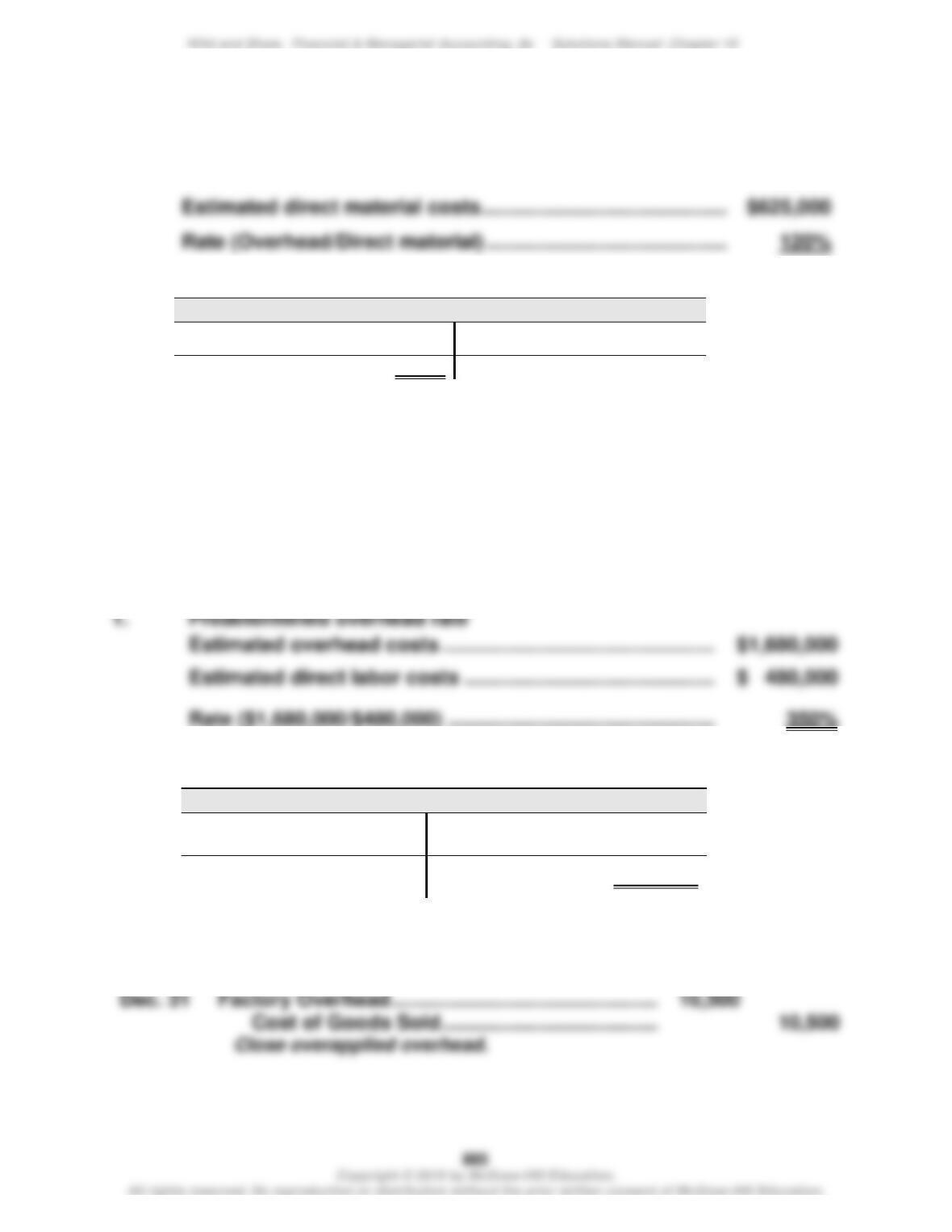
Predetermined overhead rate
Estimated overhead costs ……………………………………………………..
$750,000
Estimated direct material costs ………………………………………………
$625,000
2. & 3.
Factory Overhead
Incurred ……………………
830,000
Applied* …………………………..
822,000
Underapplied …………….
8,000
*Overhead applied to jobs = 120% x $685,000 = $822,000
4.
Dec. 31
Cost of Goods Sold ………………………………………………..
8,000
Factory Overhead ……………………………………………..
8,000
Close underapplied overhead.
Exercise 15-16 (25 minutes)
1.
2. & 3.
Overhead
Incurred …………………….
1,652,000
Applied* …………………………..
1,662,500
Overapplied …………………………..
10,500
*Overhead applied to jobs = 350% x $475,000 = $1,662,500
4.
Dec. 31
Cost of Goods Sold …………………………………………..
Close overapplied overhead.
Exercise 15-17 (30 minutes)
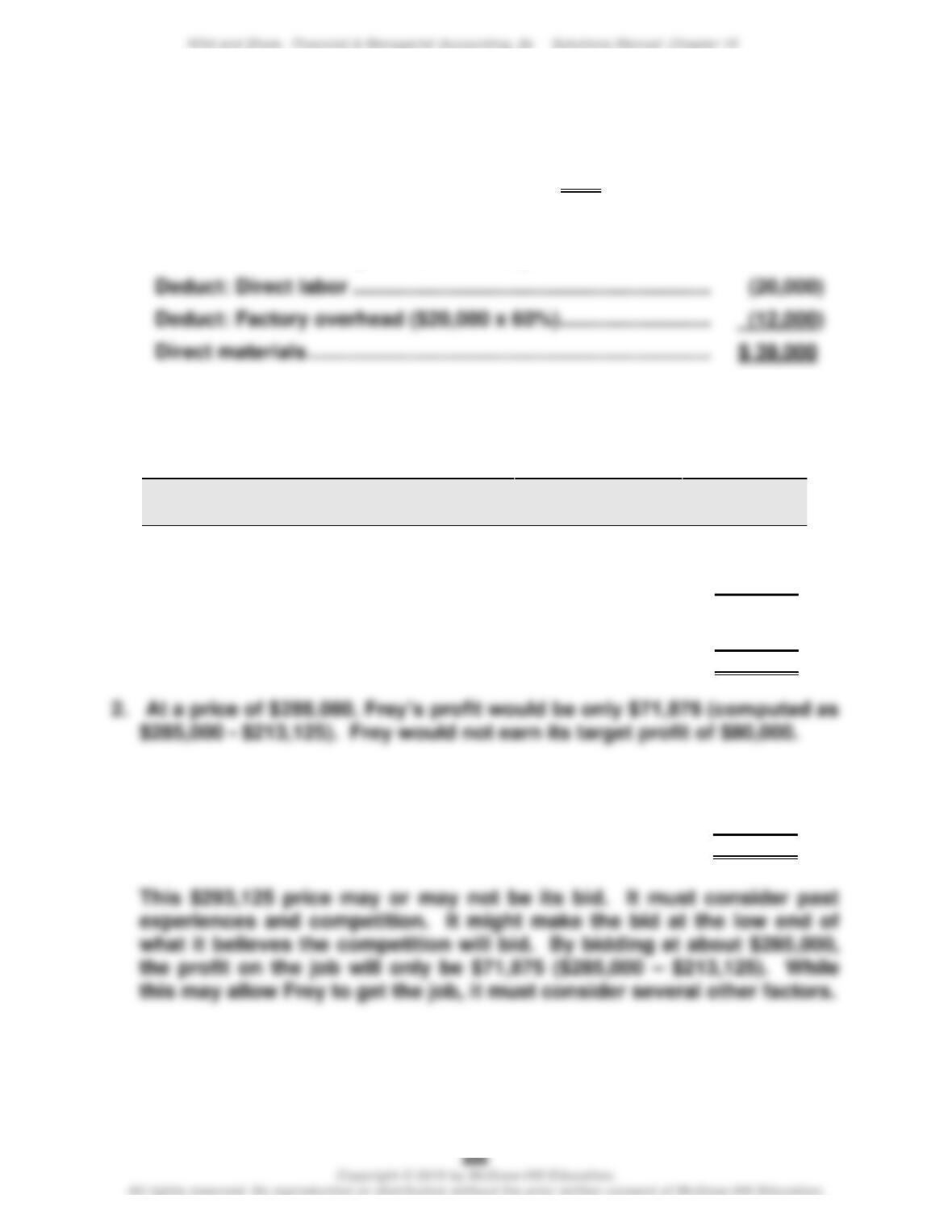
1. Overhead rate = Total overhead costs / Total direct labor costs
= $1,800,000 / $3,000,000 = 60%
2.
Total cost of work in process inventory …………………………..
$ 71,000
Direct materials ………………………………………………………………
Exercise 15-18 (35 minutes)
1. Estimated cost of the architectural job
Labor type
Estimated
hours
Hourly rate
Total cost
Architects …………………………..
150
$300
$ 45,000
Staff …………………………..
300
75
22,500
Clerical …………………………..
500
20
10,000
Total labor cost……………………………………………………………….
77,500
Overhead applied 175% of direct labor cost …………………….
135,625
Total estimated cost……………………………………………………….
$213,125
3. Frey’s price to cover both its costs and desired profit is:
Total estimated cost ……………………………………………………….
$213,125
Desired profit ………………………………………………………………….
80,000
Estimated selling price ……………………………………………………
$293,125