
Chapter 15
Transfer Pricing
Learning Objectives
1. Explain the basic issues associated with transfer pricing.
2. Explain the general transfer pricing rules and understand the underlying basis for them.
3. Identify the behavioral issues and incentive effects of negotiated transfer prices, cost-based
transfer prices, and market-based transfer prices.
4. Explain the economic consequences of multinational transfer prices.
5. Describe the role of transfer prices in segment reporting.
Chapter Overview
I. WHAT IS TRANSFER PRICING AND WHY IS IT IMPORTANT?
II. DETERMINING THE OPTIMAL TRANSFER PRICE
III. OPTIMAL TRANSFER PRICE: A GENERAL PRINCIPLE
• Other Market Conditions
o Case in Which Milk Division Is at Capacity
o Imperfect Intermediate Markets
IV. APPLYING THE GENERAL PRINCIPLE
V. HOW TO HELP MANAGERS ACHIEVE THEIR GOALS WHILE ACHIEVING THE
ORGANIZATION’S GOALS
VI. TOP MANAGEMENT INTERVENTION IN TRANSFER PRICING
VII. CENTRALLY ESTABLISHED TRANSFER PRICING POLICIES
VIII. NEGOTIATING THE TRANSFER PRICE
IX. IMPERFECT MARKETS
X. GLOBAL PRACTICES
XI. MULTINATIONAL TRANSFER PRICING
Chapter Outline
LO 15-1 Explain the basic issues associated with transfer pricing.
WHAT IS TRANSFER PRICING AND WHY IS IT IMPORTANT?
• Decentralization in the firm is often beneficial because it lowers information costs associated
with attempting to make decisions centrally and because the organization benefits from using
managers’ local knowledge.
• The accounting systems in the two divisions record the transaction as if it were an ordinary
sale (purchase) to (from) an external customer (supplier).
• Transfer price is the value assigned to the goods or services sold or rented (transferred)
from one unit of an organization to another. Transfer price is the price at which the
transaction between the divisions is recorded.
o Because the exchange takes place within the organization, the firm has considerable
discretion in setting the transfer price.
▪ Transfer prices are widely used for decision making, product costing, and
performance evaluation. It is important to consider alternative transfer pricing
methods and their advantages and disadvantages.
o The profit on the sale that accrues to the selling division is the transfer price less the cost
of goods sold.
▪ The transfer price is not a factor in the calculation of total profit for the firm and,
therefore, does not affect corporate profit if the transaction occurs. (See Business
Application box “Transfer Pricing at Weyerhaeuser.”)
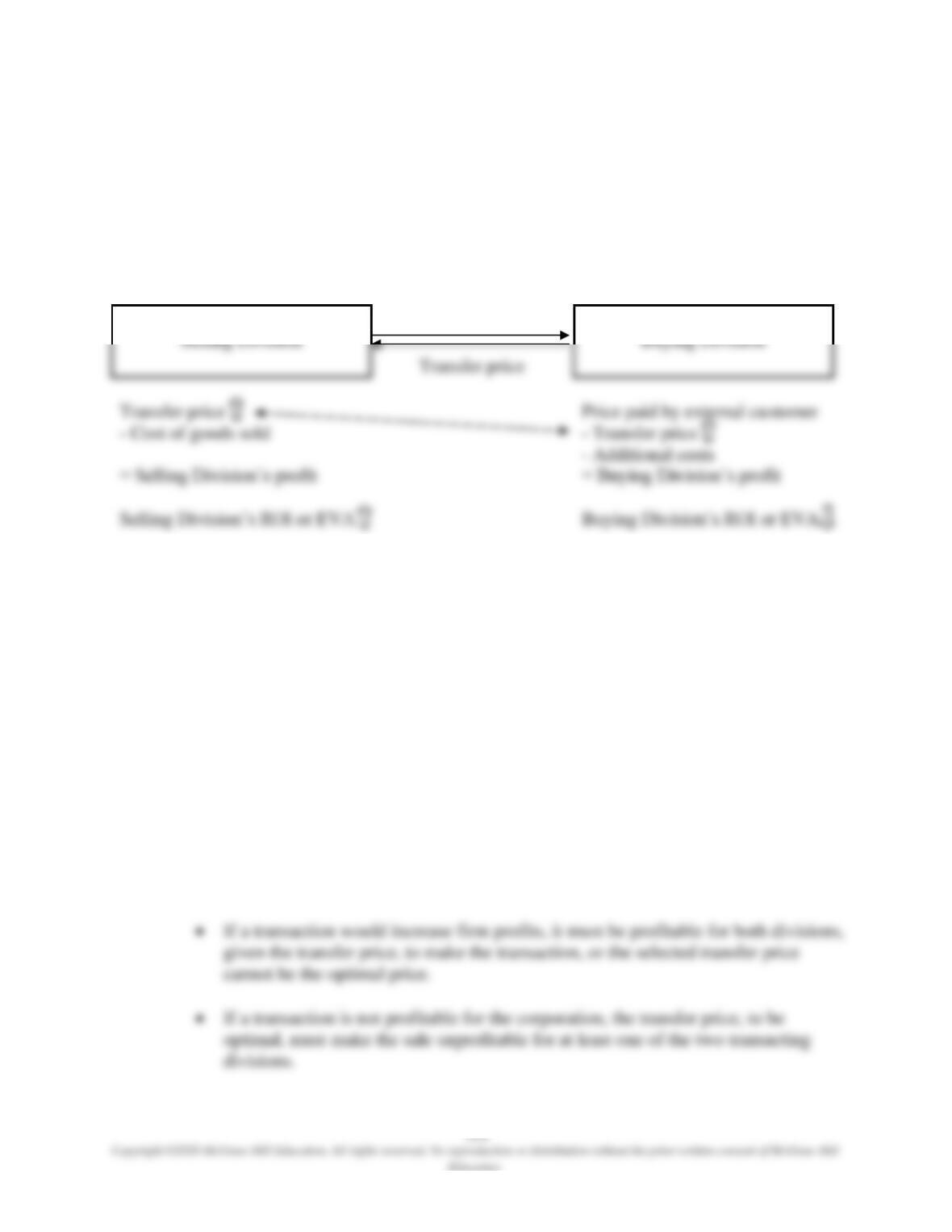
o The following diagram illustrates the relation between a selling division and a buying
division within the same organization when goods or services are exchanged internally.
The total profit calculation does not involve the transfer price used; the selling division’s
revenue from the transfer is cancelled out by the buying division’s cost for the transaction.
Goods or services
• Total profit = Selling Division’s profit + Buying Division’s profit
Total profit = Price paid by the external customer – Cost of goods sold (Selling Division)
– Additional costs (Buying Division)
• What makes the transfer price important is that it affects the division managers’ decision
about whether to engage in the transaction.
o Because the managers of both the selling division and buying division are evaluated on
division profit, they consider the effect of all sales, not just sales to customers outside the
company, on their division, not company profit.
o The definition of the transfer price can affect corporate profitability.
▪ The optimal transfer price is the price that leads both division managers, each acting
in his or her own self-interest, to make decisions that are in the firm’s interest.

▪ If business unit profitability is used to measure performance, by return on investment
(ROI) or economic value added (EVA), the transfer price will affect the evaluation of
the unit and the unit manager.
• The higher the transfer price is, the lower will be the profit (and ROI or EVA) in
the buying division and the higher the profit will be in the selling division, all
other things being equal. Refer to the previous diagram for information.
o Example 1: It costs the selling division $20 to produce one unit of a component which, if
transferred to the buying division, requires additional work costing $45 and can be sold to
outside customers for $100 per unit of the finished product. Assume that the transfer
price in question is TP. Then
Selling division’s profit (S) = TP – $20.
Buying division’s profit (B) = $100 – TP – $45.
Total profit for the firm = (TP – $20) + ($100 – TP – $45) = $35.
LO 15-2 Explain the general transfer pricing rules and understand the
underlying basis for them.
DETERMINING THE OPTIMAL TRANSFER PRICE
• The Setting
o The transfer price is a device to motivate managers to act in the best interests of the
company.
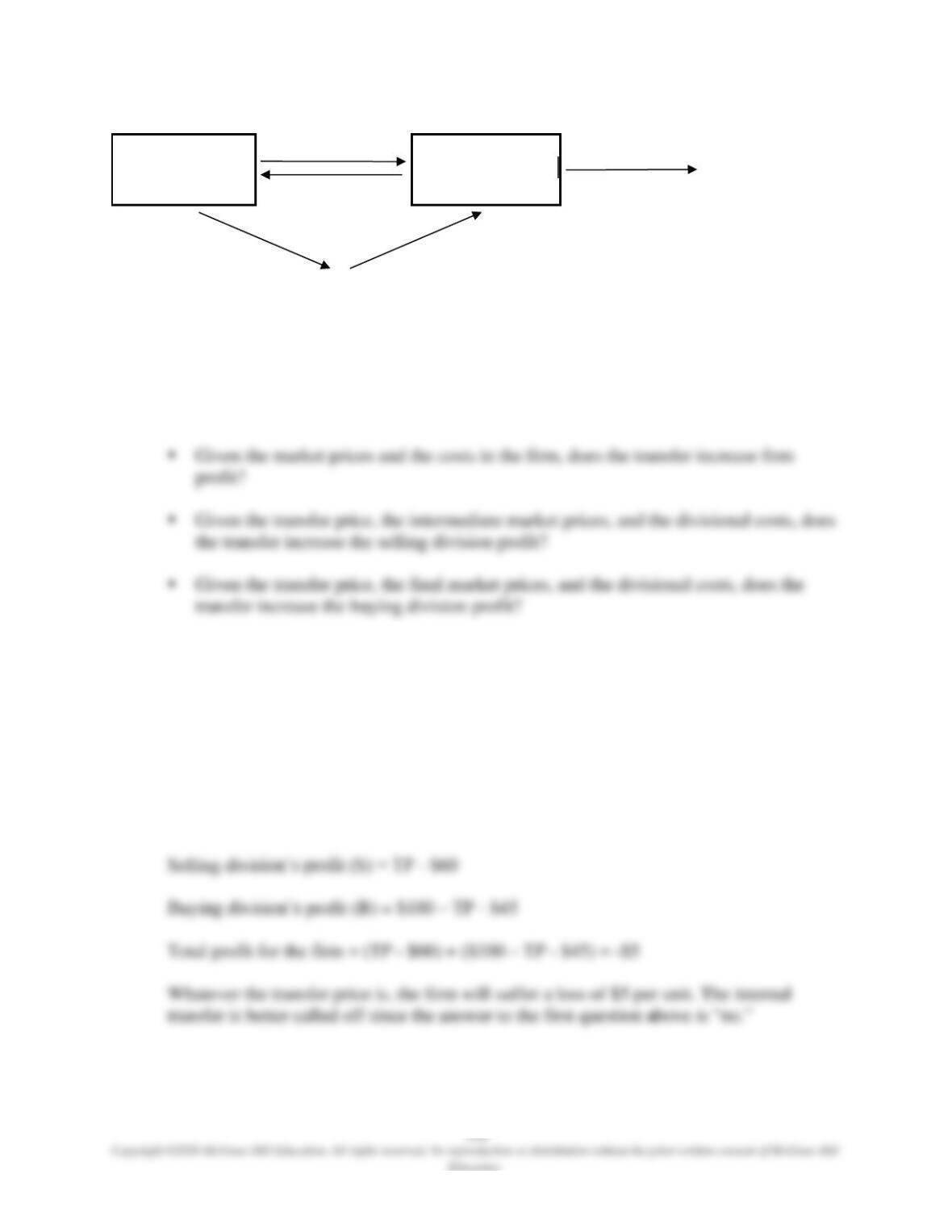
Selling Division
Goods or services
Buying Division
Final Market
Transfer price
Intermediate
Market
• Determining Whether a Transfer Price is Optimal
o There is a simple test, an application of the differential profitability analysis (discussed in
Chapter 4) to determine whether the calculated transfer price is optimal.
• If the answer to the first question is “yes,” the answers to questions 2 and 3 must
also be “yes” or the transfer price is not optimal. If the answer to the first question
is “no,” the answer to either question 2 or 3 (or both) must be “no” or the transfer
price is not optimal.
o Example 2 (Revised from Example 1): It costs the selling division $60 to produce one
unit of a component which, if transferred to the buying division, requires additional work
costing $45 and can be sold to outside customers for $100 per unit of the finished product.
Assume that the transfer price in question is TP. Then
o In determining the optimal transfer price, the important issue is the nature of the
intermediate market where the goods are being transferred. Two cases are considered:
o A market is perfect if buyers can buy and sellers can sell any quantity without affecting
the price.
• Case 1: A Perfect Intermediate Market for Milk
o The product being sold in a perfect market is not differentiated by quality, service, or
other characteristics.
o The parties in a perfect market are “price takers.”
o Given the optimal transfer price, the two division managers acting independently will
make the transfer that the corporate staff would set if it had all the information that the
division managers have. (See Business Application box “Transfer Pricing in State-Owned
Enterprises.”)
▪ With an efficient transfer pricing system like this, when external markets (both
intermediate and final) change, there is no need to change the transfer price policy.
• Case 2: No Intermediate Market
o If there is no intermediate market for the goods being transferred, or the company has
decided that it will not allow the divisions to buy or sell the items externally, then the
only outlet for the selling division is the buying division, and the only source of supply
for the buying division is the selling division.
▪ To be the optimal transfer price in general, it cannot depend on the current external
price.
o Example 3 (Revised from Example 1): It costs the selling division $20 (variable cost only)
to produce one unit of a component which, if transferred to the buying division, requires
additional work costing $45 and can be sold to outside customers for $100 per unit of the
finished product. There is no intermediate market for the component in question.
The selling division’s fixed cost is not a factor because it is unavoidable (therefore not
differential). The selling division will not accept a transfer price below $20, the variable
cost per unit.
Given the final market price of $100 and the additional cost of $45 to make the
component salable, the buying division will not pay more than $55 for the part.
If the final market price drops to $65 (= selling division’s variable cost of $20 + buying
division’s additional cost of $45) or lower, no internal transfer should take place as the
firm will suffer a loss.
With a final market price of $65 or more, the internal transfer benefits the firm. The
optimal transfer price should be set at the variable cost of the selling division to ensure
steady exchanges between the two divisions.
OPTIMAL TRANSFER PRICE: A GENERAL PRINCIPLE
• The transfer price that is optimal represents the value of the goods being transferred to the
buying division at the transfer point.
• Other Market Conditions
o Case in Which Milk Division Is at Capacity
In the case of a perfect intermediate market, the value to the buying division is equal to
what it can be sold for in the intermediate market (i.e., intermediate market price).
o Imperfect Intermediate Markets
▪ If there is no intermediate market, there is no opportunity cost and the only cost is the
variable, or outlay cost. The transfer price should be set accordingly.
APPLYING THE GENERAL PRINCIPLE
• The general principle can be easily applied with the following two general rules when
establishing a transfer price.
o If an intermediate market exists, the optimal transfer price is the market price.
o If no intermediate market exists, the optimal transfer price should be the outlay cost for
producing the goods (generally, the variable costs).
▪ This transfer price ensures that if the managers make the correct decision for their
divisions, the result (transfer or no transfer) will also be the correct decision for the
firm.
LO 15-3 Identify the behavioral issues and incentive effects of negotiated
transfer prices, cost-based transfer prices, and market-based
transfer prices.
HOW TO HELP MANAGERS ACHIEVE THEIR GOALS WHILE ACHIEVING THE
ORGANIZATION’S GOALS
• A conflict can occur between a company’s interests and the divisional manager’s interests
when transfer price-based performance measures are used.
o The general transfer pricing rules are easy to state but difficult to apply in practice.
o There are three general approaches to this type of problem in a decentralized organization:
o Direct intervention by top management
▪ If the transfer is an extraordinarily large order, or if internal transfers are rare, direct
intervention could be the best solution to the problem.
▪ The disadvantages of direct intervention are that:
▪ As long as transfer pricing problems are infrequent, the benefits of direct intervention
could outweigh the costs.
TOP MANAGEMENT INTERVENTION IN TRANSFER PRICING
• A transfer pricing policy should allow divisional autonomy yet encourage managers to
pursue corporate goals consistent with their division goals. The policy should also consider
the performance evaluation system used and the impact that alternative transfer prices will
have on managerial performance evaluation.
o Corporate managers have two economic bases on which to establish transfer price
policies: market prices and cost.
CENTRALLY ESTABLISHED TRANSFER PRICING POLICIES
• Establishing a Market Price Policy
o Market price-based transfer pricing is a transfer pricing policy that sets the transfer
price at the market price or at a small discount from the market price.
o Two general guidelines for market price-based transfer pricing are:
o Externally based market prices are generally considered the best basis for transfer pricing
when a competitive market exists for the product and when market prices are readily
available.
▪ Usually, there are differences between products produced internally and those that
can be purchased from outsiders, such as costs, quality, or product characteristics.
• Establishing a Cost-Basis Policy
o A cost-based transfer pricing policy should adhere to the following rule:
▪ Transfer at the differential outlay cost to the selling division (typically variable costs)
plus the foregone contribution to the company of making the internal transfers ($0 if
the seller has idle capacity; selling price minus the variable costs if the seller is
operating at capacity).
▪ The transfer pricing rule can be implemented as follows:
• Alternative Cost Measures
o Full Absorption Cost-Based Transfers
▪ Full-absorption costs are higher than variable costs, but probably less than the market
price.
• The use of full absorption costs does not necessarily lead to the profit-maximizing
solution for the company.
▪ Full absorption cost has some advantages:
o Cost-Plus Transfers
▪ Cost-plus transfer pricing is a transfer pricing policy based on a measure of cost
(full costing or variable costing, actual or standard cost) plus an allowance for profit.
• If actual costs are used as a basis for the transfer, any variances or inefficiencies
in the selling division are passed to the buying division.
o Standard Costs or Actual Costs
• Remedying Motivational Problems of Transfer Pricing Policies
o When the transfer pricing policy does not give the selling division a profit on the transfer:
o Dual Transfer Prices
▪ Dual transfer pricing is a transfer pricing system that charges the buying division
with costs only and credits the selling division with cost plus some profit allowance.
The difference could be accounted for in a specialized centralized account.
• This system would preserve the cost data for subsequent buyer divisions and
would encourage internal transfers by providing a profit on such transfers for the
selling divisions.
▪ Example 4 (Revised from Example 1): It costs the selling division $20 to produce one
unit of a component which, if transferred to the buying division, requires additional
work costing $45 and can be sold to outside customers for $100 per unit of the
finished product.
Selling Division:
Accounts Receivable – Buying Division
20
Intercompany Sales in Excess of Assigned Costs
3
Intercompany Sales
23
Intercompany Cost of Goods Sold
20
Finished Goods
20
Buying Division:
Inventory
20
Accounts Payable – Selling division
20
▪ Disadvantages of dual price system are:
NEGOTIATING THE TRANSFER PRICE
• Negotiated transfer pricing is a system that arrives at the transfer prices through negotiation
between managers of buying and selling divisions.
o The managers involved in negotiation should act in much the same way as the managers
of independent firms.
▪ The negotiated prices are generally between the market price at the upper limit and
some measure of cost at the lower limit.
o The major advantage to negotiated transfer pricing is that it preserves the autonomy of
the division managers.
o Two disadvantages of negotiated transfer pricing are:
o Management tends to settle for a transfer pricing system that seems to work reasonably
well when both the costs and benefits of the system are considered.
IMPERFECT MARKETS
• Transfer pricing can be quite complex when selling and buying divisions cannot sell and buy
all they want in perfectly competitive markets.
o In some cases, there may be no outside market at all. In others, the market price could
depend on how many units the divisions want to buy or sell on the market.
top management prefers.
o In extreme cases, the transfer pricing problem is so complex that top management
reorganizes the company so that buying and selling divisions report to one manager who
oversees the transfers.
GLOBAL PRACTICES
• The authors of surveys of corporate practices (summarized in Exhibit 15.5) report that nearly
45 percent of the U.S. companies surveyed use a cost-based transfer pricing system, 33
percent use a market price–based system, and 22 percent use a negotiated system. Similar
results have been found for companies in Canada and Japan.
o Generally, when negotiated prices are used, they are between the market price at the
upper limit and some measure of cost at the lower limit.
LO 15-4 Explain the economic consequences of multinational transfer prices.
MULTINATIONAL TRANSFER PRICING
• In international (or interstate) transactions, transfer prices may affect tax liabilities, royalties,
and other payments because of different laws in different countries (or states or provinces).