15
Transfer Pricing
Solutions to Review Questions
15–1.
15–2.
Yes, transfer prices exist in centralized organizations to record the transfer of goods and
15–3.
Market-based transfer pricing is considered optimal under many circumstances because it
15–4.
The key limitation is that market prices are often not readily available. The limitations of
15–5.
Direct intervention might be preferable when transfers between units are rare or where the
decision resulting from decentralized decision-making is considered too harmful to allow.
15–6.
Reasons not to use market prices include situations where: (1) market prices are not
15–7.
When actual costs are used as a basis for the transfer, any variances or inefficiencies in
15–8.
The advantage of negotiated transfer prices is that they can be used when market prices
15–9.
The general transfer pricing rule is:
15–10.
Transfer pricing is important in tax accounting, because transfers of goods or services
15–11.
Solutions to Critical Analysis and Discussion Questions
15–12.
15–13.
A cost-based or negotiated cost-based transfer pricing method would be necessary. We
15–14.
15–15.
15–16.
The transfer price becomes revenue for the selling segment and a cost to the buying
15–17.
Because transfer prices can affect the assignment of income from one jurisdiction to
15–18.
Transfer prices are similar to cost allocations in that they assign costs (and profit) to two or
15–19.
Corporate cost allocation is similar to transfer pricing where the “service” being transferred
Solutions to Exercises
15–20. (20 min.) Apply Transfer Pricing Rules: Best Practices, Inc.
15–21. (15 min.) Evaluate Transfer Pricing System: Clinton Corporation
a. If Alpha Division buys from outsiders because the transfer price is greater than $90,
15–22. (15 min.) Evaluate Transfer Pricing System
With the possibility of increased production, Maryland Division has an opportunity cost of
15–23. (20 min.) Evaluate Transfer Pricing System.
a.
Northeast
Southwest
Company
Transfer internally
Pays
$32
Receives
$30
Pays
$ 2
Pays
$11
Pays
11
Pays
Sell externally
Pays
$31
Receives
$30
Pays
Pays
Pays
b.
Northeast
Southwest
Company
Transfer internally
Pays
$32
Receives
$30
Pays
$ 2
Pays
Pays
Pays
15–24. (25 min.) Evaluate Transfer Pricing System: Seattle Transit Ltd.
a. Different prices:
(1) The opportunity cost might be considered the regular fare of $2.00 less the $0.50
15–25. (25 min.) Evaluate Transfer Pricing System: BGTS.
Total
Ms. Seville’s
Shares
(60% and
20%)
Mr. Turco’s
Shares
(40% and
60%)
15–26. (25 min.) International Transfer Prices–Ethical Issues: Trans Atlantic
Metals.
a. Analyze the tax liabilities in each jurisdiction using the alternative transfer prices. If the
transfer price is $30 million, the tax liabilities are:
Finland
U.S.
Sales revenue …………………………………………….
$30,000,000
$150,000,000
Third-party costs ………………………………………….
20,000,000
60,000,000
Transferred goods costs ……………………………….
Total costs ………………………………………………….
Taxable income …………………………………………..
Tax rate ……………………………………………………..
Tax liability ………………………………………………….
Total tax liability …………………………………………..
If the transfer price is $40 million, the tax liabilities are computed as follows:
Finland
U.S.
Sales revenue …………………………………………….
$40,000,000
$150,000,000
Third-party costs ………………………………………….
Transferred goods costs ……………………………….
Total costs ………………………………………………….
Taxable income …………………………………………..
Tax rate ……………………………………………………..
Tax liability ………………………………………………….
Total tax liability …………………………………………..
15–27. (20 min.) Transfer Pricing Policies – Ethical Issues: Best Practices, Inc.
a. As in 15-20, the minimum transfer price that the Corporate Division should obtain is
15–28. (20 min.) Evaluate Transfer Pricing System: San Jose Company.
15–29. (20 min.) International Transfer Prices: San Jose Company.
This exercise is designed to illustrate the conflict between the use of a transfer price to
motivate managerial decision making and the desire to minimize corporate taxes.
Ignoring the tax issues, leads to the same answers as in Exercise 15-28. However,
from a tax perspective, the company would prefer to be taxed in Country B (with a tax
rate of 40%) instead of Country A (with a tax rate of 60%). From a tax perspective,
15–30. (20 min.) Evaluate Transfer Pricing System: Dual Rates: Atascadero
Industries.
c. Although the dual-rate system allows both Division managers to show relatively high
profits, it suffers from the following defects. First, the total profit to the two divisions will
15–31. (20 min.) International Transfer Prices: Atascadero Industries.
This exercise is designed to illustrate the conflict between the use of a transfer price to
motivate managerial decision making and the desire to minimize corporate taxes.
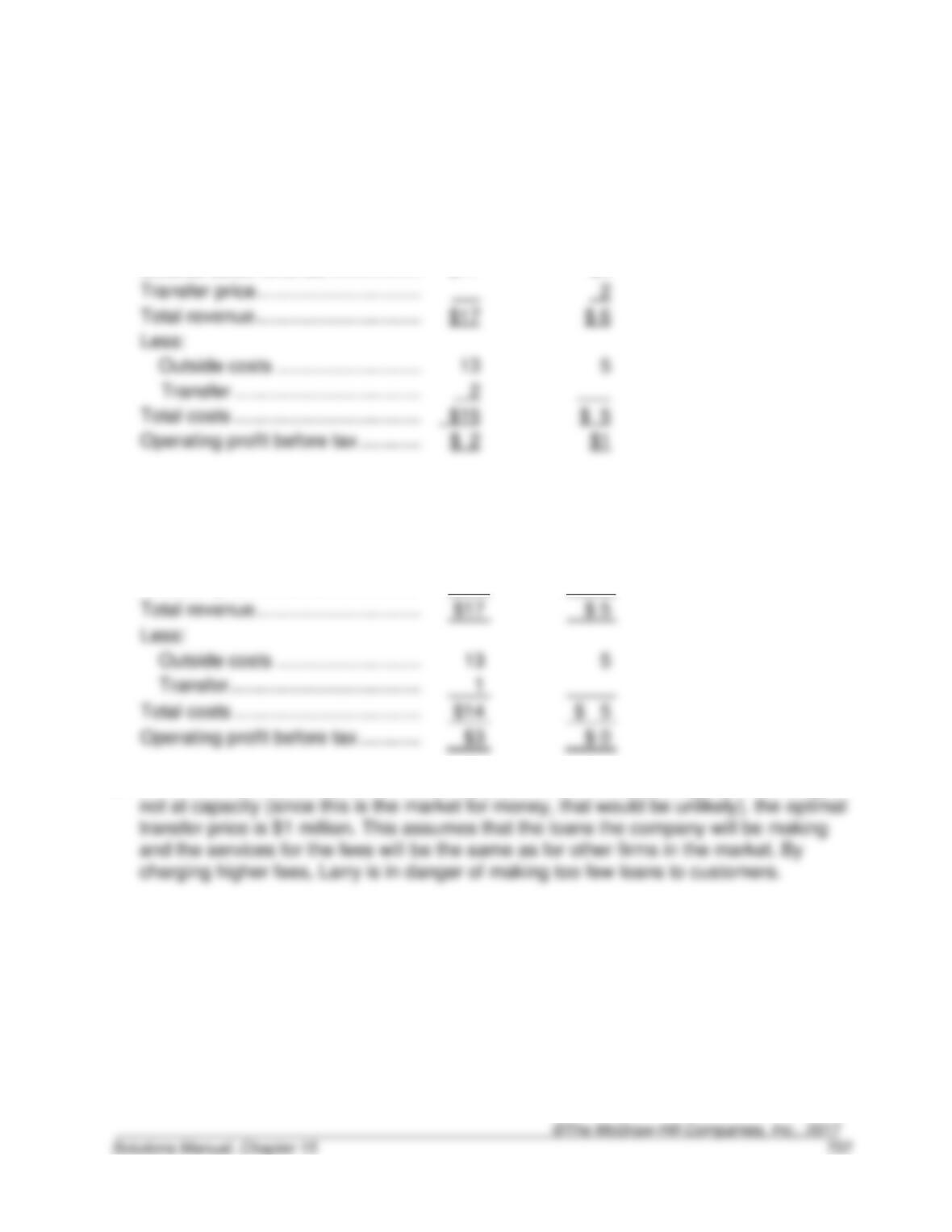
15–32. (30 min.) Segment Reporting: Leapin’ Larry’s Pre-Owned Cars
($ in millions)
a. Using a $2 million transfer price:
Item
Operation
Division
Financing
Division
Outside sales revenue …………………………………
$17
$4
Transfer price ……………………………………………..
Total revenue ……………………………………………..
$17
Less:
Total costs …………………………………………………
b. Using a $1 million transfer price:
Item
Operation
Division
Financing
Division
Outside sales revenue …………………………………
$17
$4
Transfer price ……………………………………………..
1
Total revenue ……………………………………………..
Less:
Total costs …………………………………………………
Operating profit before tax …………………………...
$3
c. If the commercial rate for loan fees is really $1 million and assuming that Financing is
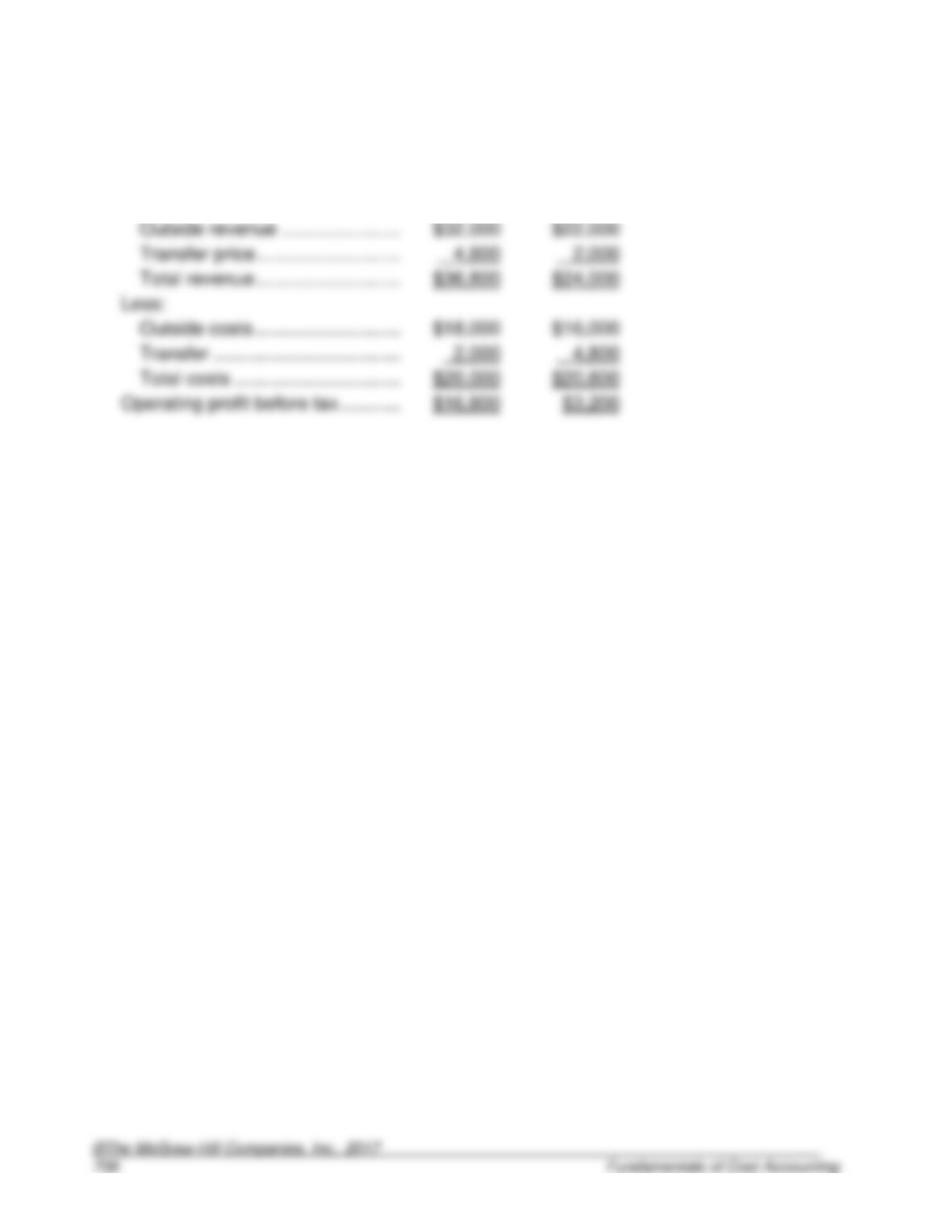
15–33. (30 min.) Segment Reporting: Perth Corporation.
($000)
Item
Casino
Hotel
Revenue:
Outside revenue ………………………………………
Total revenue …………………………………………..
Less:
Transfer ………………………………………………….
Total costs ………………………………………………
Solutions to Problems
15–34. (30 min.) Transfer Pricing With Imperfect Markets—ROI Evaluation, Normal
Costing: Oxford Company.
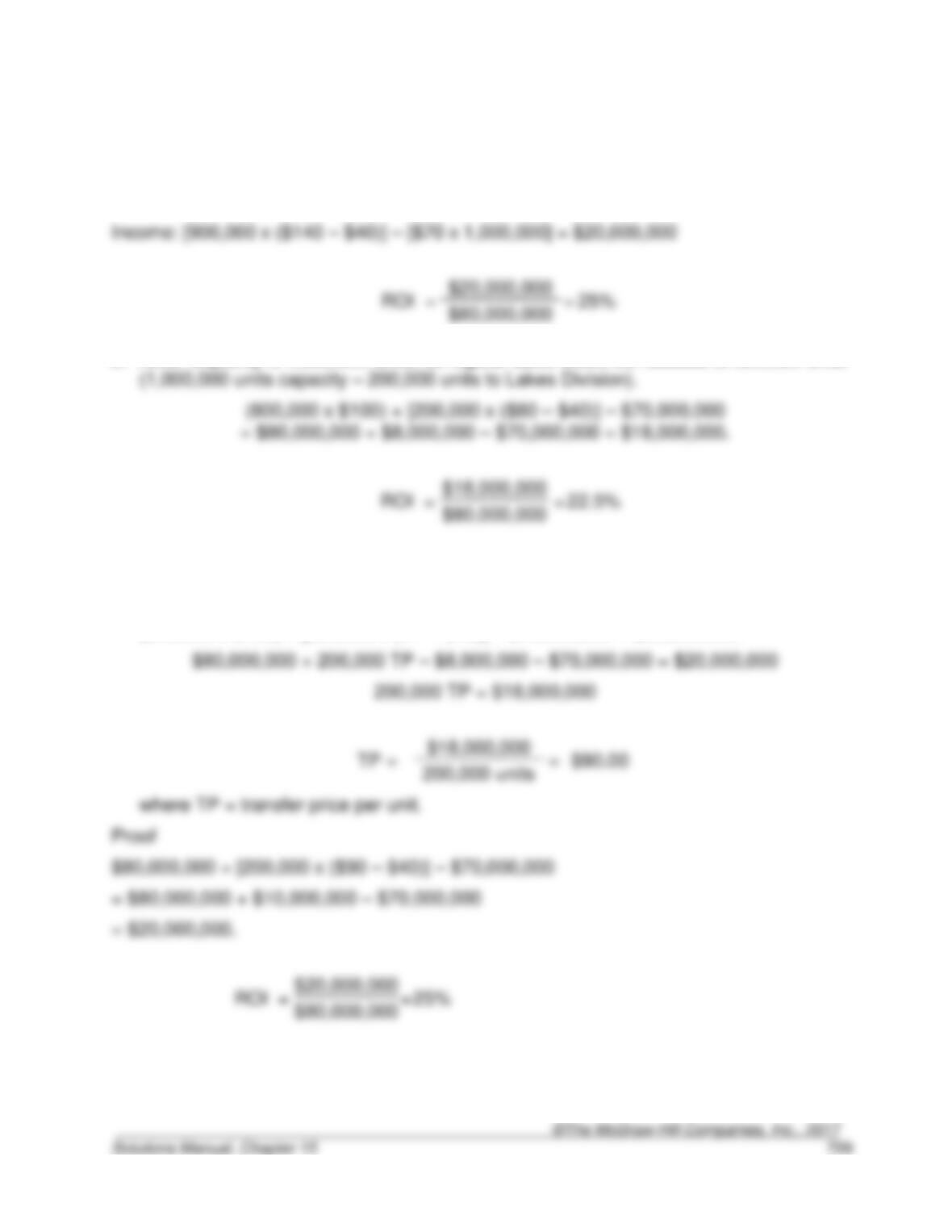
a. ROI for Thames Division.
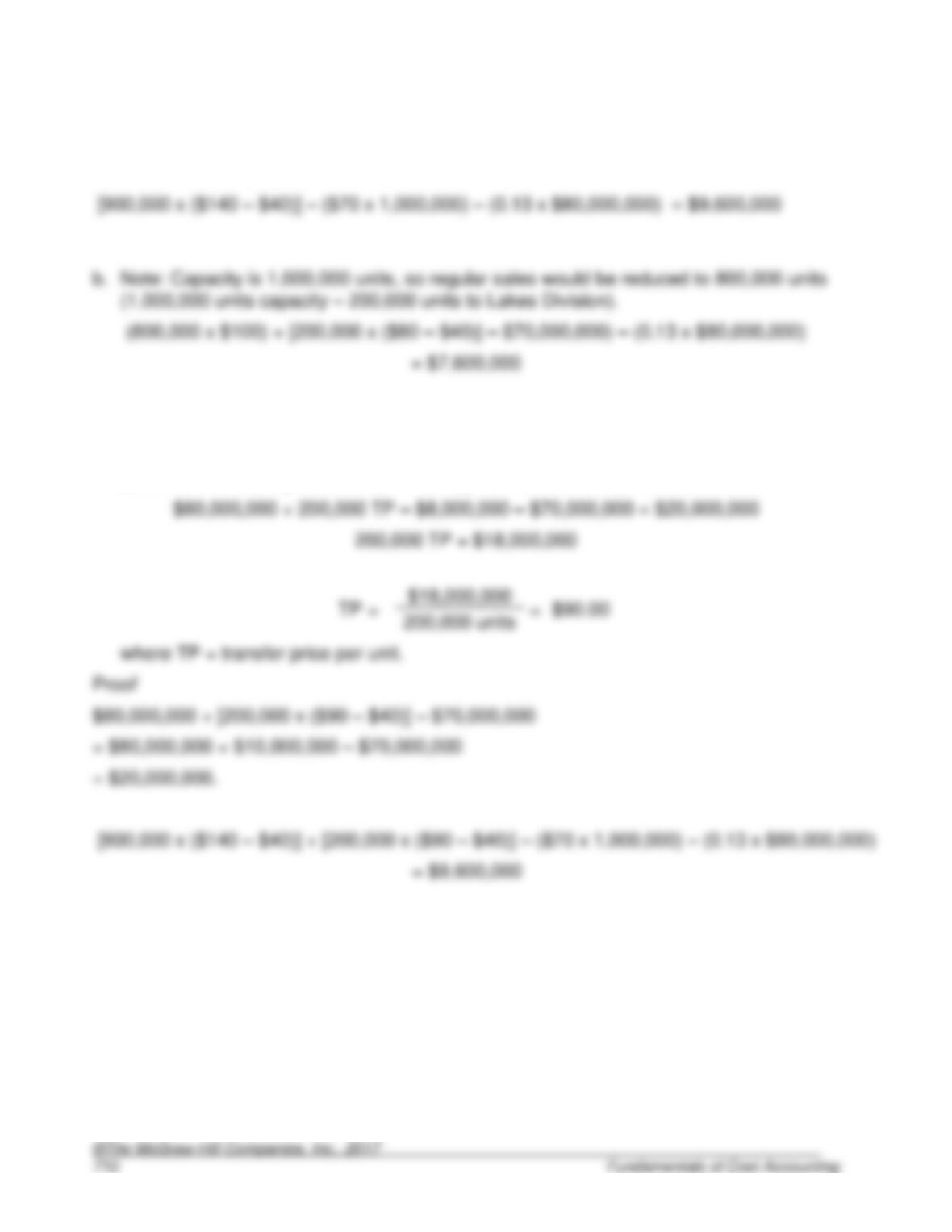
b. Note: Capacity is 1,000,000 units, so regular sales would be reduced to 800,000 units
c. Because the investments will not change, we can determine the price by setting the
two incomes equal:
(800,000 x $100) + [200,000 x (TP – $40)] – $70,000,000 = $20,000,000
15–35. (30 min.) Transfer Pricing With Imperfect Markets—RI Evaluation, Normal
Costing: Oxford Company.
a. RI for Thames Division.
c. Because the investments will not change, we can determine the price by setting the
two incomes equal:
(800,000 x $100) + [200,000 x (TP – $40)] – $70,000,000 = $20,000,000
15–36. (50 min.) Evaluate Profit Impact of Alternative Transfer Decisions: Amazon
Beverages.
(All calculations are in $000.)
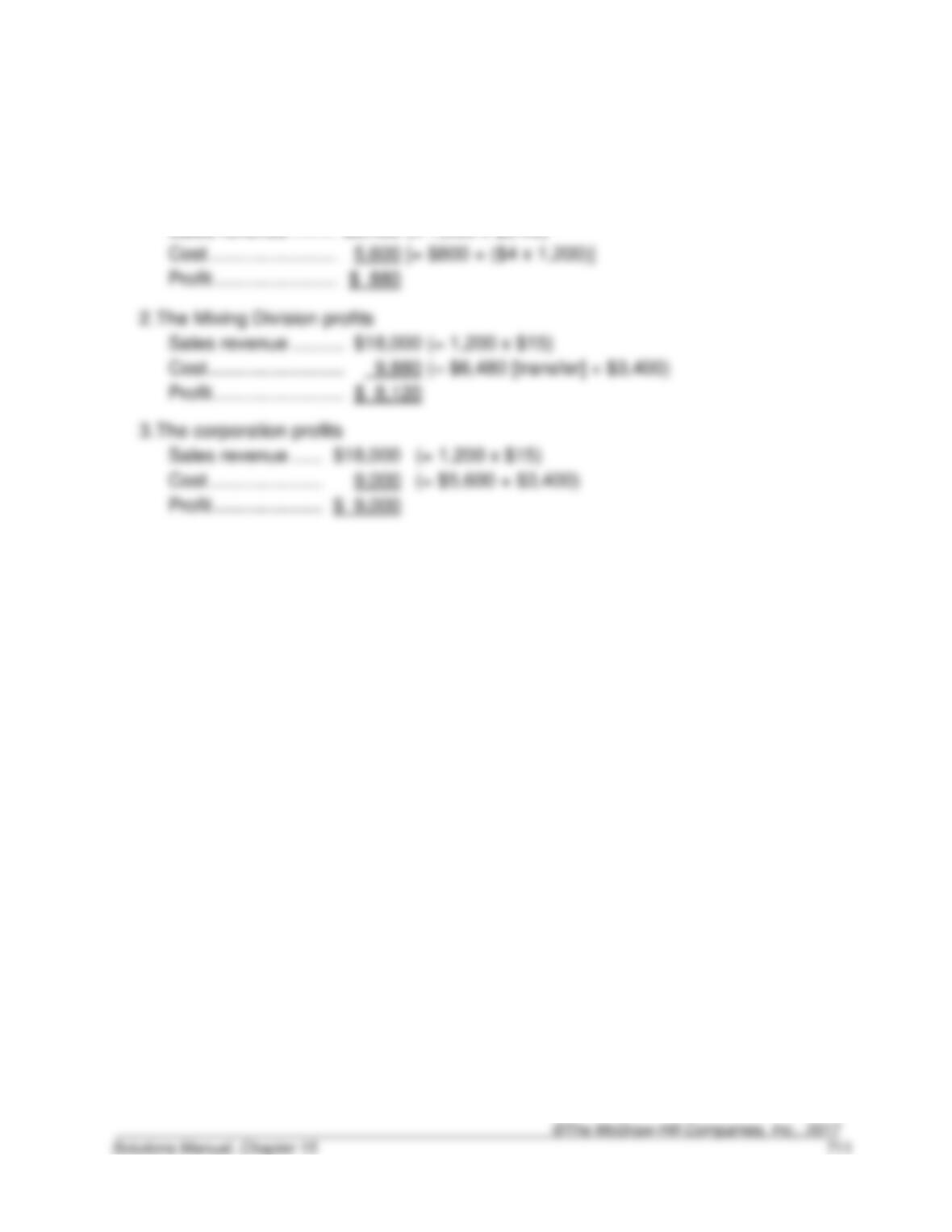
a. 1. The Container Division profits
Sales revenue …………………………………………….
$6,480
(= 1,200 x $5.40)
Sales revenue …………………………………………….
(= 1,200 x $15)
Sales revenue …………………………………………….
(= 1,200 x $15)
15-36. (continued)
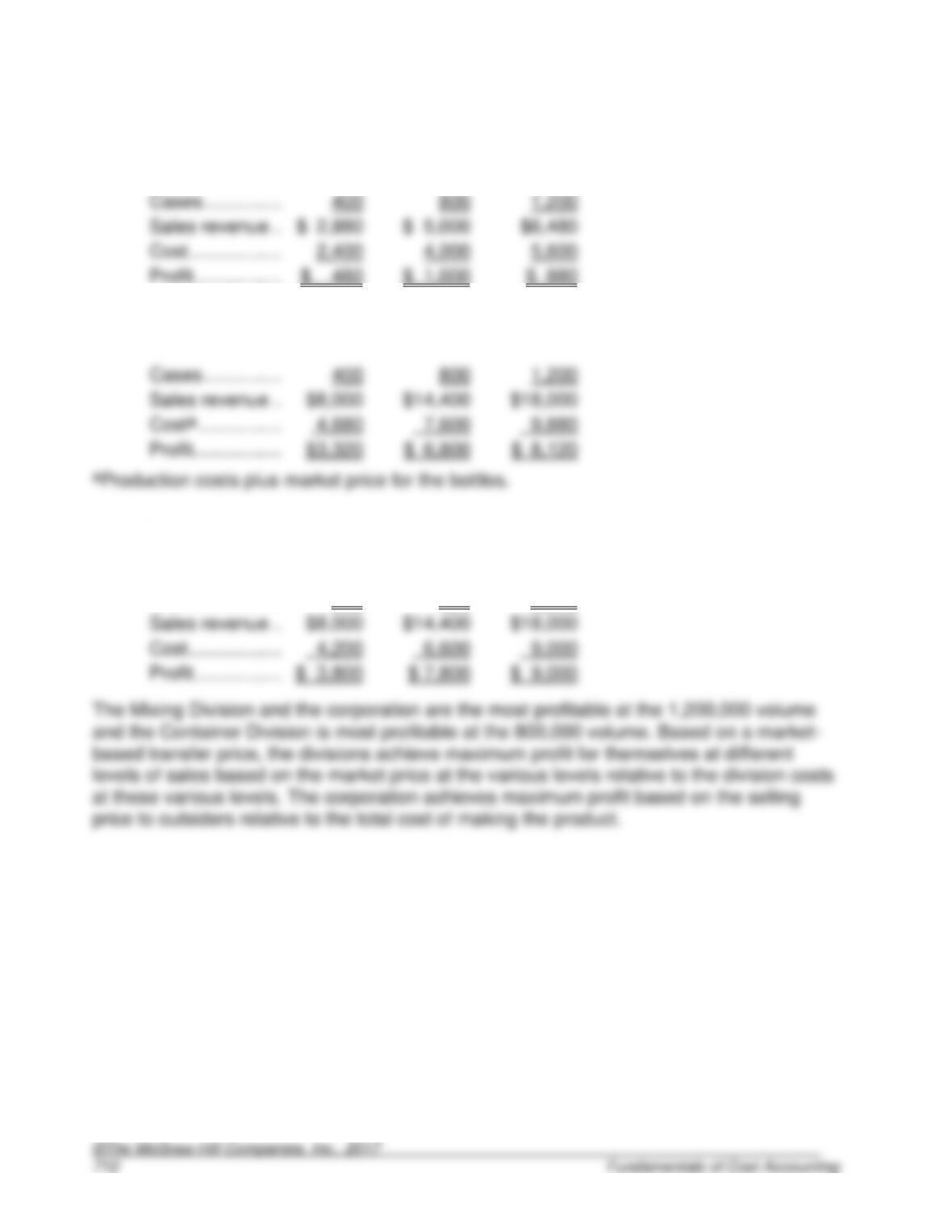
b. 1. No
Container Division Volumes
Cases ………………………………………………………..
800
1,200
5,600
2. Yes
Mixing Division Volumes
3. Yes
Corporation Volumes
Cases ………………………………………………………..
400
800
1,200
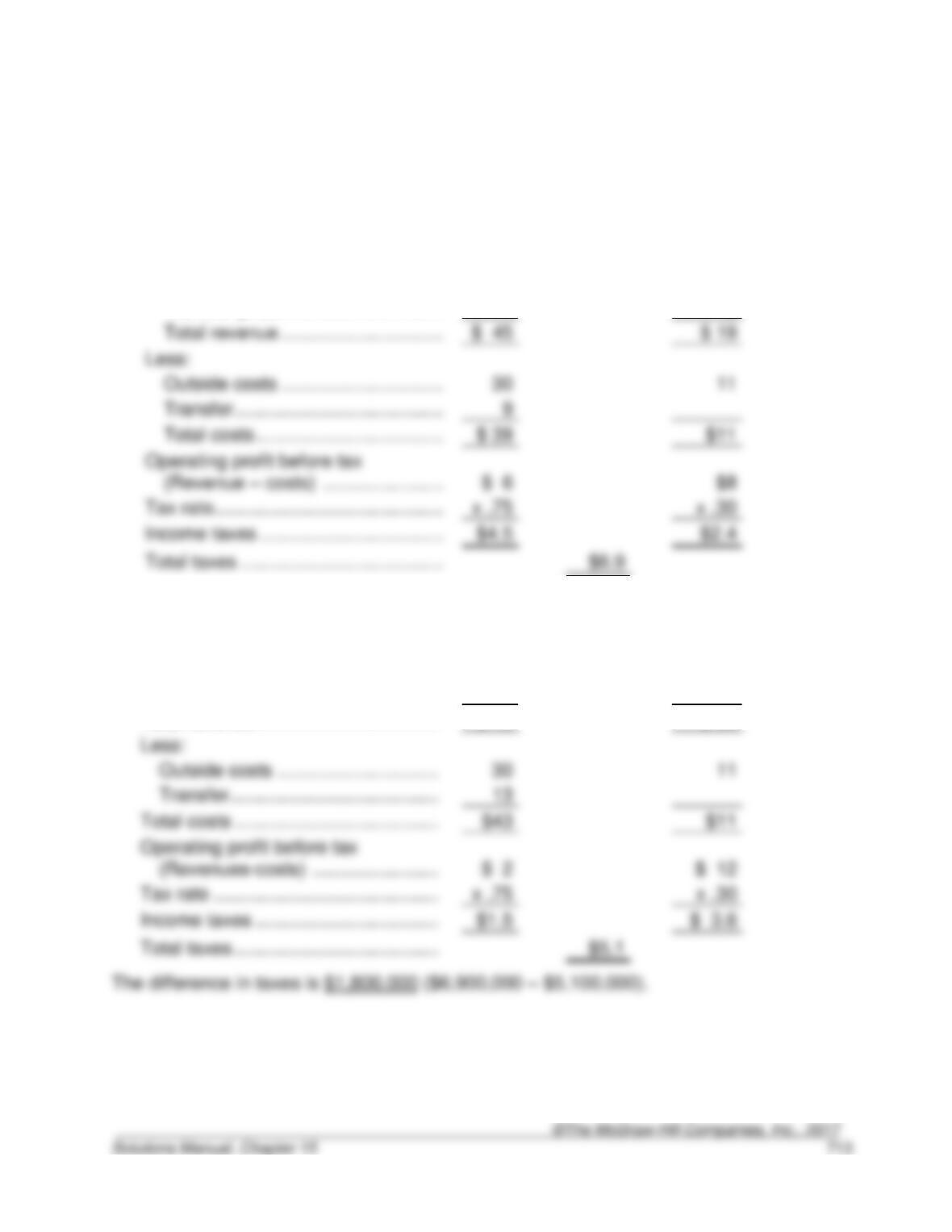
15–37. (40 min.) International Transfer Prices: Skane Shipping, Ltd.
All revenues and costs are in millions of dollars.
• Malaysian basis for transfer price:
Item
Shipping
Company
Dock
Facility
Sales revenue:
Outside sales revenue ………………………………
$ 45
$ 10
Transfer price …………………………..……………..
9
Total revenue ………………………………………….
Less:
Transfer ………………………………………………….
9
Total costs ………………………………………………
$ 39
$11
Operating profit before tax
(Revenue – costs) …………………………………..
$ 6
$8
Tax rate ……………………………………………………..
x .30
Income taxes ……………………………………………..
$4.5
$2.4
Total taxes …………………………………………………
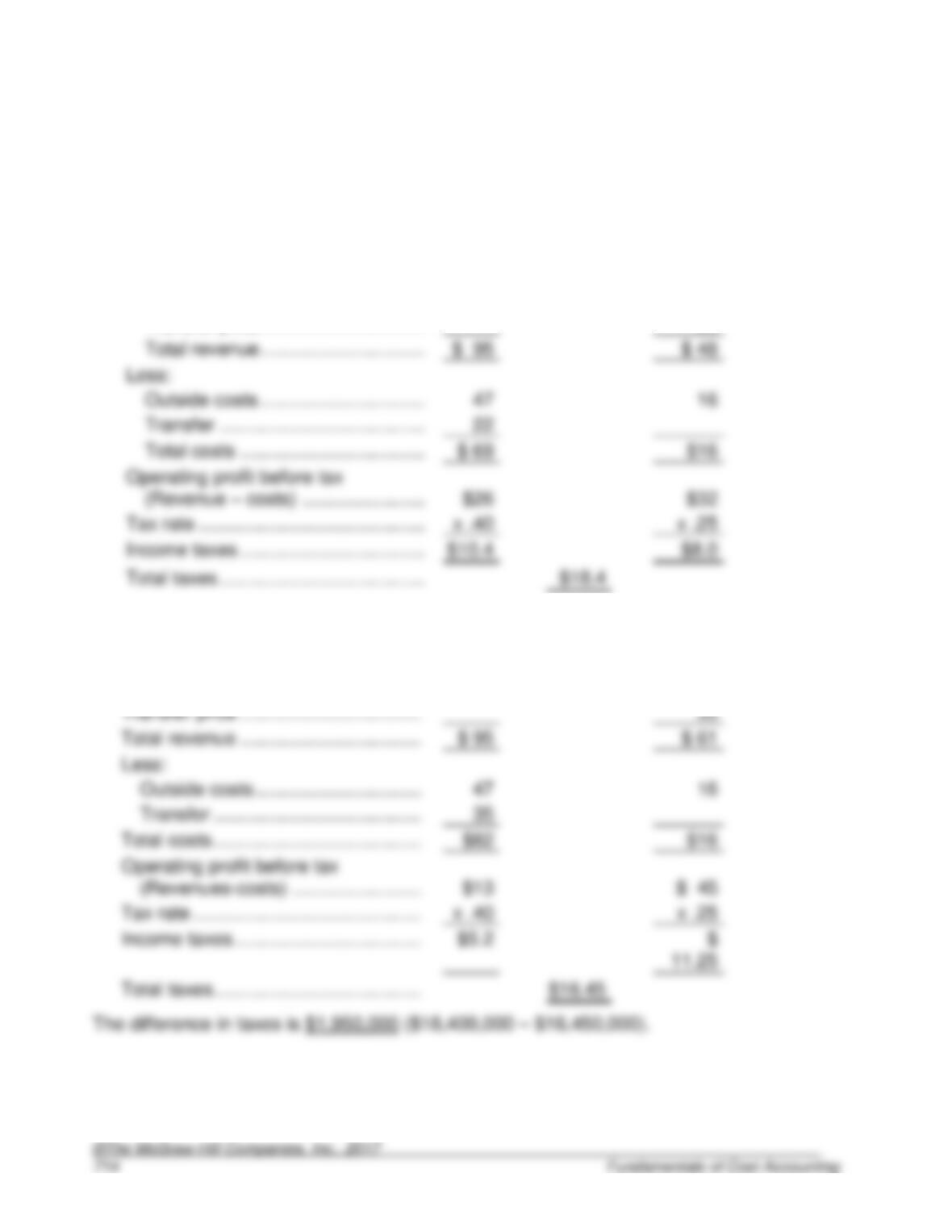
• Sweden basis for transfer price:
Item
Shipping
Company
Dock
Facility
Outside sales revenue …………………………………
$ 45
$10
Transfer price……………………………………………..
13
Total revenue ……………………………………………..
$ 45
$ 23
Less:
Outside costs ………………………………………….
11
Transfer ………………………………………………….
Total costs …………………………………………………
$43
Operating profit before tax
(Revenues-costs) ……………………………………
$ 2
$ 12
Tax rate …………………………………………………….
x .30
Income taxes ……………………………………………..
$1.5
Total taxes …………………………………………………
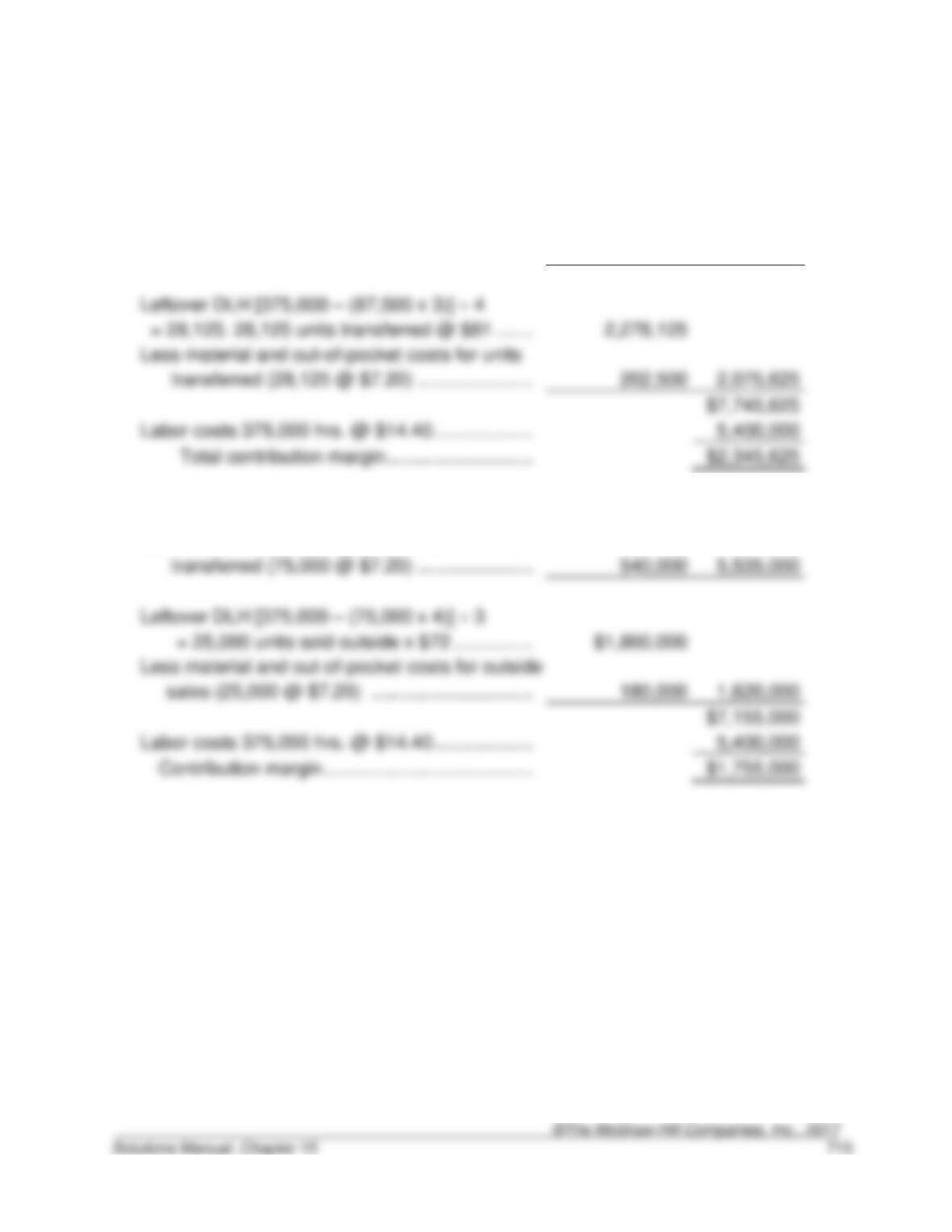
15–38. (40 min.) International Transfer Prices: Badger Air.
All revenues and costs are in millions of dollars.
• Philippine basis for transfer price:
Item
Cargo
Division
Maintenance
Division
Sales revenue:
Outside sales revenue ………………………………
$ 95
$ 26
Transfer price …………………………………………..
22
Total revenue …………………………………………..
Less:
Outside costs …………………………………………..
Transfer ………………………………………………….
Total costs ………………………………………………
Operating profit before tax
(Revenue – costs) ……………………………………
$32
Tax rate ……………………………………………………..
x .25
Income taxes ………………………………………………
$8.0
Total taxes ………………………………………………….
• US basis for transfer price:
Item
Cargo
Division
Maintenance
Division
Outside sales revenue ………………………………….
$ 95
$26
Transfer price ……………………………………………..
Total revenue …………………………..…………………
Less:
Outside costs …………………………………………..
Transfer ………………………………………………….
Total costs ………………………………………………….
$16
Operating profit before tax
(Revenues-costs) …………………………………….
$ 45
Tax rate ……………………………………………………..
x .25
Income taxes ………………………………………………
Total taxes ………………………………………………….
$16.45
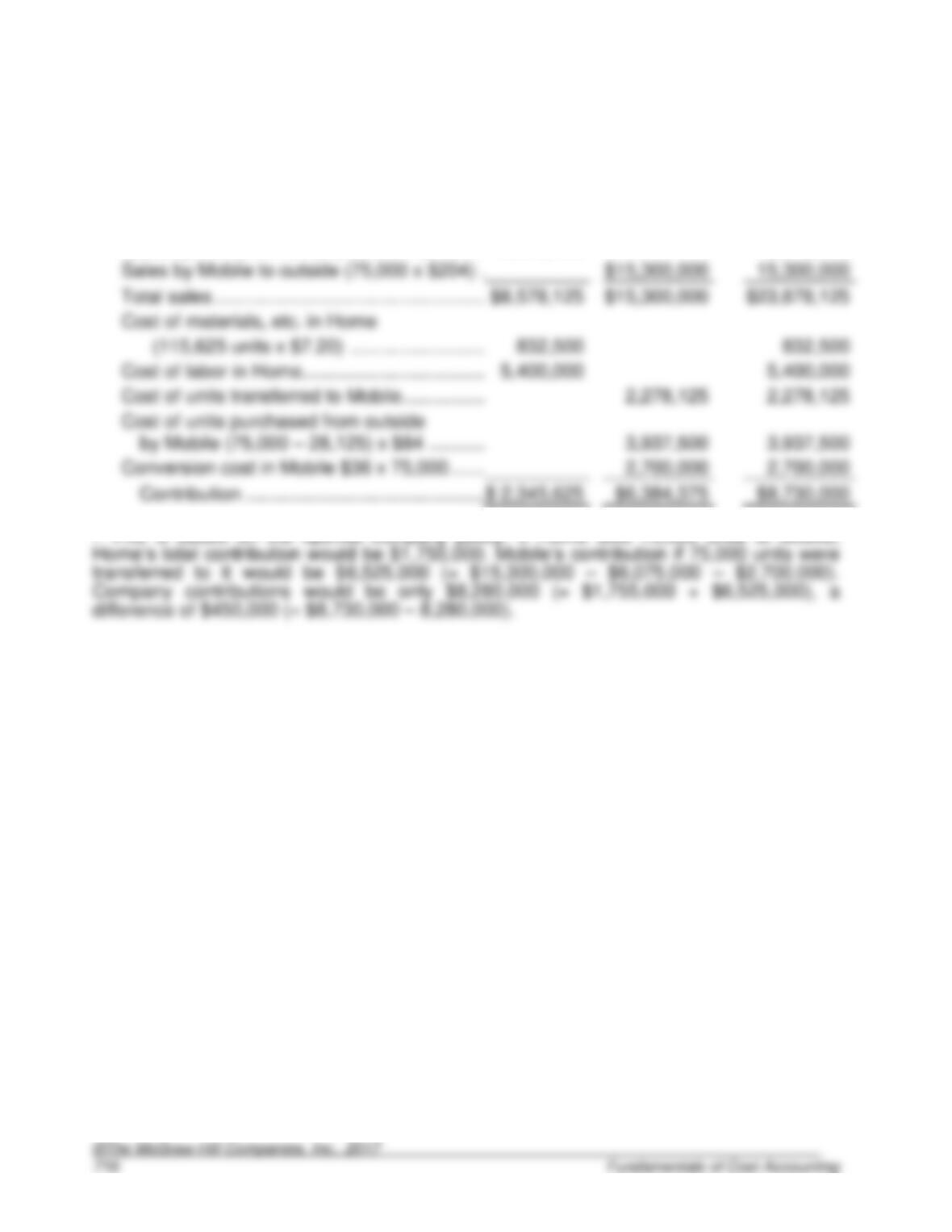
15–39.
(60 min.) Analyze Transfer Pricing Data: Elsinore Electronics.
a. If Home sells 87,500 units to outside
Outside sales revenue 87,500 @ $72.00 ………..
$6,300,000
Less material and out-of-pocket costs for outside
sales (87,500 @ $7.20) ………………………….
630,000
$5,670,000
Less material and out-of-pocket costs for units
transferred (28,125 @ $7.20) ………………….
Labor costs 375,000 hrs. @ $14.40 ……………….
b. If Home sells 75,000 units to Mobile
Units transferred 75,000 @ $81 …………………….
$6,075,000
transferred (75,000 @ $7.20) ………………….
540,000
Less material and out-of-pocket costs for outside
sales (25,000 @ $7.20) ………………………….
Labor costs 375,000 hrs. @ $14.40 ……………….
Contribution margin ………………………………….
Less material and out-of-pocket costs for units
15-39. (continued)
c. and d.a
Home
Mobile
Company
Sales by Home to outside (87,500 x $72)………..
$6,300,000
$6,300,000
Sales by Home to Mobile (28,125 x $81) ………..
2,278,125
2,278,125
Sales by Mobile to outside (75,000 x $204) …….
15,300,000
Total sales ………………………………………………….
$8,578,125
Cost of labor in Home …………………………………..
Cost of units transferred to Mobile ………………….
2,278,125
by Mobile (75,000 – 28,125) x $84 ……………..
Conversion cost in Mobile $36 x 75,000 ………….
Contribution …………………………………………….
$ 2,345,625
a This is based on the optimal company policy. If Home sold 75,000 units to Mobile,
15-39 (continued)
Alternative approach.
The following is an alternative approach to determining the optimal company policy that
uses the concepts of chapter 4.
The scarce resource in this company is labor-hours. Regardless of the production plan,
the company will use 375,000 labor-hours (the maximum) because Home production for
both their own market and the Mobile market is profitable.
The value of a labor-hour used in the two alternatives is:
Used in Regular
Home Units
Used in Units
Transferred to
Mobile
Value of 1 unit …………………………………………….
$72.00
$84.00
Material and out-of-pocket cost ……………………..
7.20
7.20
Hours to make 1 unit ……………………………………
15–40. (40 min.) Transfer Pricing—Performance Evaluation Issues: Pima
Corporation.
a. Border would not supply Metro with the thermal switch for the $60 per unit price.
b. Pima would be $66 better off, in the short run, if Border supplied Metro the switch for
$60 and the kitchen appliance was sold for $594 plus markup. Assuming the $96 per
c. In the short run there is an advantage to Pima of transferring the switch at the $60
CMA adapted.
15–41. (30 min.) Evaluate Transfer Price System: Weaver, Inc.
The purpose of this problem is to illustrate possible problems that can arise when
applying static rules, such as determining the optimal transfer price in a series of
decisions over time.
15–42. (40 min.) Evaluate transfer price system: Western States Supply.
a. Northwest division management’s attitude at the present time should be positive to
each of these prices in decreasing order (obviously preferring a higher to lower price)
b. Negotiation between the two divisions is the best method to settle on a transfer price.
Western States Supply, Inc. is organized on a highly decentralized basis and each of
the four conditions necessary for negotiated transfer prices exists. These conditions
are:
• An outside market exists that provides both parties with an alternative.
c. No, the management of Western States Supply should not become involved in this
controversy. The company is organized on a highly decentralized basis which top
15–43. (30 min.) Transfer Prices and Tax Regulations—Ethical Issues: Gage
Corporation.
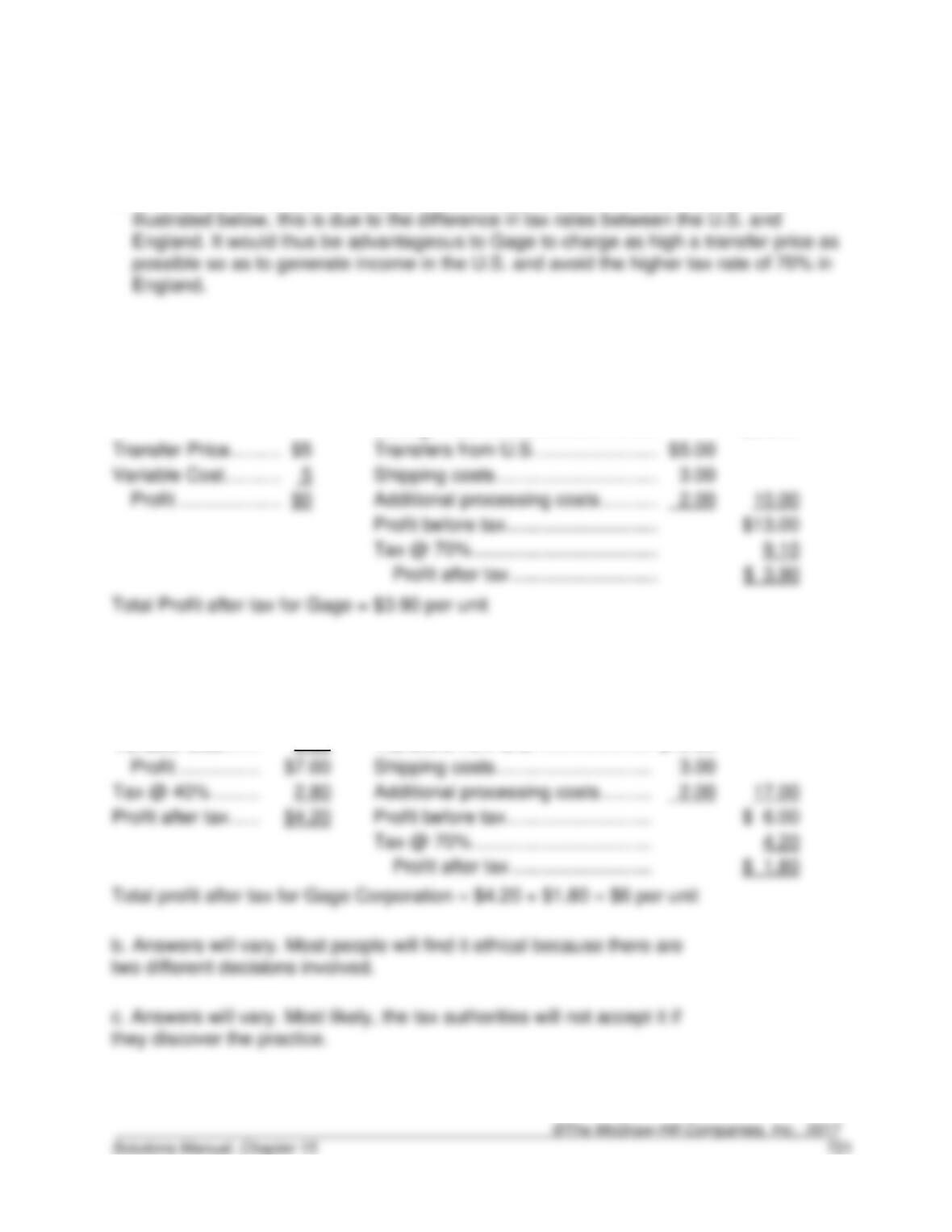
a. The transfer price economically optimal for Gage Corporation is $12 per unit. As
Profit after tax at the transfer price of $5 per unit
Adams Division, U.S.
Bute Division, England
Selling Price ……………………………………………….
$23.00
Transfer Price……………………………………………..
Transfers from U.S. ……………………………………..
Variable Cost………………………………………………
Shipping costs …………………………………………….
Additional processing costs …………………………..
Profit before tax …………………………………………..
Tax @ 70% ………………………………………………..
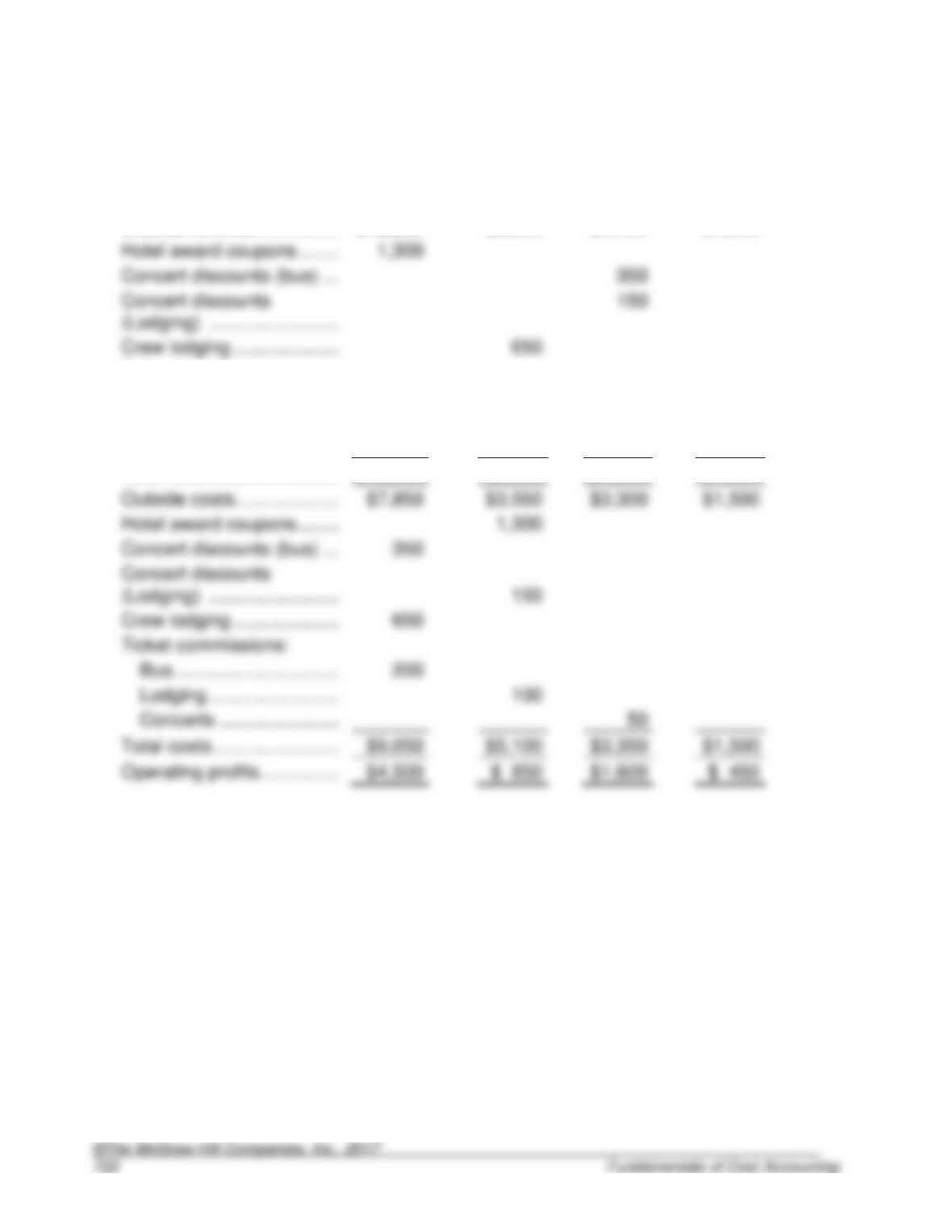
Profit after tax at the transfer price of $12 per unit
Adams Division, U.S.
Bute Division, England
Transfer Price……………………………………………..
$12.00
Selling Price ……………………………………………….
$23.00
Variable Cost………………………………………………
5.00
Transfers from U.S. ……………………………………..
$12.00
Profit ………………………………………………………
Shipping costs …………………………………………….
Tax @ 40% ………………………………………………..
Additional processing costs …………………………..
Profit after tax ……………………………………………..
Profit before tax …………………………………………..
Tax @ 70% ………………………………………………..
15–44. (40 min.) Segment Reporting: Midwest Entertainment.
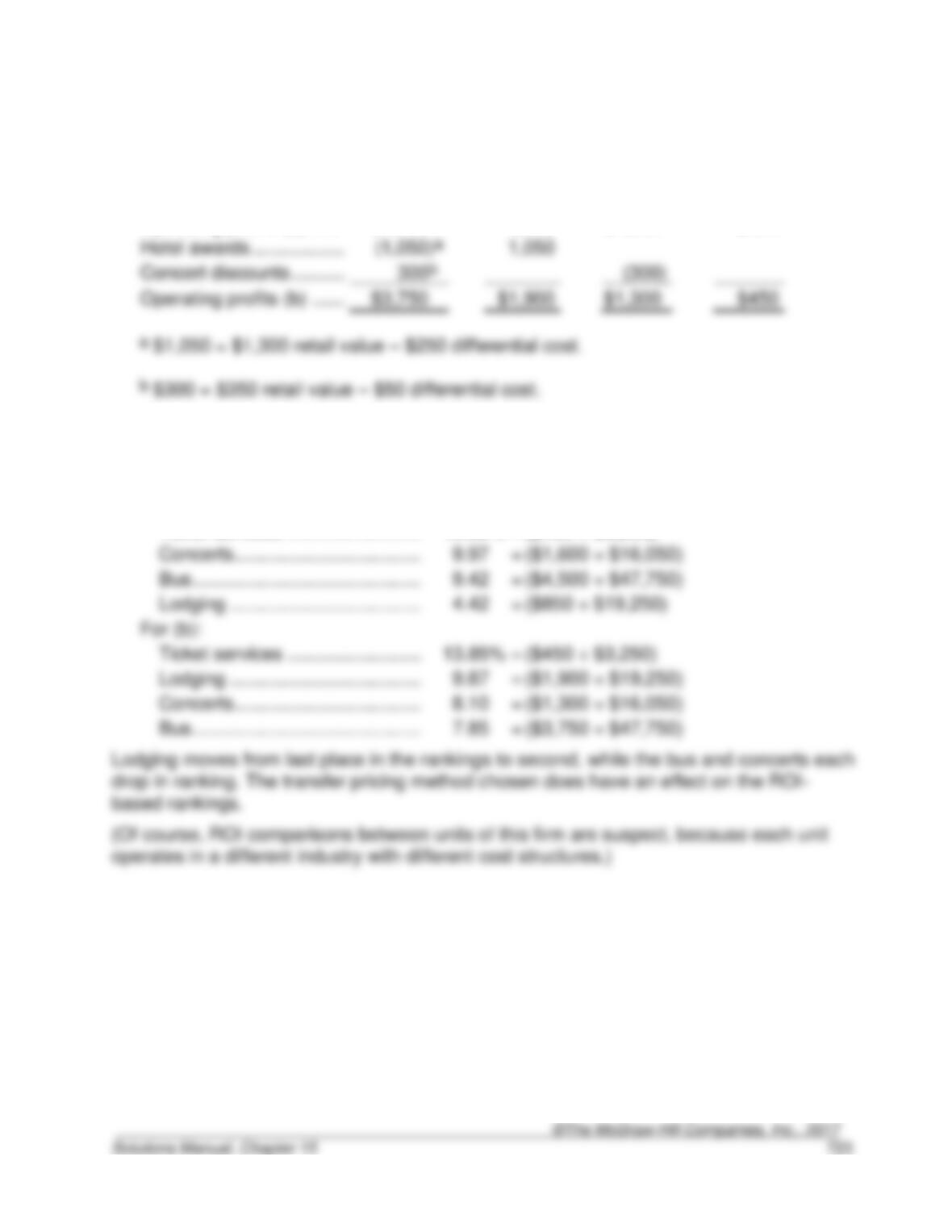
a. ($ thousands)
Bus
Charters
Lodging
Concerts
Ticket
Services
Outside revenue ………………………………………….
$12,250
$5,300
$4,450
$1,600
Hotel award coupons ……………………………………
1,300
Concert discounts (bus) ……………………………….
350
(Lodging) …………………………………………………..
Crew lodging ………………………………………………
650
Ticket commissions:
Bus…………………………………………………………
200
Lodging …………………………………………………..
100
Concerts …………………………………………………
50
Total revenues …………………………………………….
$13,550
$5,950
$4,950
$1,950
Outside costs ………………………………………………
$7,850
Hotel award coupons ……………………………………
Concert discounts (bus) ……………………………….
(Lodging) …………………………………………………..
150
Crew lodging ………………………………………………
Ticket commissions:
Bus…………………………………………………………
Lodging …………………………………………………..
100
Concerts …………………………………………………
Total costs ………………………………………………….
$9,050
Operating profits ………………………………………….
$4,500
$1,600
15-44. (continued)
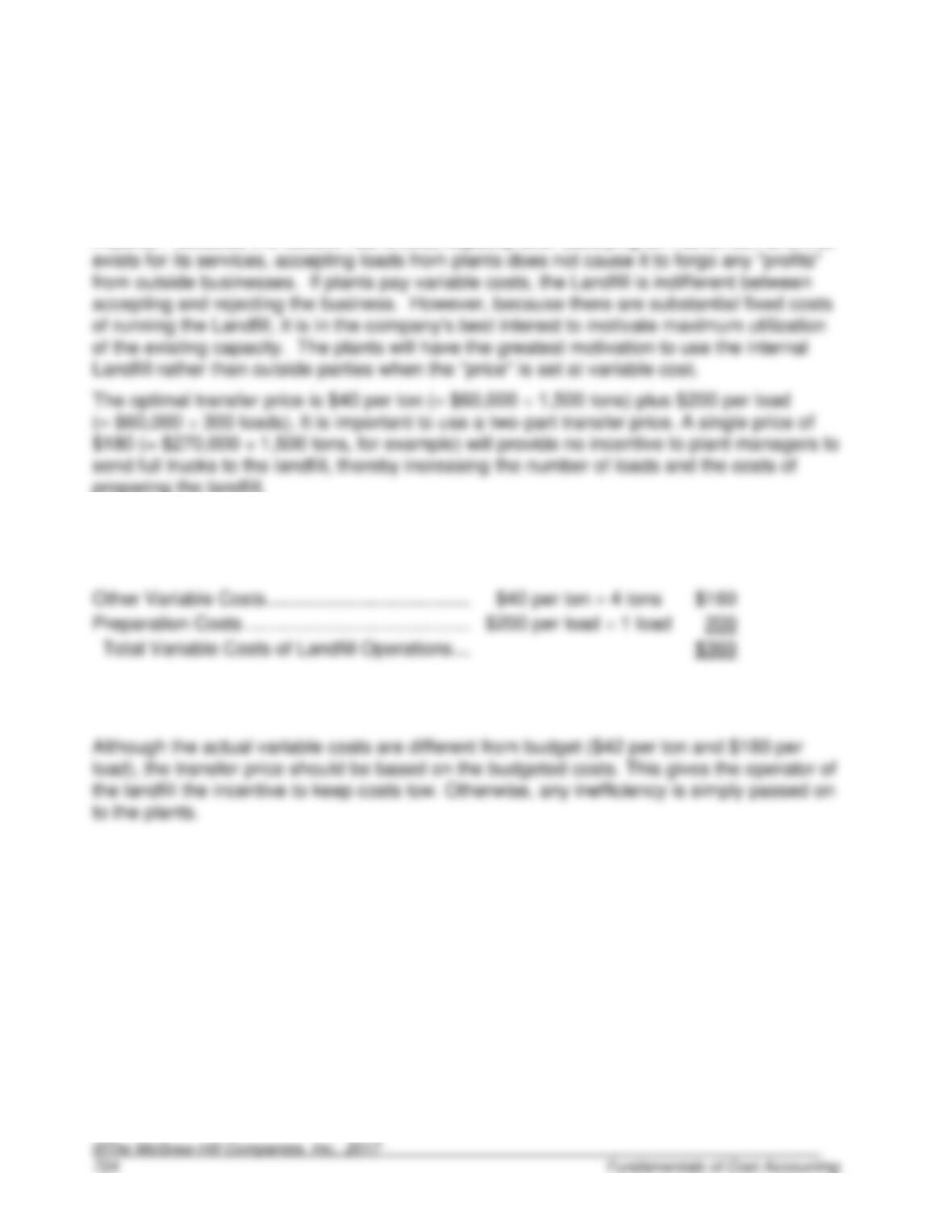
b. Adjust the operating profits in requirement a for the changed transfer prices.
Bus Charters
Lodging
Concerts
Ticket
Services
Operating profits (a) ……………………………………
$4,500
$850
$1,600
$450
Hotel awards ………………………………………………
1,050
Concert discounts ……………………………………….
Operating profits (b) ……………………………………
$3,750
$1,900
$1,300
$450
c. Divide the operating profits in requirements a and b by division assets, which are given
in the problem. The following rankings result:
For (a):
Ticket services ………………………………………..
13.85%
=
($450 ÷ $3,250)
=
($1,600 ÷ $16,050)
=
($4,500 ÷ $47,750)
Lodging ………………………………………………….
=
($850 ÷ $19,250)
For (b):
=
($450 ÷ $3,250)
Lodging ………………………………………………….
=
($1,900 ÷ $19,250)
=
($1,300 ÷ $16,050)
=
($3,750 ÷ $47,750)
15–45. (20 min.) Two-Part Transfer Prices: Mathes Corporation.
a.
Mathes should transfer at the Landfill’s variable cost of receiving and processing the
material. Because the Landfill has excess capacity after satisfying all market demand that
preparing the landfill.
b.
Based on budgeted Landfill Costs:
15–46. (20 min.) Budget Versus Actual Costs: Mathes Corporation.
15–47. (20 min.) Two-Part Transfer Prices: CHS.
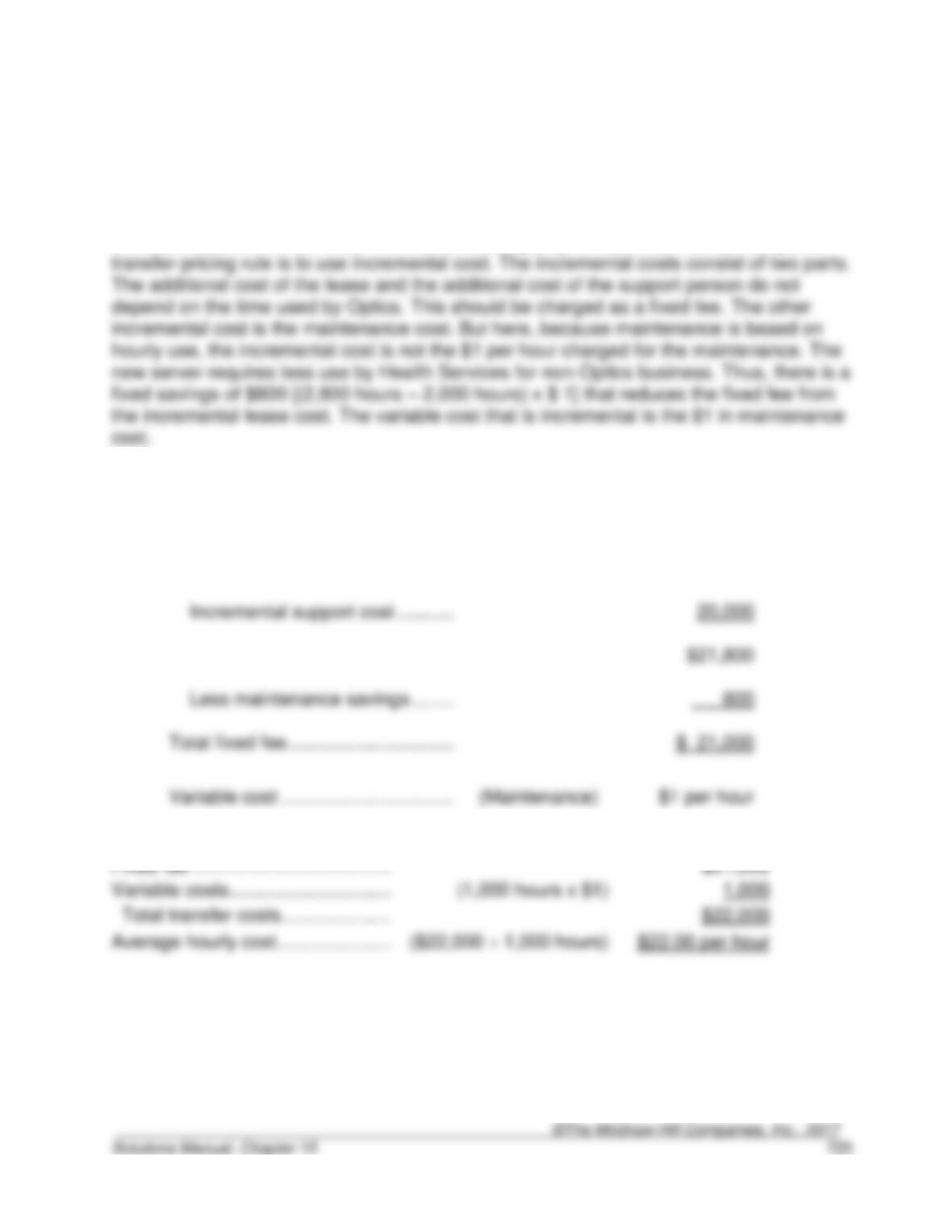
a.
This is a complicated problem, because of the requirement for a new server that would not
exist without the demands of Optics. (It is made less complicated by the fact that Health
Services leases the machine.) There is excess capacity on the machine, so the optimal
Therefore, the optimal transfer price consists of two parts:
Fixed:
Incremental lease cost ……………
($5,000 – $3,200)
$1,800
Incremental support cost …………
20,000
Less maintenance savings ………
Variable cost …………………………….
b.
Variable costs ……………………………………………..
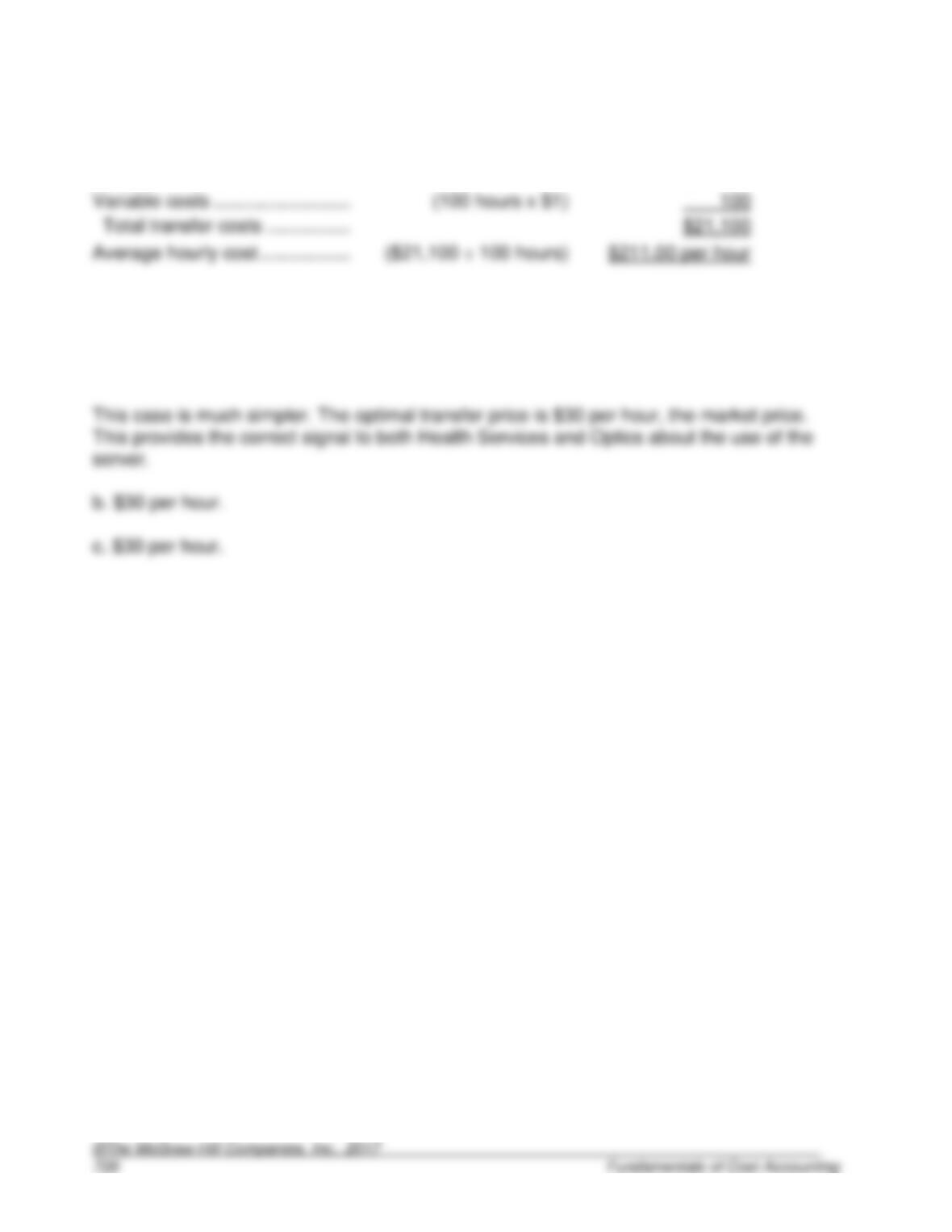
15-47. (continued)
c.
Fixed fee ……………………………………………………
$21,000
Variable costs …………………………………………….
100
Average hourly cost …………………………………….
15–48. (20 min.) Two-Part Transfer Prices: CHS.
a.
Solutions to Integrative Cases
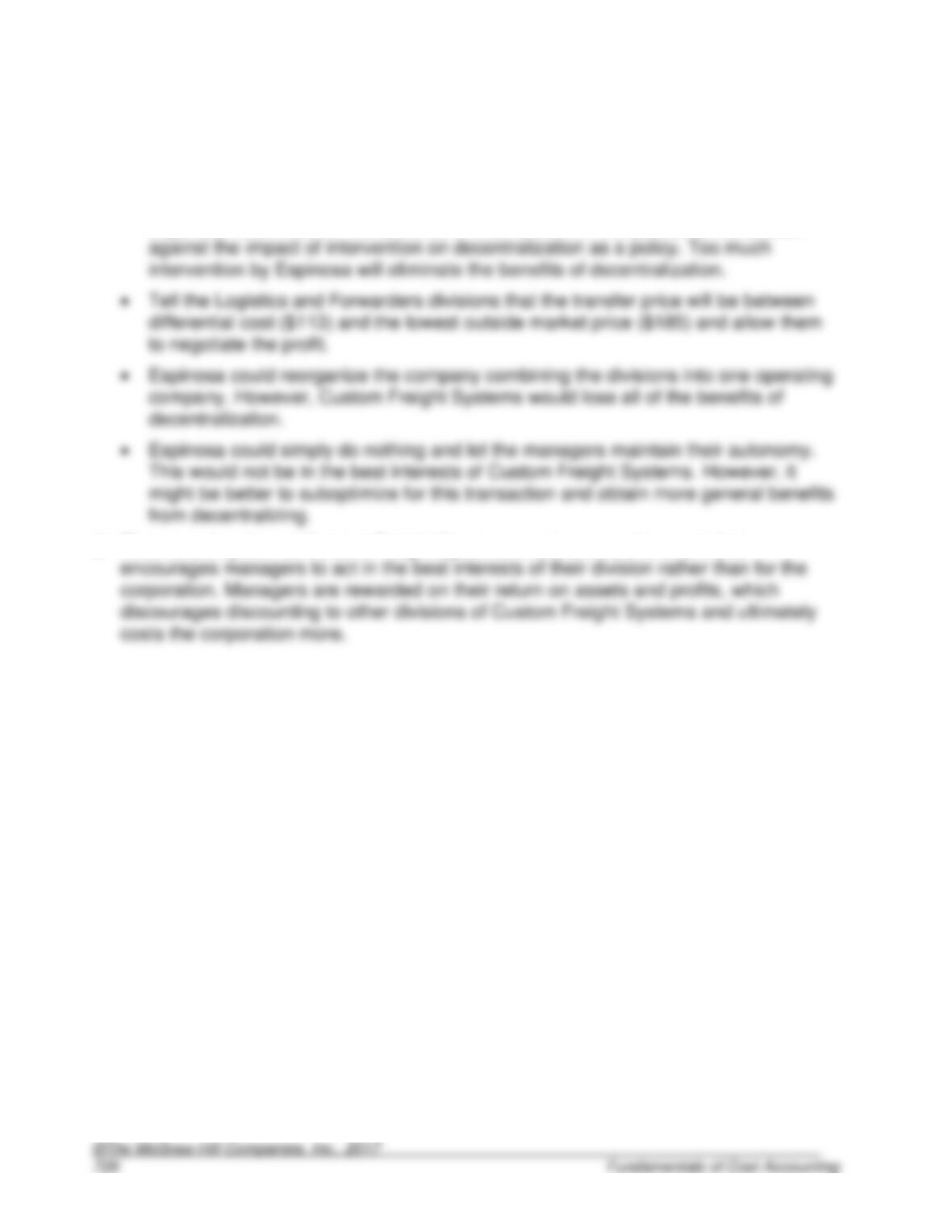
15–49. Custom Freight Systems (A): Transfer Pricing.
a. The Logistics division should accept the bid from Forwarders division. Custom Freight
Option I: Purchase Internally
Air Cargo
Division
Forwarders
Division
Logistics
Division
b. If we assume it is optimal for the transfer to be made internally, then the question
arises as to the appropriate transfer price. The economic transfer pricing rule for
making transfers to maximize a company’s profits is to transfer at the differential outlay
15-49. (continued)
c. Espinosa has many alternatives to intervention or to forcing the manager of the
Forwarders division to lower his price below $210. Each has advantages and
disadvantages.
• Espinosa must trade off the benefits of intervention on this particular transaction
d. The reward system at Custom Freight Systems creates an environment that
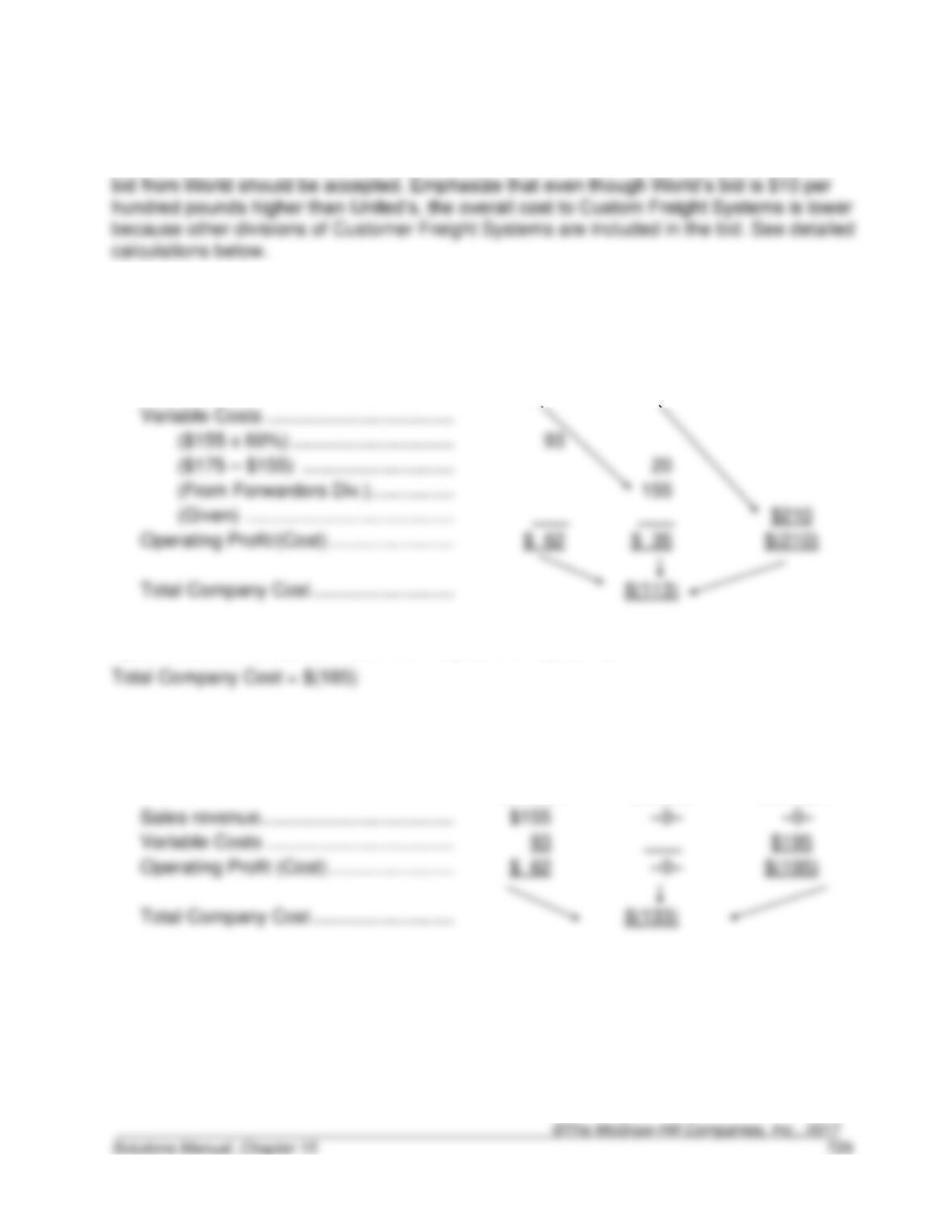
15–50. (30 min.) Custom Freight Systems (B): Transfer Pricing.
Similar to Case A, the Logistics division should accept the bid from the Forwarders
division. However, if we eliminate the Forwarders Division from the bidding process, the
Option I: (from 15–49) Purchase internally
Air Cargo
Division
Forwarders
Division
Logistics
Division
Sales revenue ……………………………….
$155
$210
–0–
Variable Costs ………………………………
Operating Profit/(Cost) ……………………
$ 62
$ 35
Option II: (from 15–49) Purchase externally (United Systems)
Option III: Purchase Externally (World Systems)
Air Cargo
Division
Forwarders
Division
Logistics
Division
Sales revenue ……………………………….
$155
Operating Profit (Cost) ……………………
$ 62