15-1
CHAPTER 15
ALLOCATION OF SUPPORT-DEPARTMENT COSTS,
COMMON COSTS, AND REVENUES
15-1 The single-rate (cost-allocation) method makes no distinction between fixed costs and
variable costs in the cost pool. It allocates costs in each cost pool to cost objects using the same
rate per unit of the single allocation base. The dual-rate (cost-allocation) method classifies costs
in each cost pool into two pools—a variable-cost pool and a fixed-cost pool—with each pool
using a different cost-allocation base.
15-4 Examples of bases used to allocate support department cost pools to operating
departments include the number of employees, square feet of space, number of direct labor
hours, and machine-hours.
15-5 The use of budgeted indirect cost allocation rates rather than actual indirect rates has
several attractive features to the manager of a user department:
a. The user knows the costs in advance and can factor them into ongoing operating
15-6 Disagree. Allocating costs on “the basis of estimated long-run use by user department
managers” means department managers can lower their cost allocations by deliberately
underestimating their long-run use (assuming all other managers do not similarly underestimate
their usage).
15-7 The three methods differ in how they recognize reciprocal services among support
departments:
a. The direct (allocation) method ignores any services rendered by one support
15-2
15-8 The reciprocal method is theoretically the most defensible method because it fully
recognizes the mutual services provided among all departments, irrespective of whether those
departments are operating or support departments.
15-9 The stand-alone cost-allocation method uses information pertaining to each user of a cost
object as a separate entity to determine the cost-allocation weights.
15-10 All contracts with U.S. government agencies must comply with cost accounting standards
issued by the Cost Accounting Standards Board (CASB).
15-11 Areas of dispute between contracting parties can be reduced by making the “rules of the
game” explicit and in writing at the time the contract is signed.
15-12 Companies increasingly are selling packages of products or services for a single price.
Revenue allocation is required when managers in charge of developing or marketing individual
products in a bundle are evaluated using product-specific revenues.
15-13 The stand-alone revenue-allocation method uses product-specific information on the
products in the bundle as weights for allocating the bundled revenues to the individual products.
15-14 Managers typically will argue that their individual product is the prime reason why
consumers buy a bundle of products. Evidence on this argument could come from the sales of the
products when sold as individual products. Other pieces of evidence include surveys of users of
each product and surveys of people who purchase the bundle of products.
15-3
15-16 (20 min.) Single-rate versus dual-rate methods, support department.
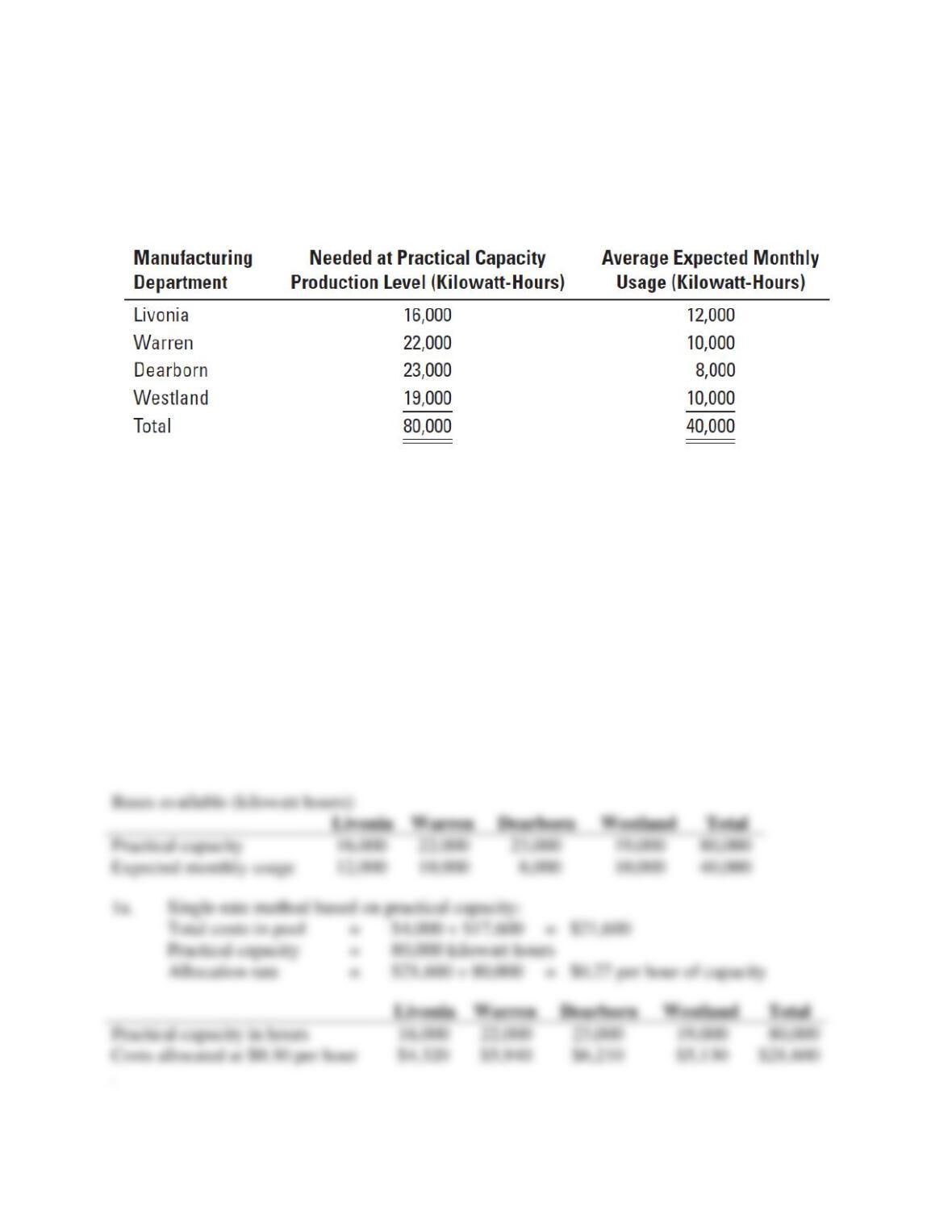
The Detroit power plant that services all manufacturing departments of MidWest Engineering
has a budget for the coming year. This budget has been expressed in the following monthly
terms:
The expected monthly costs for operating the power plant during the budget year are $21,600:
$4,000 variable and $17,600 fixed.
Required:
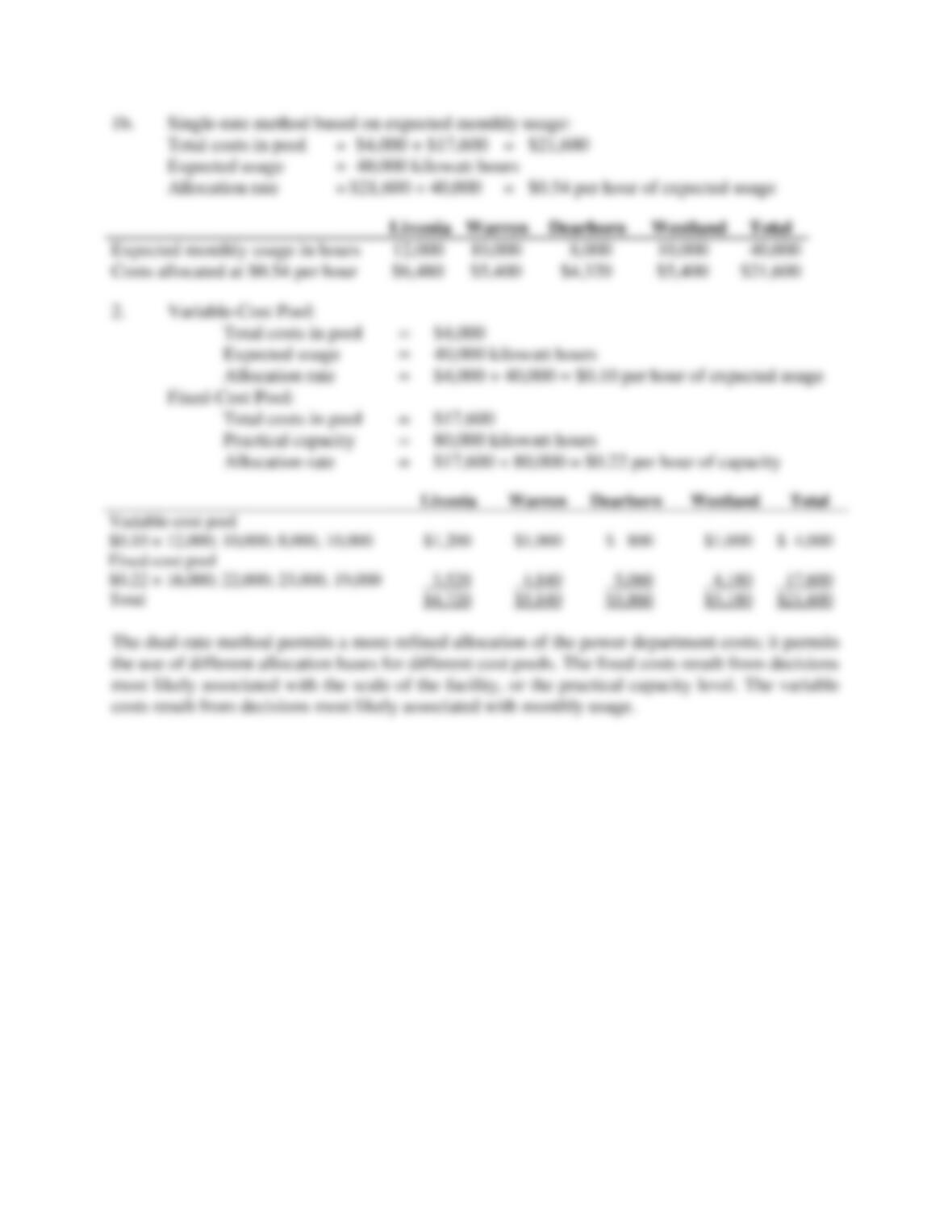
1. Assume that a single cost pool is used for the power plant costs. What budgeted amounts will
be allocated to each manufacturing department if (a) the rate is calculated based on practical
capacity and costs are allocated based on practical capacity and (b) the rate is calculated
based on expected monthly usage and costs are allocated based on expected monthly usage?
2. Assume the dual-rate method is used with separate cost pools for the variable and fixed costs.
Variable costs are allocated on the basis of expected monthly usage. Fixed costs are allocated
on the basis of practical capacity. What budgeted amounts will be allocated to each
manufacturing department? Why might you prefer the dual-rate method?
SOLUTION
15-4
15-5
15-17 (20–25 min.) Single-rate method, budgeted versus actual costs and quantities.
Chocolat Inc. is a producer of premium chocolate based in Palo Alto. The company has a
separate division for each of its two products: dark chocolate and milk chocolate. Chocolat
purchases ingredients from Wisconsin for its dark chocolate division and from Louisiana for its
milk chocolate division. Both locations are the same distance from Chocolat’s Palo Alto plant.
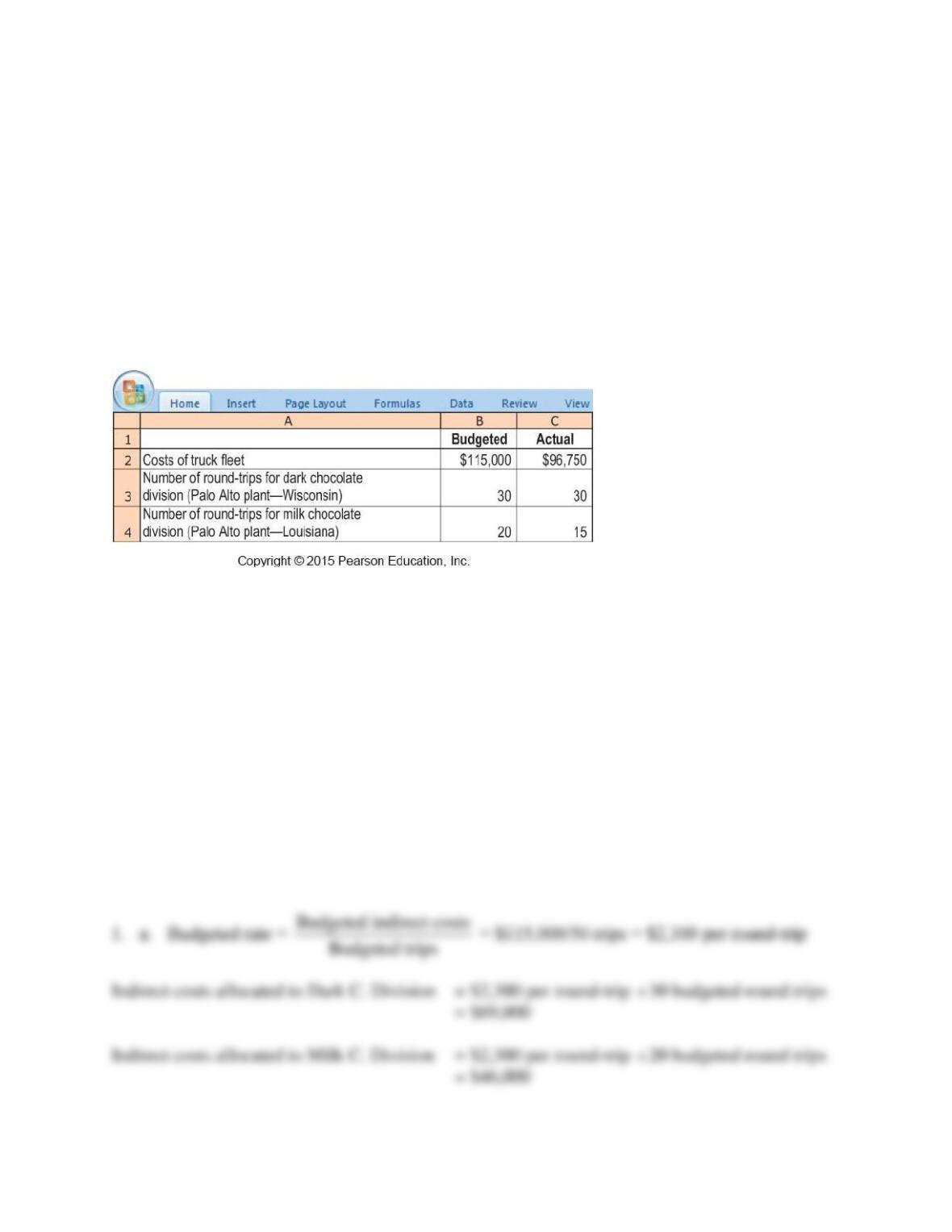
Chocolat Inc. operates a fleet of trucks as a cost center that charges the divisions for variable
costs (drivers and fuel) and fixed costs (vehicle depreciation, insurance, and registration fees) of
operating the fleet. Each division is evaluated on the basis of its operating income. For 2013, the
trucking fleet had a practical capacity of 50 round-trips between the Palo Alto plant and the two
suppliers. It recorded the following information:
Required:
1. Using the single-rate method, allocate costs to the dark chocolate division and the milk
chocolate division in these three ways.
a. Calculate the budgeted rate per round-trip and allocate costs based on round-trips
budgeted for each division.
b. Calculate the budgeted rate per round-trip and allocate costs based on actual round-trips
used by each division.
c. Calculate the actual rate per round-trip and allocate costs based on actual round-trips used
by each division.
2. Describe the advantages and disadvantages of using each of the three methods in requirement
1. Would you encourage Chocolat Inc. to use one of these methods? Explain and indicate any
assumptions you made.
SOLUTION
15-6
15-7
15-18 (20 min.) Dual-rate method, budgeted versus actual costs, and practical capacity
versus actual quantities (continuation of 15-17).
Chocolat Inc. decides to examine the effect of using the dual-rate method for allocating truck
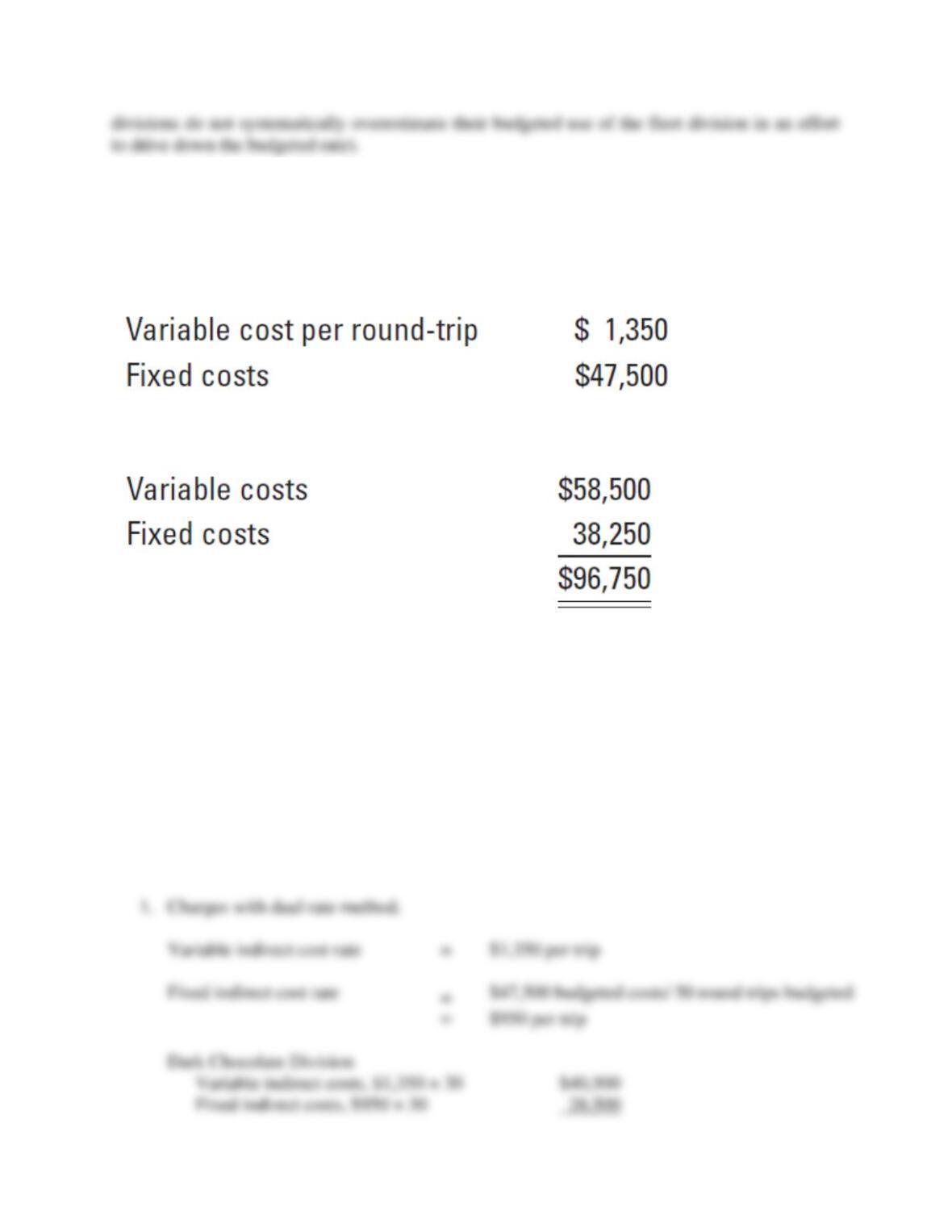
costs to each round- trip. At the start of 2013, the budgeted costs were as follows:
The actual results for the 45 round-trips made in 2013 were as follows:
Assume all other information to be the same as in Exercise 15-17.
Required:
1. Using the dual-rate method, what are the costs allocated to the dark chocolate division and
the milk chocolate division when (a) variable costs are allocated using the budgeted rate per
round-trip and actual round-trips used by each division and when (b) fixed costs are allocated
based on the budgeted rate per round-trip and round-trips budgeted for each division?
2. From the viewpoint of the dark chocolate division, what are the effects of using the dual-rate
method rather than the single-rate method?
SOLUTION
15-8
15-19 (30 min.) Support department cost allocation; direct and step-down methods.
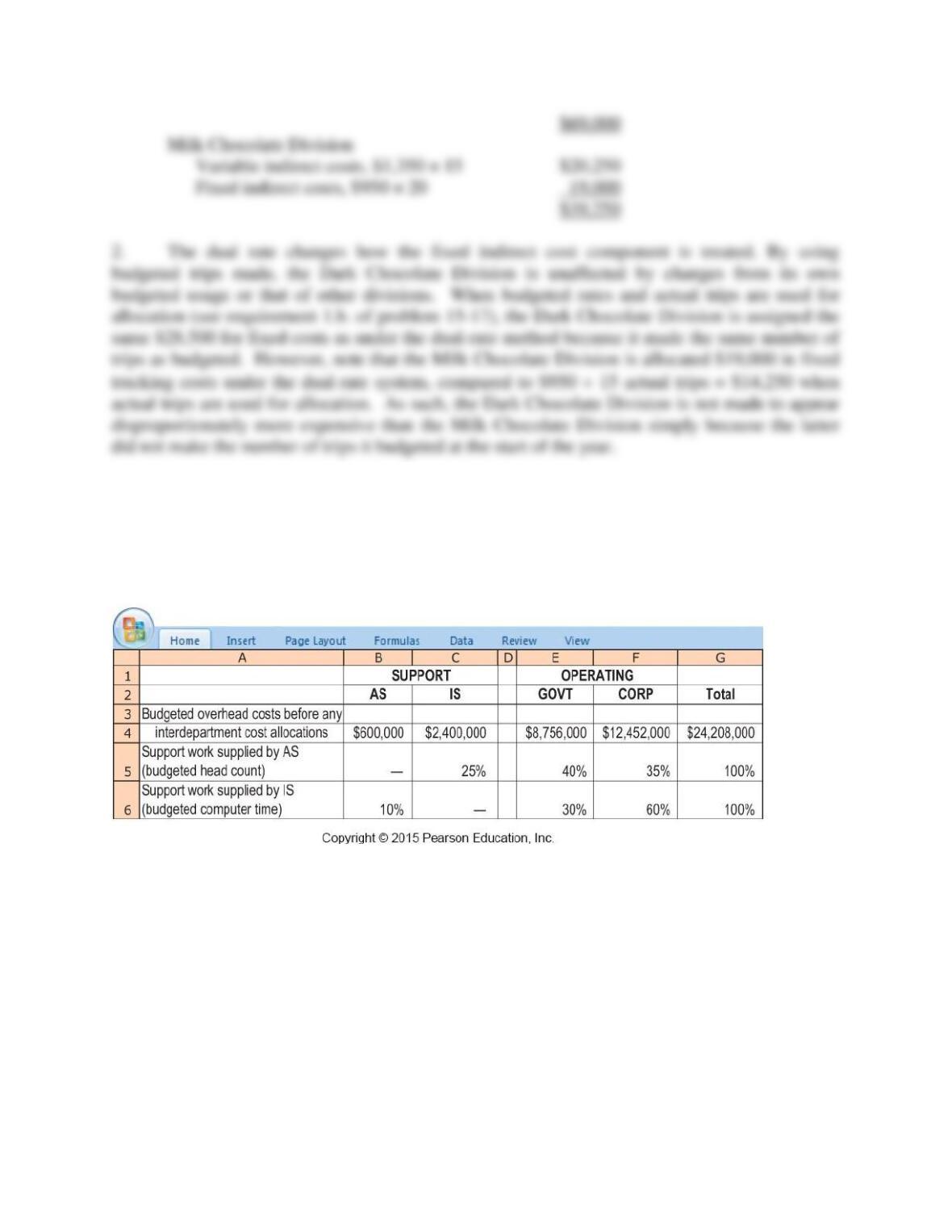
Phoenix Partners provides management consulting services to government and corporate clients.
Phoenix has two support departments—administrative services (AS) and information systems
(IS)—and two operating departments—government consulting (GOVT) and corporate consulting
(CORP). For the first quarter of 2013, Phoenix’s cost records indicate the following:
A
Required:
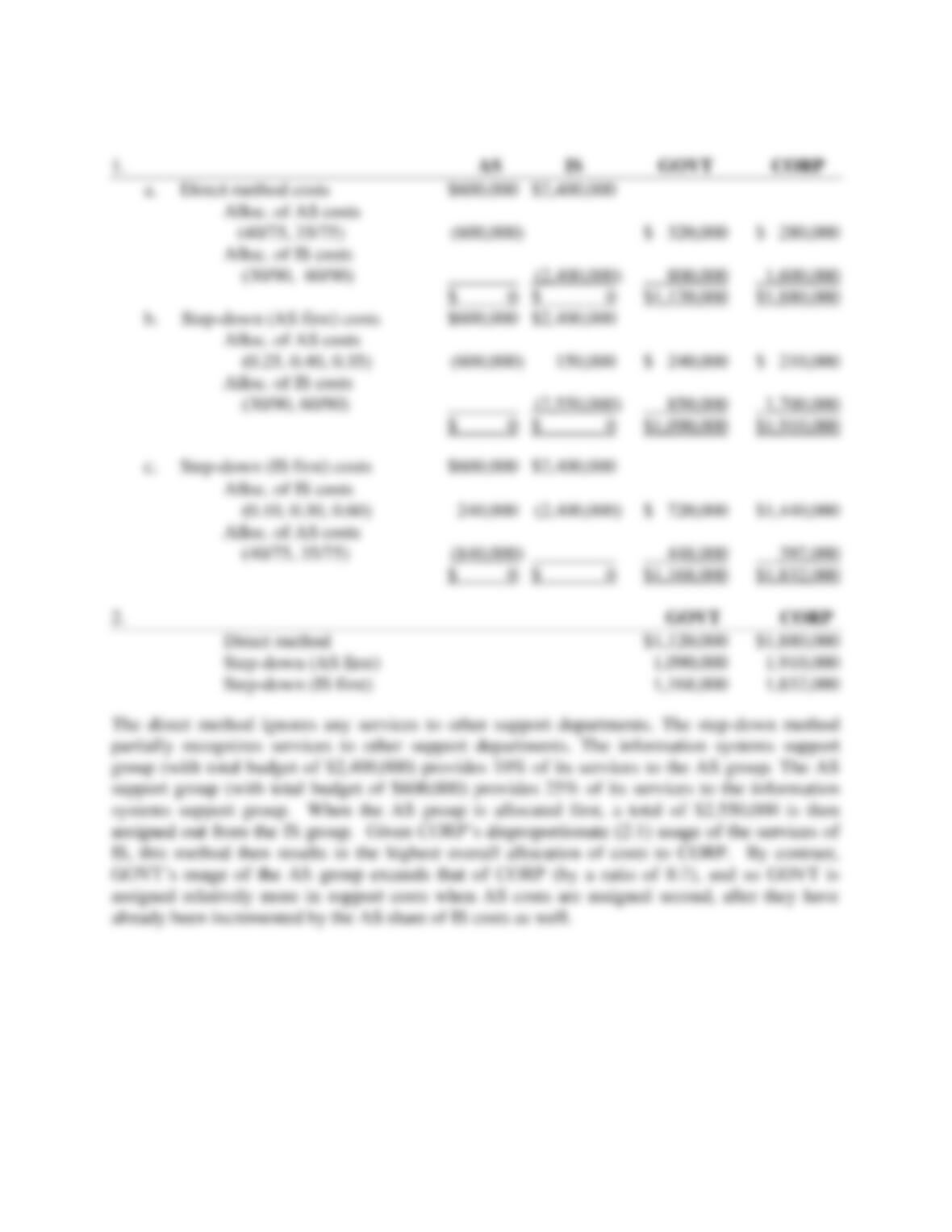
1. Allocate the two support departments’ costs to the two operating departments using the
following methods:
a. Direct method
b. Step-down method (allocate AS first)
c. Step-down method (allocate IS first)
2. Compare and explain differences in the support-department costs allocated to each operating
department.
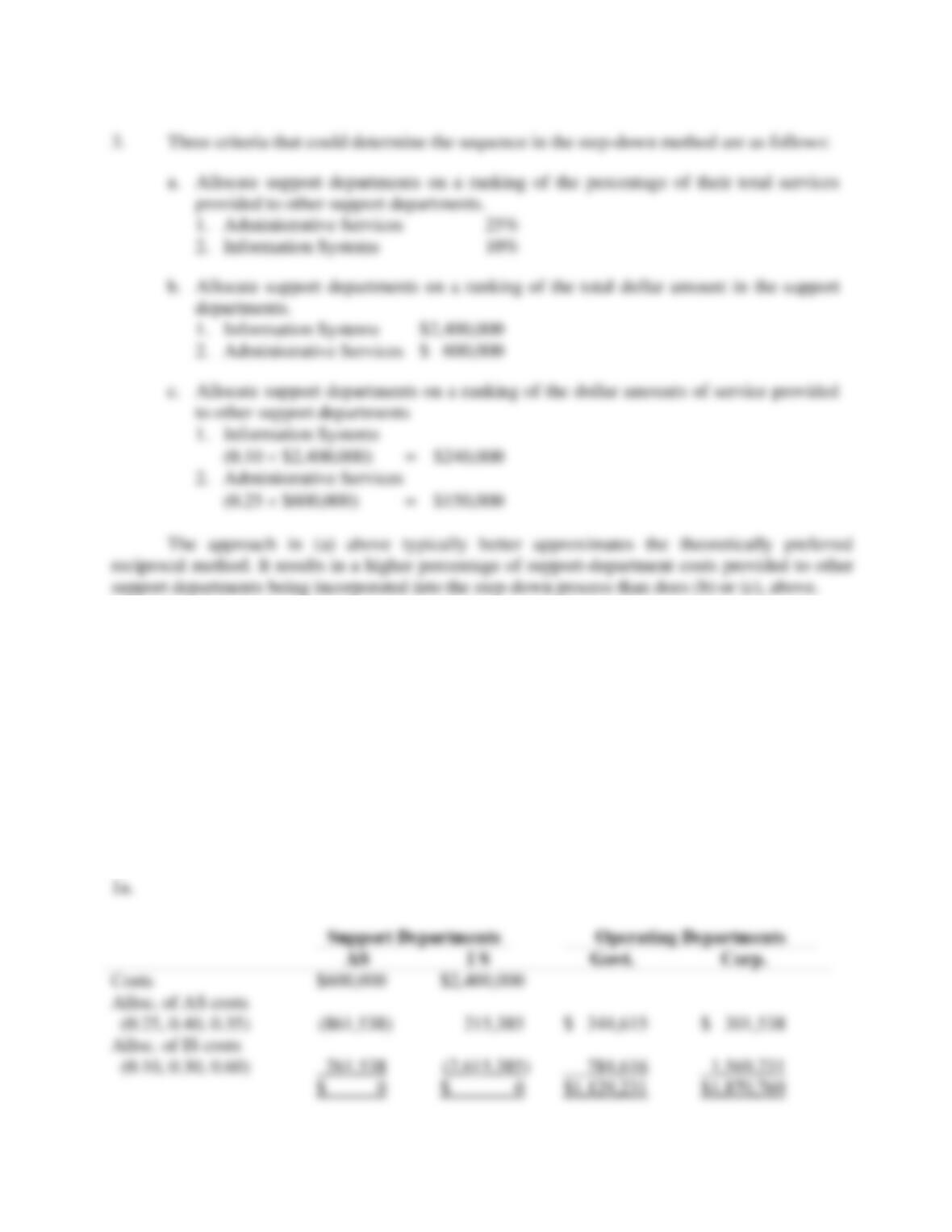
3. What approaches might be used to decide the sequence in which to allocate support
departments when using the step-down method?
15-9
SOLUTION
15-10
15-20 (50 min.) Support-department cost allocation, reciprocal method (continuation of 15-19).
Refer to the data given in Exercise 15-19.
Required:
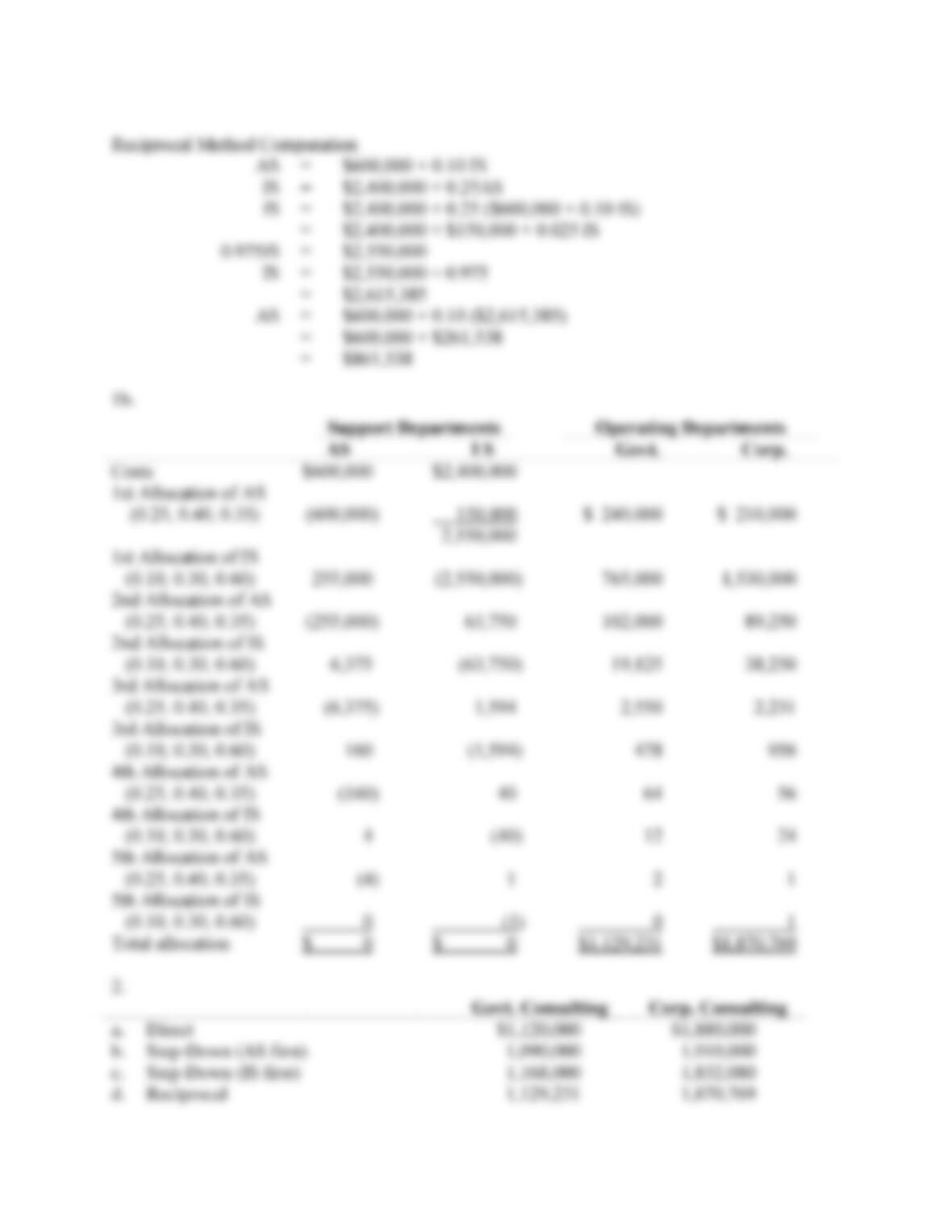
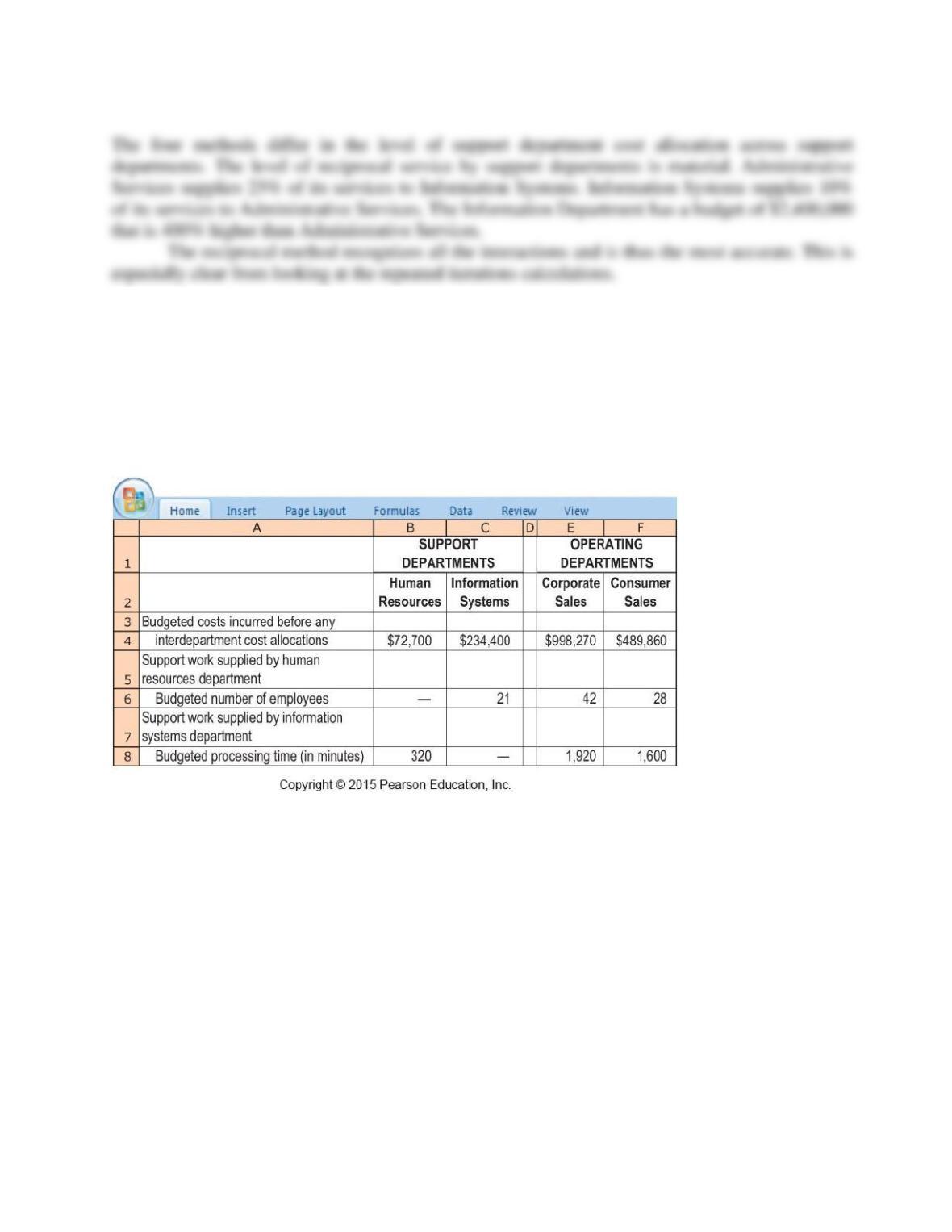
1. Allocate the two support departments’ costs to the two operating departments using the
reciprocal method. Use (a) linear equations and (b) repeated iterations.
2. Compare and explain differences in requirement 1 with those in requirement 1 of Exercise
15-19. Which method do you prefer? Why?
SOLUTION
15-11
15-12
15-21 (40 min.) Direct and step-down allocation.
E-books, an online book retailer, has two operating departments—corporate sales and consumer
sales—and two support departments—human resources and information systems. Each sales
department conducts merchandising and marketing operations independently. E-books uses
number of employees to allocate human resources costs and processing time to allocate
information systems costs. The following data are available for September 2013:
Required:
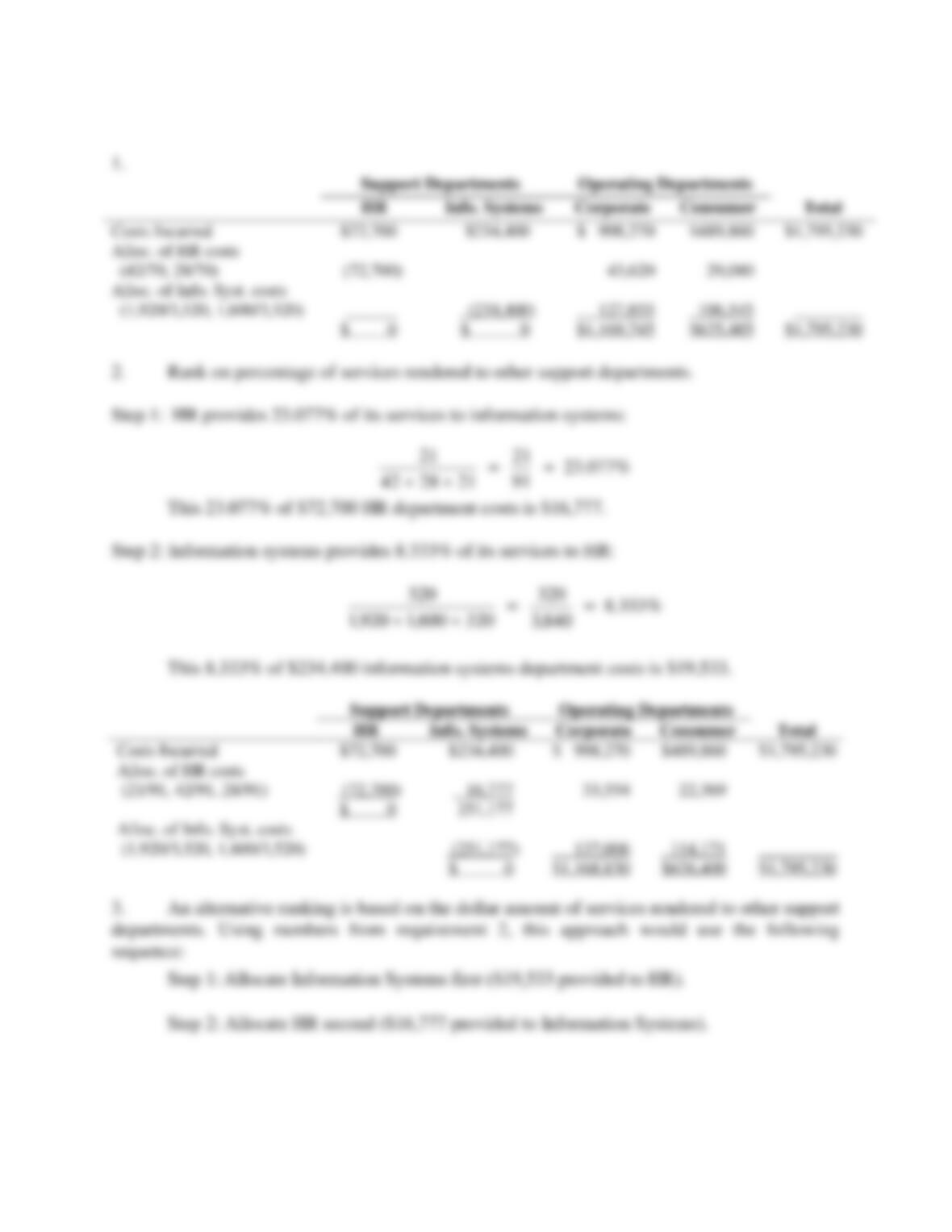
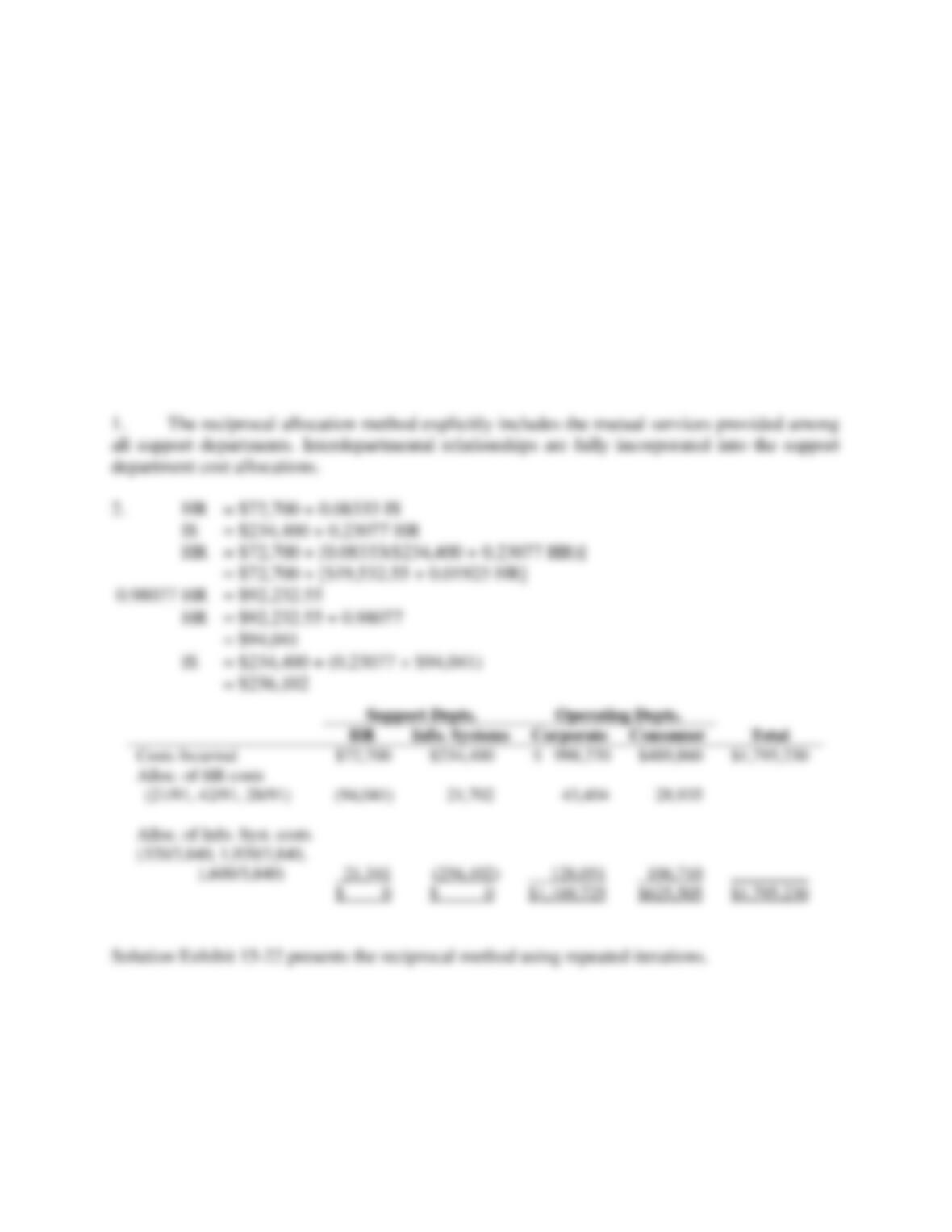
1. Allocate the support departments’ costs to the operating departments using the direct method.
2. Rank the support departments based on the percentage of their services provided to other
support departments. Use this ranking to allocate the support departments’ costs to the
operating departments based on the step-down method.
3. How could you have ranked the support departments differently?
15-13
SOLUTION
15-14
15-22 (30 min.) Reciprocal cost allocation (continuation of 15-21).
Consider E-books again. The controller of E-books reads a widely used textbook that states that
“the reciprocal method is conceptually the most defensible.” He seeks your assistance.
Required:
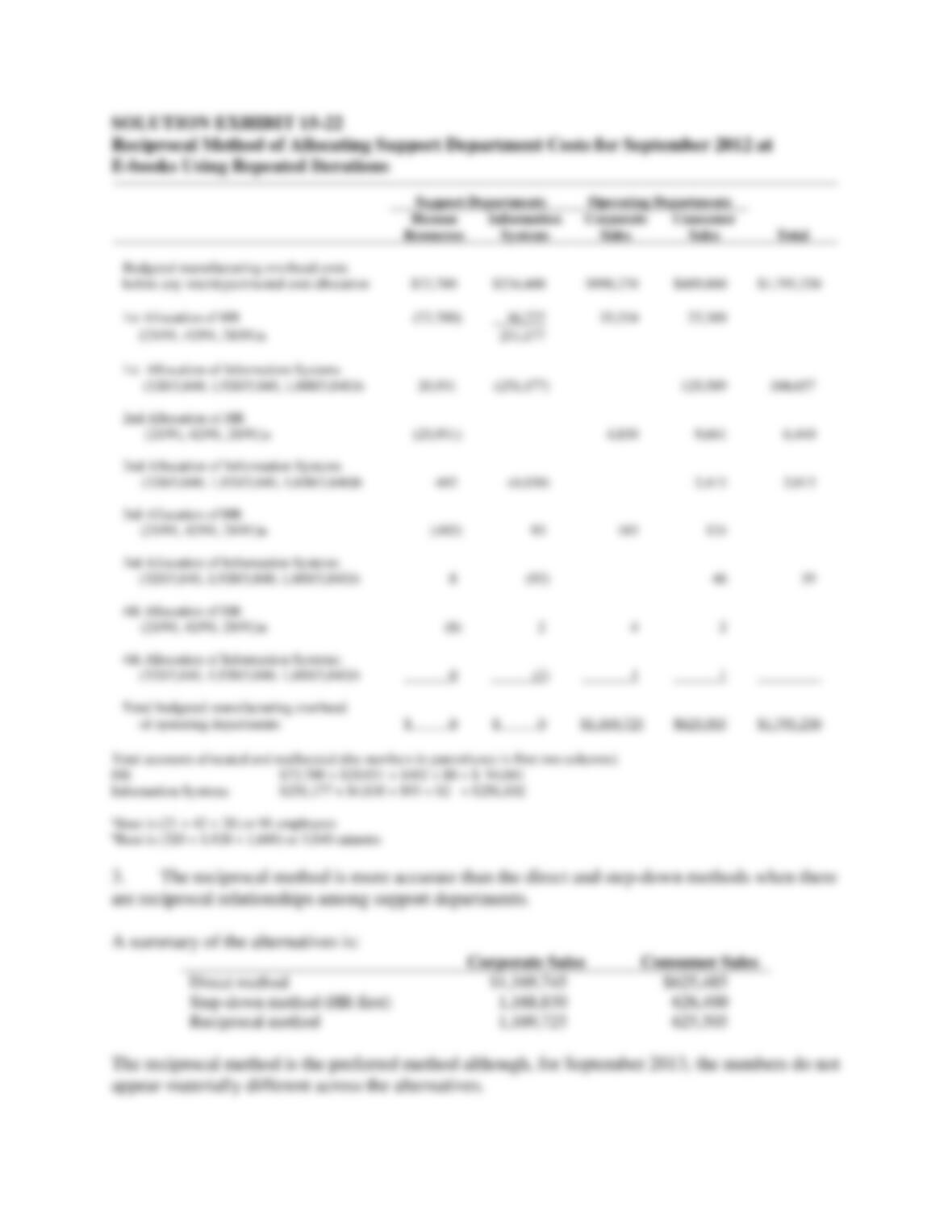
1. Describe the key features of the reciprocal method.
2. Allocate the support departments’ costs (human resources and information systems) to the
two operating departments using the reciprocal method.
3. In the case presented in this exercise, which method (direct, step-down, or reciprocal) would
you recommend? Why?
SOLUTION
15-15
15-16
15-23 (20−25 min.) Allocation of common costs.
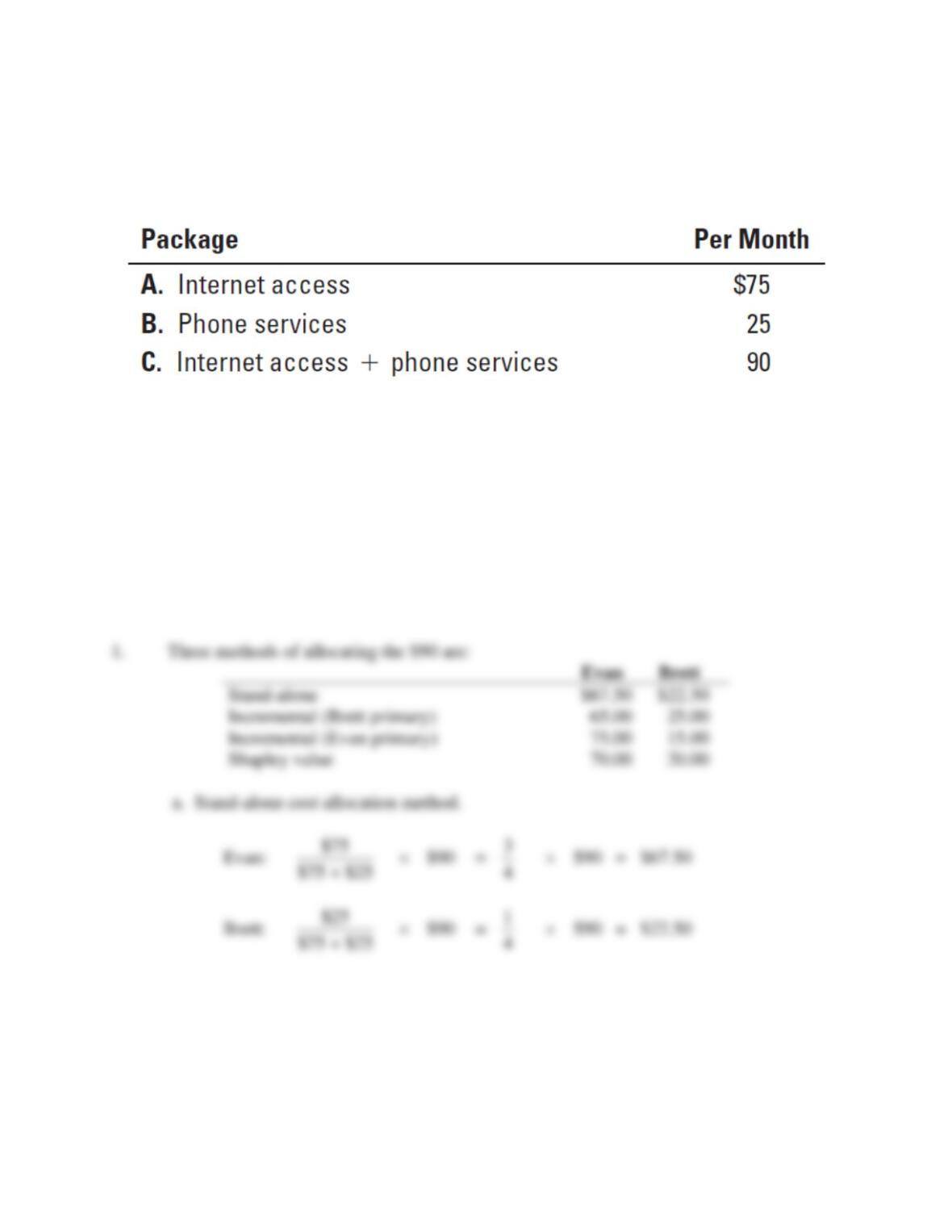
Evan and Brett are students at Berkeley College. They share an apartment that is owned by Brett.
Brett is considering subscribing to an Internet provider that has the following packages available:
Evan spends most of his time on the Internet (“everything can be found online now”). Brett
prefers to spend his time talking on the phone rather than using the Internet (“going online is a
waste of time”). They agree that the purchase of the $90 total package is a “win–win” situation.
Required:
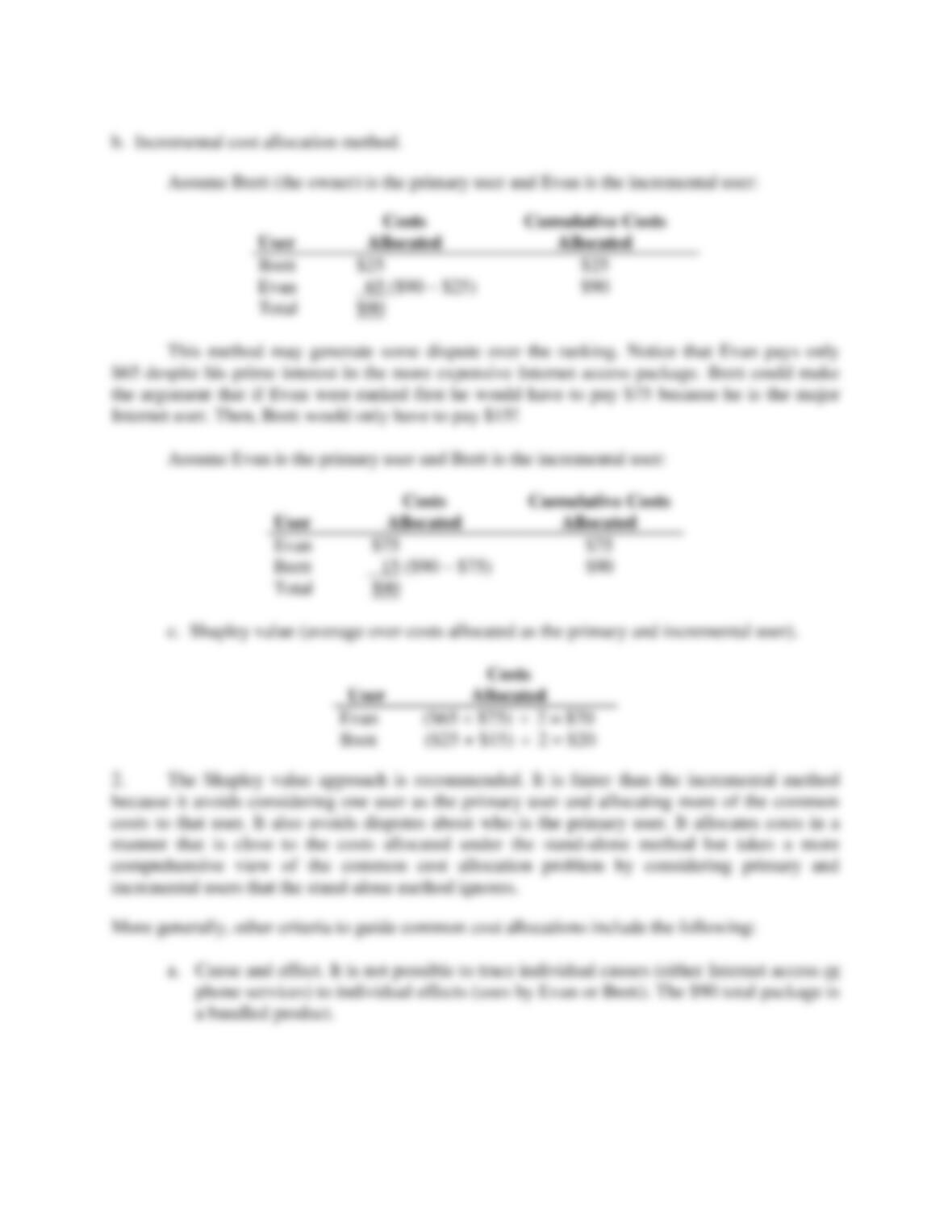
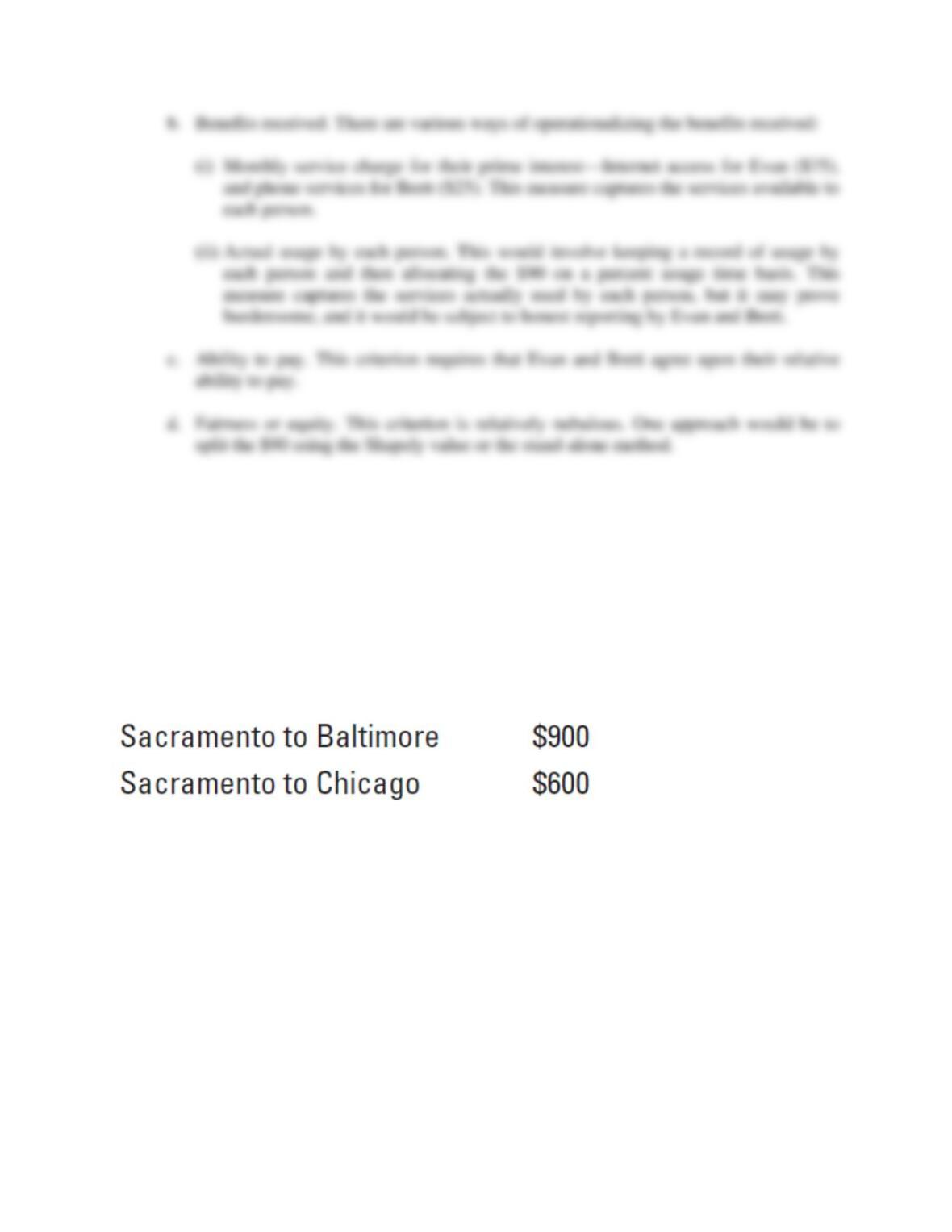
1. Allocate the $90 between Evan and Brett using (a) the stand-alone cost-allocation method,
(b) the incremental cost-allocation method, and (c) the Shapley value method.
2. Which method would you recommend they use and why?
SOLUTION
15-17
15-18
15-24 (20 min.) Allocation of common costs.
Barbara Richardson, a self-employed consultant near Sacramento, received an invitation to visit
a prospective client in Baltimore. A few days later, she received an invitation to make a
presentation to a prospective client in Chicago. She decided to combine her visits, traveling from
Sacramento to Baltimore, Baltimore to Chicago, and Chicago to Sacramento.
Richardson received offers for her consulting services from both companies. Upon her return,
she decided to accept the engagement in Chicago. She is puzzled over how to allocate her travel
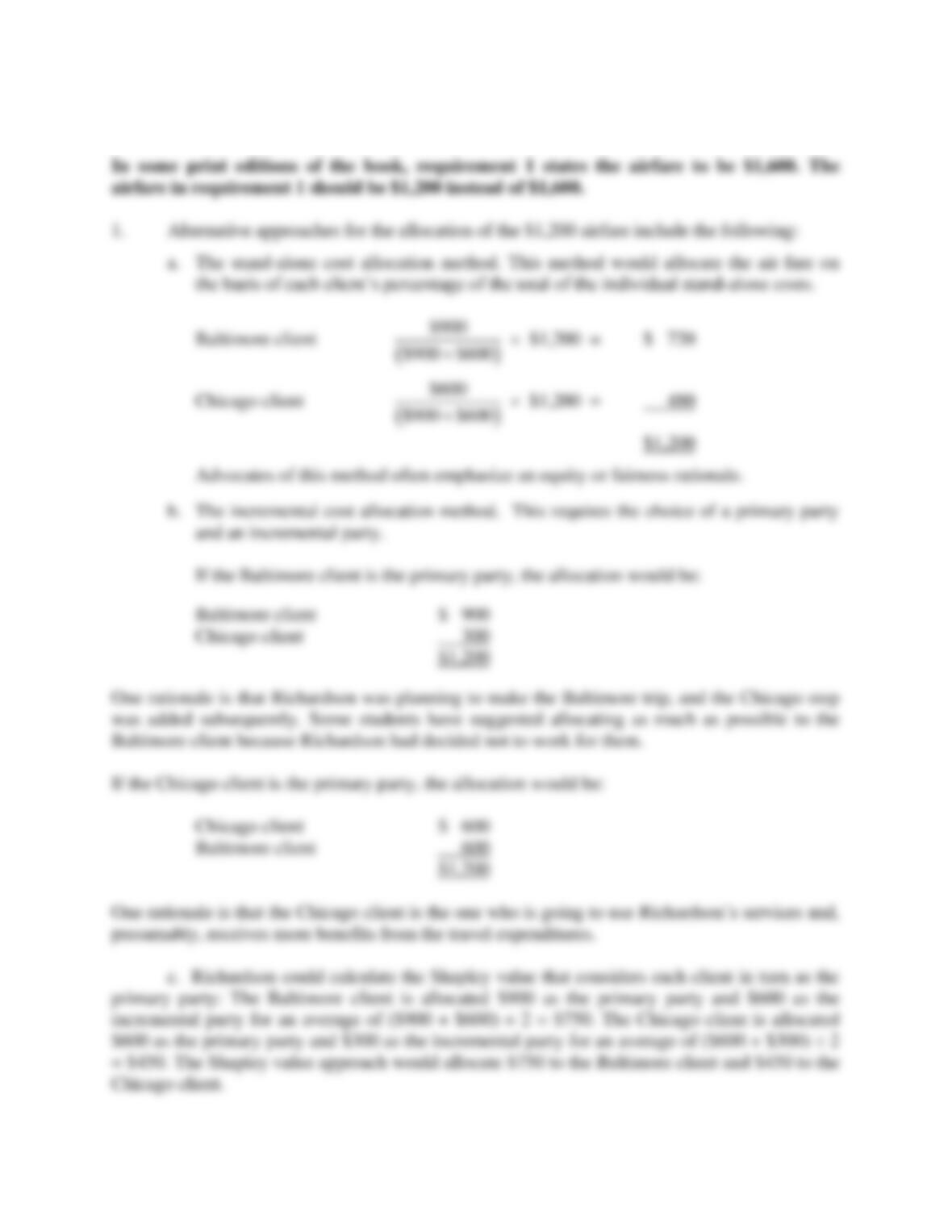
costs between the two clients. She has collected the following data for regular round-trip fares
with no stopovers:
Richardson paid $1,200 for her three-leg flight (Sacramento–Baltimore, Baltimore–Chicago,
Chicago–Sacramento). In addition, she paid $30 each way for limousines from her home to
Sacramento Airport and back when she returned.
Required:
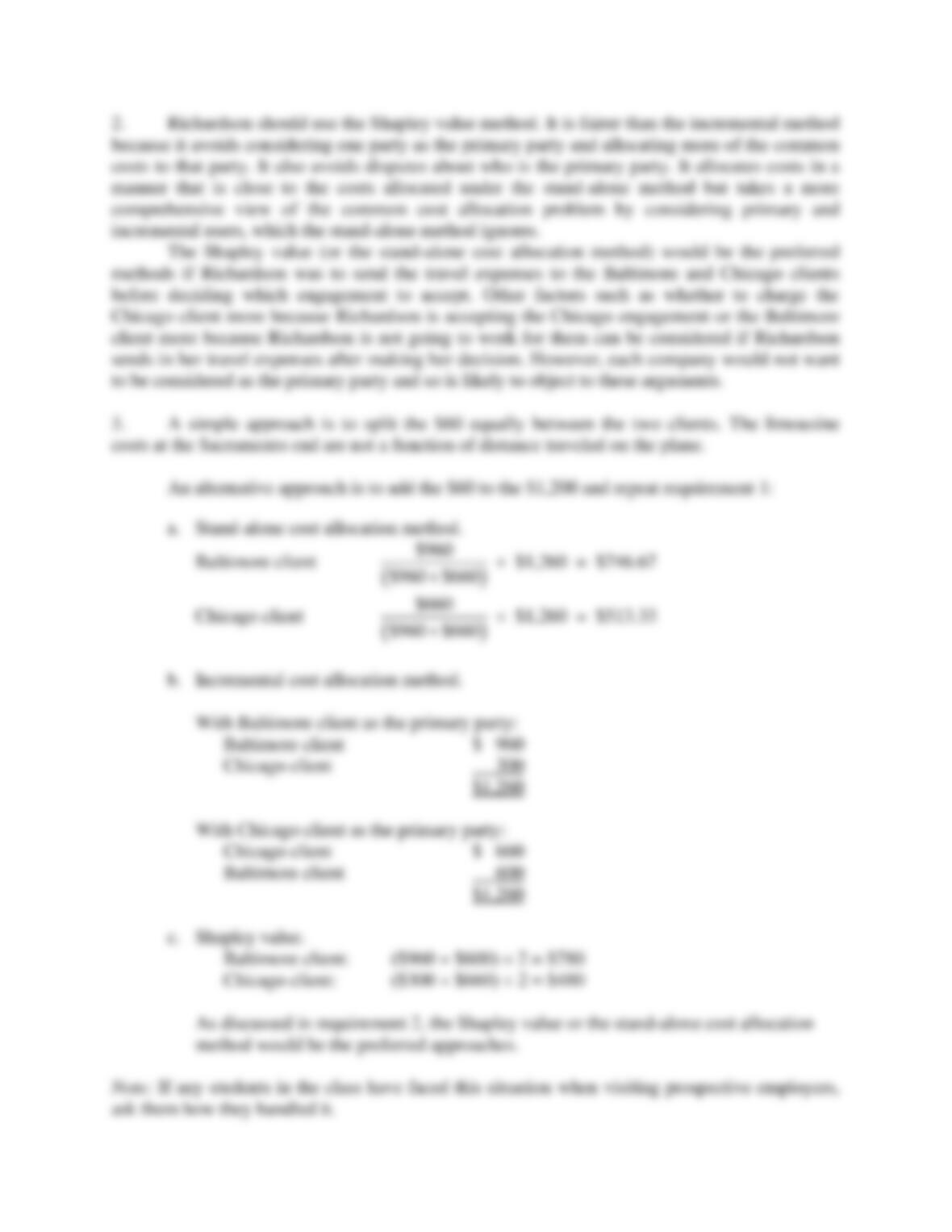
1. How should Richardson allocate the $1,600 airfare between the clients in Baltimore and
Chicago using (a) the stand-alone cost-allocation method, (b) the incremental cost-allocation
method, and (c) the Shapley value method?
2. Which method would you recommend Richardson use and why?
3. How should Richardson allocate the $60 limousine charges between the clients in Baltimore
and Chicago?
15-19
SOLUTION
15-20