o Management control considerations suggest that the transfer price reflect the value of the
goods or services being transferred.
o Companies have incentives to set transfer prices that will increase revenues (and profits)
in low-tax countries and increase costs (thereby reducing profits) in high-tax countries.
LO 15-5 Describe the role of transfer prices in segment reporting.
SEGMENT REPORTING
• The FASB requires companies engaged in different lines of business to report certain
information about segments that meet FASB’s technical requirements (Statement of
Financial Accounting Standards No.131, “Disclosure about segment of an enterprise and
related information”).
o The principal items that must be disclosed about each segment include:
▪ Segment revenue, from both internal and external customers
▪ Interest revenue and expense
o In addition, if a company has significant foreign operations, it must disclose revenues,
operating profit or loss, and identifiable assets by geographical region.
▪ The financial reporting of internal transactions requires that firms report segment
profits as computed for use by the chief operating decision maker in assessing
segment performance.
▪ The transfer pricing method used for performance evaluation will be reflected in
reported segment income and can be either cost or market based.
▪ Accounting for external reporting, in rare occasions, recognizes differences in the
way firms use financial information for internal decision making.
Appendix: Case 1a Perfect Intermediate Markets – Quality Differences
APPENDIX: CASE 1A PERFECT INTERMEDIATE MARKETS – QUALITY
DIFFERENCES
• The case of perfect intermediate markets is not interesting because there is really little
opportunity for managerial discretion.
• Example 5 (Revised from Example 1): It costs the selling division $20 to produce one unit of
a component which, if transferred to the buying division, requires additional work costing
$45 and can be sold to outside customers for $100 per unit of the finished product.
The component in question has two grades, grade I (better) and grade II. Assume that either
grade is suitable for the buying division and that there are perfect markets for the two
different grades. The intermediate market price for grade I is $50 and the intermediate market
price for grade II is $40 per unit. The selling division specializes in grade I components.
Matching
A.
Cost-plus transfer pricing
D.
Negotiated transfer pricing
B.
Dual transfer pricing
E.
Transfer price
C.
Market price-based transfer pricing
_____ 1. The value assigned to the goods or services sold or rented (transferred) from one unit
of an organization to another.
_____ 2. A system that arrives at the transfer prices through negotiation between managers of
buying and selling divisions.
Matching Answers
1. E
3. B
5. A
Multiple Choice
1. A transfer price:
a. is the value assigned to the goods or services sold from one unit of an organization to
another.
b. represents a cost to the selling division.
c. will affect the company’s total profits.
d. is the same as the market price.
2. A market is perfect if:
a. the buyers can buy at any quantity without affecting the price.
b. the sellers can sell at any quantity without affecting the price.
c. the parties in the market are price takers.
d. All of the above.
3. Which of the following statements is not correct?
4. When should the top management intervene in setting the transfer price?
a. The transfer is an extraordinarily large order.
b. Internal transfers are rare.
c. Internal transfer benefits the company but the division managers cannot agree on a price.
d. All of the above.
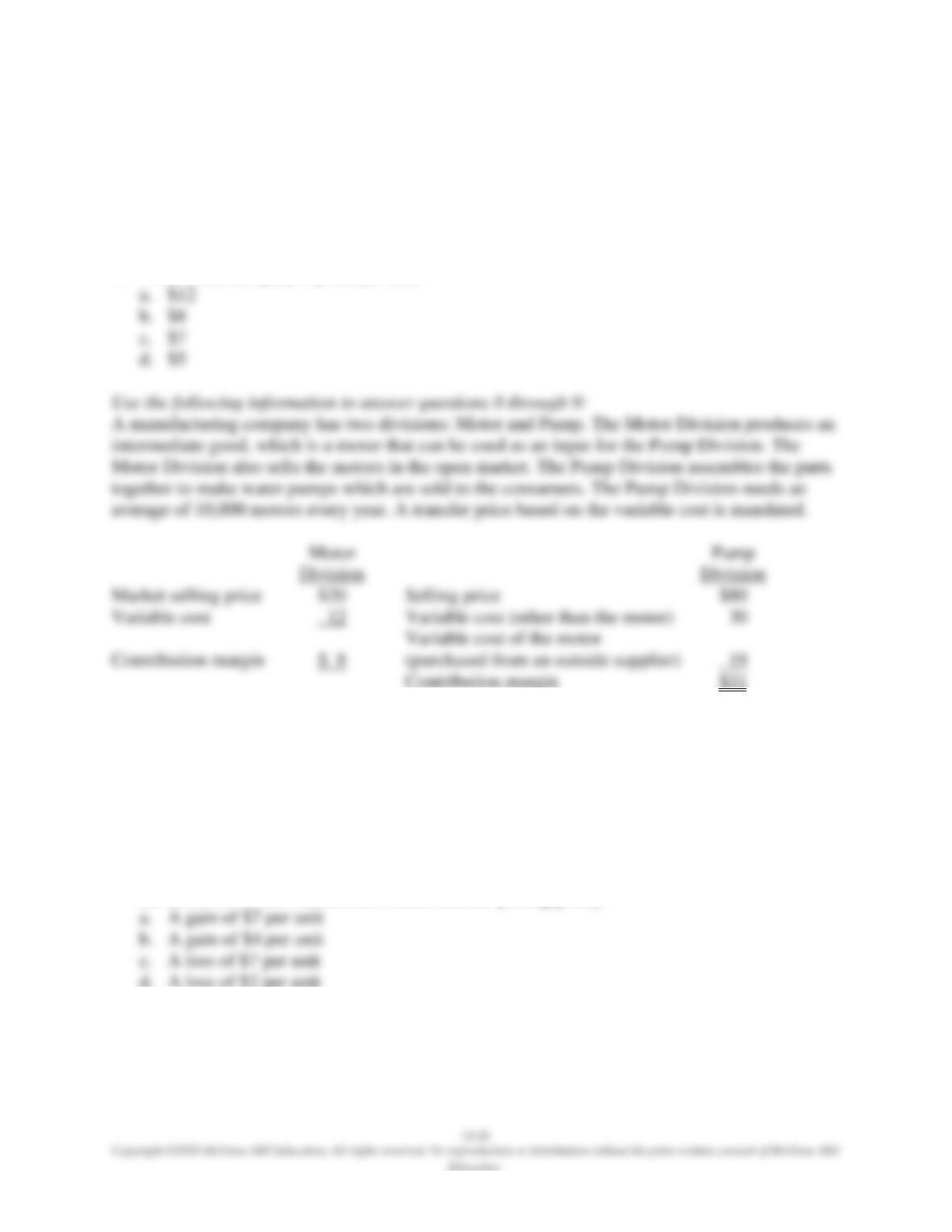
5. The selling division sells all it can produce at $18 per unit. The contribution margin lost due
to internal transfer is $6 per unit. What is the outlay cost per unit?
6. If there is no intermediate market and the selling division is not operating at capacity, what is
the optimal transfer price?
a. $15
b. $7
c. $5
d. $2
7. What is the company’s profit per unit?
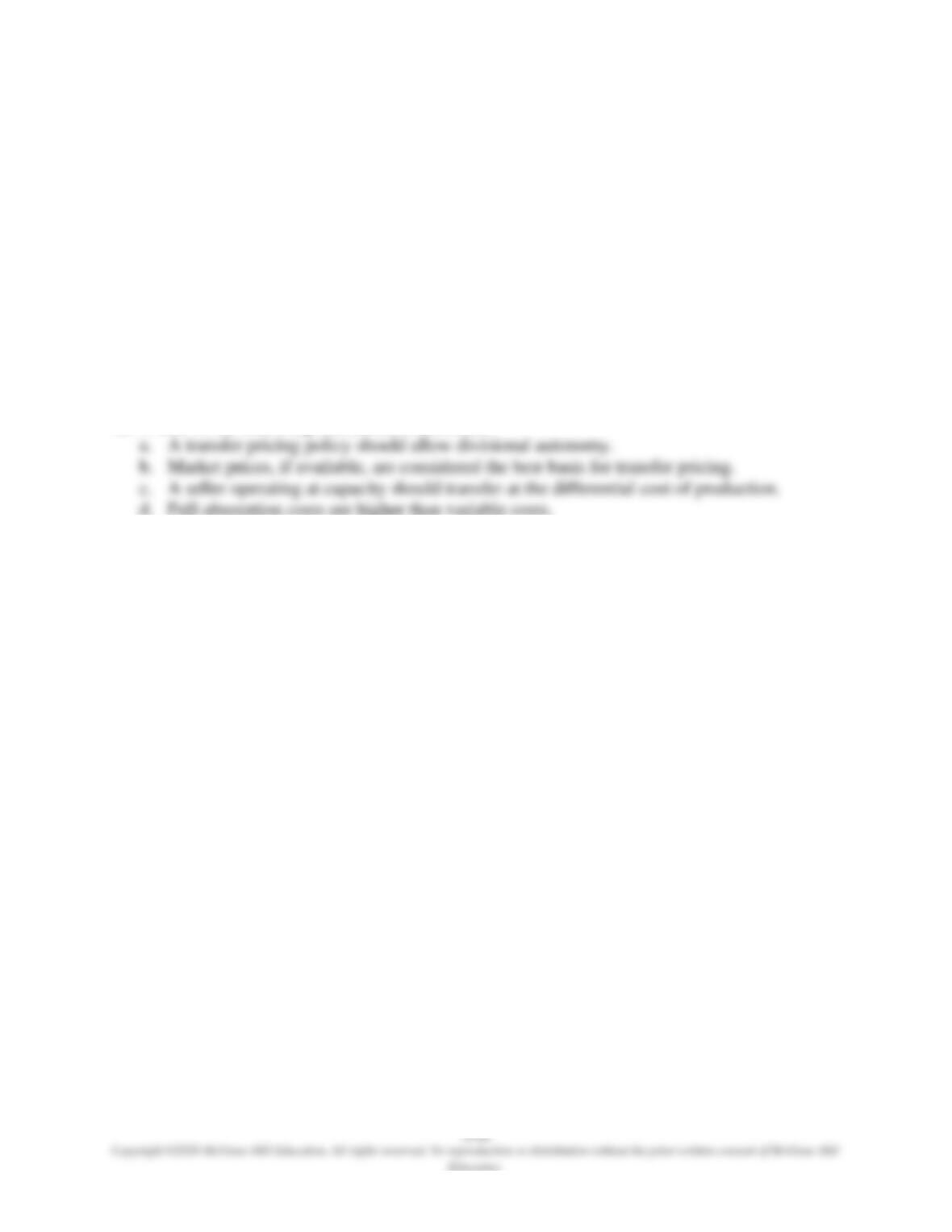
8. If the Motor Division has no excess capacity, what is the net result of the variable cost-based
transfer pricing policy?
a. A gain of $2 per unit
b. A loss of $1 per unit
c. $0
d. There is not enough information to determine the net result.
9. If the Motor Division has available capacity to handle the Pump Division’s demand, what is
the net result of the variable cost-based transfer pricing policy?
10. Segment reporting:
a. is required by FASB.
b. must disclose segment revenue, interest revenue and expense, segment operating profit or
loss, identifiable segment assets, and so on.
c. applies to foreign operations.
d. All of the above.
11. Which of the following is suitable to deal with problems as a result of transfer price-based
performance measures being adopted?
a. Direct intervention by top management
b. Centrally established transfer price policy
c. Negotiated transfer prices
d. All of the above.
12. Which of the following statements is incorrect?
Multiple Choice Answers
2. d (LO2)
4. d (LO3)
6. d (LO2)
8. b (LO2)
9. a (LO2)
10. d (LO5)
11. d (LO3)
12. c (LO3)
Demonstration Problem 1
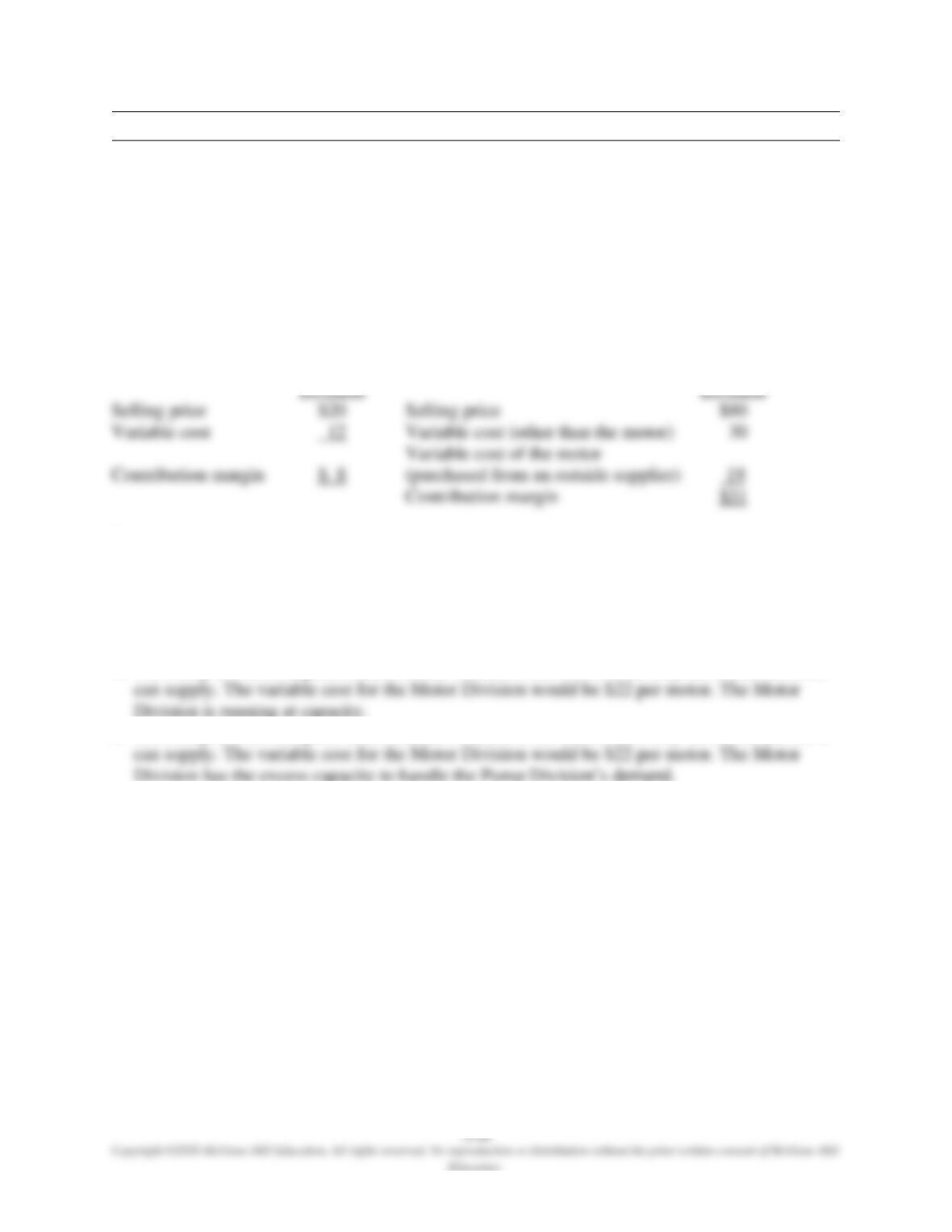
A manufacturing company has two divisions: Motor and Pump. The Motor Division produces an
intermediate good, motors, which can be used as an input for the Pump Division. The Motor
Division also sells the motors in the open market. The Pump Division secures the motors from
either the Motor Division or an outside supplier and assembles the parts together to make water
pumps which are sold to the consumers. The Pump Division needs an average of 10,000 motors
every year.
The following information is available.
Motor
Pump
Required:
1. Discuss the possible transfer prices under each of the following independent situations.
2. The Motor Division sells all it can produce (80,000 motors) to the outside customers.
3. The Motor Division can produce 80,000 motors but sells only 65,000 motors to the outsider
customers.
4. The Pump Division requires a customized version of the motors that only the Motor Division
5. The Pump Division requires a customized version of the motors that only the Motor Division
Demonstration Problem 1 – Solution
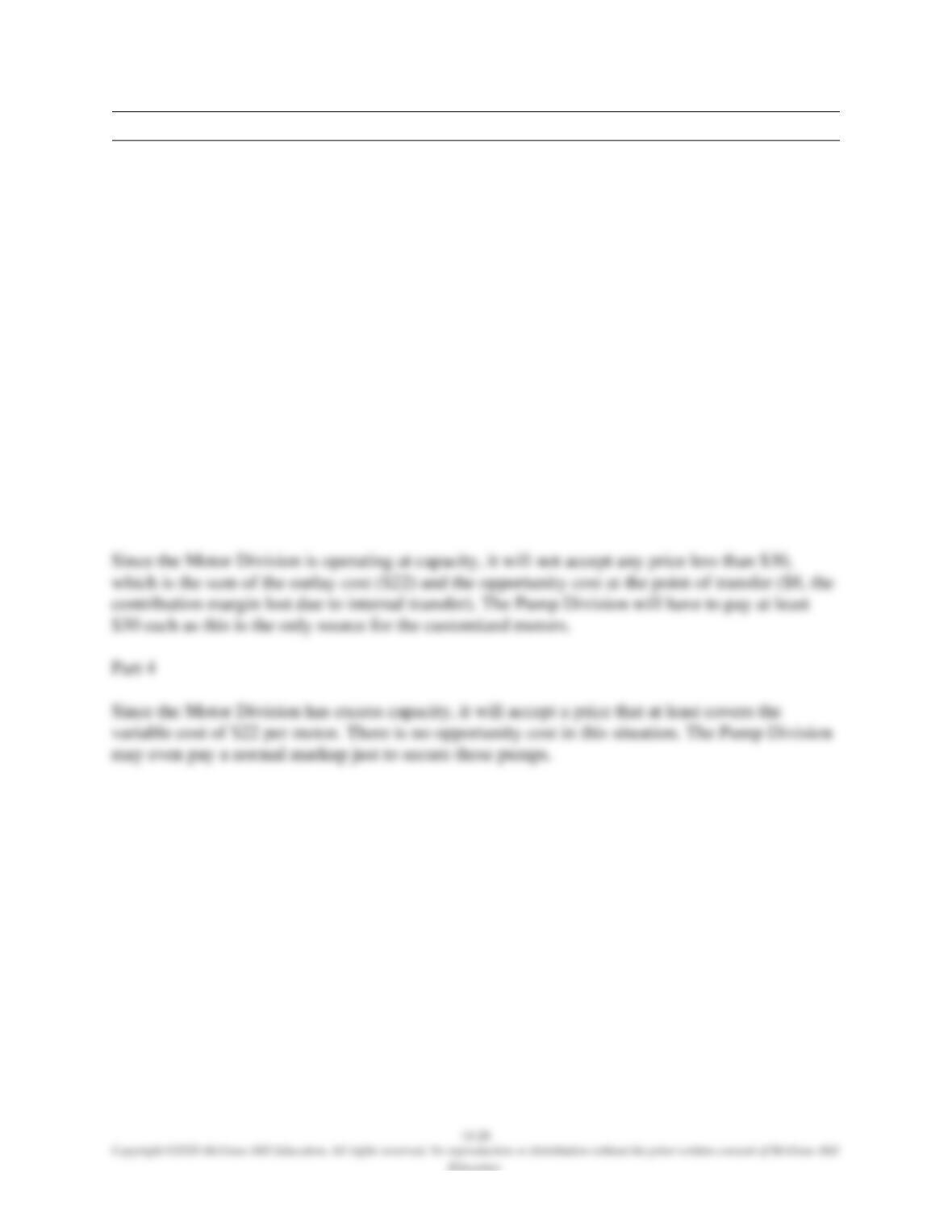
Part 1
Since the Motor Division is operating at capacity, the only transfer price that is acceptable is the
intermediate market price of $20, which is the sum of the outlay cost ($12) and the opportunity
cost at the point of transfer ($8, the contribution margin lost due to internal transfer). The Pump
Division, on the other hand, gets its motors from an outsider supplier for $19 per unit and is not
likely to give up the source. There will be no transfers between the Motor Division and the Pump
Division.
Part 2
Since the Motor Division has excess capacity, it will accept a price that at least covers the
variable cost of $12 per motor. There is no opportunity cost in this situation. The Pump Division
currently pays $19 per motor from an outsider supplier. So, a transfer price between $12 and $19
will benefit both divisions.
Part 3
Demonstration Problem 2
(Revised from Demonstration Problem 1)
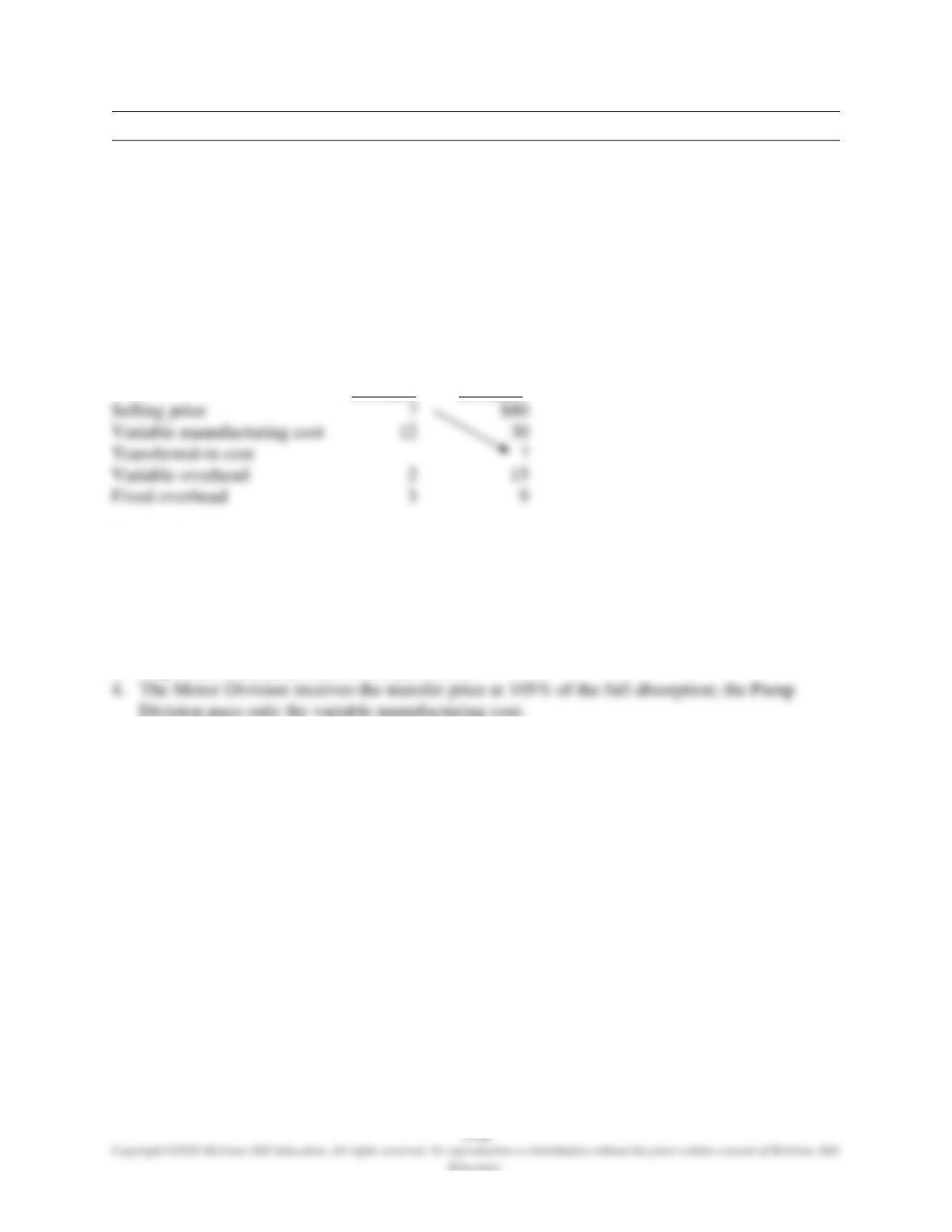
A manufacturing company has two divisions: Motor and Pump. The Motor Division produces an
intermediate good, motors, which can be used as an input for the Pump Division. The Pump
Division assembles the parts together to make water pumps which are sold to the consumers. The
Pump Division needs an average of 10,000 motors every year.
The following information is available.
Motor
Division
Pump
Division
Required:
Calculate divisional operating income and total operating income given the following
independent transfer pricing policies.
1. Market-based transfer price of $20 per motor.
2. Cost-based transfer price at 105% of the full absorption cost per motor.
3. Negotiated transfer price of $18.5 per motor.
Demonstration Problem 2 – Solution
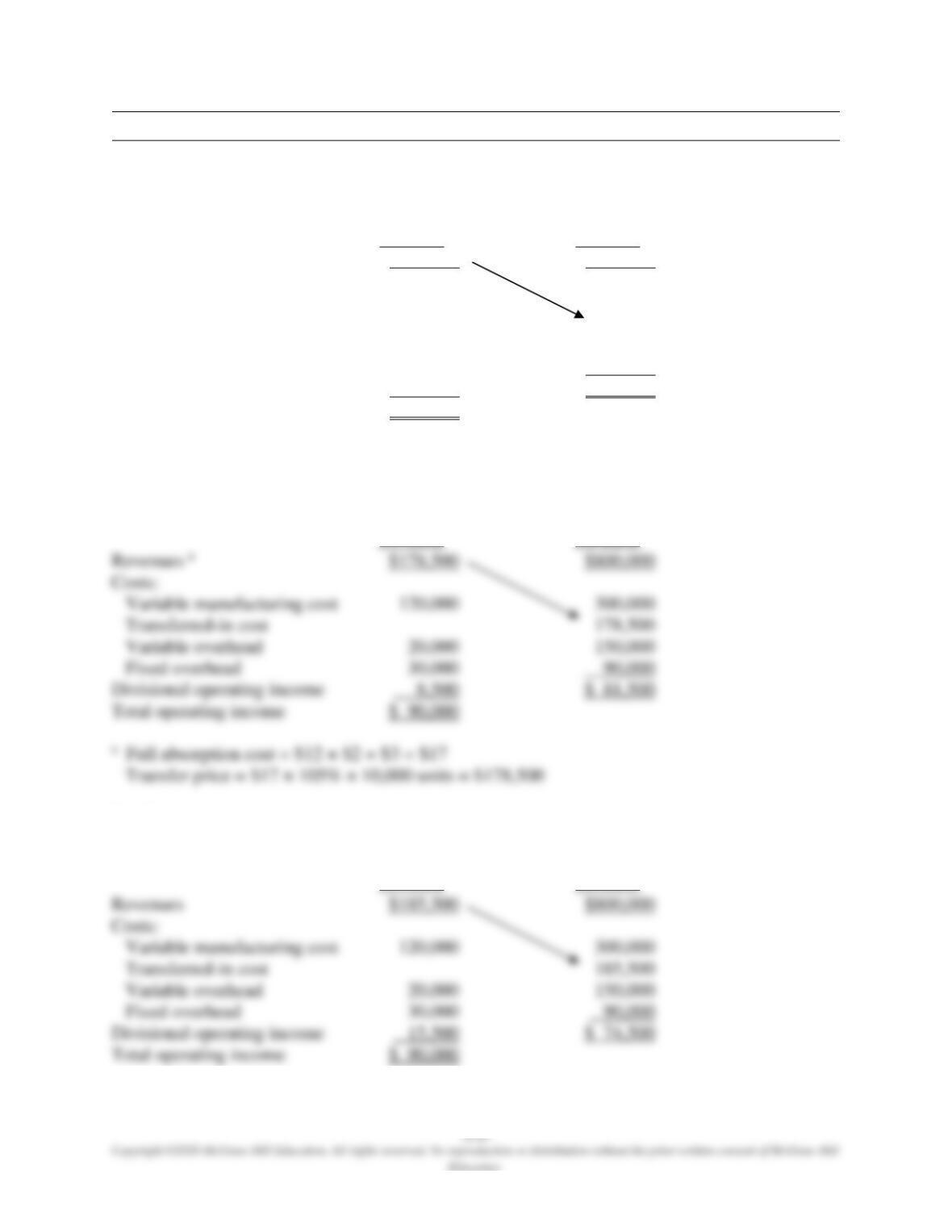
Part 1
Motor
Division
Pump
Division
Revenues a
$200,000
$800,000
Costs:
Variable manufacturing cost
120,000
300,000
Transferred-in cost
200,000
Variable overhead
20,000
150,000
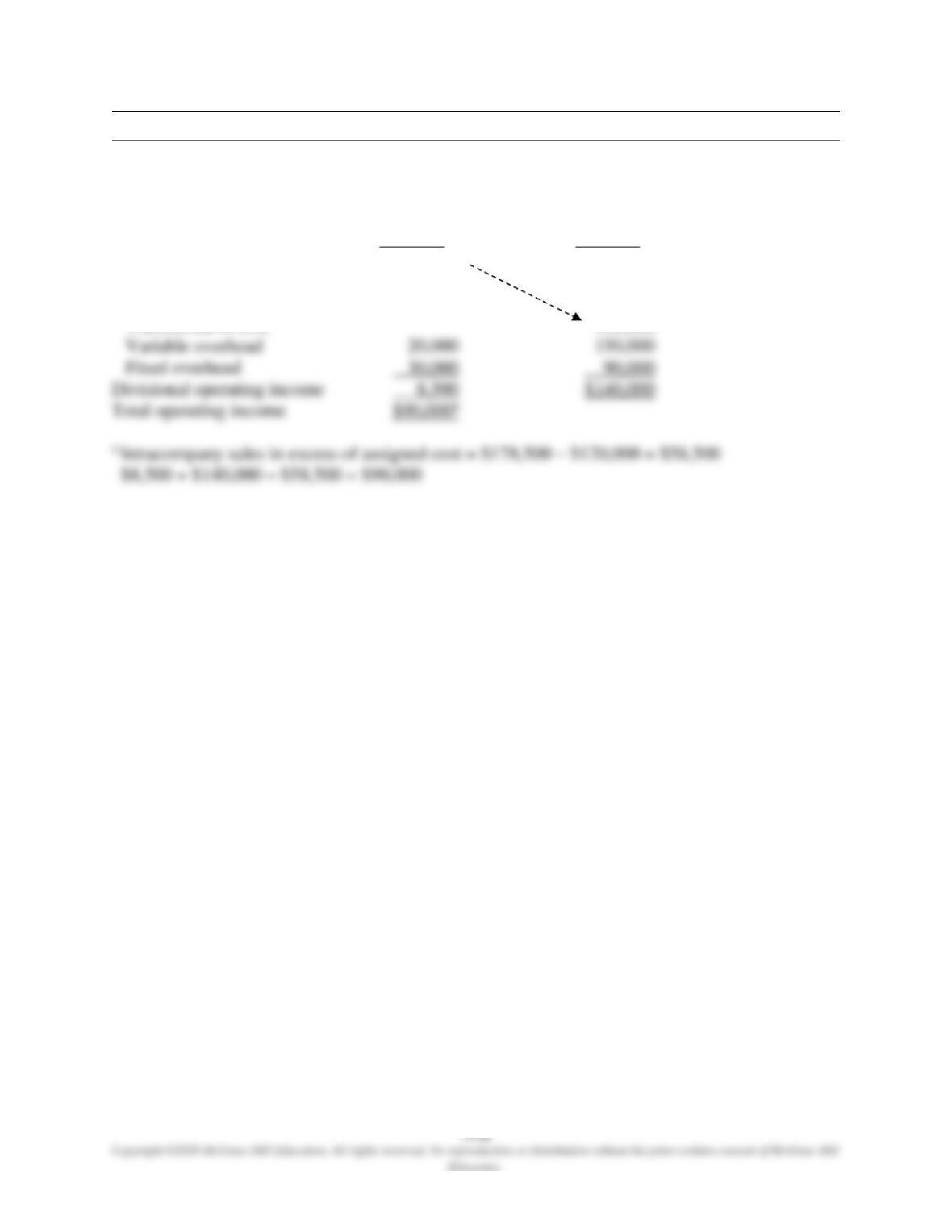
Fixed overhead
30,000
90,000
Divisional operating income
30,000
$ 60,000
Total operating income
$ 90,000
Part 2
Motor
$178,500
$800,000
Costs:
Variable manufacturing cost
120,000
300,000
Transferred-in cost
178,500
Variable overhead
20,000
150,000
Fixed overhead
30,000
90,000
Divisional operating income
$ 81,500
Total operating income
$ 90,000
Pump
Part 3
Motor
Costs:
Variable manufacturing cost
120,000
300,000
Transferred-in cost
185,500
Variable overhead
20,000
150,000
Fixed overhead
30,000
Divisional operating income
$ 74,500
Total operating income
$ 90,000
Pump
Demonstration Problem 2 – Solution, continued
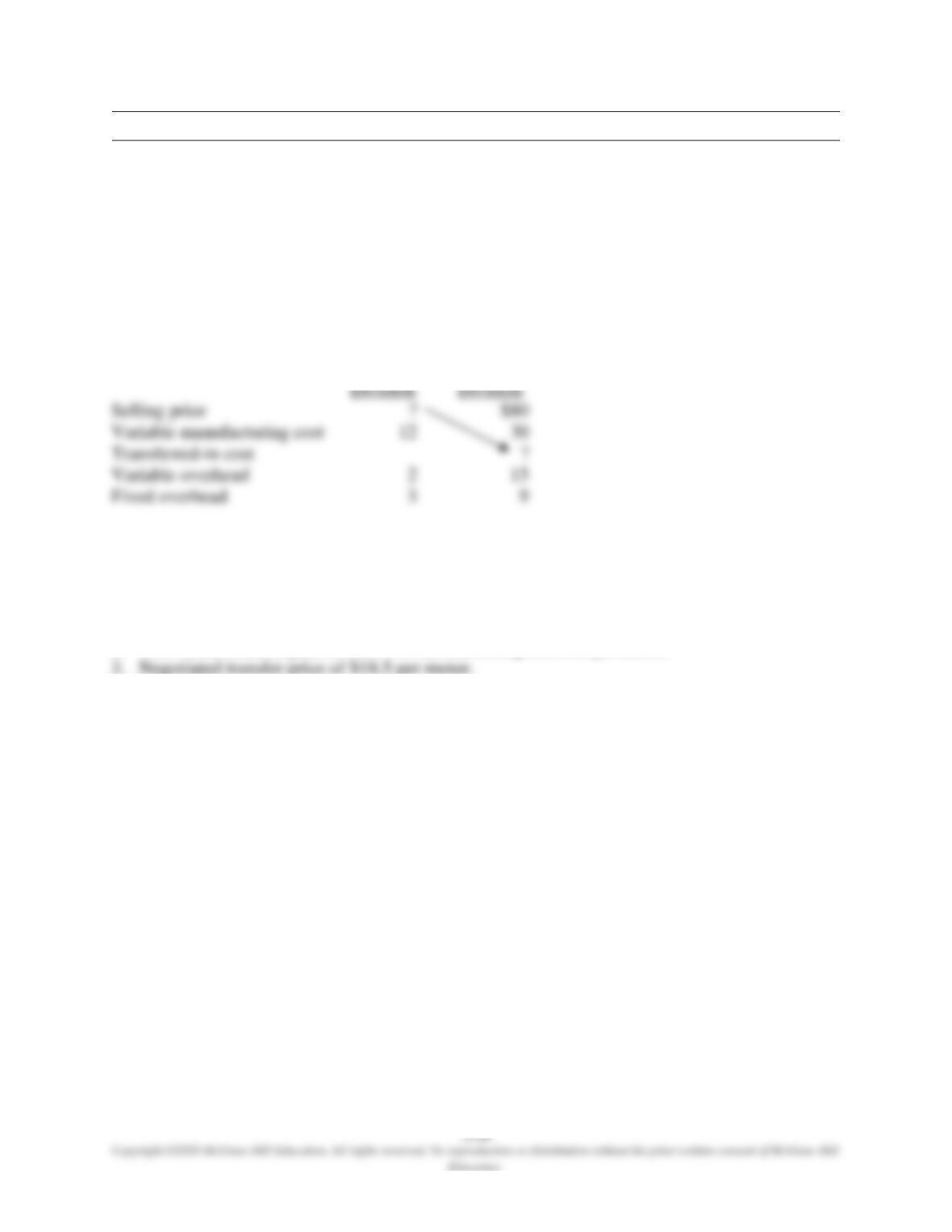
Part 4
Motor
Division
Pump
Division
Revenues
$178,500
$800,000
Costs:
Variable manufacturing cost
120,000
300,000
Transferred-in cost
120,000
Variable overhead
150,000
Fixed overhead
90,000
Divisional operating income
$140,000
Total operating income
Demonstration Problem 3
(Revised from Demonstration Problem 2)
A manufacturing company has two divisions: Motor and Pump. The Motor Division is located in
a low tax country (Tax rate = 25%) and produces an intermediate good, motors, that can be used
as an input for the Pump Division. The Pump Division is located in a high tax country (Tax rate
= 40%) and assembles the parts together to make water pumps which are sold to the outside
customers. The Pump Division needs an average of 10,000 motors every year. The following
information is available.
Motor
Pump
Required:
Calculate divisional operating income and total operating income and discuss tax implications,
given the following independent transfer pricing policies.
1. Market-based transfer price of $20 per motor.
2. Cost-based transfer price at 105% of the full absorption cost per motor.
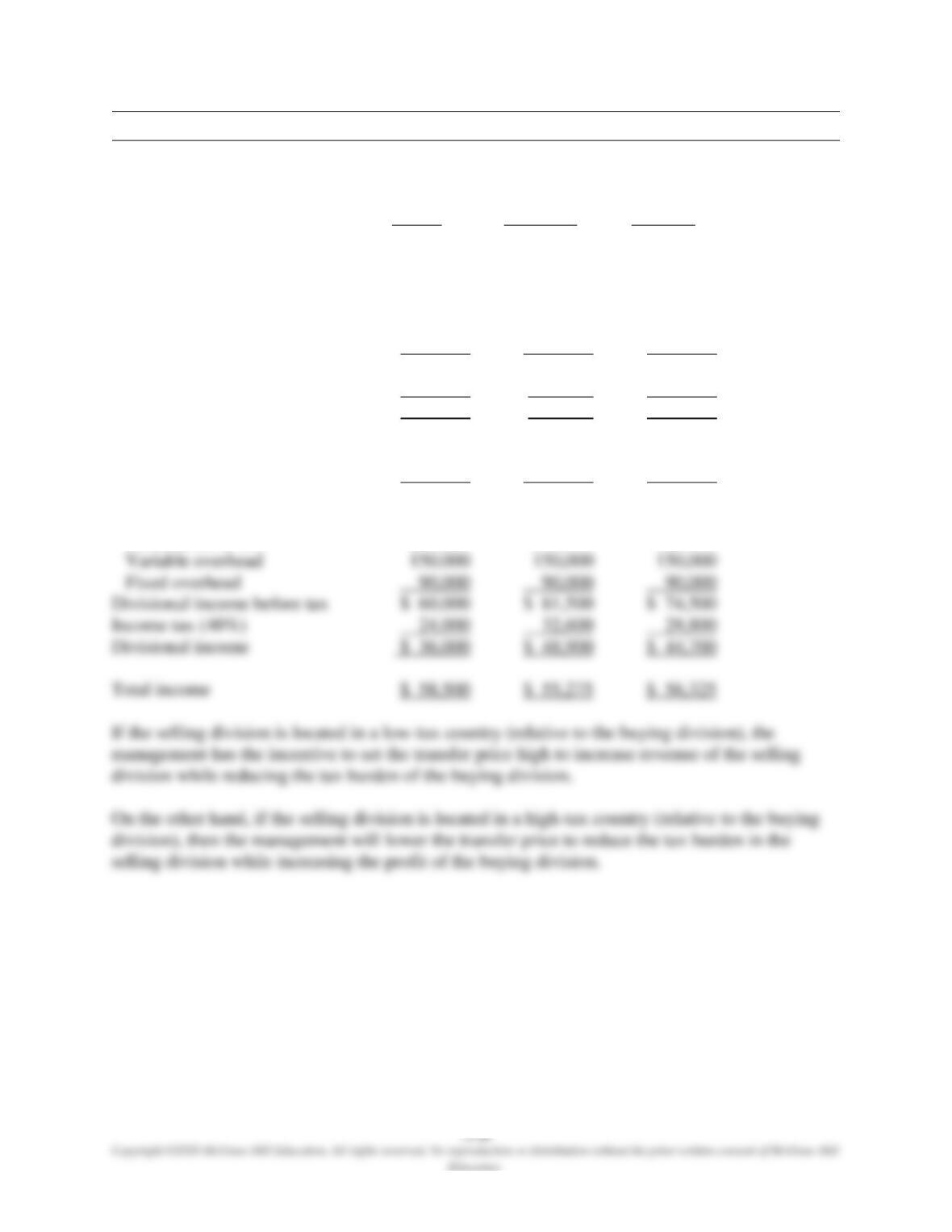
Demonstration Problem 3 – Solution, continued
Market-Based
Transfer Price
@ $20
Cost-Based
Transfer Price
@ $17.85
Negotiated
Transfer Price
@ $18.5
Motor Division
Revenues
$200,000
$178,500
$185,500
Costs:
Variable manufacturing cost
120,000
120,000
120,000
Variable overhead
20,000
20,000
20,000
Fixed overhead
30,000
30,000
30,000
Divisional income before tax
$ 30,000
$ 8,500
$ 15,500
Income tax (25%)
7,500
2,125
3,875
Divisional income
$ 22,500
$ 6,375
$ 11,625
Pump Division
Revenues
$800,000
$800,000
$800,000
Costs:
Variable manufacturing cost
300,000
300,000
300,000
Transferred-in cost
200,000
178,500
185,500
Variable overhead
150,000
150,000
150,000
Fixed overhead
90,000
90,000
90,000
Divisional income before tax
$ 60,000
$ 74,500
Income tax (40%)
24,000
32,600
29,800
Divisional income
$ 48,900
$ 44,700
Total income
$ 58,500
$ 55,275
$ 56,325