————–———————-————- CHAPTER 15 —————–———————-——
REVIEW QUESTIONS
Q15–1
a. Assets are items of value that are owned or controlled by an organization as a result of past
transactions and events.
Q15–3 The accounting equation must always balance because the dollar value of the assets must always
Q15–4 The cash basis of accounting measures the inflows and outflows of cash. Under the accrual basis of
Q15-5 An accrual recognizes assets, revenues, expenses, and liabilities attributable to one period, but not
expected to be received or paid in cash until a future period. Example: salaries earned by employees in one
Q15-6 The rules of debit and credit are as follows:
Account type Debits Credits
Q15-7 This statement is not correct. The correct statement is that for each dollar of debit to one or more
Q15-8 A journal is the book of original entry where every accounting transaction is initially recorded. The
entries show the accounts affected by each transaction and are recorded chronologically.
Q15-10 Journals and ledgers are interrelated in an accounting system through the process of posting. After
transactions and events are initially recorded in journals (books of original entry), the data is posted to the
2
Q15-11 Disagree. The fact that the total columns of the trial balance agree with each other indicates only
that the debits are equal to the credits. The accounts could be in balance even though there were numerous
Q15-12 The three basic financial statements illustrated in the text are:
a. Income statement
Q15-13 The three financial statements “articulate” with each other. An accounting period starts with
opening balances, which are shown in a balance sheet. The net income earned during an accounting period
Q15-14 The income statement and the statement of changes in owner’s equity need to show the time period
covered because they relate to specific time periods. It is important to show whether the period covered a
Q15-15 Adjusting entries are used to bring the financial statements up to date before financial statements
are prepared. Most journal entries are made only as a result of explicit transactions, such as the payment of
Q15-16 The temporary (nominal) accounts are closed at the end of the period. These are the income
3
EXERCISES
E15-1 (5 minutes)
There are many answers to this exercise. Here are a few:
1. assets increase when inventory is purchased on credit; when the invoice is paid, an asset will
decrease
E15-2 (5 minutes)
1. Cash increased; Loans payable increased
E15-3 (5 minutes)
Assets – liabilities = equity
E15-4 (5 minutes)
E15-5 (5 minutes)
1. Interest expense increased; Interest payable increased
E15-6 (20 minutes)
1. Equipment (or Truck) 24,000
2. Supplies inventory 3,500
7. Cash 5,300
E15-7 5 (minutes)
Account type Increase with Usual balance
a. Assets Debit Debit
E15-8 (10 minutes)
1. An asset increased and a liability increased
E15-9 (15 minutes)
Service revenue $30,000
Less, expenses:
Depreciation expense $ 3,000
E15-10 (15 minutes)
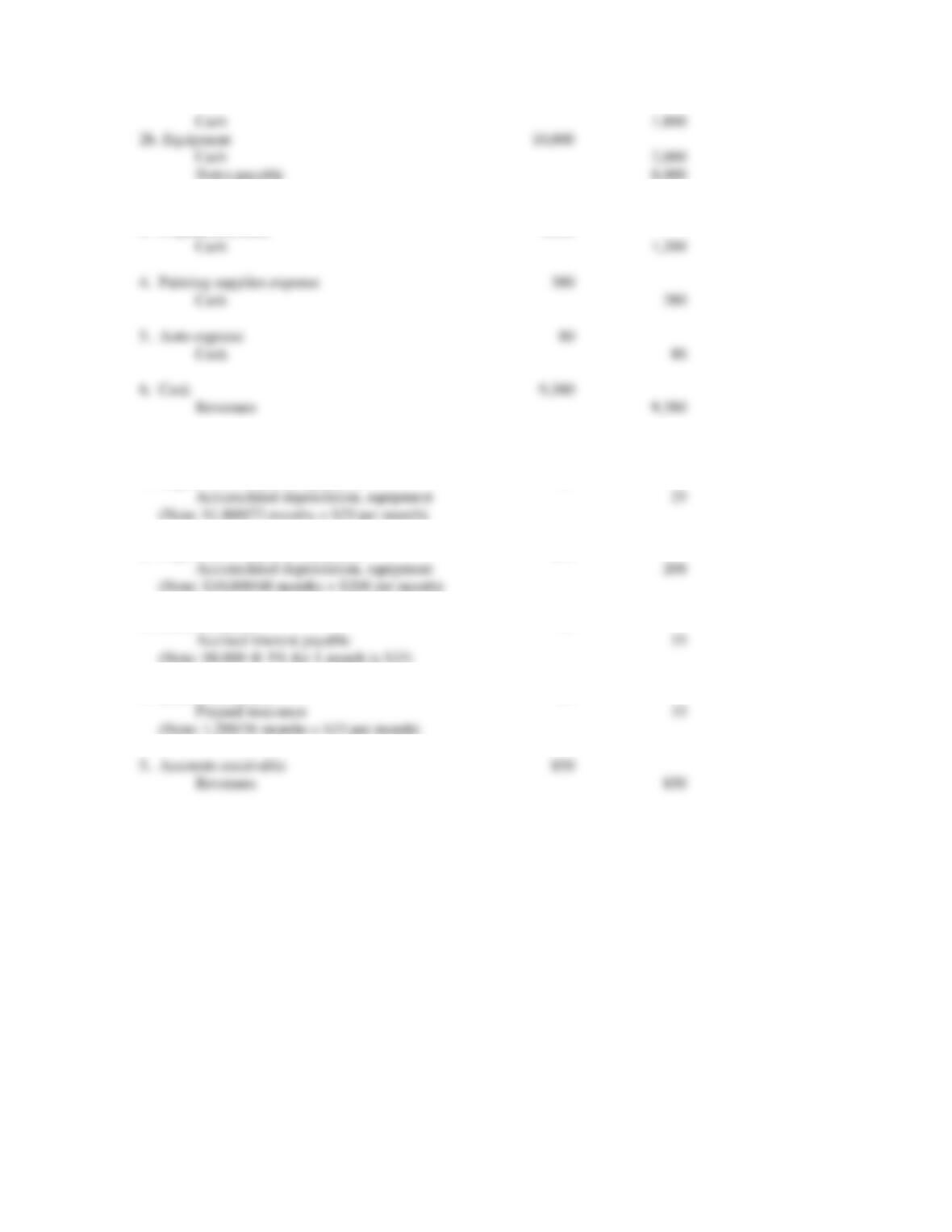
1. Cash 6,000
Ken Cascioli, Capital 3,000
Bill Ryder, Capital 3,000
5
3. Prepaid insurance 1,200
E15-11 (25 minutes)
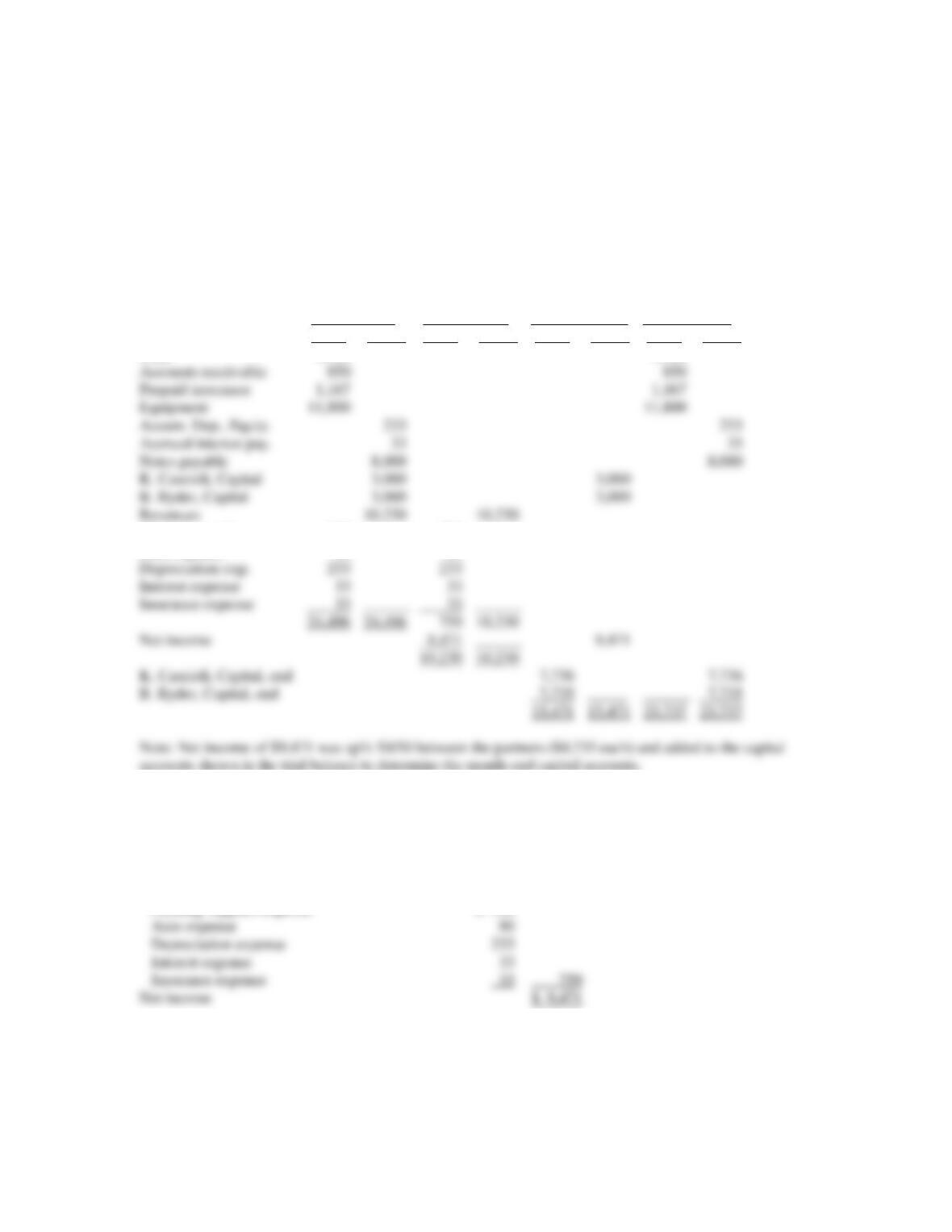
1. Depreciation expense, equipment 25
2. Depreciation expense, equipment 208
3. Interest expense 33
4. Insurance expense 33
6
E15-12 (90 minutes)
(T-accounts are not presented here. An 8-column spread sheet with the trial balance is shown below to
facilitate preparation of the financial statements.)
Trial Balance Income State. Changes Equity Balance Sheet
Debit Credit Debit Credit Debit Credit Debit Credit
Cash 9,920 9,920
Painting supplies exp. 380 380
Auto expense 80 80
accounts shown in the trial balance to determine the month-end capital accounts.
Ken Cascioli and Bill Ryder
Income Statement
For the Month Ended XX, 20XX
Revenues $10,230
Expenses:
Painting supplies expense $ 380
Ken Cascioli and Bill Ryder
Statement of Changes in Owners’ Equity
For the Month Ended XX, 20XX
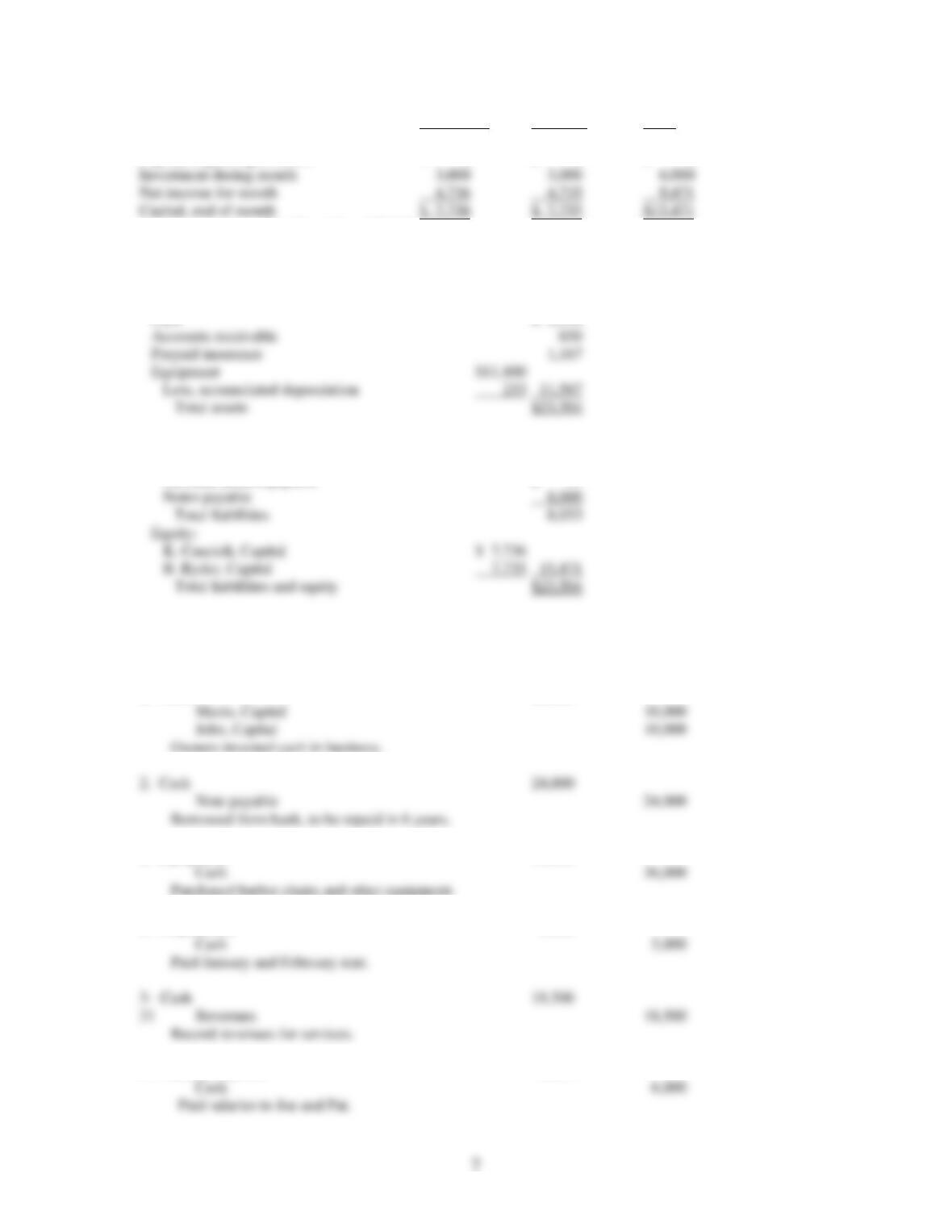
K. Cascioli B. Ryder Total
Capital, beginning of month $ 0 $ 0 $ 0
Ken Cascioli and Bill Ryder
Balance Sheet
XX, 20XX
Assets:
Cash $ 9,920
Liabilities and Equity:
Liabilities:
Accrued interest payable $ 33
E15-13 (25 minutes)
January
2. Cash 20,000
2. Equipment 36,000
2. Prepaid rent 5,000
31. Salaries expense 6,000
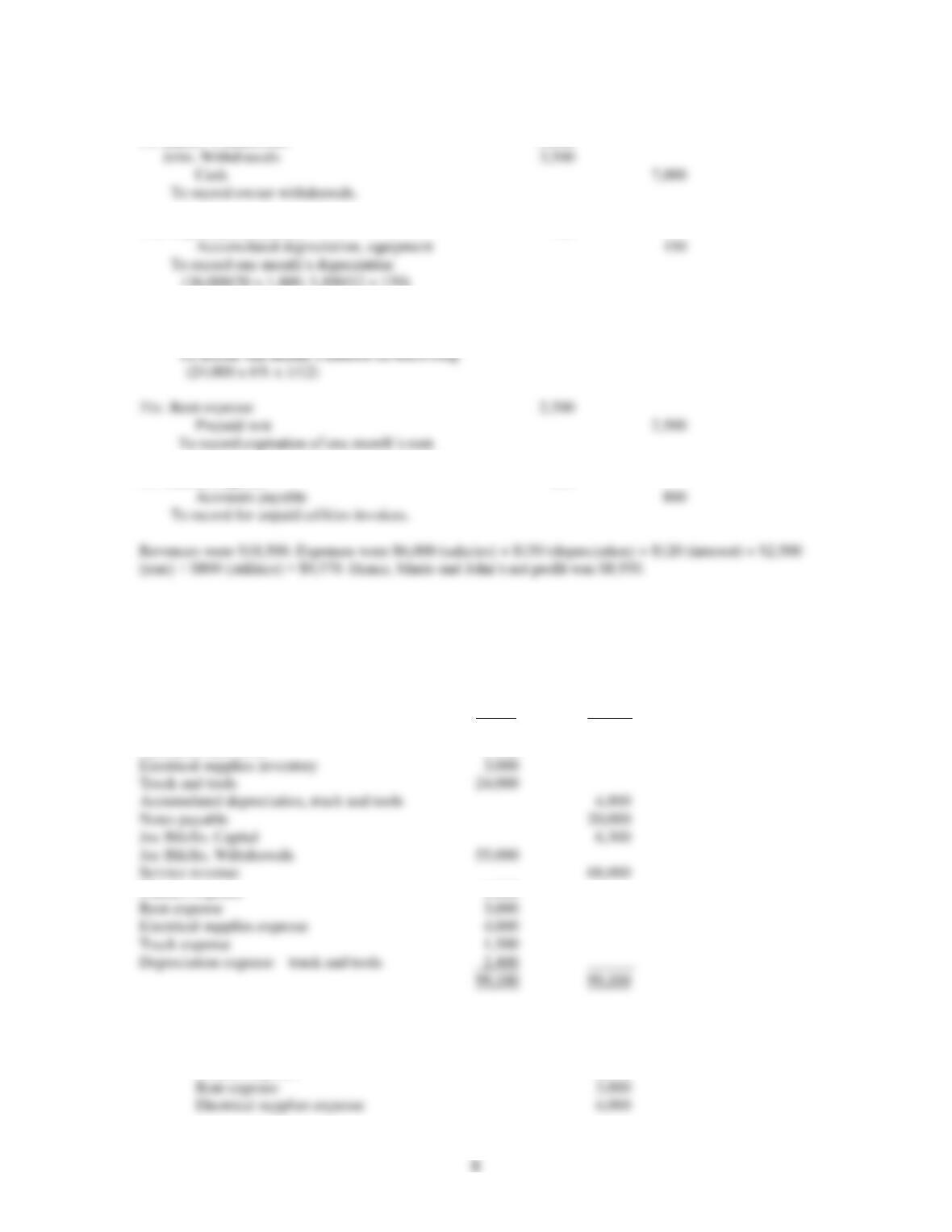
31. Mario, Withdrawals 3,500
31a. Depreciation expense 150
(36,000/20 = 1,800; 1,800/12 = 150)
31b. Interest expense 120
Accrued interest payable 120
31. Utilities expense 800
E15-14 (15 minutes)
Joe Bilello
Trial Balance
June 30, 2013
Debits Credits
Cash 4,000
Accounts receivable 1,200
Utilities expense 1,000
E15-15 (20 minutes)
Service revenue 68,000
Utilities expense 1,000
9
Joe Bilello, Capital 55,000
Joe Bilello, Withdrawals 55,000
To close withdrawals to capital.
Beginning balance 6,300
E15-16 (25 minutes)
Total assets: Cash $22,000
Accounts receivable 12,000
Equipment $50,000
E15-17 (10 minutes)
Answers are keyed to the following:
Balance sheet BS
Income statement IS
Statement of changes in owner’s equity COE
a. Bonds payable BS
f. Supplies expense IS
g. Depreciation expense IS
E15-18 (15 minutes)
1. L
2. SC
8. L
E15-19 (10 minutes)
1. b
E15-20 (10 minutes)
1. Accounts receivable 120,000
Revenues 120,000
3. Bad debts expense 1,500
11
E15-21 (5 minutes)
1. Merchandise inventory 308,000
2. Cash 130,000
Revenues 130,000
P15-1 and P15-2 (20 minutes and 10 minutes, respectively)
———–Assets————-—–— = ——-Liabilities–—— + Capital
Accts. Prepaid Notes Accts. Salaries S. Golfo
Trans. Cash Receiv. Rent Furn. Payable Payable Payable Capital
1 + 5,000 + 5,000 Investment
P15-3 (40 minutes)
1. Cash 5,000
12
1. Prepaid rent 6,000
1. Furniture 4,800
18. Salaries expense 800
20. Accounts receivable 12,000
30. Utilities expense 300
30. Food expense 500
1. Rent expense 2,000
Prepaid rent 2,000
To adjust for expiration of 1 month’s rent
2. Depreciation expense, furniture 100
13
P15-4 (90 minutes)
Sally’ Eldercare
Worksheet for Preparing Financial Statements
July 31, 2013
Income Changes in
Trial Balance Statement Owner Equity Balance Sheet
Debit Credit Debit Credit Debit Credit Debit Credit
Cash 20,800 20,800
S. Golfo, Capital 5,000 5,000
Revenues – patient care 12,000 12,000
Salaries expense 1,600 1,600
Utilities expense 300 300
Sally’s Eldercare
Income Statement
For the Month Ended July 31, 2013
Revenues – patient care $12,000
Expenses:
Salaries expense $ 1,600