Problem 15-8 (20 minutes)
Transaction
Operating
Investing
Financing
Cash
Inflow
Cash
Outflow
a.
Paid suppliers for inventory purchases ….
X
X
b.
Bought equipment for cash ………………..
X
X
c.
Paid cash to repurchase its own stock …..
X
X
d.
Collected cash from customers ……………
X
X
e.
Paid wages to employees …………………..
X
X
f.
Equipment was sold for cash ………………
X
X
X
Cash dividends were declared and paid …
X
X
A long-term loan was made to a supplier
X
X
X
Interest was paid to a lender ………………
X
X
X
Problem 15-9 (60 minutes)
The forthcoming explanation is broken down into eight steps.
1. The statement of cash flows summarizes all of a company’s cash inflows
and outflows during a period, thereby explaining the difference between
its beginning and ending cash balance.
2. The statement is divided into three sections—operating activities,
investing activities, and financing activities. The operating activities
3. The indirect method of preparing the operating activities section of the
statement of cash flows begins with net income and adjusts it to a cash
basis. The first step in completing the indirect method is to add
depreciation to net income. The total credits to Brock’s Accumulated
Depreciation account equal $140, so this amount is added to net
income. Because Brock is a merchandiser, the $140 corresponds to its
depreciation expense, which is a noncash expense that must be added
to net income to translate to a cash basis.
4. The second step is to analyze net changes in noncash balance sheet
accounts that impact the computation of net income. For Brock, this
Problem 15-9 (continued)
The inventory balance decreased by $39. This means that Brock’s
inventory purchases were less than its cost of goods sold by $39.
Brock’s cost of goods sold was $2,980; therefore, its inventory
purchases were $2,941. The company’s accounts payable balance
decreased by $45. This means that Brock’s inventory purchases were
$45 less than its cash payments to suppliers. Brock’s inventory
purchases were $2,941; therefore, its payments to suppliers must be
$2,986. Because the income statement records cost of goods sold
($2,980) and not cash paid to suppliers ($2,986), $6 must be subtracted
from net income to translate it to cash basis. If the inventory and
accounts payable adjustments are combined it equals a $6 subtraction
from net income.
5. The third step of the indirect method is to adjust for gains/losses
included in the income statement. This adjustment is necessary because
the cash realized from the sale of noncurrent assets must be disclosed
Problem 15-9 (continued)
6. The investing activities section of Brock’s statement of cash flows
7. The financing activities section of Brock’s statement of cash flows
records the gross cash flows related to its bonds payable, common
stock, and dividends. The statement includes a $40 cash inflow related
to the issuance of bonds. It also includes a $4 cash inflow related to
issuing common stock and a $35 cash outflow related to paying
dividends.
8. The net increase in cash and cash equivalents ($260) explains the
difference between the beginning and ending cash balances.
Problem 15-10 (45 minutes)
1. Net cash provided by (used in) operating activities:
Step 1: The following equation can be applied to the Accumulated
Depreciation account to compute the depreciation to add back to net
income:
Beginning balance – Debits + Credits = Ending balance
$120,000 – $30,000 + Credits = $132,000
Credits = $132,000 – $120,000 + $30,000
Credits = $42,000
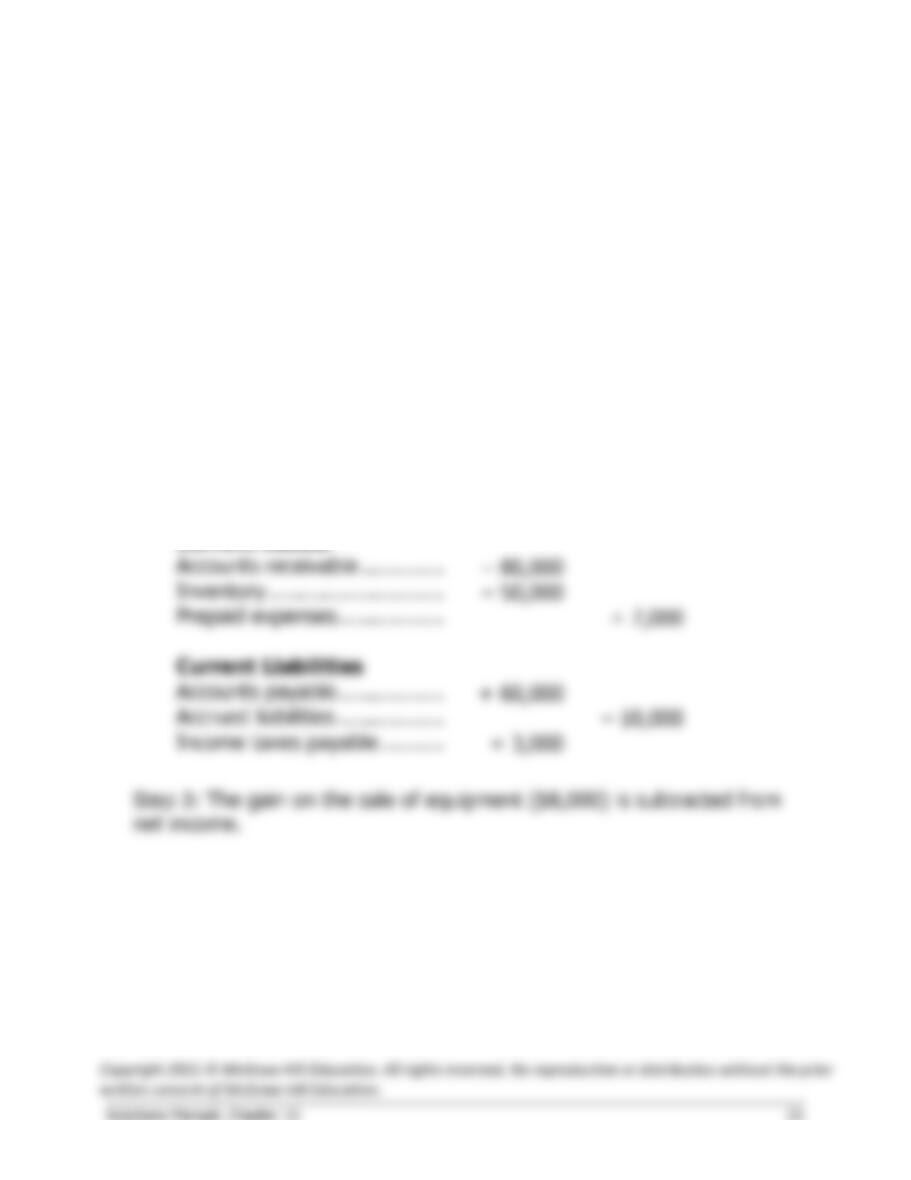
Step 2: The guidelines from Exhibit 15-2 can be used to analyze the
changes in noncash balance sheet accounts that impact net income as
follows:
Increase
in Account
Balance
Decrease
in Account
Balance
Problem 15-10 (continued)
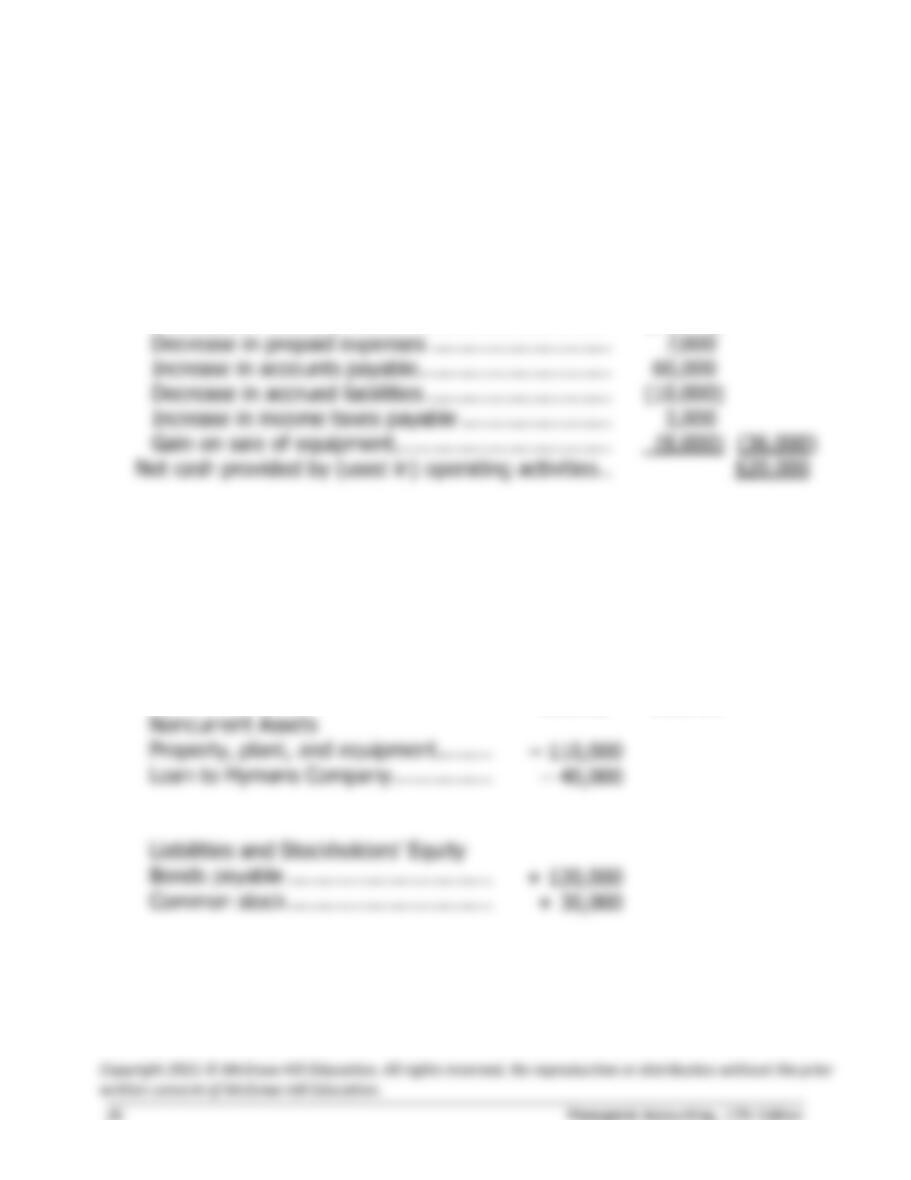
The net cash provided by (used in) operating activities is computed as
follows:
Net income …………………………………………………..
$56,000
Adjustments to convert net income to cash basis:
Depreciation ……………………………………………….
$ 42,000
Increase in accounts receivable ………………………
(80,000)
Increase in inventory ……………………………………
(50,000)
Decrease in prepaid expenses ………………………..
Increase in income taxes payable ……………………
Gain on sale of equipment……………………………..
2. Prepare a statement of cash flows.
Investing and Financing activities:
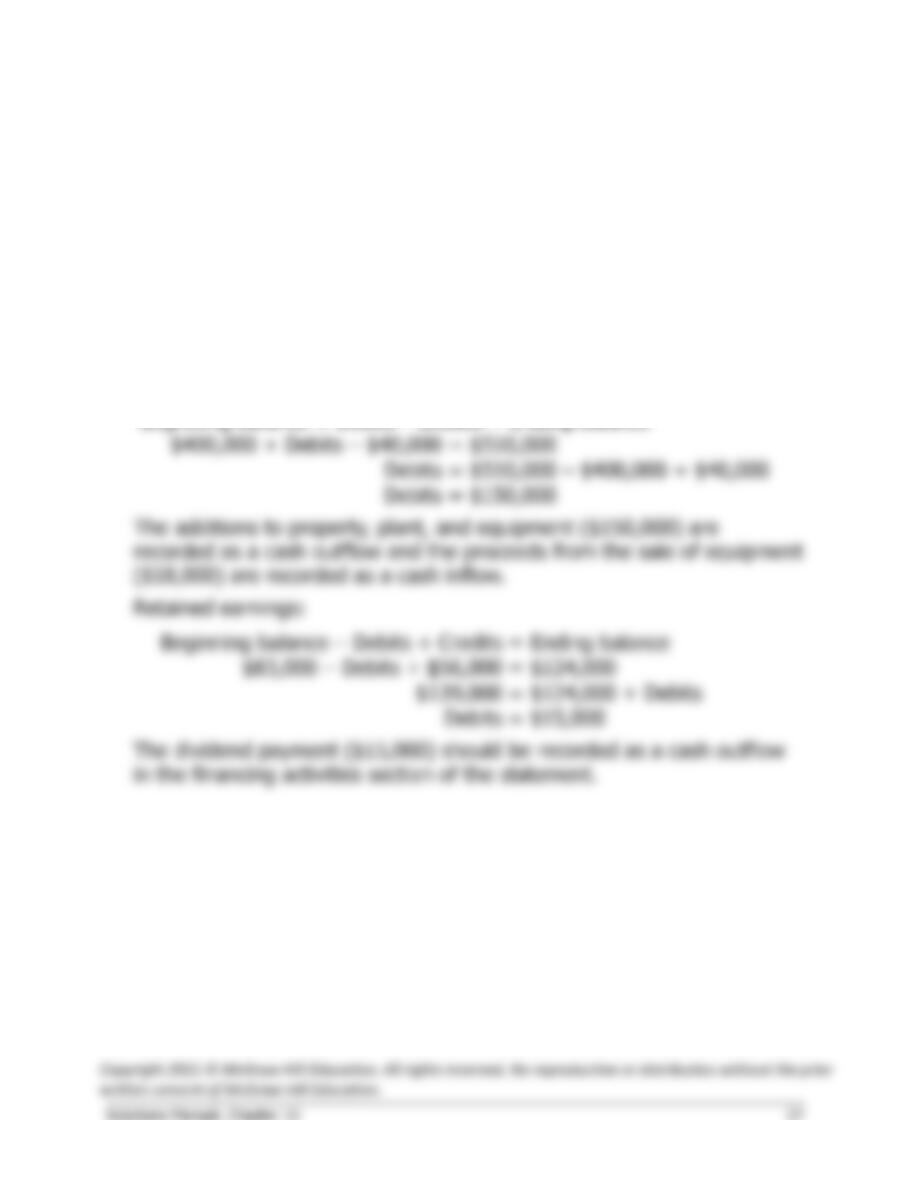
The guidelines from Exhibit 15-3 can be used to analyze the changes in
noncash balance sheet accounts that impact investing and financing
cash flows as follows:
Increase
in Account
Balance
Decrease
in Account
Balance
Problem 15-10 (continued)
The loan to Hymans ($40,000) is recorded as a cash outflow in the
investing activities section of the statement. Because Joyner did not
retire any bonds during the year, the corresponding amount in the table
on the prior page (+120,000) represents a cash inflow pertaining to a
bond issuance. Joyner did not repurchase any of its own stock during
the year, so the increase in common stock (+30,000) is reported as a
cash inflow in the financing activities section of the statement. Property,
plant, and equipment and retained earnings require further analysis as
follows:
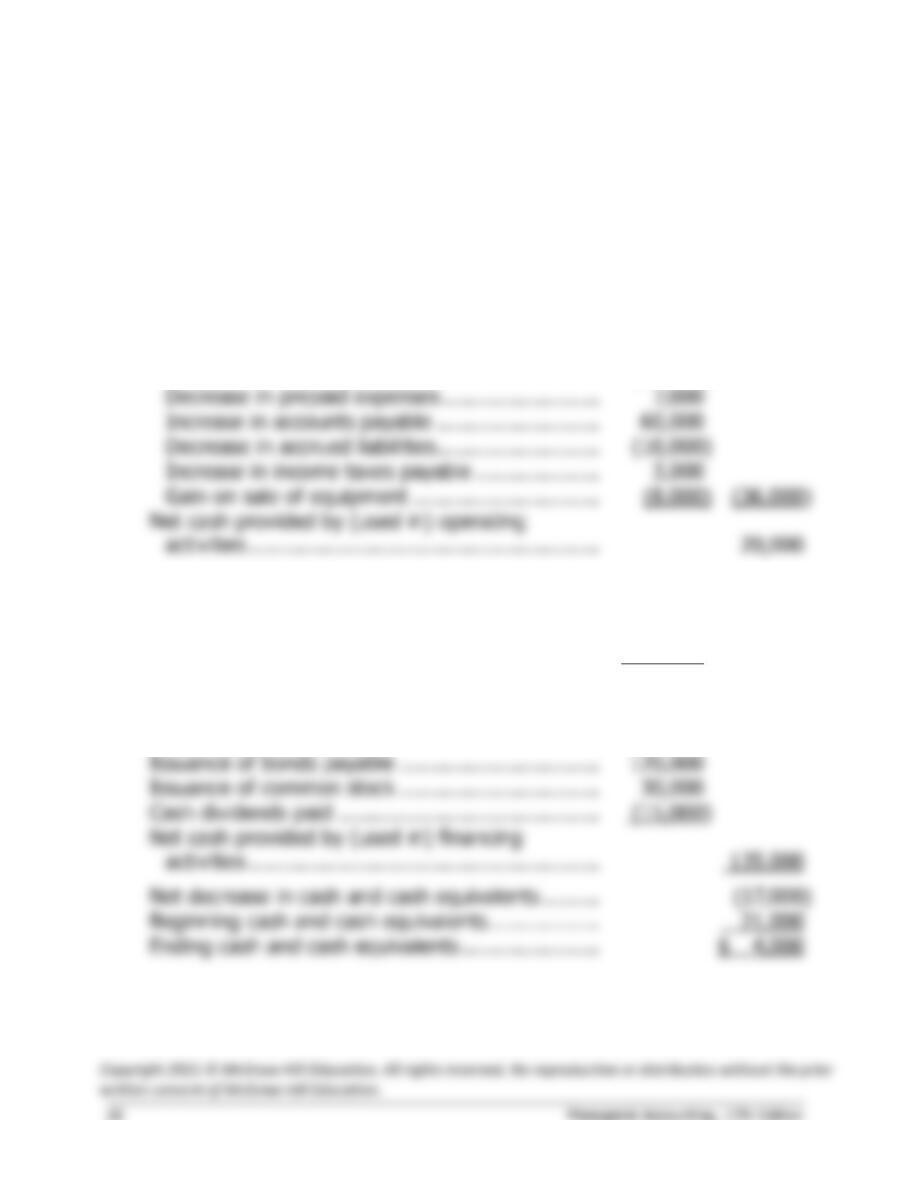
Property, plant, and equipment:
Problem 15-10 (continued)
Joyner Company
Statement of Cash Flows
For Year 2
Operating activities:
Net income ……………………………………………….
$ 56,000
Adjustments to convert net income to cash basis:
Depreciation ……………………………………………
$ 42,000
Increase in accounts receivable …………………..
(80,000)
Increase in inventory ………………………………..
(50,000)
Decrease in prepaid expenses …………………….
Increase in accounts payable ……………………..
Decrease in accrued liabilities ……………………..
Increase in income taxes payable ………………..
Gain on sale of equipment …………………………
Net cash provided by (used in) operating
activities ………………………………………………..
20,000
Investing activities:
Proceeds from sale of equipment …………………..
18,000
Loan to Hymans Company …………………………...
(40,000)
Additions to property, plant, & equipment ………..
(150,000)
Net cash provided by (used in) investing
activities ………………………………………………..
(172,000)
Financing activities:
Issuance of bonds payable …………………………..
Issuance of common stock …………………………..
Cash dividends paid ……………………………………
Net decrease in cash and cash equivalents ………
Beginning cash and cash equivalents ………………
Ending cash and cash equivalents ………………….
$ 4,000
Problem 15-10 (continued)
3. Free cash flow computation:
Net cash provided by operating activities ……
$ 20,000
Less:
Capital expenditures …………………………...
$150,000
Dividends ………………………………………….
15,000
165,000
Free cash flow …………………………..…………
$(145,000)
4. The relatively small amount of net cash provided by operating activities
during the year was largely the result of a large increase in accounts
Problem 15-11 (45 minutes)
To begin the problem, fill in the question mark pertaining to item “a”
using the following T-account:
Retained Earnings
Dividends
20,000
Net income
70,000
Change
50,000
The change in the retained earnings balance is $50,000 and the cash
dividends are $20,000; therefore, the net income must be $70,000.
Step 2: The guidelines from Exhibit 15-2 can be used to analyze the
changes in noncash balance sheet accounts that impact net income as
follows:
Increase in
Account Balance
Decrease in
Account Balance
Current Assets
Accounts receivable ….
– 110,000
Inventory ……………….
+ 65,000
Prepaid expenses ……..
+ 8,000
Current Liabilities
Accounts payable ……..
Accrued liabilities ……..
Income taxes payable .
Problem 15-11 (continued)
Step 3: The company had a $2,000 gain on the sale of equipment. The
book value of the equipment was $13,000 (= $50,000 – $37,000). The
company sold the equipment for $15,000, so its gain on the sale of
$2,000 (= $15,000 – $13,000) is subtracted from net income.
The net cash provided by (used in) operating activities can now be
calculated as follows:
Net income …………………………………………..
$ 70,000
Adjustments to convert net income to cash basis:
Investing and Financing activities:
The guidelines from Exhibit 15-3 can be used to analyze the changes in
noncash balance sheet accounts that impact investing and financing
cash flows as follows:
Increase in
Account
Balance
Decrease in
Account
Balance
Noncurrent Assets
Problem 15-11 (continued)
As stated in item “f” in the problem, it is reasonable to assume that the
$80,000 increase in long-term investments corresponds with a cash
outflow that needs to be recorded in the investing section of the
statement. The $30,000 repayment of loan received from a subsidiary
corresponds with a cash inflow that needs to be recorded in the
investing section of the statement. The increase in bonds payable
Problem 15-11 (continued)
Given the amounts above, the statement of cash flows would be as follows:
Yoric Company
Statement of Cash Flows
Operating activities:
Net income …………………………..…………………….
$ 70,000
Adjustments to convert net income to cash basis:
Depreciation ……………………………………………..
$ 42,000
Increase in accounts receivable ……………………..
(110,000)
Decrease in inventory ………………………………….
65,000
Increase in accounts payable ………………………..
Decrease in accrued liabilities ……………………….
Increase in income taxes payable …………………..
Gain on sale of equipment …………………………...
Net cash provided by (used in) operating activities
Investing activities:
Decrease in long-term loan to subsidiary ……………
30,000
Proceeds from sale of equipment ……………………..
15,000
Additions to long-term investments …………………..
(80,000)
Additions to property, plant, & equipment ………….
(270,000)
Net cash provided by (used in) investing activities .
(305,000)
Financing activities:
Issuance of bonds payable ……………………………..
400,000
Repurchase of common stock ………………………….
Cash dividends paid ………………………………………
Net increase in cash and cash equivalents ………….
Beginning cash and cash equivalents ………………..
Ending cash and cash equivalents …………………….
Problem 15-12 (45 minutes)
1 Prepare a statement of cash flows (all numbers in millions).
Operating activities:
Step 1: The following equation can be applied to the Accumulated
Depreciation account to compute the depreciation to add back to net
income:
Step 2: The guidelines from Exhibit 15-2 can be used to analyze the
changes in noncash balance sheet accounts that impact net income as
follows:
Increase in
Account Balance
Decrease in
Account Balance
Current Assets
Current Liabilities
Problem 15-12 (continued)
As an intermediate step, the net cash provided by (used in) operating
activities can now be calculated as follows:
Net income ……………………………………………….
$115
Adjustments to convert net income to cash basis:
Depreciation ……………………………………………
$132
Increase in accounts receivable …………………..
(65)
Increase in inventory ………………………………..
Increase in accounts payable ……………………..
Gain on sale of equipment …………………………
Investing and Financing activities:
The guidelines from Exhibit 15-3 can be used to analyze the changes in
noncash balance sheet accounts that impact investing and financing
cash flows as follows:
Increase
in Account
Balance
Decrease
in Account
Balance
Noncurrent Assets
Problem 15-12 (continued)
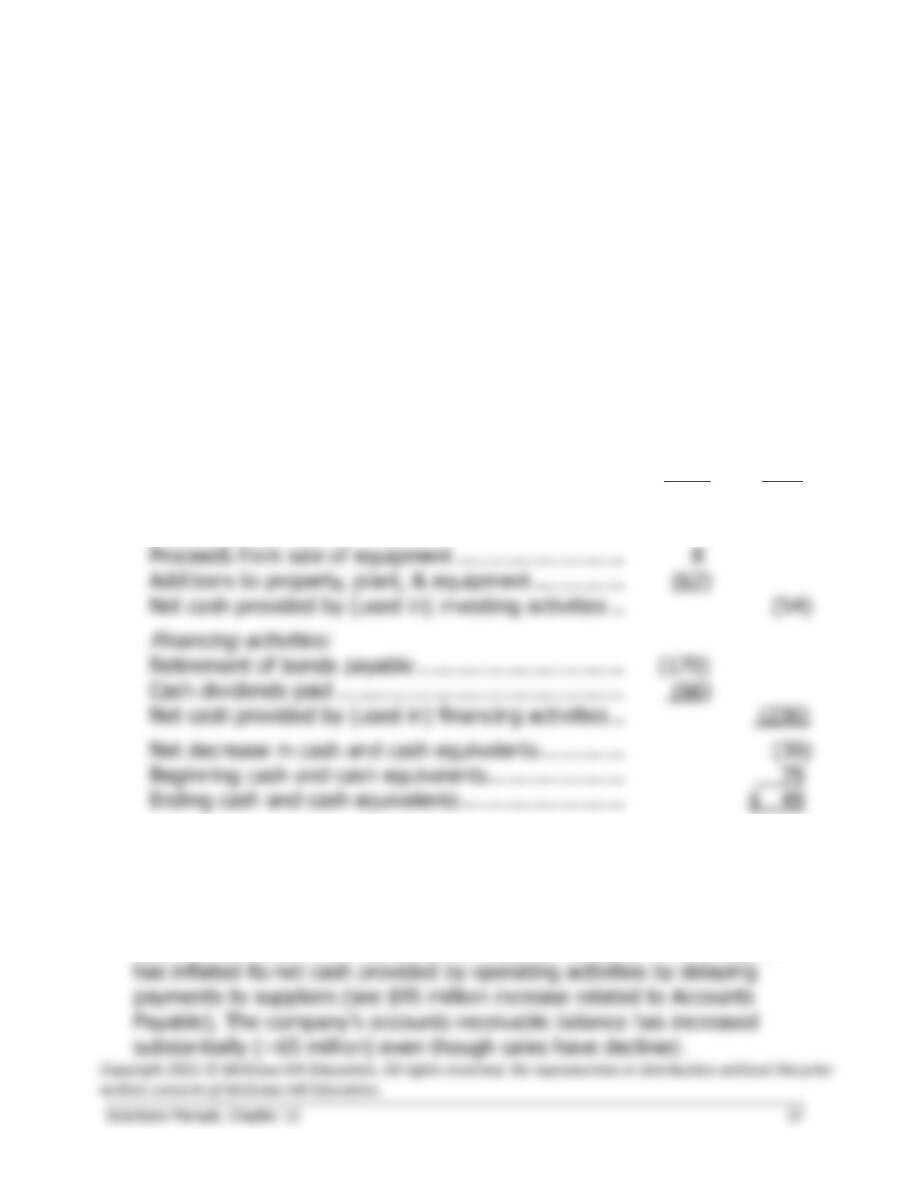
Burgess did not issue any bonds during the year; therefore, the amount
in the table on the prior page (–170) represents a cash outflow
pertaining to a bond retirement. Property, plant, and equipment and
retained earnings require further analysis as follows:
Property, plant, and equipment:
Beginning balance + Debits – Credits = Ending balance
$1,466 + Debits – $13 = $1,515
Debits = $1,515 – $1,466 + $13
Debits = $62
Problem 15-12 (continued)
Burgess Company
Statement of Cash Flows
Operating activities:
Net income …………………………………………………..
$ 115
Adjustments to convert net income to cash basis:
Depreciation ……………………………………………….
$132
Increase in accounts receivable ………………………
(65)
Increase in inventory ……………………………………
(45)
Increase in accounts payable …………………………
95
Increase in accrued liabilities ………………………….
25
Increase in income taxes payable ……………………
6
Gain on sale of equipment …………………………….
(3)
145
Net cash provided by (used in) operating activities ..
260
Investing activities:
Proceeds from sale of equipment ………………………
Additions to property, plant, & equipment ……………
(62)
Net cash provided by (used in) investing activities ..
Retirement of bonds payable …………………………...
Cash dividends paid ……………………………………….
Net cash provided by (used in) financing activities ..
Net decrease in cash and cash equivalents ………….
Beginning cash and cash equivalents ………………….
Ending cash and cash equivalents ……………………..
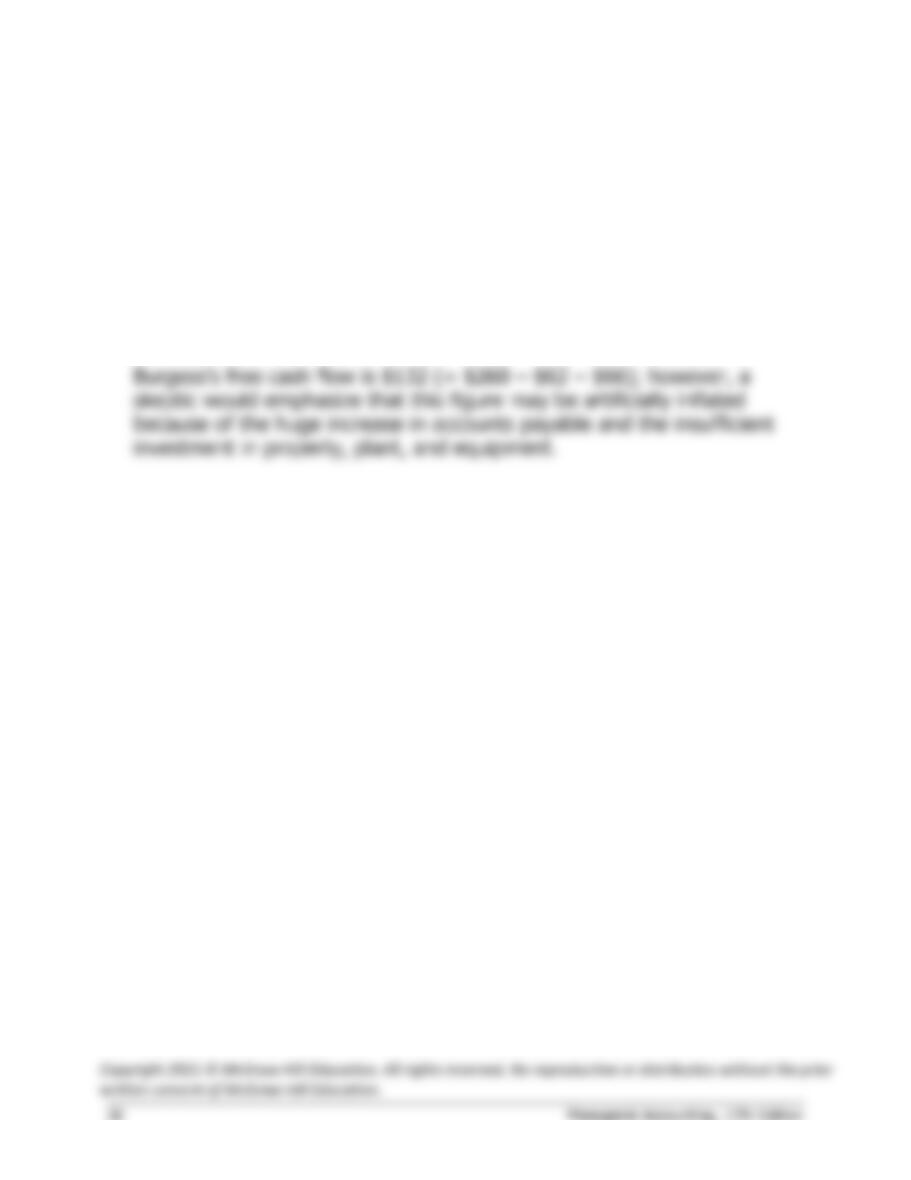
2. Burgess’s net income decreased by $20 million (= $135 million – $115
million); however, its net cash provided by operating activities increased
by $110 million (= $260 million – $150 million) over the prior year.
When net income and net cash provided by operating activities move in
opposite directions it warrants further inquiry. It appears that Burgess
Problem 15-12 (continued)
This suggests that Burgess may be inflating its net income by failing to
record a growing amount of uncollectible accounts. The company’s
inventory has increased (+45 million) even though sales have declined.
This suggests that Burgess may be inefficiently managing its inventory.
The company’s depreciation ($132 million) is much larger than its
additions to property, plant, and equipment ($62 million). This suggests
that the company is not making sufficient investments to maintain its
noncurrent assets.
Problem 15-13 (45 minutes)
1. Net cash provided by (used in) operating activities:
Step 1: The following equation can be applied to the Accumulated
Depreciation account to compute the depreciation to add back to net
income:
Beginning balance – Debits + Credits = Ending balance
$50,000 – $10,000 + Credits = $60,000
Credits = $60,000 – $50,000 + $10,000
Credits = $20,000
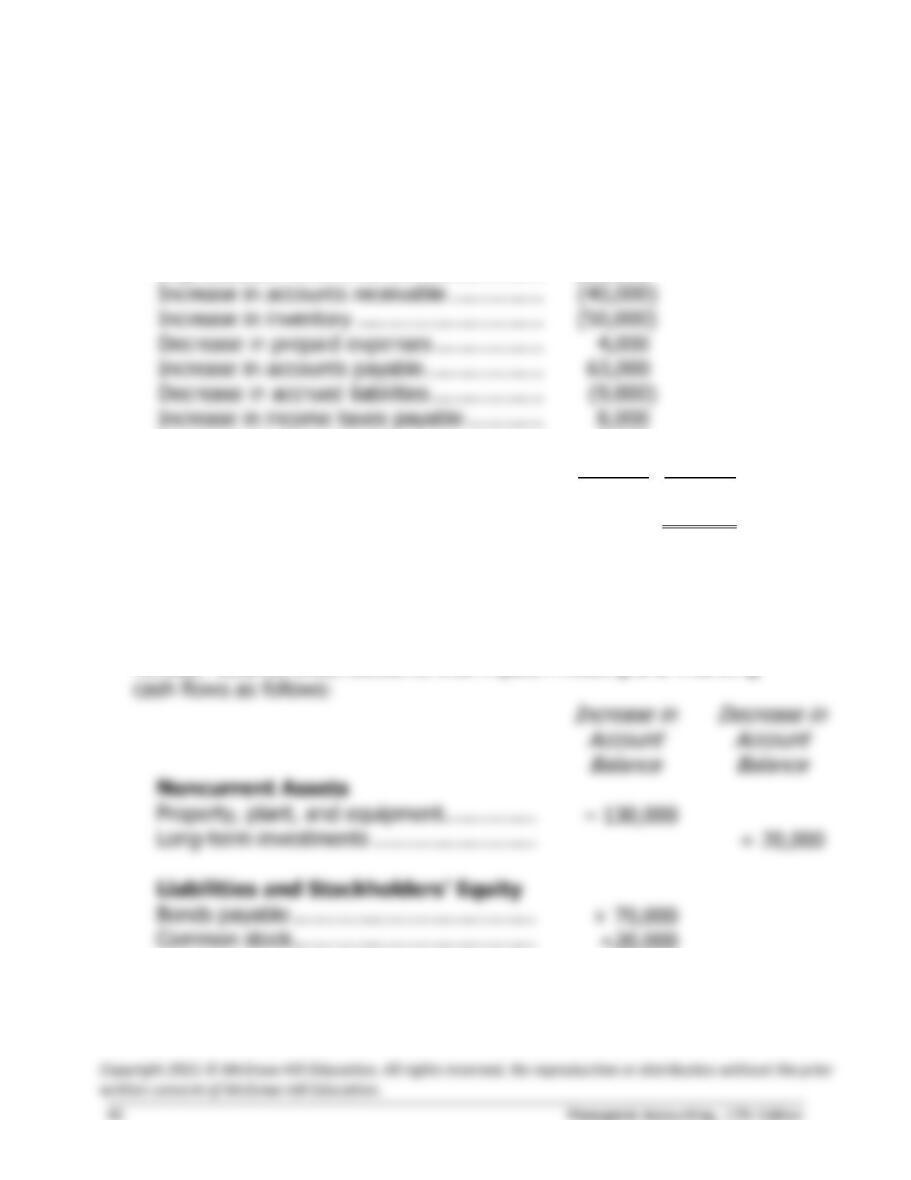
Step 2: The guidelines from Exhibit 15-2 can be used to analyze the
changes in noncash balance sheet accounts that impact net income as
follows:
Increase in
Account Balance
Decrease in
Account Balance
Current Assets
Current Liabilities
Problem 15-13 (continued)
The net cash provided by (used in) operating activities can now be
calculated as follows:
Net income ………………………………………..
$30,000
Adjustments to convert net income to cash basis:
Depreciation …………………………………….
$20,000
Increase in inventory …………………………
Decrease in prepaid expenses ……………..
4,000
Increase in income taxes payable …………
8,000
Loss on sale of equipment …………………..
2,000
Gain on sale of investments ………………..
(10,000)
(12,000)
Net cash provided by (used in) operating
activities …………………………………………
$18,000
2. Prepare a statement of cash flows.
Investing and Financing activities:
The guidelines from Exhibit 15-3 can be used to analyze the changes in