
chapter
15
Investments and Fair Value
Accounting
______________________________________________
OPENING COMMENTS
Chapter 15 discusses the various ways businesses can invest excess cash with the goal of earning
additional cash. These investments can include interest earned on deposits such as CDs, investment in
notes and bonds, or investment in stocks. These investments can be short term or long term, depending on
the need of each individual business. The motivations can range from receiving a higher return on their
money than they can earn by leaving the cash in the bank to taking over the control of another company.
This chapter introduces students to these various options and discusses the accounting methods for each
investment.
After studying the chapter, your students should be able to:
2. Describe and illustrate the accounting for debt investments.
4. Describe and illustrate valuing and reporting investments in the financial statements.
6. Describe and illustrate the computation of dividend yield.
STUDENT FAQS
• Why are investments in stock considered equity investments and investments in bonds considered
debt investments?
• Why do the methods of accounting change for different levels of investment in another company?

262 Chapter 15 Investments and Fair Value Accounting
• Why are there so many different rules for different investments? Wouldn’t be easier if there were just
one way to record investments?
• What does “fair value” accounting mean?
• Why do some items get “special presentation” on the income statement? It doesn’t change the bottom
line, so what difference does it make?
• I thought we booked only realized activities in accounting, such as revenue being recorded when
realized or realizable. So why do we now record these unrealized gains and losses? Shouldn’t we
wait until they are realized?
• Aren’t we showing unrealized gains or losses twice—once under assets along with the temporary
investment and again as part of comprehensive income? Isn’t this “double dipping”?
• If you can show unrealized gains on some things, why can’t you show an unrealized gain when
property goes up in value?
OBJECTIVE 1
Describe why companies invest in debt and equity securities.
KEY TERMS
Debt Securities Investments
Equity Securities
SUGGESTED APPROACH
This objective provides an overview of ways businesses can invest cash such as in current operations,
short-term investments, and long-term investments.
LECTURE AID — Why Companies Invest
Present students with the following scenario: B-Squared Textiles at year-end has $150,000 in excess cash.
Ask students what they would do with this money to better the business’s financial position for the future.
List the options on the board, and discuss why or why not each option might be ideal, depending on
various conditions the company might be experiencing. For example, if the company is behind
technologically, it may want or need to invest in current operations. If the company is heavily in debt, it
may wish to pay off some of that debt. If the company is in good shape in these areas, it can choose
between short-term or long-term investments to improve the future position of the business.
GROUP LEARNING ACTIVITY — Investing Cash
Ask your students to work in groups to determine the best way to invest cash for the companies described
on Transparency Master (TM) 15-1.
Chapter 15 Investments and Fair Value Accounting 263
Company
Cash
Condition
Company 1
$700,000
Very competitive in industry
Up to date with technology
No major debt
Lacks market share
Company 2
$250,000
Outdated technology
No major debt
Company 3
$100,000
No current operations needs
Conservative outlook
No major debt
OBJECTIVE 2
Describe and illustrate the accounting for debt investments.
SUGGESTED APPROACH
Debt securities include notes and bonds available as investments. Students should be familiar with the
terms “premium” and “discount” from Chapter 14 in relation to bonds. This objective focuses on the
journal entries to record the purchase, interest earned/accrued, and sale of bonds held for short-term
investments.
DEMONSTRATION PROBLEM — Accounting for Debt Investments
On May 31, 20—, Bellbugg Enterprises invested $60,000 in Johnsonville municipal bonds that pay 8%
interest semiannually on June 30 and December 31 each year. Journalize the entries to record the
purchase of the bonds. Be sure to include the interest accrued.
Record the journal entry for the interest paid on June 30 and the interest revenue on December 31.
On March 1 of the following year, the bonds are sold for 97.5. Record the journal entry for the sale.
TM 15-2 provides the solution for this problem.
INTERNET ACTIVITY — Investing in Bonds
After learning all the intricacies of accounting for bonds, your students may enjoy learning about
opportunities to invest in bonds. You may want to refer them to the following Web sites:

264 Chapter 15 Investments and Fair Value Accounting
http://www.investinginbonds.com/
http://www.fool.com/FoolFAQ/FoolFAQ0010.htm
OBJECTIVE 3
Describe and illustrate the accounting for equity investments.
KEY TERMS
Business Combination Investee
Consolidated Financial Statements Investor
Cost Method Parent Company
Equity Method Subsidiary Company
SUGGESTED APPROACH
Remind students that businesses invest in equity securities for one of the following reasons:
1. To receive a return on excess cash.
3. To gain control of another company.
Businesses invest in equity securities by buying stocks either directly from the issuing corporation or
from other investors. Purchases from other investors occur through organized stock exchanges (such as
the New York Stock Exchange) or over the counter. Use the Brainstorming Activity below to explore the
reasons a business would want to acquire control of another business. Securities purchased by a business
are classified as trading securities or available-for-sale securities.
After covering the accounting for equity investments, remind students that the sale of stock investments is
treated the same in all cases. The difference between the carrying value of the investment and the cash
proceeds (sales price less commissions and other selling costs) is recorded as a gain or loss and is
included in determining net income.
BRAINSTORMING ACTIVITY — Reasons for Investing in Another Company
Ask your students to brainstorm reasons that a business would want to gain control of another company.
While not presented in the text, at this time you may like to discuss the concepts of horizontal and vertical
integration.
Chapter 15 Investments and Fair Value Accounting 265
DEMONSTRATION PROBLEM — Equity Investments: Less than 20%
Ownership
The accounting for investments in stocks depends on whether the investor has “significant influence” over
the investee. The equity method is used whenever an investor has significant influence over the operating
and financing activities of another company. The general guideline to determine whether an investor (in
this discussion, another company) has a significant influence is the 20 percent rule. If an investor owns 20
to 50 percent or more of a company’s stock, it is presumed that the investor has significant influence and
uses the equity method of accounting to report its ownership. If an investor owns over 50% of a
company’s stock, it has control of the company and uses the consolidation accounting method. See
Exhibit 2 in the text.
If the investor does not have significant influence (owns less than 20 percent of a company’s stock), the
stocks are reported on the balance sheet at their fair value.
DEMONSTRATION PROBLEM — Equity Investments: 20%–50 Percent
Ownership – Equity Method
When a company invests in stock and obtains between 20 percent and 50 percent of the outstanding stock
of another company, it is deemed to have significant influence over the purchased company. This requires
that the equity method be applied to account for this investment.
Under the equity method, the investor records a portion of the investee’s net income as an increase to the
investment account. This increase is also recorded as income to the investor. As a result, cash dividends
can be viewed as the receipt of the income previously recorded.
266 Chapter 15 Investments and Fair Value Accounting
For example, assume that Jordan Corporation purchased a 30 percent interest in Mini-Marts, Inc. for
$500,000. For the year ended December 31, Mini-Marts reported net income totaling $100,000. On
January 18, Mini-Marts paid a $40,000 cash dividend.
Entry to record the purchase of Mini-Marts Inc. stock:
Note that the initial investment is recorded in the same manner whether or not the investor has significant
influence over the investee.
Entry to record 30 percent of Mini–Marts’ net income:
LECTURE AID — Equity Investment: More than 50 Percent Ownership
When a company acquires a controlling interest (normally anything over 50 percent) in another company
through investment in the second company’s stock, it must account for this by consolidation of the
statements of the two companies. The text does not pursue consolidation of statements.
However, if you desire to pursue this subject further, TM 15-3 lists the three methods used to combine
businesses. Review this TM with your class. Explain that parent-subsidiary relationships are accounted
for under the consolidation method. This method accounts for the purchase of a subsidiary company

TM 15-4 summarizes the steps to consolidate the income statements of two companies. The
Demonstration Problem below can be used to illustrate consolidated income statements.
OBJECTIVE 4
Describe and illustrate valuing and reporting investments in the financial statements.
KEY TERMS
Available-for-Sale Securities Trading Securities
Fair Value Unrealized Gain or Loss
Held-to-Maturity Securities
SUGGESTED APPROACH
Exhibit 3 in the text is an excellent summary of the information provided in this objective. Investments
are categorized based on the intention of the investment. Exhibit 3 is reproduced on TM 15-9. The three
categories are:
1. Trading securities
3. Held-to-maturity securities
Trading securities are current assets intended for short-term investments. The goal is to achieve a higher
rate of return than otherwise available through holding cash. Typically this involves investing in stocks
DEMONSTRATION PROBLEM — Trading Securities
First, cover the difference between a short-term and a long-term investment in stocks. An investment can
be considered short-term (a temporary investment) if two conditions are met: (1) the securities are readily
marketable and can be sold for cash at any time and (2) management intends to sell the securities when
the business needs cash for operations.
Your students will need to know how to record the purchase of short-term stock investments and the
receipt of dividends. Before presenting the journal entries, ask your students to use their accounting
knowledge to “guess” how the following transactions would be journalized.
268 Chapter 15 Investments and Fair Value Accounting
Jordan Corporation purchased 1,000 shares of ATE Inc. common stock as a temporary investment on
June 1 for a total cost of $38,500.
Correct answer:
Correct answer:
Sept. 30 Cash…………………………………..… 1,000
Dividend Revenue.………………. 1,000
GROUP LEARNING ACTIVITY — Trading Securities
Once trading securities have been purchased, they are reported on the balance sheet at their fair market
value. TM 15-5 provides information about the cost and market value of a portfolio of marketable
LECTURE AID — Available-for-Sale Securities
Available-for-sale securities are debt and equity securities that are neither held for trading, nor held to
maturity, nor held for strategic reasons. The accounting for these is similar to the accounting for trade
securities except for the reporting of changes in fair value. Changes in fair value of trade securities are
Chapter 15 Investments and Fair Value Accounting 269
LECTURE AID — Held-to-Maturity Securities
Held-to-maturity securities are typically notes or bonds purchased for the interest they provide as income.
The intent is to purchase the security and hold it until the maturity date. Revenue is generated through the
DEMONSTRATION PROBLEM — Investment in Bonds
Smyth Company purchased a $1,000 bond of Whitney Corporation on March 1 at 84 plus a $15
brokerage fee and accrued interest. The bond pays 12 percent interest semiannually, on December 31 and
June 30.
Accrued Interest: Assuming that Smyth still owns the bond on June 30, it will receive a $60 check from
Whitney Corporation for six months’ interest. However, Smyth owned the bond for only four months
The journal entry to record this bond purchase:
Investment in Bonds ($840 + $15)…… 855
Interest Revenue………………………. 20
Cash…………………………….. 875
The journal entry to record receipt of the first interest payment:
Interest Revenue
Interest paid to
270 Chapter 15 Investments and Fair Value Accounting
previous owner 20
60 Six–month interest payment
40 Four months’ interest earned by Smyth
Amortization of the Discount: Smyth purchased the Whitney Corporation bond at a discount. Even
though Smyth paid only $840 for the bond, the company will receive the full $1,000 face value if the
Assume that Smyth determines it should amortize $33 of the bond discount at the end of the first year.
The journal entry to amortize the discount:
Investment in Bonds…………………….. 33
Interest Revenue…………………. 33
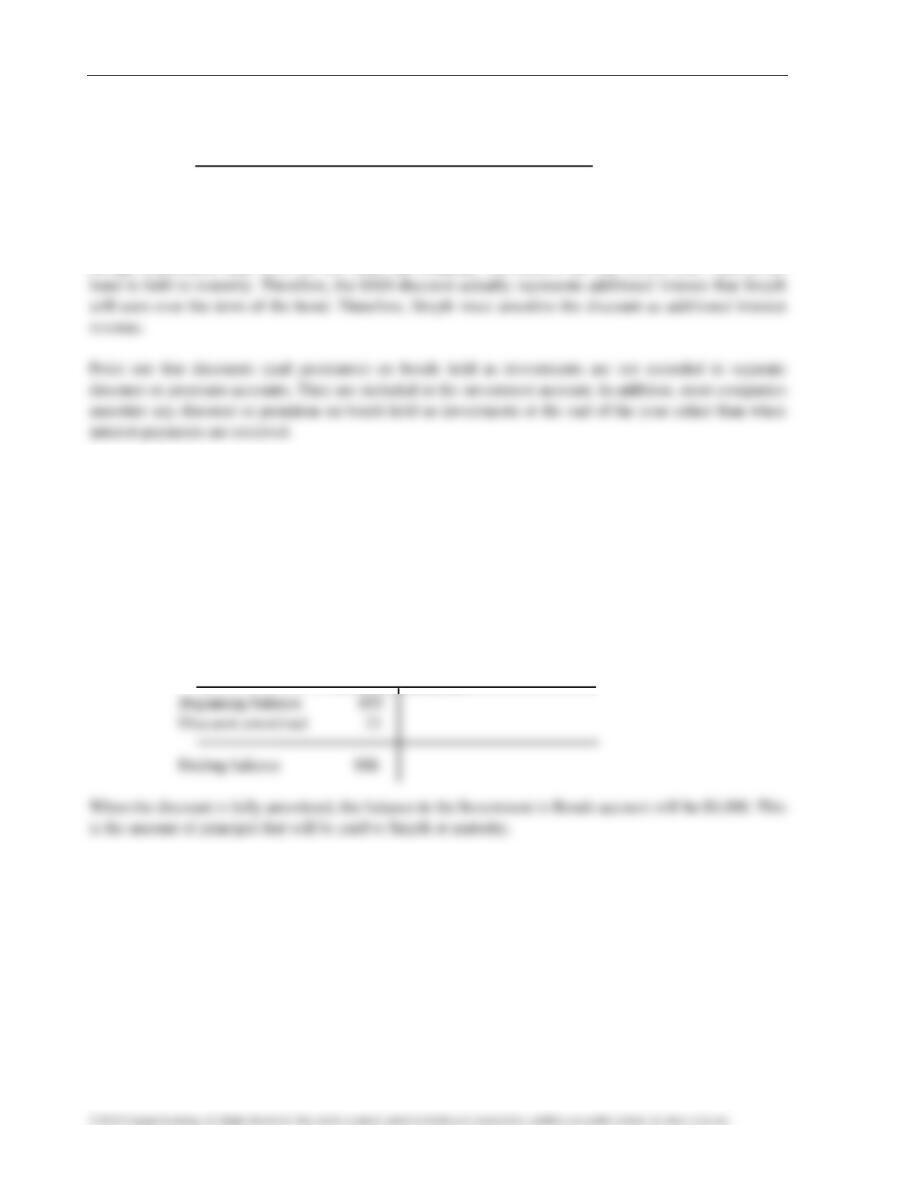
Notice that the amortization of the discount increases both the investment in bonds and the interest
revenue accounts. The balance in the Investment in Bonds account after amortization of the discount is
$888, as illustrated below:
Investment in Bonds
Ask your students the following question: Does the amortization of a premium on a bond investment
increase or decrease interest income? (Answer: decrease)
DEMONSTRATION PROBLEM — Sale of a Bond Investment
Assume that Smyth holds the bond purchased in the previous problem for three years. At the end of the
third year, the bond is sold for $1,150 plus accrued interest of $50. The carrying value of the bond
(including amortization of the premium) is $968. Note that the amortization of bond premium or discount
should be brought up to date before recording the sale of a bond investment. The journal entry to record
the sale:

Chapter 15 Investments and Fair Value Accounting 271
OBJECTIVE 5
Describe fair value accounting and its implications for the future.
SUGGESTED APPROACH
This objective discusses the possibility and potential consequences of expanding the fair value concept to
all assets, not just the investment assets discussed in this chapter. The FASB is reviewing these options
and continually ruling on the use of fair value.
OBJECTIVE 6
Describe and illustrate the computation of dividend yield.
KEY TERM
Dividend Yield
SUGGESTED APPROACH
TM 15-10 presents questions related to dividend yield. Use these questions to stimulate a class discussion
on dividend policies. In order to answer question 1, your students will need to compute dividend yield.
The formula for dividend yield is:
TMs 15-12 and 15-13 provide suggested answers.

272 Chapter 15 Investments and Fair Value Accounting
APPENDIX — COMPREHENSIVE INCOME
KEY TERMS
Accumulated other comprehensive income
Comprehensive Income
Other Comprehensive Income
SUGGESTED APPROACH
LECTURE AID — Comprehensive Income
The easiest way to explain comprehensive income adjustments is in the context of unrealized gains and
losses on investments. Therefore, you may want to cover this objective after discussing investments in
equity securities.
First, it is important to explain the difference between a realized and an unrealized gain. Assume an
investor purchases a share of Provident Corporation stock for $10. Next, assume the market price of the
stock goes up to $15. If the investor sells the stock for $15, he has a realized gain of $5. If the investor
doesn’t sell the stock, he has an unrealized gain of $5. Whether or not the investor sells the share of stock,
his net worth is increased as the value of the stock he owns increases.
Traditionally, only realized gains on investments are reported as income on a company’s income
statement. Under this conservative approach, net income is increased only for gains actually “in hand” as
Remind your students that there are other items that affect comprehensive income; however, it is best to
discuss these items (such as foreign currency items and pension liability adjustments) in advanced
accounting courses.
In summary, comprehensive income is
Traditional Net Income
+ All Changes in except those resulting from

Chapter 15 Investments and Fair Value Accounting 273
DIFFICULTY BUSPROG AICPA AICPA ACBSP ACBSP BLOOM’S TIME
Problem
Learning
Objective
Description Primary
Broad
Business
Functional Primary Secondary
Spread–
sheet
GL
DQ15-1 15-1 Easy Analytic Measurement Corporate Investments Accounting Knowledge 5 min.
DQ15-2 15-2 Easy Analytic Measurement Corporate Investments Accounting Knowledge 5 min.
DQ15-3 15-2 Easy Analytic Measurement Corporate Investments Accounting Knowledge 5 min.
DQ15-4 15-2 Easy Analytic Measurement Corporate Investments Accounting Knowledge 5 min.
DQ15-5 15-3 Easy Analytic Measurement Corporate Investments Accounting Knowledge 5 min.
DQ15-6 15-3 Easy Analytic Measurement Corporate Investments Accounting Knowledge 5 min.
DQ15-7 15-4 Easy Analytic Measurement Corporate Investments Accounting Knowledge 5 min.
DQ15-8 15-4 Easy Analytic Measurement Corporate Investments Accounting Knowledge 5 min.
DQ15-9 15-5 Easy Analytic Measurement Corporate Investments Accounting Knowledge 5 min.
DQ15-10 15-5 Easy Analytic Measurement Corporate Investments Accounting Application 5 min.
PE15-1A 15-2 Bond transactions Easy Analytic Measurement Corporate Investments Accounting Application 10 min.
PE15-1B 15-2 Bond transactions Easy Analytic Measurement Corporate Investments Accounting Application 10 min.
PE15-2A 15-3 Stock transactions Easy Analytic Measurement Corporate Investments Accounting Application 10 min.
PE15-2B 15-3 Stock transactions Easy Analytic Measurement Corporate Investments Accounting Application 10 min.
PE15-3A 15-3 Equity method Easy Analytic Measurement Corporate Investments Accounting Application 10 min.
PE15-3B 15-3 Equity method Easy Analytic Measurement Corporate Investments Accounting Application 10 min.
PE15-4A 15-4
Valuing trading securities at fair
value
Easy Analytic Measurement Corporate Investments Accounting Application 10 min.
PE15-4B 15-4
Valuing trading securities at fair
Easy Analytic Measurement Corporate Investments Accounting Application 10 min.
Valuing available-for-sale securities
PE15-5A 15-4
at fair value
Easy Analytic Measurement Corporate Investments Accounting Application 10 min.
PE15-5B 15-4
Valuing available-for-sale securities
at fair value
Easy Analytic Measurement Corporate Investments Accounting Application 10 min.
PE15-6A 15-6 Dividend yield Moderate Analytic Measurement Corporate Investments Accounting Application 15 min.
Entries for investment in bonds,
Ex15-1 15-2
interest, and sale of bonds
Easy Analytic Measurement Corporate Investments Accounting Application 10 min.
Ex15-2 15-2
Entries for investments in bonds,
interest, and sale of bonds
Easy Analytic Measurement Corporate Investments Accounting Application 10 min.
Entries for investment in bonds,
Ex15-3 15-2
interest, and sale of bonds
Easy Analytic Measurement Corporate Investments Accounting Application 5 min.
Ex15-4 15-2
Entries for investment in bonds,
interest, and sale of bonds
Easy Analytic Measurement Corporate Investments Accounting Application 5 min.
Ex15-5 15-2 Interest on bond investments Easy Analytic Measurement Corporate Investments Accounting Application 10 min.
Ex15-6 15-3
Easy Analytic Measurement Corporate Investments Accounting Application 10 min.
Ex15-7 15-3
shares
Easy Analytic Measurement Corporate Investments Accounting Application 5 min.
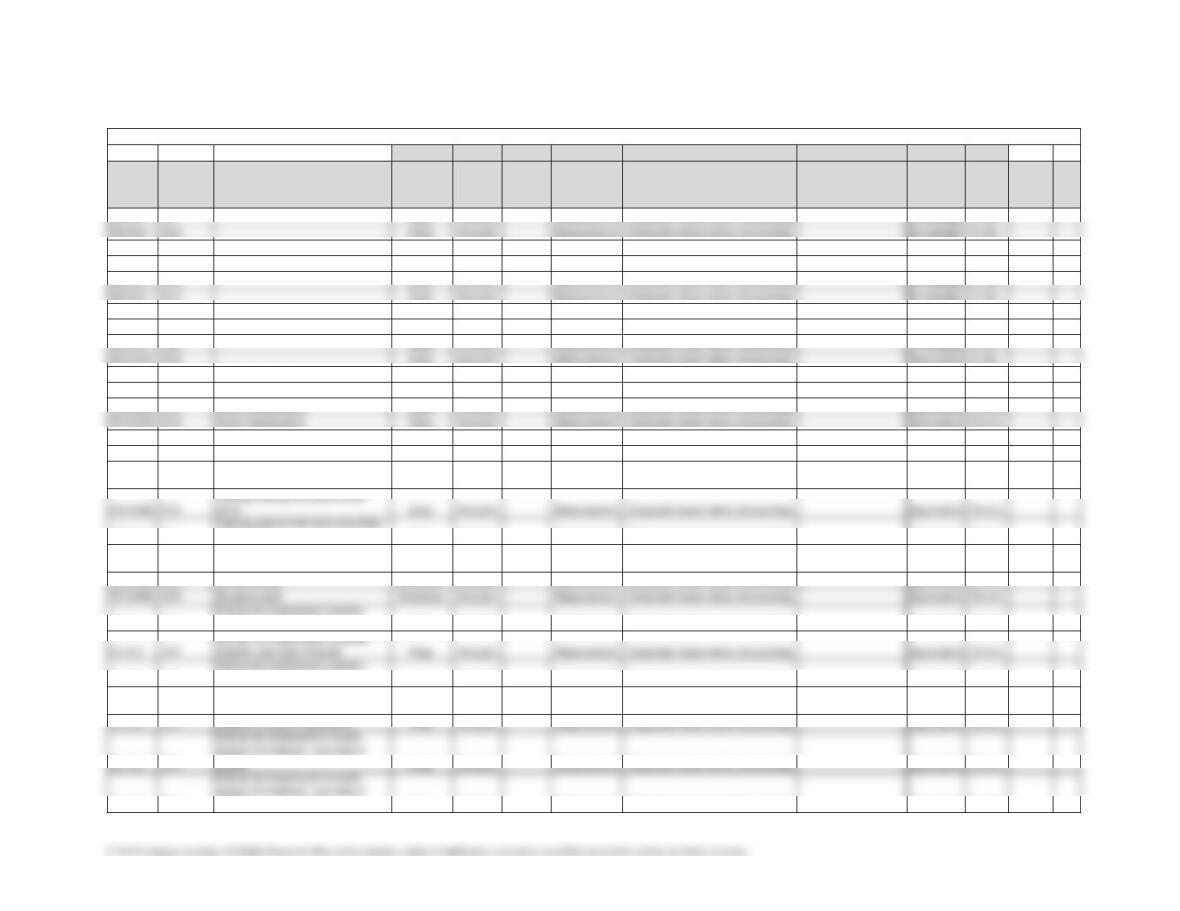
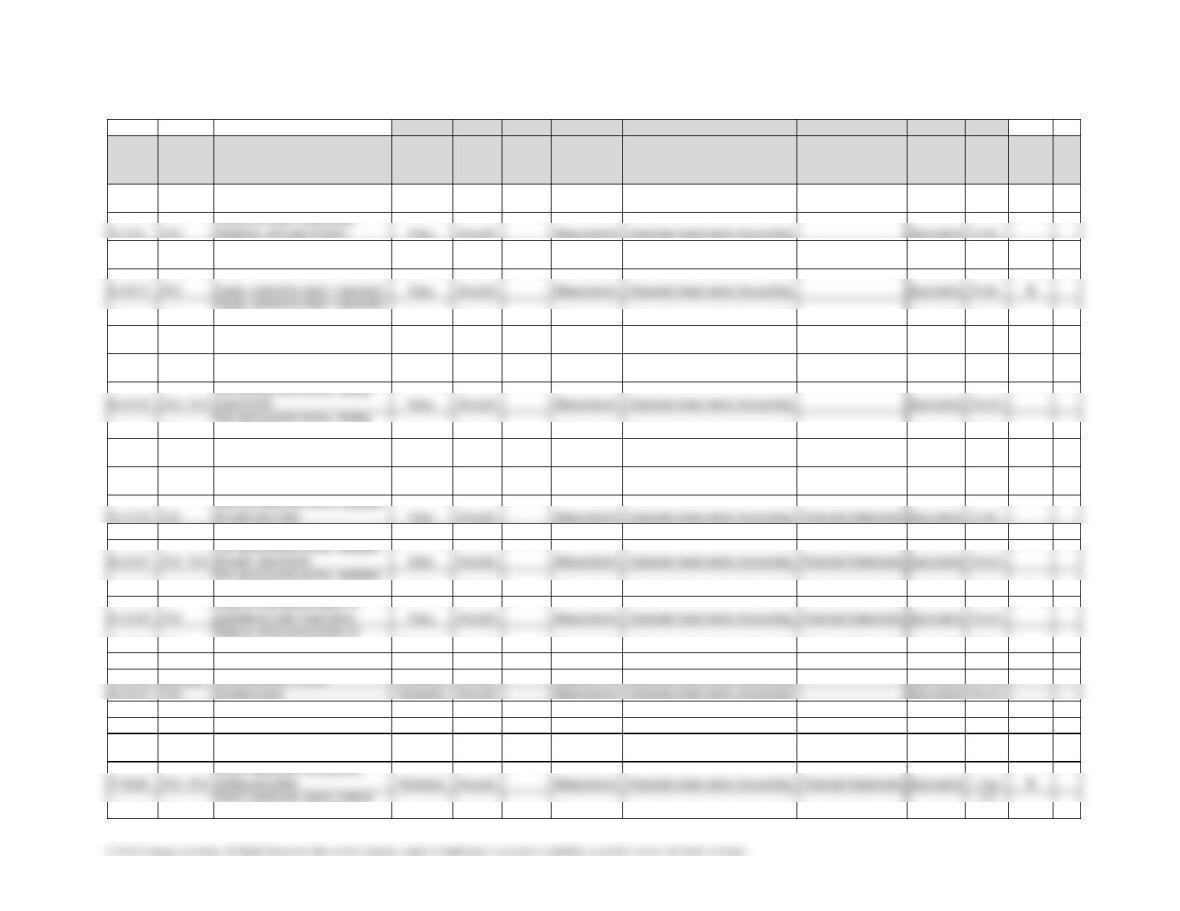
HOMEWORK CHART WITH LEARNING OUTCOMES TAGGING
DIFFICULTY BUSPROG AICPA AICPA ACBSP ACBSP BLOOM’S TIME
Problem
Learning
Objective
Description Primary
Broad
Business
Functional Primary Secondary
Spread–
sheet
GL
Ex15-8 15-3
Entries for stock investments,
dividends, and sale of stock
Easy Analytic Measurement Corporate Investments Accounting Application 5 min.
Ex15-9 15-3
Entries for stock investments,
dividends, and sale of stock
Easy Analytic Measurement Corporate Investments Accounting Application 5 min.
Ex15-10 15-3 Equity method for stock investment Easy Analytic Measurement Corporate Investments Accounting Application 5 min.
Equity method for stock investment
Ex15-12 15-3
with loss
Easy Analytic Measurement Corporate Investments Accounting Application 5 min.
Ex15-13 15-3 Equity method for stock investment Easy Analytic Measurement Corporate Investments Accounting Application 10 min.
Ex15-14 15-4
Missing statement items, trading
investments
Easy Analytic Measurement Corporate Investments Accounting Financial Statements Application 15 min.
Ex15-15 15-3, 15-4
Fair value journal entries, trading
investments
Easy Analytic Measurement Corporate Investments Accounting Application 10 min.
Fair value journal entries, trading
Ex15-16 15-3, 15-4
investments
Easy Analytic Measurement Corporate Investments Accounting Application 10 min.
Ex15-17 15-3, 15-4
Fair value journal entries, trading
investments
Easy Analytic Measurement Corporate Investments Accounting Application 10 min. X
Ex15-18 15-4
Financial statement disclosure,
trading investments
Easy Analytic Measurement Corporate Investments Accounting Financial Statements Application 5 min.
Ex15-19 15-4
Missing statement items, available-
for-sale securities
Easy Analytic Measurement Corporate Investments Accounting Financial Statements Application 5 min.
Fair value journal entries, available-
Ex15-20 15-3, 15-4
for-sale investments
Easy Analytic Measurement Corporate Investments Accounting Financial Statements Application 10 min.
Ex15-21 15-3, 15-4
Fair value journal entries, available-
for-sale investments
Easy Analytic Measurement Corporate Investments Accounting Financial Statements Application 10 min.
Fair value journal entries, available-
Ex15-22 15-3, 15-4
for-sale investments
Easy Analytic Measurement Corporate Investments Accounting Financial Statements Application 10 min. X
Ex15-23 15-4
Balance sheet presentation of
available-for-sale investments
Easy Analytic Measurement Corporate Investments Accounting Financial Statements Application 15 min.
Balance sheet presentation of
Ex15-24 15-4
available-for-sale investments
Moderate Analytic Measurement Corporate Investments Accounting Financial Statements Application 15 min.
Ex15-25 Appendix Comprehensive income Moderate Analytic Measurement Corporate Investments Accounting Application 15 min.
Ex15-26 Appendix Comprehensive income Moderate Analytic Measurement Corporate Investments Accounting Application 15 min
Ex15-27 15-6 Dividend yield Moderate Analytic Measurement Corporate Investments Accounting Application 15 min.
Ex15-28 15-6 Dividend yield Moderate Analytic Measurement Corporate Investments Accounting Application 15 min.
Ex15-29 15-6 Dividend yield Moderate Analytic Measurement Corporate Investments Accounting Application 15 min.
Pr15-1A 15-2, 15-4
Debt investment transactions,
available-for-sale valuation
Moderate Analytic Measurement Corporate Investments Accounting Financial Statements Application 1 hour X
Pr15-3A 15-3, 15-4
and available-for-sale securities
Moderate Analytic Measurement Corporate Investments Accounting Financial Statements Application
hours
X
DIFFICULTY BUSPROG AICPA AICPA ACBSP ACBSP BLOOM’S TIME
Problem
Learning
Objective
Description Primary
Broad
Business
Functional Primary Secondary
Spread–
sheet
GL
Pr15-4A
15-4
Pr15-1B 15-2, 15-4
available-for-sale valuation
Moderate Analytic Measurement Corporate Investments Accounting Financial Statements Application 1 hour X
Pr15-2B 15-3, 15-4
trading securities
Stock investment transactions,
Pr15-3B 15-3, 15-4
securities
Moderate Analytic Measurement Corporate Investments Accounting Financial Statements Application
hours
X
Pr15-4B
15-2, 15-3,
15-4
Problem
4
15-2, 15-4,
15-5, 15-6
Journalize transactions, prepare
financial statements
Challenging Analytic Measurement Corporate Investments Accounting Financial Statements Application 3 hours X
CP15-1 15-5 Benefits of fair value Easy Ethics Industry Corporate Investments Accounting Knowledge 5 min.
CP15-2 15-5 International fair value accounting Easy Ethics Industry Corporate Investments Accounting Knowledge 5 min.
CP15-3 15-5 Ethics and fair value measurement Easy Analytic Measurement Corporate Investments Accounting Analysis 10 min.
CP15-4 15-5
earnings
Easy Analytic Measurement Corporate Investments Accounting Analysis 5 min.