CHAPTER 15 Investments
Prob. 15-4B (Concluded)
The partial balance sheets with the missing amounts are as follows:
20Y8 20Y7
^^^^^^^^^^^^^^^^^^^^^^^^^^^^^^^^^^^^^^^^^^^^^^^^^^^^^^^^^^^^^^^^^^^^^^
^^^^^^^^^^^^^^^^^^^^^^^^^^^^^^^^^^^^^^^^^^^^^^^^^^^^^^^^^^^^^^^^^^^^^^
Available-for-sale investments (at cost) $147,200 $ 91,200
Valuation allowance for available-for-sale
investments 4,680 8,776
Available-for-sale investments (fair value) $151,880 $ 99,976
Accounts payable $ 91,000 $ 72,000
Common stock 80,000 80,000
Excess of issue price over par 250,000 250,000
Retained earnings 178,640 127,400
Teasdale Inc.
Partial Balance Sheets
December 31
CHAPTER 15 Investments
1. a. Cash 450,000
Common Stock 300,000
Paid-In Capital in Excess of Par—
Common Stock 150,000
c. Cash 520,000
Bonds Payable 500,000
Premium on Bonds Payable 20,000
* $500,000 × 1.04
e. Cash Dividends Payable 70,000
Cash 70,000
f. Available-for-Sale Investments—Solstice
Corp. Bonds 300,150
Cash 300,150
g. Treasury Stock 264,000
Cash 264,000
* 8,000 shares × $33 per share
COMPREHENSIVE PROBLEM 4
*
*
CHAPTER 15 Investments
Comp. Prob. 4 (Continued)
i. Cash Dividends 20,000
Cash Dividends Payable 20,000
l. Investments—Dream Inc. Bonds 90,000
Interest Receivable 375
Cash 90,375
m. Cash 98,800
Treasury Stock 85,800
Paid-In Capital from Sale of Treasury Stock 13,000
*
2,600 shares × $38 per share
**
2,600 shares × $33 per share
*
**
CHAPTER 15 Investments
Comp. Prob. 4 (Continued)
p. Interest Expense 11,500
Premium on Bonds Payable 1,000
Cash 12,500
Computation:
Semiannual interest payment ($500,000 × 5% × 1/2)……………
…
$12,500
Less amortization premium [($20,000 ÷ 10 years) × 1/2]………
…
1,000
Interest expense………………………………………………………
…
$11,500
r. Investment in Pinkberry Co. Stock 76,800
Income from Pinkberry Co. 76,800
Recorded 32% share of Pinkberry Co.
net income.
*
$240,000 × 32%, 32% = 40,000 shares ÷ 125,000 shares
*
CHAPTER 15 Investments
Comp. Prob. 4 (Continued)
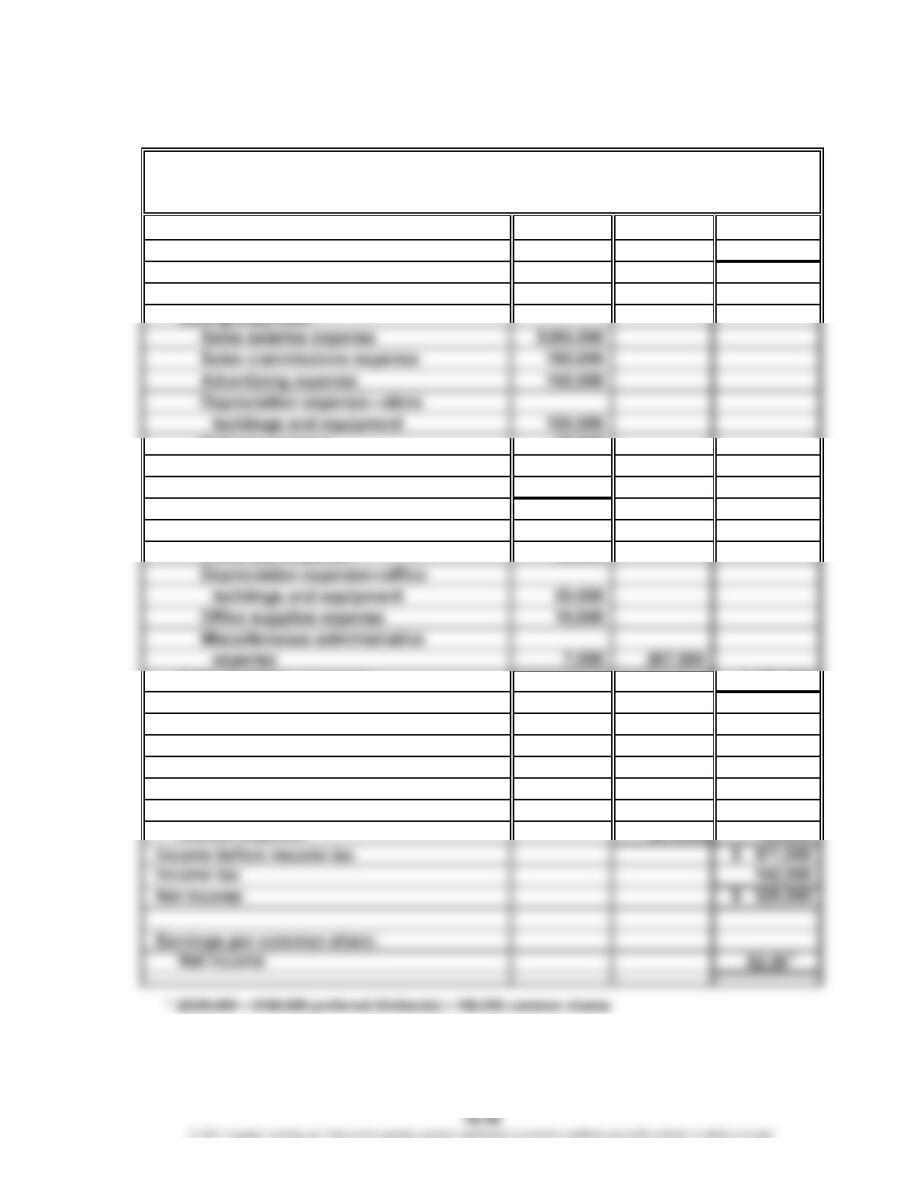
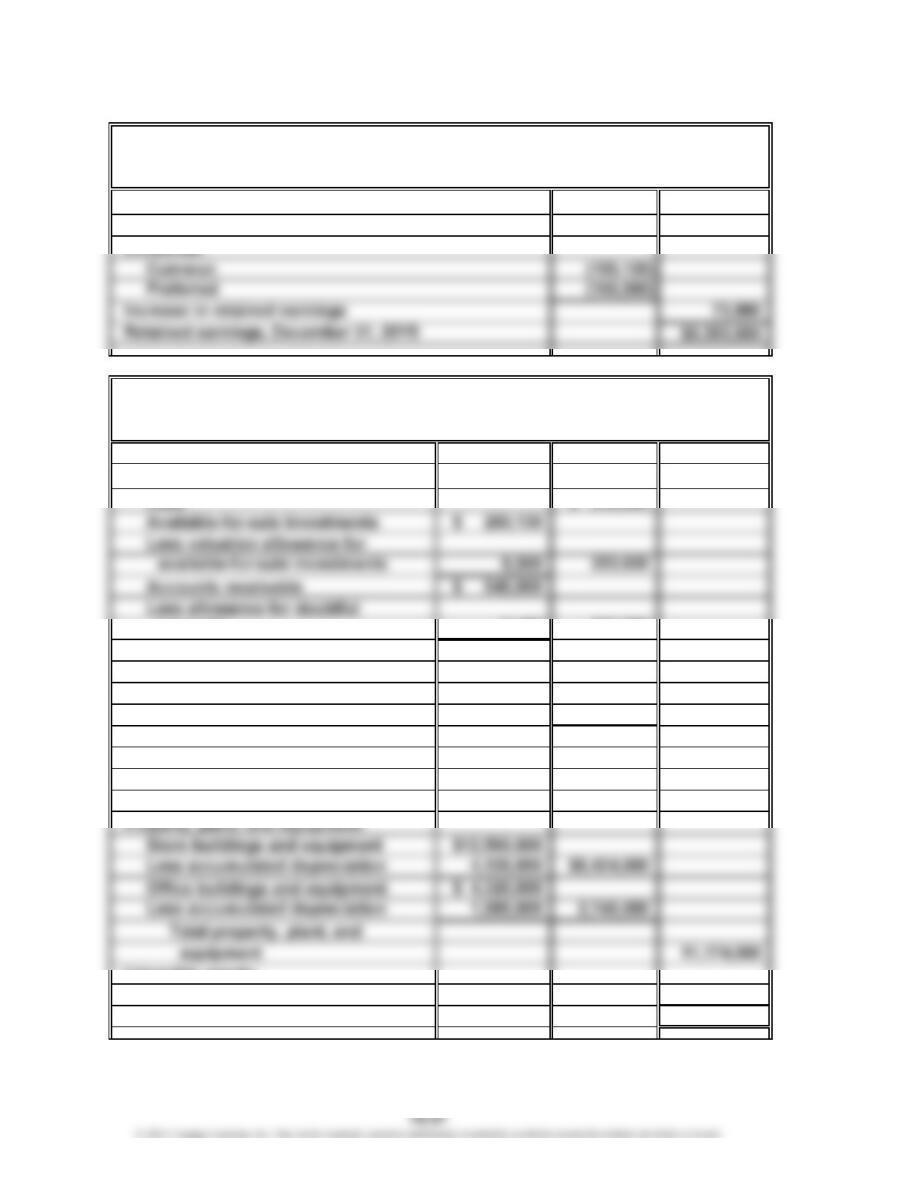
2. a.
Sales $5,254,000
Cost of merchandise sold 3,700,000
Gross profit $1,554,000
Operating expenses:
Delivery expense 30,000
Store supplies expense 21,000
Miscellaneous selling expense 14,000 $885,000
Administrative expenses:
Office salaries expense $170,000
Total operating expenses 1,152,500
Income from operations $ 401,500
Other revenue and expense:
Interest revenue $ 8,720
Income from Pinkberry Co. investment 76,800
Gain on sale of investments 4,980
Equinox Products Inc.
Income Statement
For the Year Ended December 31, 20Y5
CHAPTER 15 Investments
Comp. Prob. 4 (Continued)
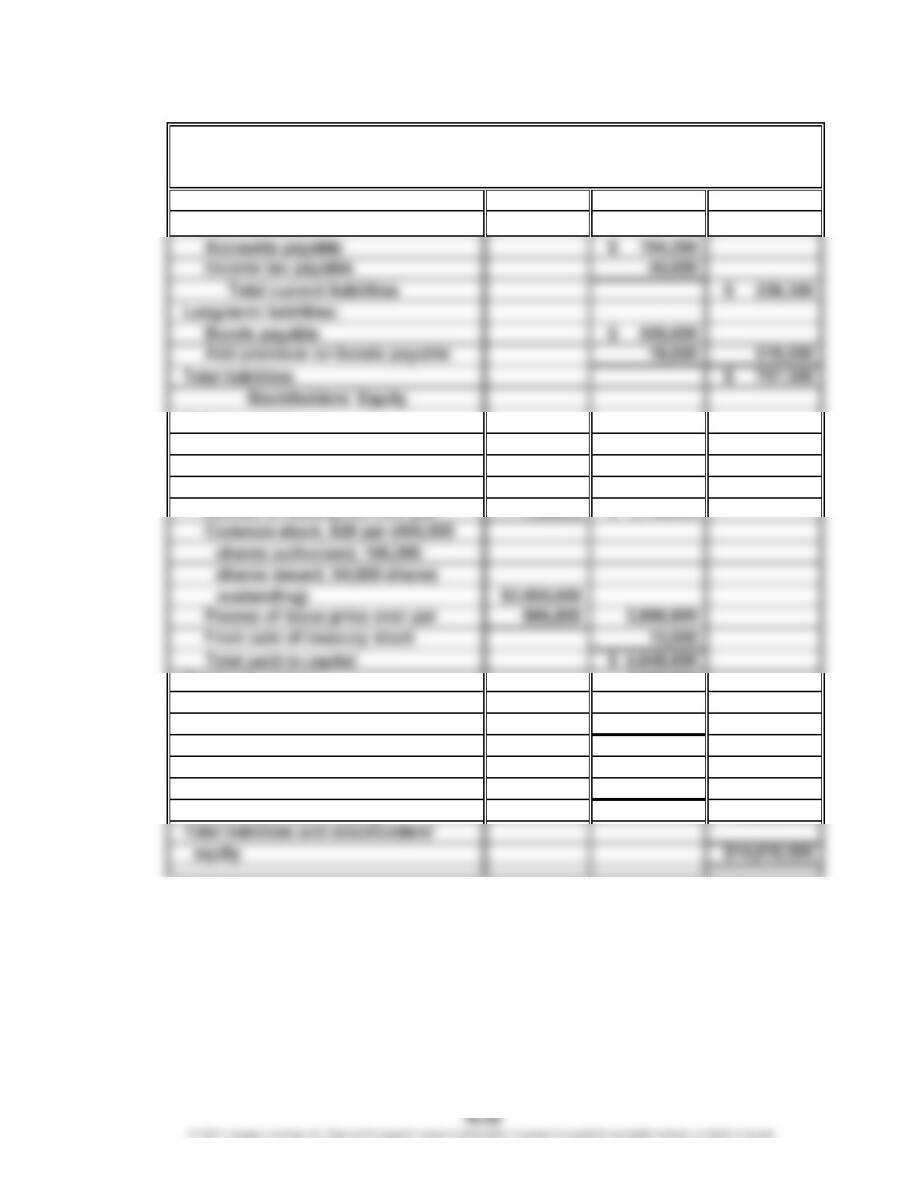
b.
Retained earnings, January 1, 20Y5 $9,319,725
Net income for year $ 329,000
c.
Current assets:
accounts 8,450 536,550
Merchandise inventory, at lower
of cost (FIFO) or market 778,000
Interest receivable 1,125
Prepaid expenses 27,400
Total current assets $ 1,842,705
Investments:
Investment in Pinkberry Co. stock 1,009,300
Investment in Dream Inc. bonds 90,000
Intangible assets:
Goodwill 500,000
Total assets $14,616,005
Assets
Equinox Products Inc.
Retained Earnings Statement
For the Year Ended December 31, 20Y5
Equinox Products Inc.
Balance Sheet
December 31, 20Y5
CHAPTER 15 Investments
Comp. Prob. 4 (Concluded)
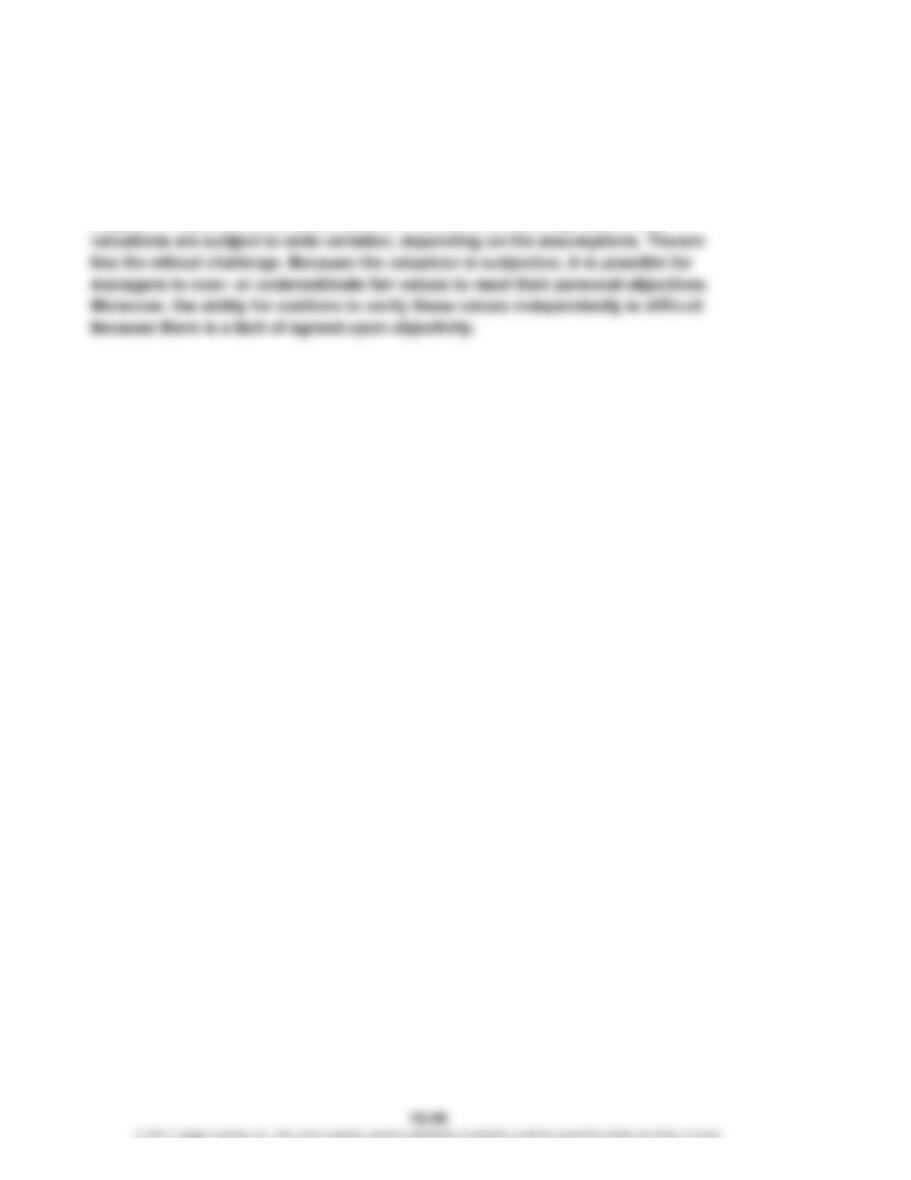
Current liabilities:
Paid-in capital:
Preferred $1 stock, $80 par
(30,000 shares authorized;
20,000 shares issued) $1,600,000
Retained earnings 9,393,605
Unrealized gain (loss) on available-
for-sale investments (6,500)
Total $14,036,905
Treasury common stock
(5,400 shares at cost) (178,200)
Total stockholders’ equity 13,858,705
Equinox Products Inc.
Balance Sheet
December 31, 20Y5
Liabilities
CHAPTER 15 Investments
CP 15-1
Because many complex and exotic investment vehicles do not have ready market
values, management must value these investments using mathematical models,
subjective inputs, and risk assessments. These mathematically determined
CASES & PROJECTS
CP 15-2
The following are portions of Notes 3 and 4 from the financial statements dated June 30, of a recent year, for Microsoft.
Investment Components, Including Associated Derivatives
Cash Equity and
Cost Unrealized Unrealized Recorded and Cash Short-Term Other
(In millions) Basis Gains Losses Basis Equivalents Investments Investments
June 30
Cash $ 3,942 $ — $ — $ 3,942 $ 3,942 $ — $ —
Mutual funds 246 — — 246 246 — —
Commercial paper 2,513 — — 2,513 2,215 298 —
Certificates of deposit 2,058 — — 2,058 1,865 193 —
U.S. Government and Agency securities 109,862 62 (1,167) 108,757 3,678 105,079 —
Foreign government bonds 5,182 1 (10) 5,173 5,173 —
NOTE 4 INVESTMENTS
CHAPTER 15 Investments
CP 15-2 (Concluded)
The components of other income (expense) were as follows:
$ 2,214 $ 1,387 $ 903
(2,733) (2,222) (1,243)
Note to Instructors: This solution is provided as a guide. Students may have different
numbers, depending on the date of the financial statements.
Answers in millions.
1. $136,667
2. $135,630 (termed “recorded basis” by Microsoft)
3.
4.
CP 15-3
Memo
To: My Instructor
From: Ima Student
Re: Look-through earnings
Look-through earnings is a concept originally developed by Mr. Warren Buffett
that adjusts GAAP net income for the equity earnings (the “forgotten-but-not
gone” earnings) in investments where less than 20% of the outstanding shares
are owned. Thus, look-through earnings would be significantly greater than
Dividends and interest income
Y2 Y1
NOTE 3 OTHER INCOME (EXPENSE)
(In millions)
Year Ended June 30, Y3
Interest expense
$220
$(1,257)
CP 15-3 (Concluded)
CP 15-4
1. Under generally accepted accounting principles, the land would be reported
at $350,000 for Wyatt Corp. and $2,000,000 for TexoPete Inc. These valuations
reflect their historical costs.
2. The historical cost valuation reduces the ability to compare the two companies.
In this scenario, both companies have nearly identical land holdings. Wyatt
CP 15-5
The accounting treatment for increases in fair value for property, plant, and
equipment under International Accounting Standards is similar to the
treatment for unrealized gains and losses from available-for-sale investments.
Increases in fair value bypass the income statement and are reported directly