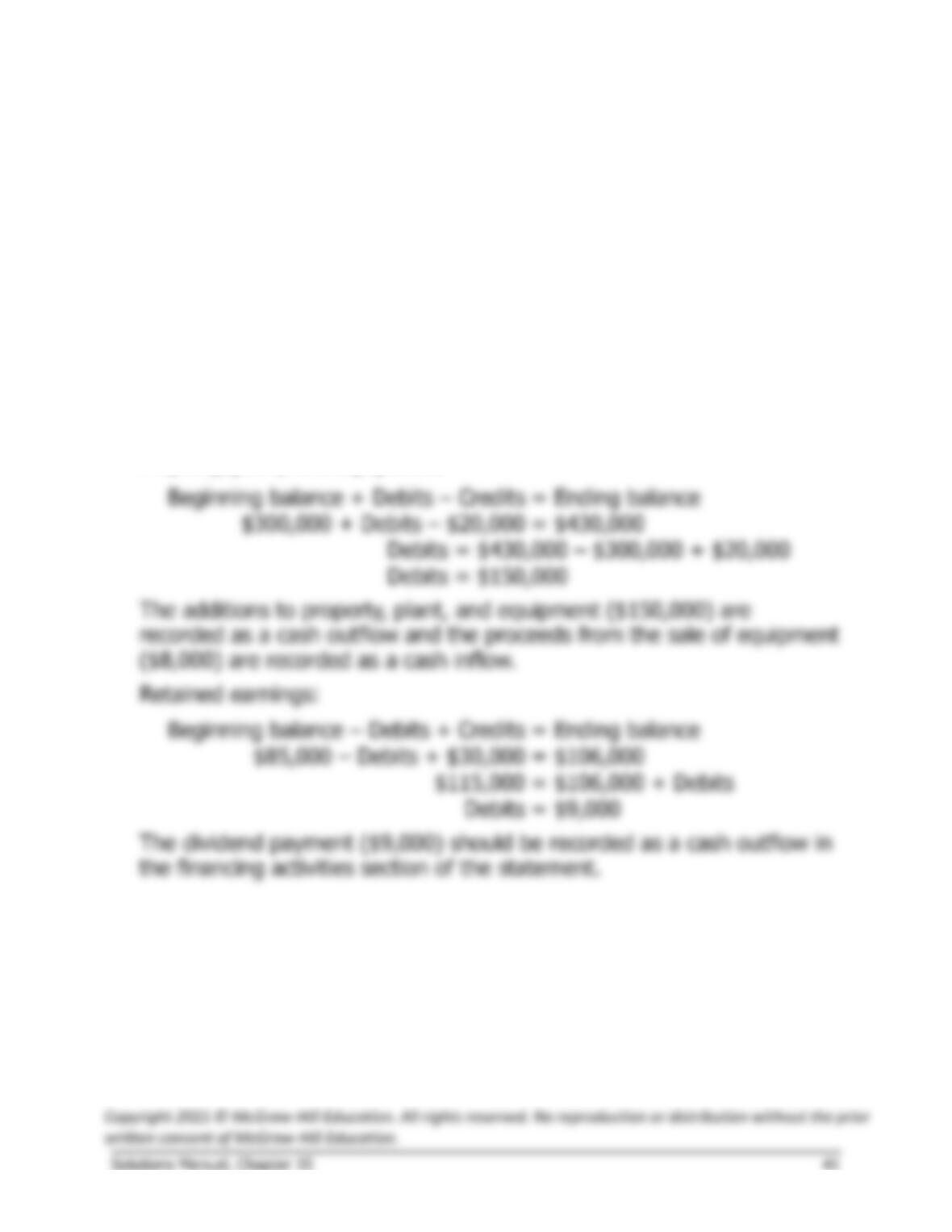
Problem 15-13 (continued)
The decrease in the long-term investments account ($20,000) equals
the cost of the long-term investment sold; therefore, Rusco did not
purchase any long-term investments during the year. The proceeds from
the sale of the long-term investment ($30,000) should be recorded as a
cash inflow in the investing activities section of the statement.
The company did not retire any bonds during the year, so the amount
on the prior page (+70,000) represents a cash inflow from a bond
issuance. The company did not repurchase any of its own stock, so the
amount on the prior page (+20,000) represents a cash inflow from
issuing common stock. Property, plant, and equipment and retained
earnings require further analysis as follows:
Property, plant, and equipment:
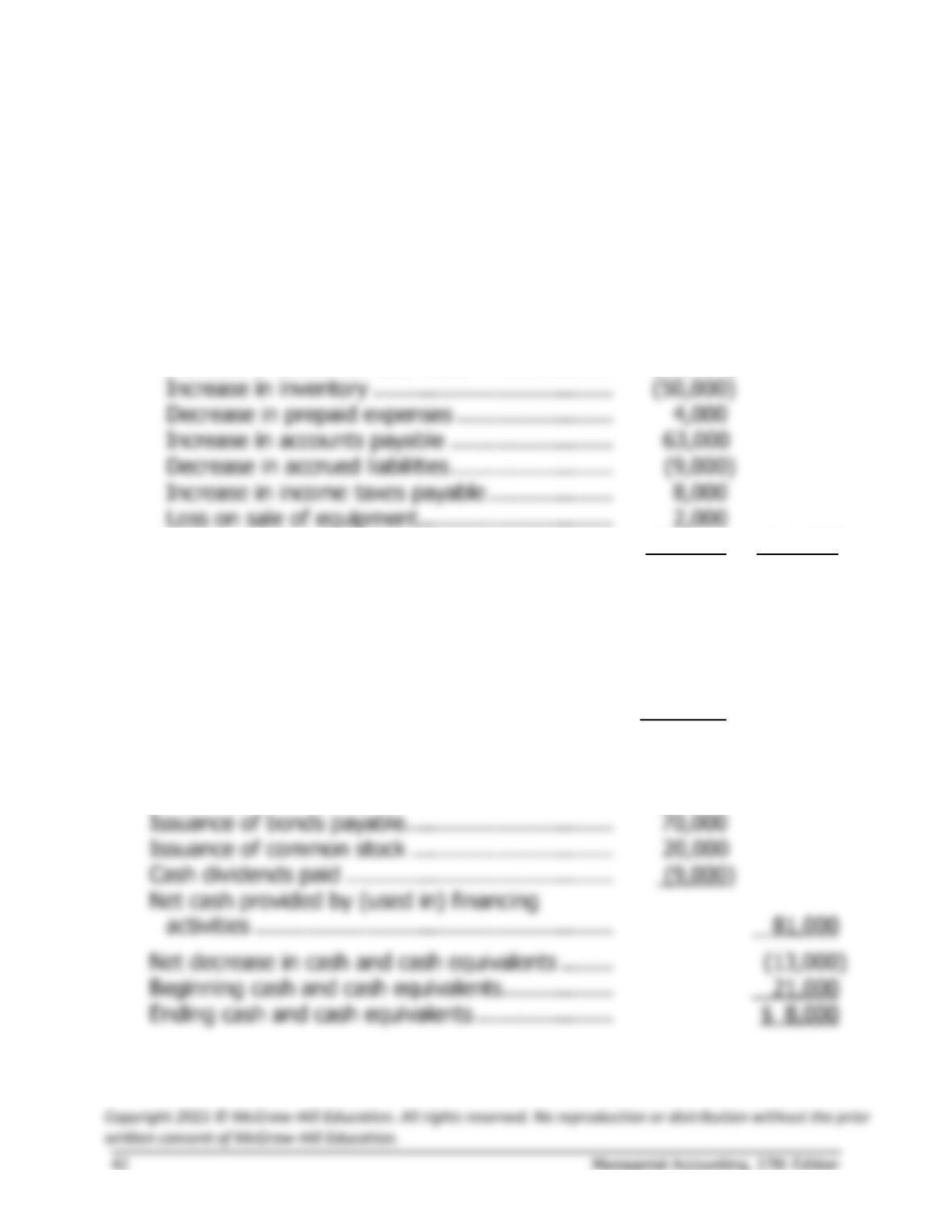
Problem 15-13 (continued)
Rusco Company
Statement of Cash Flows
For This Year Ended July 31
Operating activities:
Net income ………………………………………………
$ 30,000
Adjustments to convert net income to cash basis:
Depreciation …………………………………………..
$ 20,000
Increase in accounts receivable ………………….
(40,000)
Increase in inventory ……………………………….
(50,000)
Decrease in prepaid expenses ……………………
4,000
Decrease in accrued liabilities …………………….
Increase in income taxes payable ……………….
8,000
Loss on sale of equipment…………………………
2,000
Gain on sale of investments ………………………
(10,000)
(12,000)
Net cash provided by (used in) operating
activities ……………………………………………….
18,000
Investing activities:
Proceeds from sale of long-term investments …..
30,000
Proceeds from sale of equipment ………………….
8,000
Additions to property, plant, & equipment ……….
(150,000)
Net cash provided by (used in) investing
activities ……………………………………………….
(112,000)
Financing activities:
Issuance of bonds payable…………………………..
70,000
Issuance of common stock ………………………….
Cash dividends paid …………………………………..
activities ……………………………………………….
Net decrease in cash and cash equivalents ……..
Beginning cash and cash equivalents ……………..
Ending cash and cash equivalents …………………
Problem 15-13 (continued)
3. Free cash flow computation:
Net cash provided by operating activities ……
$ 18,000
Less:
Capital expenditures …………………………...
$150,000
Dividends ………………………………………….
9,000
159,000
Free cash flow ……………………………………..
$(141,000)
4. Although the company reported $30,000 of net income for the year, a
smaller amount of cash was provided by operating activities ($18,000)
due to increases in accounts receivable and inventory. The cash
Problem 15-14 (45 minutes)
1. Prepare a statement of cash flows.
Operating activities:
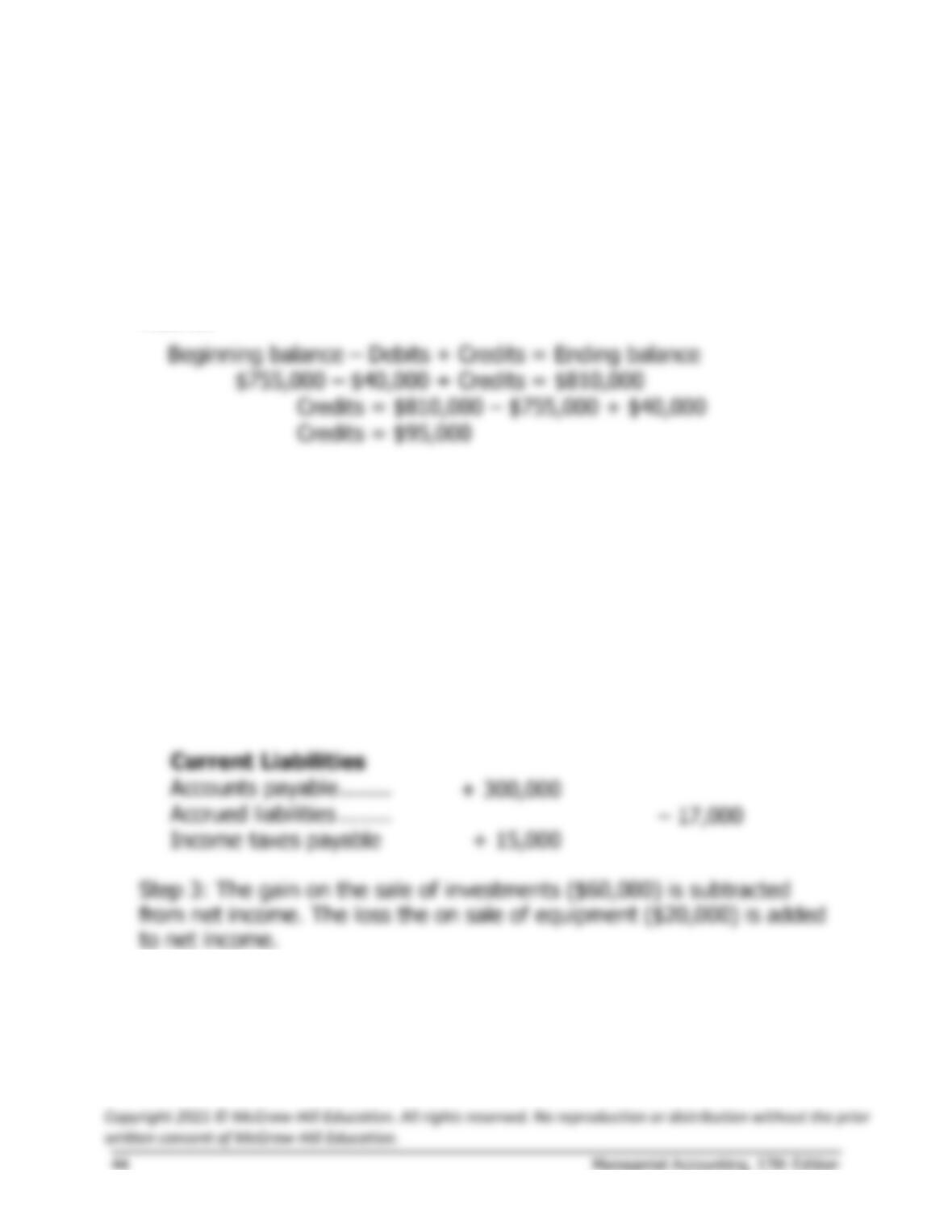
Step 1: The following equation can be applied to the Accumulated
Depreciation account to compute the depreciation to add back to net
income:
Step 2: The guidelines from Exhibit 15-2 can be used to analyze the
changes in noncash balance sheet accounts that impact net income as
follows:
Increase in
Account Balance
Decrease in
Account Balance
Current Assets
Accounts receivable ….
– 180,000
Inventory ……………….
+ 12,000
Prepaid expenses ……..
– 5,000
Current Liabilities
Accounts payable ……..
Accrued liabilities ……..
Problem 15-14 (continued)
The net cash provided by (used in) operating activities can now be
calculated as follows:
Net income ……………………………………….
$170,000
Adjustments to convert net income to cash basis:
Depreciation ……………………………………
$ 95,000
Increase in accounts receivable …………..
(180,000)
Decrease in inventory ……………………….
12,000
Increase in prepaid expenses ……………..
(5,000)
Increase in income taxes payable ………..
Loss on sale of equipment ………………….
Gain on sale of investments ……………….
Investing and Financing activities:
The guidelines from Exhibit 15-3 can be used to analyze the changes in
noncash balance sheet accounts that impact investing and financing
cash flows as follows:
Increase in
Account
Balance
Decrease in
Account
Balance
Noncurrent Assets
Property, plant, and equipment………….
– 570,000
Long-term investments ……………………
+ 50,000
Long-term loans to subsidiaries …………
– 44,000
Bonds payable ……………………………….
Common stock ……………………………….
Problem 15-14 (continued)
Lomax’s subsidiaries did not repay any loans during the year, therefore,
the amount in the table on the prior page (– 44,000) represents a cash
outflow pertaining to a new loan. The company did not repurchase any
of its own stock, so the amount on the prior page represents a $90,000
cash inflow related to a stock issuance. Property, plant, and equipment,
bonds payable, and retained earnings require further analysis as follows:
Property, plant, and equipment:
Bonds Payable:
Beginning balance – Debits + Credits = Ending balance
$600,000 – 350,000 + Credits = $820,000
Credits = $820,000 – $600,000 + 350,000
Credits = $570,000
Retained earnings:
Problem 15-14 (continued)
Lomax Company
Statement of Cash Flows
Operating activities:
Net income ………………………………………………
$170,000
Adjustments to convert net income to cash basis:
Depreciation …………………………………………..
$ 95,000
Increase in accounts receivable ………………….
(180,000)
Decrease in inventory ………………………………
12,000
Increase in prepaid expenses …………………….
(5,000)
Increase in accounts payable ……………………..
300,000
Decrease in accrued liabilities …………………….
(17,000)
Increase in income taxes payable ……………….
15,000
Loss on sale of equipment …………………………
20,000
Gain on sale of investments ……………………….
(60,000)
180,000
Net cash provided by (used in) operating
activities ………………………………………………..
350,000
Investing activities:
Proceeds from sale of long-term investments ……
110,000
Proceeds from sale of equipment …………………..
70,000
Loans to subsidiaries …………………………………..
Additions to property, plant, & equipment ………..
Net cash provided by (used in) investing
Financing activities:
Issuance of bonds payable …………………………...
570,000
Issuance of common stock …………………………...
90,000
Retirement of bonds payable …………………………
(350,000)
Cash dividends paid …………………………………….
Net cash provided by (used in) financing
Net increase in cash and cash equivalents………..
Beginning cash and cash equivalents ………………
40,000
Problem 15-14 (continued)
2. The large amount of cash provided by operating activities is traceable
for the most part to the $300,000 increase in accounts payable. If the
accounts payable had remained basically unchanged, the same as
inventory, then operating activities would have provided very little cash
and the company might have experienced serious cash problems.
Note particularly that the cash provided by operating activities was used
to purchase plant and equipment. Thus, the company is using cash
derived from a short-term source (buildup of accounts payable) to
finance long-term asset acquisitions. In short, although the company is
generating substantial cash from operating activities, the
quality
of this
source is open to question.
Appendix 15A
The Direct Method of Determining the Net Cash
Provided by Operating Activities
Exercise 15A-1 (15 minutes)
Sales………………………………………………….
$700
Adjustments to a cash basis:
Increase in accounts receivable …………..
– 110
$590
Cost of goods sold ………………………………..
400
Adjustments to a cash basis:
Decrease in inventory ……………………….
– 70
Increase in accounts payable ……………..
– 35
295
Adjustments to a cash basis:
Increase in prepaid expenses ……………..
Decrease in accrued liabilities ……………..
Depreciation ……………………………………
– 60
137
Income tax expense ……………………………..
36
Adjustments to a cash basis:
Increase in income taxes payable ………..
– 8
28
$130
Exercise 15A-2 (15 minutes)
1.
Sales …………………………………………………….
$150,000
Adjustments to a cash basis:
Increase in accounts receivable ………………
– 10,000
$140,000
Cost of goods sold ……………………………………
90,000
Adjustments to a cash basis:
Increase in inventory …………………………...
+ 9,000
Increase in accounts payable …………………
– 7,000
92,000
Selling and administrative expenses …………….
40,000
Adjustments to a cash basis:
Increase in prepaid expenses …………………
Decrease in accrued liabilities ………………..
Depreciation ………………………………………
– 7,500
Income taxes ………………………………………….
Decrease in income taxes payable …………..
2. Gains and losses on the sale of assets would have no effect on the
computations in (1). The reason is that these items are not part of sales,
cost of goods sold, selling and administrative expenses, or income taxes.
Thus, gains and losses on the income statement are ignored under the
direct method.
Exercise 15A-3 (15 minutes)
Sales…………………………………………………
$275
Adjustments to a cash basis:
Decrease in accounts receivable …………
+ 2
$277
Cost of goods sold ……………………………….
150
Adjustments to a cash basis:
Selling and administrative expenses …………
Adjustments to a cash basis:
Depreciation …………………………………..
Exercise 15A-4 (15 minutes)
Sales……………………………………………………..
$ 350,000
Adjustments to a cash basis:
Increase in accounts receivable ………………
– 19,000
$331,000
Cost of goods sold ……………………………………
140,000
Adjustments to a cash basis:
Increase in inventory …………………………...
+ 33,000
Increase in accounts payable …………………
– 15,000
158,000
Selling and administrative expenses ……………..
160,000
Adjustments to a cash basis:
Decrease in prepaid expenses ………………..
Decrease in accrued liabilities …………………
Depreciation ……………………………………….
– 20,000
141,000
Income taxes ………………………………………….
15,000
Adjustments to a cash basis:
Increase in income taxes payable ……………
– 4,000
11,000
$ 21,000
Problem 15A-5 (45 minutes)
1.
The income statement adjusted to a cash basis:
Sales …………………………………………………
$500,000
Adjustments to a cash basis:
Increase in accounts receivable …………..
– 40,000
$460,000
Cost of goods sold ………………………………..
300,000
Adjustments to a cash basis:
Increase in inventory ………………………..
+ 50,000
Increase in accounts payable ……………..
– 63,000
287,000
Selling and administrative expenses ………….
158,000
Adjustments to a cash basis:
Decrease in prepaid expenses …………….
Decrease in accrued liabilities……………..
Depreciation …………………………………..
Income taxes ………………………………………
Adjustments to a cash basis:
Increase in income taxes payable ………..
$ 18,000
Problem 15A-5 (continued)
2.
Rusco Company
Statement of Cash Flows
For This Year Ended July 31
Operating activities:
Cash received from customers …………………….
$460,000
Less cash disbursements for:
Cost of merchandise purchased …………………
$287,000
Selling and administrative expenses ……………
143,000
Income taxes ………………………………………..
12,000
Total cash disbursements …………………………...
Net cash provided by (used in) operating
activities ………………………………………………
Investing activities:
Proceeds from sale of investments ……………….
30,000
Proceeds from sale of equipment …………………
Additions to property, plant, & equipment ………
Net cash provided by (used in) investing
activities ………………………………………………
(112,000)
Financing activities:
Issuance of bonds payable………………………….
70,000
Issuance of common stock …………………………
20,000
Cash dividends paid ………………………………….
(9,000)
Net cash provided by (used in) financing
activities ………………………………………………
81,000
Net decrease in cash and cash equivalents …….
Beginning cash and cash equivalents …………….
21,000
Ending cash and cash equivalents ………………..
Problem 15A-5 (continued)
3. There are two reasons for the sharp decline in cash. First, note that a
relatively small amount of cash was provided by operations during the
year. This is due to a build-up in accounts receivable and inventory,
which together have grown by $90,000 (= $40,000 + $50,000); the
build-up of receivables reduced the amount of cash received from
Problem 15A-6 (30 minutes)
1.
Sales …………………………………………………………..
$800
Adjustments to a cash basis:
Increase in accounts receivable …………………….
– 100
$700
Cost of goods sold ………………………………………….
500
Adjustments to a cash basis:
Decrease in inventory …………………………………
– 50
Increase in accounts payable ……………………….
– 80
370
Selling and administrative expenses …………………..
213
Adjustments to a cash basis:
Increase in prepaid expenses ……………………….
Decrease in accrued liabilities ………………………
Depreciation …………………………………………….
– 24
205
Income taxes ………………………………………………..
Increase in income taxes payable ………………….
Net cash provided by (used in) operating activities ..
$104
Problem 15A-6 (continued)
2.
Weaver Company
Statement of Cash Flows
For This Year Ended December 31
Operating activities:
Cash received from customers …………………………...
$700
Less cash disbursements for:
Cost of merchandise purchased ………………………..
$370
Selling and administrative expenses …………………..
205
Income taxes ……………………………………………….
21
Total cash disbursements …………………………………..
596
Net cash provided by (used in) operating activities ….
104
Proceeds from sale of long-term investments …………
Proceeds from sale of equipment ………………………..
Additions to property, plant, & equipment ……………..
Net cash provided by (used in) investing activities…..
Financing activities:
Issuance of bonds payable …………………………………
110
Repurchase of common stock …………………………….
(40)
Cash dividends paid …………………………………………
Net cash provided by (used in) financing activities ….
Net decrease in cash and cash equivalents ……………
Beginning cash and cash equivalents ……………………
Ending cash and cash equivalents ……………………….
Problem 15A-7 (45 minutes)
1.
Sales …………………………………………………….
$900,000
Adjustments to a cash basis:
Increase in accounts receivable ………………
– 80,000
$820,000
Cost of goods sold ……………………………………
500,000
Adjustments to a cash basis:
Selling and administrative expenses …………….
328,000
Adjustments to a cash basis:
Decrease in prepaid expenses ………………..
Decrease in accrued liabilities ………………..
+ 10,000
Increase in income taxes payable ……………
$ 20,000
Problem 15A-7 (continued)
2.
Joyner Company
Statement of Cash Flows
For Year 2
Operating activities:
Cash received from customers ……………………..
$820,000
Less cash disbursements for:
Cost of merchandise purchased ………………….
$490,000
Selling and administrative expenses …………….
289,000
Income taxes …………………………………………
21,000
Total cash disbursements …………………………….
800,000
Net cash provided by (used in) operating
activities ……………………………………………….
20,000
Investing activities:
Proceeds from sale of equipment ………………….
18,000
Loan to Hymans Company …………………………..
Additions to property, plant, & equipment ……….
Net cash provided by (used in) investing
activities ……………………………………………….
Financing activities:
Issuance of bonds payable …………………………..
120,000
Issuance of common stock ………………………….
30,000
Cash dividends paid …………………………………..
(15,000)
Net cash provided by (used in) financing
activities ……………………………………………….
135,000
Net decrease in cash and cash equivalents ……..
(17,000)
Beginning cash and cash equivalents ……………..
21,000
Ending cash and cash equivalents …………………
$ 4,000
3. The decline in cash occurs largely because the company only generated
$20,000 from operating activities. This small amount is due primarily to