
15
Transfer Pricing
Solutions to Review Questions
15–1.
A transfer price is used to record the revenue or the cost from a sale between units (e.g.,
divisions) of a firm. It allows the completion of separate financial statements within the
firm.
15–2.
Yes, transfer prices exist in centralized organizations to record the transfer of goods and
services from one unit to another for the same reasons such organizations allocate costs
(e.g., inventory valuation, cross-department monitoring).
15–3.
Market-based transfer pricing is considered optimal under many circumstances because it
15–4.
The key limitation is that market prices are often not readily available. The limitations of
15–5.
Direct intervention might be preferable when transfers between units are rare or where the
decision resulting from decentralized decision-making is considered too harmful to allow.
The advantage of direct intervention is it promotes short-run profits by ensuring proper
action. The disadvantages of such a practice are that top management will become too
involved in pricing disputes, and division managers will lose flexibility and autonomy in
their decision making. The company also loses the other advantages of decentralization.
15–6.
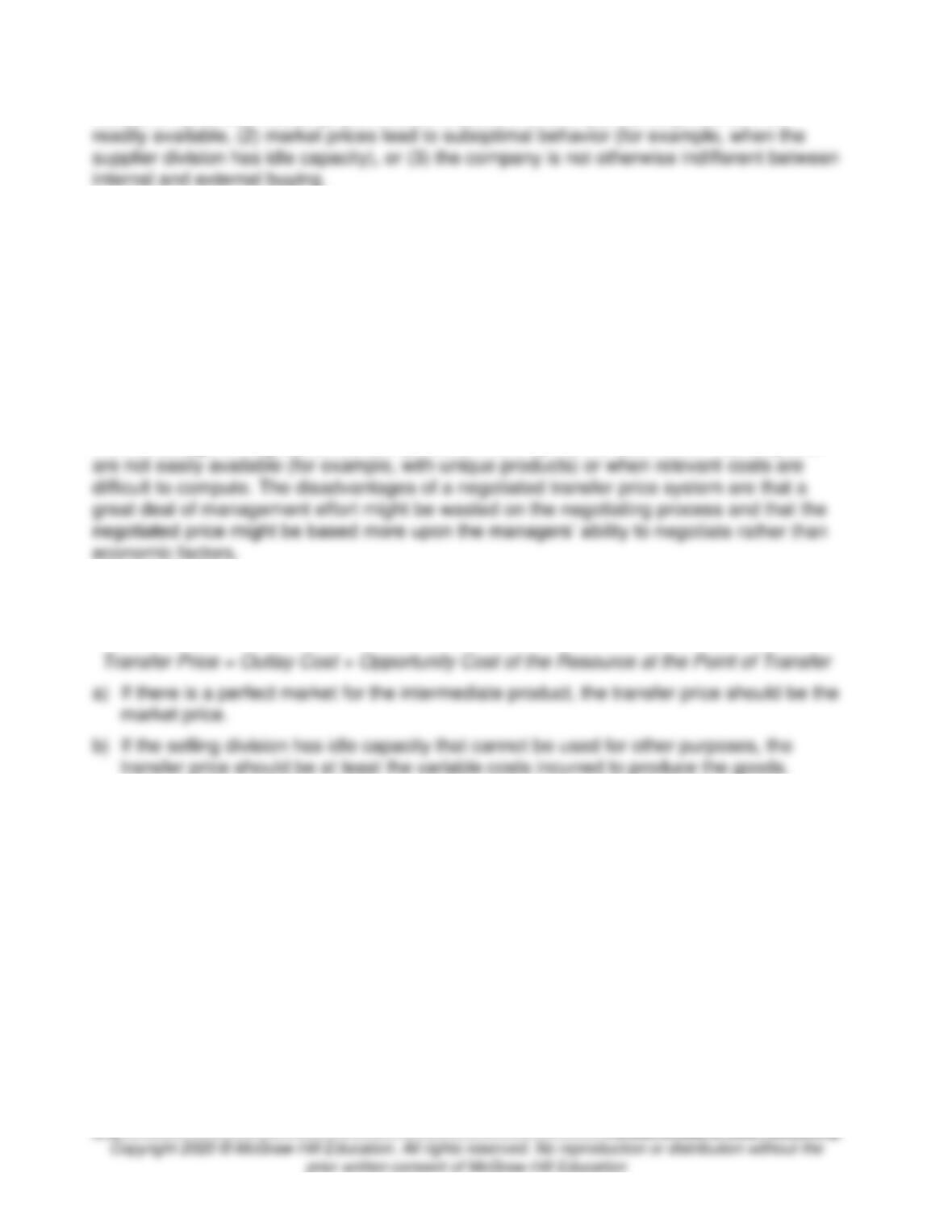
Reasons not to use market prices include situations where: (1) market prices are not
15–7.
When actual costs are used as a basis for the transfer, any variances or inefficiencies in
the selling division are passed along to the buying division. To promote responsibility in
the selling division and to isolate variances within divisions, standard costs are usually
used as a basis for transfer pricing in cost-based systems. (Note: Standard cost transfer
pricing is only appropriate if standard costs are up to date and reflect reasonable
estimates of cost.)
15–8.
The advantage of negotiated transfer prices is that they can be used when market prices
15–9.
The general transfer pricing rule is:
15–10.
Transfer pricing is important in tax accounting, because transfers of goods or services
often occurs across different tax jurisdictions (countries, for example). The transfer price
affects the revenue (income) and cost (income) that are reported in the different
jurisdictions. If the different jurisdictions have different income tax rates, the total tax
liability across all jurisdictions will depend on the transfer price.
15–11.
Transfer pricing is important in segment reporting, because it affects the reported
revenues and costs, and therefore income, shown for the different segments.

Solutions to Critical Analysis and Discussion Questions
15–12.
Three goals of transfer pricing in a decentralized organization are (1) to coordinate the
activities of various responsibility centers, (2) to motivate managers to perform in the
company’s best interest and (3) to serve as a performance measure for responsibility
centers.
15–13.
A cost-based or negotiated cost-based transfer pricing method would be necessary. We
15–14.
15–15.
Most likely Weyerhaeuser uses a market price, because the products are commodity
products (wood, pulp, and so on) with well-established markets.
15–16.
The transfer price becomes revenue for the selling segment and a cost to the buying
15–17.
Because transfer prices can affect the assignment of income from one jurisdiction to
another, there is a tendency to set a cross-jurisdictional transfer price in such a manner
that income is shifted to the jurisdiction with a lower tax burden. Of course, management
needs to be aware of differences in tax laws, currency controls and other factors when
establishing a transfer price. Moreover, taxing authorities might challenge a transfer price
that is deemed unreasonable.

15–18.
Transfer prices are similar to cost allocations in that they assign costs (and profit) to two or
more cost objects. In fact, if we think about the service department cost allocations in
Chapter 11, these could be considered transfer prices from service departments to
production departments. They are different primarily in that they allocate more than cost.
Solutions to Exercises
15–20. (10 min.) Basic Transfer Pricing Issues: Tops Corporation
a. The current transfer price is $300 per unit. There is no intermediate market, so the
revenue in the Manufacturing Division is all from the transfer price. Therefore, the
transfer price is $300 (= $3,000,000 ÷ 10,000 units).
15–21. (10 min.) Basic Transfer Pricing Issues: Tops Corporation
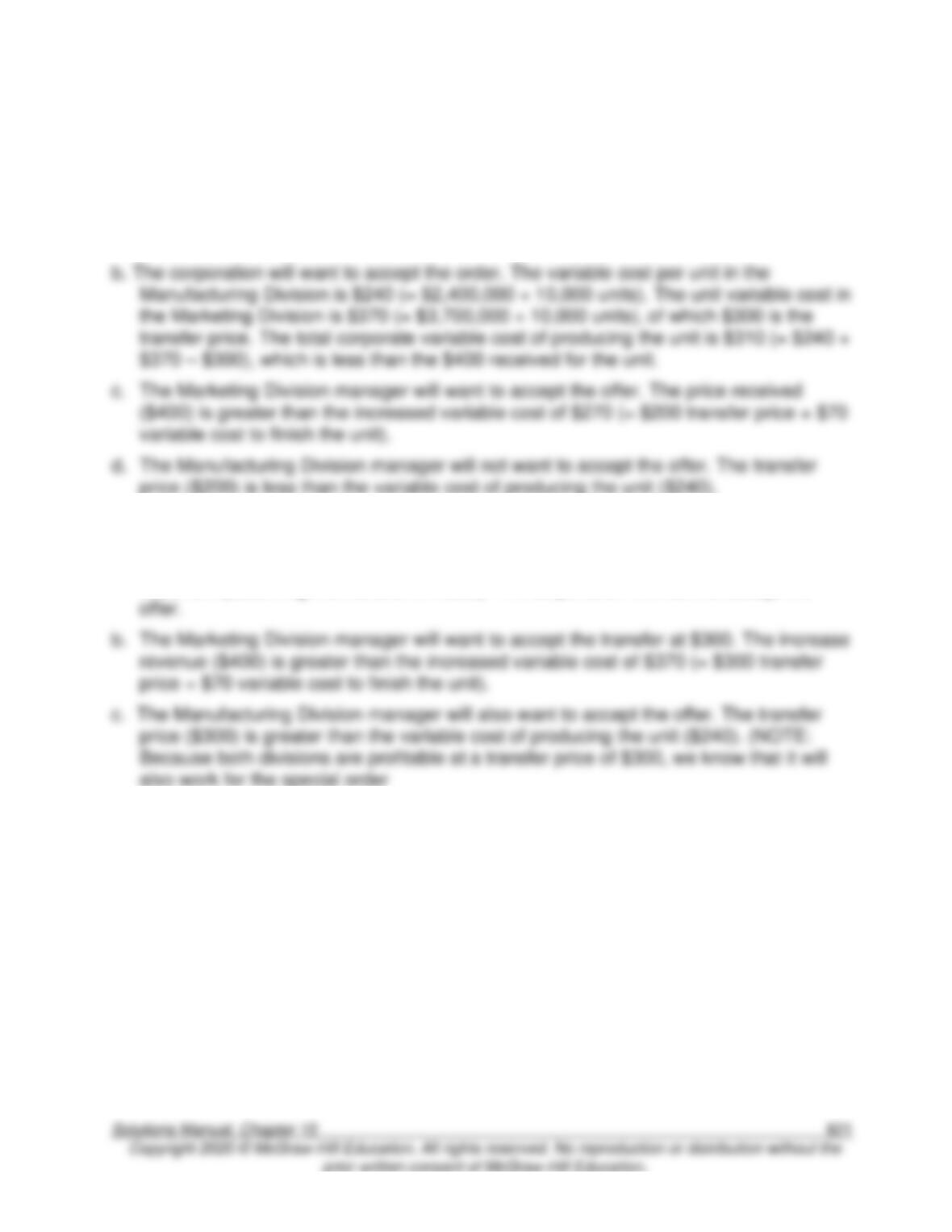
a. The analysis does not change for the corporation, because the transfer price is
irrelevant (assuming the transfer is made). The corporation will want to accept the
15–22. (20 min.) Apply Transfer Pricing Rules: Best Practices, Inc.
a. The minimum transfer price that the Corporate Division should obtain is $600 per hour,
the market price for these services.
b. The maximum transfer price that the Government Division should pay is $200 per hour,
the cost of the best alternative.
c. Answer (a) would be $200 per labor hour. Answer (b) would not be affected.

15–23. (15 min.) Evaluate Transfer Pricing System: Clinton Corporation
a. If Alpha Division buys from outsiders because the transfer price is greater than $90,
15–24. (15 min.) Evaluate Transfer Pricing System
With the possibility of increased production, Maryland Division has an opportunity cost of
transferring to Virginia Division of $230 per square foot, which is the appropriate transfer
price. However, the opportunity cost of acquiring the warehouse space is $190 per square
foot for Virginia Division. Therefore, it would be in the company’s best interest if Virginia
Division rented the space from the outside company. [This assumes no additional costs
such as moving expenses to Virginia Division in using outside facilities.]
15–25. (20 min.) Evaluate Transfer Pricing System.
a.
Northeast
Southwest
Company
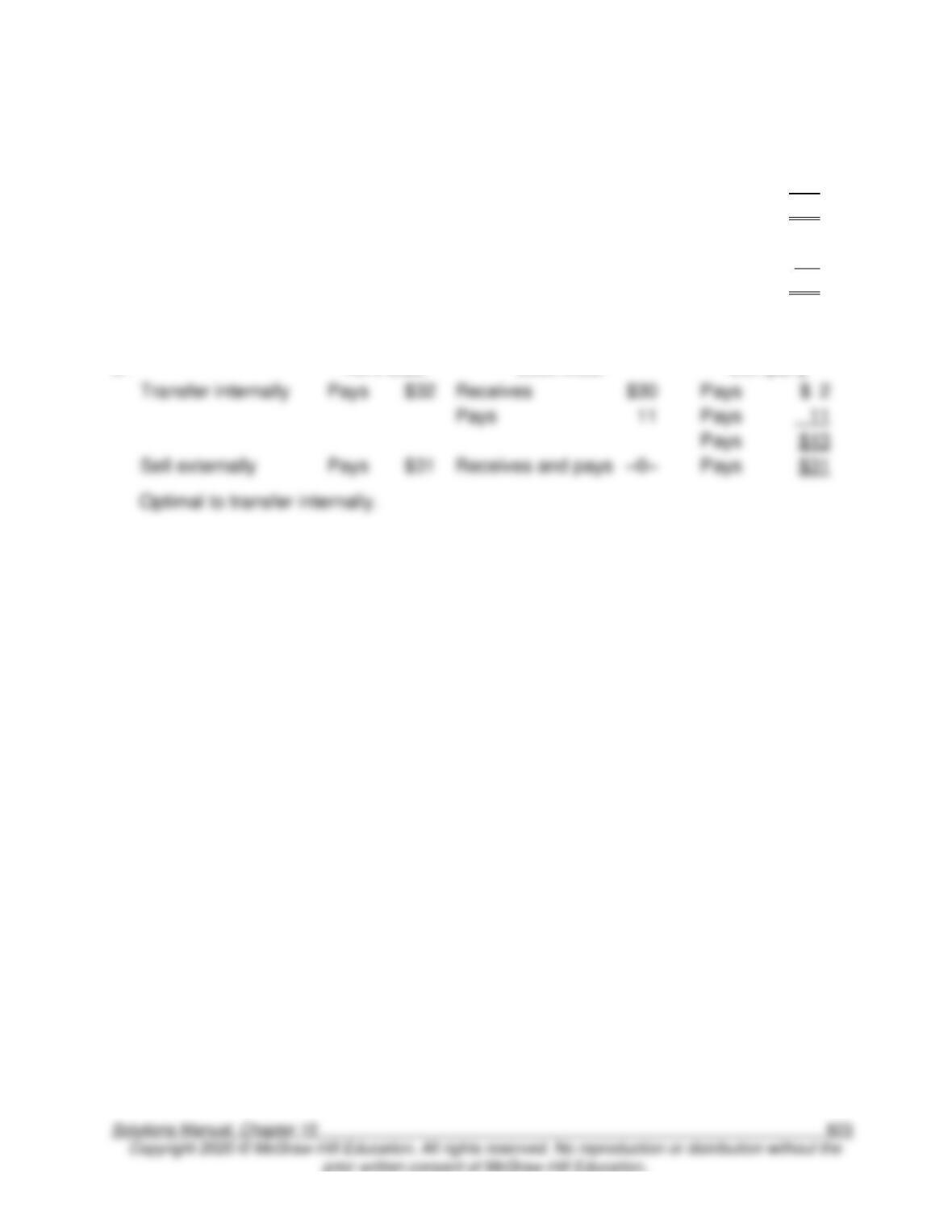
Transfer internally
Pays
$32
Receives
$30
Pays
$ 2
Pays
$11
Pays
11
Pays
$13
Sell externally
Pays
$31
Receives
$30
Pays
$ 1
Pays
11
Pays
11
Pays
$12
Optimal to sell externally.
b.
Transfer internally
Pays
Receives
Pays
Pays
Pays
Pays

15–26. (25 min.) Evaluate Transfer Pricing System: Seattle Transit Ltd.
a. Different prices:
(1) The opportunity cost might be considered the regular fare of $2.00 less the $0.50
fee collected.
(2) The full cost is $4.00 less the $0.50 fee collected.
(3) One might suggest that if the transit vehicles are not running at capacity, the
opportunity cost is zero because the senior citizens are riding in seats that would
otherwise be empty.
d. The difference is $525,000 per month, which equals 150,000 rides at $3.50 per ride.
The $3.50 is the difference between the full cost and the $0.50 fare collected.
15–27. (25 min.) Evaluate Transfer Pricing System: BGTS.
Total
Ms. Seville’s
Shares
(60% and
20%)
Mr. Turco’s
Shares
(40% and
60%)
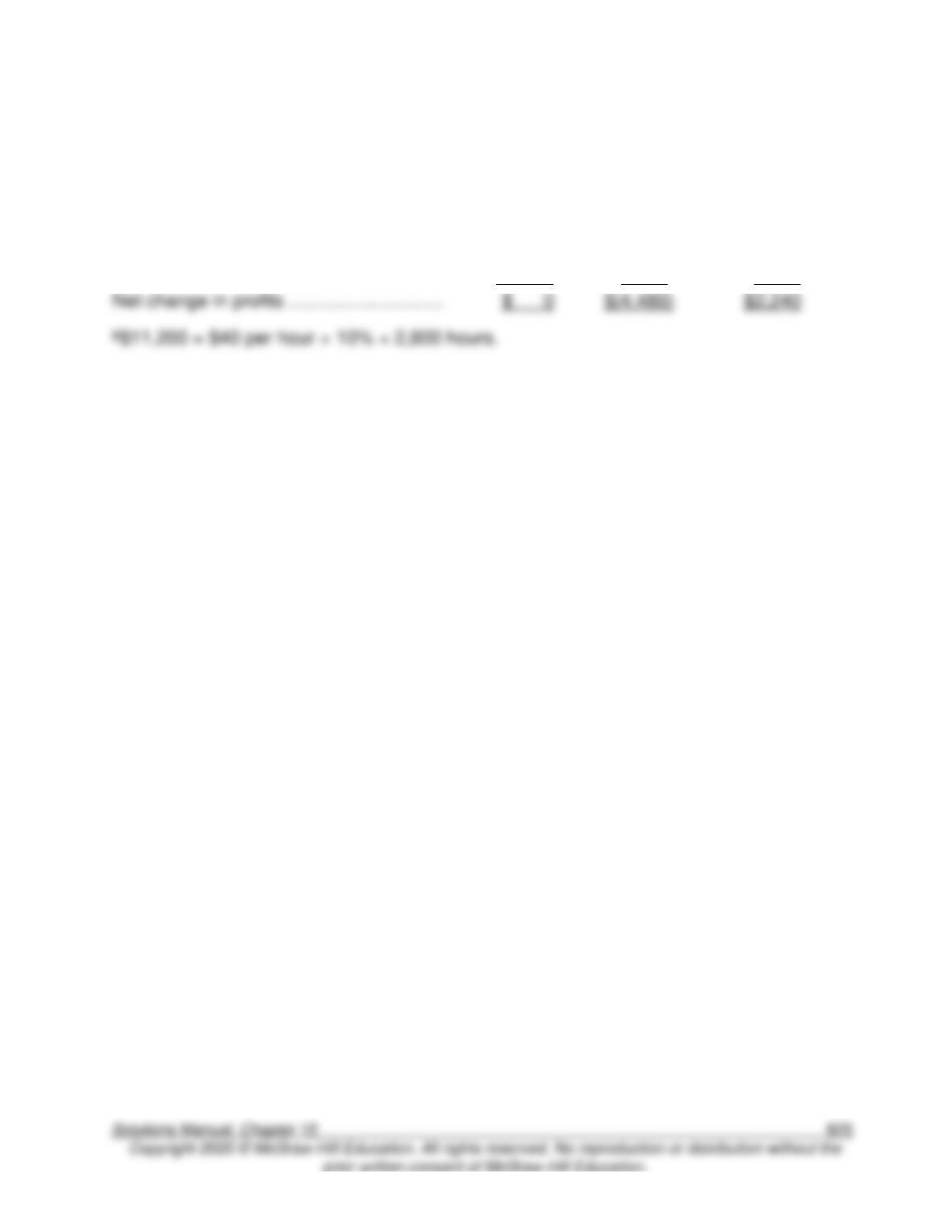
Decrease in profits at BGTS ………………
$(11,200)a
$(6,720)
$(4,480)
Increase in profits at Big City Developers
11,200
2,240
6,720
15–28. (25 min.) International Transfer Prices–Ethical Issues: Trans Atlantic
Metals.
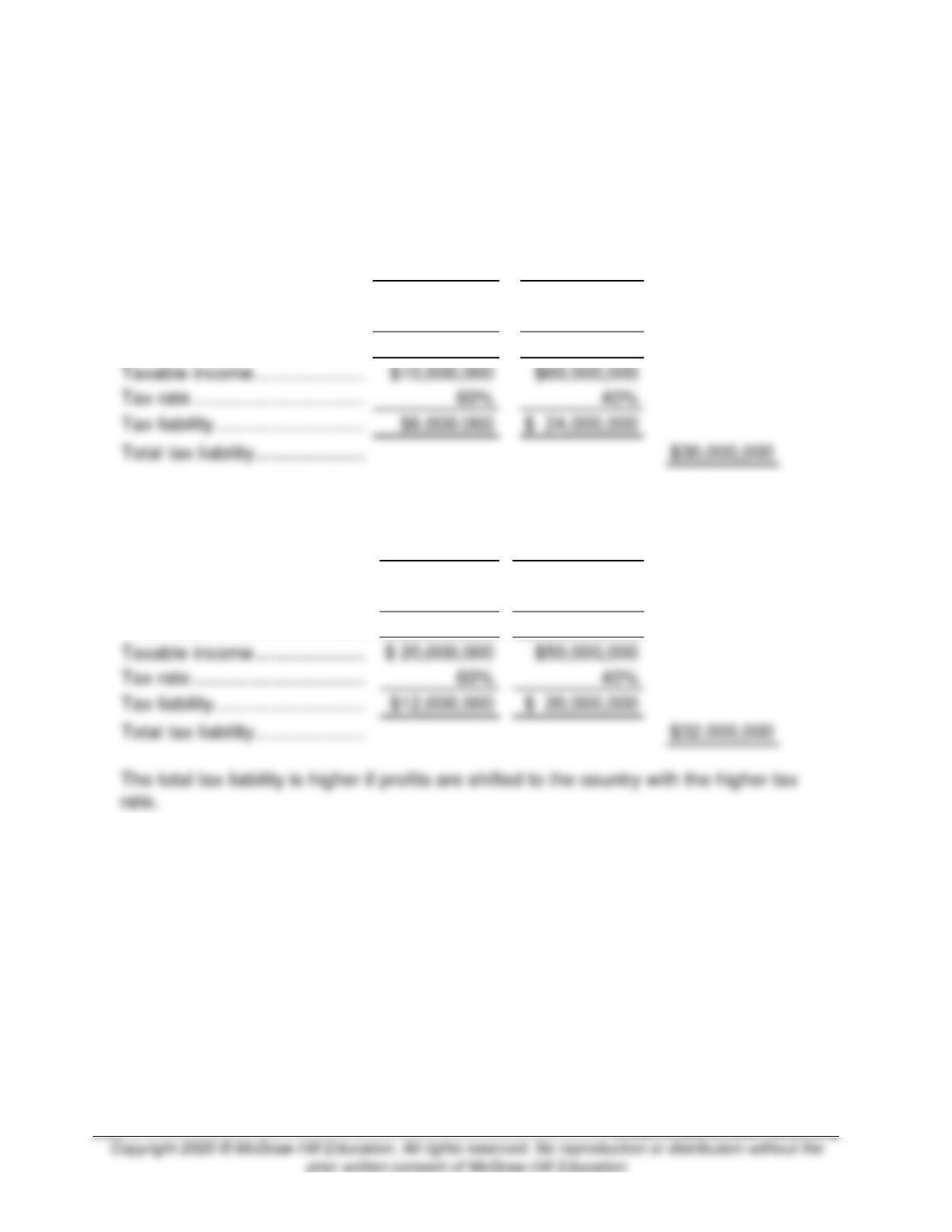
a. Analyze the tax liabilities in each jurisdiction using the alternative transfer prices. If the
transfer price is $30 million, the tax liabilities are:
Finland
U.S.
Sales revenue …………………..
$30,000,000
$150,000,000
Third-party costs ………………..
20,000,000
60,000,000
Transferred goods costs ……..
30,000,000
Total costs ………………………..
$20,000,000
$90,000,000
Taxable income …………………
$60,000,000
Tax rate …………………………...
Tax liability ………………………..
Total tax liability …………………
If the transfer price is $40 million, the tax liabilities are computed as follows:
Finland
U.S.
Sales revenue …………………..
$40,000,000
$150,000,000
Third-party costs ………………..
20,000,000
60,000,000
Transferred goods costs ……..
40,000,000
Total costs ………………………..
$ 20,000,000
$100,000,000
Taxable income …………………
Tax rate …………………………...
Tax liability ………………………..
Total tax liability …………………
b. Answers will vary. In general, most people will view the choice as ethical. Obviously,
misstating costs simply to avoid taxes is unethical (and illegal).

15–29. (20 min.) Transfer Pricing Policies – Ethical Issues: Best Practices, Inc.
a. As in 15-22, the minimum transfer price that the Corporate Division should obtain is
$600 per hour, the market price for these services. This reflects the (opportunity) cost
of the Corporate Division and is ethical.
15–30. (20 min.) International Transfer Pricing and Taxes: MBS.
a. $100. Fabrication is operating below capacity, so the optimal transfer price is the
variable cost. The Marketing order will not exceed the current capacity.
b. $560,000.
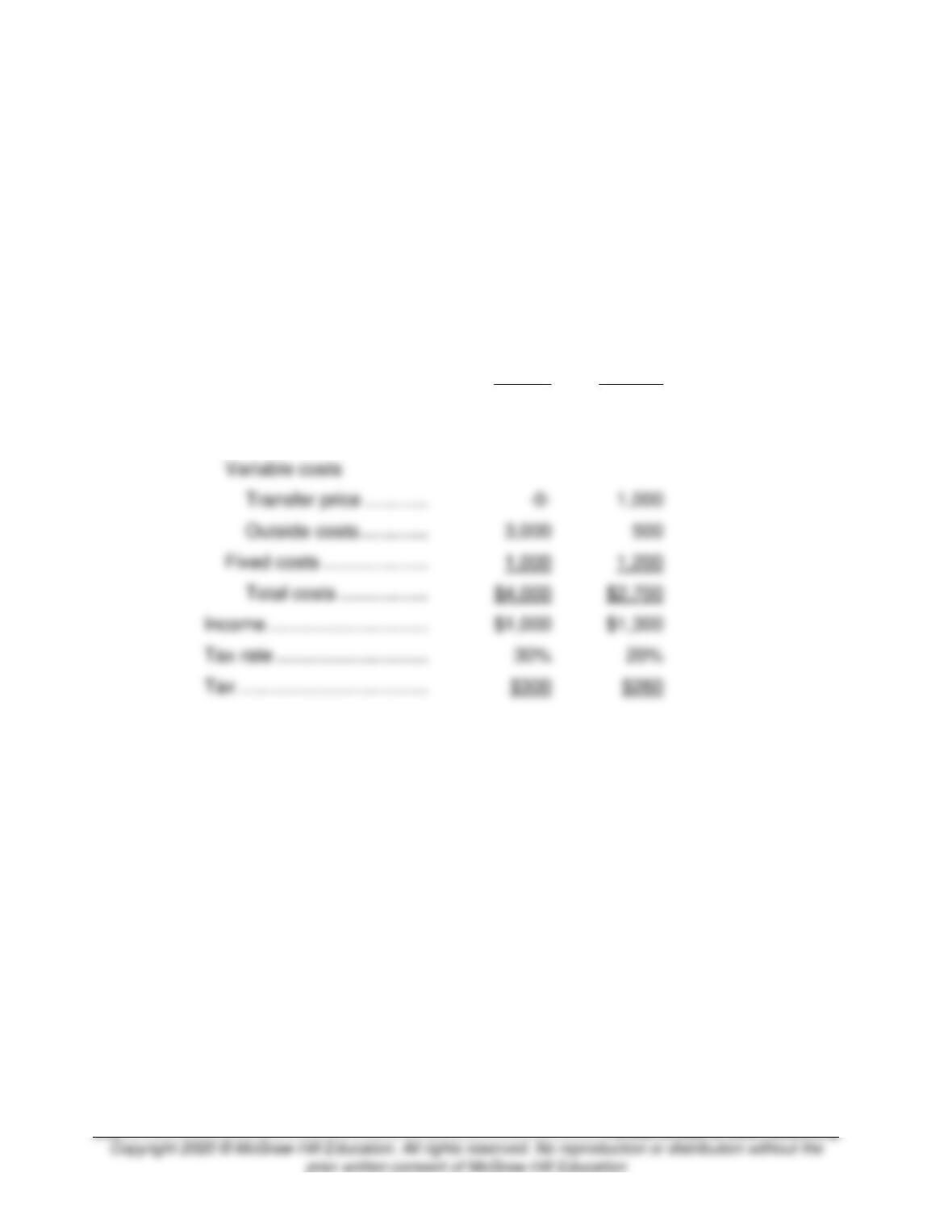
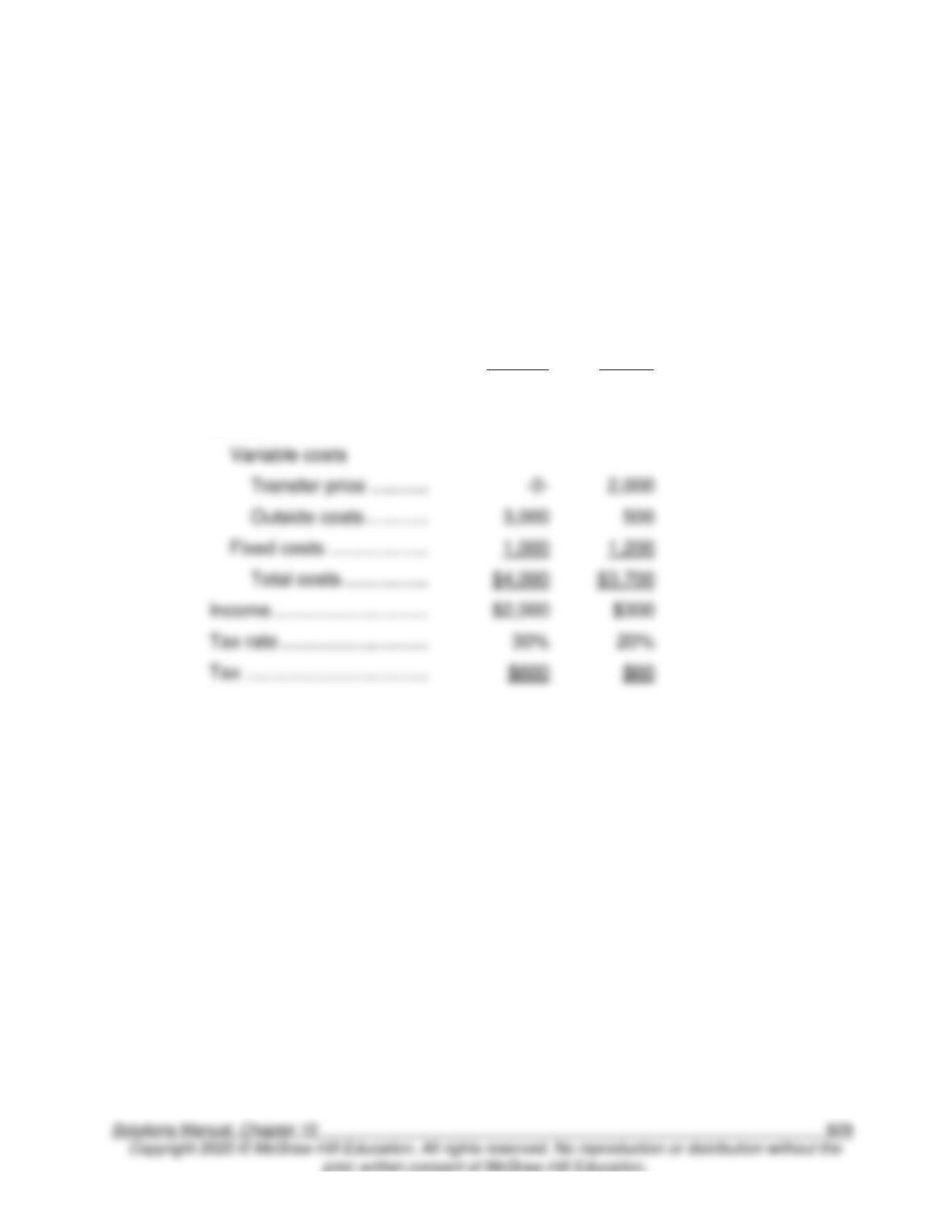
At a transfer price of $100, income and taxes (in thousands of dollars) in the two
divisions will be:
Fabrication
Marketing
Revenues:
From outside ………………
$4,000
$4,000
From transfer ……………..
1,000
-0-
Total revenue ………….
$5,000
$4,000
Costs:
Variable costs
Transfer price …………
Outside costs ………….
Fixed costs ………………..
Total costs ……………..
$4,000
$2,700
Income ………………………….
$1,000
$1,300
Tax rate ………………………..
Tax ………………………………
c. $200. Manufacturing is operating at capacity, so the optimal transfer price is the market
price.
15–30. (continued)
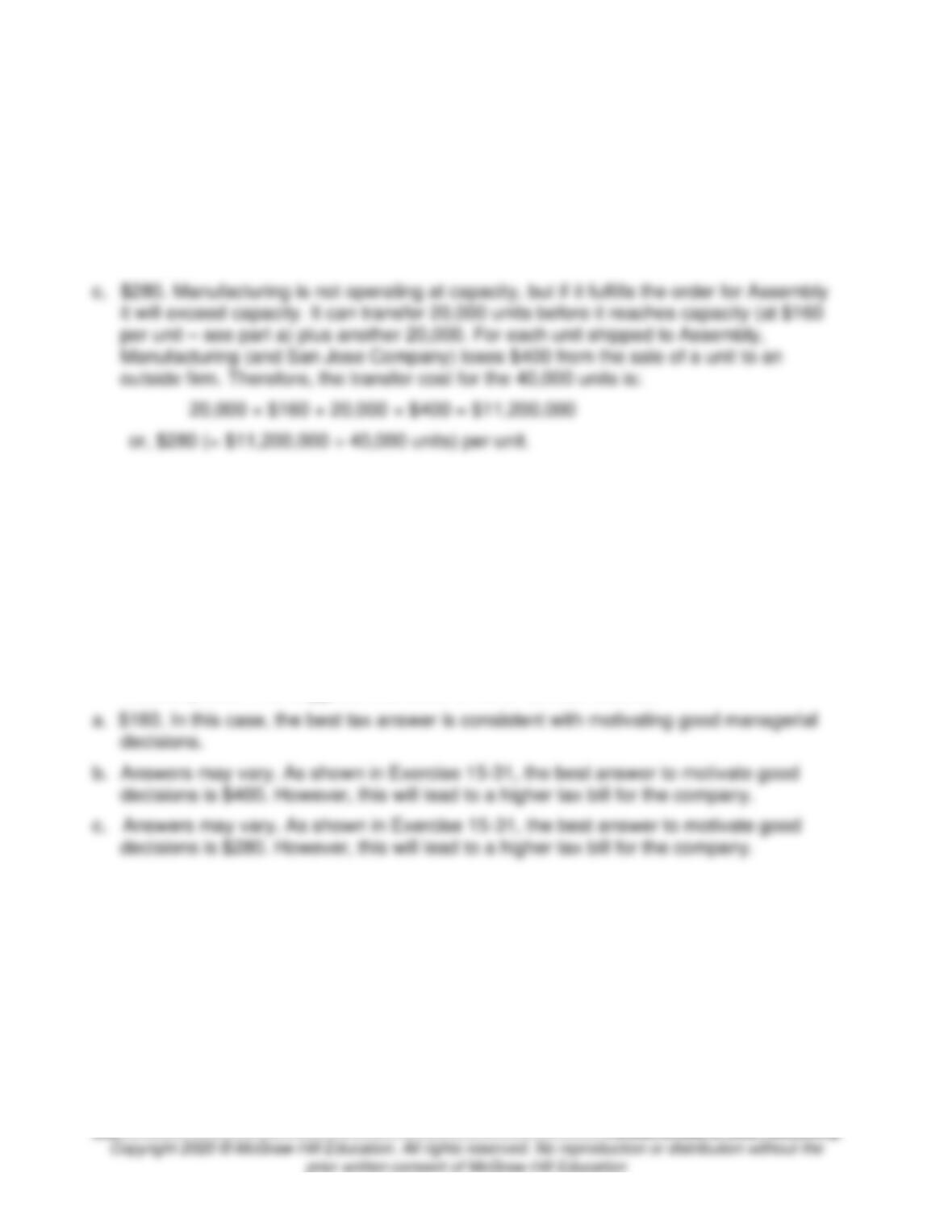
d. $660,000.
At a transfer price of $200, income and taxes (in thousands of dollars) in the two
divisions will be:
Fabrication
Marketing
Revenues:
From outside ……………..
$4,000
$4,000
From transfer …………….
2,000
-0-
Total revenue …………
$6,000
$4,000
Costs:
Variable costs
Transfer price ………..
Outside costs …………
Fixed costs ……………….
Total costs …………….
$4,000
$3,700
Income …………………………
$2,000
Tax ……………………………..
15–31. (20 min.) Evaluate Transfer Pricing System: San Jose Company.
a. $160. Manufacturing is operating below capacity, so the optimal transfer price is the
variable cost. The Assembly order will not exceed the current capacity.
b. $400. Manufacturing is operating at capacity. For each unit shipped to Assembly,
Manufacturing (and San Jose Company) loses $400 from the sale of a unit to an
outside firm.
15–32. (20 min.) International Transfer Prices: San Jose Company.
This exercise is designed to illustrate the conflict between the use of a transfer price to
motivate managerial decision making and the desire to minimize corporate taxes.
Ignoring the tax issues, leads to the same answers as in Exercise 15-31. However,
from a tax perspective, the company would prefer to be taxed in Country B (with a tax
rate of 40%) instead of Country A (with a tax rate of 60%). From a tax perspective,
then, the best transfer is $160, which will result in zero profits on the transferred units.
This might, in cases, result in a conflict with the managerial decision making role of
transfer prices. This suggests that there is not a “correct” answer.

15–33. (20 min.) Evaluate Transfer Pricing System: Dual Rates: Atascadero
Industries.
a. $560. Manufacturing is operating below capacity, so the optimal transfer price is the
variable cost. The Marketing order will not exceed the current capacity.
b. $1,400. Manufacturing is operating at capacity. For each unit shipped to Marketing,
Manufacturing (and Atascadero Industries) loses $1,400 from the sale of a unit to an
outside firm.
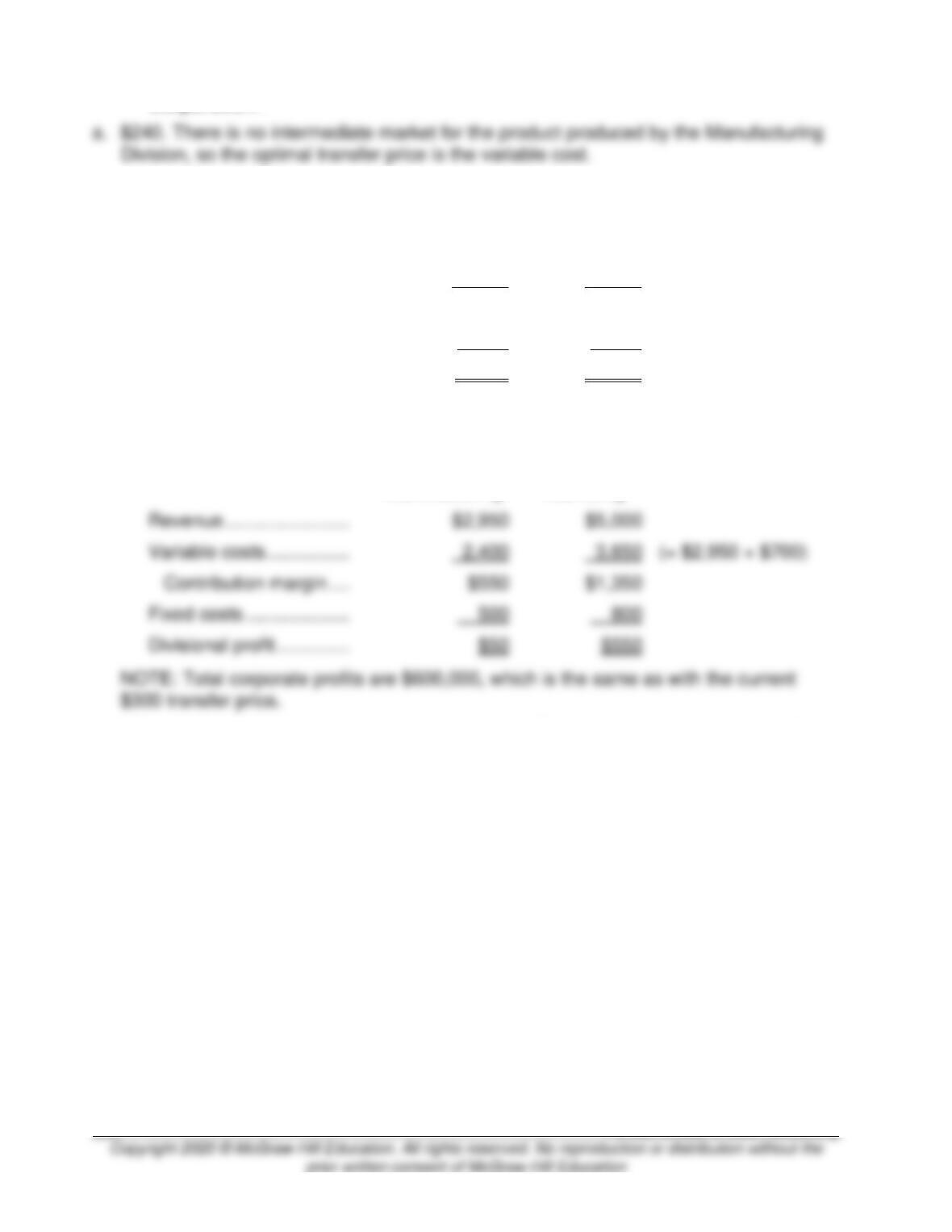
15–34. (20 min.) Evaluate Transfer Pricing System: Negotiated Rates: Tops
b. (All values are in thousands of dollars.)
Manufacturing
Marketing
Revenue ……………………
$2,400
$5,000
Variable costs …………….
2,400
3,100
(= $2,400 + $700)
Contribution margin ….
$-0-
$1,900
Fixed costs ………………..
500
800
Divisional profit …………..
($500)
$1,100
NOTE: Total corporate profits are $600,000, which is the same as with the current
$300 transfer price.
c. (All values are in thousands of dollars.)
Manufacturing
Marketing
Revenue ……………………
$2,950
$5,000
Variable costs …………….
2,400
3,650
(= $2,950 + $700)
Contribution margin ….
Fixed costs ………………..
500
800
Divisional profit …………..
d. Although the negotiated transfer price allows both Division managers to show positive
profits, it suffers from the following defect. It can lead to dysfunctional decisions. For
example, if an outside customer offers to pay Tops Corporation $325 per unit for a
special order, the corporation would want to accept it, because the revenue ($325) is
greater than the total corporate variable cost of $310 (= $240 + $70). Manufacturing
would be willing to produce the units at a transfer price of $295, but Marketing would
not be willing to accept the order. The revenue received by Marketing ($325) would be
less than Marketing’s total variable cost of $365 (= $295 transfer price + $70 finishing
costs).

15–35. (20 min.) International Transfer Prices: Atascadero Industries.
This exercise is designed to illustrate the conflict between the use of a transfer price to
motivate managerial decision making and the desire to minimize corporate taxes.
Ignoring the tax issues, leads to the same answers as in Exercise 15-33 (a) and (b).
However, from a tax perspective, the company would prefer to be taxed in Country Y
(with a tax rate of 35%) instead of Country X (with a tax rate of 65%). From a tax
perspective, then, the best transfer is $560, which will result in zero profits on the
transferred units. This might, in cases, result in a conflict with the managerial decision
making role of transfer prices. This suggests that there is not a “correct” answer.
a. $560. In this case, the best tax answer is consistent with motivating good managerial
decisions.
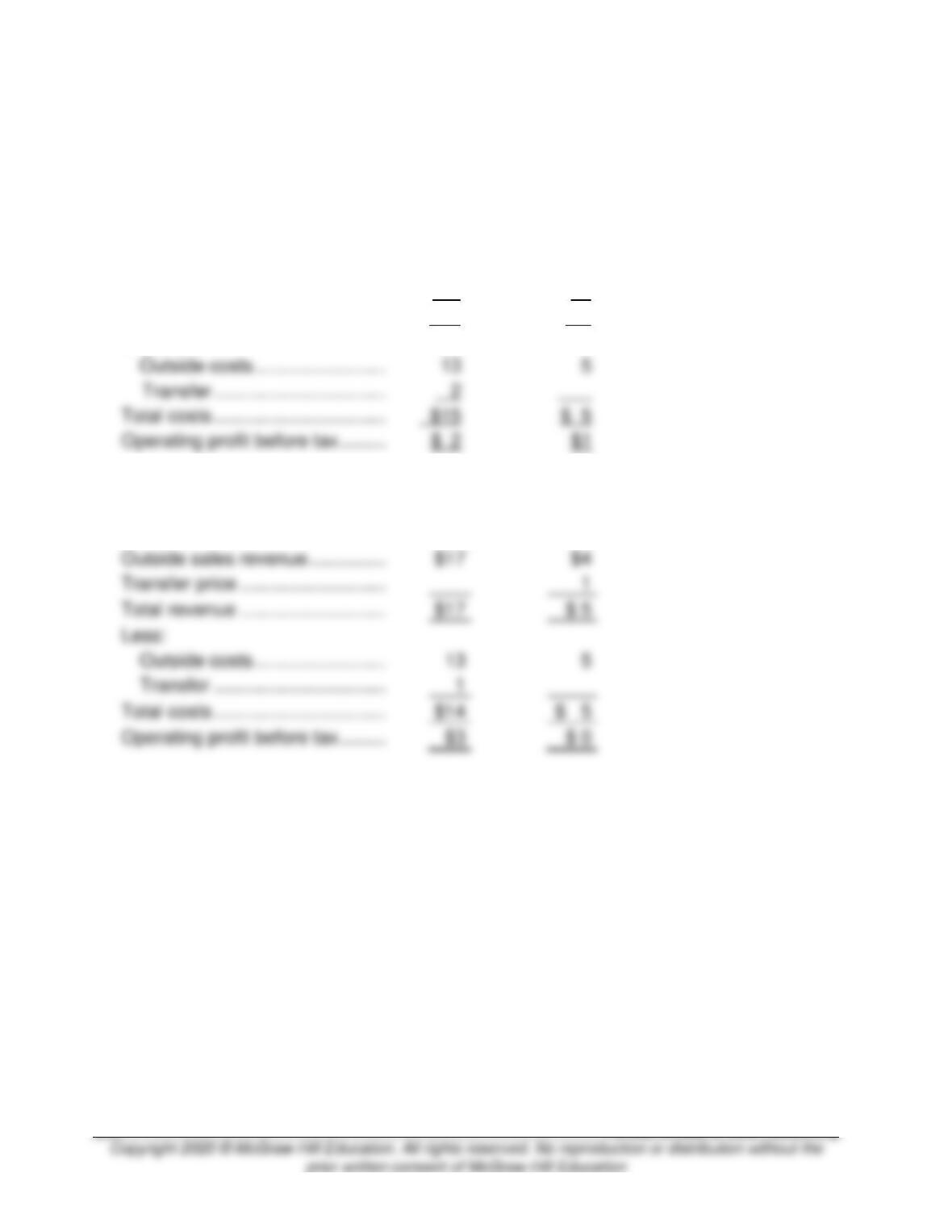
15–36. (30 min.) Segment Reporting: Leapin’ Larry’s Pre-Owned Cars
($ in millions)
a. Using a $2 million transfer price:
Item
Operation
Division
Financing
Division
Outside sales revenue ……………
$17
$4
Transfer price ……………………….
2
Total revenue ……………………….
$17
$ 6
Less:
Total costs …………………………...
b. Using a $1 million transfer price:
Item
Operation
Division
Financing
Division
Outside sales revenue ……………
Transfer price ……………………….
Total revenue ……………………….
$ 5
Less:
Total costs …………………………...
Operating profit before tax ………
$3
c. If the commercial rate for loan fees is really $1 million and assuming that Financing is
not at capacity (since this is the market for money, that would be unlikely), the optimal
transfer price is $1 million. This assumes that the loans the company will be making
and the services for the fees will be the same as for other firms in the market. By
charging higher fees, Larry is in danger of making too few loans to customers.
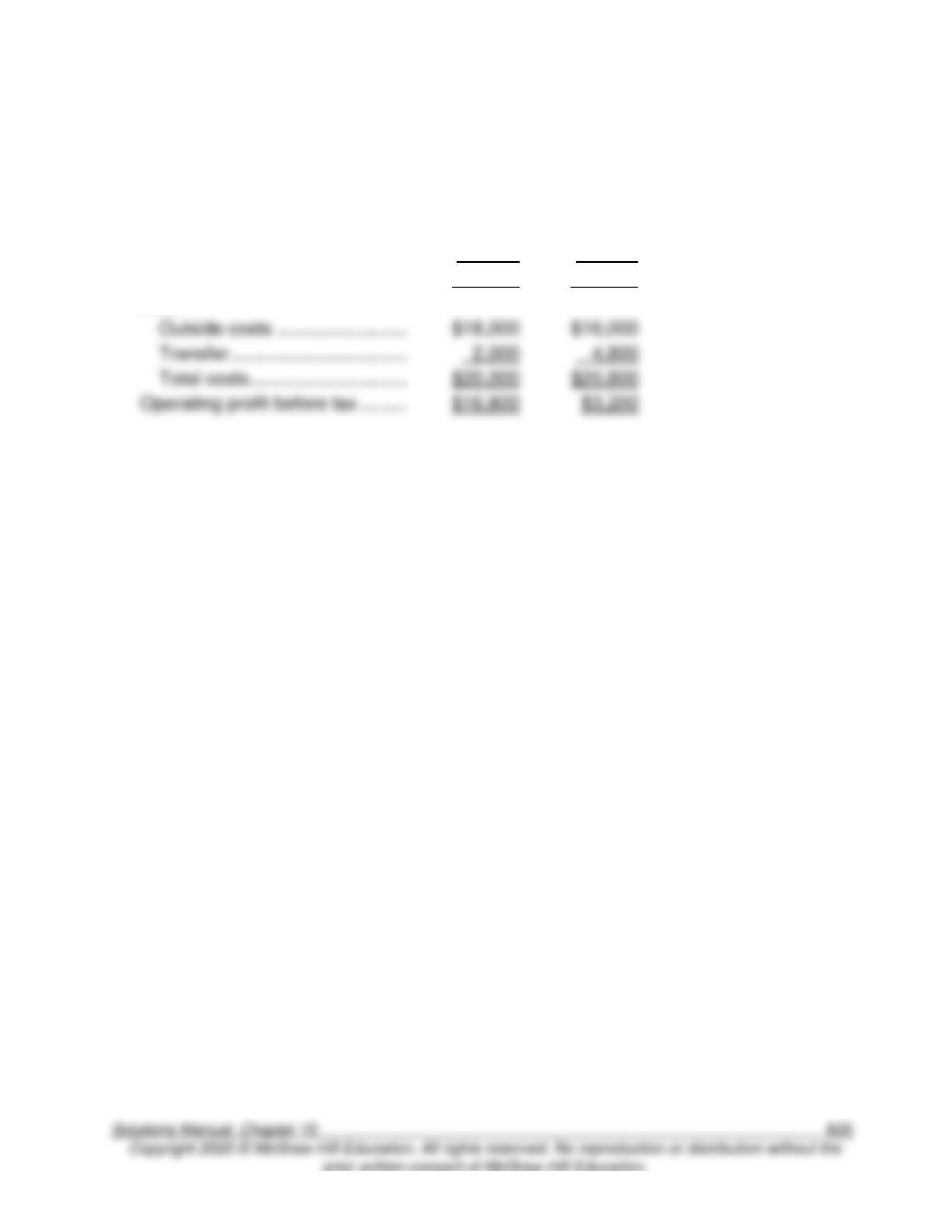
15–37. (30 min.) Segment Reporting: Perth Corporation.
($000)
Item
Casino
Hotel
Revenue:
Outside revenue …………………
$32,000
$22,000
Transfer price …………………….
4,800
2,000
Total revenue …………………….
$36,800
$24,000
Less:
Outside costs …………………….
Transfer …………………………….
Total costs …………………………
$20,800
Solutions to Problems
15–38. (30 min.) Transfer Pricing With Imperfect Markets—ROI Evaluation, Normal
Costing: Oxford Company.
a. ROI for Thames Division.
Income: [900,000 × ($140 – $40)] – [$70 × 1,000,000] = $20,000,000
ROI
=
$20,000,000
=
25%
$80,000,000
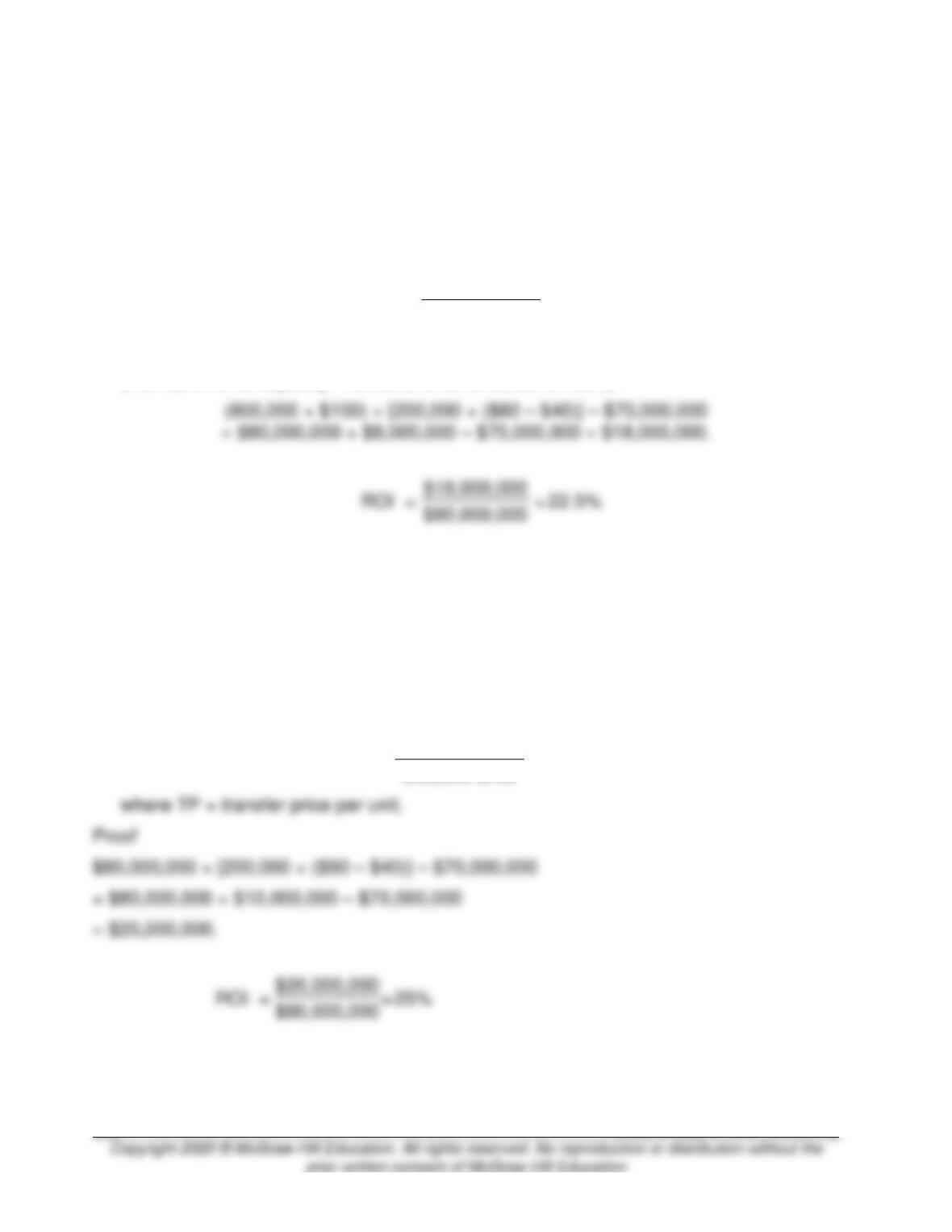
b. Note: Capacity is 1,000,000 units, so regular sales would be reduced to 800,000 units
(1,000,000 units capacity – 200,000 units to Lakes Division).
=
=
22.5%
c. Because the investments will not change, we can determine the price by setting the
two incomes equal:
(800,000 × $100) + [200,000 x (TP – $40)] – $70,000,000 = $20,000,000
$80,000,000 + 200,000 TP – $8,000,000 – $70,000,000 = $20,000,000
200,000 TP = $18,000,000
TP
=
$18,000,000
=
$90.00
=
25%