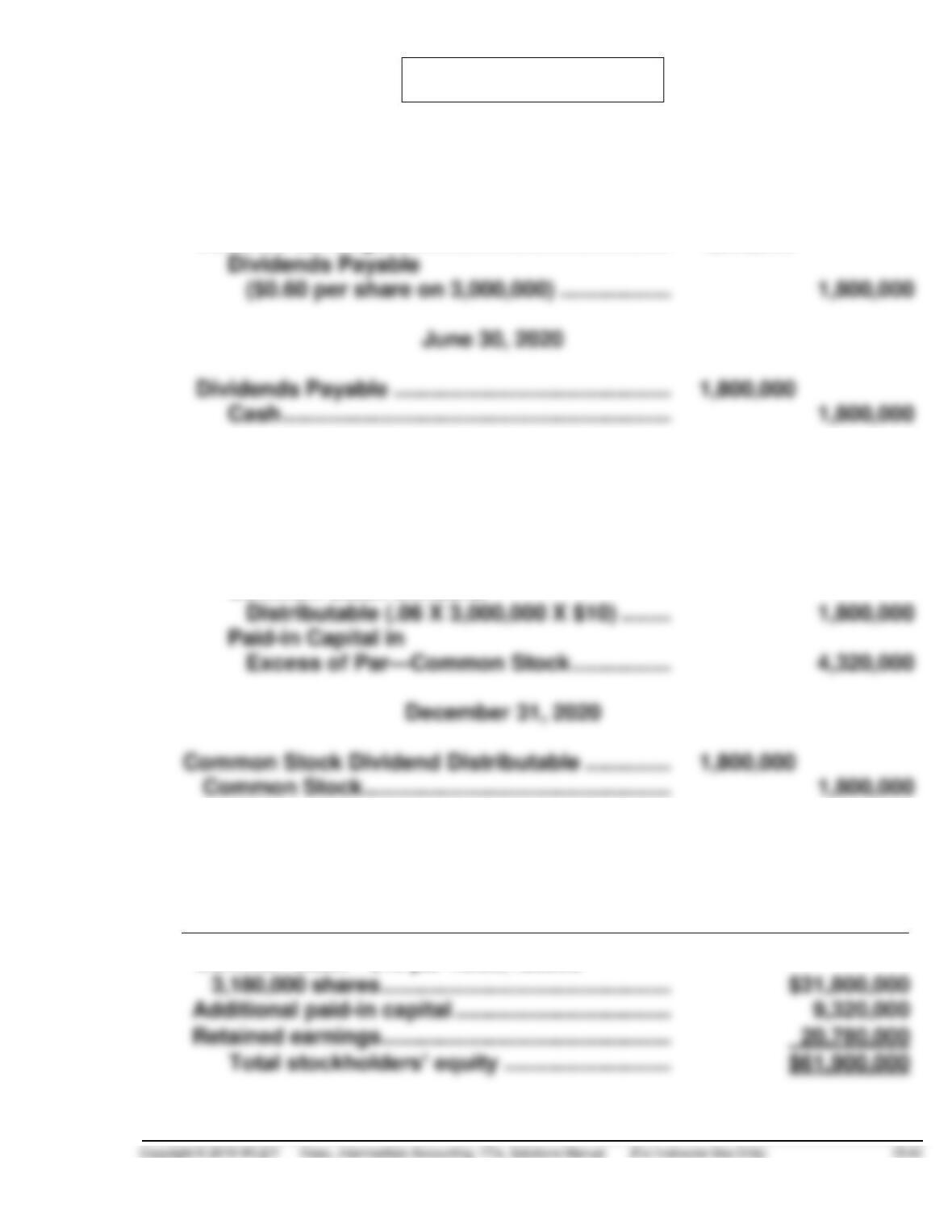
PROBLEM 15.11
(a)
May 5, 2020
Retained Earnings ………………………………………. 1,800,000
(b)
November 30, 2020
Retained Earnings (.06 X 3,000,000 X $34) ……. 6,120,000
Common Stock Dividend
(c)
EARNHART CORPORATION
Stockholders’ Equity
December 31, 2020
Common stock—$10 par value, issued
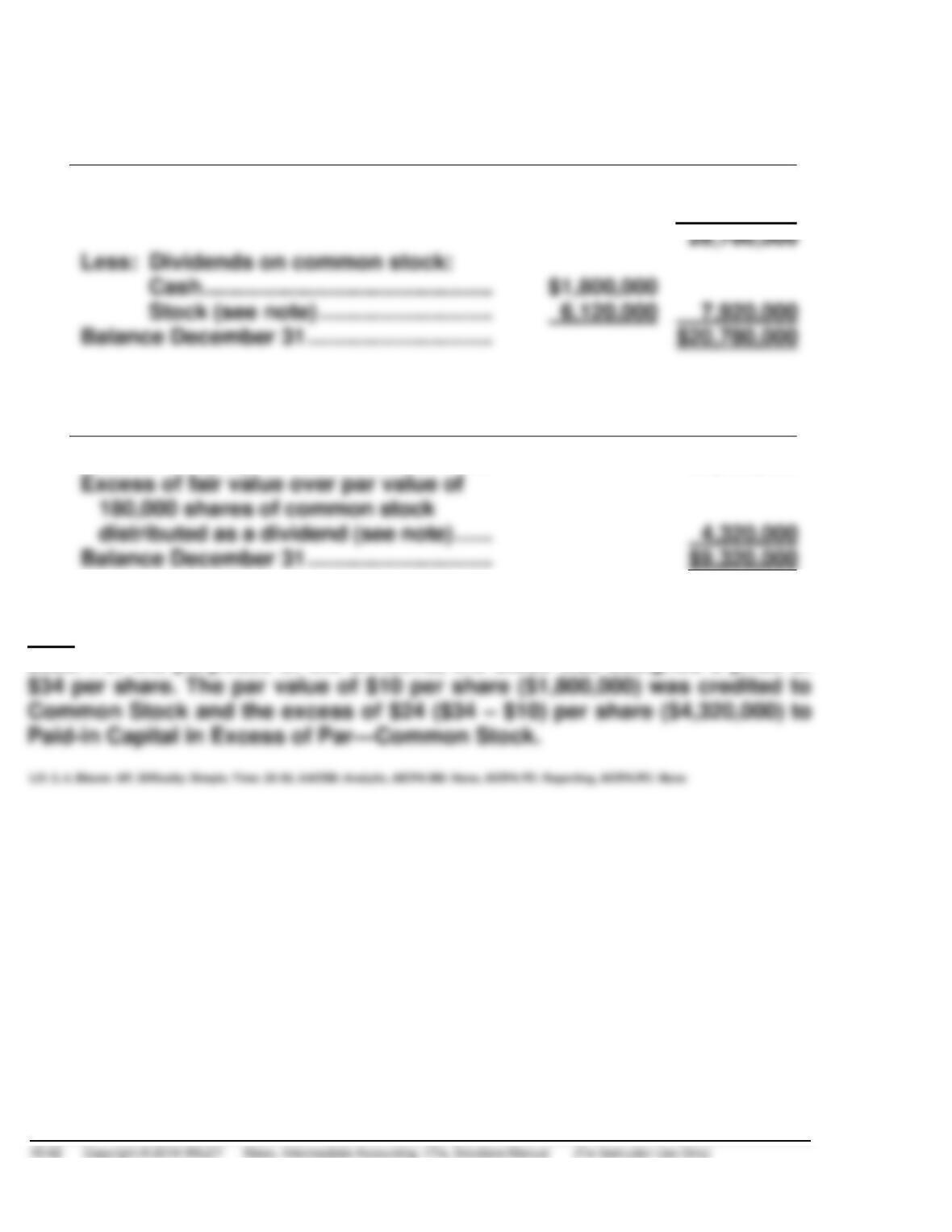
PROBLEM 15.11 (Continued)
Statement of Retained Earnings
For the Year Ended December 31, 2020
Balance, January 1 …………………………….
$24,000,000
Add: Net income ………………………………
4,700,000
28,700,000
Less: Dividends on common stock:
Cash ………………………………………..
Stock (see note) ……………………….
7,920,000
Schedule of Additional Paid-in Capital
For the Year Ended December 31, 2020
Balance January 1 ……………………………..
$5,000,000
distributed as a dividend (see note) ……
Note: The 6% stock dividend (180,000 shares) was declared on November 30,
2020. For the purposes of the dividend, the stock was assigned a price of
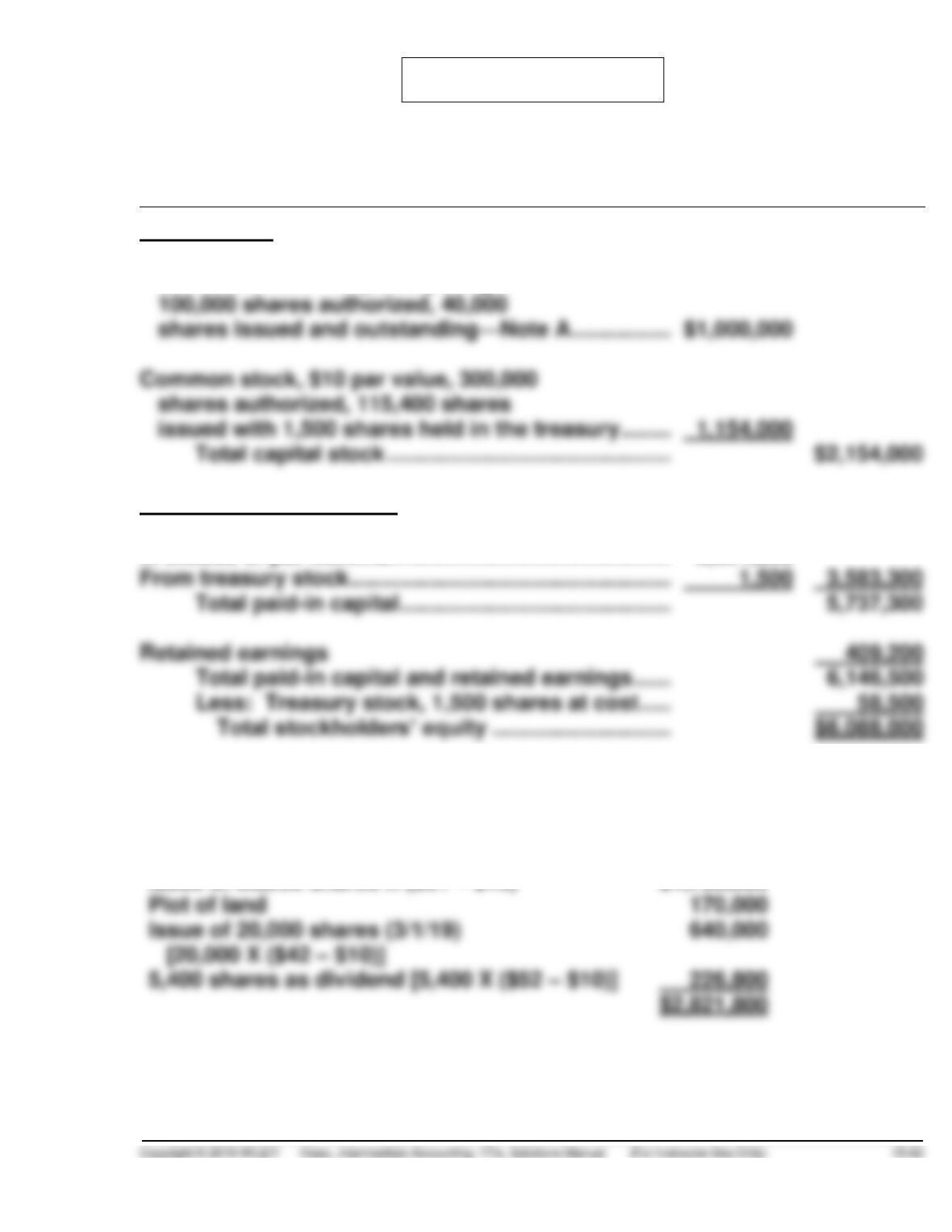
PROBLEM 15.12
PENN COMPANY
Stockholders’ Equity
June 30, 2021
Capital stock
8% preferred stock, $25 par value,
cumulative and nonparticipating,
100,000 shares authorized, 40,000
Common stock, $10 par value, 300,000
shares authorized, 115,400 shares
issued with 1,500 shares held in the treasury ……..
Total capital stock …………………………..…………..
Additional paid-in capital
In excess of par-preferred …………………………………….
760,000
In excess of par-common …………………………………….
2,821,800*
From treasury stock …………………………………………….
Total paid-in capital ……………………………………..
5,737,300
Note A: Penn Company is in arrears on the preferred stock in the amount
of $40,000.
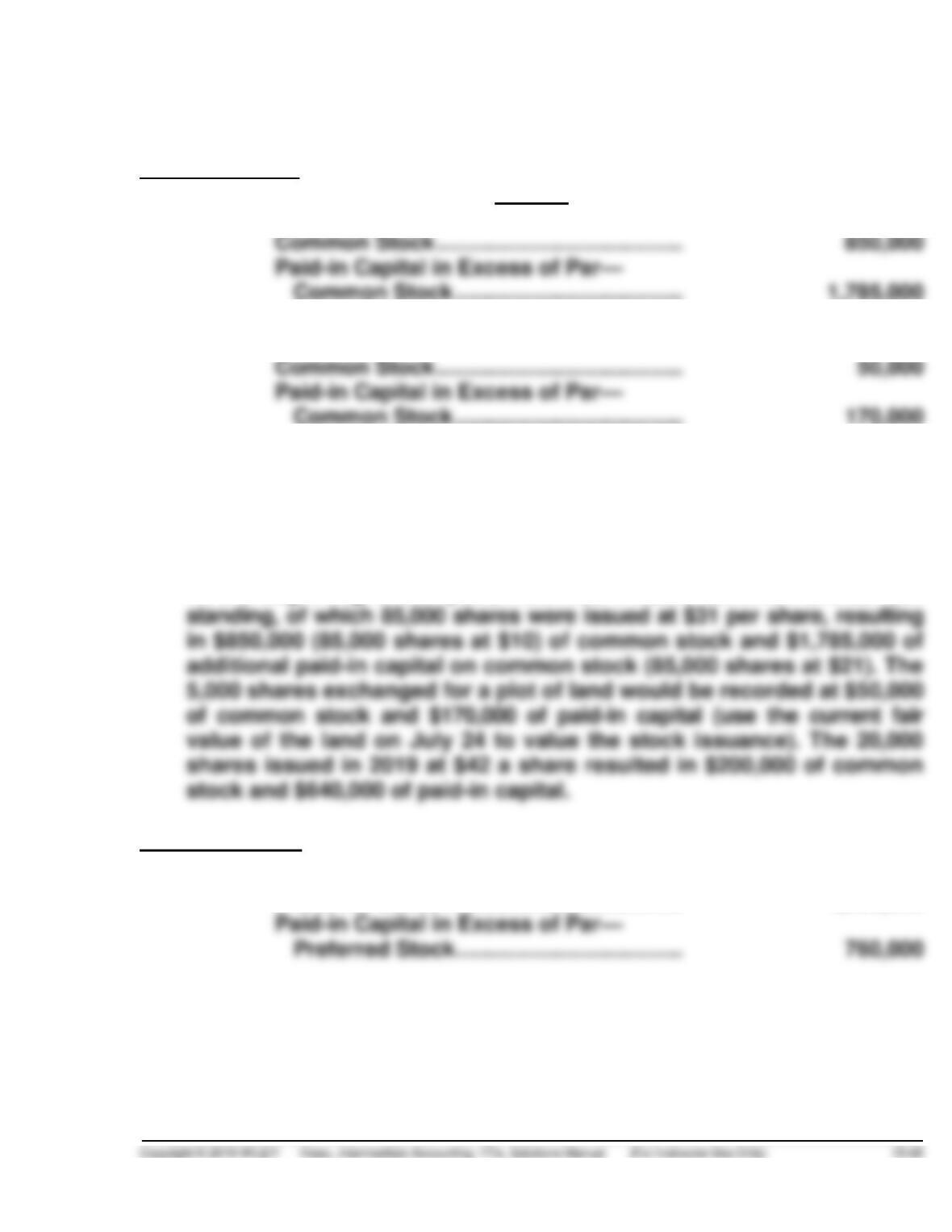
* Paid-In Capital in Excess of Par—Common Stock:
Issue of 85,000 shares X ($31 – $10)
$1,785,000
[20,000 X ($42 – $10)]
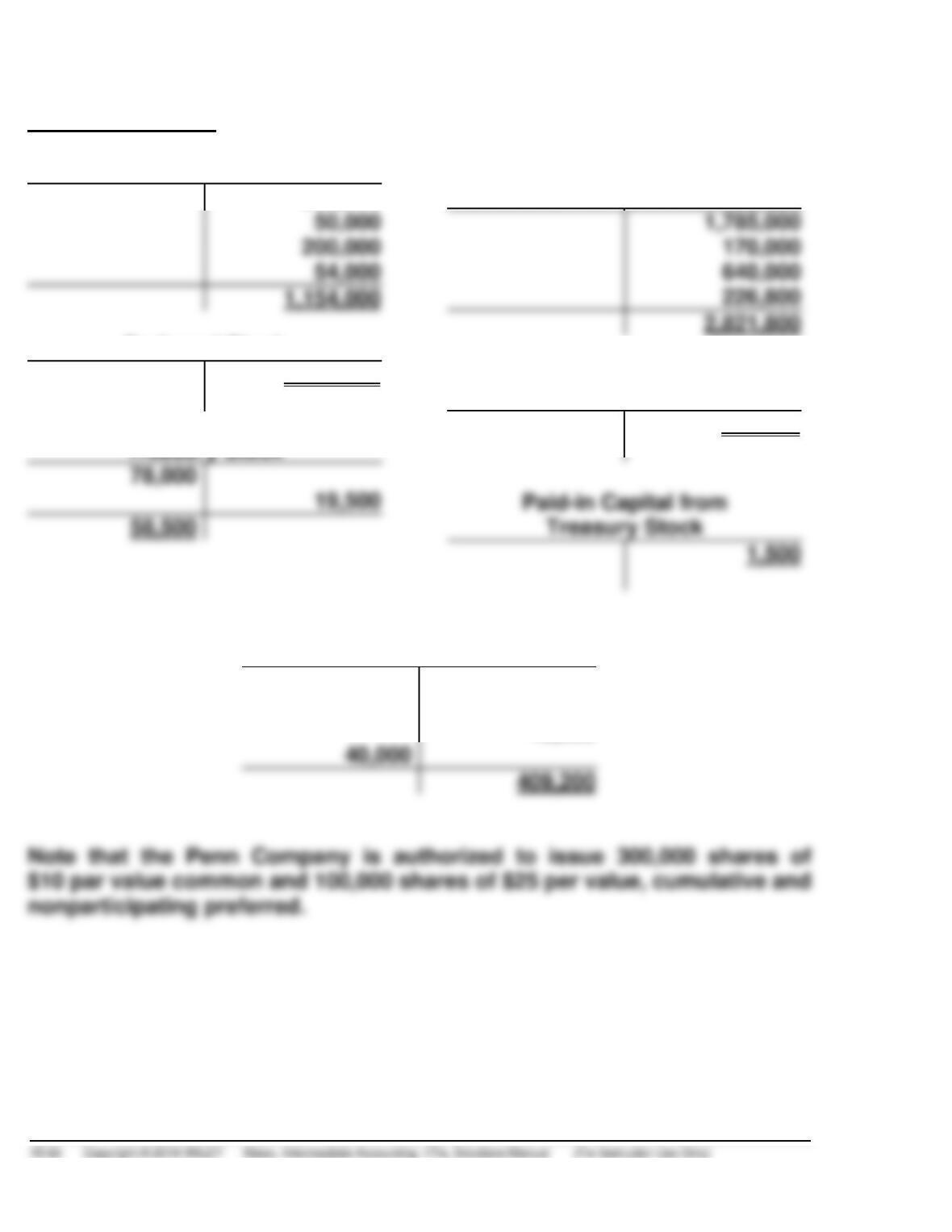
PROBLEM 15.12 (Continued)
Account Balances
Common Stock
850,000
50,000
200,000
54,000
1,154,000
1,785,000
170,000
640,000
226,800
2,821,800
Preferred Stock
1,000,000
Treasury Stock
58,500
Paid-in Capital in
Excess of Par—Common Stock
Paid-in Capital in
Excess of Par—Preferred Stock
760,000
Retained Earnings
690,000
280,800
40,000
40,000
409,200
PROBLEM 15.12 (Continued)
Entries supporting the balances.
Common Stock
Entries
1. Cash ……………………………………………………….. 2,635,000
2. Land ……………………………………………………….. 220,000
3. Cash ……………………………………………………….. 840,000
Common Stock …………………………………. 200,000
Paid-in Capital in Excess of Par—
Common Stock ………………………………. 640,000
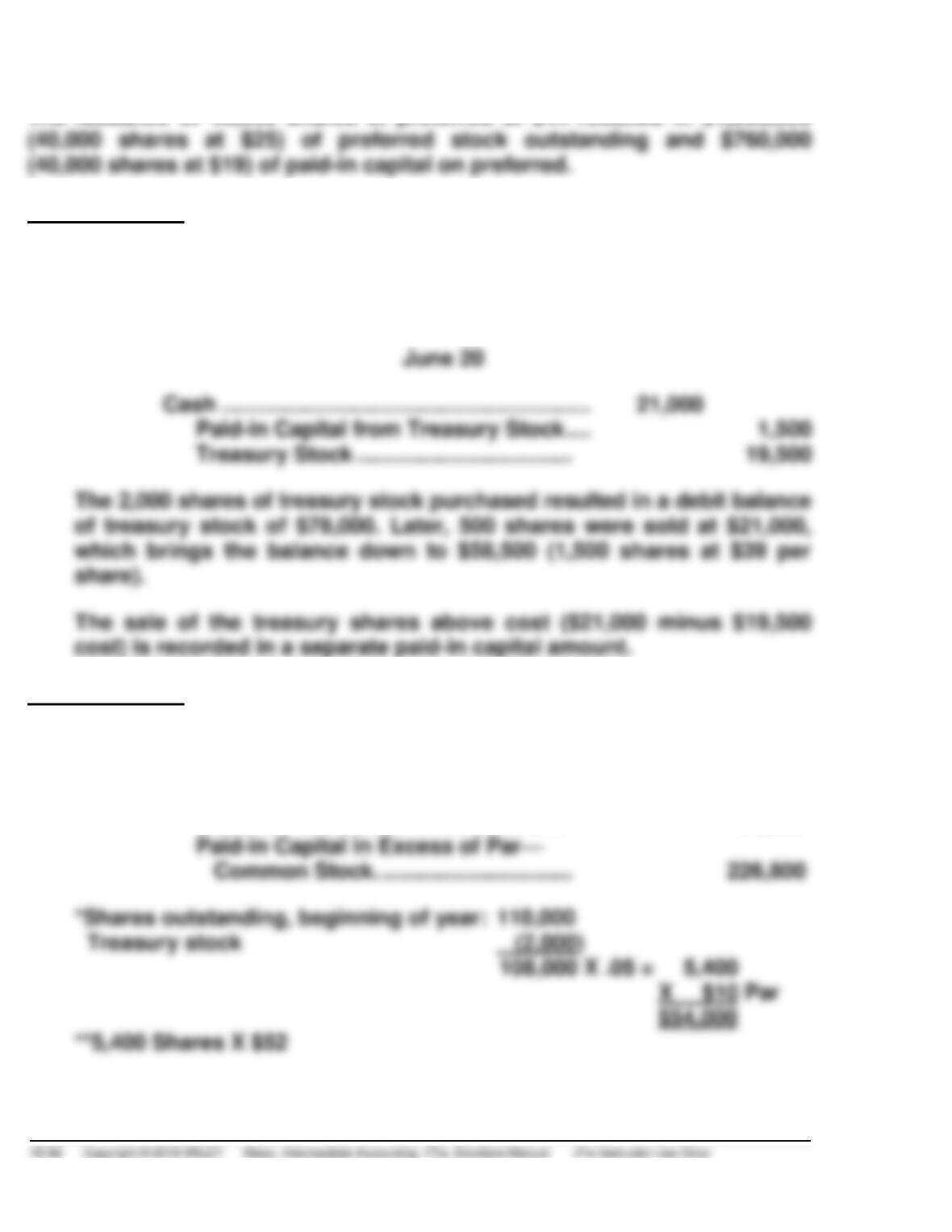
At the beginning of the year, Penn had 110,000 common shares out–
Preferred Stock
Cash ……………………………………………………….. 1,760,000
Preferred Stock ………………………………… 1,000,000
PROBLEM 15.12 (Continued)
The issuance of 40,000 shares of preferred at $44 resulted in $1,000,000
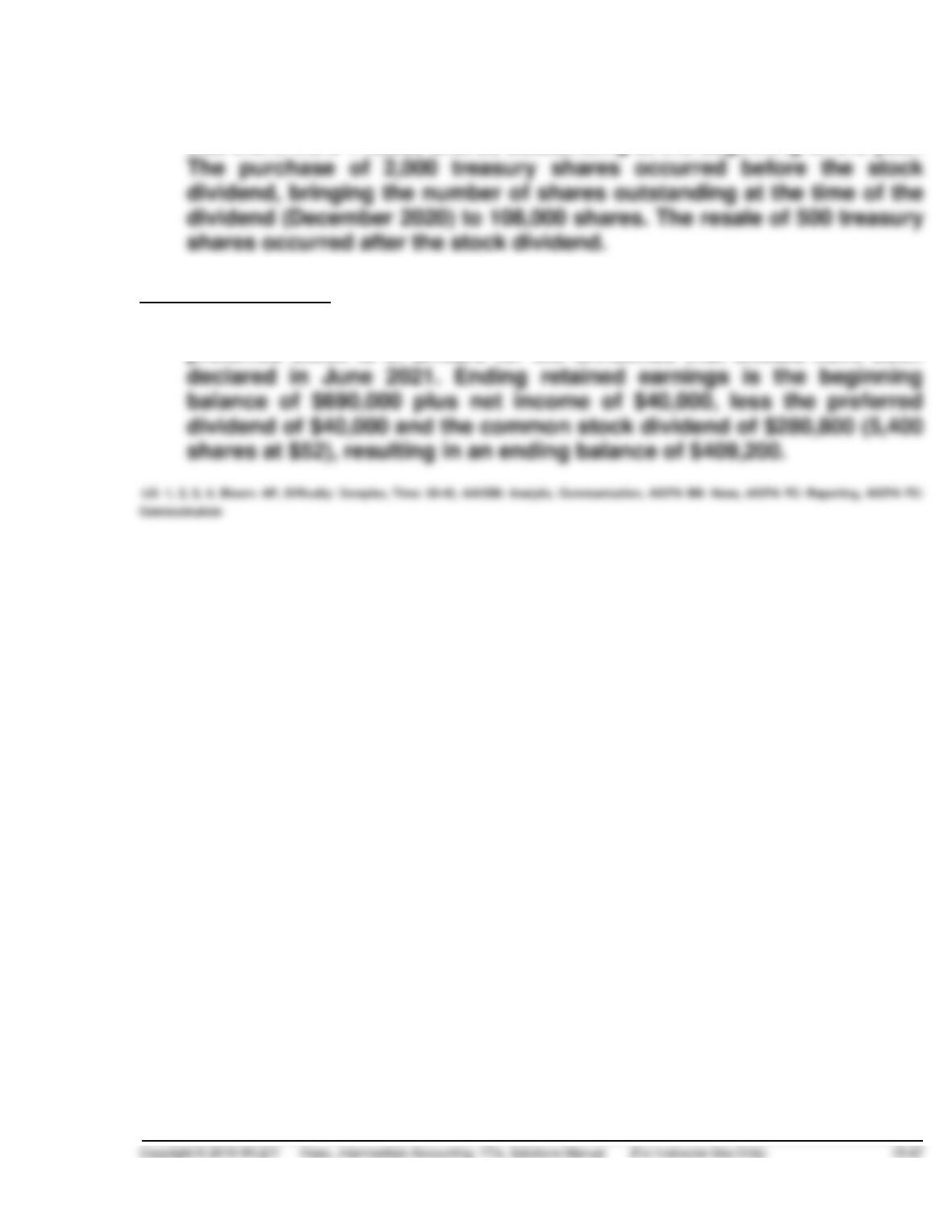
Treasury Stock
November 30
Treasury Stock ……………………………………. 78,000
Cash ………………………………………………. 78,000
Stock Dividend
December 15
Retained Earnings …………………………….. 280,800**
Common Stock …………………………….. 54,000*
PROBLEM 15.12 (Continued)
The 5% stock dividend resulted in an increase of 5,400 shares. Recall
that there were 110,000 shares outstanding at the beginning of the year.
Retained Earnings
The cash dividends only affect the retained earnings. Note that the
preferred stock is in arrears for the dividends that should have been
TIME AND PURPOSE OF CONCEPTS FOR ANALYSIS
CA 15.1 (Time 10–20 minutes)
Purpose—to provide the student with some familiarity with the applications of the capital stock share
CA 15.2 (Time 15–20 minutes)
Purpose—to provide the student with an opportunity to discuss the bases for recording the issuance of
CA 15.3 (Time 25–30 minutes)
Purpose—to provide a five-part theory case on equity based on Statement of Financial Accounting
CA 15.4 (Time 25–30 minutes)
Purpose—to provide the student with an understanding of the conceptual framework that underlies
CA 15.5 (Time 15–20 minutes)
Purpose—to provide the student with an understanding of the theoretical concepts and implications that
CA 15.6 (Time 20–25 minutes)
Purpose—to provide the student with a situation containing a cash dividend declaration, a stock dividend,
and a reacquisition and reissuance of shares requiring the student to explain the accounting treatment.
CA 15.7 (Time 10–15 minutes)
Purpose—to provide an opportunity for the student to consider and discuss the ethical issues involved
SOLUTIONS TO CONCEPTS FOR ANALYSIS
CA 15.1
(a) To share proportionately in any new issues of stock of the same class (the preemptive right).
(b) Derek Wallace bought an additional $100,000 par value stock. His original ownership was
$200,000 ($250,000 X .80). Thus, he increased his ownership by 100/200 (50%). This imbalance
(c) No information is given with respect to the fair value of the stock. In this situation, an estimate for
fair value could be developed based on market transactions involving comparable assets. Otherwise,
discounted expected cash flows could be used to approximate fair value. In this closely held
CA 15.2
(a) The general rule to be applied when stock is issued for services or property other than cash is
that the property or services be recorded at either their fair value or the fair value of the stock
issued, whichever is more clearly determinable.
CA 15.3
(a) Equity, or net assets, is the owners’ residual interest in the assets of an entity that remains after
deducting liabilities; in other words, equity equals assets less liabilities. Assets are probable future
(c) Investments by owners are increases in net assets resulting from transfers by other entities of
something of value to obtain ownership. Examples of investments by owners are issuance of
preferred or common stock, conversion of convertible bonds, reissuance of treasury stock, assess–
ments on stock, and issuance of stock warrants. Generally, investments by owners cause an
CA 15.4
(a) A stock dividend is the issuance by a corporation of its own stock to its stockholders on a prorata
(1) From a legal standpoint, a stock split is distinguished from a stock dividend in that a split
results in an increase in the number of shares outstanding and a corresponding decrease in
(2) From an accounting standpoint, the major distinction is that a stock dividend requires a
journal entry to decrease retained earnings and increase paid-in capital, while there is no
entry for a stock split. In addition, from the accounting standpoint the distinction between a
CA 15.4 (Continued)
(b) The usual reason for issuing a stock dividend is to give the stockholders something on a dividend
date and yet conserve working capital.
A stock dividend that is charged to retained earnings reduces the total accumulated earnings,
and all stock dividends reduce the per share earnings. Issuing a stock dividend to achieve these
(c) The amount of retained earnings to be capitalized in connection with a stock dividend (in the
accounting sense) might be (1) the legal minimum (usually par or stated value), (2) the average
paid-in capital per outstanding share, or (3) the fair value of the shares.
The third basis is generally recommended because recipients tend to regard the market value of
the stock received as a dividend as the amount of earnings distributed to them. If the corporation
CA 15.5
(a) The case against treating an ordinary stock dividend as income is supported by a majority of
accounting authorities. It is based upon “entity” and “proprietary” interpretations.
If the corporation is considered an entity separate from stockholders, the income of the
corporation is corporate income and not income to stockholders, although the equity of the
CA 15.5 (Continued)
(b) The case against issuing stock dividends on treasury stock rests principally upon the argument
that stock reacquired by the corporation is a “reduction of capital” through the payment of cash to
CA 15.6
(a) Mask Company should account for the purchase of the treasury stock on August 15, 2020, by
debiting Treasury Stock and crediting Cash for the cost of the purchase, $18,000 (1,000 shares X
$18 per share). Mask should account for the sale of the treasury stock on September 14, 2020,
(b) Mask should account for the stock dividend by debiting Retained Earnings for $21 per share (the
market price of the stock in October 2020, the date of the stock dividend) multiplied by the
1,950 shares distributed. Mask should then credit Common Stock for the par value of the common
stock ($10 per share) multiplied by the 1,950 shares distributed, and credit Paid–In Capital in
CA 15.7
(a) The stakeholders are the dissident stockholders, the other stockholders, potential investors,
creditors, and Kenseth.
FINANCIAL REPORTING PROBLEM
(a) P&G’s preferred stock has a stated value of $1 per share.
(d) At June 30, 2017 and June 30, 2016, P&G had 2,553.3 (4,009.2 –
1,455.9) million and 2,668.0 (4,009.2 – 1,341.2) million shares of
common stock outstanding, respectively.
2017: $7,242 / ($15,326 – $247) = 48.0%
2016: $7,181 / ($10,508 – $255) = 70.0%
(h) Price range for the quarter ended June 30, 2017:
COMPARATIVE ANALYSIS CASE
(a) Par value:
Coca-Cola, $0.25 per share.
PepsiCo, $0.012/3 per share.
(d) Common or capital stock shares outstanding, year-end 2017:
Coca-Cola, 7,040,000,000 – 2,781,000,000 = 4,259,000,000.
PepsiCo, 1,866,000,000 – 446,000,000 = 1,420,000,000.
(f) Return on common stockholders’ equity.
2017: