Wild and Shaw, Financial and Managerial Accounting 9e Solutions Manual: Chapter 14
922
Problem 14-4B (40 minutes)
Part 1
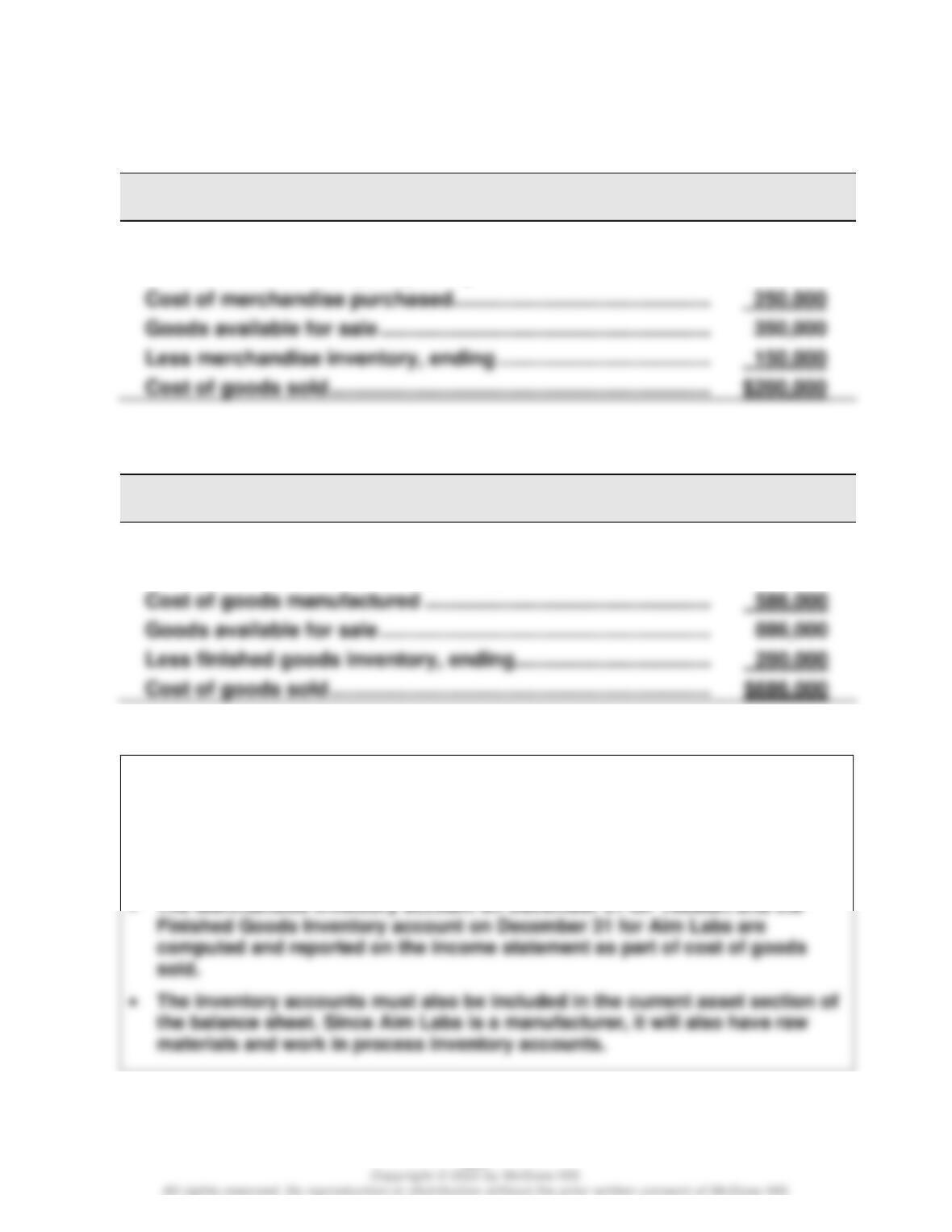
MERCHANDISING BUSINESS
TEEMART RETAILING
Cost of Goods Sold for the Year
Cost of goods sold
Merchandise inventory, beginning ……………………………………
$100,000
Cost of merchandise purchased……………………………………….
Goods available for sale …………………………………………………..
Less merchandise inventory, ending ………………………………..
Cost of goods sold …………………………………………………………..
MANUFACTURING BUSINESS
AIM LABS MANUFACTURING
Cost of Goods Sold for the Year
Cost of goods sold
Finished goods inventory, beginning ……………………………….
$300,000
Cost of goods manufactured ……………………………………………
Goods available for sale …………………………………………………..
Less finished goods inventory, ending……………………………..
Part 2
MEMORANDUM
TO:
FROM:
DATE:
SUBJECT:
Answers will vary slightly but should include:
Wild and Shaw, Financial and Managerial Accounting 9e Solutions Manual: Chapter 14
923
Problem 14-5B (30 minutes)
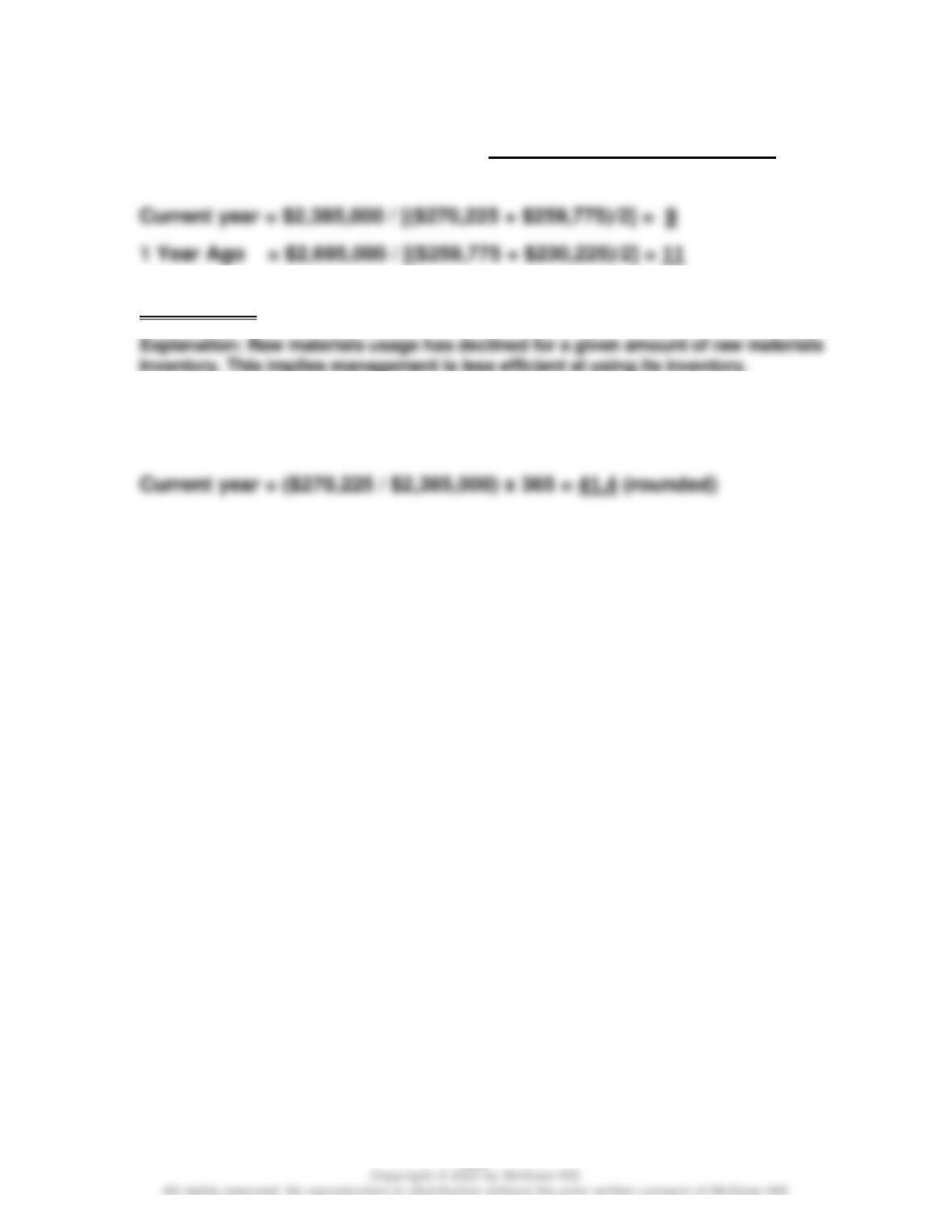
1. Raw materials inventory turnover = Raw materials used
Average raw materials inventory
2. Unfavorable
3. Days’ sales in raw materials inventory =
(Ending raw materials inventory/Raw materials used) x 365
Wild and Shaw, Financial and Managerial Accounting 9e Solutions Manual: Chapter 14
SERIAL PROBLEM — SP 14
Serial Problem, Business Solutions (30 minutes)
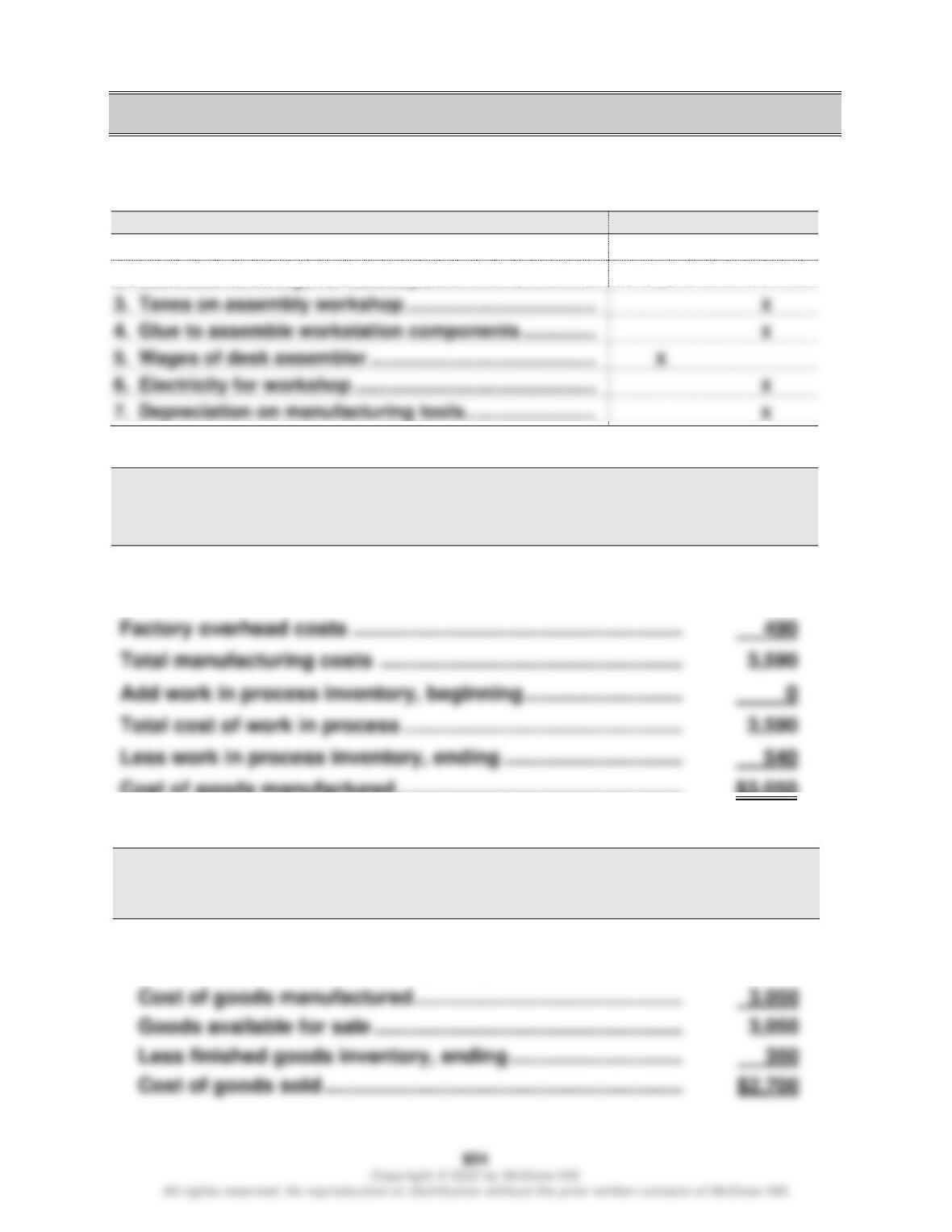
1.
Product Costs
Direct
Indirect
1. Monthly fee to clean workshop ……………………………..
X
2. Laminate coverings for desktops ………………………….
X
3. Taxes on assembly workshop ………………………………
X
4. Glue to assemble workstation components …………..
X
5. Wages of desk assembler …………………………………….
X
6. Electricity for workshop ……………………………………….
X
2.
Business Solutions
Schedule of Cost of Goods Manufactured
For Month Ended January 31, 2022
Direct materials ……………………………………………………………….
$2,200
Direct labor …………………………………………………………………….
900
Add work in process inventory, beginning ……………………….
Total cost of work in process …………………………………………..
Cost of goods manufactured ……………………………………………
$3,050
3.
Business Solutions
Partial Income Statement
For Month Ended January 31, 2022
Cost of goods sold
Finished goods inventory, beginning …………………………….
$ 0
Cost of goods manufactured …………………………………………
Goods available for sale ……………………………………………….
Less finished goods inventory, ending ………………………….
Wild and Shaw, Financial and Managerial Accounting 9e Solutions Manual: Chapter 14
Company Analysis — AA 14-1
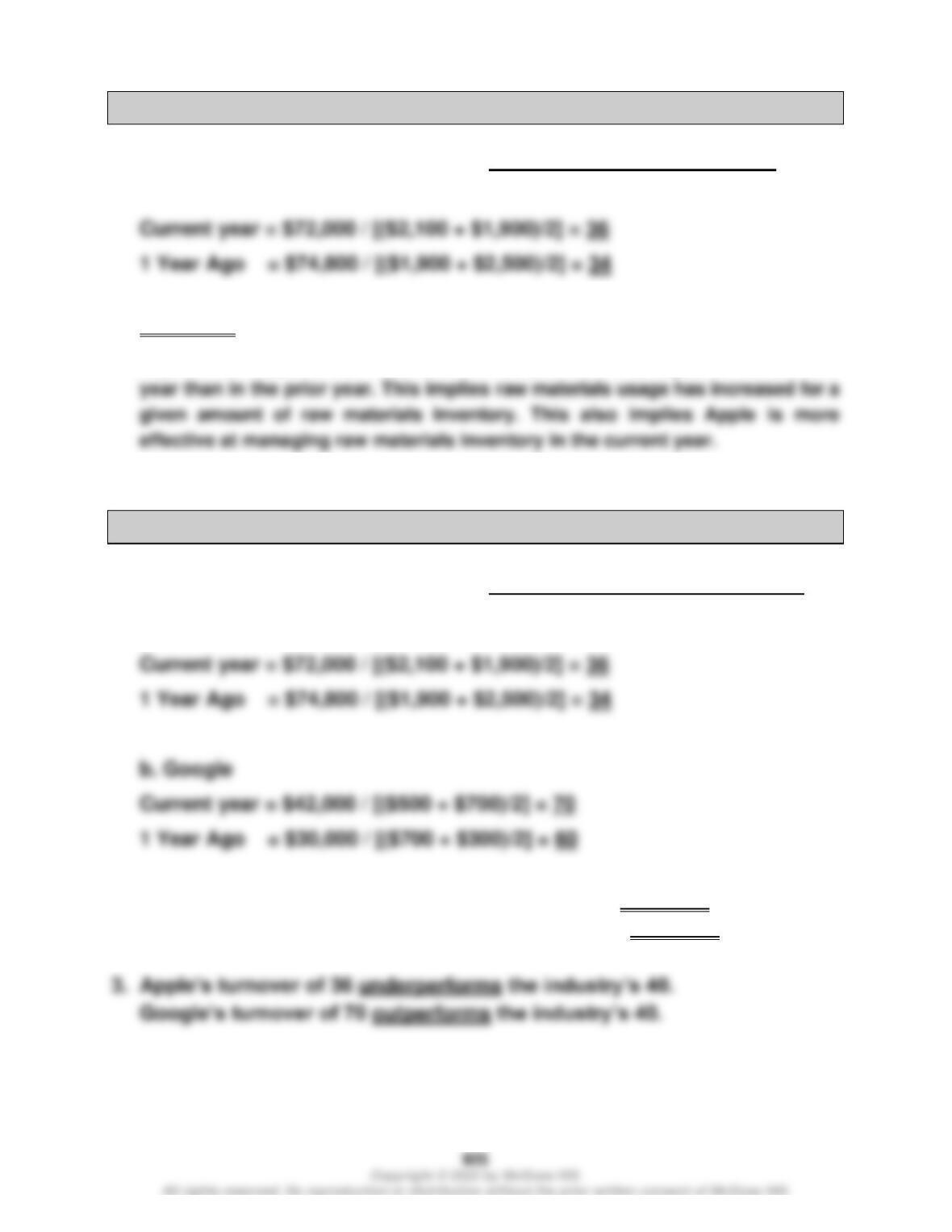
1. Raw materials inventory turnover = Raw materials used
Average raw materials inventory
2. Favorable
Explanation: Apple’s raw materials inventory turnover is higher in the current
Comparative Analysis — AA 14-2
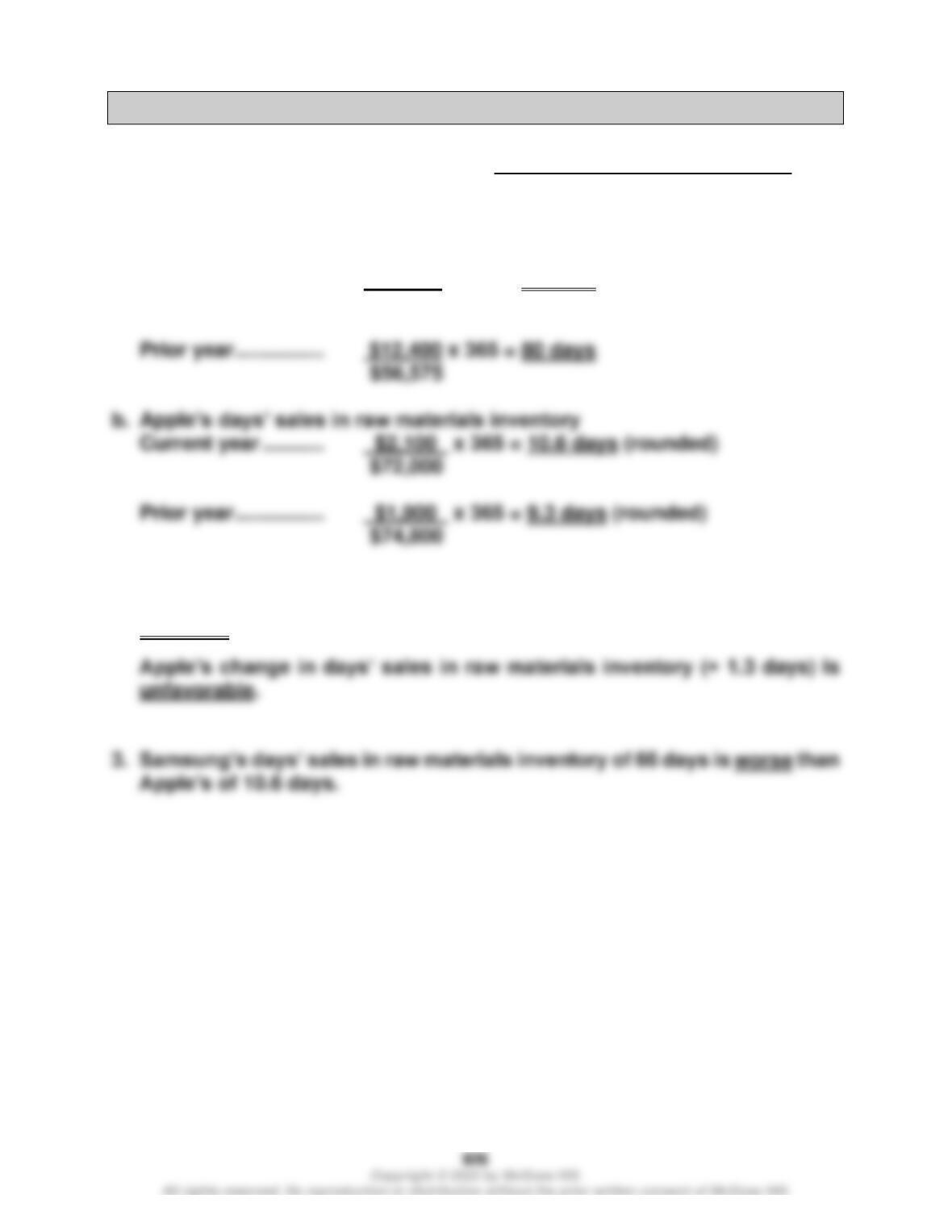
1. Raw materials inventory turnover = Raw materials used
Average raw materials inventory
a. Apple
2. Apple’s change in raw materials inventory (+ 2) is favorable.
Google’s change in raw materials turnover (+10) is favorable.
Wild and Shaw, Financial and Managerial Accounting 9e Solutions Manual: Chapter 14
Extended Analysis — AA 14-3
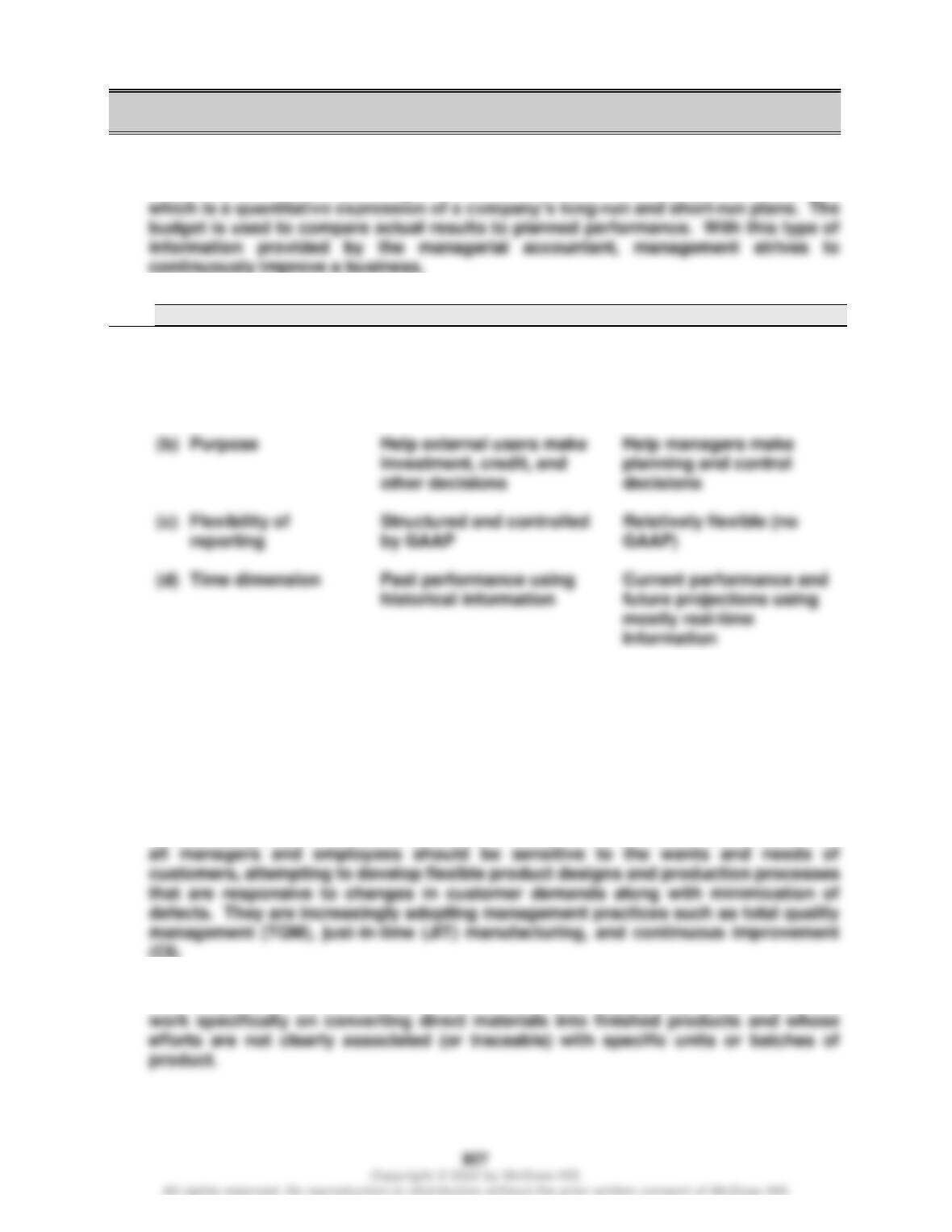
Days’ sales in raw materials inventory = Ending raw materials inventory x 365
Raw materials used
1.
a. Samsung’s days’ sales in raw materials inventory
Current year ……….. $11,500 x 365 = 66 days
$63,598
2. Samsung’s change in days’ sales in raw materials inventory (– 14 days) is
favorable.
Wild and Shaw, Financial and Managerial Accounting 9e Solutions Manual: Chapter 14
DISCUSSION QUESTIONS
1. The managerial accountant plays an important role in preparing the information
necessary for effective planning and control decisions. One example is the budget,
2.
Financial Accounting
Managerial Accounting
(a) Users
External users: Investors,
creditors, and others
outside of the company’s
managers
Internal users: Managerial
and executive employees
inside the organization
investment, credit, and
other decisions
planning and control
decisions
(c) Flexibility of
Structured and controlled
by GAAP
Relatively flexible (no
GAAP)
(e) Focus
The whole company
A company’s projects,
processes, and divisions
(f) Nature
Monetary information
Mostly monetary; some
nonmonetary
3. A customer orientation has led companies to adopt the principles of the lean business
model in response to consumer demands. The essence of customer orientation is that
4. Direct labor refers to the efforts of employees who physically convert materials to
finished product. Indirect labor refers to the efforts of factory employees who do not
Wild and Shaw, Financial and Managerial Accounting 9e Solutions Manual: Chapter 14
928
5. Factory overhead is limited to indirect costs that are incurred in the production
process. That is, it consists of activities that support the production process, such
6. Direct materials are raw materials that physically become part of the product and can
be clearly traced to specific units or batches of product. Indirect materials are used
7. Direct labor is both a prime cost and a conversion cost.
8. Direct costs of iPhones include: costs of materials such as smartphone cameras,
memory chips, screens, and processors, as well as the labor of workers who
9. Nonmanufacturing costs include selling expenses and general and administrative
expenses. Examples of selling expenses include advertising costs, delivery costs,
10. The production manager should likely not be evaluated on the basis of general and
administrative expenses. General and administrative expenses are not under the
influence of production managers, and they should not be held accountable for them.
11. Product costs are capitalized because they represent a future value (an asset) to the
12. A manufacturing business produces a product, whereas in a merchandising or service
business this is not the case. In making a product, the manufacturing business must
13. To run a successful business, management must make predictions and estimates
about what will occur in the future. Thus, managerial accountants must project how
the numbers will look under different possibilities.
Wild and Shaw, Financial and Managerial Accounting 9e Solutions Manual: Chapter 14
929
14. A manufacturing firm converts raw materials into finished products. A manufacturing
company would report three types of inventories on its balance sheet: raw materials,
work in process, and finished goods. The finished goods are included on the income
15. Manufacturers’ balance sheets usually include small tools, factory buildings, factory
16. Manufacturing firms have inventories at various stages of completion. Manufacturing
a product requires raw materials, which are converted to finished goods.
17. The goals of the lean business model are to eliminate waste, satisfy customers, and
provide a positive return to the company.
18. The three categories of manufacturing costs are: direct materials, direct labor, and
factory overhead.
19. Examples of factory overhead costs include: indirect materials, indirect labor,
depreciation of the factory equipment and plant, amortization of patents, the cost of
20.
Components of Schedule of COGM
Apple Examples
Direct material ……………………………………………..
Processors, chips, covers
Direct labor ………………………………………………….
Wages of production employees
Factory overhead …………………………………………
Factory heat, factory lighting
21.
Google
Schedule of Cost of Goods Manufactured
For Year Ended December 31
The date matches the period of the income statement. The “schedule of cost of goods
Wild and Shaw, Financial and Managerial Accounting 9e Solutions Manual: Chapter 14
22. The bottom line of the schedule of cost of goods manufactured is the cost of goods
23. Raw materials inventory turnover and days’ sales in raw materials inventory can be
used to assess raw materials inventory management. Raw materials inventory
24. The triple bottom line reports on an organization’s financial, social, and environmental
performance.
25. The four overarching principles are: Honesty, Fairness, Objectivity, and
Responsibility. The IMA suggests first trying to resolve ethical conflicts by applying
the established policies of your organization. If this is unsuccessful, contact your
Wild and Shaw, Financial and Managerial Accounting 9e Solutions Manual: Chapter 14
931
Ethics Challenge — BTN 14-1
1. The purchase of raw materials should be recorded in Raw Materials
2. The challenge is how to handle a request to use one’s accounting skills
in an inappropriate manner. It is important to remember that the behavior
of the managerial accountant is governed by ethical rules. This means
Communicating in Practice — BTN 14-2
Instructor note: The solution to this project depends on the database and career fields reviewed.
The objective of this Communicating in Practice project is to make students
aware of the earnings potential of different professions—particularly, the
Wild and Shaw, Financial and Managerial Accounting 9e Solutions Manual: Chapter 14
932
Teamwork in Action — BTN 14–3
Part 1
a. Materials used
= Beg. Materials
+ Materials purchased
– End. materials
= $177,500
+ $872,500
– $168,125
= $881,875
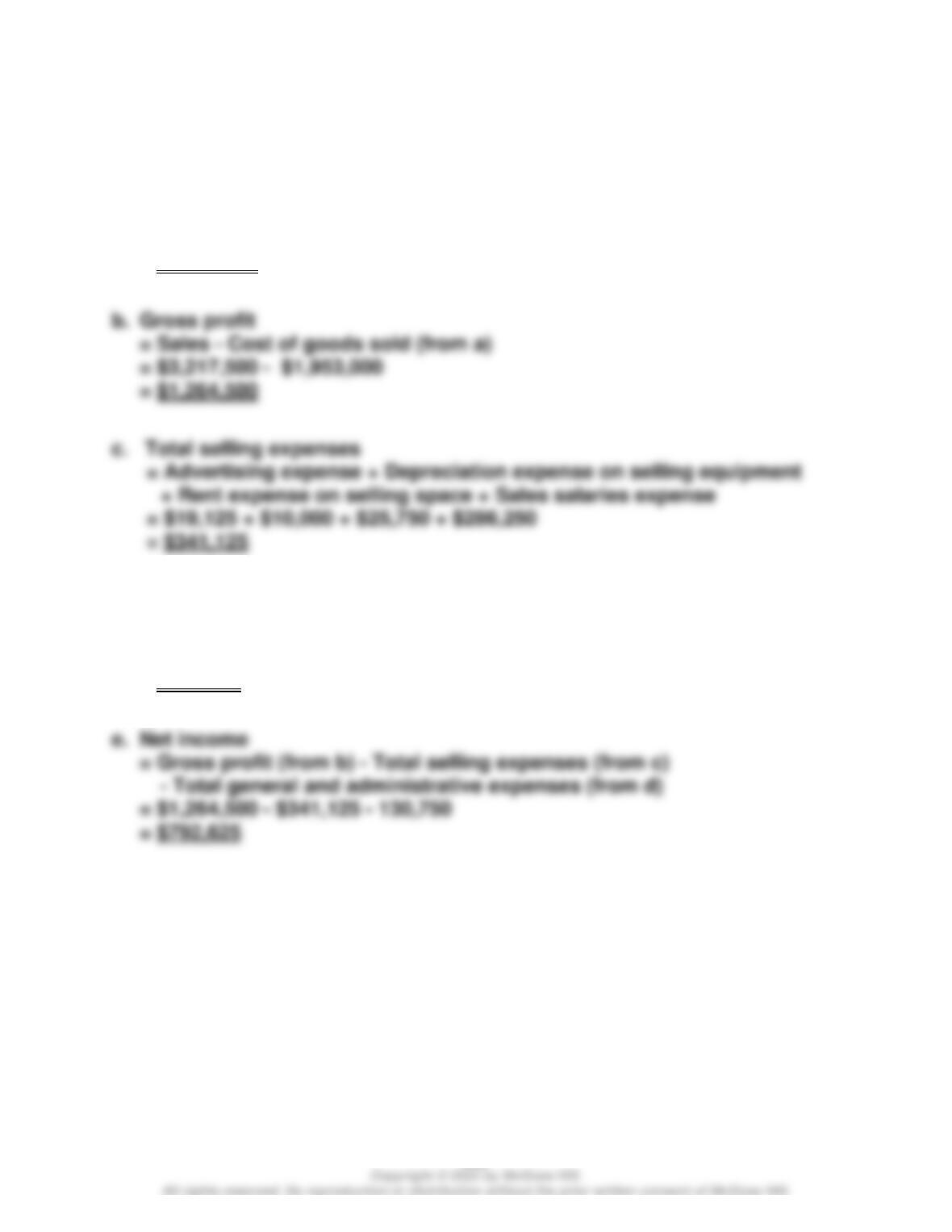
b. Factory overhead
d. Total cost of work in process
= Beg. WIP Inv. + Total manufacturing costs (from c)
= $15,875 + $1,915,750
= $1,931,625
Part 2
Requires that the team check answer to part (1e) with instructor before
proceeding to part (3).
Wild and Shaw, Financial and Managerial Accounting 9e Solutions Manual: Chapter 14
933
Teamwork in Action (Continued)
Part 3
a. Cost of goods sold
= Beg. finished goods + Cost of goods manuf. (from 1e) – End. finished goods
= $164,375 + $1,917,625 – $129,000
= $1,953,000
d. Total general and administrative expenses
= Depreciation expense on office equipment + Office salaries expense
+ Rent expense on office space
= $8,750 + $100,875 + $21,125
= $130,750
Wild and Shaw, Financial and Managerial Accounting 9e Solutions Manual: Chapter 14
934
Entrepreneurial Decision — BTN 14-4
1. A merchandiser computes cost of goods sold as:
Beginning merchandise inventory + Purchases – Ending merchandise
inventory
Teanna must monitor and control her cost of merchandise purchases,
2. Four goals of a total quality management (TQM) process are reduced
waste, better inventory control, fewer defects, and continuous
improvement.
Sweet Tea Cosmetics can use TQM to ensure its key raw materials are of