FINANCIAL REPORTING PROBLEM (Continued)
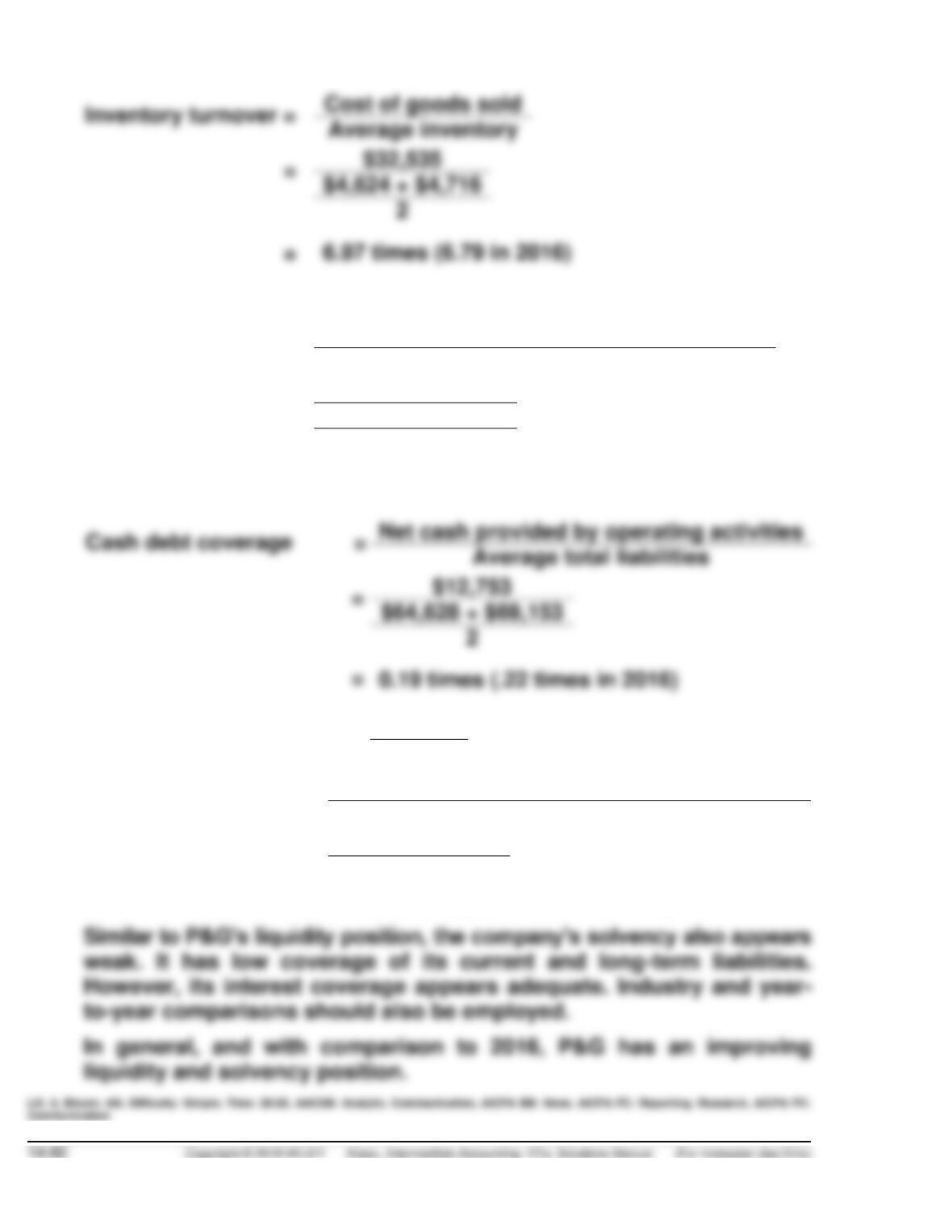
$4,624 + $4,716
=
Current cash debt
coverage =
Net cash provided by operating activities
Average current liabilities
=
$12,753
$30,210 + $30,770
2
=
0.42 times (0.48 in 2016)
$12,753
$64,628 + $69,153
Debt to assets ratio =
$64,628
= 0.54 (.54 in 2016)
$120,406
Time interest earned =
Income before income taxes and interest expense
Interest expense
=
$13,257 + $465
$465
=
29.51 times (22.36 times in 2016)
COMPARATIVE ANALYSIS CASE
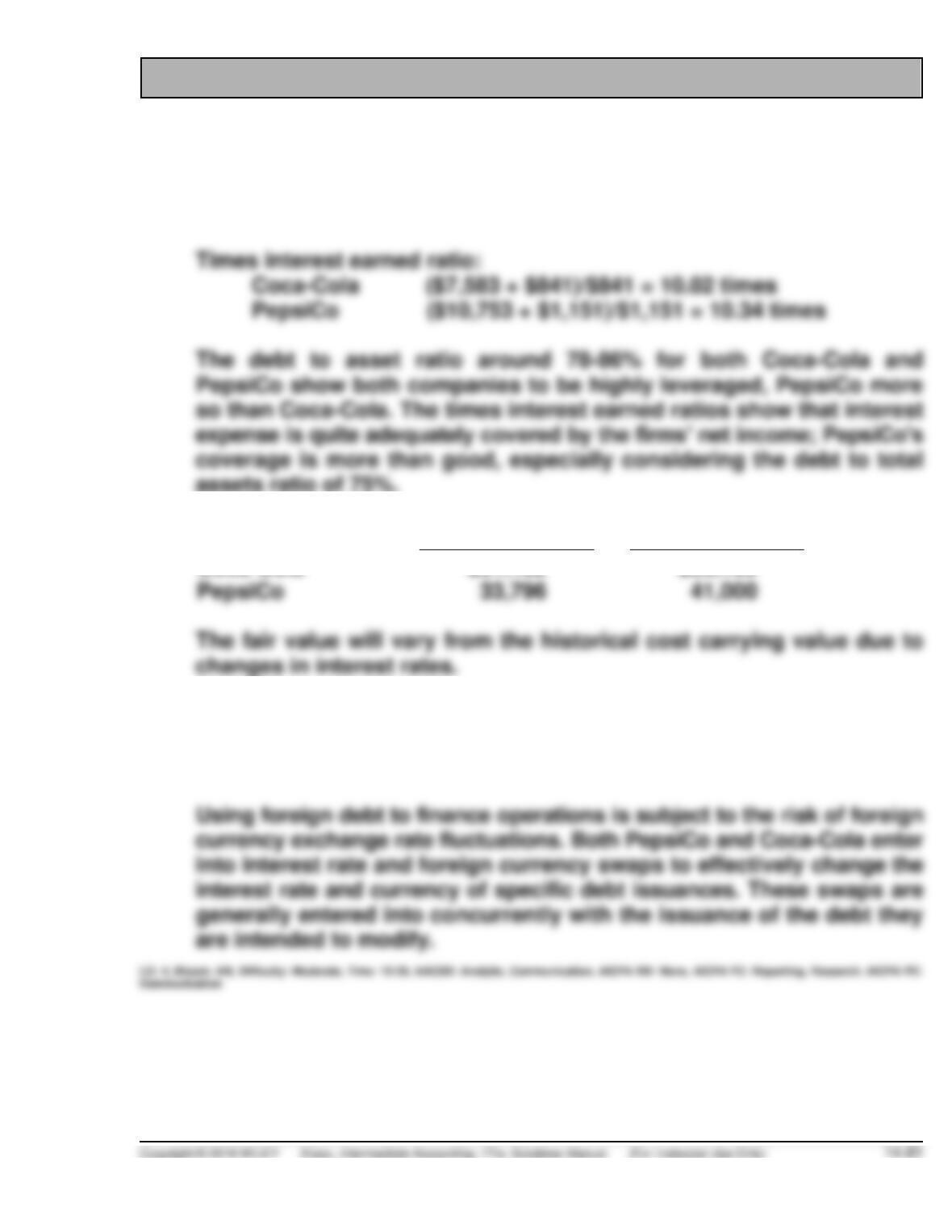
(a) Debt to asset ratio:
Coca-Cola $68,919/$87,896 = 78.4%
PepsiCo $68,823/$79,804 = 86.2%
assets ratio of 75%.
(b)
Carrying Value
Fair Value
Coca-Cola
$31,182
$35,169
(c) 1. Lower interest rates may be available in foreign countries.
2. Credit may be more readily available in foreign countries.
FINANCIAL STATEMENT ANALYSIS CASE
COMMONWEALTH EDISON CO.
(a) Due to the markdown from 99.803 to 99.25, Commonwealth Edison
(b) In the same Wall Street Journal article, the following explanation was
provided for Commonwealth Edison’s bond markdown and slow sale:
“Commonwealth had the misfortune to begin its giant
Other economic events that can and do affect the price of securities
issued are:
1. A change in the Federal Reserve’s lending rate.
2. A change in the bank prime rate.
FINANCIAL STATEMENT ANALYSIS CASE (Continued)
Of course, noneconomic, political, or other world events can also affect
the day-to-day sale of securities.
The “recent rebound in industrial productivity” mentioned in the article
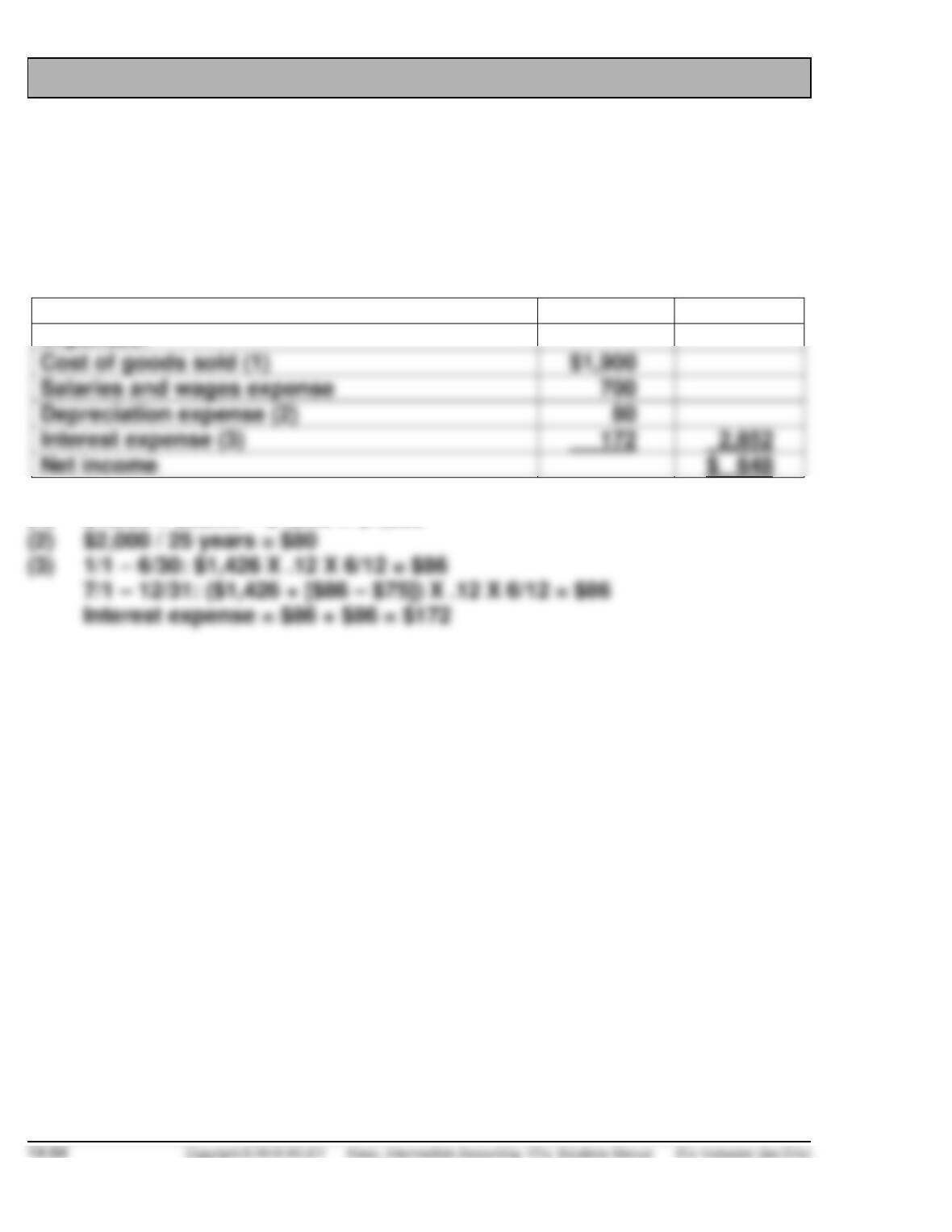
ACCOUNTING, ANALYSIS, AND PRINCIPLES
Accounting
BUGANT, INC.
Income Statement
For the year Ended December 31, 2021
Sales revenue
$3,500
Expenses:
Cost of goods sold (1)
$1,900
Salaries and wages expense
Depreciation expense (2)
Interest expense (3)
Net income
$ 648
(1) $1,800 + $2,000 – $1,900 = $1,900
ACCOUNTING, ANALYSIS, AND PRINCIPLES (Continued)
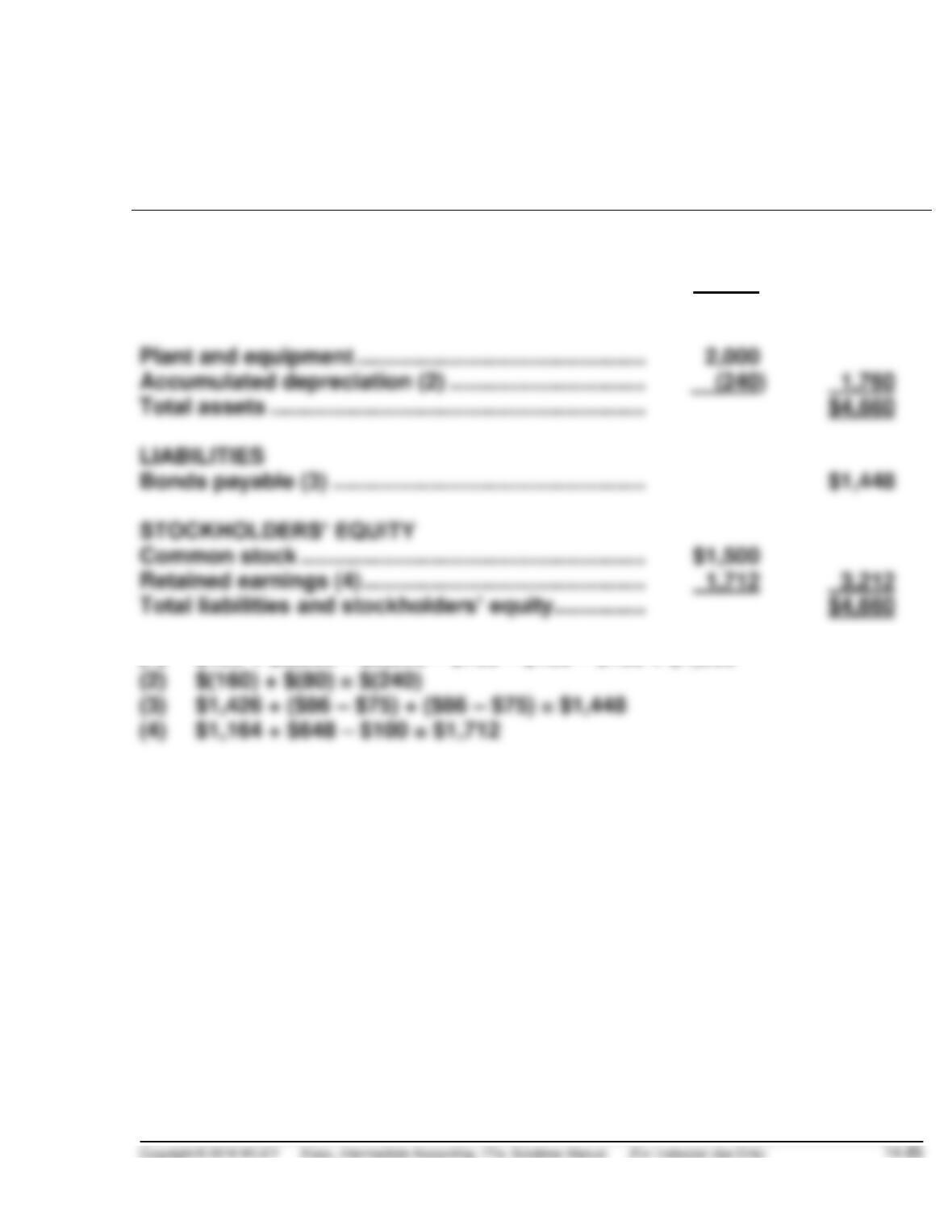
BUGANT, INC.
Balance Sheet
December 31, 2021
ASSETS
Cash (1) …………………………………………………………..
$1,000
Inventory …………………………………………………………
1,900
Total current assets …………………………………………
$2,900
Plant and equipment ………………………………………..
Accumulated depreciation (2) …………………………..
Total assets …………………………………………………….
$4,660
LIABILITIES
Bonds payable (3) ……………………………………………
$1,448
Common stock ………………………………………………..
$1,500
Retained earnings (4) ……………………………………….
1,712
3,212
$4,660
(1) $450 + $3,500 – $2,000 – $700 – $100 – $150 = $1,000
ACCOUNTING, ANALYSIS, AND PRINCIPLES (Continued)
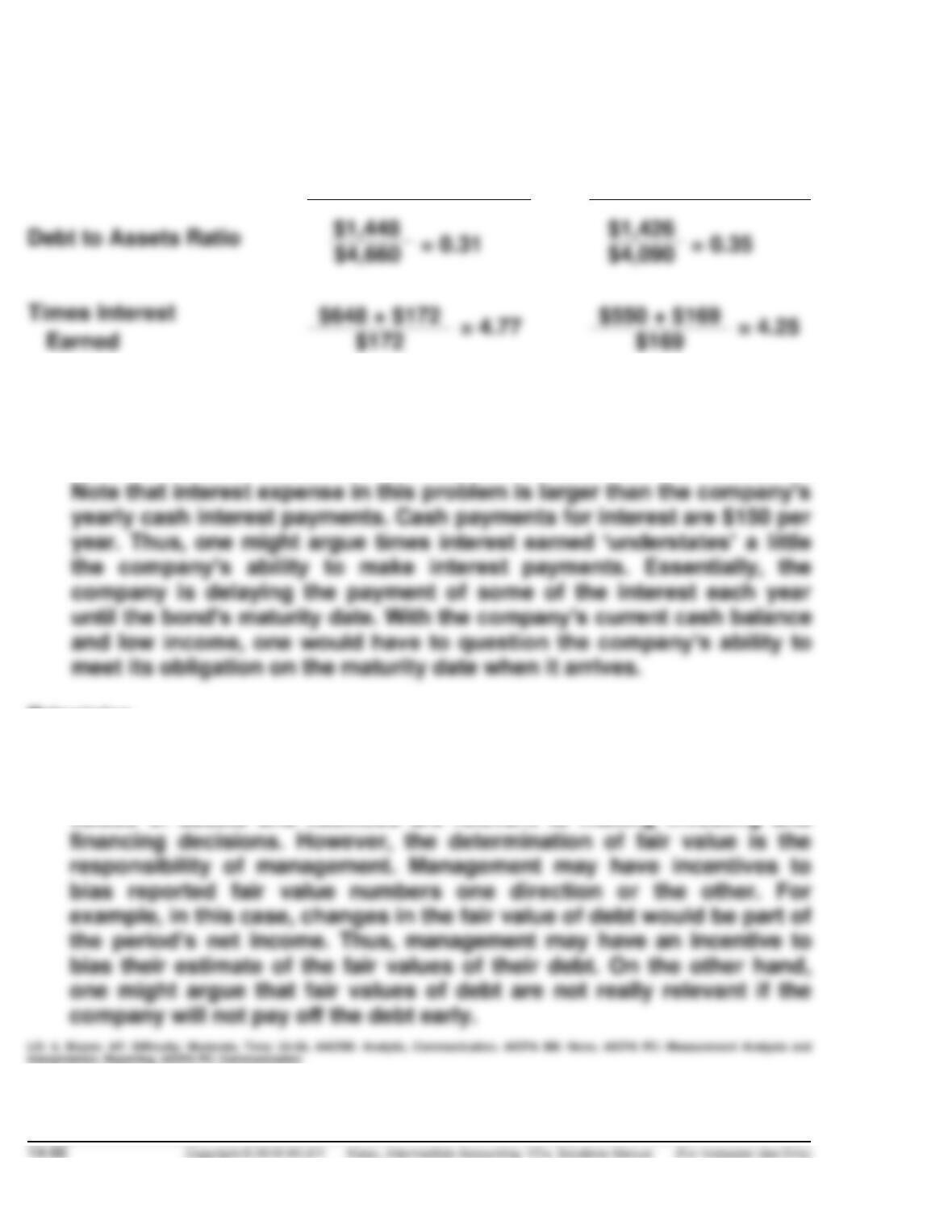
Analysis
2021
2020
Earned
Less than one-third of Bugant’s financing comes from debt, which is
good. Earnings before interest are also more than 4.5 times interest
expense. Both ratios also improved during the year.
Principles
One could argue that this represents a classic trade-off between
relevance and faithful representation. Many people think that the fair
values of assets and liabilities are relevant to making investing and
CODIFICATION EXERCISES
CE14.1
Master Glossary
(a) An obligation is callable at a given date if the creditor has the right at that date to demand, or to
give notice of its intention to demand, repayment of the obligation owed to it by the debtor.
CE14.2
According to FASB ASC 470-10–50-1 (Disclosure of Long-Term Obligations):
The combined aggregate amount of maturities and sinking fund requirements for all long-term borrowings
CE14.3
According of FASB ASC 470-10–45-1 (Classification of Debt that Includes Covenants):
Some long-term loans contain certain covenants that must be met on a quarterly or semiannual basis.
If a covenant violation occurs that would otherwise give the lender the right to call the debt, a lender may

CE14.4
According to FASB ASC 470-10-S99-2 (SAB Topic 4.A, Subordinated Debt):
Subordinated debt may not be included in the stockholders’ equity section of the balance sheet. Any
CODIFICATION RESEARCH CASE
(a) According to FASB ASC 835-30–05
05-2 Business transactions often involve the exchange of cash or
property, goods, or service for a note or similar instrument. When
a note is exchanged for property, goods, or service in a bargained
transaction entered into at arm’s length, there should be a general
05-3 This Subtopic provides guidance for the appropriate accounting
when the face amount of a note does not reasonably represent the
present value of the consideration given or received in the
exchange. The circumstance may arise if the note is non-interest-
CODIFICATION RESEARCH CASE (Continued)
According to FASB ASC 835-30–15
15-2 The guidance in the Subtopic applies to receivables and payables
that represent contractual rights to receive money or contractual
obligations to pay money on fixed or determinable dates, whether
or not there is any stated provision for interest, with certain
(b) According to FASB ASC 835-30–25
25-3 If an established exchange price is not determinable and if the
note has no ready market, the problem of determining present
value is more difficult. To estimate the present value of a note
CODIFICATION RESEARCH CASE (Continued)
45–1A The discount or premium resulting from the determination of
present value in cash or noncash transactions is not an asset or
45-2 The description of the note shall include the effective interest
rate. The face amount shall also be disclosed in the financial
statements or in the notes to the statements.
IFRS CONCEPTS AND APPLICATION
IFRS14.1
Bond discount and bond premium are amortized on an effective-interest
basis. The effective-interest method results in an increasing or decreasing
IFRS14.2
A transfer of noncash assets (real estate, receivables, or other assets) or the
issuance of the debtor’s shares can be used to settle a debt obligation in an
IFRS14.3
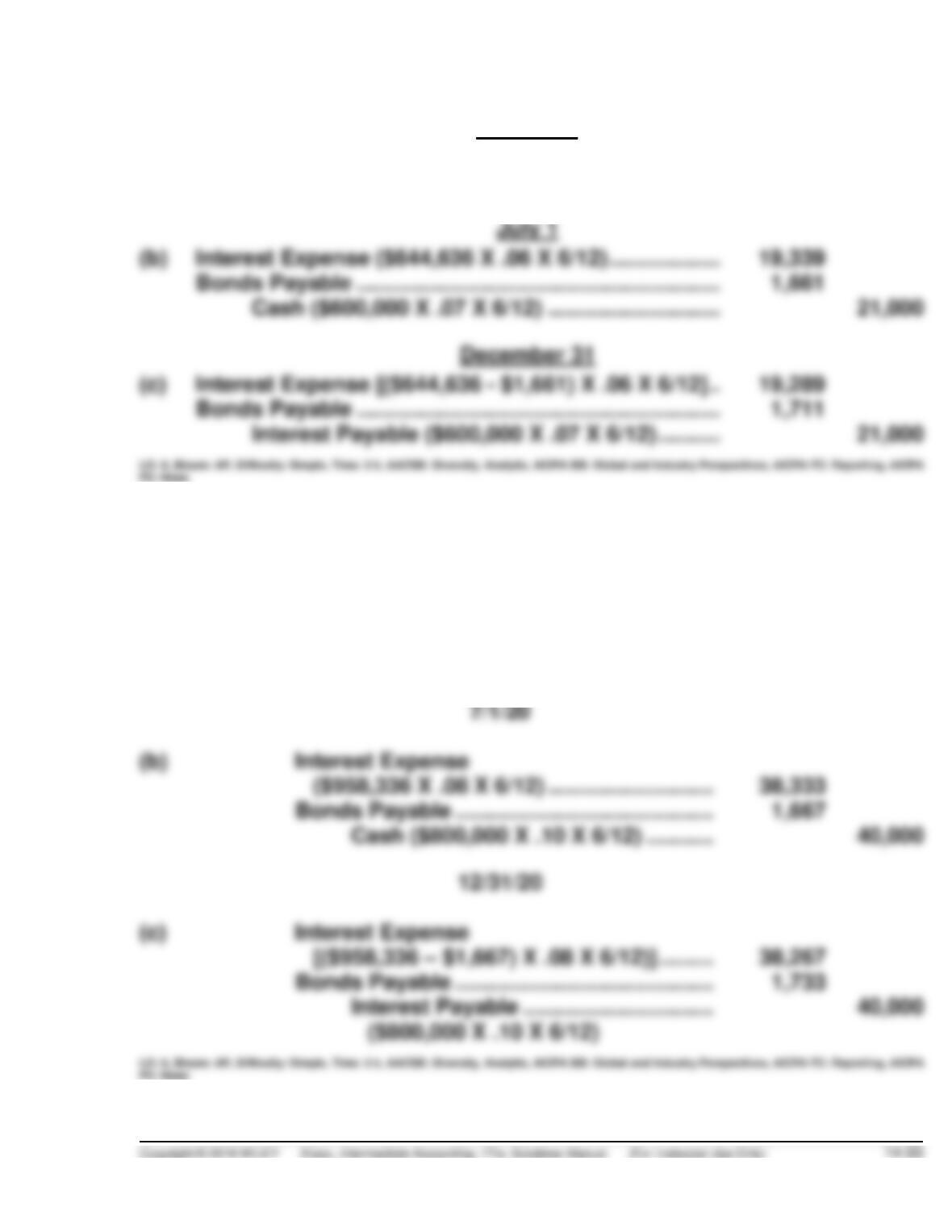
January 1
(a)
Cash …………………………………………………………..
559,224
Bonds Payable ……………………………………
559,224
(b)
Interest Expense ($559,224 X .08 X 6/12) ……….
Cash ($600,000 X .07 X 6/12) …………………
Bonds Payable ……………………………………
(c)
Interest Expense [(559,224 + 1,369) X .08 X 6/12]
Interest Payable ($600,000 X .07 X 6/12) ..
IFRS14.4
January 1
(a)
Cash ………………………………………………………………….
644,636
Bonds Payable …………………………………………..
644,636
(b)
Interest Expense ($644,636 X .06 X 6/12) ………………
Bonds Payable …………………………………………………..
Cash ($600,000 X .07 X 6/12) ……………………….
(c)
Interest Expense [($644,636 – $1,661) X .06 X 6/12] ..
Bonds Payable …………………………………………………..
Interest Payable ($600,000 X .07 X 6/12) ……….
IFRS14.5
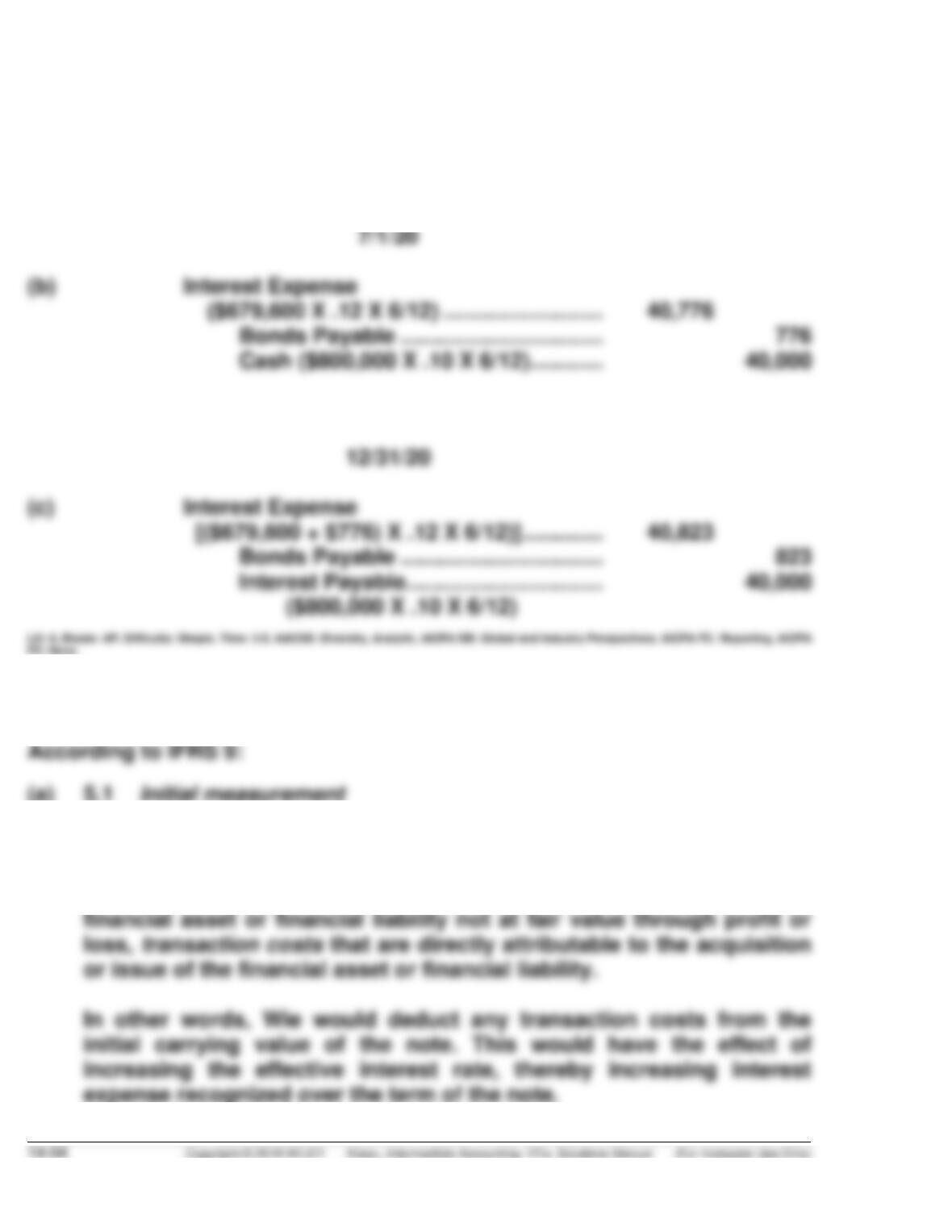
1/1/20
(a)
Cash ($800,000 X 1.19792) ………………………….
958,336
Bonds Payable ………………………………….
958,336
7/1/20
Bonds Payable ………………………………………….
Cash ($800,000 X .10 X 6/12) ………………
Bonds Payable ………………………………………….
IFRS14.6
1/1/20
(a)
Cash ($800,000 X .8495) …………………………..
679,600
Bonds Payable ………………………………….
679,600
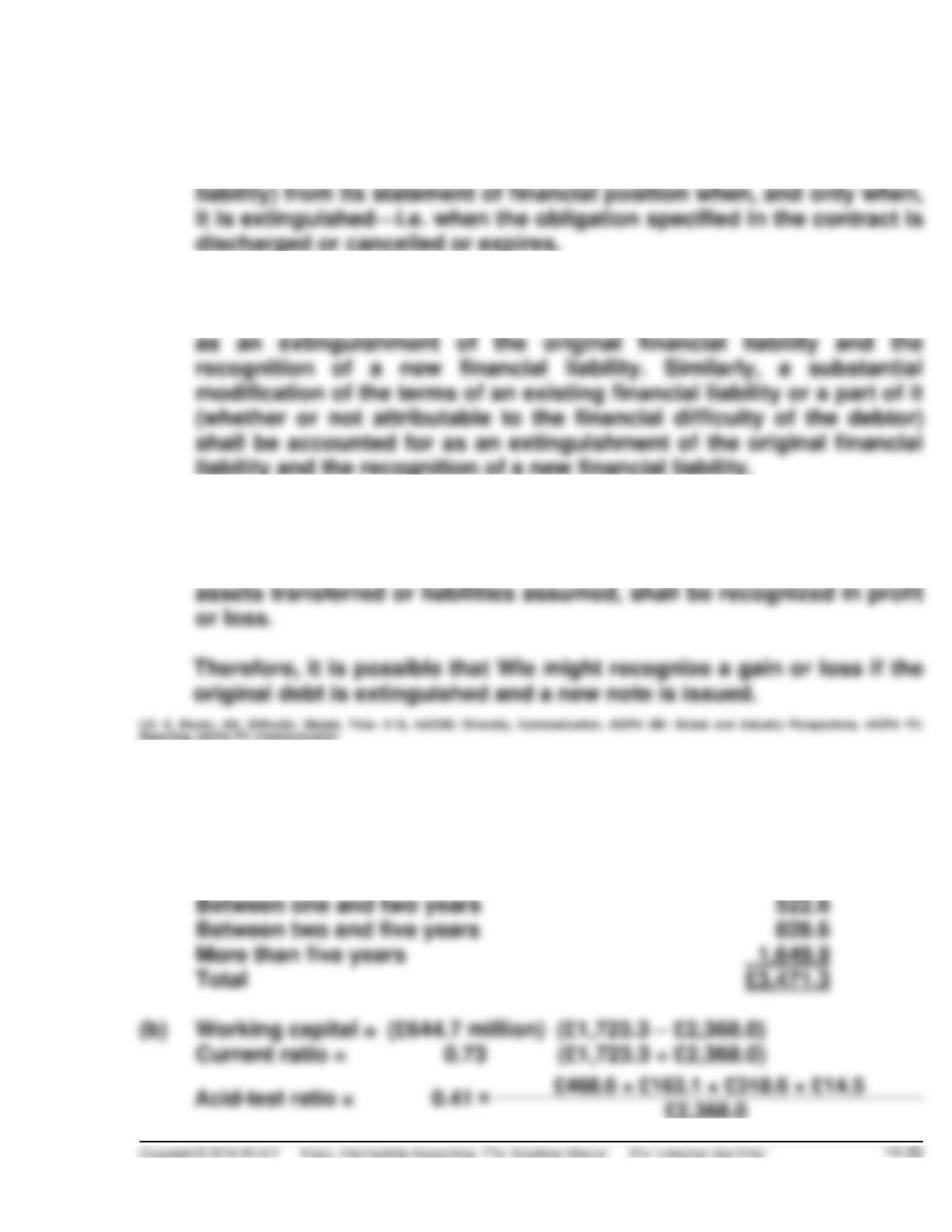
7/1/20
Bonds Payable ………………………………….
Cash ($800,000 X .10 X 6/12)……………….
Bonds Payable ………………………………….
IFRS14.7
5.1.1 Except for trade receivables within the scope of paragraph 5.1.3,
at initial recognition, an entity shall measure a financial asset or
financial liability at its fair value plus or minus, in the case of a
IFRS14.7 (Continued)
(b) 3.3 Derecognition of financial liabilities
3.3.1 An entity shall remove a financial liability (or a part of a financial
3.3.2 An exchange between an existing borrower and lender of debt
instruments with substantially different terms shall be accounted for
3.3.3 The difference between the carrying amount of a financial
liability (or part of a financial liability) extinguished or transferred to
another party and the consideration paid, including any non-cash
IFRS14.8
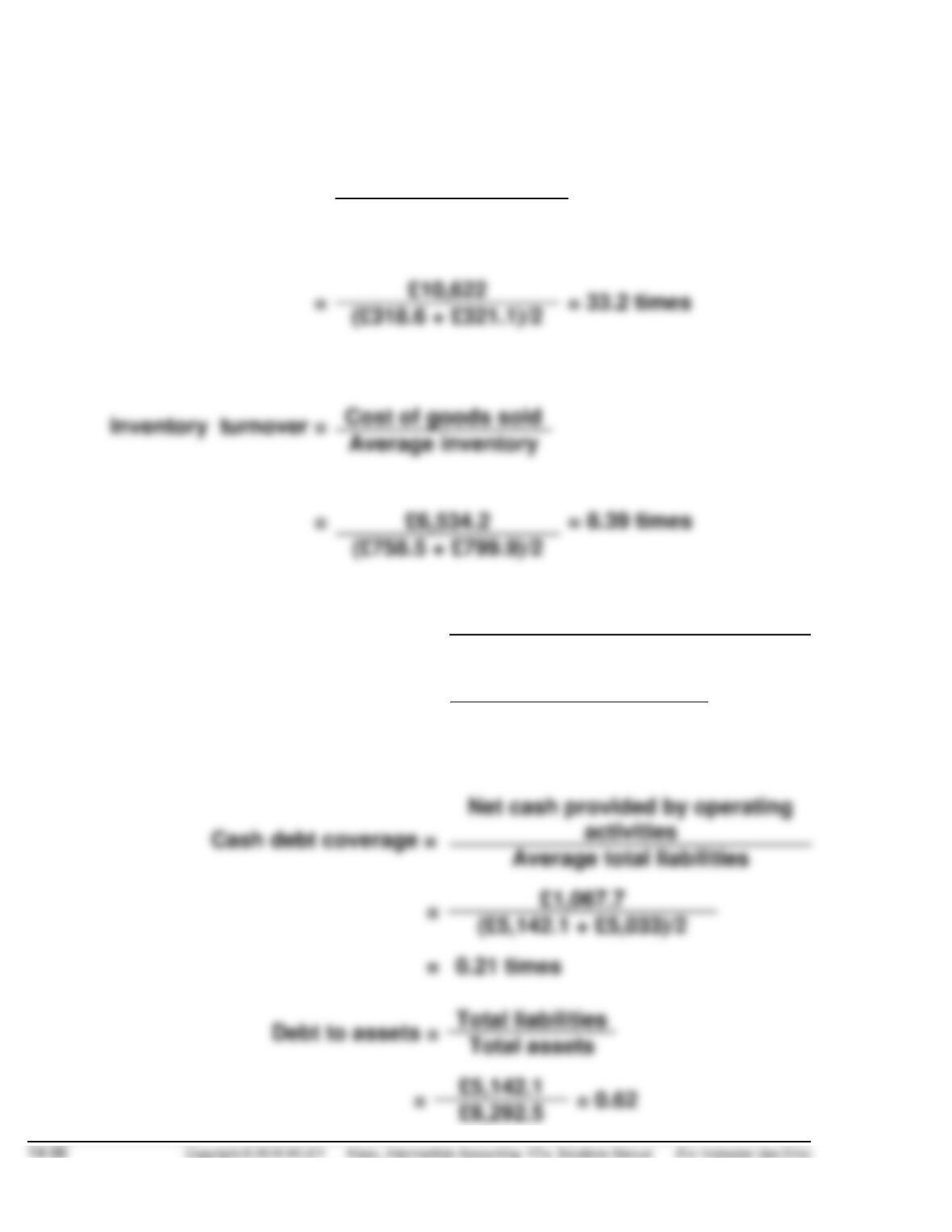
(a) From Note 21
Within one year £ 470.2
IFRS14.8 (Continued)
The following ratios are also calculated.
Receivables turnover =
Net sales
Average receivables
Current cash debt coverage =
Net cash provided by operating
activities
Average current liabilities
=
£1,067.7
(£2,368 + £2,014.8)/2
=
0.49 times
Net cash provided by operating
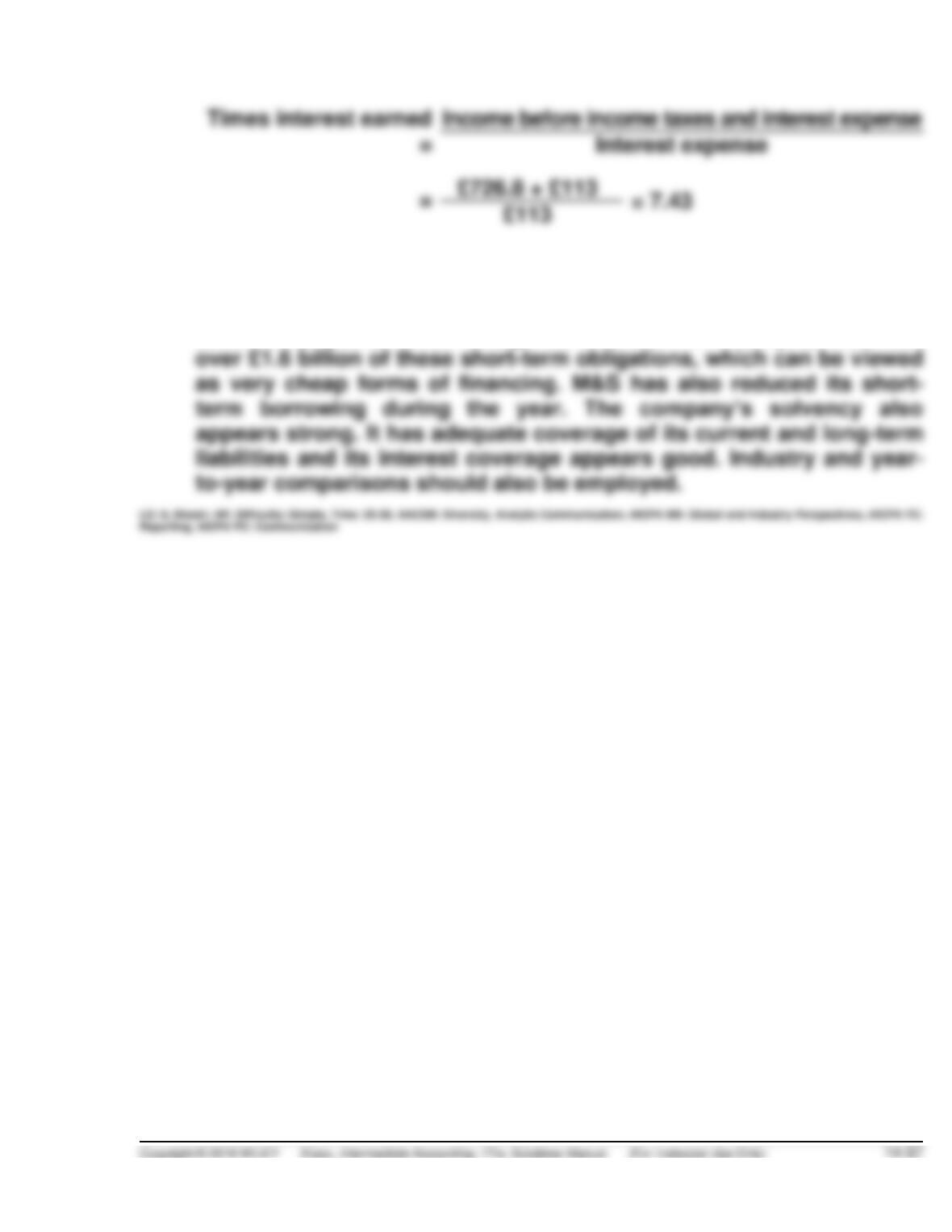
IFRS14.8 (Continued)
As discussed above, M&S’s acid-test and current ratios are below one
and its working capital is negative. The lower acid-test ratio may not
be a problem. Many large companies carry relatively high levels of
accounts payable, which charge no interest. For example, M&S has