PROBLEM 14.9
12/31/19
(a)
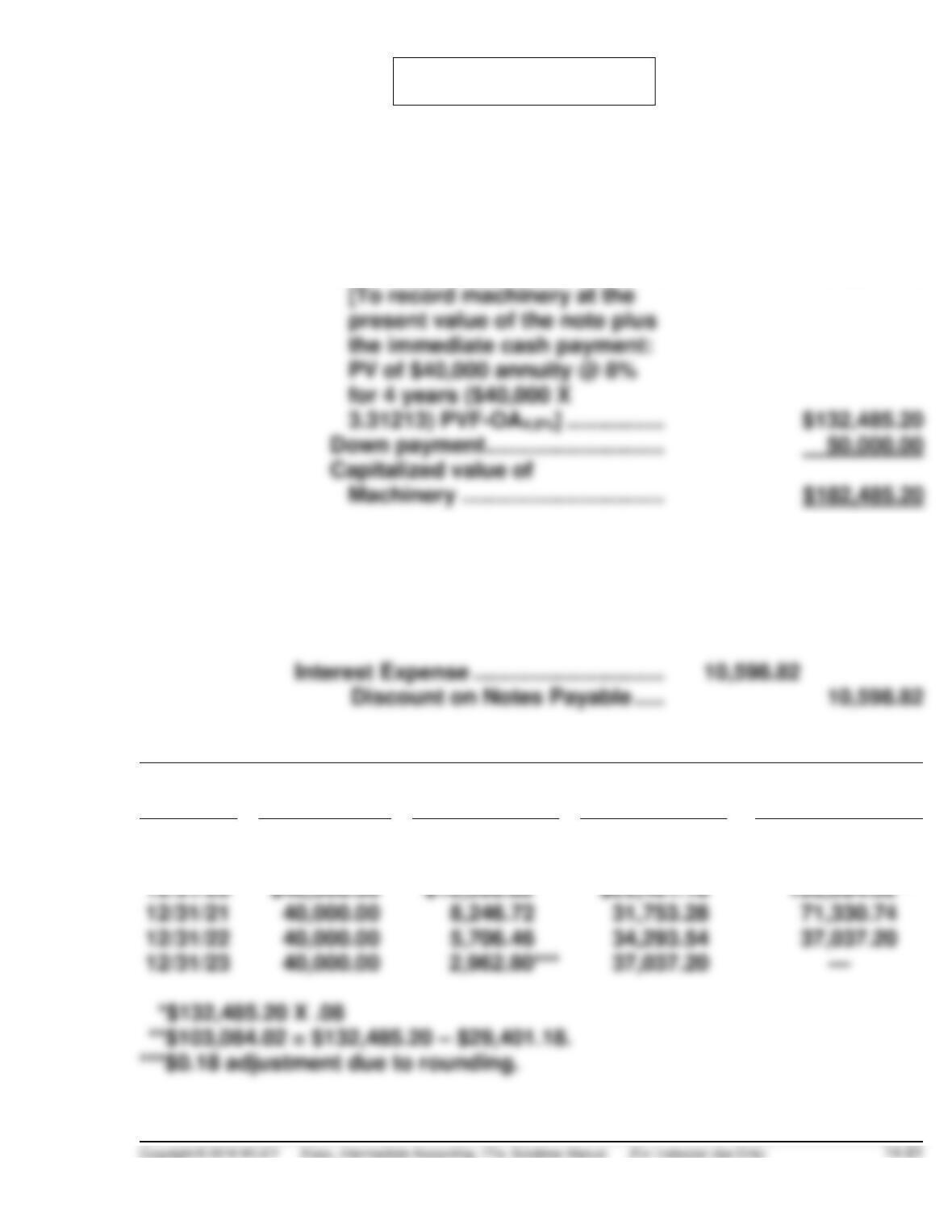
Machinery ……………………………………………………….
182,485.20
Discount on Notes Payable …………………………..
27,514.80
Cash ……………………………………………………….
50,000.00
Notes Payable …………………………..
160,000.00
[To record machinery at the
present value of the note plus
the immediate cash payment:
for 4 years ($40,000 X
3.31213) PVF-OA4,8%] …………………………..
Down payment …………………………..
Capitalized value of
12/31/20
(b)
Notes Payable ……………………………………………………….
40,000.00
Cash ……………………………………………………….
40,000.00
Interest Expense …………………………..
10,598.82
Discount on Notes Payable …………………………..
Schedule of Note Discount Amortization
Date
Cash Paid
Interest
Expense
Amortization
Carrying
Amount of Note
12/31/19
(1)
(2)
(1) – (2)
$132,485.20
PROBLEM 14.9 (Continued)
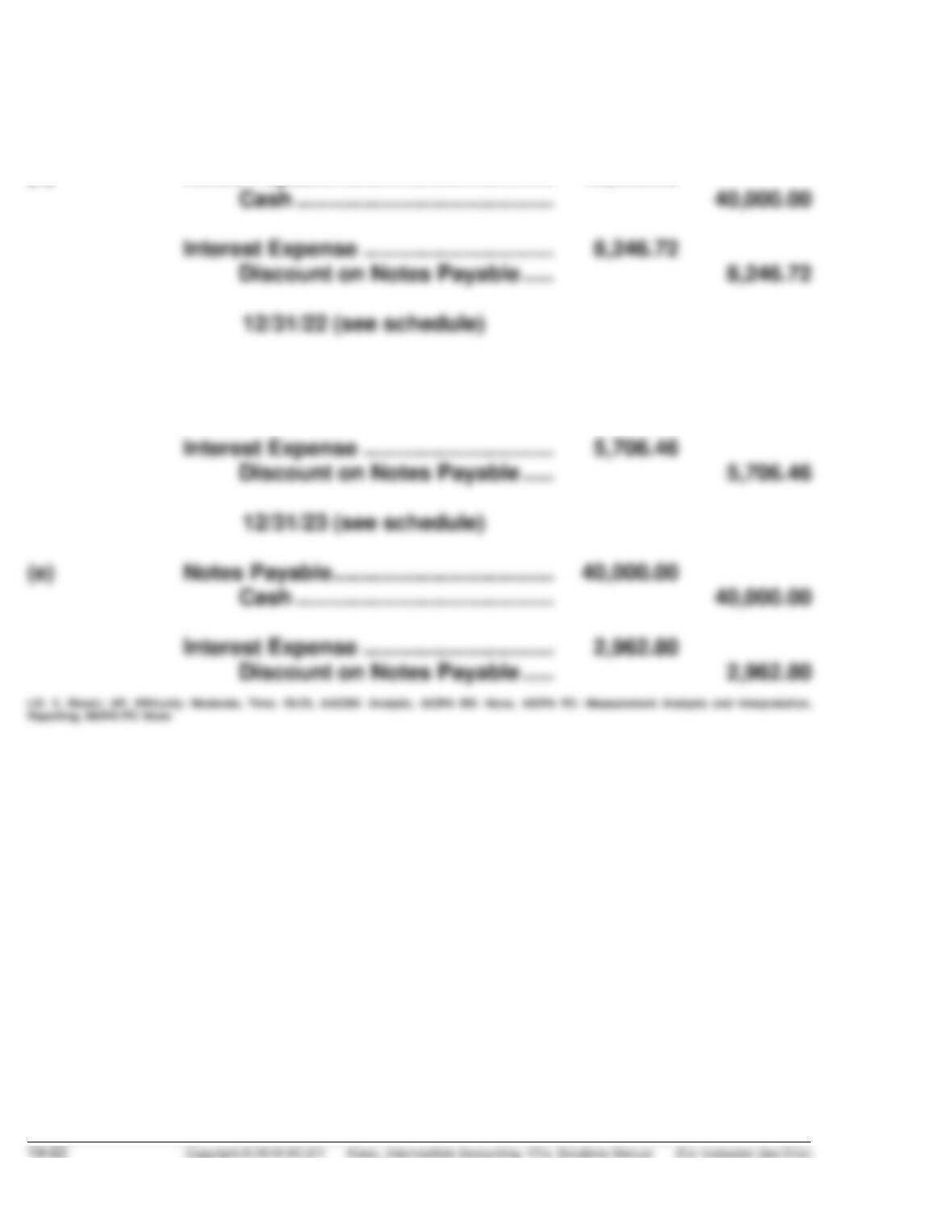
12/31/21 (see schedule)
(c)
Notes Payable ……………………………………………………….
40,000.00
Cash ……………………………………………………….
Interest Expense …………………………..
Discount on Notes Payable …………………………..
(d)
Notes Payable ……………………………………………………….
40,000.00
Cash ……………………………………………………….
40,000.00
Interest Expense …………………………..
Discount on Notes Payable …………………………..
(e)
Notes Payable ……………………………………………………….
Cash ……………………………………………………….
Interest Expense …………………………..
Discount on Notes Payable …………………………..
PROBLEM 14.10
(a)
Wilke Co.
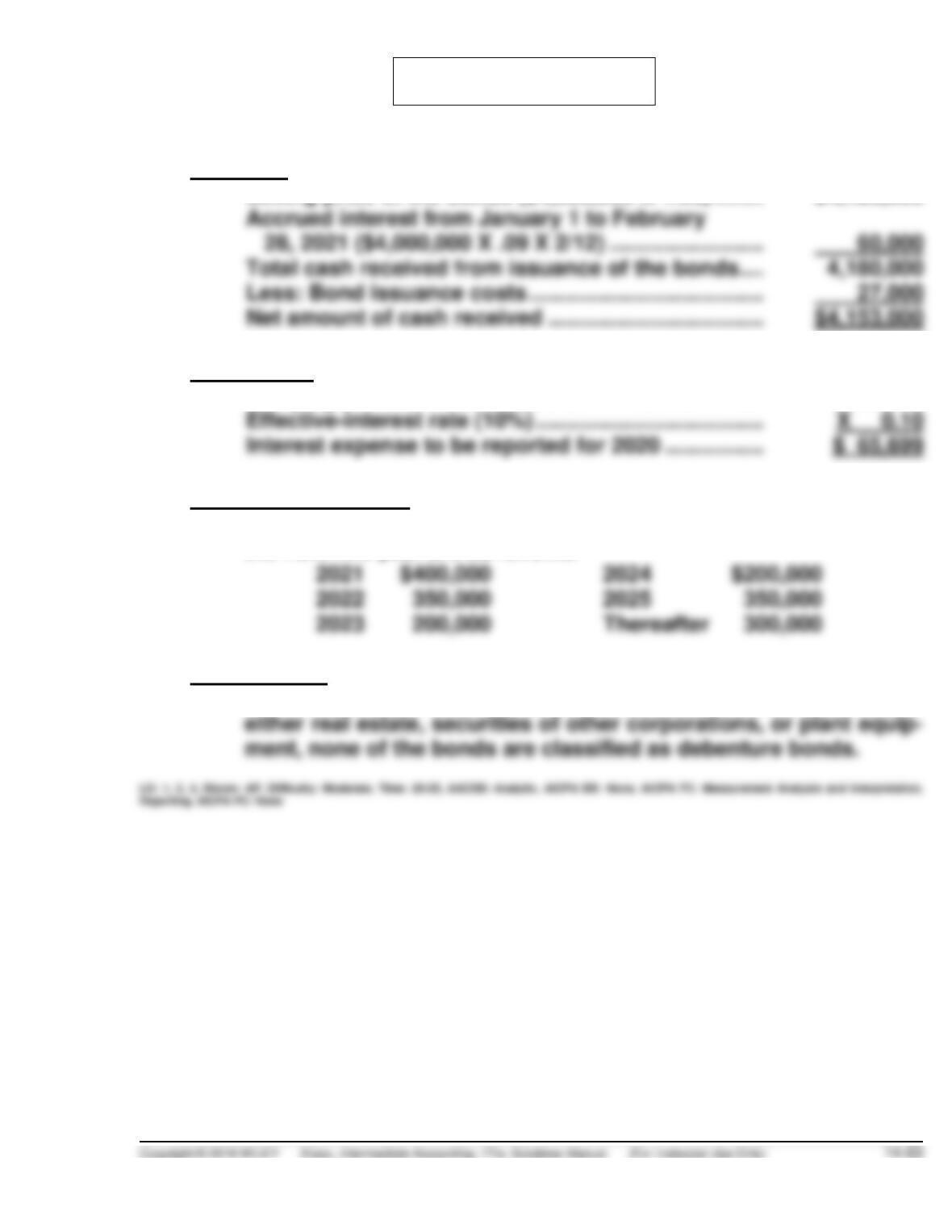
Selling price of the bonds ($4,000,000 X 1.03) ……..
$4,120,000
Accrued interest from January 1 to February
28, 2021 ($4,000,000 X .09 X 2/12) …………………….
Total cash received from issuance of the bonds ….
Less: Bond issuance costs ………………………………..
27,000
(b)
Langley Co.
Carrying amount of the bonds on 1/1/20 ……………..
$656,992
Effective-interest rate (10%) ……………………………….
(c)
Tweedie Building Co.
Maturities and sinking fund requirements on long-term debt for
the next five year are as follows:
$400,000
$200,000
Thereafter
(d)
Beckford Inc.
Since the three bonds reported by Beckford Inc. are secured by
PROBLEM 14.11
Dear Samantha,
When a bond is issued at face value, the annual interest expense and the
interest payout equals the face value of the bond times the interest rate
stated on its face. However, if the bond is issued to yield a higher or lower
However, a better way of recording interest expense in the period during
which it is incurred is the effective–interest method. Assume a premium: the
theory behind this method is that, as time passes, the difference between
the face value of the bond and its carrying amount becomes smaller,
To amortize the premium applying this method to the data provided, you
must know the bond’s face amount, its stated rate of interest, its effective
rate of interest, and its premium.
2. Calculate the carrying amount by adding the premium to the bond’s
PROBLEM 14.11 (Continued)
3. Subtract the amount calculated in #2 from that found in #1. This is the
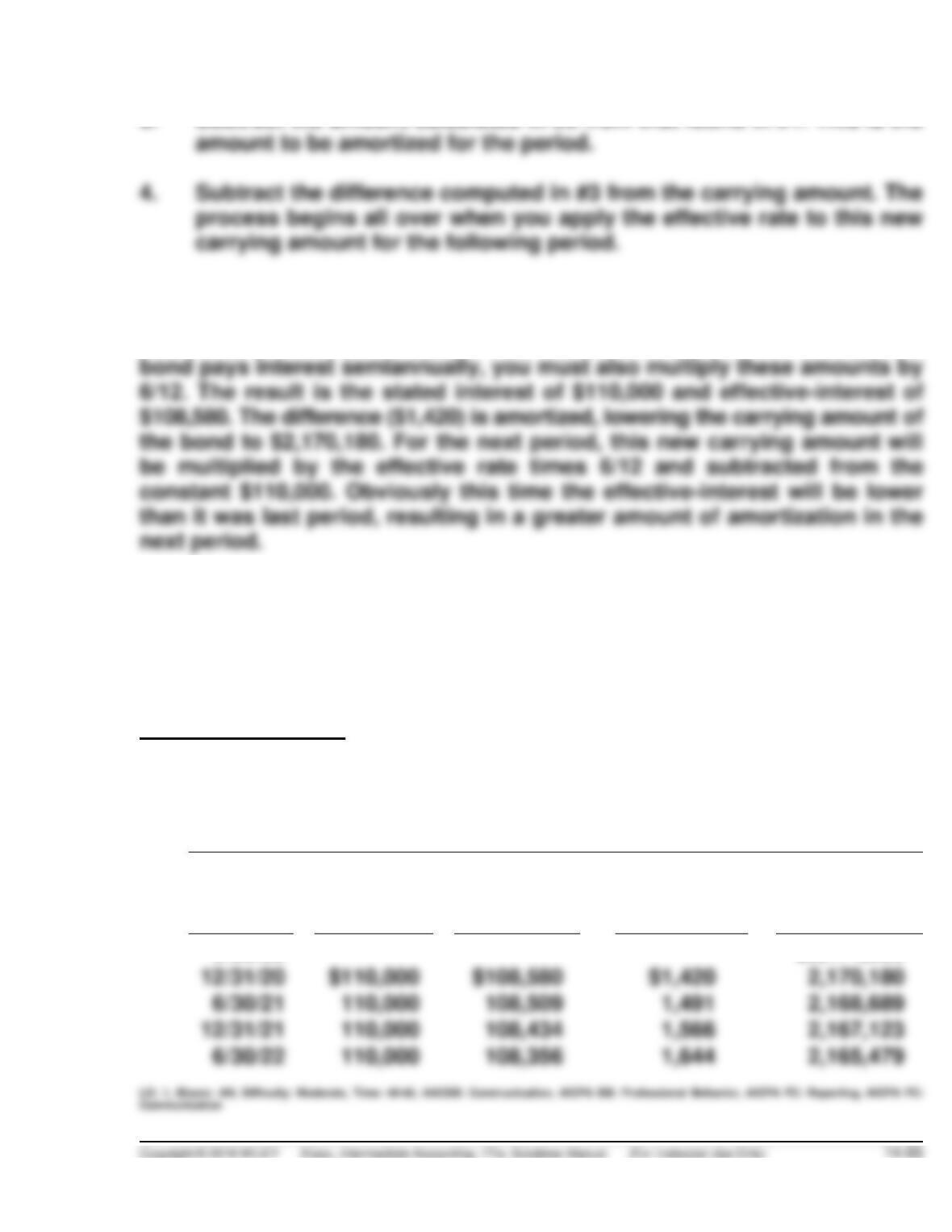
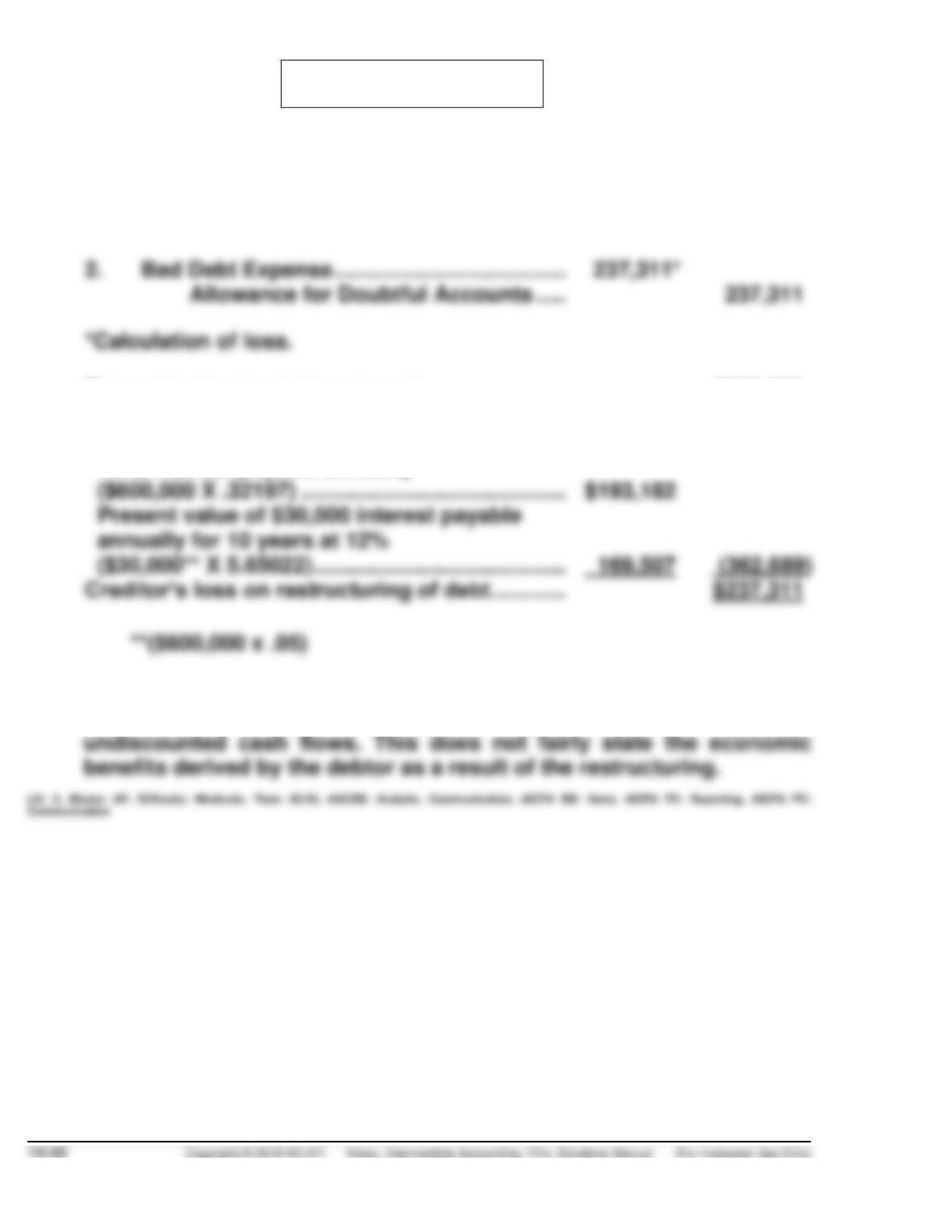
The schedule below illustrates this calculation. The face value ($2,000,000)
is multiplied by the stated rate of 11 percent, while the carrying amount
($2,171,600) is multiplied by the effective rate of 10 percent. Because this
Follow these steps and you should have no trouble amortizing premiums
and discounts over the life of a bond.
Sincerely,
Attachment to letter
HOBART COMPANY
Interest and Discount Amortization Schedule
11% Bond Issued to Yield 10%
Date
Cash
Paid
(11%)
Interest
Expense
(10%)
Premium
Amortized
Carrying
Amount of
Bond
6/30/20
$2,171,600
6/30/21
*PROBLEM 14.12
(a) It is a troubled debt restructuring.
(b)
1. No entry.
Allowance for Doubtful Accounts ……………..
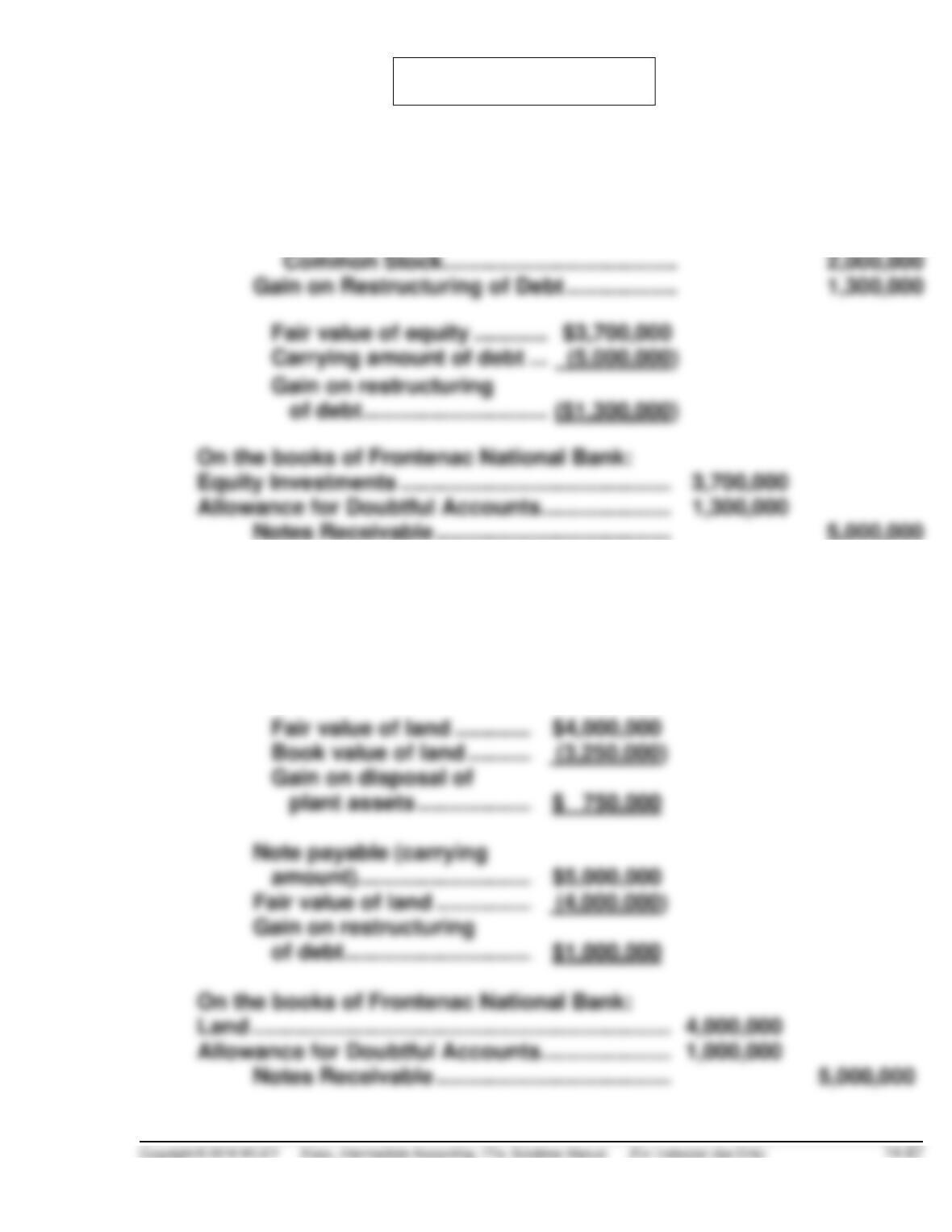
*Calculation of loss.
Pre-restructure carrying amount
$600,000
Present value of restructured cash flows:
Present value of $30,000 interest payable
annually for 10 years at 12%
Present value of $600,000 due in 10 years at
12%, interest payable annually
(c) Losses are calculated based upon the discounted present value of
future cash flows. However, the debtor’s gain is calculated using the
*PROBLEM 14.13
(a)
On the books of Halvor Corporation:
Notes Payable ……………………………………………………….
5,000,000
Common Stock ………………………………………………
1,700,000
Gain on Restructuring of Debt …………………………
1,300,000
Fair value of equity …………………………..
Gain on restructuring
On the books of Frontenac National Bank:
Equity Investments …………………………………………………
Allowance for Doubtful Accounts …………………………..
1,300,000
Notes Receivable ……………………………………………
5,000,000
Paid-in Capital in Excess of Par—
(b)
On the books of Halvor:
Notes Payable ……………………………………………………….
5,000,000
Land ……………………………………………………….
3,250,000
Gain on Disposal of Plant Assets …………………….
750,000
Gain on Restructuring of Debt …………………………
1,000,000
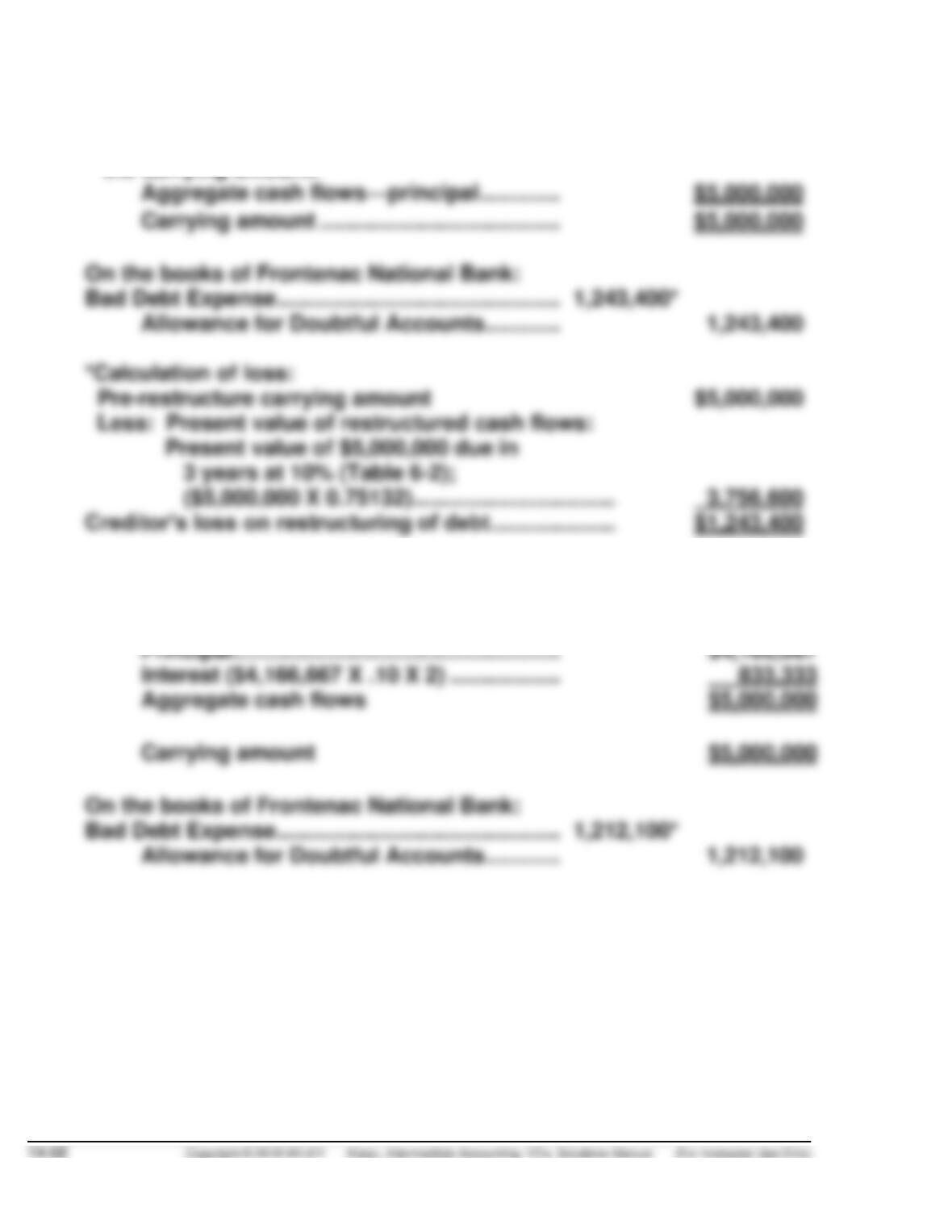
Fair value of land …………………………..
$4,000,000
Book value of land …………………………..
Gain on disposal of
Note payable (carrying
amount)…………………………..
Fair value of land …………………………..
Gain on restructuring
On the books of Frontenac National Bank:
Land ………………………………………………………………………
Allowance for Doubtful Accounts …………………………..
Notes Receivable ……………………………………………
*PROBLEM 14.13 (Continued)
(c)
On the books of Halvor:
No entry is needed because aggregate cash flows equal
the carrying amount.
On the books of Frontenac National Bank:
Allowance for Doubtful Accounts …………………….
3 years at 10% (Table 6-2);
($5,000,000 X 0.75132) ……………………………….
(d)
On the books of Halvor:
No entry is needed because aggregate cash flows equal
the carrying amount.
Principal ……………………………………………………….
Interest ($4,166,667 X .10 X 2) ………………………….
On the books of Frontenac National Bank:
Allowance for Doubtful Accounts …………………….
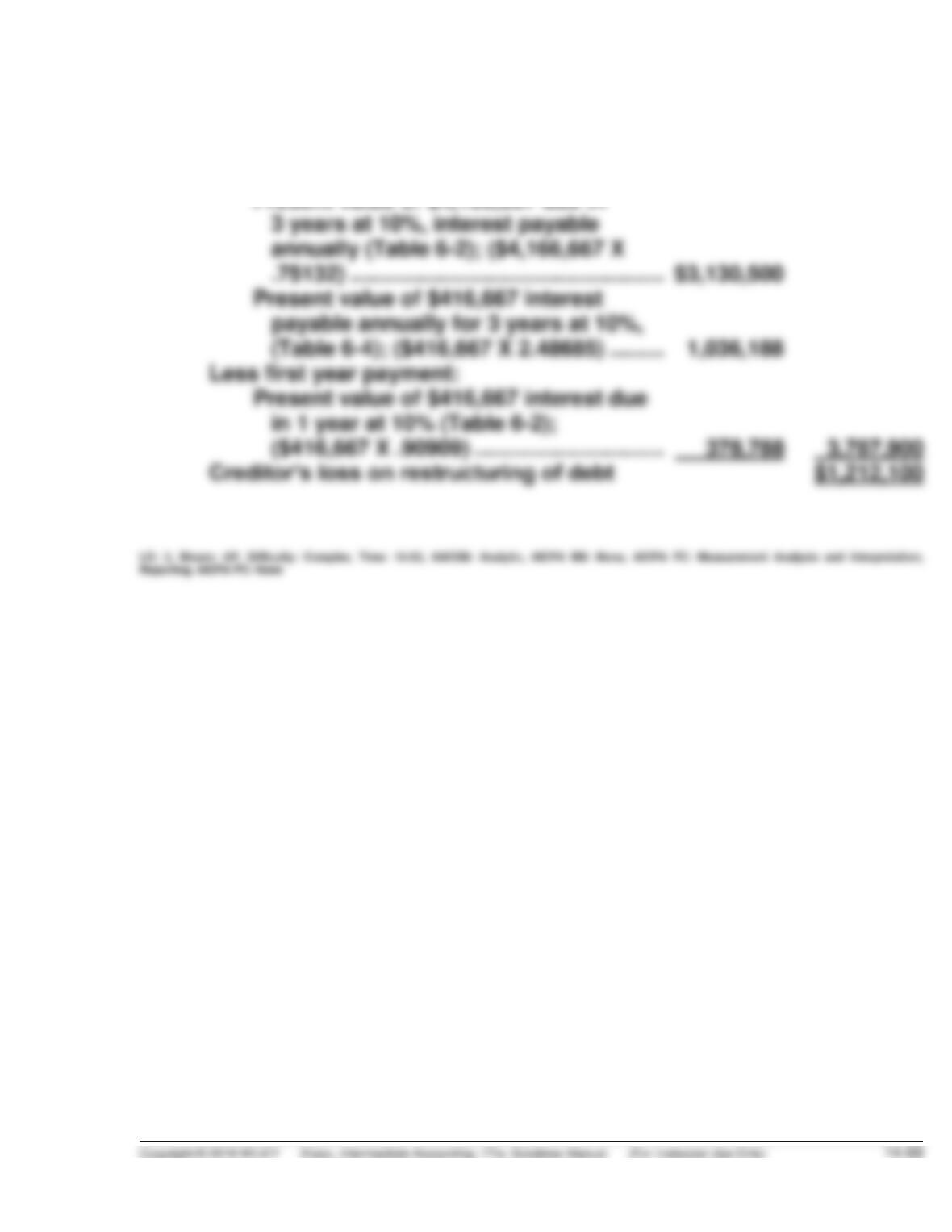
*PROBLEM 14.13 (Continued)
*Calculation of loss:
Pre-restructure carrying amount …………………………..
$5,000,000
Present value of restructured cash flows:
Present value of $4,166,667 due in
3 years at 10%, interest payable
annually (Table 6-2); ($4,166,667 X
.75132) ……………………………………………………….
Present value of $416,667 interest
payable annually for 3 years at 10%,
(Table 6-4); ($416,667 X 2.48685) …………………..
Present value of $416,667 interest due
in 1 year at 10% (Table 6-2);
($416,667 X .90909) …………………………..
3,787,900
*PROBLEM 14.14
Carrying amount of the debt at date of restructure, $330,000 + $33,000 =
$363,000. Total future cash flow, $300,000 + ($300,000 X .10 X 3) = $390,000.
Because the future cash flow exceeds the carrying amount of the debt, no
gain is recognized at the date of restructure.
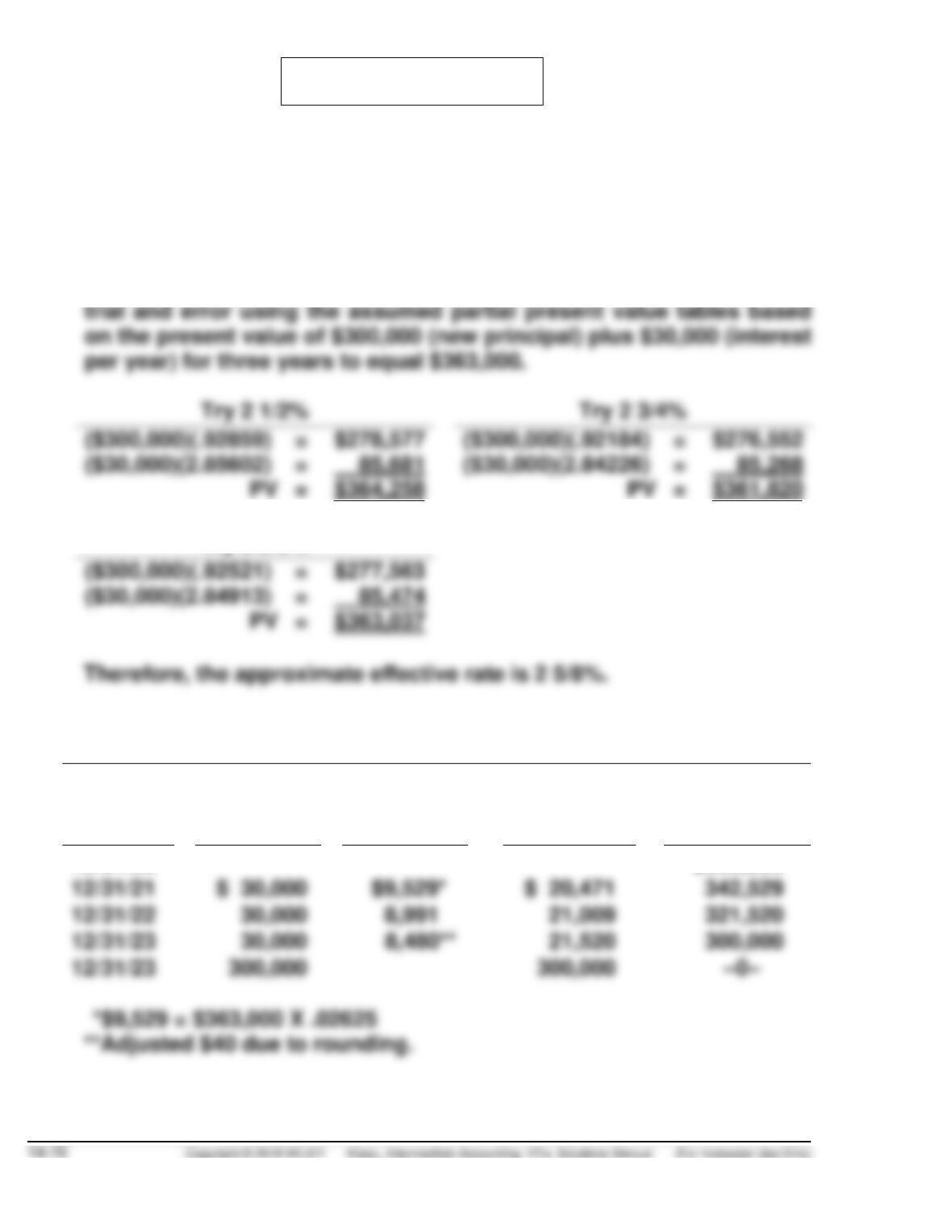
(a) The effective-interest rate subsequent to restructure is computed by
Try 2 1/2%
Try 2 3/4%
=
=
Try 2 5/8%
($30,000)(2.84913)
=
=
(b) SCHEDULE OF DEBT REDUCTION
AND INTEREST EXPENSE AMORTIZATION
Date
Cash Paid
Interest
Expense
Premium
Amortized
Carrying
Amount of
Note
12/31/20
$363,000
12/31/22
*PROBLEM 14.14 (Continued)
(c)
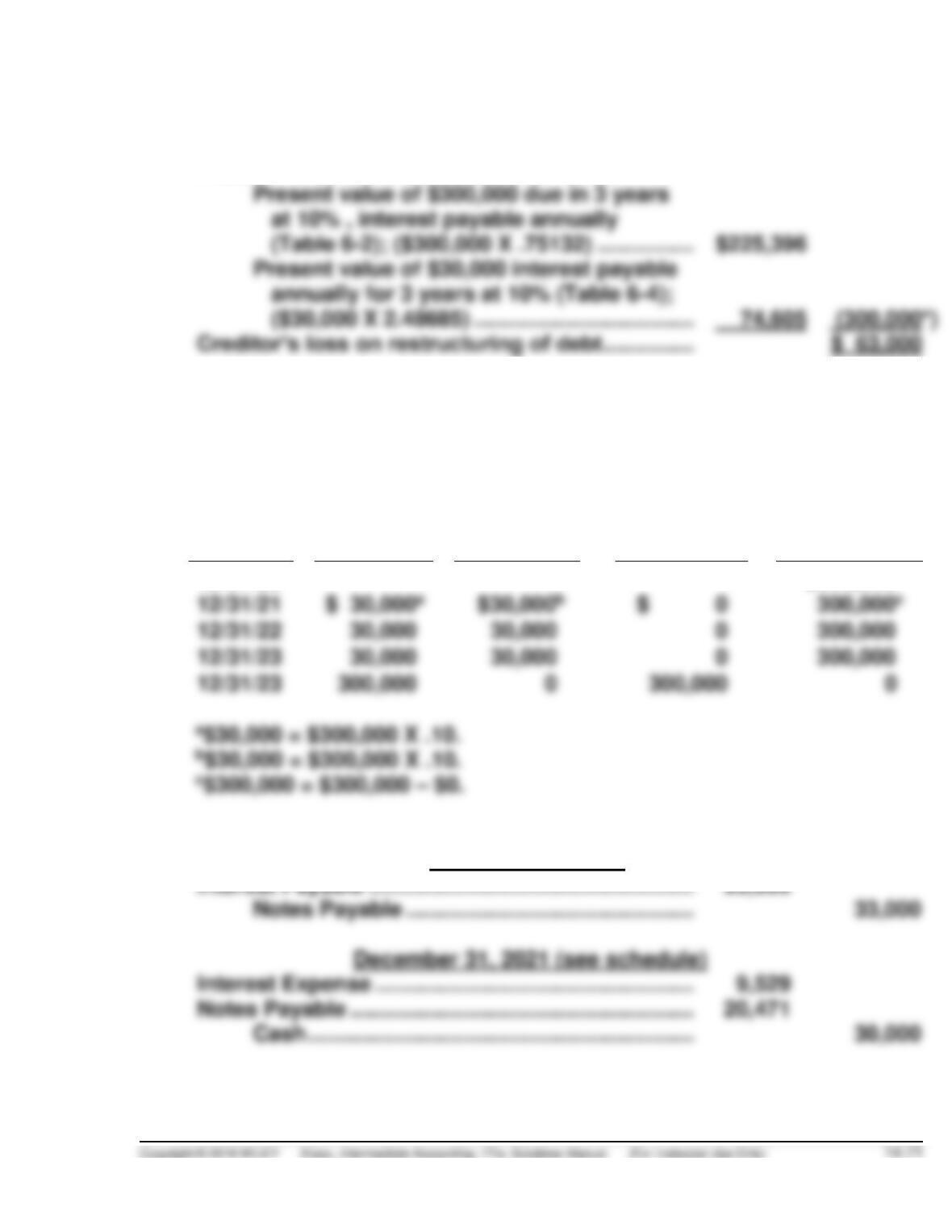
Calculation of loss:
Pre-restructure carrying amount …………………………..
$363,000
Present value of restructured cash flows:
Present value of $300,000 due in 3 years
at 10% , interest payable annually
(Table 6-2); ($300,000 X .75132) …………………….
Present value of $30,000 interest payable
annually for 3 years at 10% (Table 6-4);
($30,000 X 2.48685) ………………………………………
*Although the sum of the present value amounts is $300,001, the true
present value of a 10% note discounted at 10% is face value, or
$300,000. The $1 difference is due to rounding.
Date
Cash
Received
Interest
Revenue
Change in
Carrying
Amount
Carrying
Amount of
Note
12/31/20
$300,000
(d)
Crocker Corp. entries:
December 31, 2020
Interest Payable ……………………………………………………..
Notes Payable ………………………………………………..
Interest Expense …………………………………………………….
Notes Payable ……………………………………………………….
Cash ……………………………………………………….
*PROBLEM 14.14 (Continued)
December 31, 2022
Interest Expense …………………………………………………….
Cash ……………………………………………………….
December 31, 2020
(e)
Bad Debt Expense …………………………………………………..
63,000
Allowance for Doubtful Accounts …………………….
TIME AND PURPOSE OF CONCEPTS FOR ANALYSIS
CA 14.1 (Time 25–30 minutes)
Purpose—to provide the student with some familiarity with the economic theory which relates to the
CA 14.2 (Time 15–25 minutes)
Purpose—this case includes discussions of the determination of the selling price of bonds, presentation
CA 14.3 (Time 20–25 minutes)
Part I—Purpose—to provide the student with an understanding of the significance of the difference
CA 14.4 (Time 20–30 minutes)
Purpose—the student is asked to explain project financing arrangements, take–or-pay contracts, off-
CA 14.5 (Time 20–30 minutes)
SOLUTIONS TO CONCEPTS FOR ANALYSIS
CA 14.1
(a) 1. This is a common balance sheet presentation and has the advantage of being familiar to users
of financial statements. The face or maturity value of $1,000,000 is shown in an obvious
(b) When an entity issues interest-bearing bonds, it normally accepts two types of obligations: (1) to
pay interest at regular intervals and (2) to pay the principal at maturity. The investors who
purchase Nichols Company bonds expect to receive $55,000 each January 1 and July 1 through
(c) 1. The use of the coupon rate for discounting bond obligations would give the face value of the
bond at January 1, 2020, and at any interest-payment due thereafter. Although the coupon rate
CA 14.1 (Continued)
2. The effective-interest rate at January 1, 2020 is the market rate to Nichols Company for long-
term borrowing. This rate gives a discounted value for the bond obligations, which is the
amount that could be invested at January 1, 2020 at the market rate of interest. This
(d) Using a current yield rate produces a current value, that is, the amount which could currently be
invested to produce the desired payments. When the current yield rate is lower than the rate at the
issue date (or than at the previous valuation date), the liabilities for principal and interest would
CA 14.2
(a) 1. The selling price of the bonds would be the present value of all of the expected net future cash
2. Immediately after the bond issue is sold, the current asset, cash, would be increased by the
proceeds from the sale of the bond issue. A noncurrent liability, bonds payable, would be
presented in the balance sheet at the face value of the bonds less the discount. The bond
issue costs would be classified as a “noncurrent asset, deferred charge” under generally
CA 14.3
Part I.
(a) The effective-interest method of amortization of bond discount or premium applies a constant
interest rate to the carrying value of the debt. The straight-line method applies a constant dollar
(b) Before the effective-interest method of amortization can be used, the effective yield or interest rate
of the bond must be computed. The effective yield rate is the interest rate that will discount the two
components of the debt instrument to the amount received at issuance. The two components in
the value of a bond are the present value of the principal amount due at the end of the bond term
and the present value of the annuity represented by the periodic interest payments during the life
of the bond. Interest expense using the effective interest method is based upon the effective yield
or interest rate multiplied by the carrying value of the bond (par value adjusted for unamortized
Part II.
(a) 1. Gain or loss to be amortized over the remaining life of old debt. The basic argument
supporting this method is that if refunding is done to obtain debt at a lower cash outlay (interest
2. Gain or loss to be amortized over the life of the new debt instrument. This argument states
that the gain or loss from early extinguishment of debt actually affects the cost of obtaining a new
CA 14.3 (Continued)
3. Gain or loss recognized in the period of extinguishment. Proponents of this method state
that the early extinguishment of debt to be refunded actually does not differ from other types of
extinguishment of debt where the consensus is that any gain or loss from the transaction
should be recognized in full in current net earnings. The early extinguishment of the debt is
prompted for the same reason that other debt instruments are extinguished, namely, that the
value of the debt instrument has changed in light of current financial circumstances and early
CA 14.4
(a) Such financing arrangements arise when (1) two or more entities form another entity to construct
an operating plant that will be used by both parties; (2) the new entity borrows funds to construct
the project and repays the debt from the proceeds received from the project; and (3) payment of
the debt is guaranteed by the companies that formed the new entity.
(b) In some cases, project financing arrangements become more formalized through the use of take–
or-pay contracts or similar types of contracts. In a simple take-or-pay contract, a purchaser of goods
signs an agreement with the seller to pay specified amounts periodically in return for products or
CA 14.4 (Continued)
According to current practice, Ryan does not record an asset relating to the future purchase
commitment. However, if the dollar amount involved is material, the details of the contract should
be disclosed in a footnote to the balance sheet. In addition, if the contracted price is in excess of
the purchase market price and it is expected that losses will occur when the purchase is affected,
losses should be recognized in the accounts in the period during which such declines in prices
take place.
(e) Off-balance-sheet financing is an attempt to borrow monies in such a way that the obligations
CA 14.5
(a) The stakeholders in the Wichita case are:
Donald Lennon, president, founder, and majority stockholder.
(b) The ethical issues:
The desires of the majority stockholder (Donald Lennon) versus the desires of the minority stock-
holders (Nina Friendly and others).
FINANCIAL REPORTING PROBLEM
(a) According to the Short-Term and Long-Term Debt note (Note 4),
(b) (Amounts in $millions)
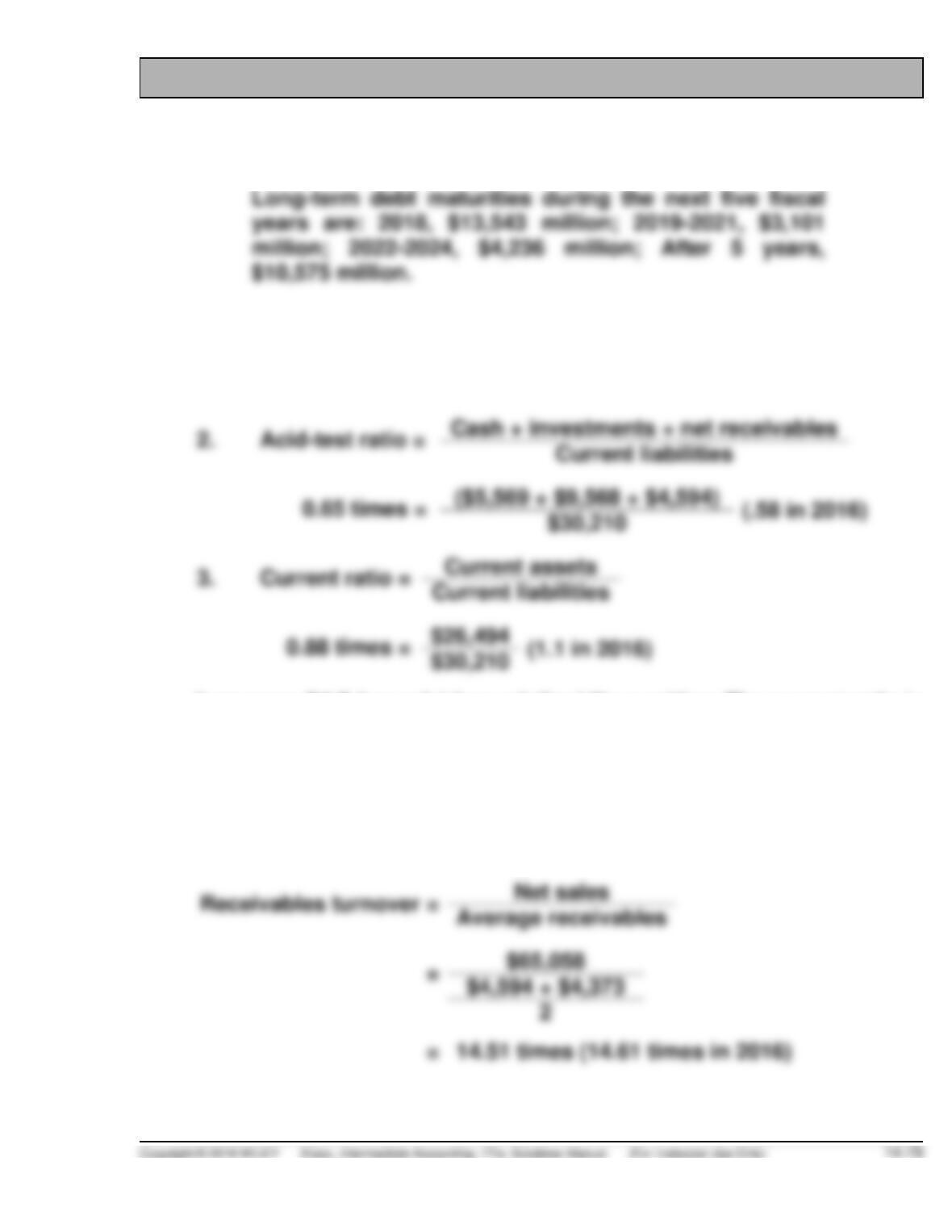
1. Working capital = Current assets less current liabilities.
($3,716) = $26,494 – $30,210
It appears P&G has a fairly weak liquidity position. The current ratio is
below 1. The acid-test ratio is significantly below 1, possibly due to a
slowing economy. However, P&G’s high current liabilities could
reflect a cheap form of financing.
The other ratio analysis below provides P&G’s additional insight into
financial position in 2017.