Wild and Shaw, Financial & Managerial Accounting, 8e Solutions Manual: Chapter 14
Chapter 14
Managerial Accounting
Concepts and Principles
QUESTIONS
1. The managerial accountant plays an important role in preparing the information
necessary for effective planning and control decisions. One example is the budget,
2.
Financial Accounting
Managerial Accounting
(a) Users and decision
makers
Investors, creditors, and
other users external to the
organization
Managers, employees, and
decision makers internal to
the organization
Wild and Shaw, Financial & Managerial Accounting, 8e Solutions Manual: Chapter 14
816
3. A customer orientation has led companies to adopt the principles of the lean
business model in response to consumer demands. The essence of customer
4. Direct labor refers to the efforts of employees who physically convert materials to
finished product. Indirect labor refers to the efforts of factory employees who do not
5. Factory overhead is limited to indirect costs that are incurred in the production
process. That is, it consists of activities that support the production process, such
6. Direct materials are raw materials that physically become part of the product and
can be clearly traced to specific units or batches of product. Indirect materials are
7. Direct labor is both a prime cost and a conversion cost.
8. Direct costs of iPhones include: costs of materials such as smartphone cameras,
memory chips, screens, and processors, as well as the labor of workers who
9. The production manager should likely not be evaluated on the basis of operating
expenses. Operating expenses are not under the influence of production managers,
and they should not be held accountable for them.
10. Management usually must be able to predict financial performance to be successful.
12. A manufacturing business produces a product, whereas in a merchandising or
service business this is not the case. In making a product, the manufacturing
13. To run a successful business, management must make predictions and estimates
about what will occur in the future. Thus, managerial accountants must project how
the numbers will look under different possibilities.
14. A manufacturing firm converts raw materials into finished products. A
manufacturing company would report three types of inventories on its balance
sheet: raw materials, work in process, and finished goods. The finished goods are
15. Manufacturers’ balance sheets usually include small tools, factory buildings, factory
16. Manufacturing firms have inventories at various stages of completion.
Manufacturing a product requires raw materials, which are converted to finished
17. Manufacturing activities of a company are described in the Schedule of Cost of
Goods Manufactured. This schedule summarizes the types and amounts of costs
incurred in a company’s manufacturing process (or activities).
19. Examples of factory overhead costs include: indirect materials, indirect labor,
depreciation of the factory equipment and plant, amortization of patents, the cost of
small tools used, factory utilities, insurance on the factory and equipment, property
Wild and Shaw, Financial & Managerial Accounting, 8e Solutions Manual: Chapter 14
20.
Components of Schedule of COGM
Apple Examples
Direct material ……………………………………………………….
Processors, chips, covers
21.
Google
Schedule of Cost of Goods Manufactured
For Year Ended December 31, 2019
22. The income statement describes the revenues and expenses for the year. Included
in the calculation of the cost of goods sold is a line item identified as the cost of
23. Raw materials inventory turnover and days’ sales in raw materials inventory can be
used to assess raw materials inventory management. Raw materials inventory
24. The triple bottom line reports on an organization’s financial, social, and
environmental performance.
25.
Inventory Components ($ millions)
3M Co. (December 31, 2017)
Finished goods ……………………………………………………….
$1,915
Work in process ……………………………………………………….
Raw materials and supplies ………………………………………
Wild and Shaw, Financial & Managerial Accounting, 8e Solutions Manual: Chapter 14
819
QUICK STUDIES
Quick Study 14-1 (5 minutes)
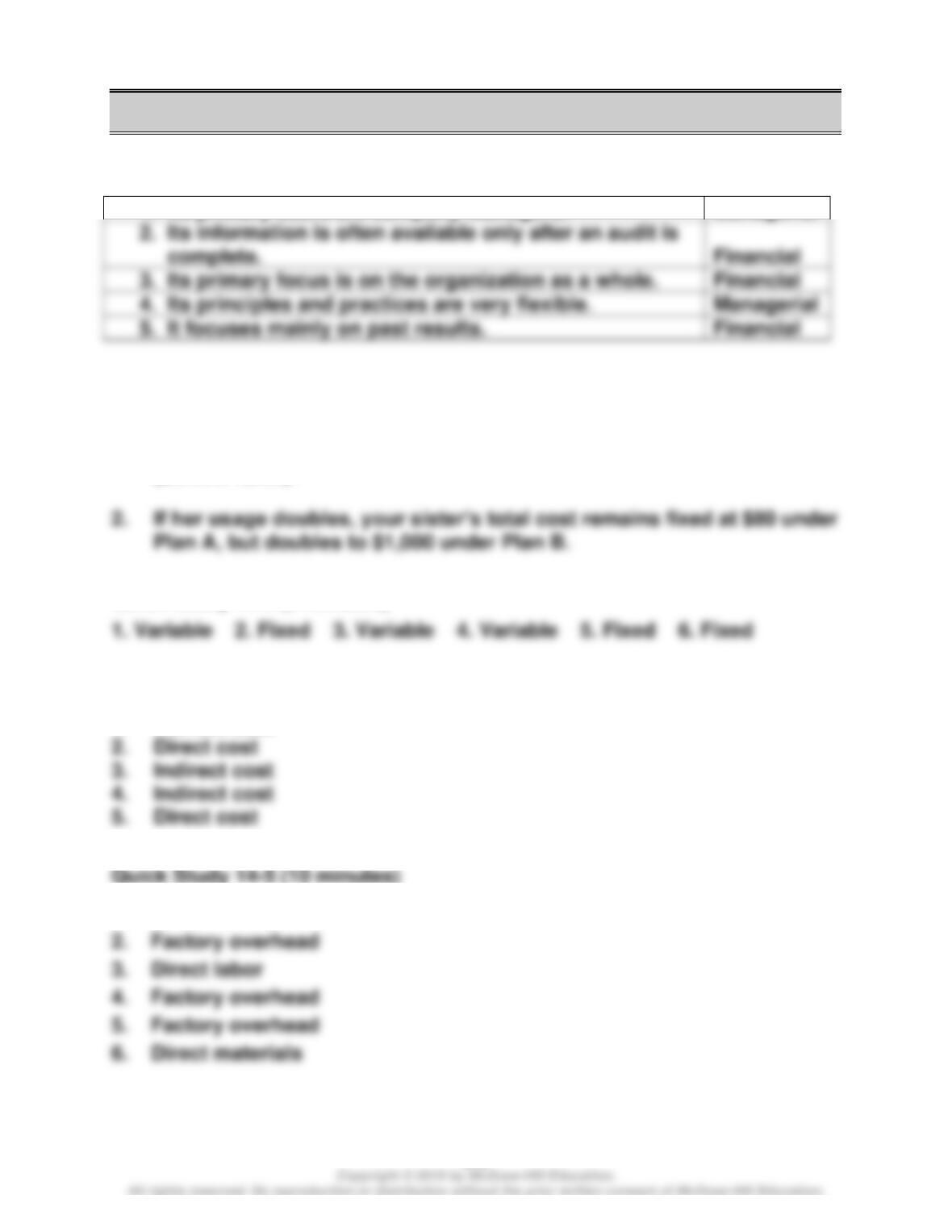
1. Its primary users are company managers.
Managerial
Financial
3. Its primary focus is on the organization as a whole.
Financial
4. Its principles and practices are very flexible.
Managerial
5. It focuses mainly on past results.
Financial
Quick Study 14-2 (5 minutes)
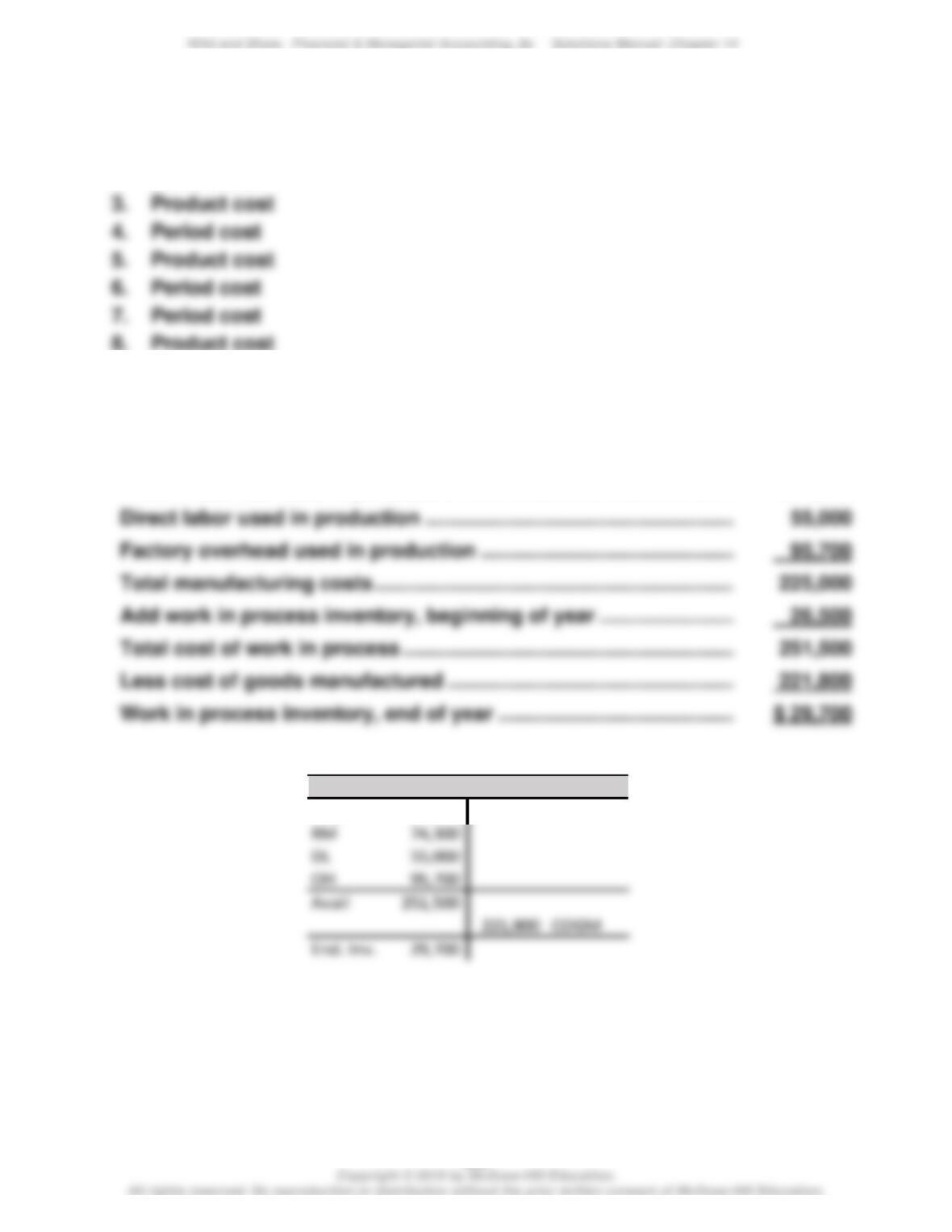
1. At her normal usage, your sister’s total cost with Plan A is $80 (fixed).
Under Plan B, her total cost is $500, computed as ($0.20 x 1,700) +
($0.10 x 1,600).
Quick Study 14-3 (5 minutes)
Quick Study 14-4 (5 minutes)
1. Indirect cost
1. Direct materials
820
Quick Study 14-6 (10 minutes)
1. Product cost
2. Period cost
Quick Study 14-7 (5 minutes)
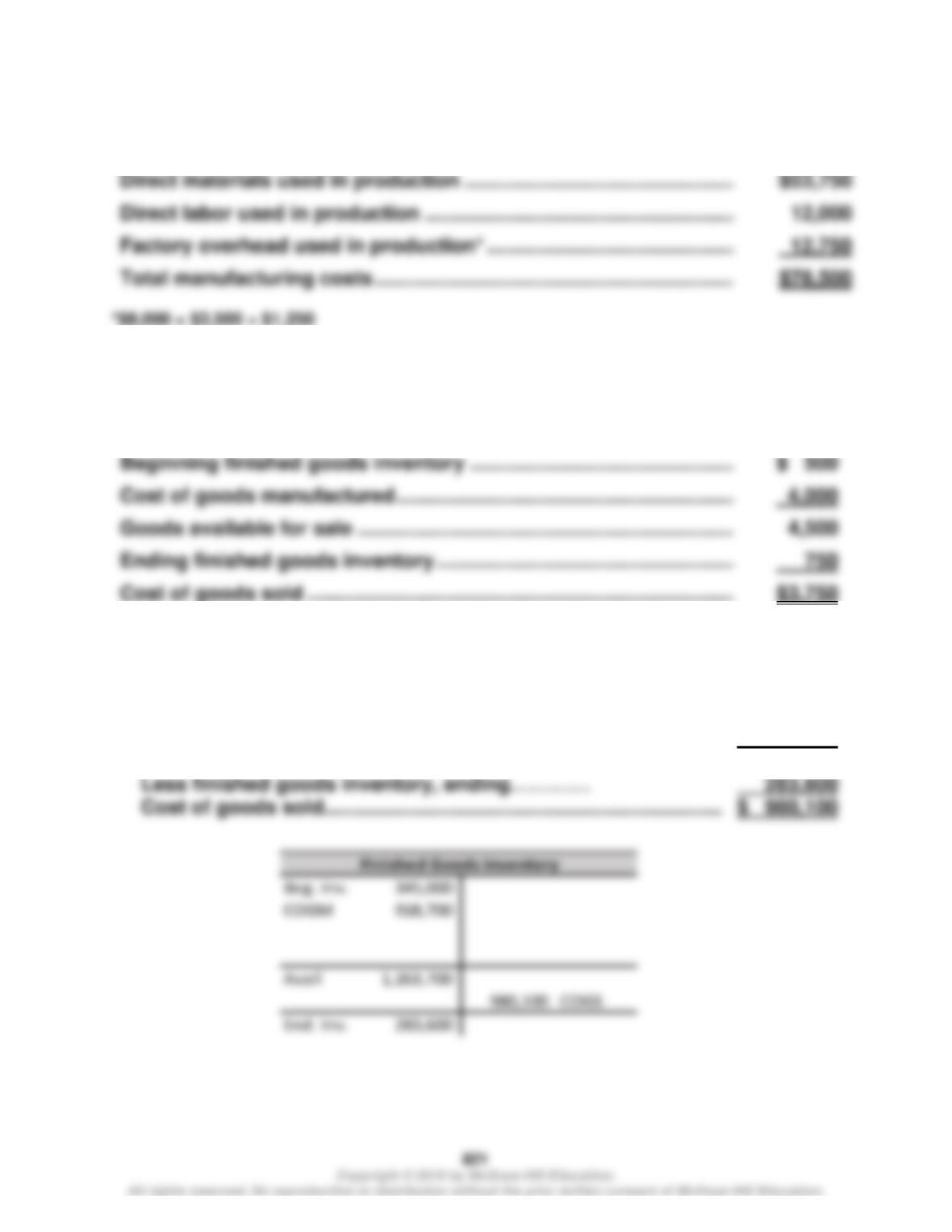
Ending work in process inventory is computed as:
Direct materials used in production …………………………………………..
$74,300
Direct labor used in production …………………………………………………
225,000
Beg. Inv. 26,500
Work in Process Inventory
Wild and Shaw, Financial & Managerial Accounting, 8e Solutions Manual: Chapter 14
Quick Study 14-8 (5 minutes)
Total manufacturing cost is computed as:
Direct labor used in production …………………………………………………
Factory overhead used in production* ……………………………………….
Total manufacturing costs …………………………………………………………
Quick Study 14-9 (10 minutes)
Cost of goods sold is computed as:
Beginning finished goods inventory ………………………………………….
Cost of goods manufactured ……………………………………………………..
Goods available for sale ……………………………………………………………
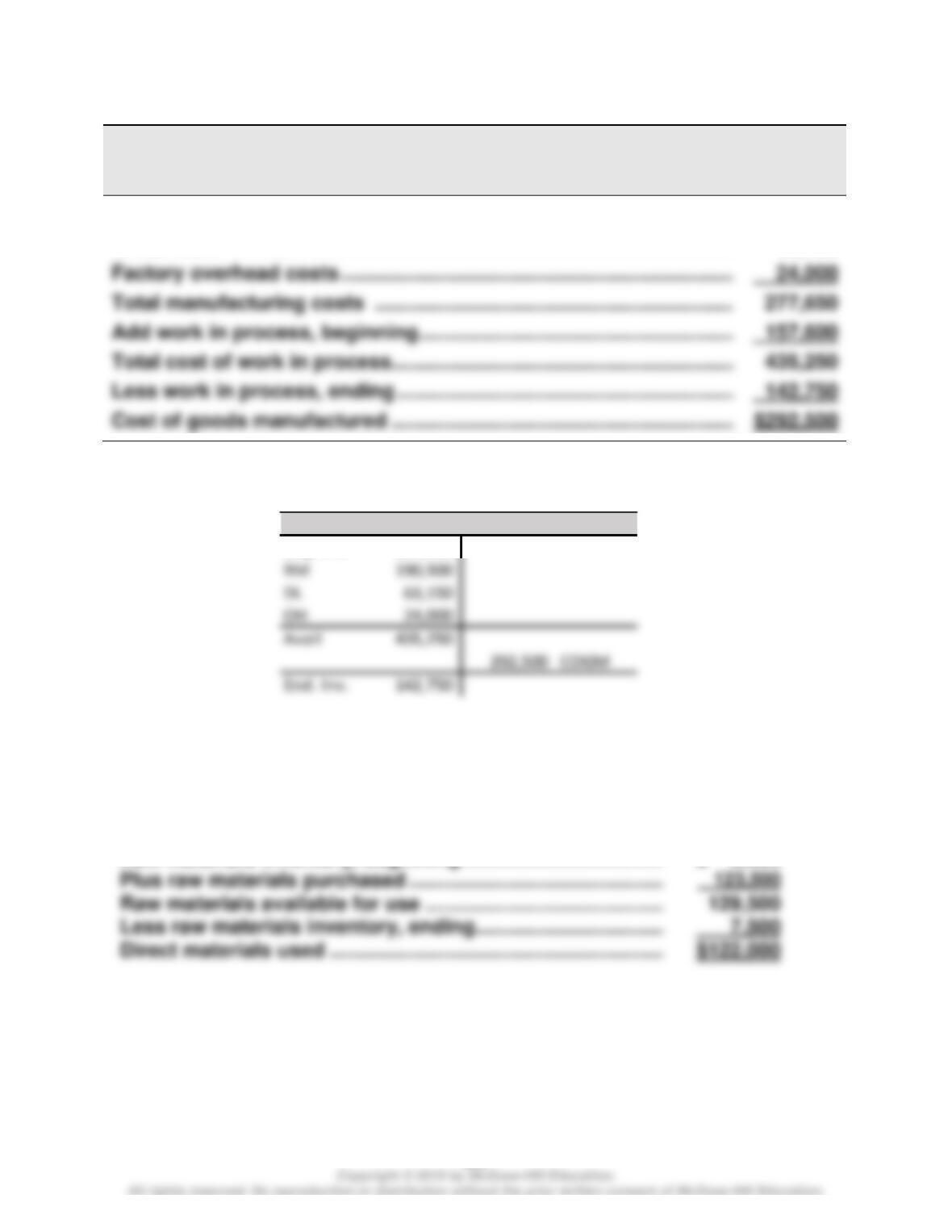
Quick Study 14–10 (10 minutes)
Finished goods inventory, beginning …………………………………..
$ 345,000
Plus cost of goods manufactured ………………………………………..
918,700
Cost of goods available for sale …………………………………………..
1,263,700
283,600
Wild and Shaw, Financial & Managerial Accounting, 8e Solutions Manual: Chapter 14
822
Quick Study 14-11 (15 minutes)
Barton Company
Schedule of Cost of Goods Manufactured
Direct materials …………………………..……………………………………………..
$190,500
Direct labor ……………………………………………………………………………….
63,150
Total manufacturing costs …………………………………………………………
Add work in process, beginning ………………………………………………….
Total cost of work in process ………………………………………………………
Beg. Inv. 157,600
Work in Process Inventory
Quick Study 14-12 (5 minutes)
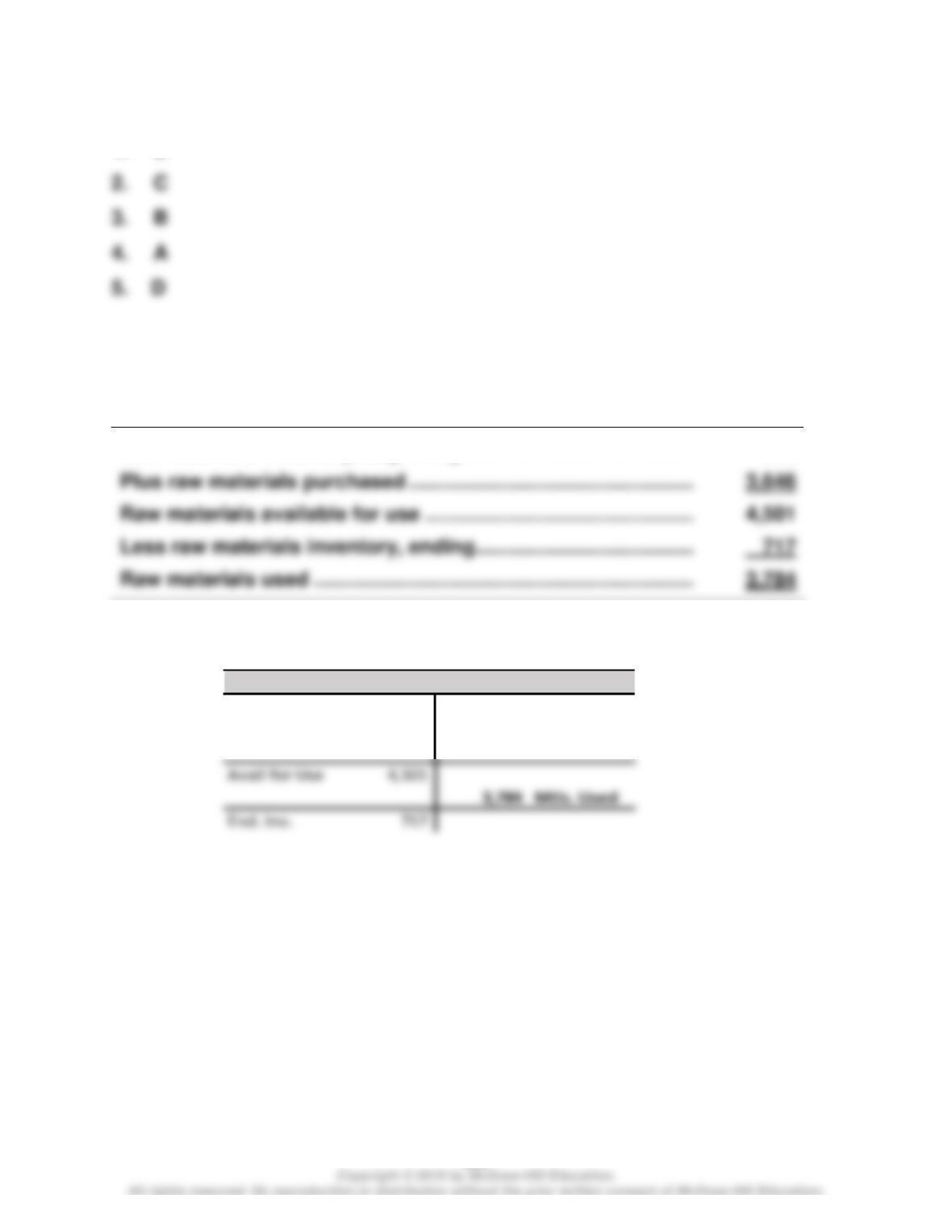
Raw materials inventory, beginning ……………………………………
$ 6,000
Plus raw materials purchased …………………………………………….
Raw materials available for use ………………………………………….
Wild and Shaw, Financial & Managerial Accounting, 8e Solutions Manual: Chapter 14
823
Quick Study 14-13 (10 minutes)
1. E
Quick Study 14-14 (5 minutes)
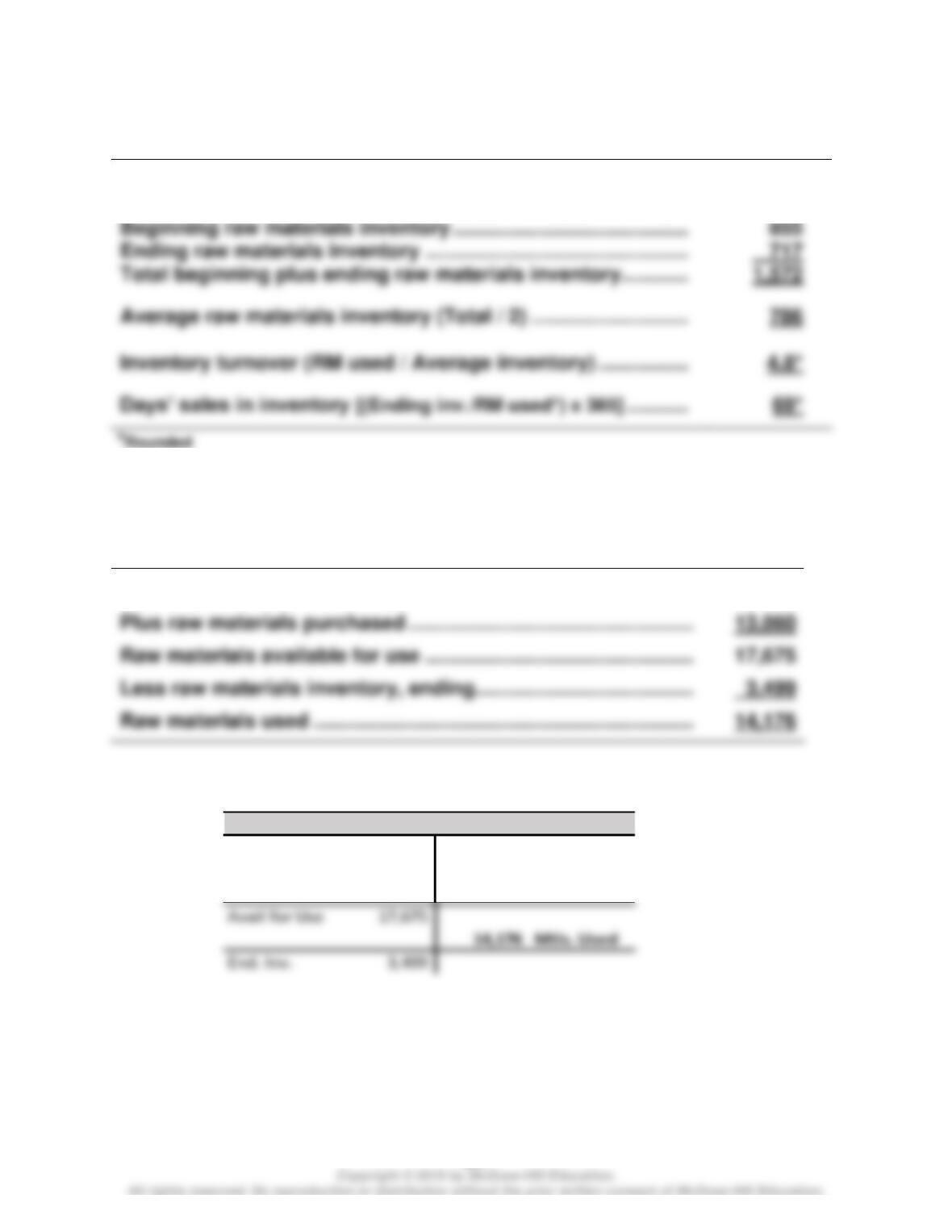
(Amounts in $ millions)
Raw materials inventory, beginning ……………………………………
855
Plus raw materials purchased …………………………………………….
Raw materials available for use ………………………………………….
Beg. Inv. 855
Purchases 3,646
Raw Materials inventory
Wild and Shaw, Financial & Managerial Accounting, 8e Solutions Manual: Chapter 14
824
Quick Study 14-15 (10 minutes)
(in $ millions)
Cost of raw materials used ……………………………………………….
$3,784
Beginning raw materials inventory ……………………………………
Total beginning plus ending raw materials inventory…………
Average raw materials inventory (Total / 2) ……………………….
Quick Study 14–16 (5 minutes)
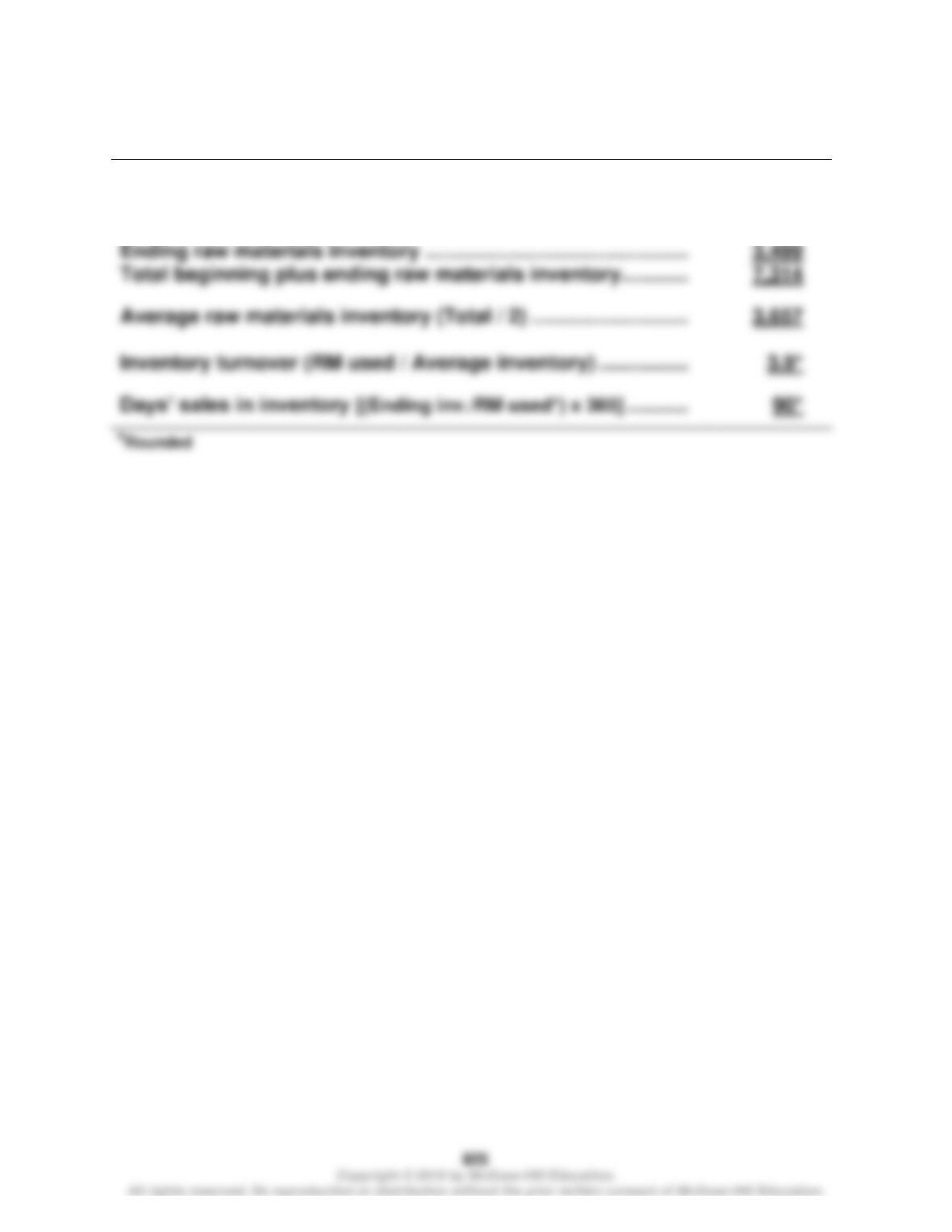
(Amounts in millions of Swiss francs)
Raw materials inventory, beginning ……………………………………
3,815
Plus raw materials purchased …………………………………………….
Raw materials available for use …………………………..……………..
Beg. Inv. 3,815
Purchases 13,860
Raw Materials inventory
Wild and Shaw, Financial & Managerial Accounting, 8e Solutions Manual: Chapter 14
Quick Study 14–17 (10 minutes)
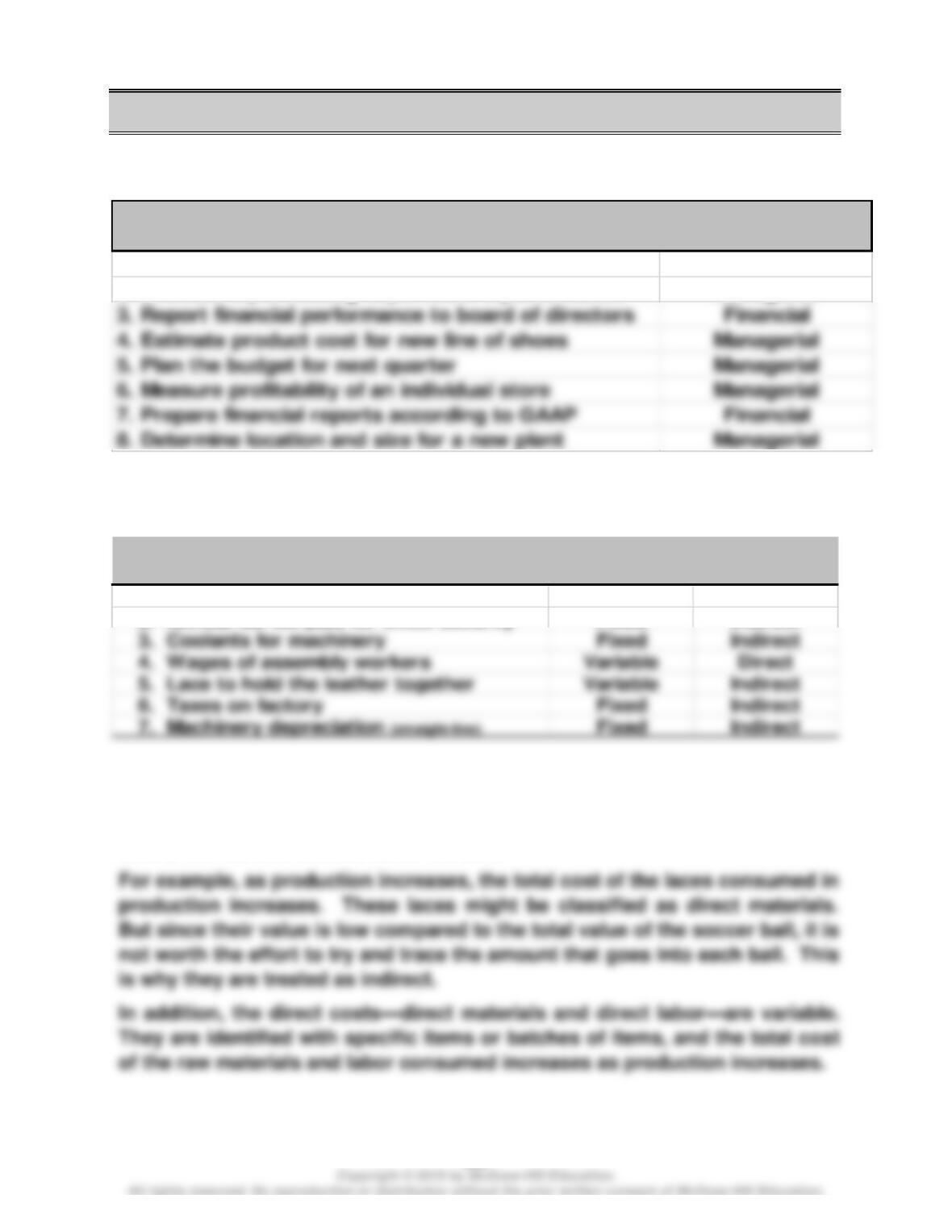
(in millions of Swiss francs)
Cost of raw materials used ……………………………………………….
14,176
Beginning raw materials inventory ……………………………………
3,815
3,499
7,314
3,657
Wild and Shaw, Financial & Managerial Accounting, 8e Solutions Manual: Chapter 14
826
EXERCISES
Exercise 14-1 (10 minutes)
Primary Information
Source
Financial
Managerial
Business Decision
1. Determine whether to lend to a company
2. Evaluate a purchasing department’s performance
Exercise 14-2 (20 minutes)
Product Cost
Variable
or Fixed
Direct
or Indirect
1. Leather cover for soccer balls Variable Direct
2. Annual flat fee paid for office security Fixed Indirect
5. Lace to hold the leather together Variable Indirect
6. Taxes on factory Fixed Indirect
Most fixed costs are indirect. Fixed costs normally are resources acquired to
support the production process rather than being traceable to individual
products or batches of product. However, not all indirect costs are fixed.
Some, like indirect materials, are variable.
Wild and Shaw, Financial & Managerial Accounting, 8e Solutions Manual: Chapter 14
Exercise 14-3 (10 minutes)
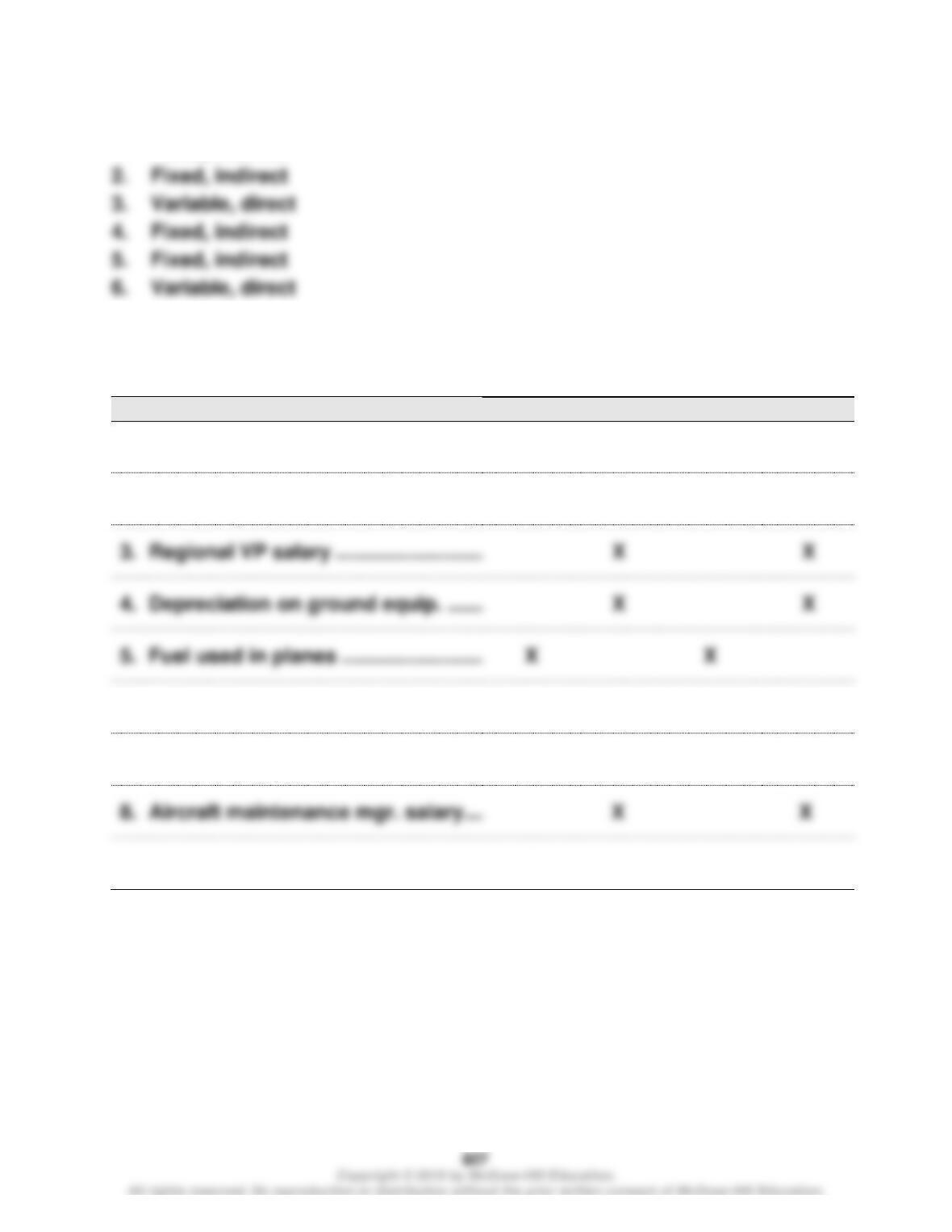
1. Fixed, indirect
Exercise 14-4 (20 minutes)
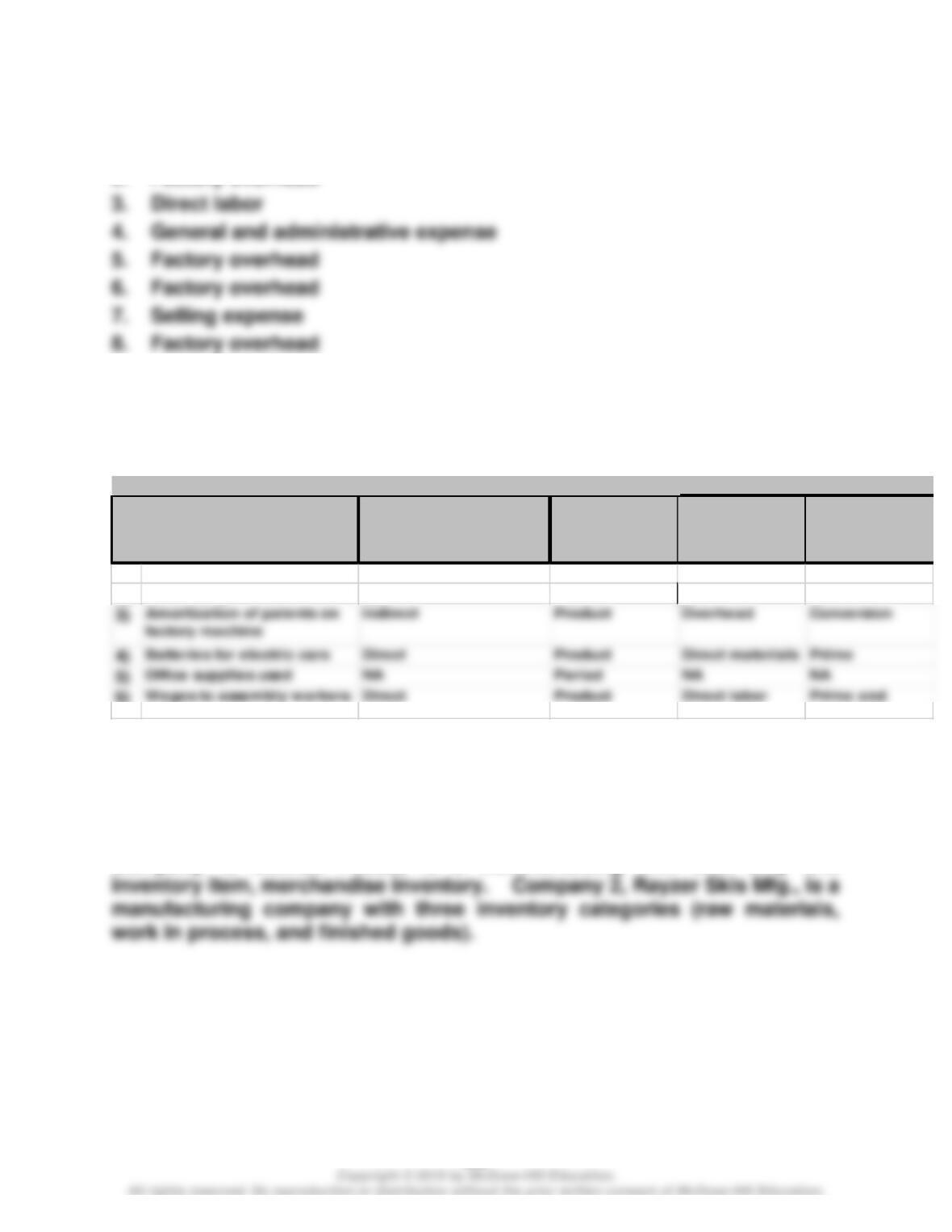
Cost
Variable
Fixed
Direct
Indirect
1. Advertising ……………………………………..
X
X
2. Beverages served on planes ……………
X
X
3. Regional VP salary ………………………….
4. Depreciation on ground equip. ………..
5. Fuel used in planes …………………………
X
X
6. Flight attendant wages …………………….
X
X
7. Pilot wages ……………………………………..
X
X
8. Aircraft maintenance mgr. salary ……..
X
X
Wild and Shaw, Financial & Managerial Accounting, 8e Solutions Manual: Chapter 14
828
Exercise 14-5 (15 minutes)
1. Direct material
2. Factory overhead
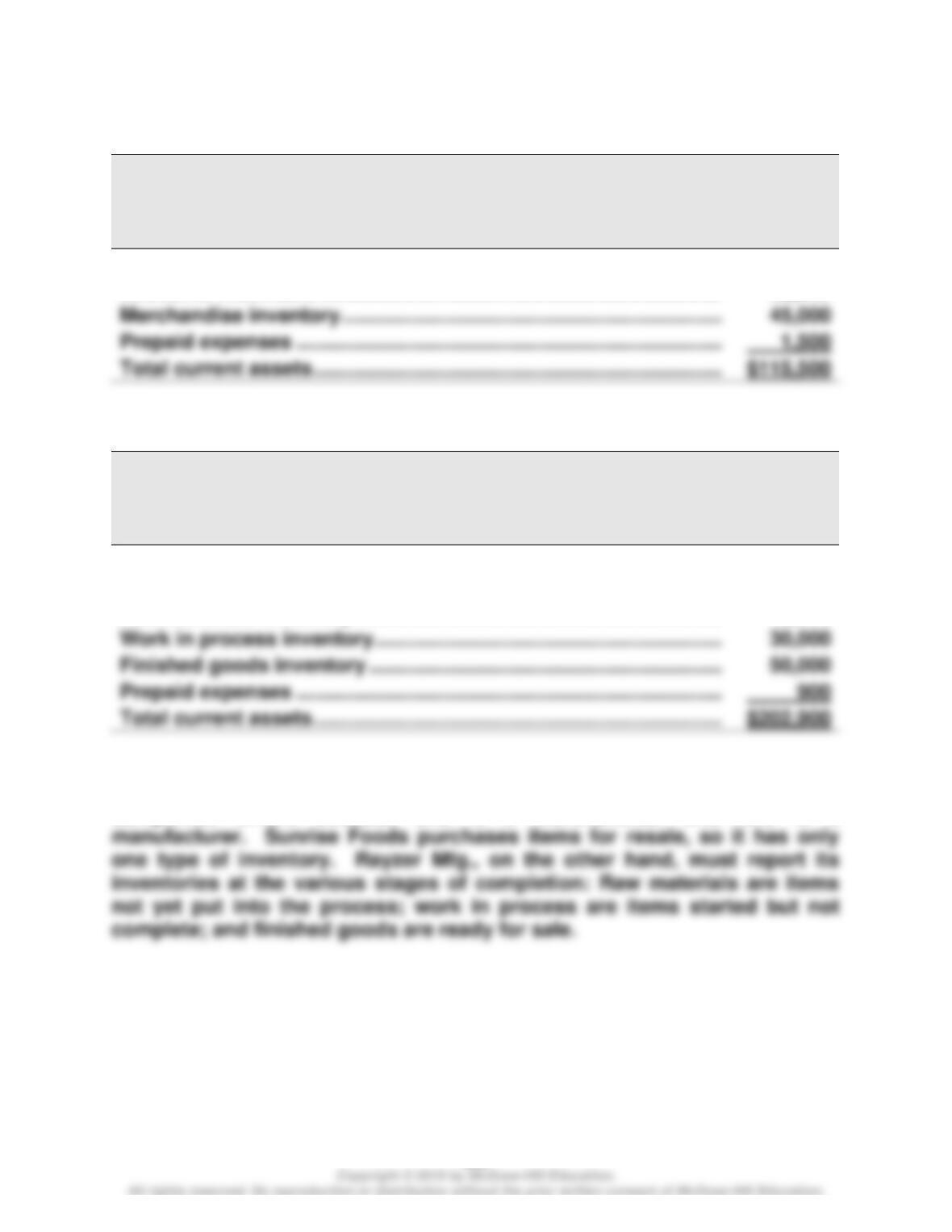
Exercise 14-6 (20 minutes)
If Product Cost, Then:__
Direct or Indirect
Product or
Period
Product Cost
Type
Prime or
Conversion
1) Factory electricity Indirect Product Overhead Conversion
2) Advertising NA Period NA NA
6) Wages to assembly workers Direct Product Direct labor
conversion
Cost
Exercise 14-7 (20 minutes)
Part 1
Company 1, Sunrise Foods, is a merchandising firm with only one
Wild and Shaw, Financial & Managerial Accounting, 8e Solutions Manual: Chapter 14
829
Exercise 14–7 (concluded)
Part 2
Company 1
Sunrise Foods
Balance Sheet—Current Assets Section
Fiscal Year-end
Cash ………………………………………………………………………………………………..
$ 7,000
Accounts receivable …………………………………………………………………………
62,000
Merchandise inventory ……………………………………………………………………..
45,000
Total current assets ………………………………………………………………………….
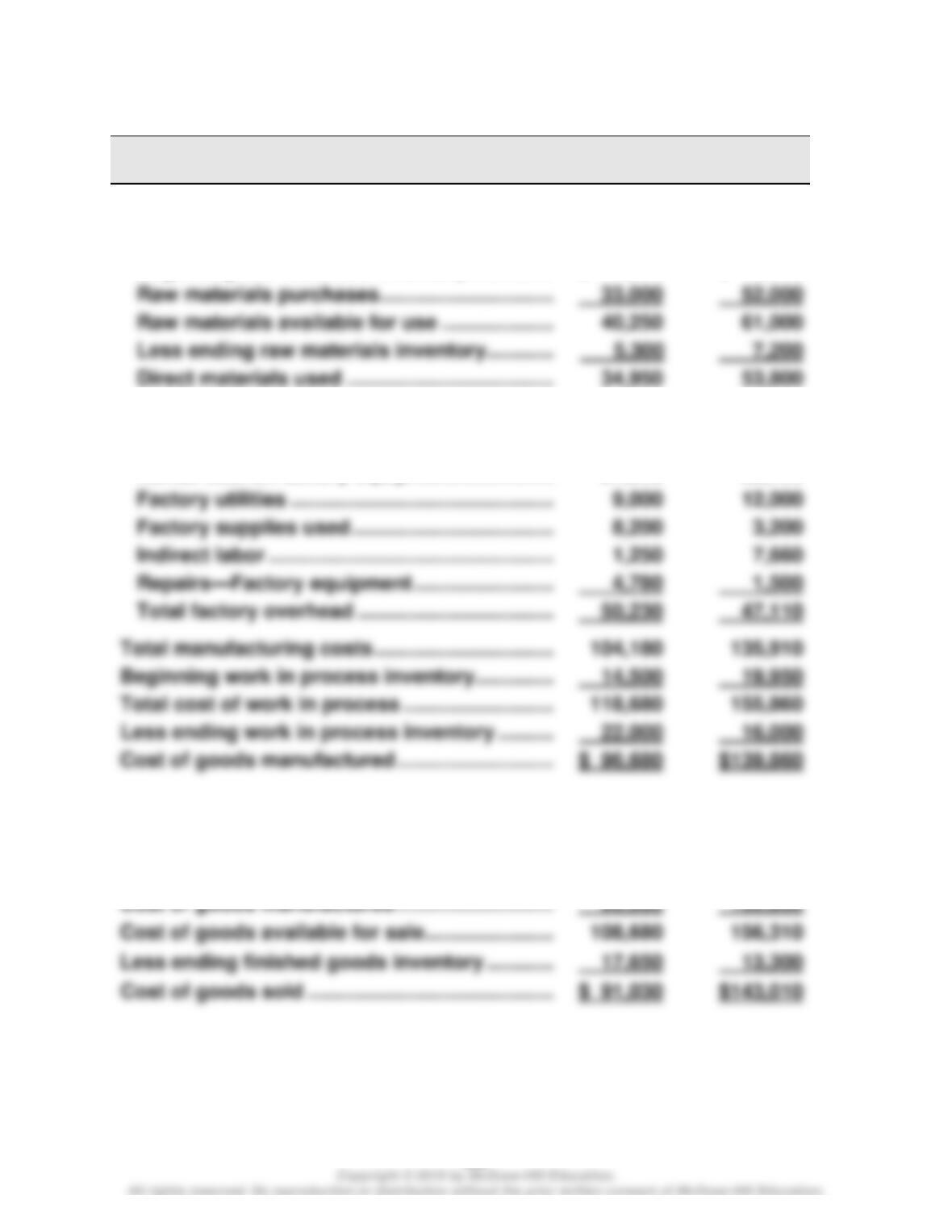
Company 2
Rayzer Skis Mfg.
Balance Sheet—Current Assets Section
Fiscal Year-end
Cash ………………………………………………………………………………………………..
$ 5,000
Accounts receivable …………………………………………………………………………
75,000
Raw materials inventory …………………………………………………………………..
42,000
30,000
Total current assets ………………………………………………………………………….
Discussion: The current assets section of the balance sheet for these two
companies differs because one is a merchandiser and one is a
Wild and Shaw, Financial & Managerial Accounting, 8e Solutions Manual: Chapter 14
830
Exercise 14-8 (30 minutes)
Garcon
Company
Pepper
Company
1. COST OF GOODS MANUFACTURED
Direct materials
Beginning raw materials inventory ……………..
$ 7,250
$ 9,000
Raw materials purchases …………………………..
Raw materials available for use ………………….
40,250
61,000
Less ending raw materials inventory …………..
Direct labor …………………………………………………..
19,000
35,000
Factory overhead
Rental cost on factory equipment ……………….
27,000
22,750
Factory utilities ………………………………………….
12,000
Factory supplies used ………………………………..
Indirect labor ……………………………………………..
Total manufacturing costs …………………………..
Beginning work in process inventory …………….
Total cost of work in process ………………………..
Less ending work in process inventory …………
Cost of goods manufactured …………………………
$ 96,680
$139,860
2. COST OF GOODS SOLD
Beginning finished goods inventory ……………..
$ 12,000
$ 16,450
Cost of goods manufactured …………………………
Cost of goods available for sale …………………….
Less ending finished goods inventory …………..
Cost of goods sold ……………………………………….
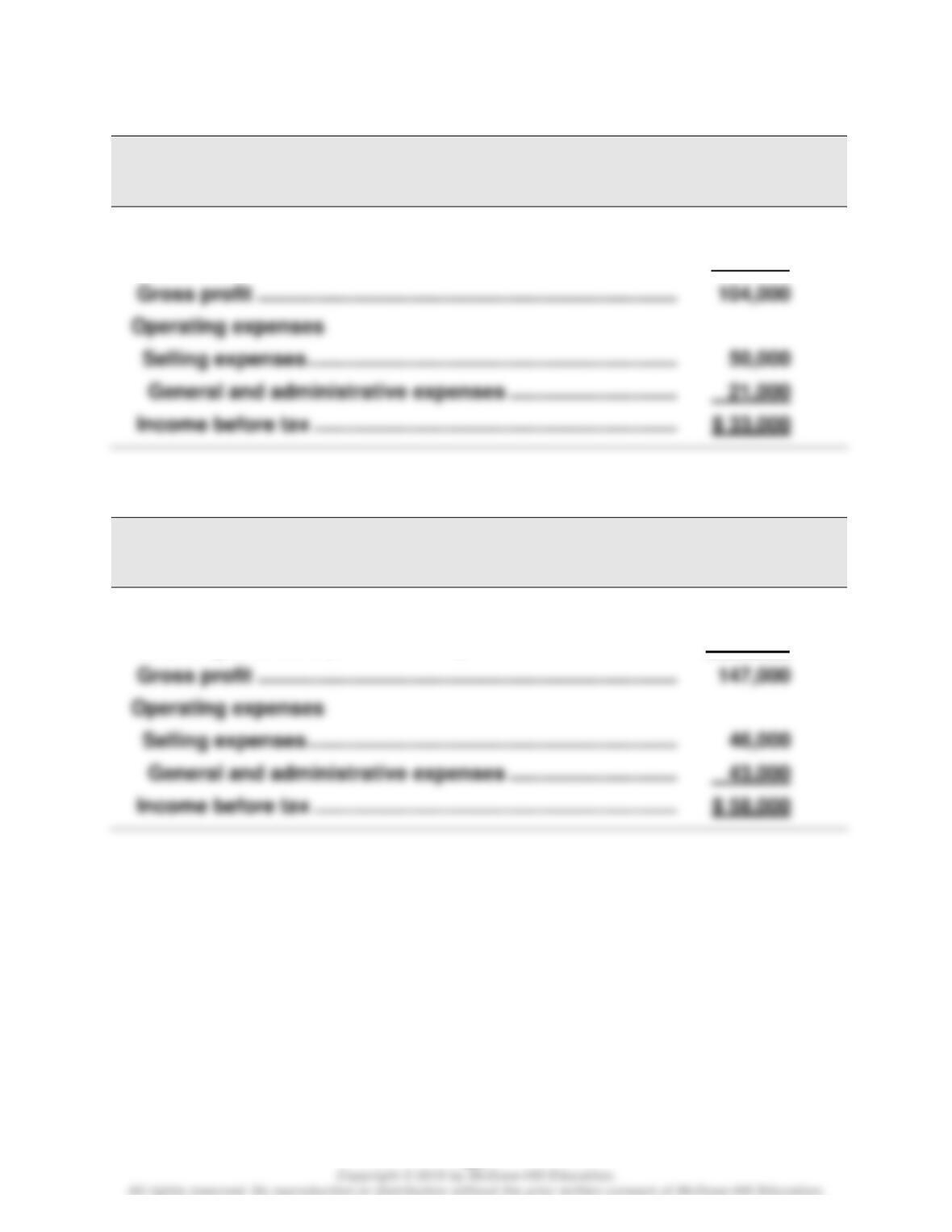
$ 91,030
$143,010
Wild and Shaw, Financial & Managerial Accounting, 8e Solutions Manual: Chapter 14
831
Exercise 14–9 (30 minutes)
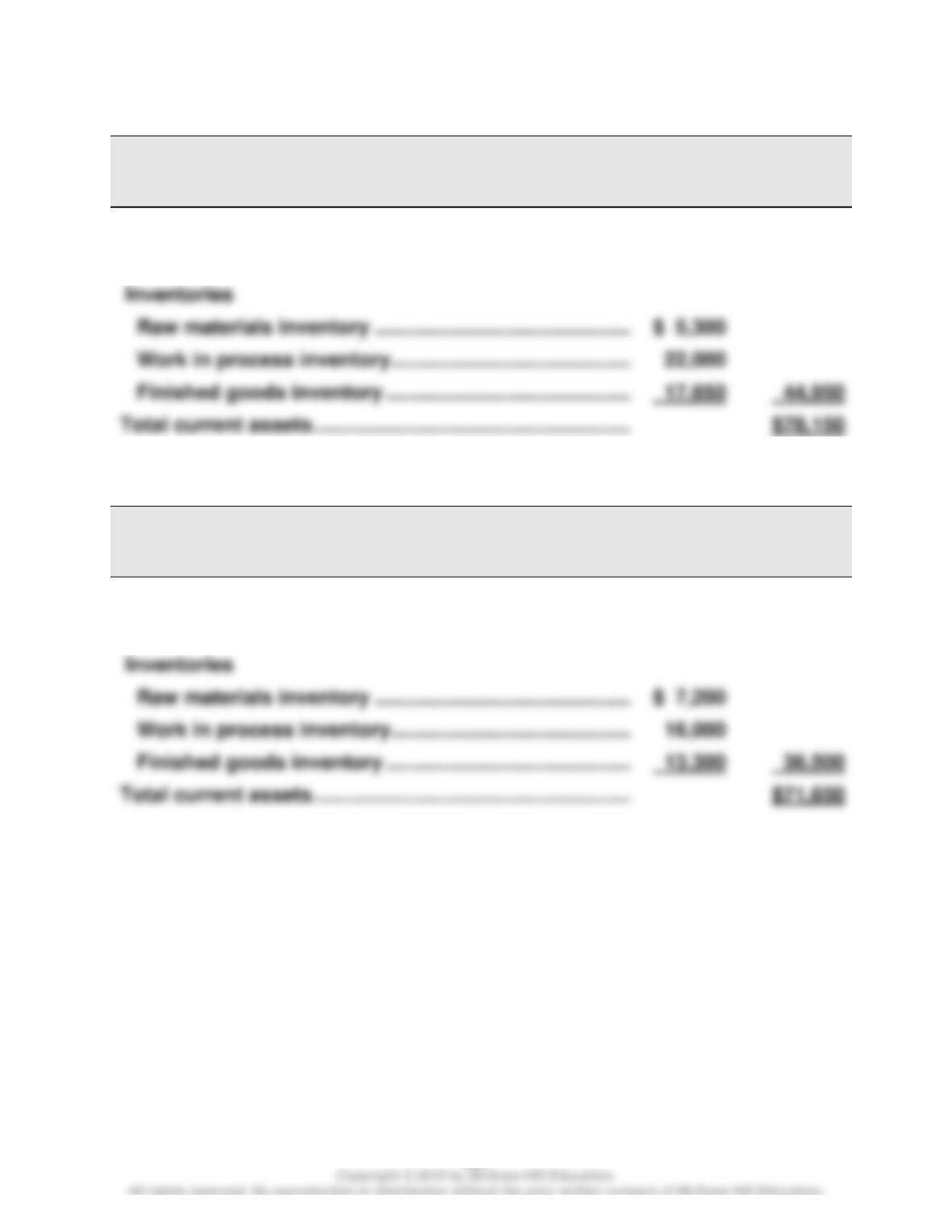
GARCON COMPANY
Income Statement
For Year Ended December 31, 2019
Sales …………………………………………………………………………………
$195,030
Cost of goods sold (from Ex. 14–8) …………………………………….
91,030
Gross profit …………………………..………………………………………….
PEPPER COMPANY
Income Statement
For Year Ended December 31, 2019
Sales …………………………………………………………………………………
$290,010
Cost of goods sold (from Ex. 14–8) …………………………………….
143,010
Gross profit …………………………..………………………………………….
Wild and Shaw, Financial & Managerial Accounting, 8e Solutions Manual: Chapter 14
832
Exercise 14–9 (continued)
GARCON COMPANY
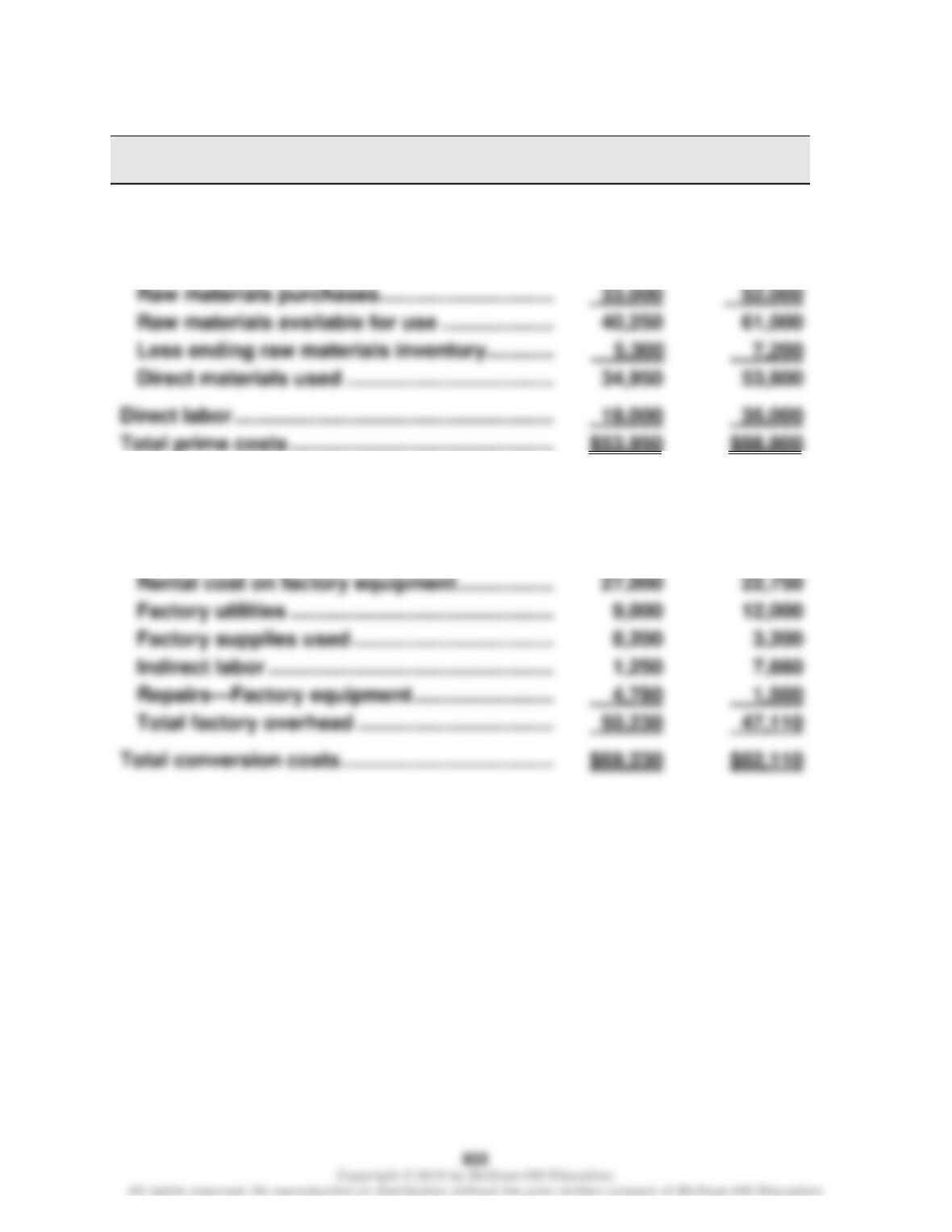
Partial Balance Sheet
As of December 31, 2019
Cash ………………………………………………………………………………
$20,000
Accounts receivable, net ………………………………………………..
13,200
Total current assets ……………………………………………………….
$78,150
PEPPER COMPANY
Partial Balance Sheet
As of December 31, 2019
Cash ………………………………………………………………………………
$15,700
Accounts receivable, net ………………………………………………..
19,450
Total current assets ……………………………………………………….
$71,650
Wild and Shaw, Financial & Managerial Accounting, 8e Solutions Manual: Chapter 14
Exercise 14-10 (20 minutes)
Garcon
Company
Pepper
Company
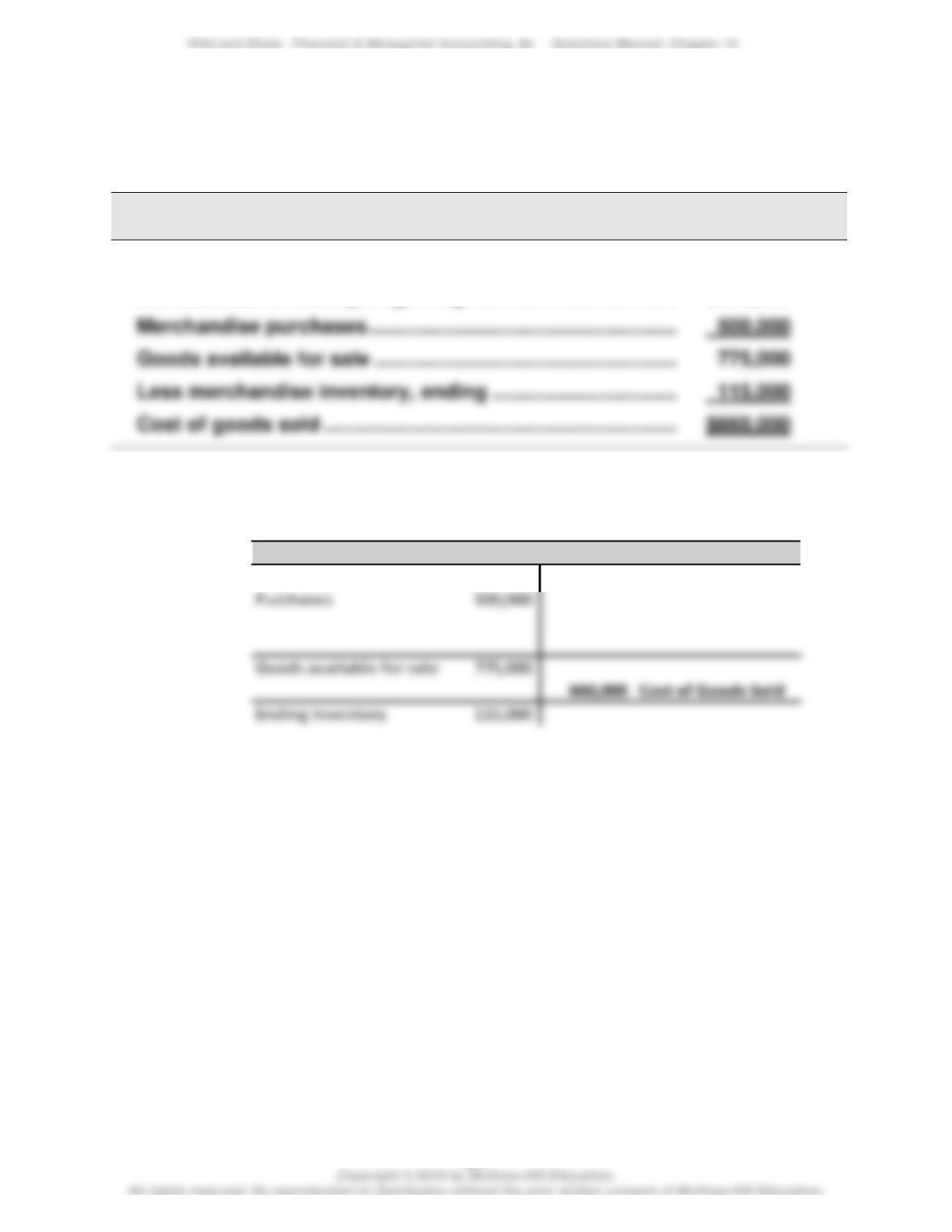
1. PRIME COSTS
Direct materials
Beginning raw materials inventory ……………..
$ 7,250
$ 9,000
Raw materials purchases …………………………..
Raw materials available for use ………………….
Less ending raw materials inventory …………..
2. CONVERSION COSTS
Direct labor …………………………………………………..
Factory overhead
$19,000
$35,000
Rental cost on factory equipment ……………….
Factory utilities ………………………………………….
Factory supplies used ………………………………..
Indirect labor ……………………………………………..
Total conversion costs ………………………………….
834
Exercise 14–11 (20 minutes)
Merchandising Business
UNIMART
Computation of Cost of Goods Sold
Cost of goods sold
Merchandise inventory, beginning …………………………………….
$275,000
Merchandise purchases …………………………………………………….
Goods available for sale ……………………………………………………
Less merchandise inventory, ending …………………………………
Beginning Inventory 275,000
Merchandise Inventory