
250 Chapter 14 Long-Term Liabilities: Bonds and Notes
OBJECTIVE 6
Describe and illustrate how the number of times interest charges are earned is used to
evaluate a company’s financial condition.
KEY TERMS
Number of Times Interest Charges Are Earned
SUGGESTED APPROACH
The number of times interest charges are earned compares the “pool” of money available for interest
payments to a company’s interest expense. The larger the “pool,” the easier it is for a company to meet its
interest payments. The group learning activity below will help your students master this concept.
GROUP LEARNING ACTIVITY — Number of Times Interest Charges Earned
TM 14-16 lists revenue and expense data for Bates Corporation. Ask your students, working in small
groups, to compute the amount of funds available to pay interest charges. The correct answer is $10,000.
This amount is obtained by subtracting the operating expenses from the revenues. If any of your groups
answer $6,000, they have deducted income taxes. Point out that interest is a tax-deductible expense;
therefore, it is paid out of before-tax earnings. Bates’s income before taxes is $9,000.
Next, present the formula for number of times interest charges earned:
Income before income tax + Interest expense
Interest expense
Ask your students to calculate Bates’s number of times interest charges earned. The answer is:

Chapter 14 Long-Term Liabilities: Bonds and Notes 251
APPENDIX 1 — PRESENT VALUE CONCEPTS
AND PRICING BONDS PAYABLE
SUGGESTED APPROACH — Computation of Present Value of Bonds
Payable
This introduces students to present value concepts used to price bonds. This concept is new to most
accounting principles students, and many find it very difficult. Therefore, you may want to spend time
discussing present value in general before applying this concept to bonds.
A series of questions follow, which you can ask your class to lead into a discussion of present value.
Several Demonstration Problems showing the use of present value outside the area of bonds are also
presented. To give your students a chance to practice these concepts, assign Handout 14-1 as a group
learning activity or as homework.
This process can be overwhelming to some students, but when broken down to a simple four-step process,
it becomes manageable. The four-step process is as follows:
2. Calculate the interest payment. Use the bond interest rate for this calculation
4. Add the PV of the lump sum (step 1) to the PV of the annuity (step 3). The results will be the present
value of the bond.
LECTURE AID — Introduction to Present Value
Present the following scenario to your class:
If I told you that I would give you $100 today or $100 one year from now, how many of
you would want the money today? What if I told you that I would give you $100 today or
$105 one year from now? How many of you would wait one year to get an extra $5? If I
offered to pay $110 one year from now, how many would wait one year for an extra $10?
What about $125 in one year? What about $150 in one year?
Ask a student who did not raise a hand when you offered $105 why he or she was not willing to wait one
year for the extra $5. Next, ask a student who did raise a hand when you offered $125 or $150 why he or
she was willing to wait one year to receive an extra $25 or $50.
Your students’ comments should provide a good lead-in to a discussion of time value of money.

252 Chapter 14 Long-Term Liabilities: Bonds and Notes
DEMONSTRATION PROBLEM — Present Value of a Single Sum
One hundred dollars today is more valuable than $100 in the future. You can invest the $100 you have
today and end up with more than $100 in the future.
Ask your students to calculate how much money they would have in one year if they invested $100 and
earned 7 percent interest on their money. (Answer: $107)
Look at this same concept from the reverse perspective. How much money do you need to invest today to
have $100 in one year if interest rates are 7 percent? Show your students how to solve this problem with
an algebraic equation.
Let X = $ to be invested today
X + .07X = $100
1.07X = $100
$93.46 is the present value of receiving $100 in one year if interest rates are 7 percent.
Next, ask your students to write down the equation to determine how much they would need to invest to
have $100 in two years, assuming a 7 percent interest rate. After a minute, show them the correct formula.
Therefore,
This calculation gets fairly complex after just two years because of the compounding of interest. Present
value tables, such as the one in Exhibit 4 in the text, were developed as a shortcut. To calculate the
amount needed today to accumulate $100 in two years at 7 percent, the present value factor from the table
for two periods at 7 percent is multiplied by $100.

Chapter 14 Long-Term Liabilities: Bonds and Notes 253
Assume that you have a rich uncle who dies. In his will, he leaves you with the following
option: You can have $100,000 today or $200,000 in ten years. Interest rates are 10
percent. Which should you choose?
DEMONSTRATION PROBLEM — Present Value of an Annuity
Begin by defining an annuity. An annuity is a series of equal payments at equal intervals (for example,
$100 per year for five years). Ask students for examples of annuities. Examples include insurance and
pension annuities.
Demonstrate the need to calculate the present value of an annuity through the following scenario:
Assume that you have won a sweepstakes with a $5 million grand prize. Now you have to choose how to
take your winnings: $500,000 per year for ten years or $3 million now. If interest rates are 11 percent,
which would you choose?
To solve this problem, you need to compare the $3 million that could be yours today with what receiving
the money over ten years is worth today. In other words, you need to compute the present value of an
annuity using the table in text Exhibit 5.
To calculate the present value of an annuity:
Annuity Amount Factor from PV Table for Annuities (Exhibit 5)
Next, ask your students to determine whether they would want the sweepstakes prize today or over ten
years if they could earn only 6 percent interest on investments.
GROUP LEARNING ACTIVITY — Present Value of an Annuity
TM 14-9 contains additional annuity problems to be solved with present value concepts. One of these
problems requires students to use present value interest factors for a 20-year period. These factors can be
found in the expanded present value tables included in Appendix A of the text.

254 Chapter 14 Long-Term Liabilities: Bonds and Notes
LECTURE AID — Pricing Bonds
The selling price of a bond is determined by the relationship between the bond’s contract interest rate and
the market interest rate when the bond is sold.
If contract rate = market rate, bond sells at face value.
When determining the present value of a bond, the following two components must be viewed separately:
APPENDIX 2 — EFFECTIVE INTEREST RATE
METHOD OF AMORTIZATION
Two Demonstration Problems to help you introduce effective interest amortization are provided below.
Stress that this method reports a constant rate of interest. Interest expense reported on the income
statement is always the same percentage of the beginning carrying value of any bonds. That percentage is
the market rate of interest on the date bonds were issued.
The following comparison of the straight-line and effective interest amortization methods will help your
students distinguish between the two methods:
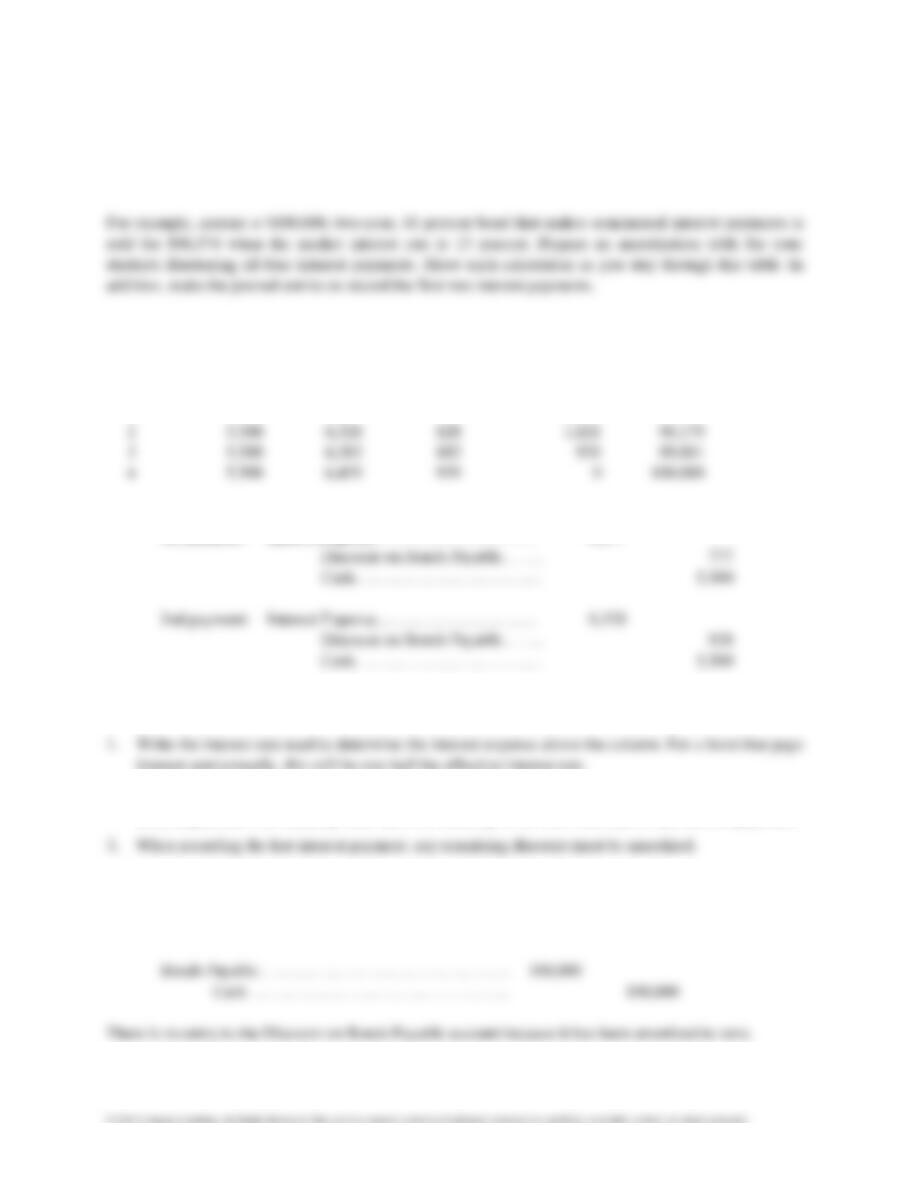
DEMONSTRATION PROBLEM — Amortizing a Bond Discount Using the
Effective Interest Method
The easiest way to amortize a bond discount correctly is to set up an amortization table with the following
headings:
Chapter 14 Long-Term Liabilities: Bonds and Notes 255
Interest Interest
Paid Expense Bond
Interest (based on the (based on the Discount Unamortized Carrying
Payment contract rate) market rate) Amortization Discount Amount
5.5% 6.5% Bond
Interest Interest Interest Discount Unamortized Carrying
Payment Paid Expense Amortization Discount Amount
3,426 96,574
1 5,500 6,277 777 2,649 97,351
Journal entries:
1st payment: Interest Expense………………………… 6,277
Your students may find the following hints helpful:
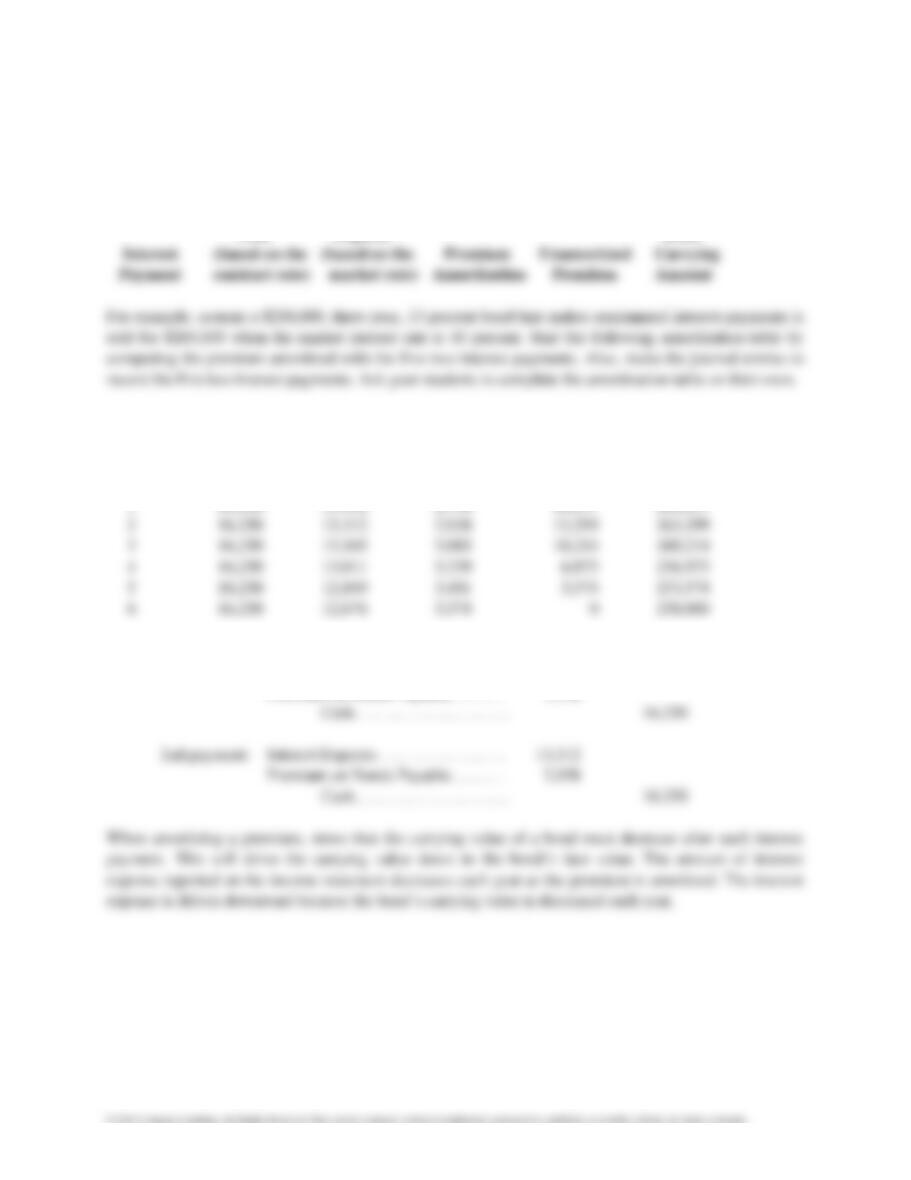
2. When amortizing a discount, make sure that the carrying value of the bond increases after each
interest payment. The carrying value must be raised up to the face value by the last interest payment.
Point out that interest expense reported on the income statement increases each year as you amortize the
bond discount. This occurs because the bond’s carrying value is increasing. You may also want to
illustrate the journal entry to repay the bond at maturity:
256 Chapter 14 Long-Term Liabilities: Bonds and Notes
DEMONSTRATION PROBLEM — Amortizing a Bond Premium
The easiest way to amortize a bond premium correctly is to set up an amortization table with the
following headings:
Interest Interest
Paid Expense Bond
6.5% 5% Bond
Interest Interest Interest Premium Unamortized Carrying
Payment Paid Expense Amortization Premium Amount
19,035 269,035
1 16,250 13,452 2,798 16,237 266,237
Journal entries:
1st payment: Interest Expense…………………… 13,452
Premium on Bonds Payable……….. 2,798

Handout 14-1
PRESENT-VALUE PROBLEMS
2. You’ve just accepted a contract to provide services for a client for seven years at a fee of
3. Ellen Saber is contemplating paying several years’ rent on her business office in advance.
4. Craig Jones owns a computer sales and repair business. He has decided to sell maintenance
contracts with new computers that cover all repairs needed within three years of purchase.
5. You have just won the Florida lottery, and the jackpot was $10 million! Your first major
decision is how to take your prize winnings. You can choose $1 million a year for ten years
or $5.65 million now. Which would you choose if you believe you can earn 10 percent
interest on money you invest?
DIFFICULTY BUSPROG AICPA AICPA ACBSP ACBSP BLOOM’S TIME
Problem
Learning
Objective
Description Primary
Broad
Business
Functional Primary Secondary
Spread-
sheet
GL
DQ14-1 14-2 Easy Analytic Measurement Long-Term Liabilities Reporting Knowledge 5 min.
DQ14-2 14-2 Easy Analytic Measurement Long-Term Liabilities Reporting Knowledge 5 min.
DQ14-4 14-2 Easy Analytic Measurement Long-Term Liabilities Reporting Knowledge 5 min.
DQ14-5 14-2 Easy Analytic Measurement Long-Term Liabilities Reporting Knowledge 5 min.
DQ14-6 14-2 Easy Analytic Measurement Long-Term Liabilities Reporting Knowledge 5 min.
DQ14-7 14-3 Easy Analytic Measurement Long-Term Liabilities Reporting Knowledge 5 min.
DQ14-8 14-3 Easy Analytic Measurement Long-Term Liabilities Reporting Knowledge 5 min.
DQ14-9 14-3 Easy Analytic Measurement Long-Term Liabilities Reporting Knowledge 5 min.
DQ14-10 14-4 Easy Analytic Measurement Long-Term Liabilities Reporting Knowledge 5 min.
PE14-1A 14-1 Alternative financing plans Easy Analytic Measurement Long-Term Liabilities Reporting
Accounting for
Corporations
Application 5 min.
PE14-2A 14-3 Issuing bonds at a discount Easy Analytic Measurement Long-Term Liabilities Reporting Application 5 min.
PE14-2B 14-3 Issuing bonds at a discount Easy Analytic Measurement Long-Term Liabilities Reporting Application 5 min.
PE14-3A 14-3 Discount amortization Easy Analytic Measurement Long-Term Liabilities Reporting Application 5 min.
PE14-3B 14-3 Discount amortization Easy Analytic Measurement Long-Term Liabilities Reporting Application 5 min.
PE14-4A 14-3 Issuing bonds at a premium Easy Analytic Measurement Long-Term Liabilities Reporting Application 5 min.
PE14-4B 14-3 Issuing bonds at a premium Easy Analytic Measurement Long-Term Liabilities Reporting Application 5 min.
PE14-5A 14-3 Premium amortization Easy Analytic Measurement Long-Term Liabilities Reporting Application 5 min.
PE14-5B 14-3 Premium amortization Easy Analytic Measurement Long-Term Liabilities Reporting Application 5 min.
PE14-6A 14-3 Redemption of bonds payable Easy Analytic Measurement Long-Term Liabilities Reporting Application 5 min.
PE14-6B 14-3 Redemption of bonds payable Easy Analytic Measurement Long-Term Liabilities Reporting Application 5 min.
PE14-7A 14-4 Journalizing installment notes Easy Analytic Measurement Long-Term Liabilities Reporting Application 5 min.
PE14-7B 14-4 Journalizing installment notes Easy Analytic Measurement Long-Term Liabilities Reporting Application 5 min.
PE14-8A 14-6
are earned
Easy Analytic Measurement Long-Term Liabilities Reporting Application 5 min.
PE14-8B 14-6
Number of times interest charges
are earned
Easy Analytic Measurement Long-Term Liabilities Reporting Application 5 min.
Ex14-1 14-1
Effect of financing on earnings per
share
Easy Analytic Measurement Long-Term Liabilities Reporting Application 10 min. X
Ex14-2 14-1 Evaluate alternative financing plans Easy Analytic Measurement Long-Term Liabilities Reporting
Ex14-3 14-1 Corporate financing Easy Analytic Measurement Long-Term Liabilities Reporting
Corporations
Application 5 min.
Ex14-4 14-3 Bond price Easy Analytic Measurement Long-Term Liabilities Reporting Application 10 min.
Ex14-5 14-3 Entries for issuing bonds Easy Analytic Measurement Long-Term Liabilities Reporting Application 10 min.
Ex14-6 14-3
method
Easy Analytic Measurement Long-Term Liabilities Reporting Application 5 min.
HOMEWORK CHART WITH LEARNING OUTCOMES TAGGING
DIFFICULTY BUSPROG AICPA AICPA ACBSP ACBSP BLOOM’S TIME
Problem
Learning
Objective
Description Primary
Broad
Business
Functional Primary Secondary
Spread-
sheet
GL
Ex14-7 14-2, 14-3
Entries for issuing bonds and
amortizing premium by straight-line
method
Easy Analytic Measurement Long-Term Liabilities Reporting Application 5 min.
Ex14-8 14-3
Easy Analytic Measurement Long-Term Liabilities Reporting Application 5 min.
Entries for issuing and calling
Ex14-9 14-3
bonds; gain
Easy Analytic Measurement Long-Term Liabilities Reporting Application 5 min.
Ex14-10 14-4
Easy Analytic Measurement Long-Term Liabilities Reporting Application 5 min.
Entries for issuing installment note
Ex14-11 14-4
transactions
Easy Analytic Measurement Long-Term Liabilities Reporting Application 10 min.
Ex14-12 14-4
Entries for issuing installment note
transactions
Easy Analytic Measurement Long-Term Liabilities Reporting Application 15 min.
Ex14-13 14-5 Reporting bonds Easy Analytic Measurement Long-Term Liabilities Reporting Application 10 min.
Ex14-14 14-6
Number of times interest charges
Easy Analytic Measurement Long-Term Liabilities Reporting Application 10 min.
Ex14-15 14-6
are earned
Easy Analytic Measurement Long-Term Liabilities Reporting Application 10 min.
Ex14-16 14-6
Number of times interest charges
are earned
Easy Analytic Measurement Long-Term Liabilities Reporting Application 10 min.
Ex14-17
Appendix
1 Present value of amounts due Easy Analytic Measurement Long-Term Liabilities Reporting Application 15 min.
Ex14-18
Appendix
1 Present value of annuity Moderate Analytic Measurement Long-Term Liabilities Reporting Application 15 min.
Ex14-19
1 Present value of annuity Moderate Analytic Measurement Long-Term Liabilities Reporting Application 15 min.
Ex14-20
Appendix
1 Present value of annuity Moderate Analytic Measurement Long-Term Liabilities Reporting Application 15 min.
Ex14-21
Appendix
1
Present value of bonds payable;
discount
Moderate Analytic Measurement Long-Term Liabilities Reporting Application 15 min.
Ex14-22
1
Moderate Analytic Measurement Long-Term Liabilities Reporting Application 15 min.
Amortize discount by interest
Ex14-23
2
method
Moderate Analytic Measurement Long-Term Liabilities Reporting Application 15 min.
Ex14-24
Appendix
2
Amortize premium by interest
method
Moderate Analytic Measurement Long-Term Liabilities Reporting Application 15 min.
Ex14-25
Moderate Analytic Measurement Long-Term Liabilities Reporting Application 15 min.
Appendix
1,
Appendix
Compute bond proceeds, amortizing
premium by interest method, and
Ex14-26
2
interest expense
Moderate Analytic Measurement Long-Term Liabilities Reporting Application 15 min.
Pr14-1A 14-1
Effects of financing on earnings per
share
Moderate Analytic Measurement Long-Term Liabilities Reporting
Accounting for
Corporations
Application 1.5 hours X
DIFFICULTY BUSPROG AICPA AICPA ACBSP ACBSP BLOOM’S TIME
Problem
Learning
Objective
Description Primary
Broad
Business
Functional Primary Secondary
Spread-
sheet
GL
Pr14-2A 14-2, 14-3
Bond discount, entries for bonds
payable transactions
Moderate Analytic Measurement Long-Term Liabilities Reporting Application 1 hour X
Pr14-3A 14-2, 14-3
Moderate Analytic Measurement Long-Term Liabilities Reporting Application 1 hour X
Entries for bonds payable
Pr14-4A 14-3, 14-4
installment note transactions
Moderate Analytic Measurement Long-Term Liabilities Reporting Application 1 hour X X
Pr14-5A
2
Moderate Analytic Measurement Long-Term Liabilities Reporting Application 45 min.
Appendix
Appendix
Bond premium, entries for bonds
Appendix
1,
Appendix
Bond premium, entries for bonds
payable transactions, interest
Pr14-6A
2
method of amortizing bond premium
Moderate Analytic Measurement Long-Term Liabilities Reporting Application 45 min.
Pr14-1B 14-1
Effects of financing on earnings per
share
Moderate Analytic Measurement Long-Term Liabilities Reporting
Accounting for
Corporations
Application 1.5 hours X
Pr14-2B 14-2, 14-3
Bond premium, entries for bonds
payable transaction
Moderate Analytic Measurement Long-Term Liabilities Reporting Application 1 hour X
Bond premium, entries for bonds
Entries for bonds payable and
Pr14-4B 14-3, 14-4
installment note transactions
Moderate Analytic Measurement Long-Term Liabilities Reporting Application 1 hour X X
Pr14-5B
2
Moderate Analytic Measurement Long-Term Liabilities Reporting Application 45 min.
Appendix
Appendix
1,
Appendix
Bond premium, entries for bonds
payable transactions, interest
Pr14-6B
2
method of amortizing bond premium
Moderate Analytic Measurement Long-Term Liabilities Reporting Application 45 min.
CP14-1 14-2 General Electric bond issuance Easy Ethics Industry Long-Term Liabilities Reporting Analysis 5 min.
CP14-2 14-2
Ethics and professional conduct in
business
Easy Ethics Industry Long-Term Liabilities Reporting Analysis 5 min.
CP14-3 14-2 Present values Easy Analytic Measurement Long-Term Liabilities Reporting Application 10 min.
CP14-4 14-1 Preferred stock vs. bonds Easy Analytic Measurement Long-Term Liabilities Reporting Comprehension 5 min.
CP14-5 14-2 Financing business expansion Moderate Analytic Measurement Long-Term Liabilities Reporting
Accounting for
Corporations
Application 30 min.
Financial