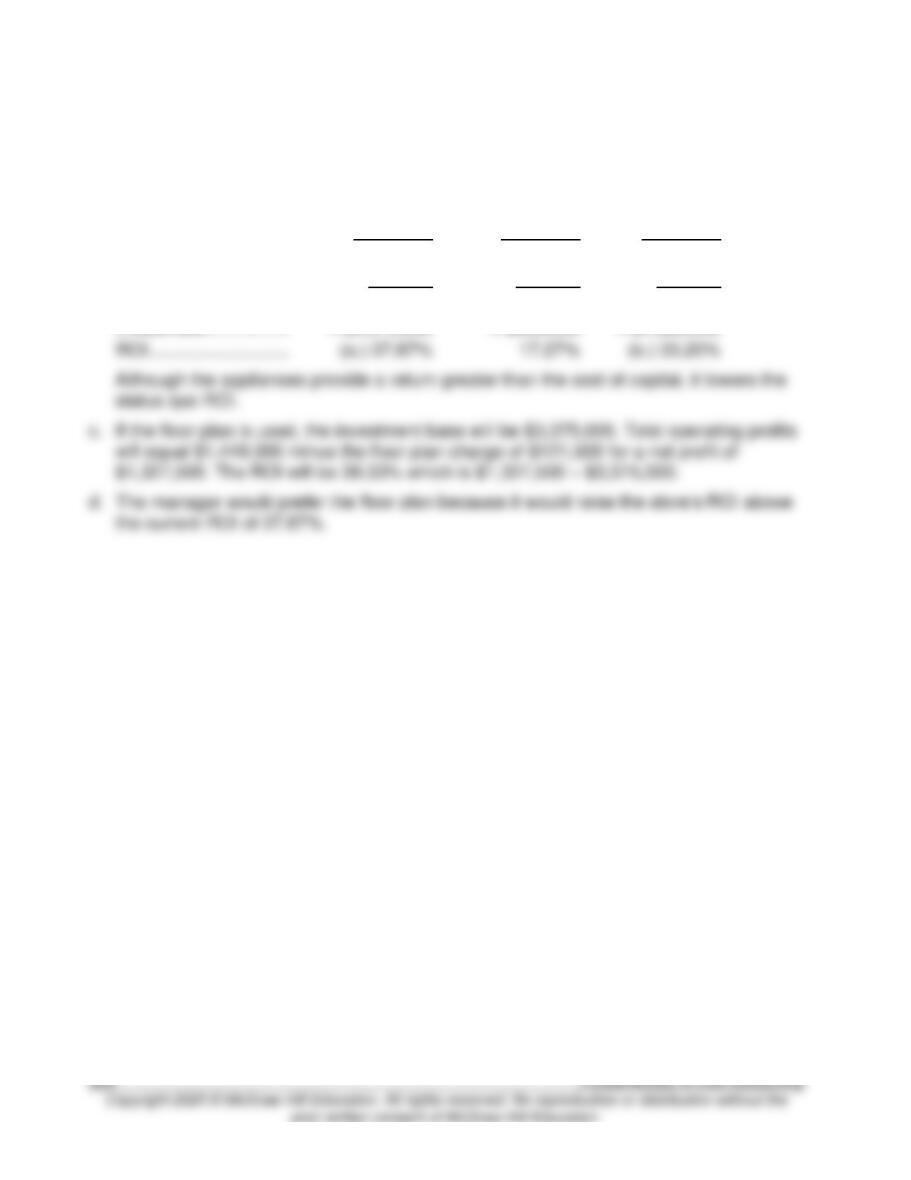
14–53. (35 min.) ROI, Residual Income, Different Asset Bases: Hy’s.
a. and b.
Income statements to summarize the alternatives are as follows:
Regular
Merchandise
Appliances
Total
Sales revenue ………..
$4,680,000
$1,350,000
$6,030,000
Cost of sales…………..
2,934,000
1,026,000
3,960,000
Gross margin ………….
$1,746,000
$324,000
$2,070,000
Operating expense ….
468,000
153,000
621,000
Operating profit ……….
$1,278,000
$171,000
$1,449,000
Investment ……………..
ROI ……………………….

14–53. (continued)
e.
Income statements to summarize the alternatives are as follows: ($ in thousands)
Regular
Merchandise
Appliances
Total
Sales revenue ………………………..
$4,680,000
$1,350,000
$6,030,000
Cost of sales ………………………….
2,934,000
1,026,000
3,960,000
Gross margin …………………………
$1,746,000
$324,000
$2,070,000
Operating expense …………………
468,000
153,000
621,000
Operating profit ………………………
$1,278,000
$171,000
$1,449,000
Capital cost (@ 8%) ………………..
270,000a
79,200b
349,200c
Residual income ……………………
$1,008,000
$91,800
$1,099,800
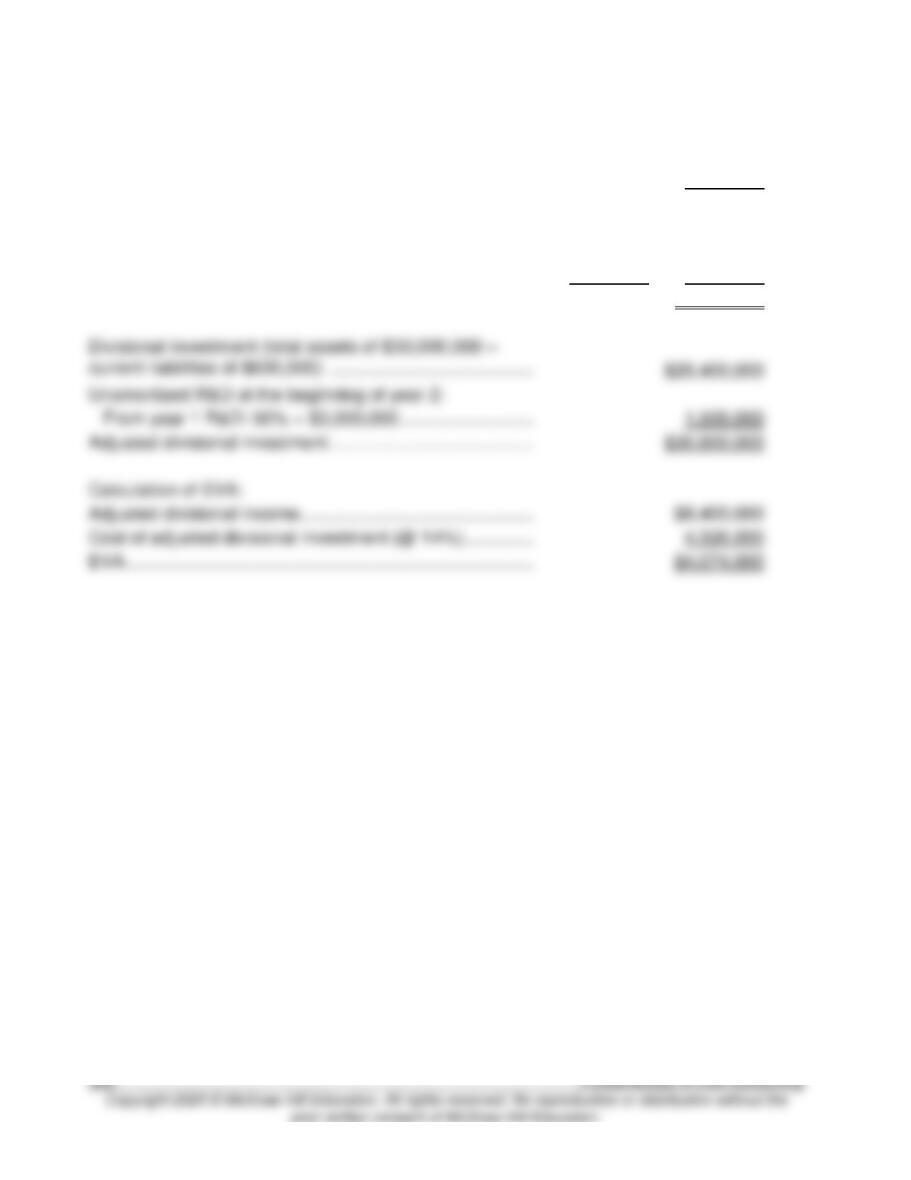
14–54. (35 min.) Economic Value Added: Bisbee Health Products.
After-tax income ………………………………………………………
$7,500,000
Add back R&D expense for year 2 ……………………………..
4,800,000
$12,300,000
Less amortization of R&D:
Year 1 R&D: 50% × $3,000,000………………………………
$1,500,000
Year 2 R&D; 50% × $4,800,000………………………………
2,400,000
3,900,000
Adjusted divisional income ………………………………………..
$8,400,000
Unamortized R&D at the beginning of year 2:
From year 1 R&D: 50% × $3,000,000 ………………………
Adjusted divisional investment …………………………………..
$30,900,000
Calculation of EVA:
Adjusted divisional income ………………………………………..
Cost of adjusted divisional investment (@ 14%) …………..
4,326,000
$4,074,000
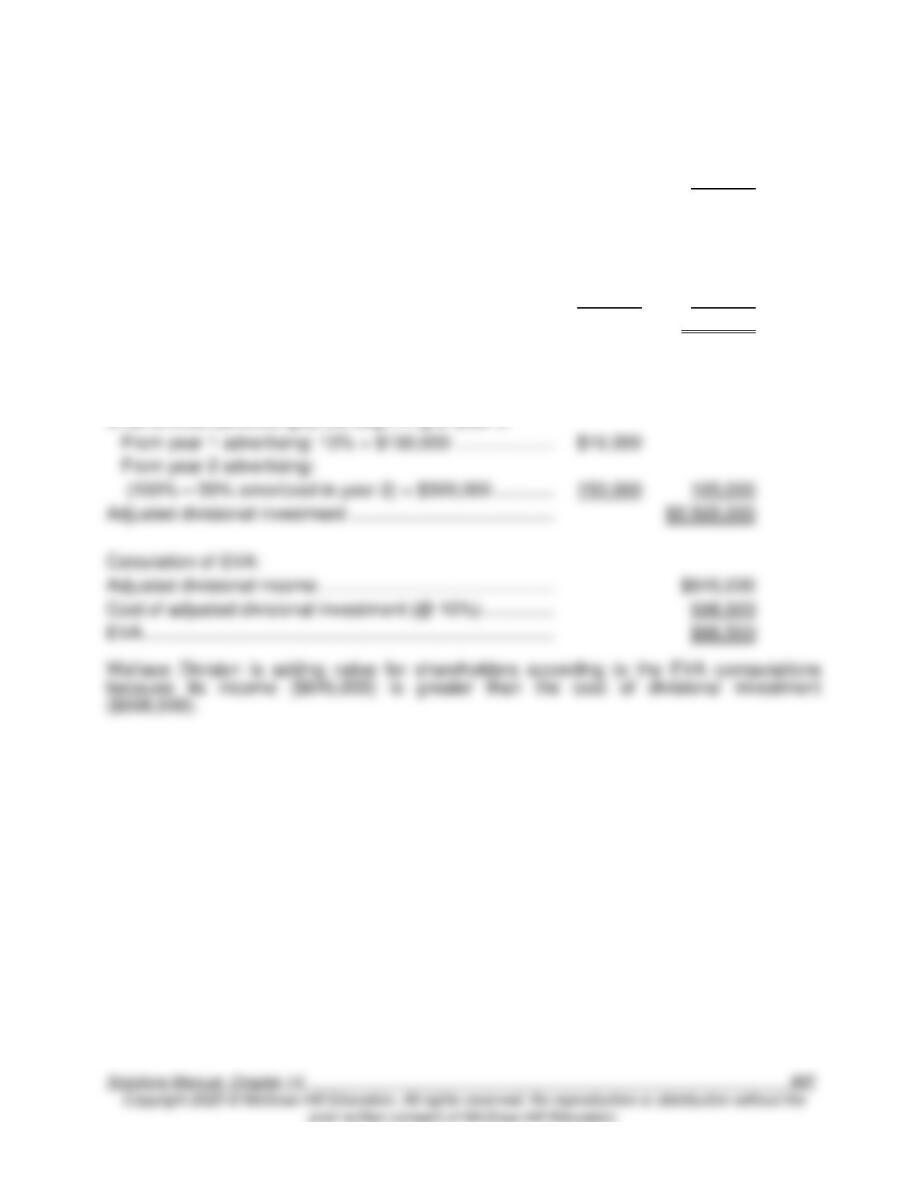
14–55. (35 min.) Economic Value Added: Biddle Company.
After-tax income ………………………………………………………
$600,000
Add back advertising expense for year 3 …………………….
360,000
$960,000
Less amortization of advertising:
Year 1 advertising: 10% × $150,000 ………………………..
$15,000
Year 2 advertising: 40% × $300,000 ………………………..
120,000
Year 3 advertising; 50% × $360,000 ………………………..
180,000
315,000
Adjusted divisional income ………………………………………..
$645,000
Divisional investment (total assets of $6,300,000 –
current liabilities of $900,000) …………………………………..
$5,400,000
Unamortized advertising at the beginning of year 3:
From year 1 advertising: 10% × $150,000 ………………..
$15,000
Adjusted divisional investment …………………………………..
Calculation of EVA:
Adjusted divisional income ………………………………………..
$645,000
Cost of adjusted divisional investment (@ 10%) …………..

14–56. (40 min.) Decision Making, ROI, and Residual Income: T4 Enterprises.
a. Income with the lease is reduced by the lease amount ($775,000). With the purchase of
the technology, it is reduced by the annual amortization of $400,000 (= $2,800,000 ÷ 7
years). The investment is not affected under the lease option, but is increased by the cost
of the technology if purchased ($2,800,000).
The ROIs of the two options are (dollar amounts in thousands):
Purchase:
($5,000 – $400)
=
14.02%
($30,000 + $2,800)
Lease:
($5,000 – $775)
=
14.08%
$30,000
The manager will prefer to lease.
=
14.02%
=
14–57. (30 min.) Compare Historical Cost, Net Book Value to Gross Book Value: Ste.
Marie Division.
a. Net Book Value (In thousands of dollars)
Year 1:
($20,000 – $9,000) – 0.12 × ($90,000 – $9,000)
=
$1,280
Year 2:
($20,000 – $9,000) – 0.12 × [$90,000 – ( 2 x $9,000)]
=
$2,360
Year 3:
($20,000 – $9,000) – 0.12 × [$90,000 – ( 3 x $9,000)]
=
$3,440
Year 4:
($20,000 – $9,000) – 0.12 × [$90,000 – ( 4 x $9,000)]
=
$4,520
b. Gross Book Value (In thousands of dollars)
Year 1:
($20,000 – $9,000) – 0.12 × ($90,000)
=
$200
Year 2:
($20,000 – $9,000) – 0.12 × ($90,000)
=
$200
Year 3:
($20,000 – $9,000) – 0.12 × ($90,000)
=
$200
Year 4:
($20,000 – $9,000) – 0.12 × ($90,000)
=
$200
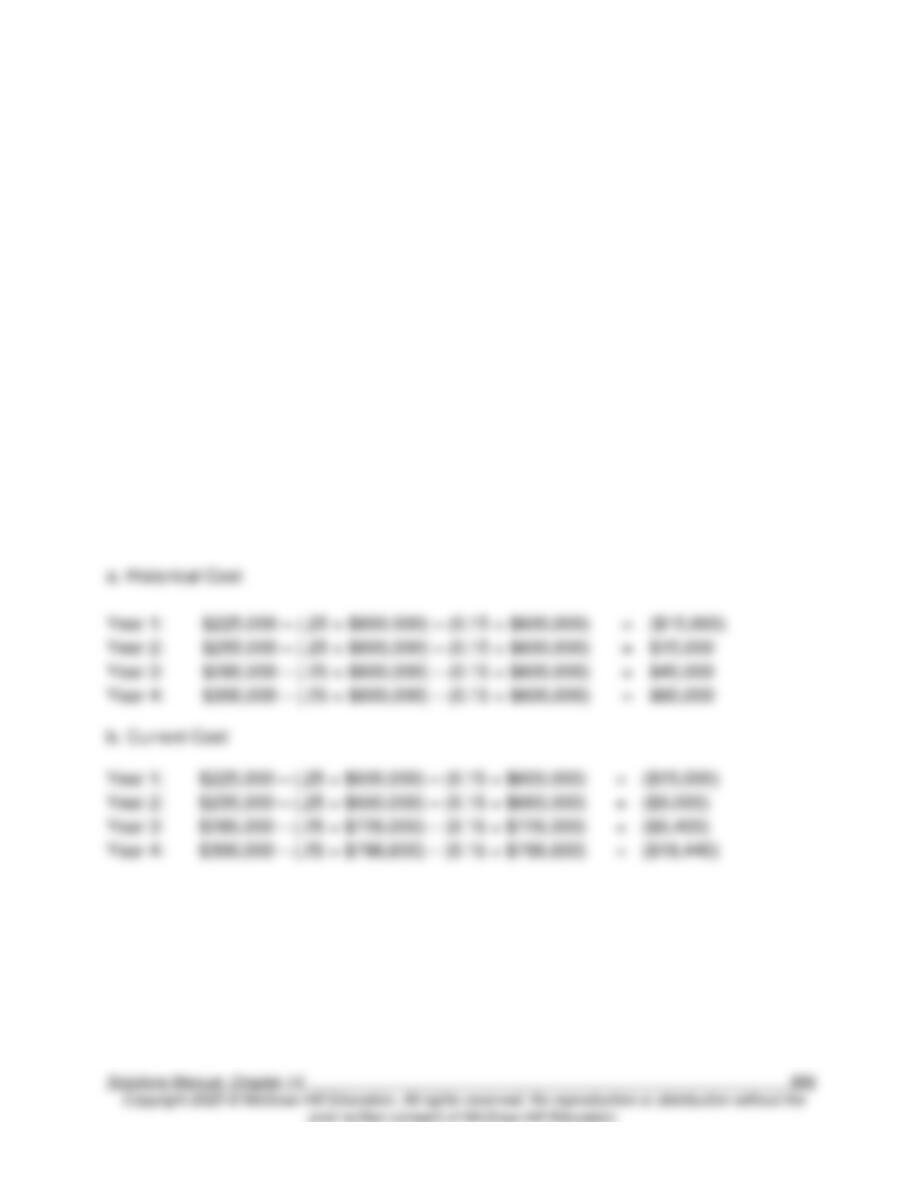
14–58. (30 min.) Effects of Current Cost on Performance Measurements: Upper
Division.
Year 1:
=
($15,000)
Year 2:
=
$15,000
Year 3:
=
$45,000
Year 4:
=
$60,000
Year 1:
=
($15,000)
Year 2:
=
($9,000)
Year 3:
=
($5,400)
Year 4:
=
($19,440)
Solutions to Integrative Cases
14–59. (60 – 90 min.) Barrows Consumer Products (A).
a.
There are many possible problems in identifying the “best” performer, but some of the
most commonly cited by students are:
• Different measures can be used in the sector. Different performance measures lead
to different conclusions about the best performer. If different managers use different
performance measures to evaluate their subordinates, they are likely to come to
different conclusions.
14–59. (continued)
b.
(1) Income is given in the case:
County
Indonesia
The Philippines
Vietnam
Income ($000)
$2,065
$1,176
$21
Rank
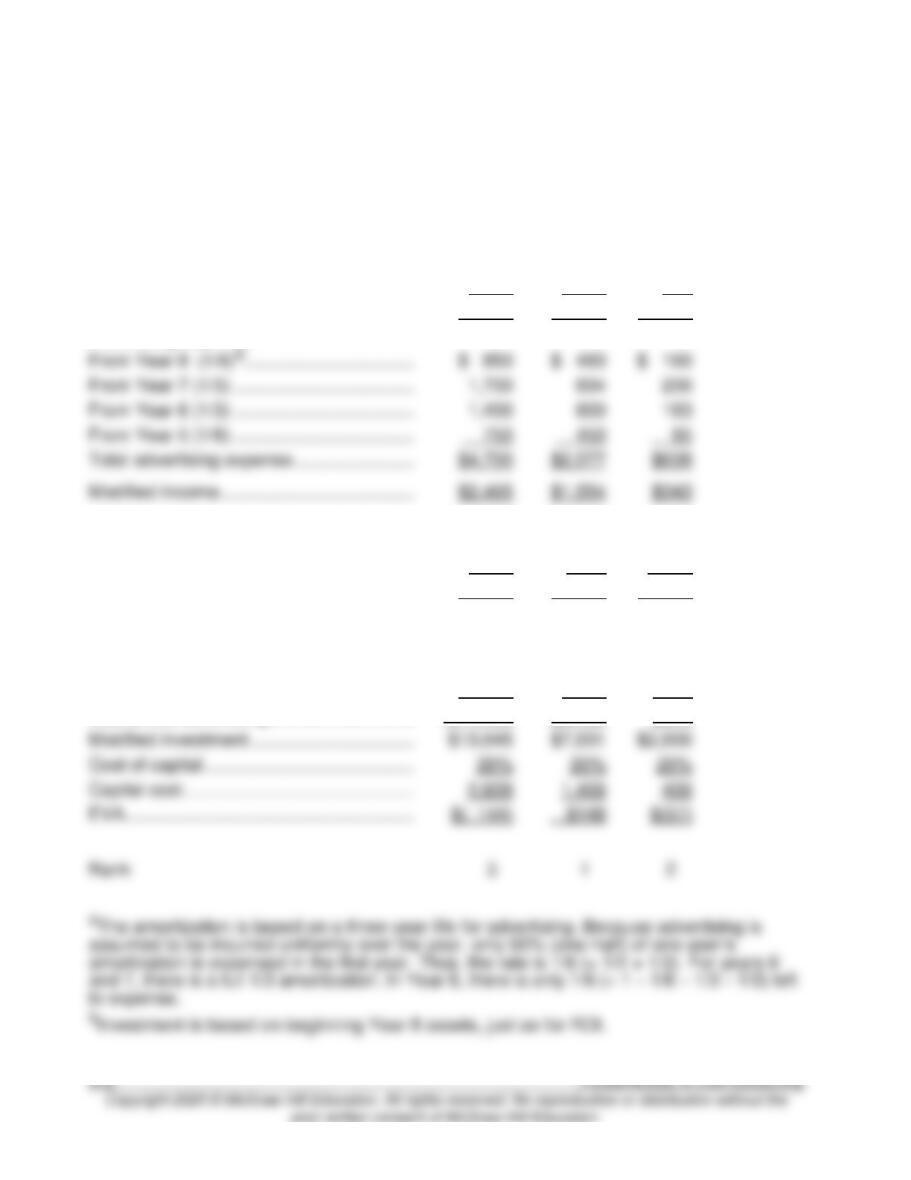
(2) ROI is computed at Barrows as Operating income ÷ Beginning assets. Notice that
Barrows does not use after-tax income in computing this ratio. This might be a good
time to discuss with students the fact that different companies and different analysts
use different formulas to compute ratios. In addition, sometimes the same ratio
(formula) is given multiple names. The important thing is that the analyst understands
why he or she is using a particular formula. That is, it is important that the ratio as
computed provides information the analyst will find useful in making a decision.
County
Indonesia
The Philippines
Vietnam
Income ($000)
$2,950
$1,680
$30
Assets ($000)
ROI
1.6%
Rank
14–59. (continued)
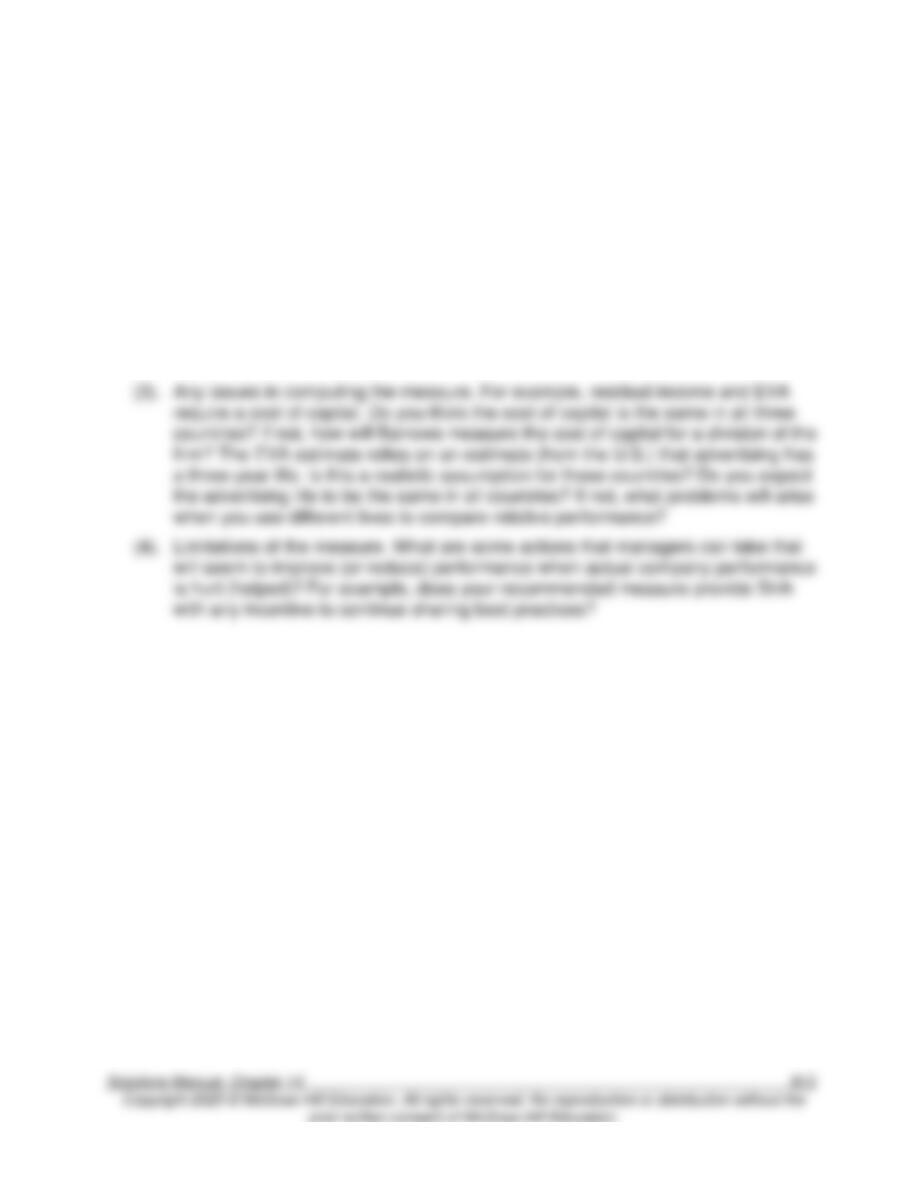
(3) EVA can be computed in many ways. This is one, in which advertising is amortized
over three years and advertising expenditures are assumed to be incurred uniformly
over the year.
($000)
Indonesia
Philippines
Vietnam
Income ……………………………………………..
$2,065
$1,176
$ 21
Advertising ………………………………………..
5,100
2,955
960
Income before advertising ……………………
$7,165
$4,131
$ 981
Advertising expense:
$ 850
$ 493
$ 160
From Year 7 (1/3) ………………………………
1,700
200
From Year 6 (1/3) ………………………………
1,400
183
From Year 5 (1/6) ………………………………
95
Total advertising expense ……………………
$4,700
$2,577
Modified income …………………………………
$2,465
$1,554
Assets b ……………………………………………
$7,200
$4,000
$1,880
Less current liabilities………………………….
1,255
704
750
Net assets …………………………..…………….
$5,945
$3,296
$1,130
Capitalized advertising:
From Year 7 (5/6) ………………………………
$4,250
$2,085
$ 500
From Year 6 (3/6) ………………………………
2,100
1,200
275
From Year 5 (1/6) ………………………………
750
450
95
Capitalized advertising ………………………..
$3,735
Modified investment …………………………...
$7,031
$2,000
Cost of capital ……………………………………
Capital cost ……………………………………….
2,609
1,406
400
Rank
14–59. (continued)
c.
Answers will vary. Some common suggestions include dividing by population or by
income. Others suggest a subjective assessment.
d.
The following items should be included:
(1). The measure you recommend and why. It is important that the measure be one
that the company can actually collect data for use in calculations.
(2). Some of the issues involved (see a. above). For example, how will your measure
address (if at all) the different demographics. Some students have recommended
a “profit per capita” measure as one approach. This measure still neglects
differences in income and culture.

14–60. (60 – 90 min.) Capital Investment Analysis and Decentralized Performance
Measurement: Diversified Electronics.
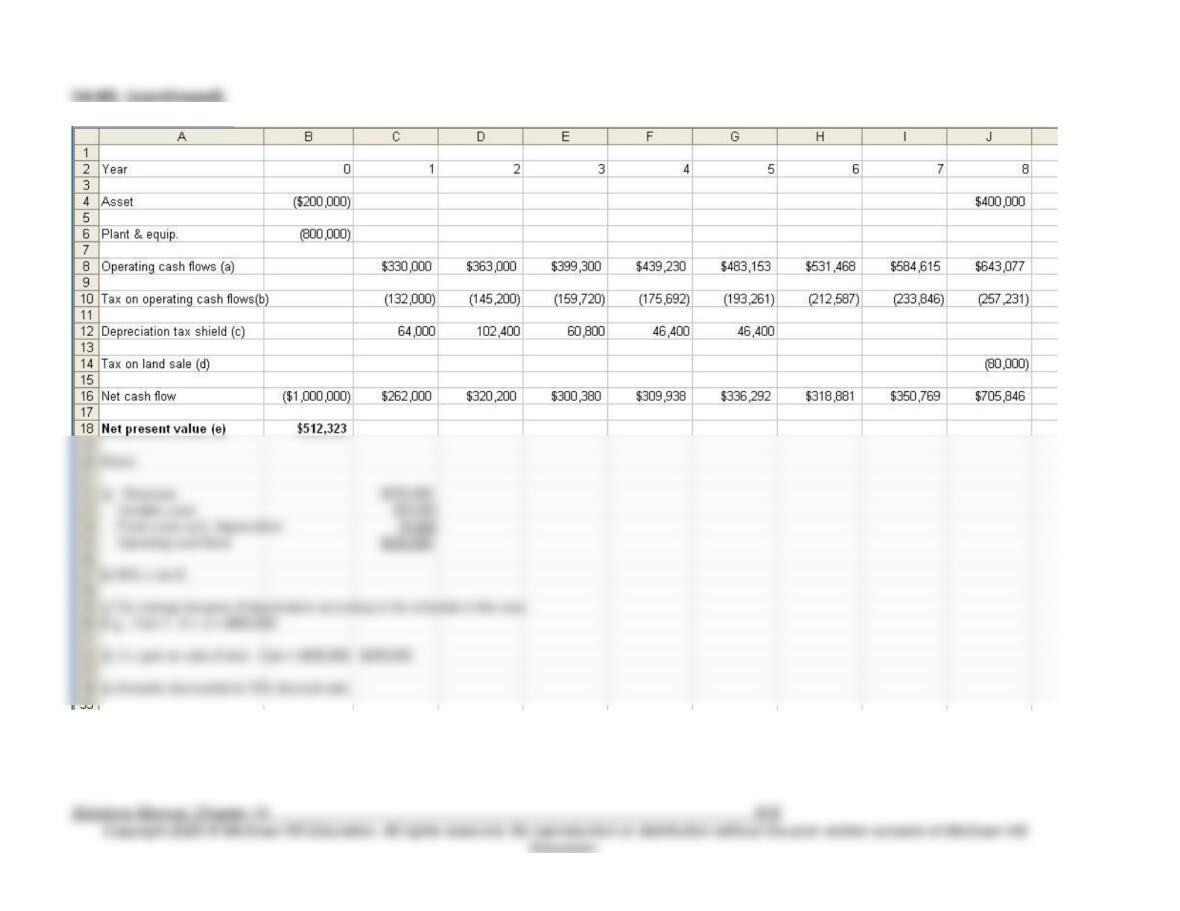
a. David Parker’s new product proposal was rejected because its ROI was less than 15
The decision was not correct because it is inappropriate to use a short-term measure
like ROI to evaluate a long-term decision, ignoring completely the project’s cash flows.
Also, a performance measure that is suitable for measuring past performance should
not be used for an investment decision. (This is why accrual accounting might be
appropriate for evaluating past performance while cash flows are used for decision
making. If the company had used DCF (Discounted Cash Flows) analysis, the results
would have been as shown in the spreadsheet on the following page.
b. It appears that Diversified Electronics’ management wanted the focus of division
managers to be on the profitability of their assets, which is why company management
used the investment center concept for performance evaluation. Therefore, Diversified
Electronics’ choice of ROI makes sense because it is a measure of profitability of
assets used. (The company could also have used EVA.) By focusing on ROI, company
management delegates decision rights regarding sales (e.g., product pricing) and
costs to division managers. The benefits of delegation include reduction in cost of
corporate administration, improvement in operational decision making, increased
motivation at division level, and freeing corporate management up for more effective
utilization. However, some unexpected ROI-related pitfalls that the company’s
management apparently did not anticipate are:
14–60. (continued)
Possible Modification to the Present System
1. Within a division there could be a corporate ROI for evaluating the division and
another ROI for evaluating the manager. Each should only include items
controllable by the division and manager, respectively.
4. Corporate management could consider using EVA, if division managers have
incentives to reject projects having a return that is greater than the cost of capital
but less than currently earned ROI.
c. When a performance evaluation measure like ROI is used by divisions at the same
time as DCF models for capital budgeting, managers often have conflicting incentives.
Managers will have incentives to reject positive NPV projects if these projects do not
have a positive impact on ROI for several years. Also, there will be a disincentive for
them to invest in any positive NPV project that may lower division ROI by increasing
the denominator by a relatively larger proportion than the numerator.