14–39
PROBLEM 14-58 (45 MINUTES)
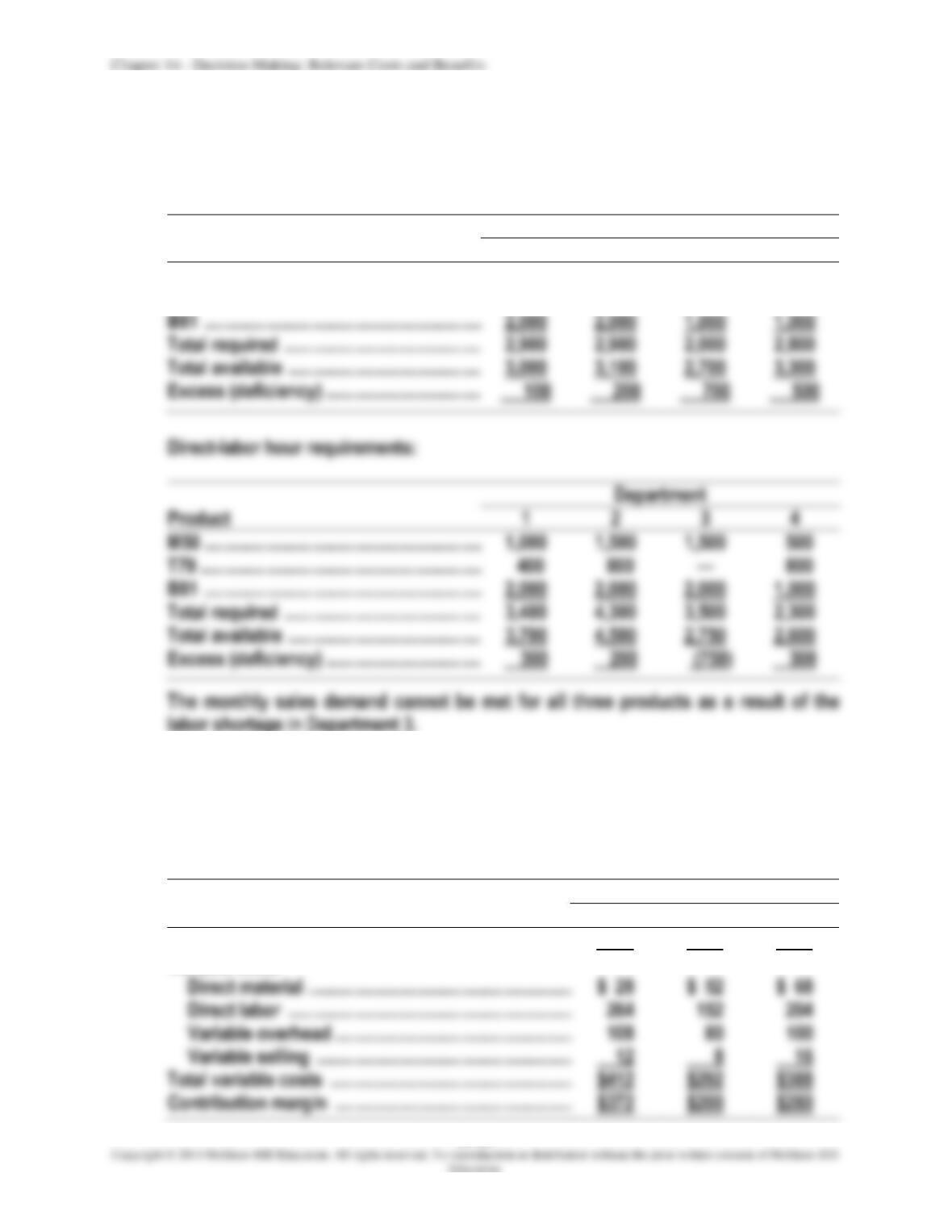
1. Machine hour requirements:
Department
Product
1
2
3
4
M50 ……………………………………………………….
500
500
1,000
1,000
T79 ……………………………………………………….
400
400
—
800
B81 ……………………………………………………….
2,000
2,000
1,000
1,000
Total required ……………………………………………………….
2,900
2,900
2,000
2,800
Total available ……………………………………………………….
3,000
3,100
2,700
3,300
Department
Product
1
2
3
4
M50 ……………………………………………………….
1,000
1,500
1,500
500
T79 ……………………………………………………….
400
800
—
800
B81 ……………………………………………………….
2,000
2,000
2,000
1,000
Total required ……………………………………………………….
3,400
4,300
3,500
2,300
Total available ……………………………………………………….
3,700
4,500
2,750
2,600
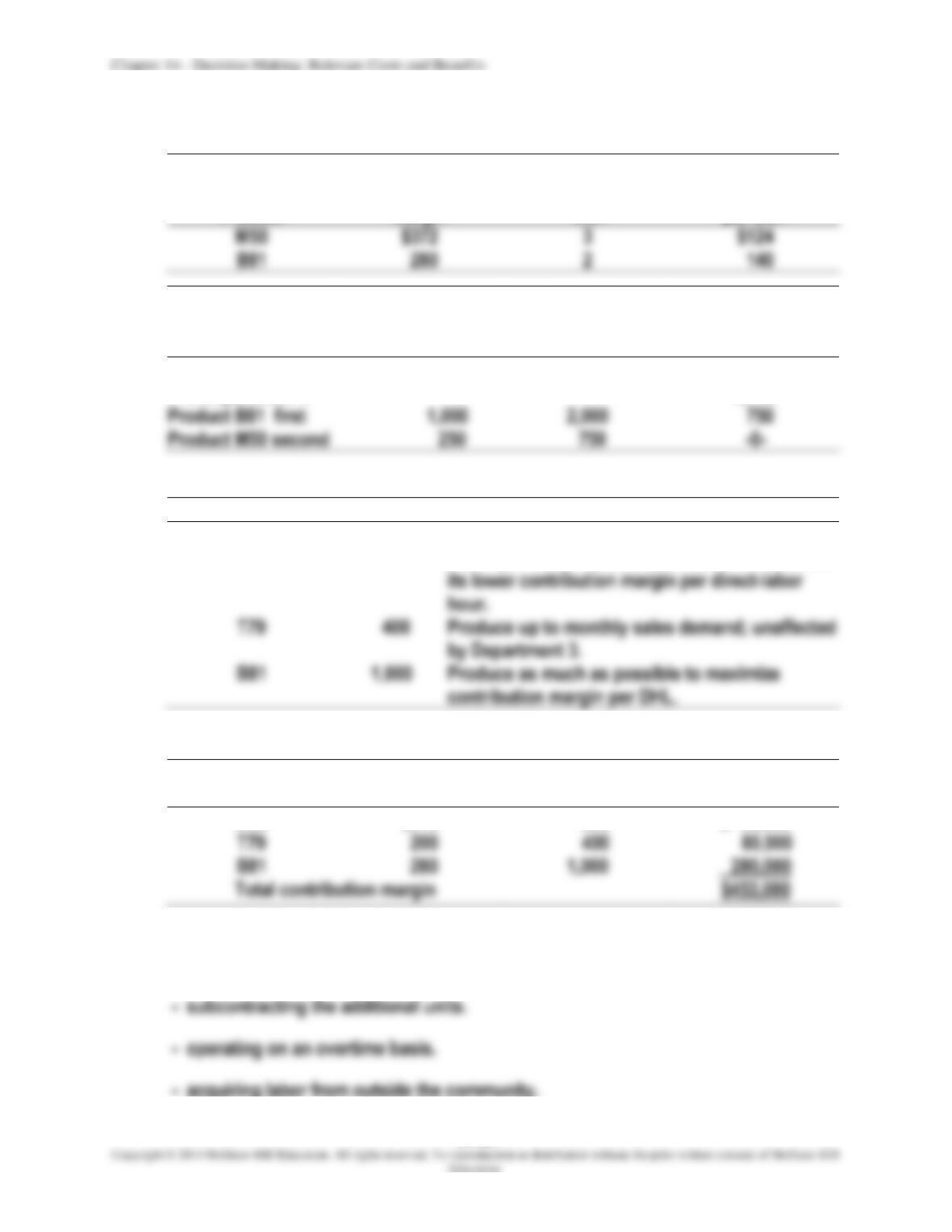
2. The goal is to maximize contribution margin. Fixed costs are not relevant. The scarce
resource is direct-labor hours (DLH) in Department 3. Oceana should first produce
the product that maximizes contribution margin per unit of the scarce resource
(DLH). In this case two products, M50 and B81, require direct-labor hours in
Department 3.
Product
M50
T79
B81
Sales price ………………………………………………………………….
$784
$492
$668
Variable costs
264
152
204
108
100
14–40
PROBLEM 14-58 (CONTINUED)
Product
Contribution
Margin
Department 3
DLH
Contribution
Margin
per DLH
M50
$372
$124
Units
Department 3
DLH
Required
Balance (DLH)
Maximum DLH available
in Department 3
2,750
Product B81 first
1,000
2,000
Product M50 second
RESULTING PRODUCTION SCHEDULE
Product
Units
Comments
M50
250
by Department 3.
Produce as much as possible to maximize
Produce as much as the constraint allows (750 ÷
3 DLH per unit). Reduced production is based on
SCHEDULE OF CONTRIBUTION MARGIN BY PRODUCT
Product
Contribution
Margin per Unit
Units
Produced
Contribution
to Profit
M50
$372
250
$ 93,000
1,000
3. To supply the additional quantities of M50 that are required, Oceana should
consider:
Chapter 14 – Decision Making: Relevant Costs and Benefits
14–41
PROBLEM 14-59 (45 MINUTES)
1. The objective function and constraints that Time Saver Meals, Inc. should use to
maximize profits are as follows:
Maximize
60P + 45H
Chapter 14 – Decision Making: Relevant Costs and Benefits
14–42
PROBLEM 14-59 (CONTINUED
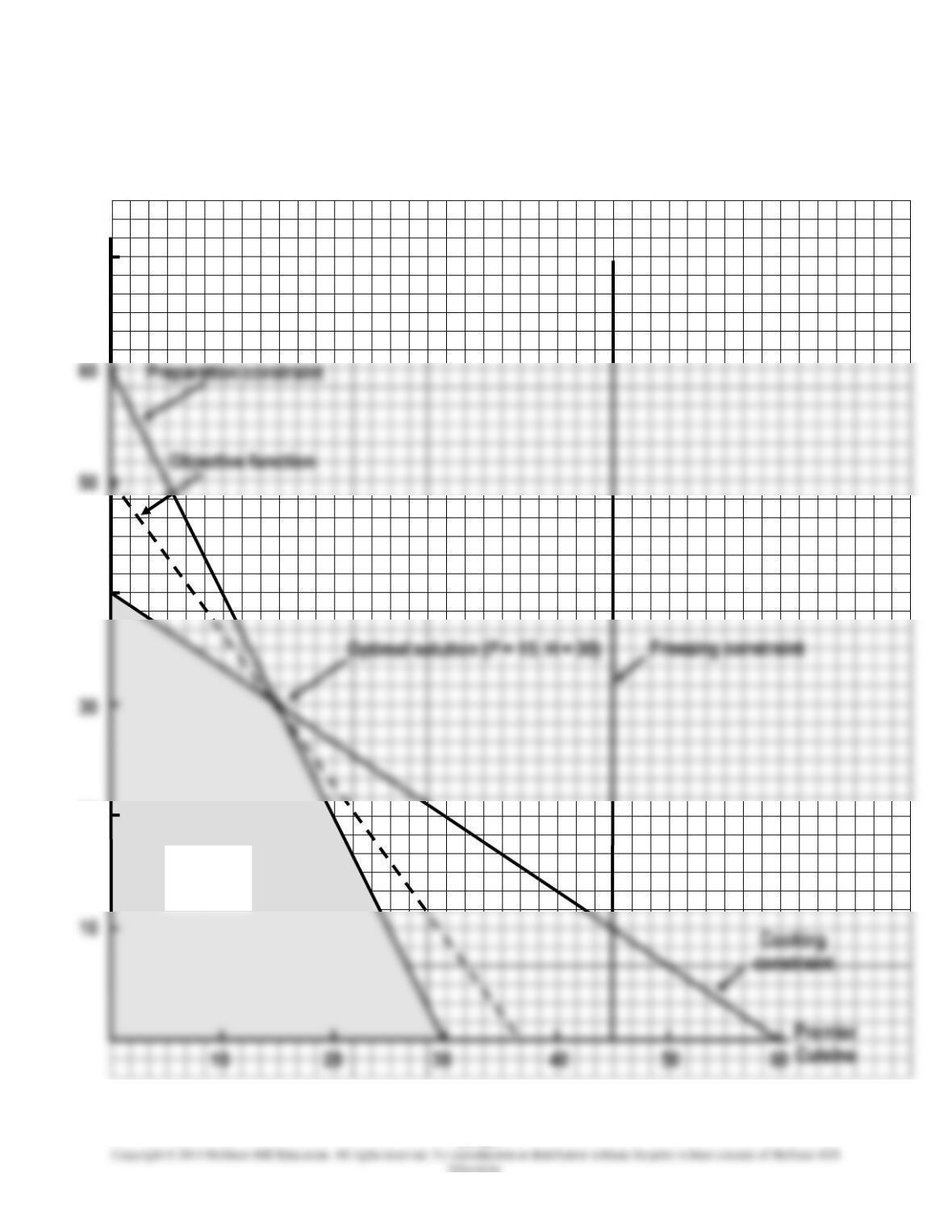
2. Graph of linear program:
Haute Cuisine
60
50
70
40
30
20
10
Feasible
region
Chapter 14 – Decision Making: Relevant Costs and Benefits
14–43
PROBLEM 14-59 (CONTINUED)
3. & 4.
Corner Points
in Feasible Region
Objective Function
Value
P = 0
H =0
($60)(0) + ($45)(0) = 0
P = 0
H = 40
($60)(0) + ($45)(40) = $1,800
P = 15
H = 30
($60)(15) + ($45)(30) = $2,250
Chapter 14 – Decision Making: Relevant Costs and Benefits
14–44
PROBLEM 14-59 (CONTINUED)
5. Graph of linear program:
Haute Cuisine
70
60
50
40
30
20
10
Cooking
constraint
10
20
30
40
50
60
Chapter 14 – Decision Making: Relevant Costs and Benefits
14–45
PROBLEM 14-59 (CONTINUED)
Corner Points
in Feasible Region
Objective Function
Value
P = 0
H =0
($60)(0) + ($45)(0) = 0
P = 0
H = 40
($60)(0) + ($45)(40) = $1,800
P = 45
H = 10
($60)(45) + ($45)(10) = $3,150
14–46
PROBLEM 14-60 (40 MINUTES)
1. In order to maximize contribution margin, the objective function and constraint
functions would be formulated as follows:
Notation:
E = number of batches of Eclipse candy bars
N = number of batches of Nova candy bars
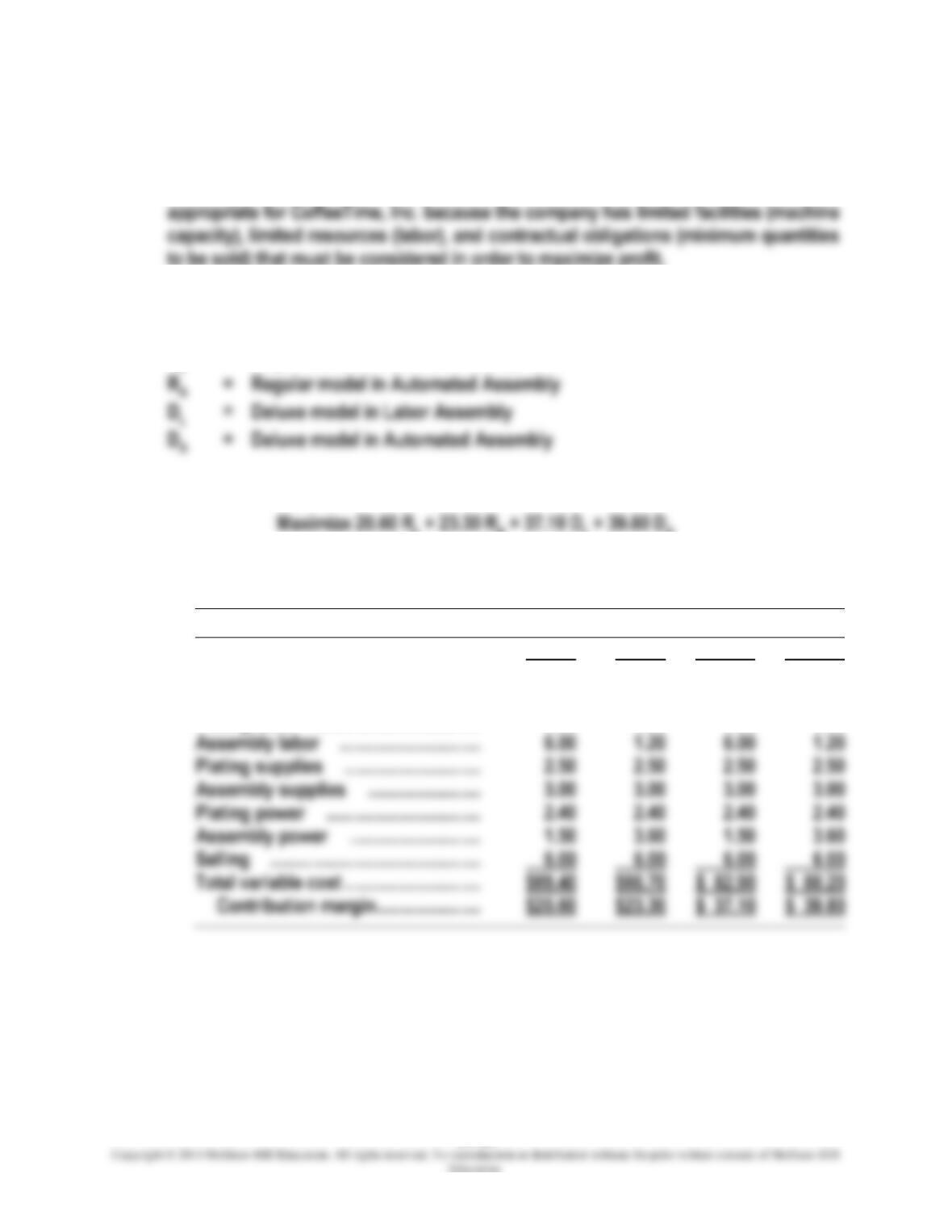
2. The number of batches of each candy bar that should be produced to maximize
14–47
PROBLEM 14-60 (CONTINUED)
Graph of linear program:
500
300
100
200
300
100
400
500
Eclipse
Chapter 14 – Decision Making: Relevant Costs and Benefits
14–48
PROBLEM 14-61 (50 MINUTES)
1. Linear programming (LP) is designed to determine the optimum mix when resources
are limited and can be switched or allocated among products. LP would be
2. Notation:
RL
=
Regular model in Labor Assembly
RA
=
Regular model in Automated Assembly
DL
=
Deluxe model in Labor Assembly
DA
=
Deluxe model in Automated Assembly
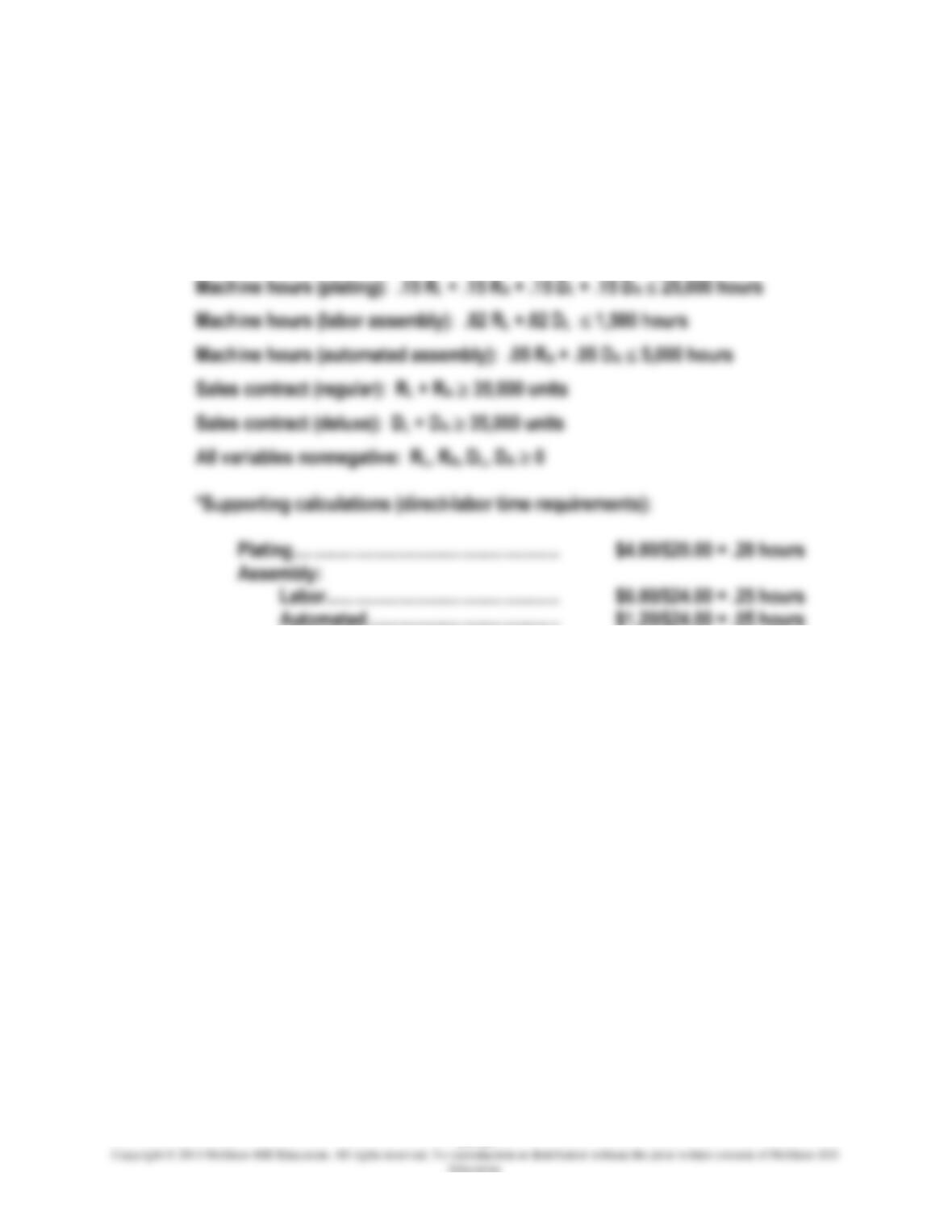
a. Objective function: *
*Supporting calculations (per-unit basis):
RL
RA
DL
DA
Selling price …………………………………
$90.00
$90.00
$120.00
$120.00
Less: Variable costs:
Raw material …………………………….
$44.00
$44.00
$ 57.50
$ 57.50
Plating labor ……………………………..
4.00
4.00
4.00
4.00
Assembly labor …………………………
6.00
1.20
6.00
1.20
Plating supplies ………………………..
2.50
2.50
2.50
2.50
Assembly supplies ……………………
3.00
3.00
3.00
3.00
Plating power …………………………...
2.40
2.40
2.40
2.40
Assembly power ……………………….
1.50
3.60
1.50
3.60
6.00
6.00
6.00
6.00
Total variable cost ………………………..
$69.40
$66.70
$ 82.90
$ 80.20
Chapter 14 – Decision Making: Relevant Costs and Benefits
14–49
PROBLEM 14-61 (CONTINUED)
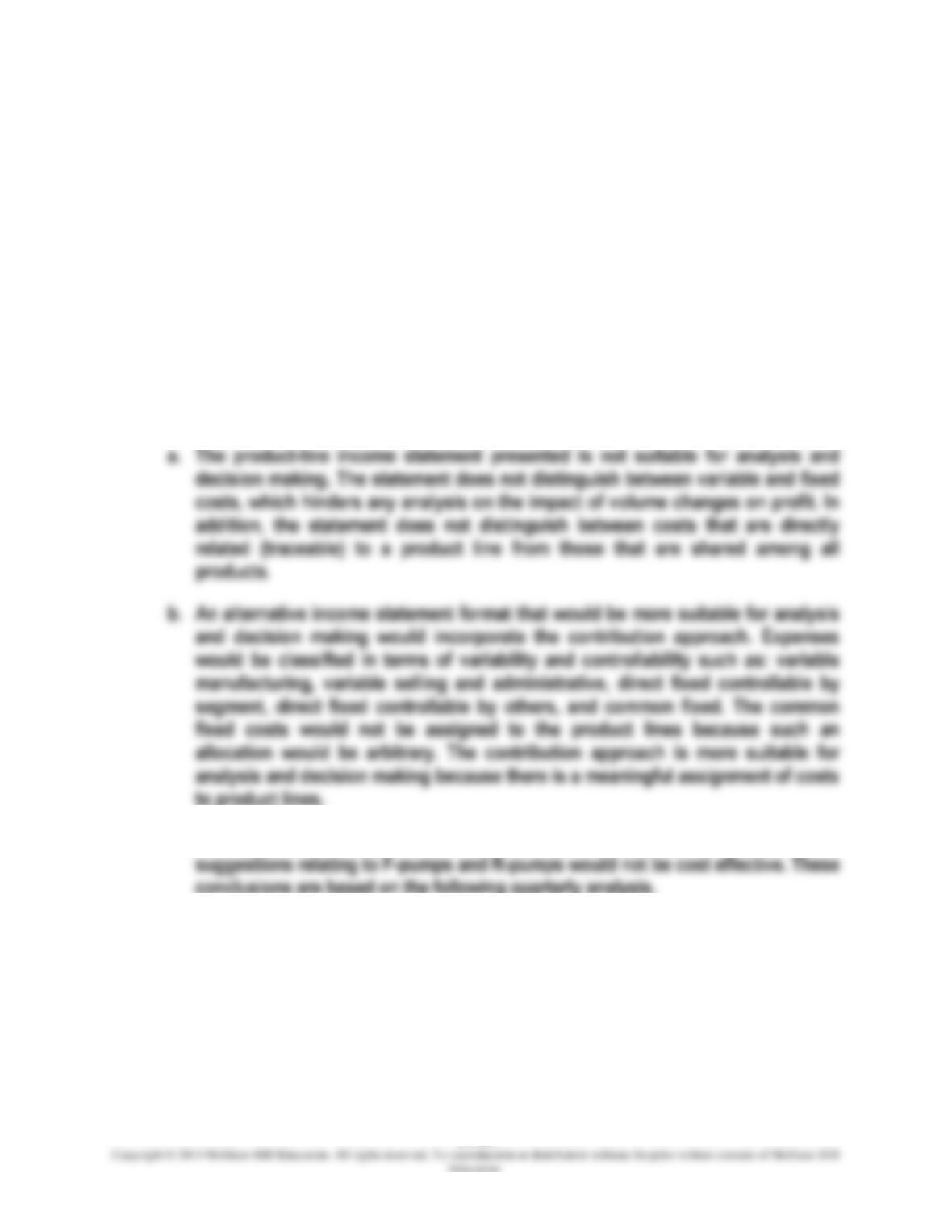
b. Constraints:
Direct labor (plating): .2 RL + .2 RA + .2 DL + .2 DA 30,000 hours
Direct labor (assembly): .25 RL + .05 RA + .25 DL + .05 DA 40,000 hours
Chapter 14 – Decision Making: Relevant Costs and Benefits
14–50
SOLUTIONS TO CASES
CASE 14-62 (60 MINUTES)
1.
Memorandum
Date:
Today
To:
Maria Carlo, President, Ontario Pump Company
From:
I.M. Student
Subject:
Suggested revision of product-line income statement
2. a. The suggested discontinuance of the S-pumps would be cost effective, but the
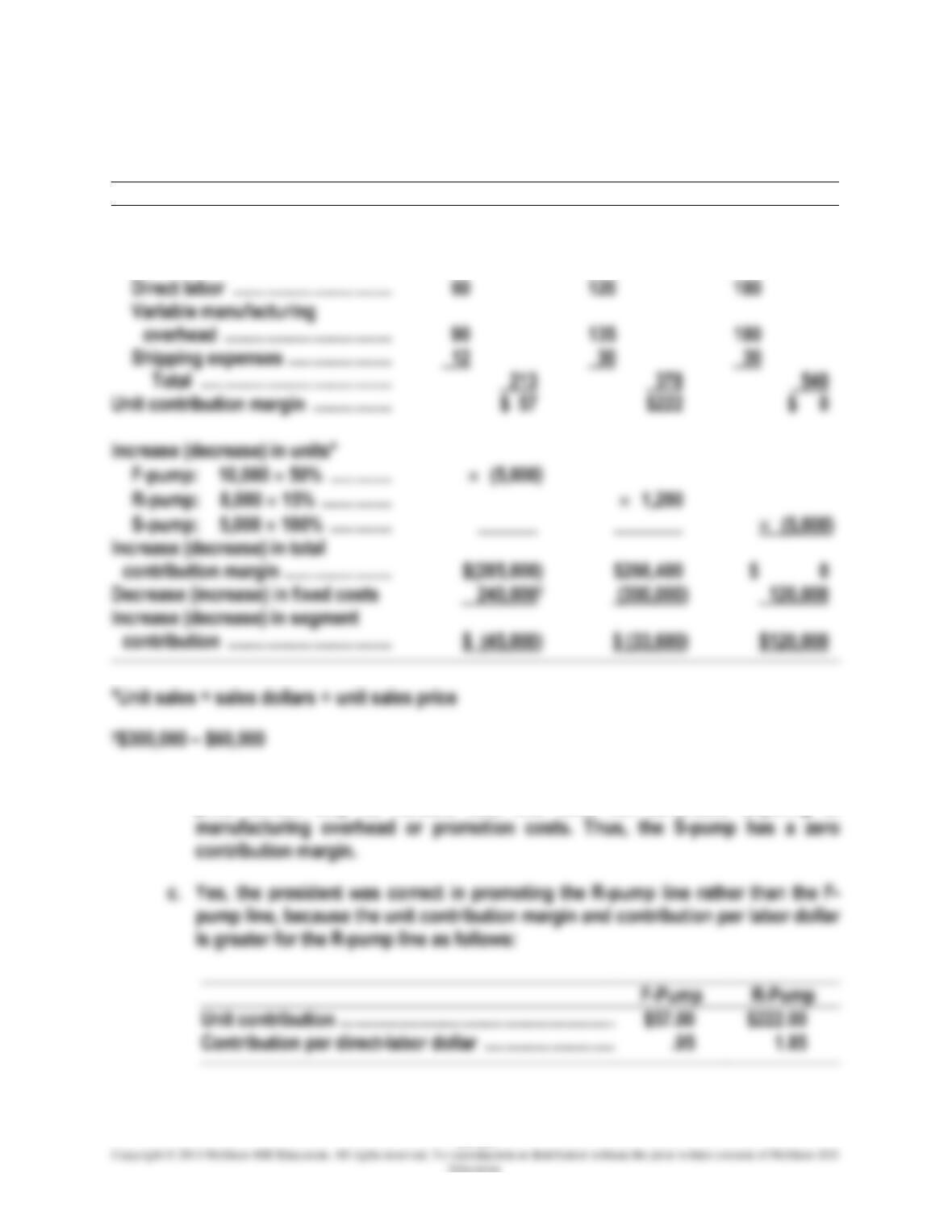
Chapter 14 – Decision Making: Relevant Costs and Benefits
14–51
CASE 14-62 (CONTINUED)
F-Pump
R-Pump
S-Pump
Unit selling price …………………………
$270
$600
$540
Unit variable costs
Raw material …………………………..
$51
$ 93
$150
Direct labor …………………………….
120
180
135
180
Shipping expenses ………………….
Unit contribution margin ……………..
$222
Increase (decrease) in units*
)
)
Decrease (increase) in fixed costs
)
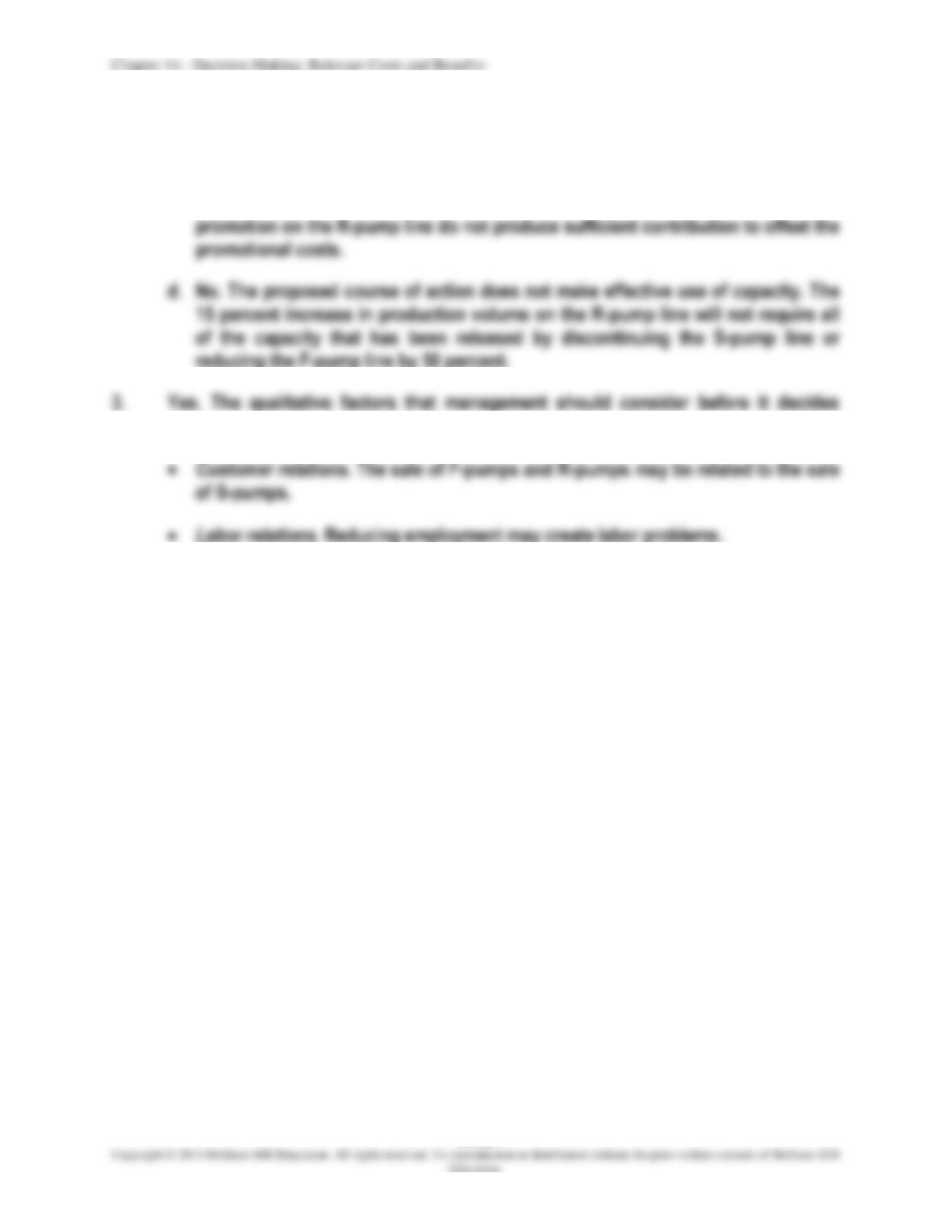
b. Yes, the president was correct in eliminating the S-pumps. The S-pump sales
price covers only its variable cost and does not contribute anything to
Unit contribution ……………………………………………………….
14–52
CASE 14-62 (CONTINUED)
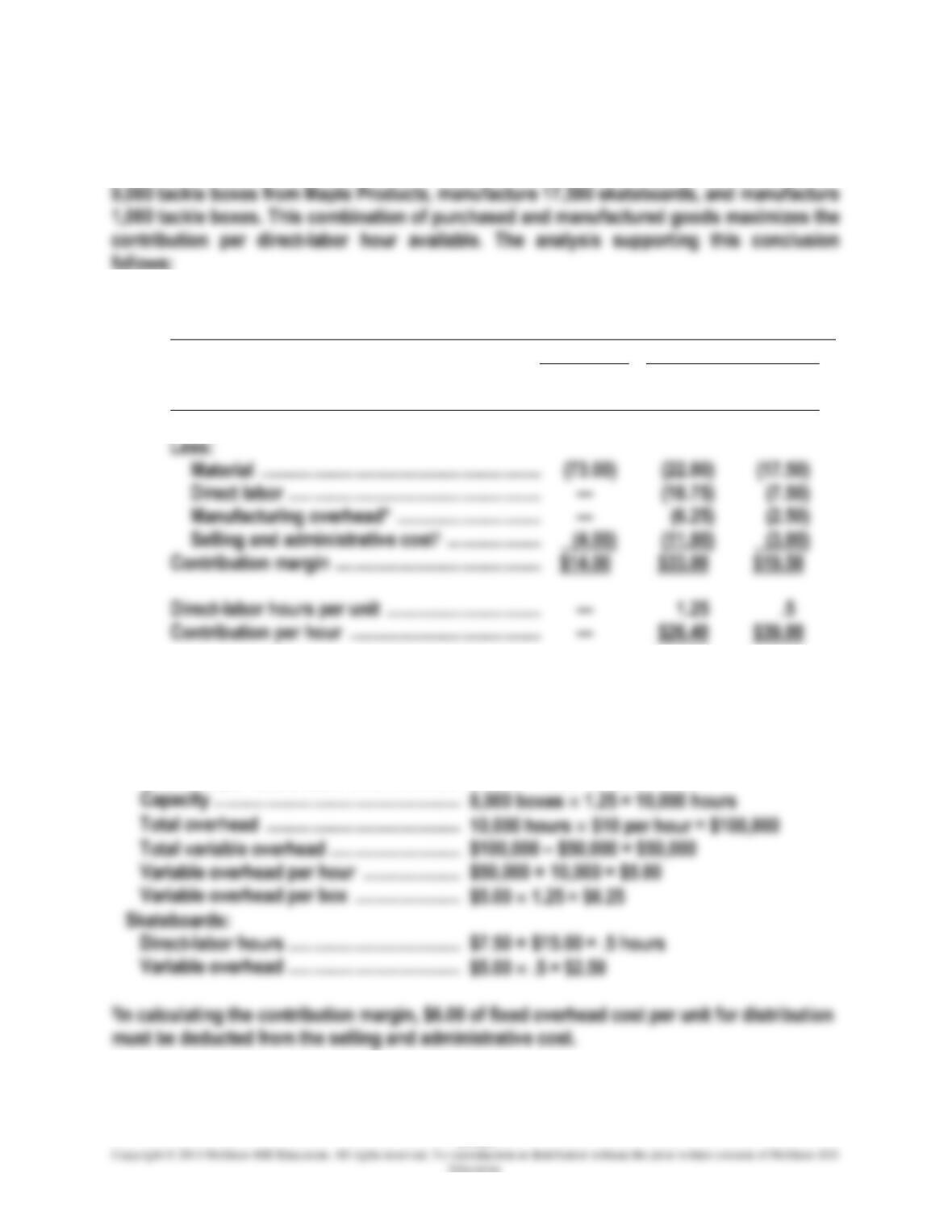
However, the president’s decisions regarding promotion expense do not seem
well conceived. The decreased promotion on the F-pump line and the increased
whether to drop the S-pump line include:
Chapter 14 – Decision Making: Relevant Costs and Benefits
14–53
CASE 14-63 (45 MINUTES)
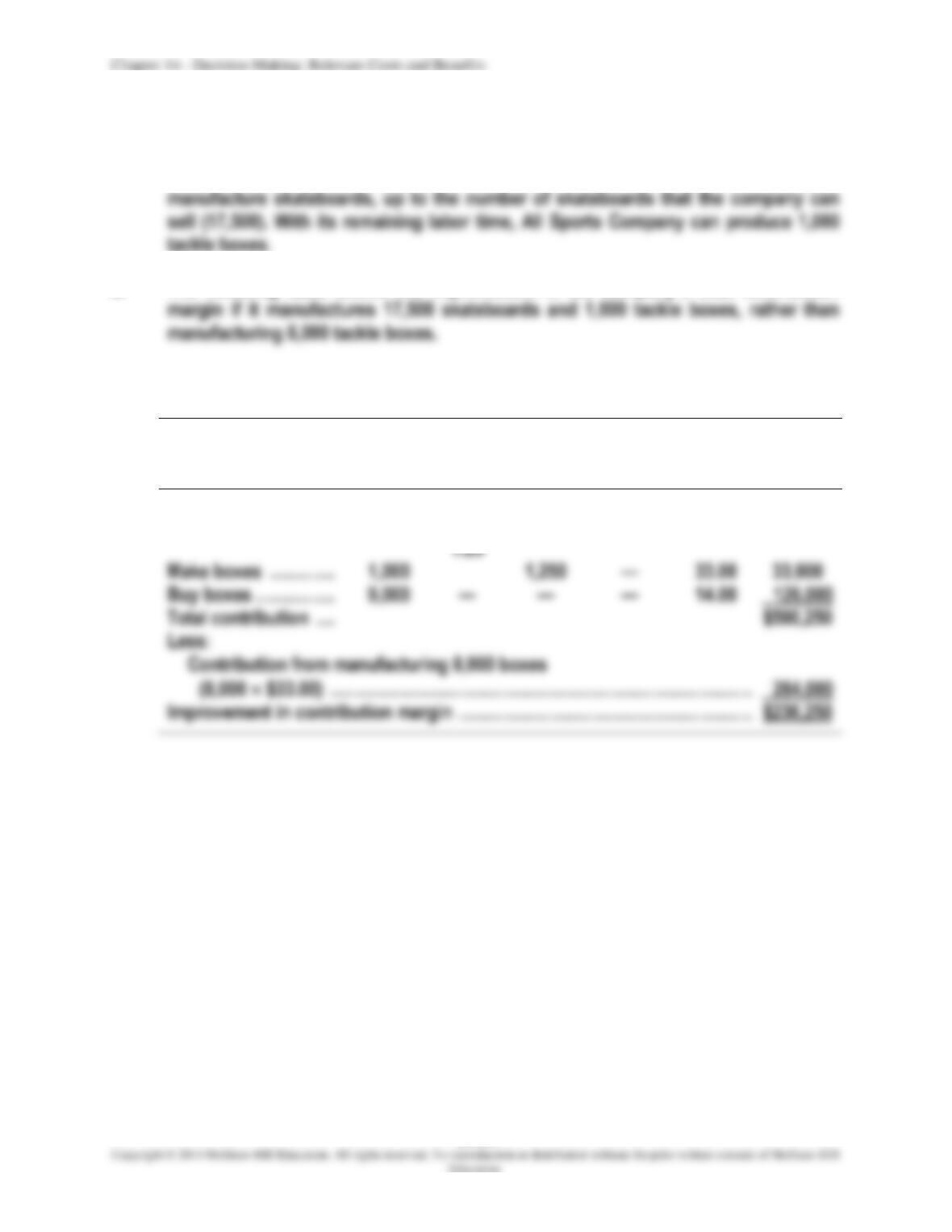
In order to maximize the company’s profitability, All Sports Company should purchase
1. Calculate unit contribution margins:
Purchased
Manufactured
Tackle
Boxes
Tackle
Boxes
Skate-
boards
Selling price ……………………………………………………….
$91.00
$91.00
$50.00
Less:
Contribution margin ……………………………………………………
$14.00
$33.00
$19.50
Direct-labor hours per unit ………………………………………….
*Calculation of variable overhead per unit:
Tackle boxes:
Direct-labor hours ………………………………….
$18.75 ÷ $15.00 = 1.25 hours
Overhead per direct-labor hour ………………
$12.50 ÷ 1.25 = $10.00
Total variable overhead ………………………….
$100,000 – $50,000 = $50,000
Variable overhead per hour ……………………
$50,000 ÷ 10,000 = $5.00
Skateboards:
Direct-labor hours ………………………………….
$7.50 ÷ $15.00 = .5 hours
14–54
CASE 14-63 (CONTINUED)
The optimal use of All Sports Company’s scarce resource (direct labor) is to
2. The following table shows the improvement in the company’s total contribution
The optimal use of All Sports Company’s available direct-labor hours (DLH):
Item
Quantity
DLH
per
Unit
Total
DLH
Balance
of
DLH
Unit
Contri-
bution
Total
Contri-
bution
Total hours ……………
10,000
Skateboards ………….
17,500
.50
8,750
1,250
$19.50
$341,250
Make boxes …………..
1,250
Buy boxes ……………..
Total contribution ….
$500,250
Chapter 14 – Decision Making: Relevant Costs and Benefits
14–55
FOCUS ON ETHICS (See page 613 in the text.)
This scenario addresses the effects of a decision to outsource, and as a result, close a
department.
Edgeworth is not acting ethically in asking Mint to withhold the ABC costing analysis
data from Mello. To do so would be tantamount to deliberately risking that the company