14-1
CHAPTER 14
COST ALLOCATION, CUSTOMER-PROFITABILITY
ANALYSIS, AND SALES-VARIANCE ANALYSIS
14-1 Disagree. Cost accounting data plays a key role in many management planning and
control decisions. The division president will be able to make better operating and strategy
decisions by being involved in key decisions about cost pools and cost allocation bases. Such an
understanding, for example, can help the division president evaluate the profitability of different
customers.
14-3 Companies that separately record (a) the list price and (b) the discount have sufficient
information to subsequently examine the level of discounting by each individual customer and
by each individual salesperson.
14-5 Five categories in a customer cost hierarchy are identified in the chapter. The examples
given relate to the Provalue Division of Astel Computers used in the chapter:
• Customer output-unit-level costs—costs of activities to sell each unit (computer) to a
customer. An example is product-handling costs of each computer sold.
• Customer batch-level costs—costs of activities that are related to a group of units
(computers) sold to a customer. Examples are costs incurred to process orders or to make
deliveries.
14-6 Charting cumulative profits by customer or product type generates a whale curve. This
provides information on the profitability of customers and clearly differentiates the most
profitable from the least profitable.
14-2
14-7 Disagree. In general, companies have three choices regarding the allocation of corporate
costs to divisions: allocate all corporate costs, allocate some corporate costs (those “controllable”
by the divisions), and allocate none of the corporate costs. Which one of these is appropriate
depends on several factors: the composition of corporate costs, the purpose of the costing
exercise, and the time horizon, to name a few. For example, one can easily justify allocating all
corporate costs when they are closely related to the running of the divisions and when the
purpose of costing is, say, pricing products or motivating managers to consume corporate
resources judiciously.
14-9 Disagree. If corporate costs allocated to a division can be reallocated to the indirect cost
pools of the division on the basis of a logical cause-and-effect relationship, then it is in fact
preferable to do so—this will result in fewer division-indirect-cost pools and a more cost-
effective cost allocation system. This reallocation of allocated corporate costs should only be
done if the allocation base used for each division indirect cost pool has the same cause-and-effect
relationship with every cost in that indirect cost pool, including the reallocated corporate cost.
14-11 When allocating costs to divisions, channels, and customers, companies must construct
cost pools that are, to the extent possible, homogeneous, so that all costs in the cost pool have the
same or a similar cause-and-effect or benefits-received relationship with the cost-allocation base.
If each cost category has a cause-and-effect or benefits-received relationship with a different
cost-allocation base, the company should maintain separate cost pools for each of these costs.
Determining homogeneous cost pools requires judgment and should be revisited on a regular
basis.
14-3
14-14 A favorable sales-quantity variance arises because the actual units of all products sold
exceed the budgeted units of all products sold.
14-15 The sales-quantity variance can be decomposed into (a) a market-size variance (which
arises when the actual total market size in units is different from the budgeted market size in
units) and (b) a market share variance (which arises when the actual market share of a company
is different from its budgeted market share). Both variances use the budgeted average
contribution margin per unit.
14-16 (15-20 min.) Cost allocation in hospitals, alternative allocation criteria.
Dave Meltzer vacationed at Lake Tahoe last winter. Unfortunately, he broke his ankle while
skiing and spent two days at the Sierra University Hospital. Meltzer’s insurance company
received a $4,800 bill for his two-day stay. One item that caught Meltzer’s attention was an
$11.52 charge for a roll of cotton. Meltzer is a salesman for Johnson & Johnson and knows that
the cost to the hospital of the roll of cotton is between $2.20 and $3.00. He asked for a
breakdown of the $11.52 charge. The accounting office of the hospital sent him the following
information:
Meltzer believes the overhead charge is outrageous. He comments, “There was nothing I could
do about it. When they come in and dab your stitches, it’s not as if you can say, ‘Keep your
cotton roll. I brought my own.’”
Required:
14-4
1. Compute the overhead rate Sierra University Hospital charged on the cotton roll.
2. What criteria might Sierra use to justify allocation of the overhead items b–i in the preceding
list? Examine each item separately and use the allocation criteria listed in Exhibit 14-8 (page
563) in your answer.
3. What should Meltzer do about the $11.52 charge for the cotton roll?
SOLUTION
14-5
14-17 (30 min.) Customer profitability, customer-cost hierarchy.
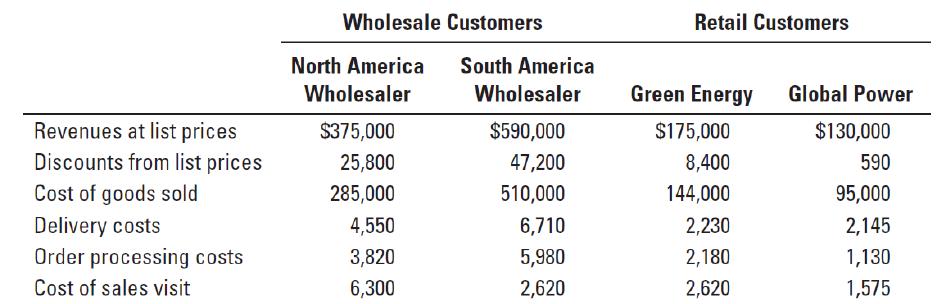
Enviro-Tech has only two retail and two wholesale customers. Information relating to each
customer for 2013 follows (in thousands):
Enviro-Tech’s annual distribution-channel costs are $33 million for wholesale customers and
$12 million for retail customers. The company’s annual corporate-sustaining costs, such as salary
for top management and general-administration costs, are $48 million. There is no cause-and-
effect or benefits-received relation- ship between any cost-allocation base and corporate-
sustaining costs. That is, Enviro-Tech could save corporate-sustaining costs only if the company
completely shuts down.
Required:
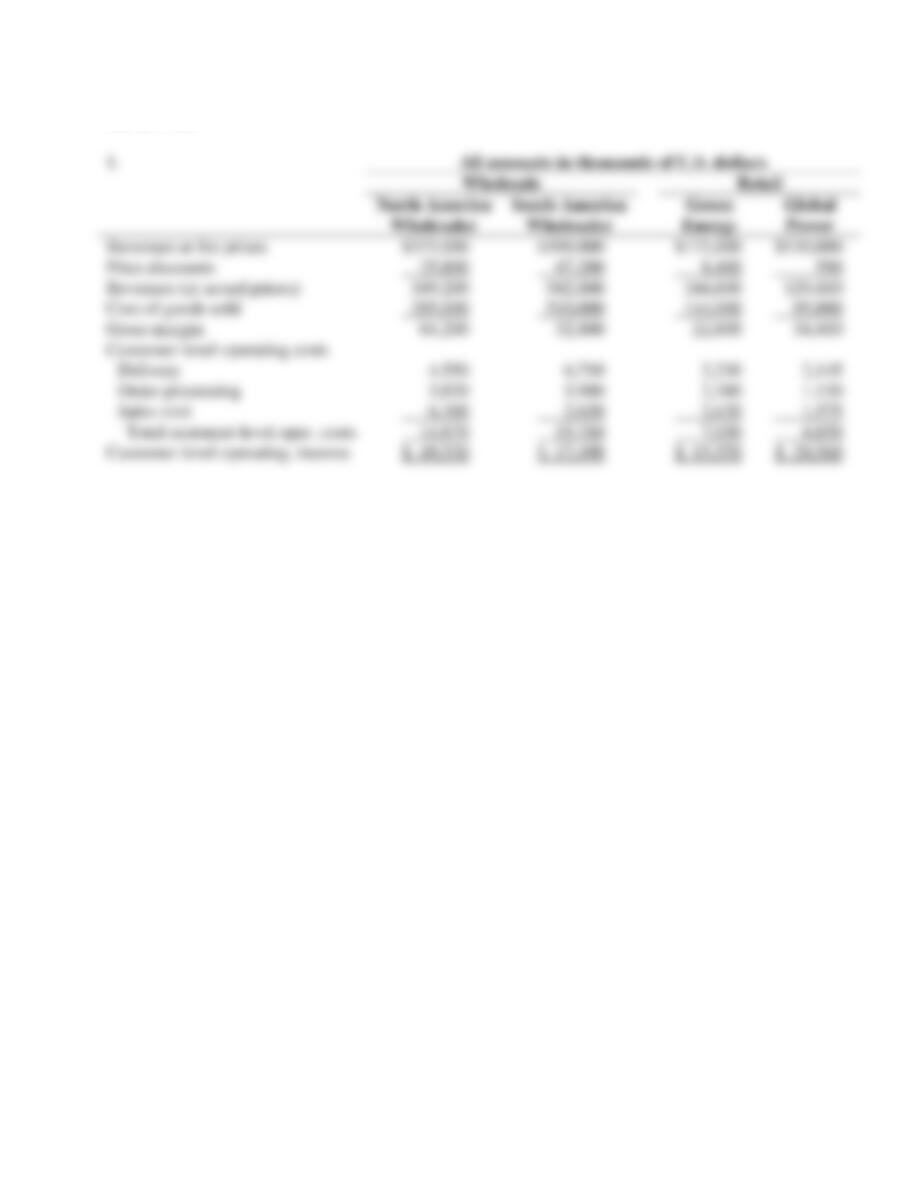
1. Calculate customer-level operating income using the format in Exhibit 14-3.
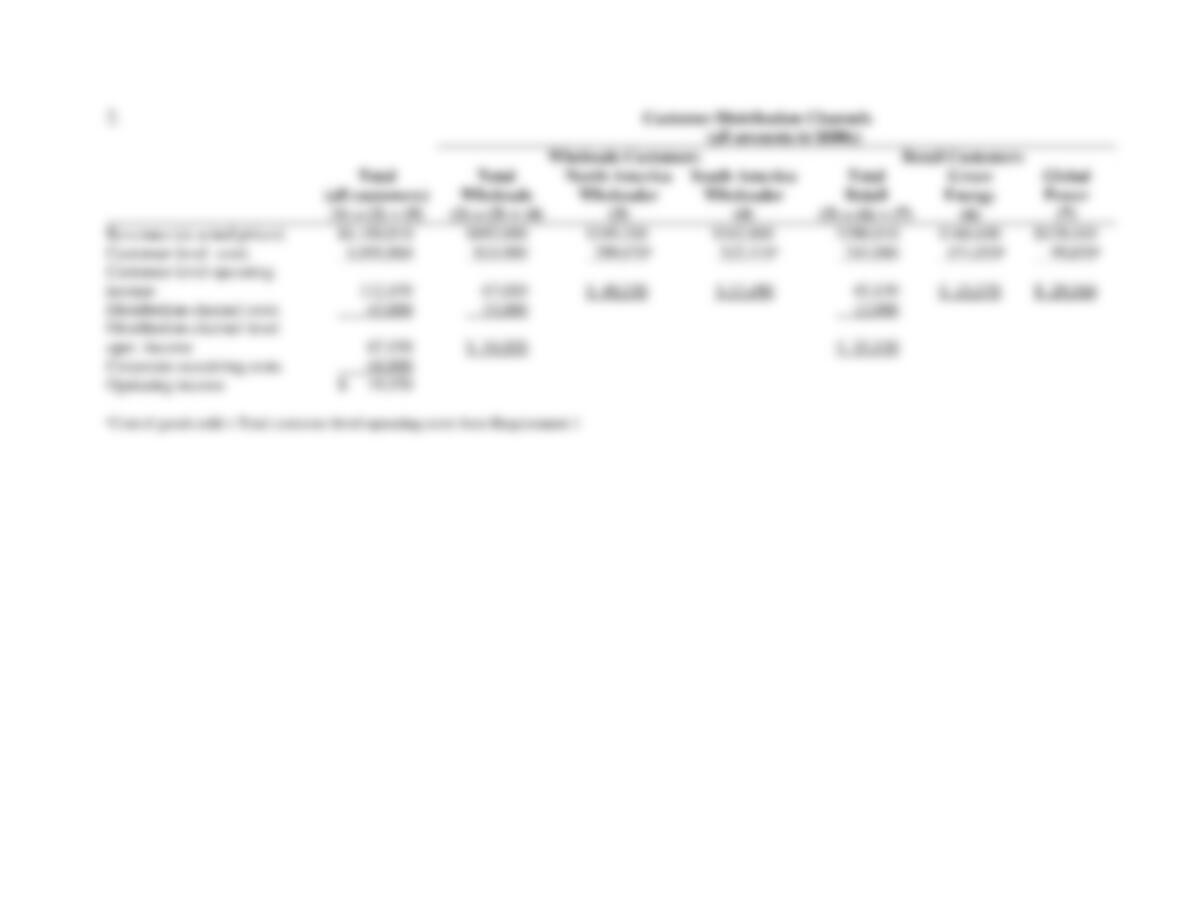
2. Prepare a customer-cost hierarchy report, using the format in Exhibit 14-6.
3. Enviro-Tech’s management decides to allocate all corporate-sustaining costs to distribution
channels: $38 million to the wholesale channel and $10 million to the retail channel. As a
result, distribution channel costs are now $71 million ($33 million + $38 million) for the
wholesale channel and $22 million ($12 million + $10 million) for the retail channel.
Calculate the distribution channel–level operating income. On the basis of these calculations,
what actions, if any, should Enviro-Tech’s managers take? Explain.
4. How might Enviro-Tech use the new cost information from its activity-based costing system
to better manage its business?
14-6
SOLUTION
14-7
14-8
14-18 (20−30 min.) Customer profitability, service company.
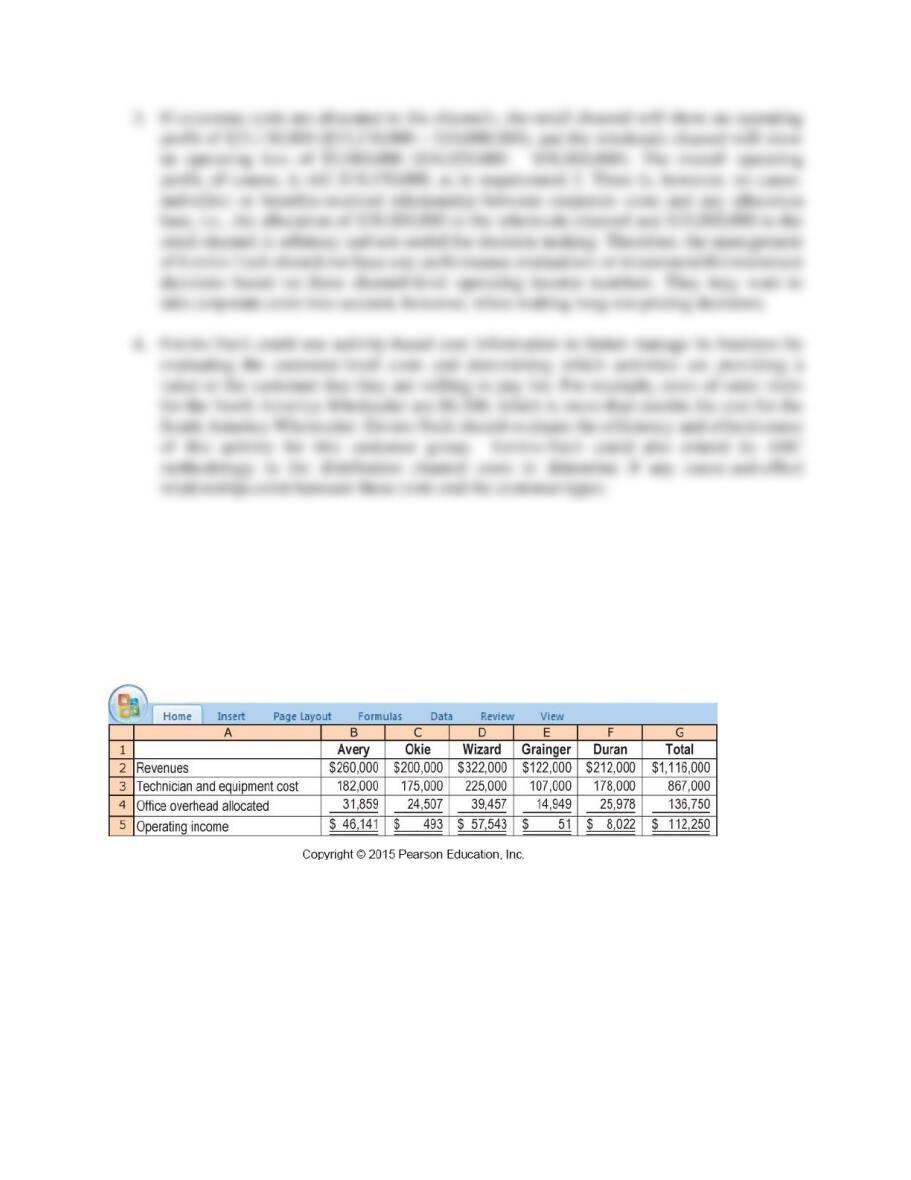
Instant Service (IS) repairs printers and photocopiers for five multisite companies in a tristate
area. IS’s costs consist of the cost of technicians and equipment that are directly traceable to the
customer site and a pool of office overhead. Until recently, IS estimated customer profitability by
allocating the office overhead to each customer based on share of revenues. For 2013, IS
reported the following results:
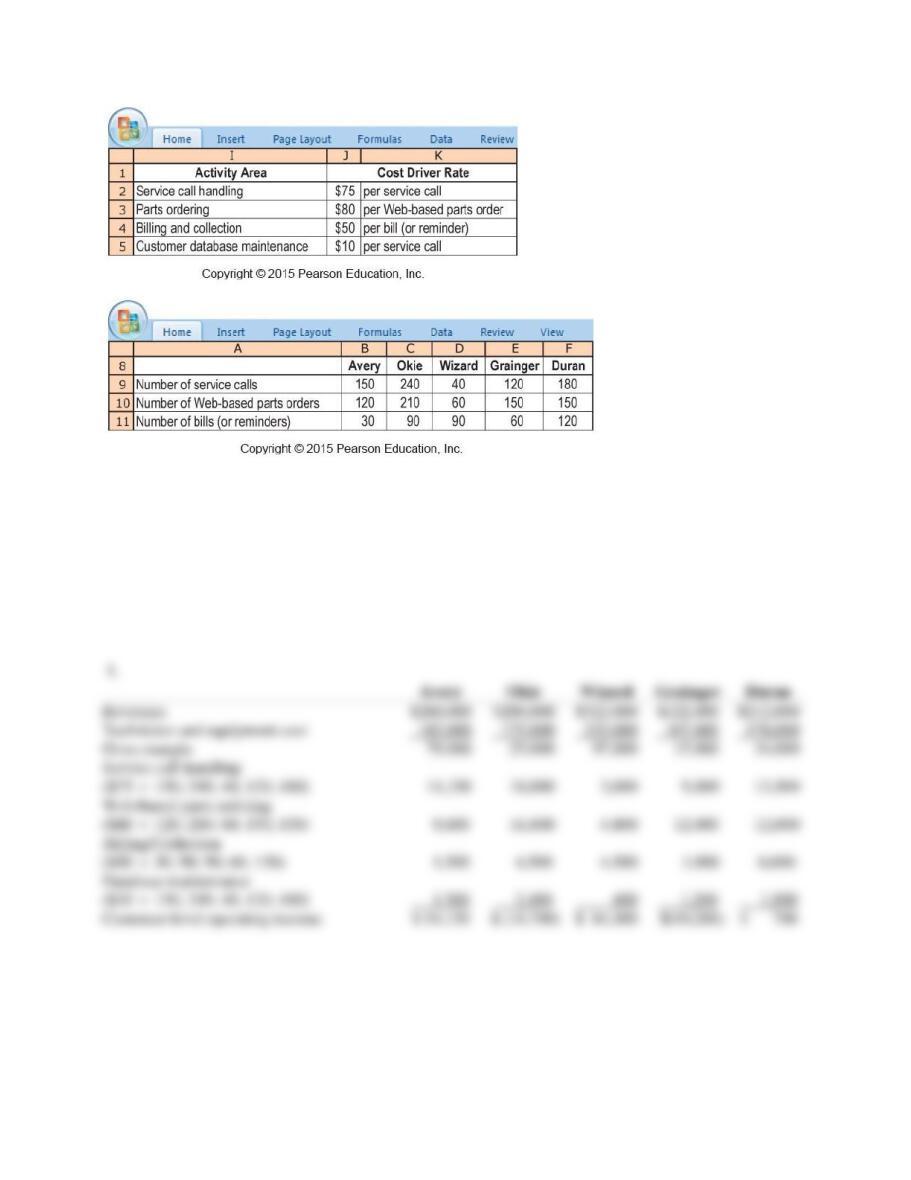
Tina Sherman, IS’s new controller, notes that office overhead is more than 10% of total costs, so
she spends a couple of weeks analyzing the consumption of office overhead resources by
customers. She collects the following information:
14-9
Required:
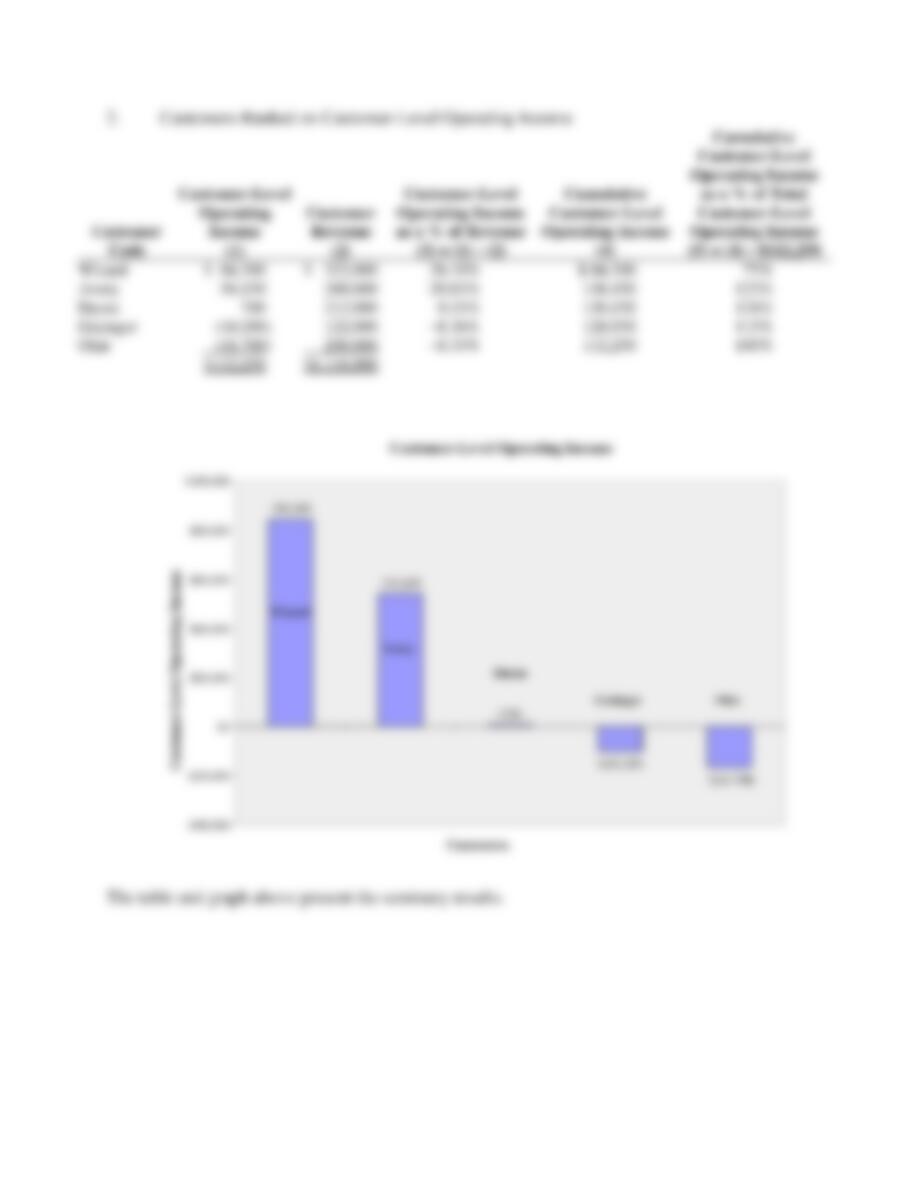
1. Compute customer-level operating income using the new information that Sherman has
gathered.
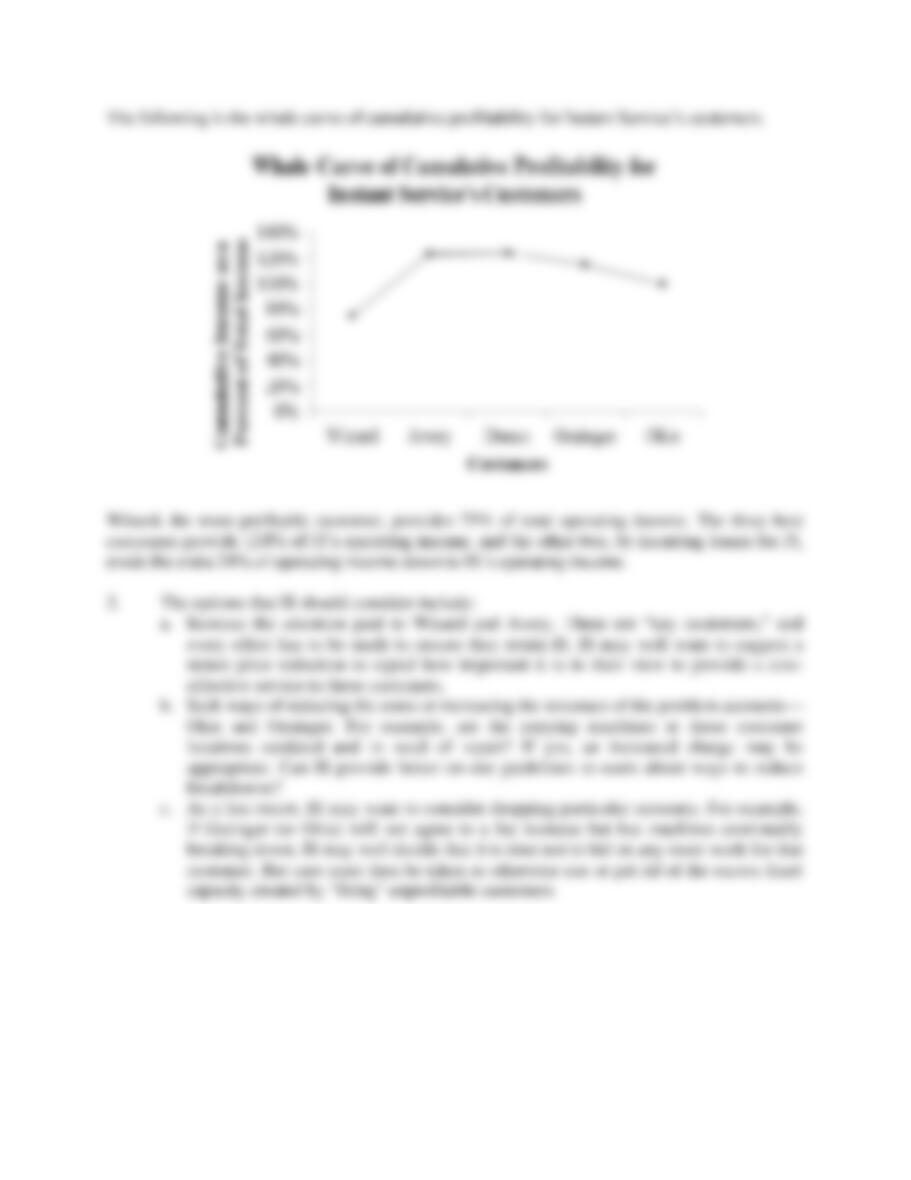
2. Prepare exhibits for IS similar to Exhibits 14-4 and 14-5. Comment on the results.
3. What options should IS consider, with regard to individual customers, in light of the new
data and analysis of office overhead?
SOLUTION
14-10
14-11
14-19 (20−25 min.) Customer profitability, distribution.
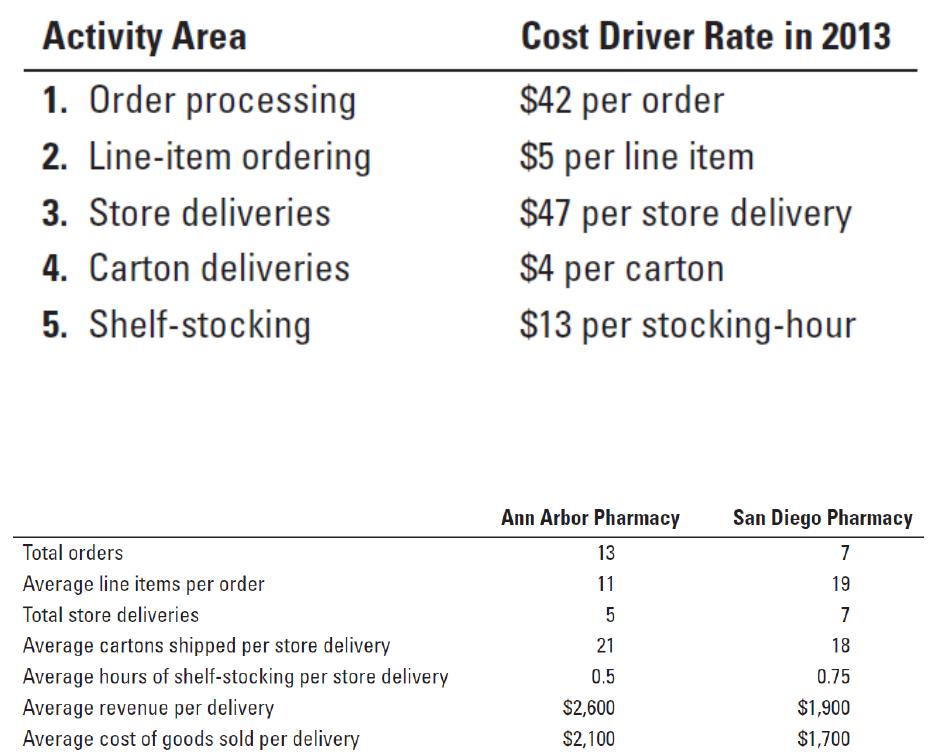
Best Drugs is a distributor of pharmaceutical products. Its ABC system has five activities:
14-12
Rick Flair, the controller of Best Drugs, wants to use this ABC system to examine individual
customer profitability within each distribution market. He focuses first on the Ma and Pa single-
store distribution market. Using only two customers helps highlight the insights available with
the ABC approach. Data pertaining to these two customers in August 2013 are as follows:
Required:
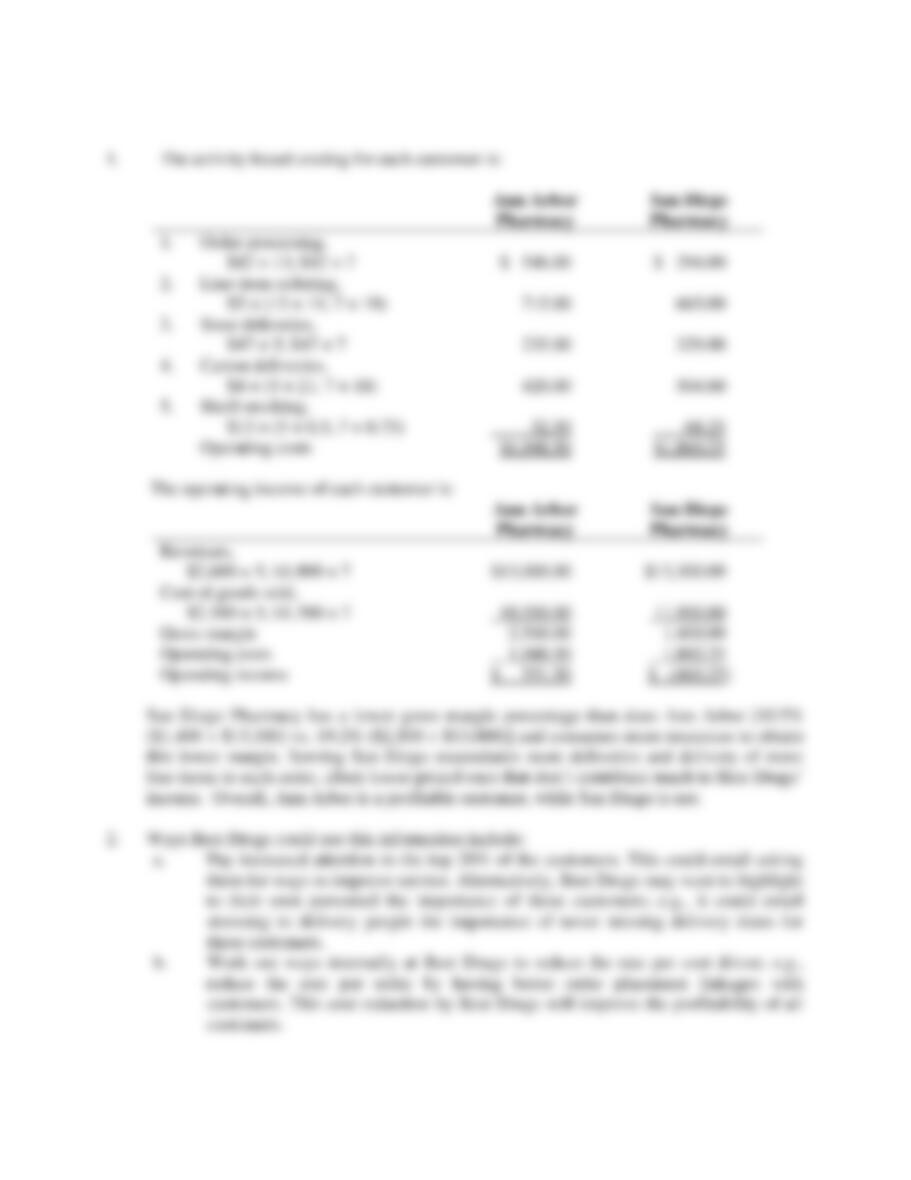
1. Use the ABC information to compute the operating income of each customer in August 2013.
Comment on the results and what, if anything, Flair should do.
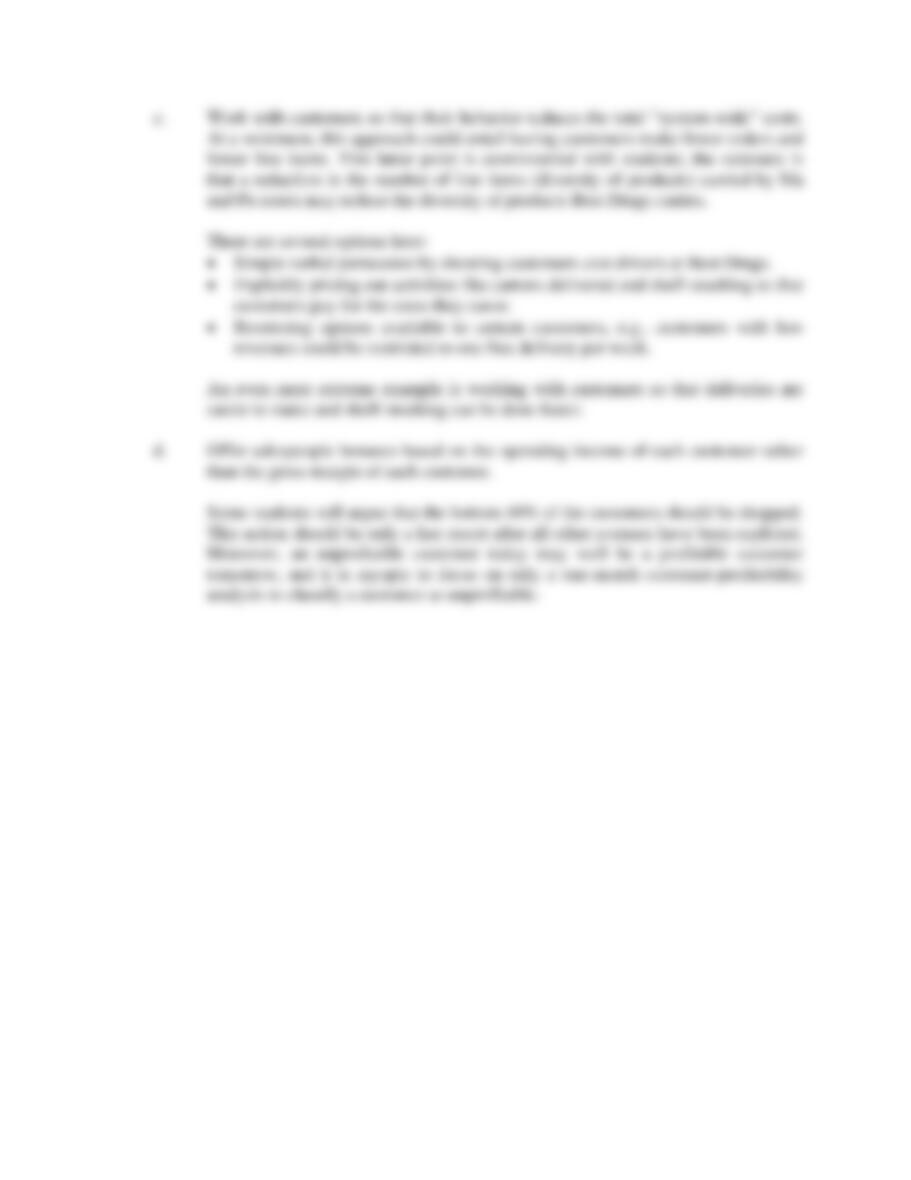
2. Flair ranks the individual customers in the Ma and Pa single-store distribution market on the
basis of monthly operating income. The cumulative operating income of the top 20% of
customers is $58,120. Best Drugs reports operating losses of $23,670 for the bottom 40% of
its customers. Make four recommendations that you think Best Drugs should consider in light
of this new customer-profitability information.
14-13
SOLUTION
14-14
14-15
14-20 (15 min.) Cost allocation and decision making.
Greenbold Manufacturing has four divisions named after its locations: Arizona, Colorado,
Delaware, and Florida. Corporate headquarters is in Minnesota. Greenbold corporate
headquarters incurs $8,400,000 per period, which is an indirect cost of the divisions. Corporate
headquarters currently allocates this cost to the divisions based on the revenues of each division.
The CEO has asked each division manager to suggest an allocation base for the indirect
headquarters costs from among revenues, segment margin, direct costs, and number of
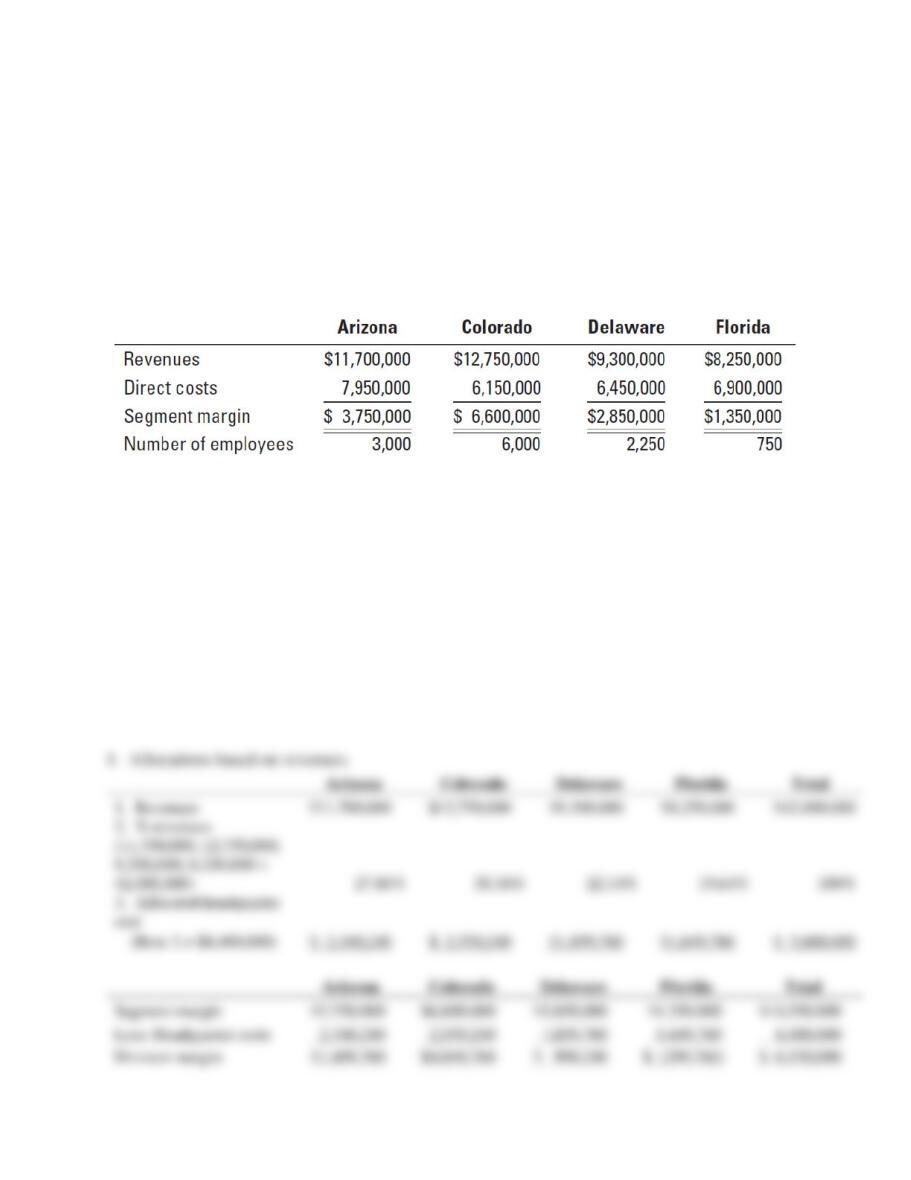
employees. The following is relevant information about each division:
Required:
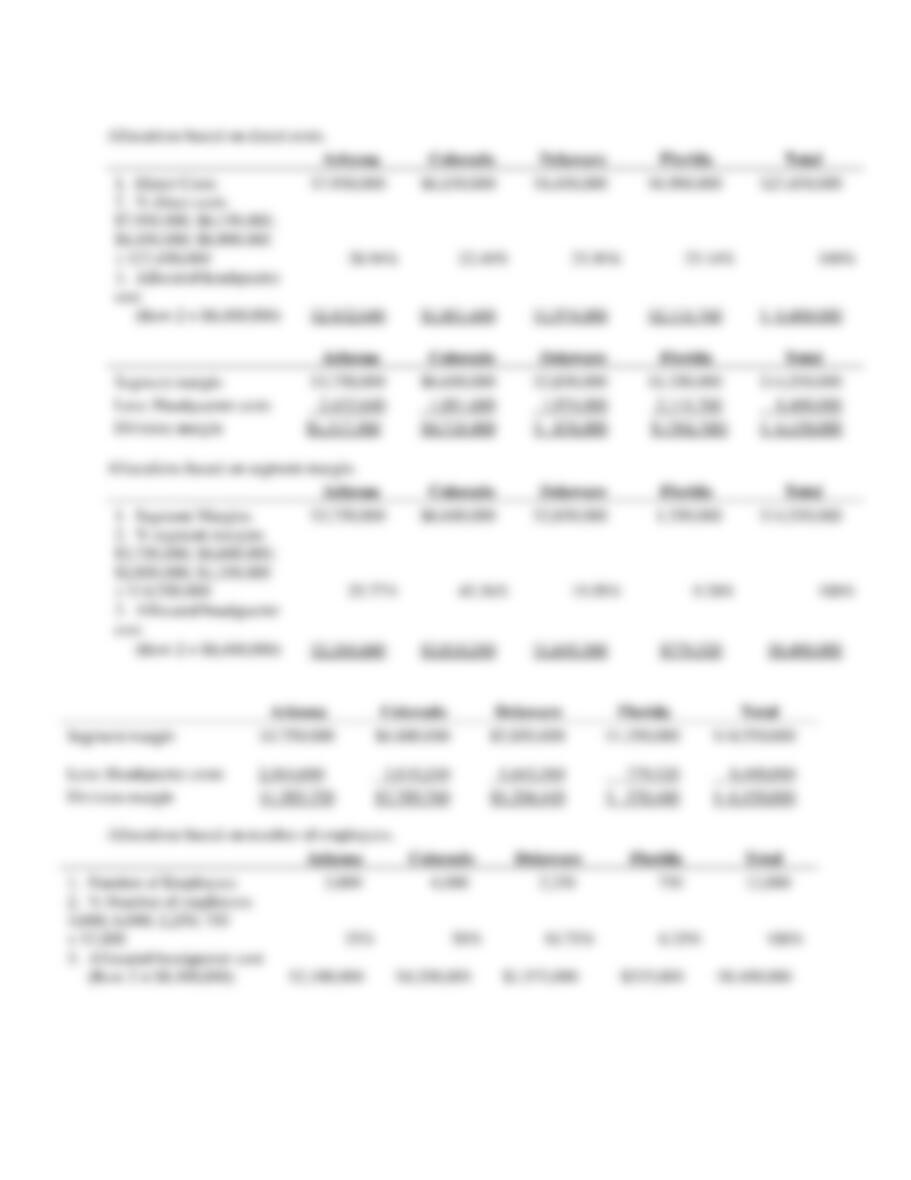
1. Allocate the indirect headquarters costs of Greenbold Manufacturing to each of the four
divisions using revenues, direct costs, segment margin, and number of employees as the
allocation bases. Calculate operating margins for each division after allocating headquarters
costs.
2. Which allocation base do you think the manager of the Florida division would prefer?
Explain.
3. What factors would you consider in deciding which allocation base Greenbold should use?
4. Suppose the Greenbold CEO decides to use direct costs as the allocation base. Should the
Florida division be closed? Why or why not?
SOLUTION
14-16
14-17
14-21 (30 min.) Cost allocation to divisions.
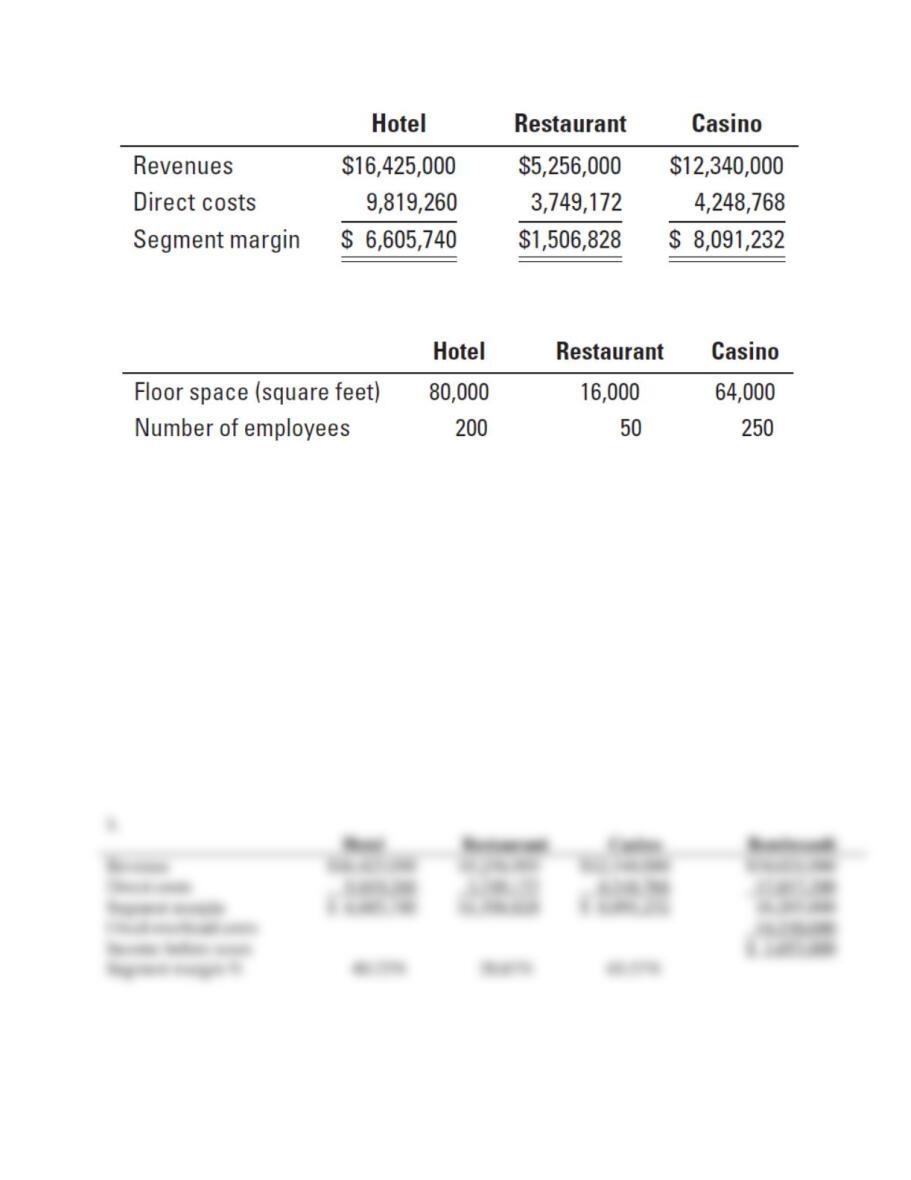
Rembrandt Hotel & Casino is situated on beautiful Lake Tahoe in Nevada. The complex includes
a 300-room hotel, a casino, and a restaurant. As Rembrandt’s new controller, your manager asks
you to recommend the basis the hotel should use for allocating fixed overhead costs to the three
divisions in 2014. You are presented with the following income statement information for 2013:
14-18
You are also given the following data on the three divisions:
You are told that you may choose to allocate indirect costs based on one of the following: direct
costs, floor space, or the number of employees. Total fixed overhead costs for 2013 were
$14,550,000.
Required:
1. Calculate division margins in percentage terms prior to allocating fixed overhead costs.
2. Allocate indirect costs to the three divisions using each of the three allocation bases
suggested. For each allocation base, calculate division operating margins after allocations in
dollars and as a percentage of revenues.
3. Discuss the results. How would you decide how to allocate indirect costs to the divisions?
Why?
4. Would you recommend closing any of the three divisions (and possibly reallocating
resources to other divisions) as a result of your analysis? If so, which division would you
close and why?
SOLUTION
14-19
14-20