
Auditing: A Risk Based Approach to Conducting a Quality Audit, 10e
Solutions for Chapter 14
True/False Questions
14-2 T
14-4 F
14-6 F
14-8 T
14-10 F
14-12 F
14-14 T
14-16 T
14-18 F
14-20 F
14-22 T
14-24 F
14-26 T
Multiple–Choice Questions
14-28 B
14-30 A
14-32 D
14-34 B
14-36 C
14-2
14-37 D
14-39 B
14-41 C
14-43 D
14-45 C
14-47 D
14-49 B
14-51 C
14-52 D
Review and Short Case Questions
14-53
An adjustment is a journal entry that is used to correct a misstatement detected during the audit.
The auditor does not make these adjustments; it is management’s responsibility to do so.
Adjustments are critical to audit quality because if the misstatements are material and remain
uncorrected, then a known misstatement remains in the audited financial statements, which is
obviously unacceptable from a user standpoint.
If management refuses to make an audit adjustment to correct a known misstatement, the auditor
should be skeptical that management is inappropriately biased. The following are examples of
bias in this setting:
• The selective correction of misstatements brought to management’s attention during the
audit (for example, correcting misstatements that have the effect of increasing reported
earnings but not correcting misstatements that have the effect of decreasing reported
earnings).
14-54
A summary of possible adjustments working paper helps the auditor determine whether the
financial statements are fairly presented by summarizing uncorrected misstatements identified
14-55
Management’s incentives may affect whether they are willing to book, that is, correct detected
misstatements. For example, management that wishes to show higher net income may argue with
the auditor to not correct an income-reducing misstatement. In such a situation, the auditor may

14-4
14-56
Debit (Credit) .
Assets Liabilities Retained Net
Account/Description Current Noncurrent Current Noncurrent Earnings Earnings
UNCORRECTED KNOWN MISSTATEMENTS:
Sales 972
Accounts Receivable (972)
Pricing error.
General & Admin Exp. 13,000
CARRYOVER EFFECT OF PRIOR YEAR MISSTATEMENTS:
Retained earnings 69,000
General & Admin. Exp. (9,000)
TAX ADJUSTMENT
Income Taxes Payable ($69,000 – $$41,535) * .4 10,986
———– ———– ———– ———– ———– ———–
Total Likely Misstatement (14,465) 0 (2,014) 0 41,400 (24,921)
CONCLUSION: In my opinion, the total likely misstatements are not material to the financial statements taken as a whole, and correcting the
above misstatements is not necessary
PREPARED BY: DATE
REVIEWED BY: DATE
14-5
14-57
These actions reflect poorly on the integrity and ethics of management. In the first case,
management is obviously selectively correcting to achieve desired financial reporting outcomes;
14-58
14-59
Attorneys are hesitant to provide much information to auditors. They know that the auditors will
14-60
14-61
14-62
a. This is a scope limitation that would cause the auditor to issue a qualified opinion or a
disclaimer, depending on the severity of the contingency.
We are not aware of any pending or threatened litigation, claims, or
14-63
a. No action is necessary. Disclosure of remote contingencies is not appropriate.
b. The auditor should ask the client to accrue the minimum of the range ($250,000) and
14-64
Accounting estimates provide management with opportunity for bias or even fraud. The auditor
should exercise heightened professional skepticism in auditing accounting estimates because
there have been several instances where such estimates have been used to manage earnings. The
auditor must make sure management has made all estimates that could be material to the
financial statements and that they are reasonable.
In evaluating the reasonableness of an estimate, the auditor normally concentrates on key factors
and assumptions that are:
14-7
14-65
Accounting
Estimate
Critical Factors Affecting Estimate, Audit Evidence Needed,
Procedures to Determine if Management is Using the Account to
‘Smooth’ Earnings
a. Pension
Obligation
1. Critical Factors:
• Interest rate assumption on assets invested
• Projection of work-force
2. Sensitivity of Factors:
• The interest rate assumption is very critical in determining
whether or not the pension plan is over or under invested.
• The work force has become more mobile. As the work force
3. Audit Evidence:
• Interest rate assumptions should be compared with a moving
average of returns on investment for the past several years
coupled with an analysis of interest rate and investment returns
14-8
Accounting
Estimate
Critical Factors Affecting Estimate, Audit Evidence Needed,
Procedures to Determine if Management is Using the Account to
‘Smooth’ Earnings
4. Evidence of Manipulation:
• The auditor should be alert to significant variations in either the
expense or the liability in any given year.
• The auditor should always evaluate the change in estimates for
their impact on net income. For example, if net income would
b. Warranty Liability and
Related Expense
1. Critical Factors:
• Warranties offered. For example, a few years ago many of the
car manufacturers extended their warranty from a limited 2-
year, 24,000 mile warranty to a 3-year, 36,000 bumper-to–
bumper warranty. The latter should cost more.
• Claims data
o Types of claims.
o Frequency
• Changes in units sold and produced.
2. Sensitivity of Factors:
• The liability and related expense is sensitive to all of the
3. Audit Evidence:
14-9
Accounting
Estimate
Critical Factors Affecting Estimate, Audit Evidence Needed,
Procedures to Determine if Management is Using the Account to
‘Smooth’ Earnings
• The auditor should evaluate the sophistication of the client’s
estimation program. For example, the client should probably
4. Evidence of Smoothing:
• All the factors identified above and the analysis used in the
previous two parts of the question should be evaluated.
c. Allowance for
Uncollectible
Accounts (mfg)
1. Critical Factors:
• Most of the factors are the same as identified above for the
financial institutions except:
2. Sensitivity of Factors:
3. Audit Evidence:
4. Evidence of Smoothing:
• Similar to loans. More emphasis on aging of accounts
receivable, comparison of current write-offs with both
historical trends and current economic conditions.
d. Allowance for
Returned Goods,
(catalog vendor
with guaranteed
1. Critical Factors:
• Quality control for goods sold.
• Current economic conditions. For example, if there are
problems with an increasing amount of credit card debt, there
14-10
Accounting
Estimate
Critical Factors Affecting Estimate, Audit Evidence Needed,
Procedures to Determine if Management is Using the Account to
‘Smooth’ Earnings
2. Sensitivity:
3. Audit Evidence:
• If the client has a good tracking database, the auditor may
spend most of the time analyzing the results.
• Compare previous year estimates with actual.
5. Evidence of Smoothing:
• Analysis is pretty much the same as for other accounts.
14-66
It is impossible to remember all of the matters that should be considered for disclosure. A
14-67
When assessing disclosures, the auditor should have reasonable assurance that:
• Disclosed events and transactions have occurred and pertain to the entity.
14-68
The risks that the related party transactions at OAO Gazprom pose for PwC concern possible
government intervention or interference with the audit process. If PwC objects to the company’s
disclosures, or lack thereof, the firm may face penalties or sanctions that could inhibit the ability
14-11
of PwC to continue to operate in Russia. PwC is in a relatively weak political position given the
14-69
Auditing standards recognize that there are inherent limitations in an auditor’s ability to detect
material misstatements relating to the entity’s compliance with laws and regulations. These
limitations include:
• Laws and regulations often relate to operational issues within the entity that do not
necessarily relate to the financial statements, so the information systems relating to
14-70
The main provisions of the FCPA include:
• No U.S. person or company that has securities listed on U.S. markets may make a
payment to a foreign official for the purpose of obtaining or retaining business. This
provision is commonly called the anti-bribery provision of the FCPA.
14-71
Triton’s violations included:
• Improper payments were made to a middle-man who used the funds to reduce Triton
Indonesia’s tax liability
14-12
14-72
Yes. The auditor is required to evaluate the likelihood of each audit client being a going concern
as a part of each audit. There are several conditions for which the auditor should be alert when
performing the audit:
• Negative trends, such as recurring losses, working capital deficiencies, negative cash
flows from operating activities, and adverse key financial ratios
• Internal matters, such as loss of key personnel, employee strike, outdated facilities and
products, and uneconomic long-term commitments
14-73
The results of the Altman Z-score should be combined with the other evidence of going concern
problems and management’s plans to mitigate those problems. If the auditor continues to have
substantial doubt about the client’s ability to remain a going concern, a paragraph should be
14-13
14-74
Potential indicators of going-concern problems include the following:
• Negative trends, such as recurring losses, working-capital deficiencies, negative cash
flows from operating activities, and adverse key financial ratios (low – these are
quantitative measures that can be compared to prior-year figures and industry averages)
14-75
a. The auditor has a responsibility to assess the likelihood management can accomplish the
mitigating actions to overcome the going-concern problems. If the auditor does not believe
management can be successful, the audit report should contain a going concern paragraph stating
b. This action tells the reader that the auditor does not believe management can overcome the
going-concern problems. It may be that management is not capable, or that the circumstances of
14-14
d. Elements of management’s plan and audit assessment approaches are:
Management Plan
Elements
Audit Evidence to Assess Management Plan
Another public
offering of stock to
raise $200 million
in capital. The stock
Examine correspondence between company and investment bankers.
Review current stock analyst reviews of the stock to evaluate whether or
not the market is receptive to a new stock issue.
Sign an agreement
with at least fifty
more local
distributors during
the year.
Examine the success the company had in the past two years in signing
distributors and the retention rate of the companies signed.
Examine contracts to determine if the terms of the contract have changes.
Improve
warehousing and
distribution to cut at
least 20% off the
distribution costs
Review management plans to cut distribution costs. Make a realistic
assessment as to whether management’s plans are optimistic.
Determine how operating costs are calculated and whether some of the
costs that are cut may lead to one-time expense charges and the creation
realistic.
marketing to
Increase sales by
50% through more
advertising,
coupons, and better
Determine if company has a model to estimate the effectiveness of each
of the methods proposed to increase revenues. Determine if the model is
consistent with the results described.
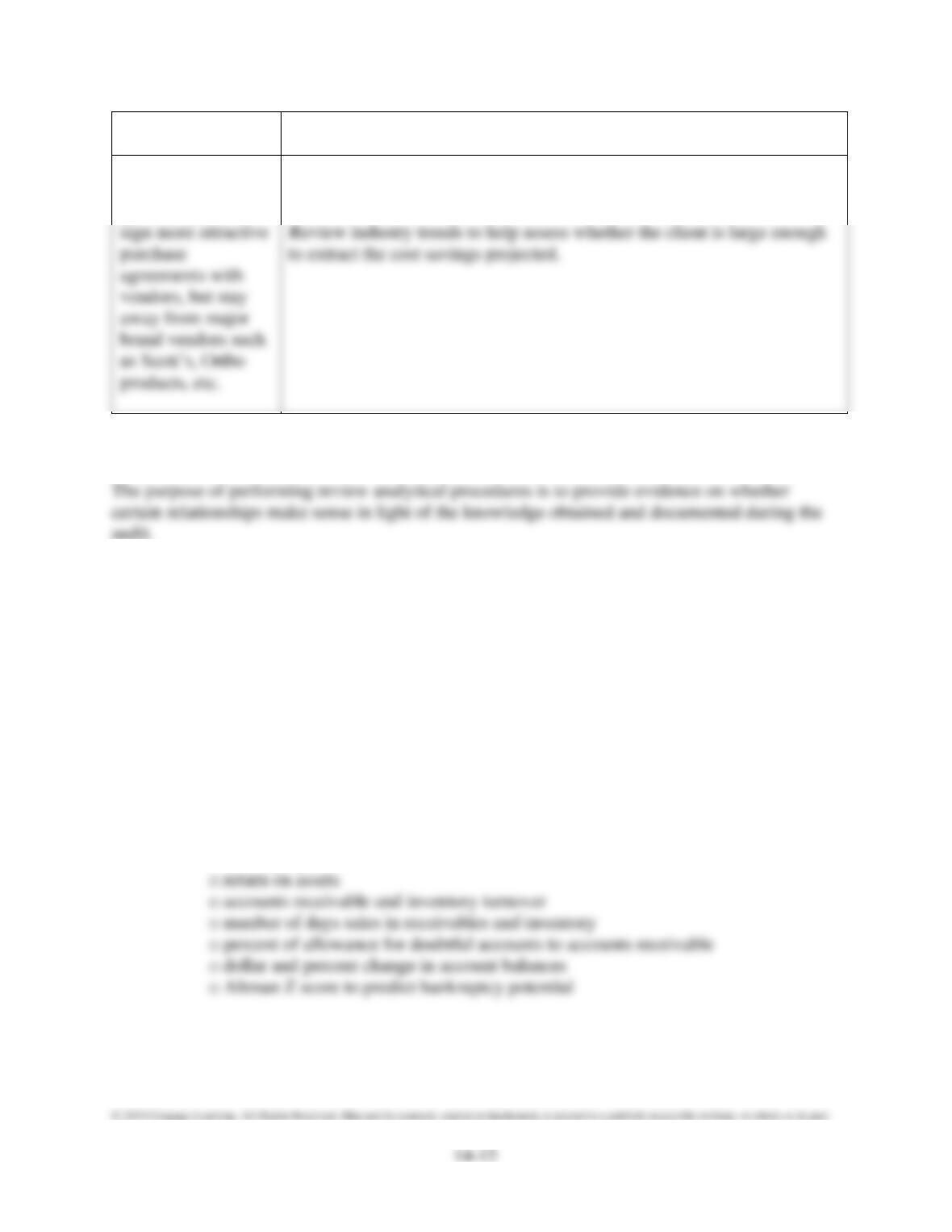
Management Plan
Elements
Audit Evidence to Assess Management Plan
Improve profit
margins by using its
purchase power to
Review recent contract signings to determine if there appears to be
significant price reductions.
14-76
14-77
a. Analytical procedures should be performed by the most experienced auditor because
he/she is most familiar with the industry and the client and is in the best position to identify
unexpected results.
b. Following are some the analytical procedures that could be performed in completing the
audit:
• Prepare a common size income statement and balance sheet and compare with prior years
and industry data.
• Calculate ratios and statistics such as the following and compare with prior years and
industry data:
o current and quick ratios
o debt/equity ratio
c. The procedures will help the auditor determine whether the audit documentation explains
any unexpected results from the analyses or whether more evidence needs to be obtained before
an audit opinion is issued.
14-16
14-78
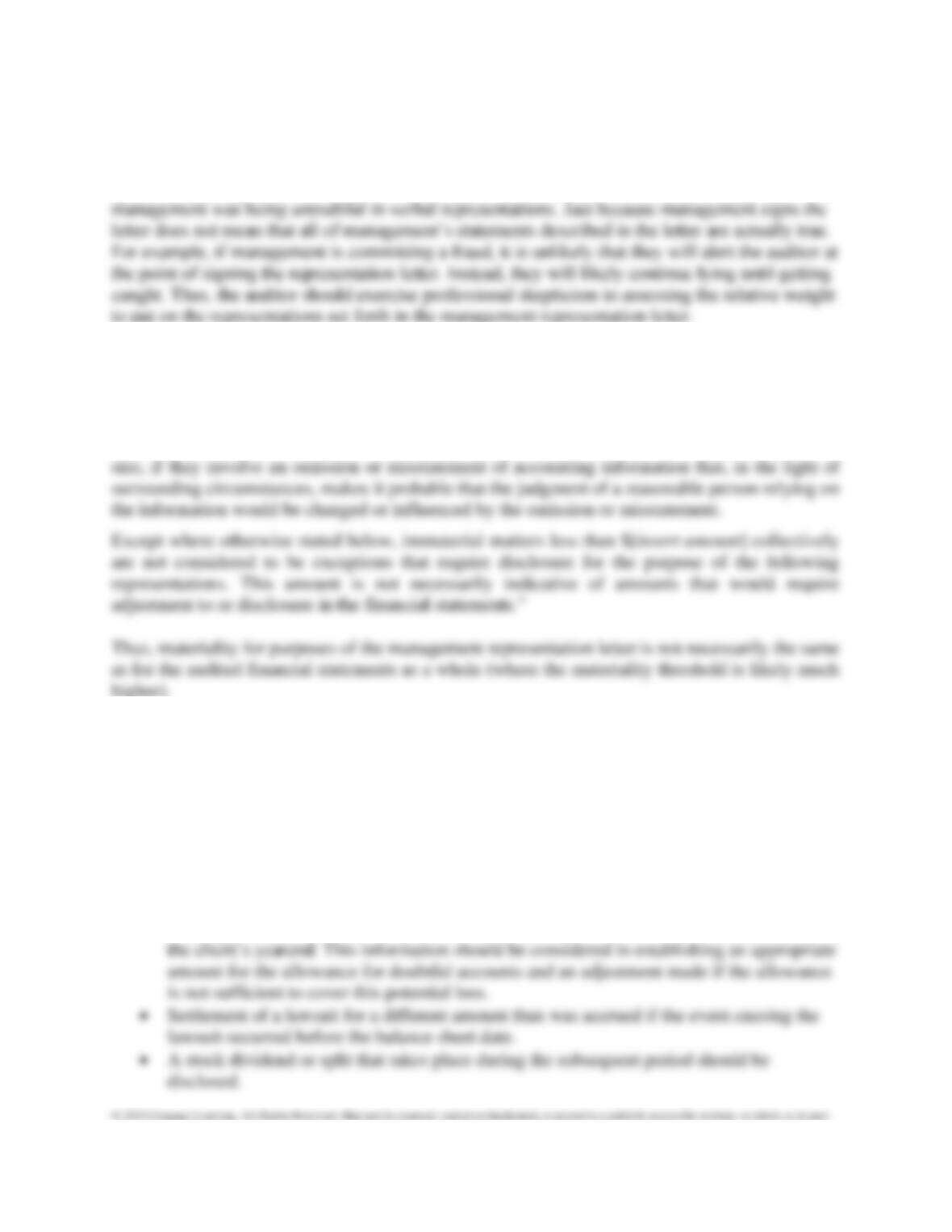
Financial Trend
CFO’s Likely Non-Fraud Explanation
Cash balances have declined to their lowest
level since FYE 2004.
Both sales and accounts receivables have
declined due to the recession.
returned to about FYE 2004 levels.
2008 to 2009. Relatedly, gross profit has
decreased sharply over the period, with a
particularly significant decrease from FYE
2008 to 2009.
increased cost of goods sold.
SG&A as a percentage of sales has risen
sharply over the period, with a particularly
These are mostly fixed costs, so as sales
volume declined, these costs have remained
Sales increased over the period, but have
Recession.
significant increase from FYE 2008 to 2009.
the same.
Net Income as a percentage of sales has
decreased sharply over the period, with a
particularly significant decrease from FYE
2008 to 2009.
Current liabilities as a percentage of sales
has remained relatively stable over the
period, so there do not appear to be
problems in the purchasing cycle.
No explanation required.
14-79
A management representation letter is a letter signed by the CEO and CFO, dated as of the audit
report date, and is prepared by the auditor. It is a reminder to management of their primary
14-17
14-80
If management refuses to sign the representation letter, it means that they are not willing to stand
by their verbal representations when asked to do so in writing; in short, it would imply that
14-81
Materiality plays an important role in determining what must be discussed in the management
representation letter. The sample letter notes that “Certain representations in this letter are
described as being limited to matters that are material. Items are considered material, regardless of
14-82
The first type of subsequent event is one that provides evidence about conditions that existed at
the balance sheet date. The financial statement numbers should be adjusted to reflect this
information. Footnote disclosure may also be necessary to provide additional information.
Examples are:
• A major customer files for bankruptcy during the subsequent period. The cause is a
deteriorating financial condition of which the client and auditor were not aware until
learning of the bankruptcy filing. But the deteriorating financial condition existed as of
The second type of subsequent event is one that indicates conditions that did not exist at the
balance sheet date. The financial statement numbers should not be adjusted for these events, but
they should be considered for disclosure. Examples are:
• A customer bankruptcy during the subsequent period caused by an uninsured casualty
that occurred after the balance sheet date. Since the inability of the customer to pay did
14-83
Some of the procedures discussed in prior chapters relate to subsequent events, such as cutoff
tests, review of subsequent collections of receivables, and the search for unrecorded liabilities.
Additional procedures include:
• Read the minutes of the meetings of the board of directors, stockholders, and other
authoritative groups. The auditor should obtain written assurance that minutes of all such
meetings have been made available to the auditor. This can be included in the
• Inquire of management concerning:
o Any significant changes noted in the interim statements.
o The existence of significant contingent liabilities or commitments at the balance sheet
date or date of inquiry, which should be near the end of the field work.