Chapter 14
Notes Receivable and Notes Payable
Chapter Overview
This chapter discusses notes receivable and notes payable. It begins with the illustration of a promissory
note and an understanding of the maker, the payee, the principal, and the maturity date. Interest is calculated
Learning Objectives
After studying Chapter 14, your students should gain proficiency in the following:
2. Journalizing Entries to Record Notes.
4. Journalize Adjustments for Interest Expense and Interest Income.
Chapter 14 Assignment Grid
Estimated Level
Learning Time in of
Assignment Topic(s) Objective(s) Minutes Difficulty
Discussion Questions and Critical Thinking/Ethical Case
1 Notes Payable and Accounts Payable 1 5 Easy
8 Discounting a Note 3 5 Easy
9 Contingent Liability 3 5 Easy
10 Interest 3 5 Easy
11 Discount on Notes Payable 4 5 Easy
12 Effective Interest Rate 4 5 Easy
13 Discount on Notes Payable 4 5 Easy
14 Ethical Case 4 5 Easy
Concept Checks
1 Determining Maturity Date 1 10 Easy
2 Calculate Maturity Value 1 15 Easy
3 Journalizing Notes for Buyer and Seller 2 15 Easy
Exercises (Set A)
14A-1 Interest 1 15 Easy
14A-2 Maturity Value 1 15 Easy
14A-3 Interest Table 1 15 Easy
14A-4 Discounting/Dishonoring Notes 2, 3 15 Medium
14A-3 Journalizing Note Transactions 4 25 Easy
14A-4 Journalizing Note Transactions 1, 2, 3, 4 60 Hard
Estimated Level
Learning Time in of
Assignment Topic(s) Objective(s) Minutes Difficulty
Problems (Set B)
14B-1 Buyer and seller entries 2 30 Medium
14B-2 Note computations 3 35 Medium
Financial Report Problem
Reading Amazon’s Annual Report 1 15 Easy
Keeping It Real
Suarez Computer Center 1 20 Medium
Chapter 14
Notes Receivable and Notes Payable
Chapter Introduction Summary:
Companies use notes instead of informal promises for many reasons, such as recording sales of high-cost
items like farm machinery or construction equipment that have long-term credit periods (usually over 60
days). This can give additional time to settle past due accounts or allow borrowing money from a bank for a
Learning Unit 14-1: Interest Calculations and Determining Maturity
Dates on Notes
Summary: A promissory note (often called simply a note) is a written promise by a borrower to pay a
certain sum of money to the lender at a fixed future date. The principal is the face amount of the
promissory note or the amount that was borrowed. The payee is the person to whom a note is payable. The
Key Concepts: Promissory note, principal, payee, maturity date, maker, note payable, note receivable.
Lecture Outline:
1. Promissory notes:
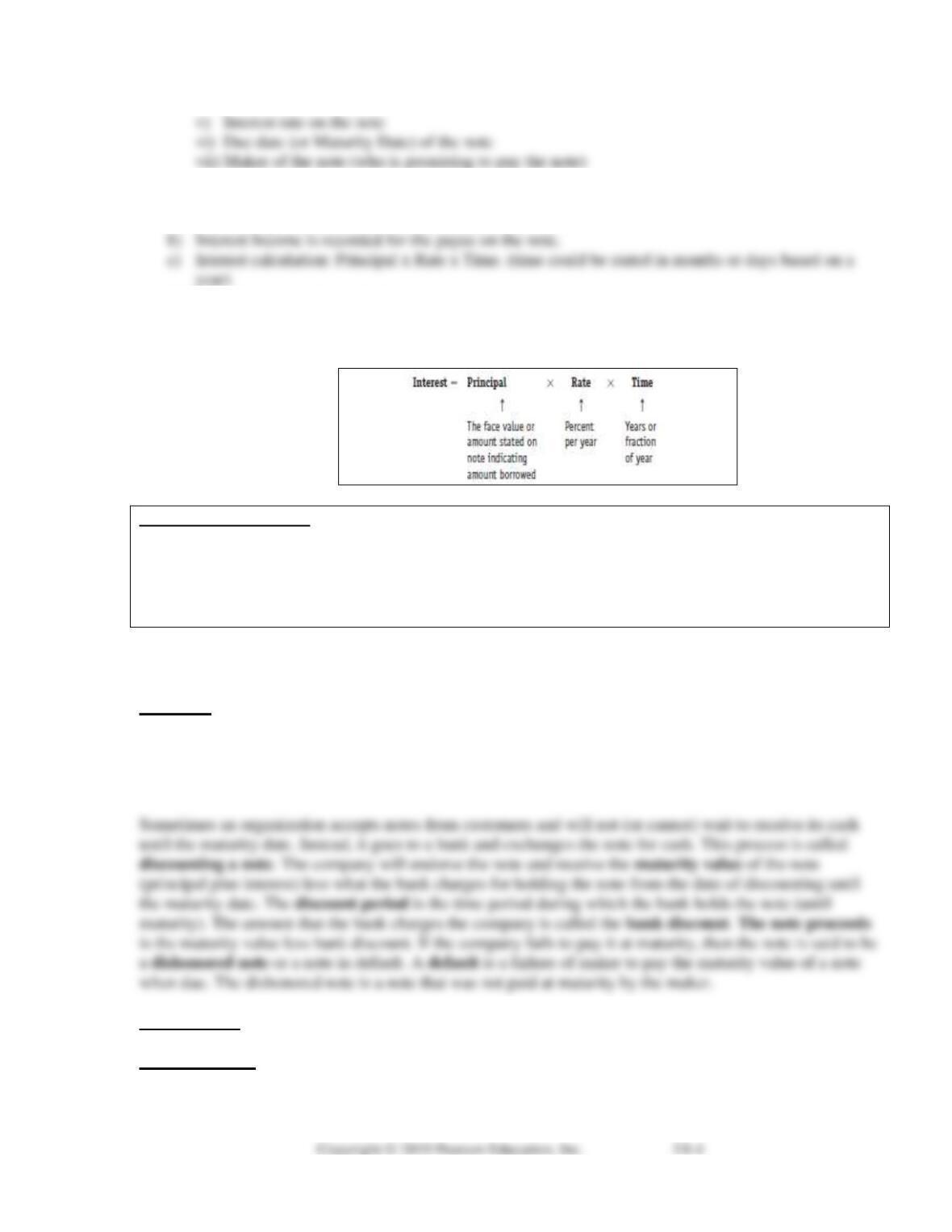
a) Formal written promise by a borrower to pay a certain sum at a fixed future date (See Figure 14.1)
b) Notes include the following:
2. Interest:
a) Interest Expense is recorded for the maker of the note.
3. Maturity date can be determined by:
a) Exact days using set up in text, calendar, or table of days in a year (Table 14.1)
b) Number of months
Teaching Tips/Strategy: The Discussion Questions #1 – #4 are excellent for a pre-lecture preparation.
Concepts covered on the objective require prior knowledge of the topics before the exercises are completed.
For lecture demonstration you can utilize Concepts Checks #1 and #2 and Exercises 14A-1, 14A-2, and
14A-3.
Use the “Ten-Minute Quiz” questions #1, #2, #3, and #4 to reinforce the learning concept.
Learning Unit 14-2: Journalizing Entries to Record Notes
Summary: There are several types of transactions that can be used involving notes. An extension of time to
pay on an accounts payable can be granted by the exchanging and signing of a notes payable for an
accounts payable. Notes can be paid by maturity due date. It is possible that a note may be renewed at
maturity to extend time when maker is unable to pay at maturity. A note may also be given in exchange for
equipment or other asset.
IT 14-2
Key Concepts: Dishonored note, default.
Lecture Outline:
1. Promissory note:
a) Note receivable is a promissory note from the payee’s point of view.
b) Note payable is a promissory note from the maker’s point of view.
c) Time Extension:
i) Maker may request a time extension to gain additional time,
ii) Or to settle past due accounts payable and convert the accounts payable to a note payable.
iii) Payee may accept the time extension because a note is a formal written promise to pay, and
interest is accumulated on the note (See Figure 14.3).
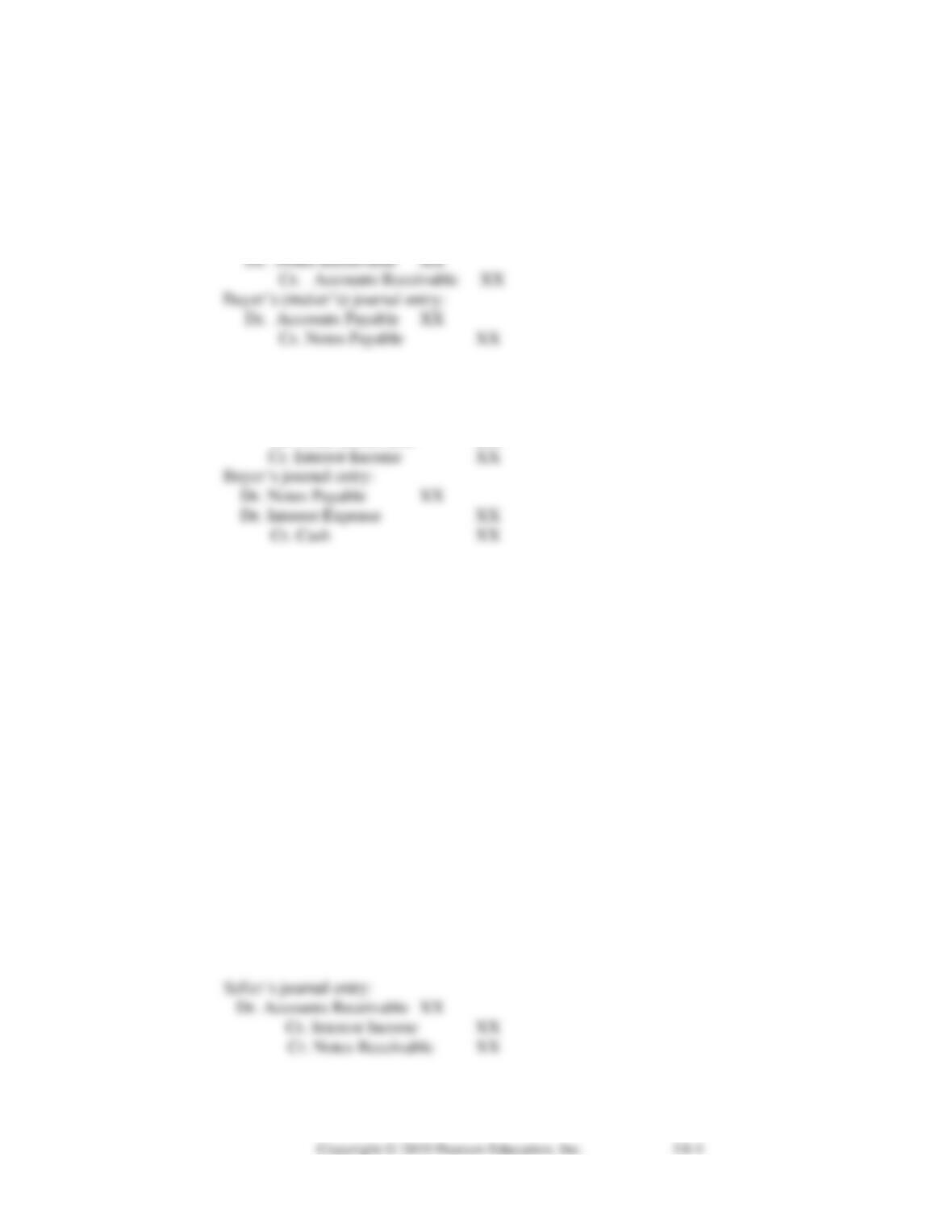
Seller’s (payee’s) journal entry:
d) Interest is calculated on the maturity day of the note (See Figure 14.4)
Seller’s journal entry:
Dr. Cash XX
Cr. Notes Receivable XX
e) If the note is renewed at maturity (See Figure 14.5)
i) Interest for the original note is recognized and recorded.
ii) Original note principal + interest = principal of the new note.
Seller journal entry:
Dr. Cash (if any) XX
Dr. Notes Rec. (new) XX
Cr. Notes Receivable (old) XX
Cr. Interest Income XX
Buyer journal entry:
Dr. Notes Payable (old) XX
Dr. Interest Expense XX
Cr. Notes Payable (new) XX
Cr. Cash (if any) XX
f) A dishonored note:
i) Note was not paid at maturity by the maker.
ii) Maker is considered to have defaulted on the note.
iii) Note principal + interest due are transferred to the customer’s accounts receivable and
subsidiary ledger.
Buyer’s journal entry:
Dr. Notes Payable XX
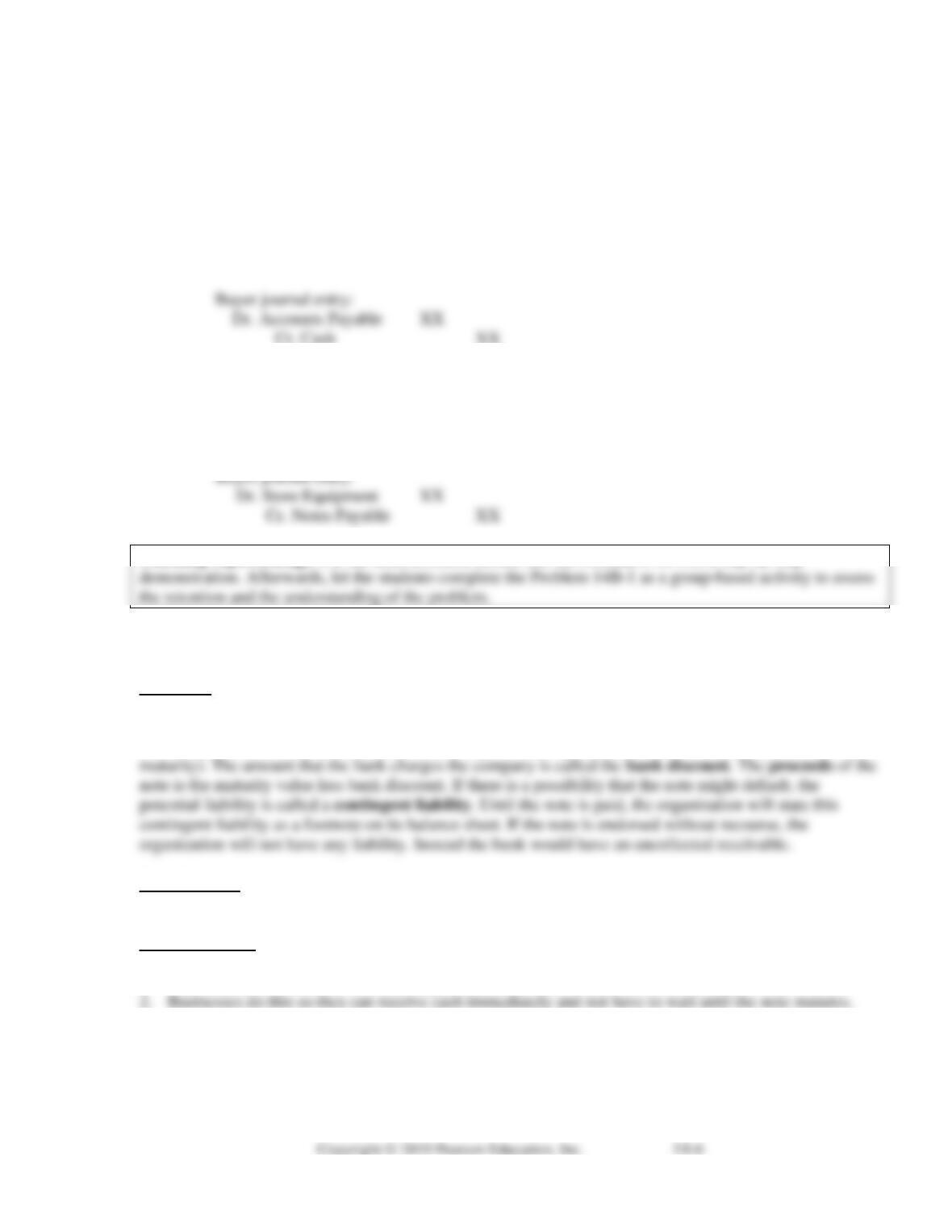
Dr. Interest Expense XX
Cr. Accounts Payable XX
g) If the note is repaid, the accounts receivable for the seller and the accounts payable for the buyer are
paid and removed from the ledger accounts.
Seller journal entry:
Dr. Cash XX
Cr. Accounts Receivable XX
Cr. Cash XX
h) If the note is given in exchange for equipment or other asset:
Seller journal entry:
Dr. Notes Receivable XX
Cr. Sales XX
Teaching Tips/Strategy: For the demonstration lecture use the Problem 14A-1 as a step-by-step
Learning Unit 14-3: Journalizing Entries to Discount a Note
Summary: When the customer or seller goes to a bank and exchanges the note for cash, this process is
called discounting a note. The company will endorse the note and receive the maturity value of the note
(principal plus interest) less what the bank charges for holding the note from the date of discounting until
the maturity date. The discount period is the time period during which the bank holds the note (until
Key Concepts: Discounting a note, maturity value, discount period, bank discount, proceeds, contingent
liability.
Lecture Outline:
Discounting a note:
1. This is the process or act of transferring the note to a bank before the maturity date.
3. The company signs the note over to the bank and receives the maturity value of the note (principal plus
interest) less the amount the bank charges (bank discount) for it to hold the note until maturity or the
bank discount.
a) The discount period is the amount of time between the date the note was discounted and the
maturity date. (It is the amount of time the bank will hold the note.)
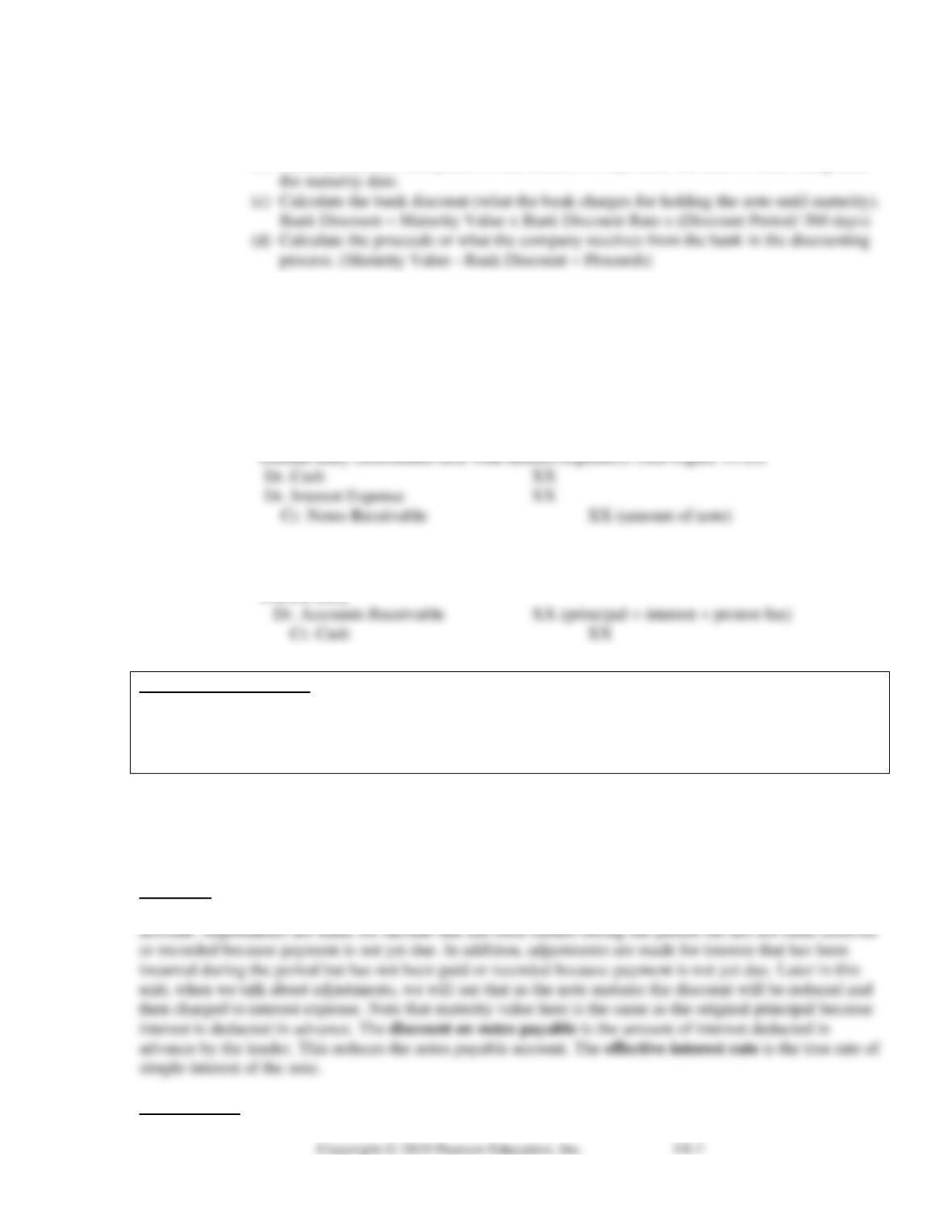
b) Steps in discounting a note:
(a) Find the maturity value of the note: principal plus interest.
(b) Calculate the discount period or the number of days from the date of discounting until
Journal entry from the proceeds (discounted note with interest income): (See Figure 14.9)
Dr. Cash XX
Cr. Notes Receivable XX (amount of note)
Cr. Interest Income XX
c) If the interest on the note does not cover the bank discount rate, there is interest expense
instead of interest income. This is more likely to occur when a note is discounted early in
the life of a note.
d) When the note is discounted, the company agrees to pay the bank the maturity value of the
note. If the maker dishonors the note, this is a contingent liability. (See Figure 14.11)
Journal entry
Teaching Tips/Strategy: Use Accounting Coach LU 14-3 to check for understanding of concepts. The
Discussion Question #8 is useful to review steps in discounting a note. For lecture demonstration you can
utilize Concepts Checks #4 – #7. Assign Problem 14A-2 or 14B-2 for students to complete.
Use the “Ten–Minute Quiz” questions #8, #9, and #10 to reinforce the Learning Objective.
Learning Objective 14-4: Adjustments for Interest Expense and
Interest Income
Summary: Because interest-bearing notes are often taken out and then paid off in different accounting
periods, it is necessary to adjust or bring up-to-date the interest income account and the interest expense
Key Concepts: Discount on notes payable, effective interest rate.
Lecture Outline:
1. Discounting a business’s own note is done when the company borrows money from the bank in the
form of a note.
2. There are several steps involved:
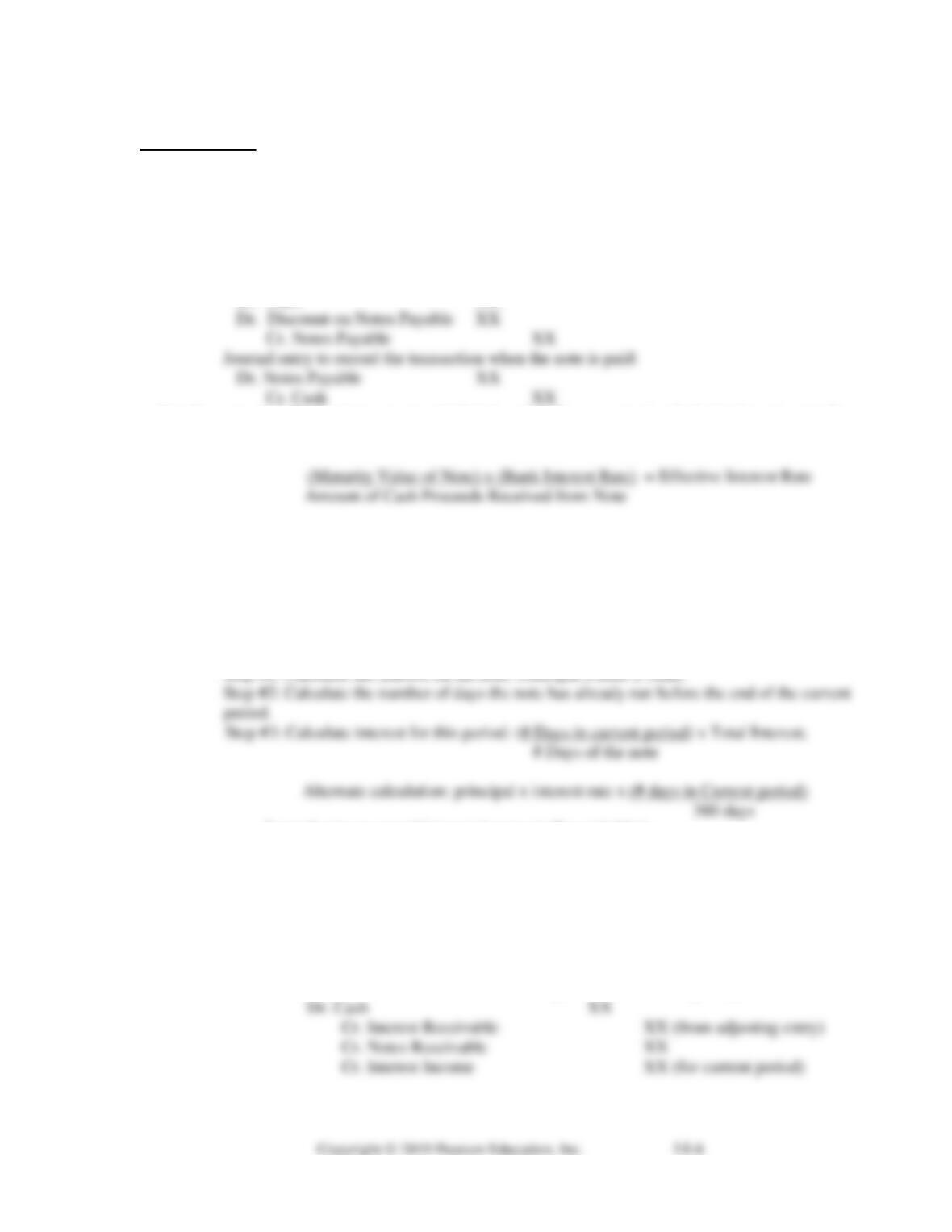
a) Compute the discount which is the amount of interest deducted in advance by the lender.
Bank discount = Maturity Value x Interest Rate x (Discount Period /360 days)
Journal entry to record the receipt of cash and the discount:
Dr. Cash XX
b) Compute the effective interest rate which is based on the amount of cash the business is actually
borrowing:
c) Adjusting for interest is often necessary because interest-bearing notes are often paid in a different
period from when the note was initiated.
i) Payee must adjust for interest income that has been earned during the period but has not been
received or recorded because payment is not yet due.
ii) Maker must adjust for interest expense that has been incurred during the period but has not
been paid or recorded because payment is not yet due.
iii) The steps in recording the interest income or expense:
Step #1: Calculate the interest on the note: Principal x Rate x Time.
Journal entry to record interest income (seller or holder):
Dr. Interest Receivable XX
Cr. Interest Income XX
Journal entry to record interest expense (buyer or debtor):
Dr. Interest expense XX
Cr. Interest Payable XX
Journal entry for the seller when the note is paid and no reversing entry:
Journal entry for the seller when the note is paid with a reversing entry:
Journal entry for the buyer when the note is paid (with reversing entry):
Dr. Notes Payable XX
3. When a business discounts its own note and adjusts for interest expense over more than one accounting
cycle, the discount on notes payable must be adjusted as well.
a) Calculate the percentage of time that has elapsed between the start of the note and the end of the
accounting cycle.
b) Multiply this percentage by the discount on notes payable.
Journal Entry to record the interest expense: (See Figure 14.17)
Teaching Tips/Strategy: The Problem 14A-4 is an excellent review for the entire chapter objectives. This
problem can be assigned or completed in groups during class time.
Use the “Ten-Minute Quiz” questions #6, #7, #8, #9 and #10 to reinforce the Learning Objective #2-4
concepts.

Name Date Section
CHAPTER 14
TEN-MINUTE QUIZ
Circle the letter of the best response.
1. Which of the following is not a required element needed to compute interest?
a. principal b. rate
c. time d. payer
2. The party signing a note payable is called:
a. the maker b. the payee
c. the lender d. none of the above
3. Interest on a $7,500, 8%, 120-day note is:
a. $197 b. $600
c. $6,000 d. $72,000
4. The amount being borrowed is called the:
a. loan b. defaulting note
c. principal d. note obligation
5. The entry to record the payment of an interest-bearing promissory note is:
a. Cash XX
Notes Payable XX
b. Notes Payable XX
Interest Expense XX
Cash XX
c. Notes Payable XX
Cash XX
d. Interest Expense XX
Cash XX
Notes Payable XX
6. When a customer cannot pay their account receivable and is willing to sign a note payable, the
seller entry is:
a. Debit Notes Payable, credit Accounts Payable
b. Debit Accounts Payable, credit Notes Payable
c. Debit Notes Receivable, credit Accounts Receivable
d. Debit Accounts Receivable, credit Notes Receivable
7. The entry by the seller when a note is dishonored is:
a. Notes Payable XX
Interest Expense XX
Accounts Payable XX
b. Cash XX
Accounts Receivable XX
c. Accounts Payable XX
Cash XX
d. Accounts Receivable XX
Interest Income XX

Notes Receivable XX
8. The entry to record discounting a note with interest income is:
a. Cash XX
Interest Expense XX
Notes Receivable XX
b. Cash XX
Notes Receivable XX
Interest Income XX
c. Notes Receivable XX
Interest Income XX
Cash XX
d. Notes Receivable XX
Interest Expense XX
Cash XX
9. If a 120-day, 11% note, with a face value of $7,000 is discounted after being held for only 3 days
and the bank’s discount rate is 17%, how much is the discount?
a. $10.63 b. $400.93
c. $275 d. $7,764
10. If a 120-day, 11% note, with a face value of $7,000 is discounted after being held for only 3 days
and the bank’s discount rate is 17%, what are the proceeds?
a. $10.63 b. $11.01
c. $275 d. $6,855.73
Answer Key to Chapter 14 Quiz
1. d