25 Minutes, Easy
(Dollars in
Millions)
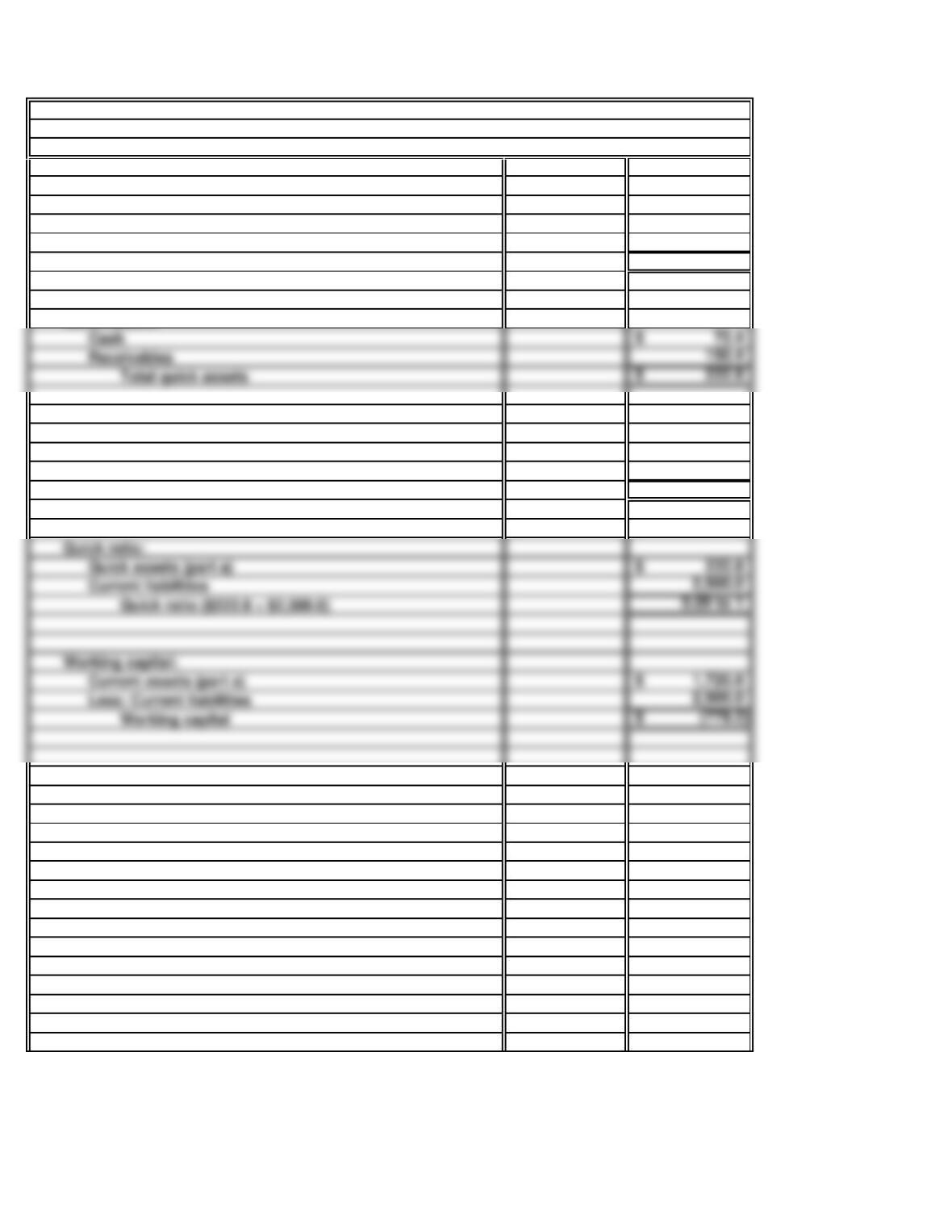
a. Current assets:
(
Cash 72.4$
Receivables 150.4
Merchandise inventories 1,400.0
Prepaid expenses 98.0
Total current assets 1,720.8$
Quick assets:
b. Current ratio:
(
Current assets (part a) 1,720.8$
Current liabilities 2,500.0
Current ratio ($1,720.8 ÷ $2,500.0) 0.69 to 1
Quick ratio:
(
Quick assets (part a) 222.8$
Working capital:
(
Current assets (part a) 1,720.8$
PROBLEM 14.4B
CHEZO, INC.
(
Receivables 150.4
Total quick assets 222.8$
d.
e.
In evaluating Chezo’s liquidity, it would be useful to review the company’s financial position
PROBLEM 14.4B
CHEZO, INC. (concluded)
Due to characteristics of the industry, cheese stores tend to have smaller amounts of current
35 Minutes, Medium
(Dollars in
Thousands)
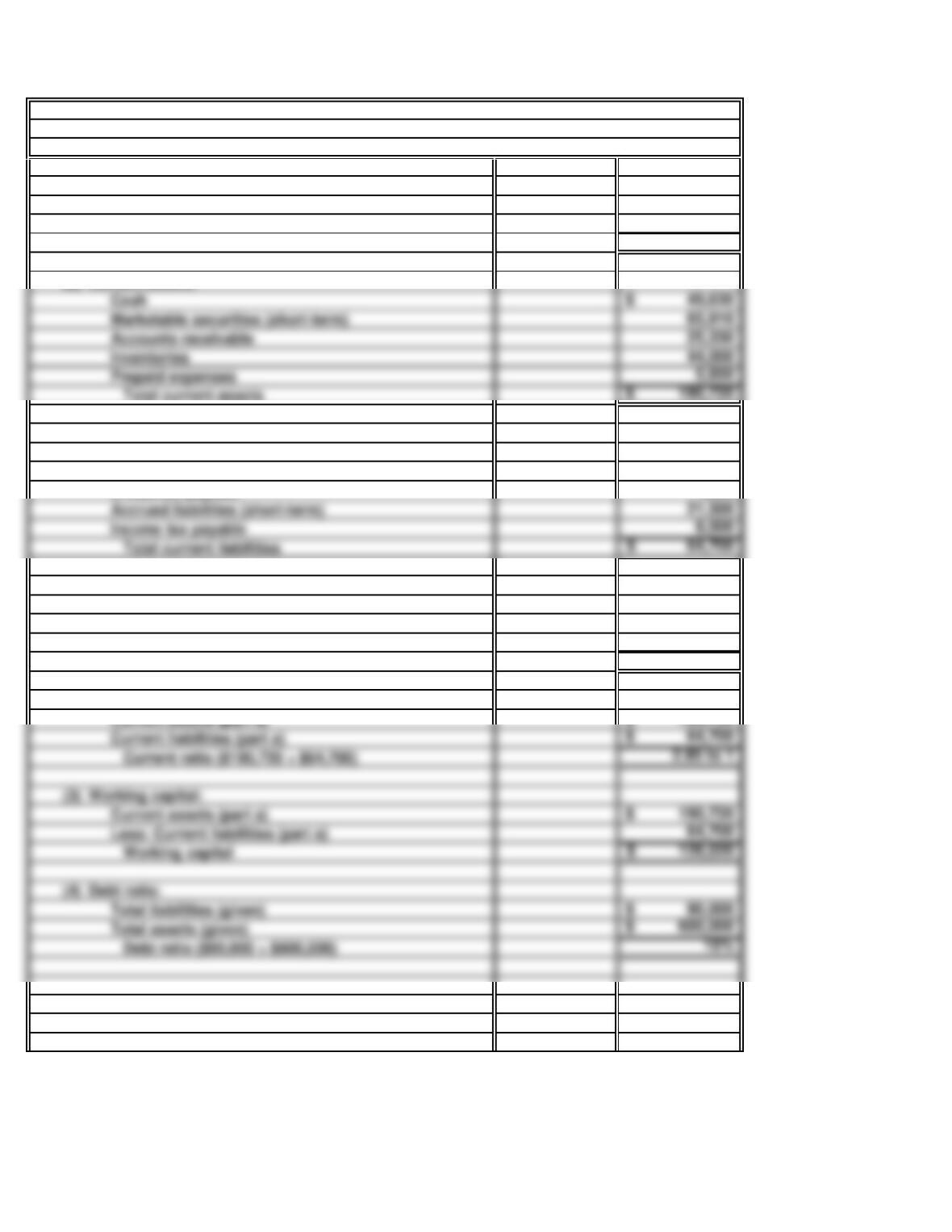
a. (1) Quick assets:
(
(
Cash 49,630$
Marketable securities (short-term) 65,910
Accounts receivable 25,330
Total quick assets 140,870$
(2) Current assets:
Total current assets 190,720$
(3) Current liabilities:
(
(
Notes payable to banks (due within one year) 28,000$
Accounts payable 4,900
Dividends payable 1,800
Accrued liabilities (short-term) 21,500
Income tax payable 8,500
Total current liabilities 64,700$
b. (1) Quick ratio:
(
Quick assets (part a) 140,870$
Current liabilities (part a) 64,700
Quick ratio: ($140,870 ÷ $64,700) 2.18 to 1
(2) Current ratio:
Current assets (part a) 190,720$
Current liabilities (part a) 64,700$
(
(
Current assets (part a) 190,720$
Less: Current liabilities (part a) 64,700
Working capital 126,020$
(4) Debt ratio:
Total liabilities (given) 90,000$
Total assets (given) 600,000$
PROBLEM 14.5B
SWEET AS SUGAR, INC.
(
(
Marketable securities (short-term) 65,910
Accounts receivable 25,330
Prepaid expenses 5,850
c. (1)
(2)
(3)
From the viewpoint of stockholders, Sweet as Sugar may appear overly liquid. Current
PROBLEM 14.5B
SWEET AS SUGAR, INC. (concluded)
From the viewpoint of short-term creditors, Sweet as Sugar appears highly liquid. Its
Long-term creditors should feel relatively secure. Not only is the company highly liquid,
45 Minutes, Strong
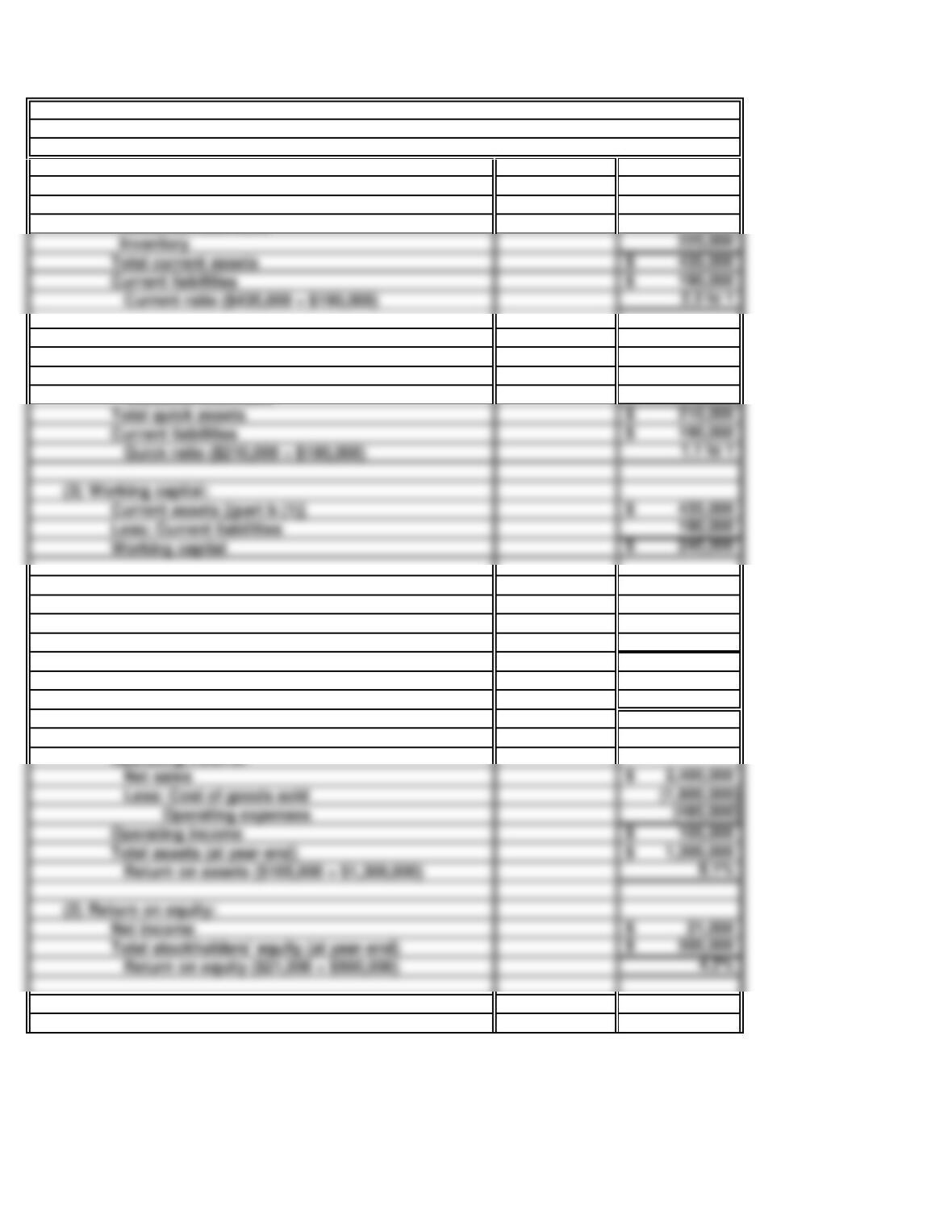
b. (1) Current ratio:
(
(
Current assets:
Cash 35,000$
Accounts receivable 175,000
(2) Quick ratio:
(
(
Quick assets:
Cash 35,000$
Accounts receivable 175,000
Total quick assets 210,000$
Current liabilities 190,000$
Quick ratio ($210,000 ÷ $190,000) 1.1 to 1
(3) Working capital:
(
(
Current assets [(part b (1)] 435,000$
Less: Current liabilities 190,000
Working capital 245,000$
(4) Debt ratio:
(
Total liabilities
Total assets 1,300,000$
Less: Total stockholders’ equity 500,000
Total liabilities 800,000$
Total assets 1,300,000$
Debt ratio ($800,000 ÷ $1,300,000) 61.5%
d. (1) Return on assets:
Operating income:
Net sales 2,400,000$
Less: Cost of goods sold (1,800,000)
Operating income 105,000$
(
(
Total assets (at year-end) 1,300,000$
Return on assets ($105,000 ÷ $1,300,000) 8.1%
Net income 21,000$
Total stockholders’ equity (at year-end) 500,000$
Return on equity ($21,000 ÷ $500,000) 4.2%
PROBLEM 14.6B
HAMILTON STORES
Parts a, c, e, and f appear on the following page.
Inventory 225,000
Total current assets 435,000$
Current liabilities 190,000$
Current ratio ($435,000 ÷ $190,000) 2.3 to 1
a.
c.
e.
f. (1)
(2)
PROBLEM 14.6B
HAMILTON STORES (concluded)
In the statement of cash flows, amounts are reported on a cash basis, whereas in the income
statement, they are reported under the accrual basis. Apparently $8,000 of the interest
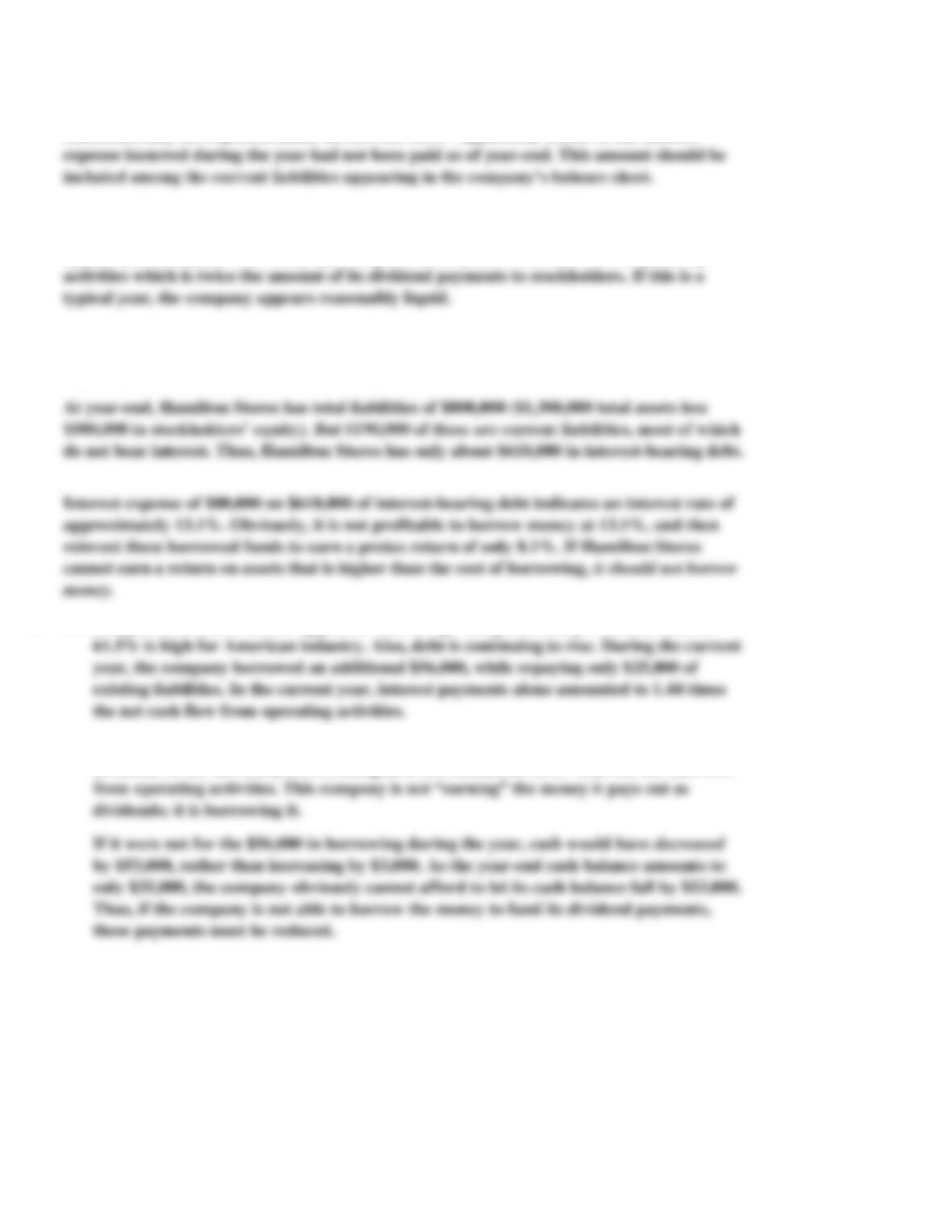
By traditional measures, the company’s current ratio (2.3 to 1) and quick ratio (1.1 to 1)
appear quite adequate. The company also generates a positive cash flow from operating
The 8.1% return on assets is adequate by traditional standards. However, the 4.2% return on
equity is very low. The problem arises because of Hamilton Stores’ relatively large interest
expense, which is stated as $80,000 for the year.
At year-end, Hamilton Stores has total liabilities of $800,000 ($1,300,000 total assets less
61.5% is high for American industry. Also, debt is continuing to rise. During the current
Long-term creditors do not appear to have a high margin of safety. The debt ratio of
If the current year is typical, Hamilton Stores can not continue its $24,000 annual
dividend. In the current year, investing activities consumed more than the net cash flow
25 Minutes, Medium
(Dollar Amounts
in Thousands)
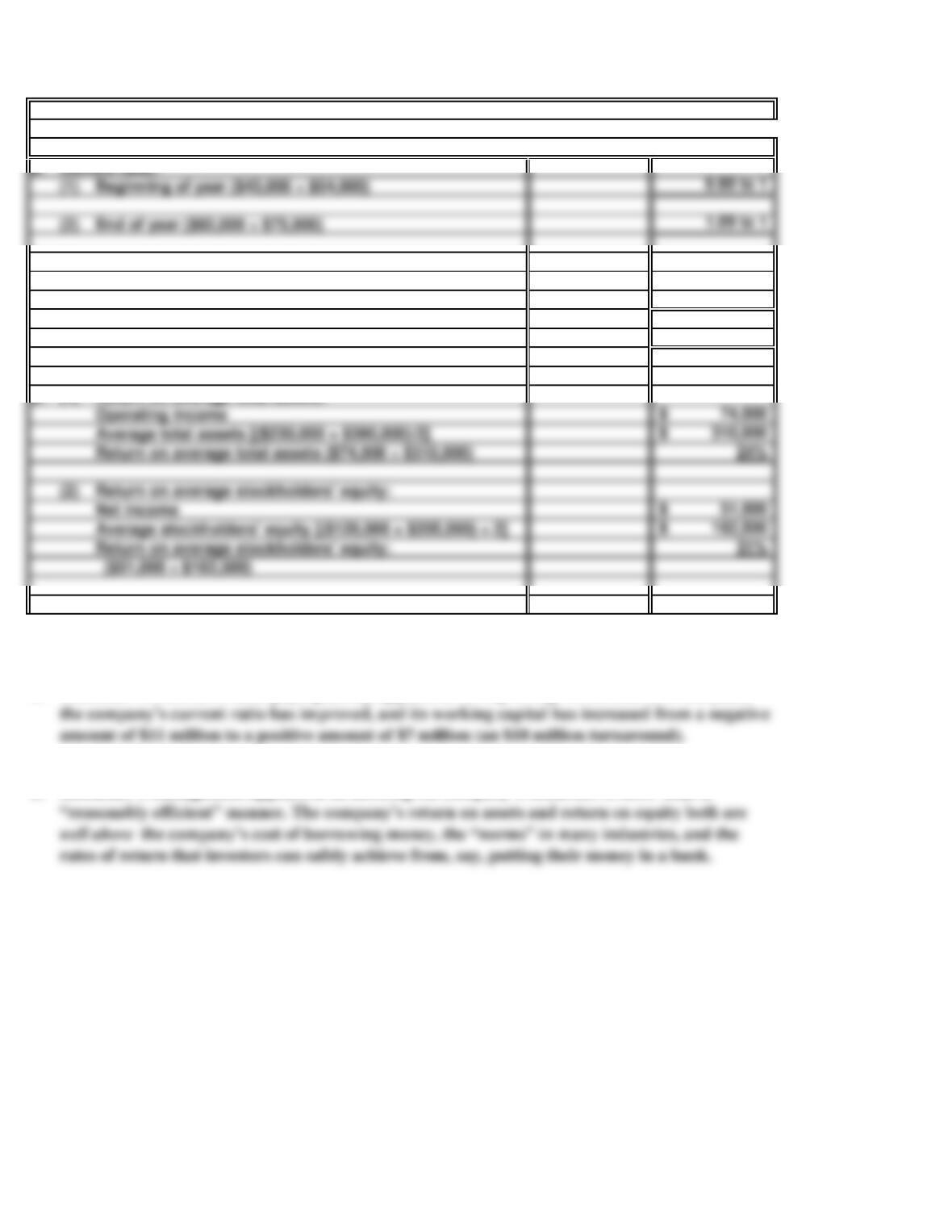
b. Working capital:
(1) Beginning of year ($43,000 – $54,000) (11,000)$
(2) End of year ($82,000 – $75,000) 7,000$
d. (1) Return on average total assets:
c.
e.
Rochester’s management appears to be utilizing the company’s resources in more than a
PROBLEM 14.7B
ROCHESTER CORPORATION
c. and e.
Rochester’s short-term debt-paying ability appears to be improving. In the course of the year,
(1) Beginning of year ($43,000 ÷ $54,000) 0.80 to 1
25 Minutes, Medium
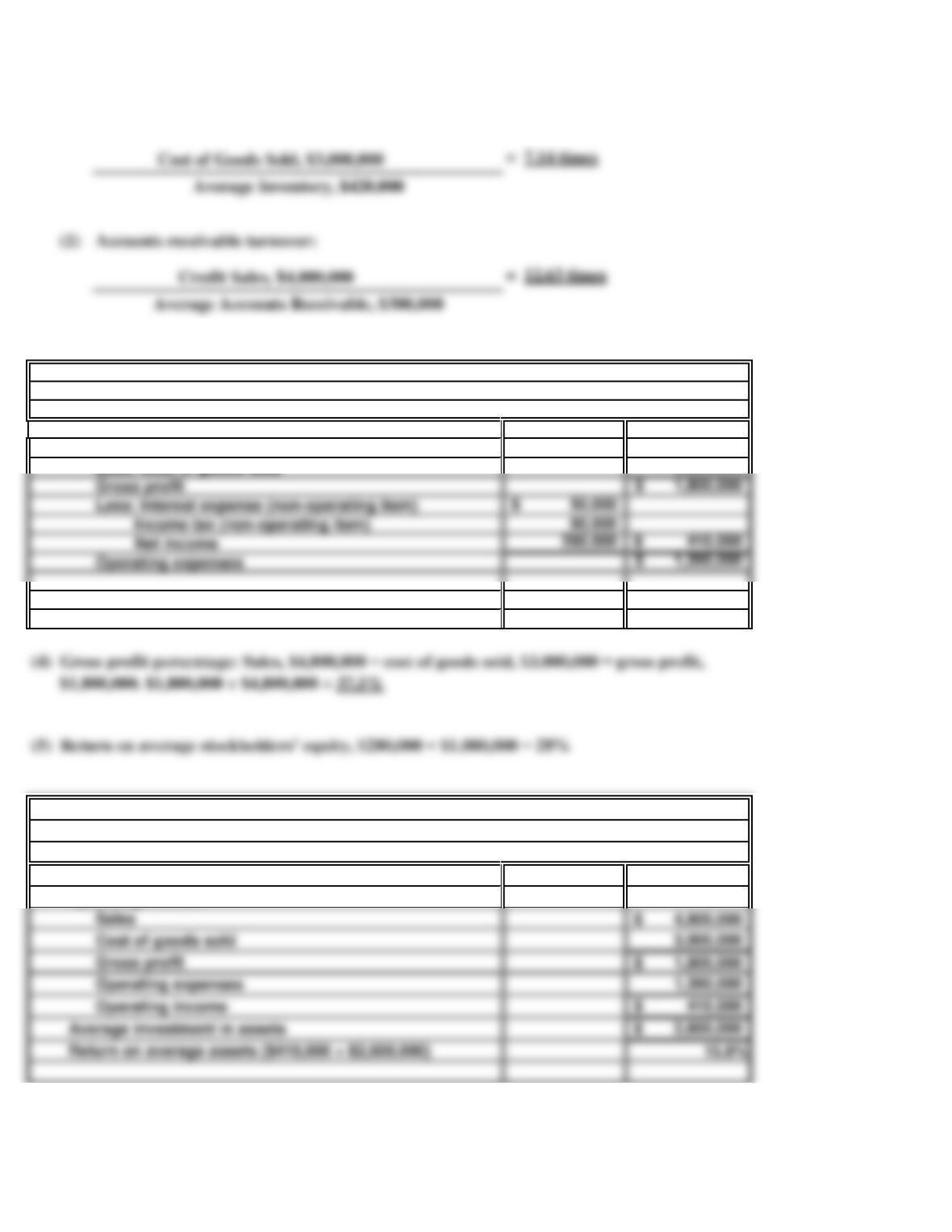
a. (1) Inventory turnover:
(3) Total operating expenses:
Sales 4,800,000$
Less: Cost of goods sold 3,000,000
Gross profit 1,800,000$
(6) Return on average assets:
Operating income:
PROBLEM 14.8B
SOLAR SYSTEMS, INC.
b.
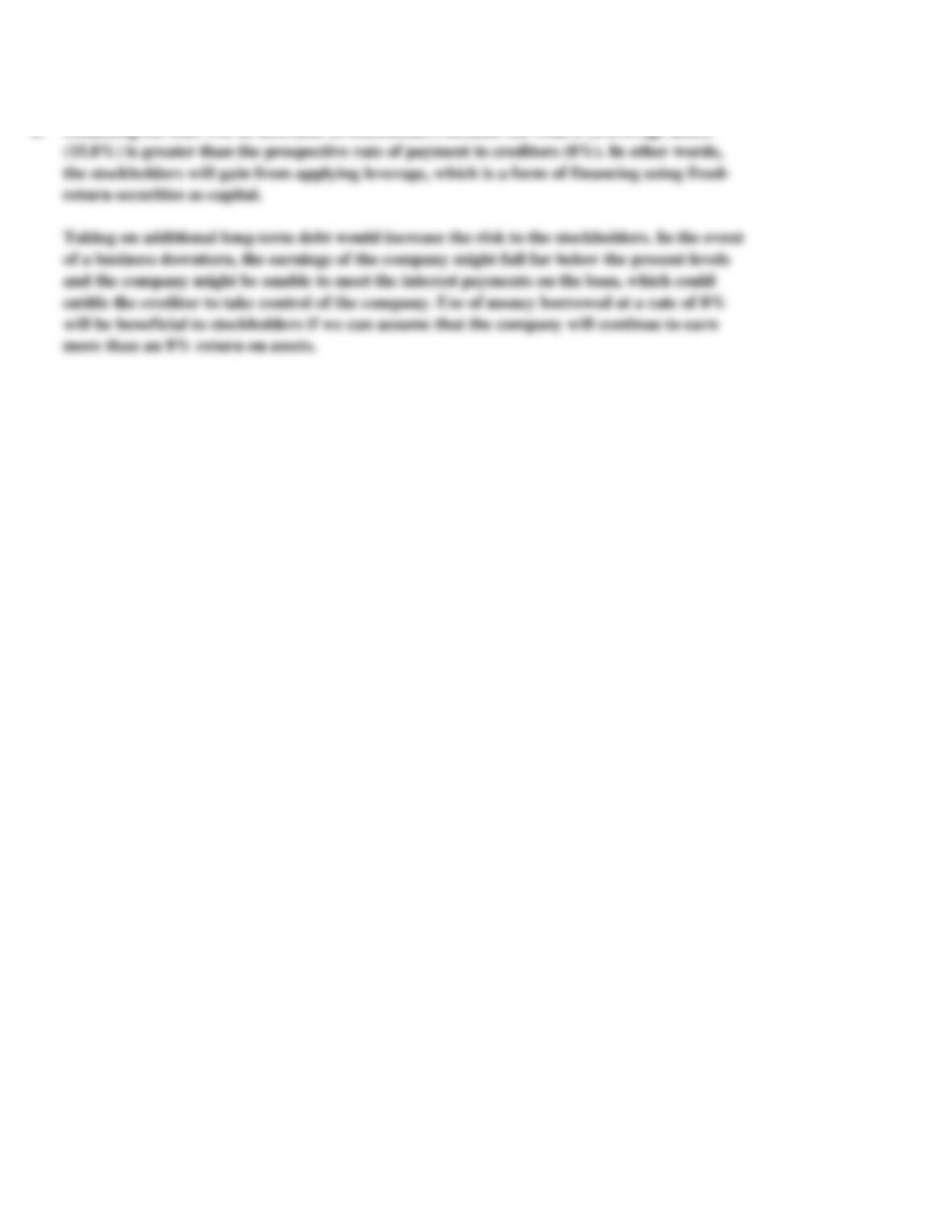
Obtaining the loan will be desirable to stockholders because the return on average assets
PROBLEM 14.8B
SOLAR SYSTEMS, INC. (concluded)
35 Minutes, Medium
a.
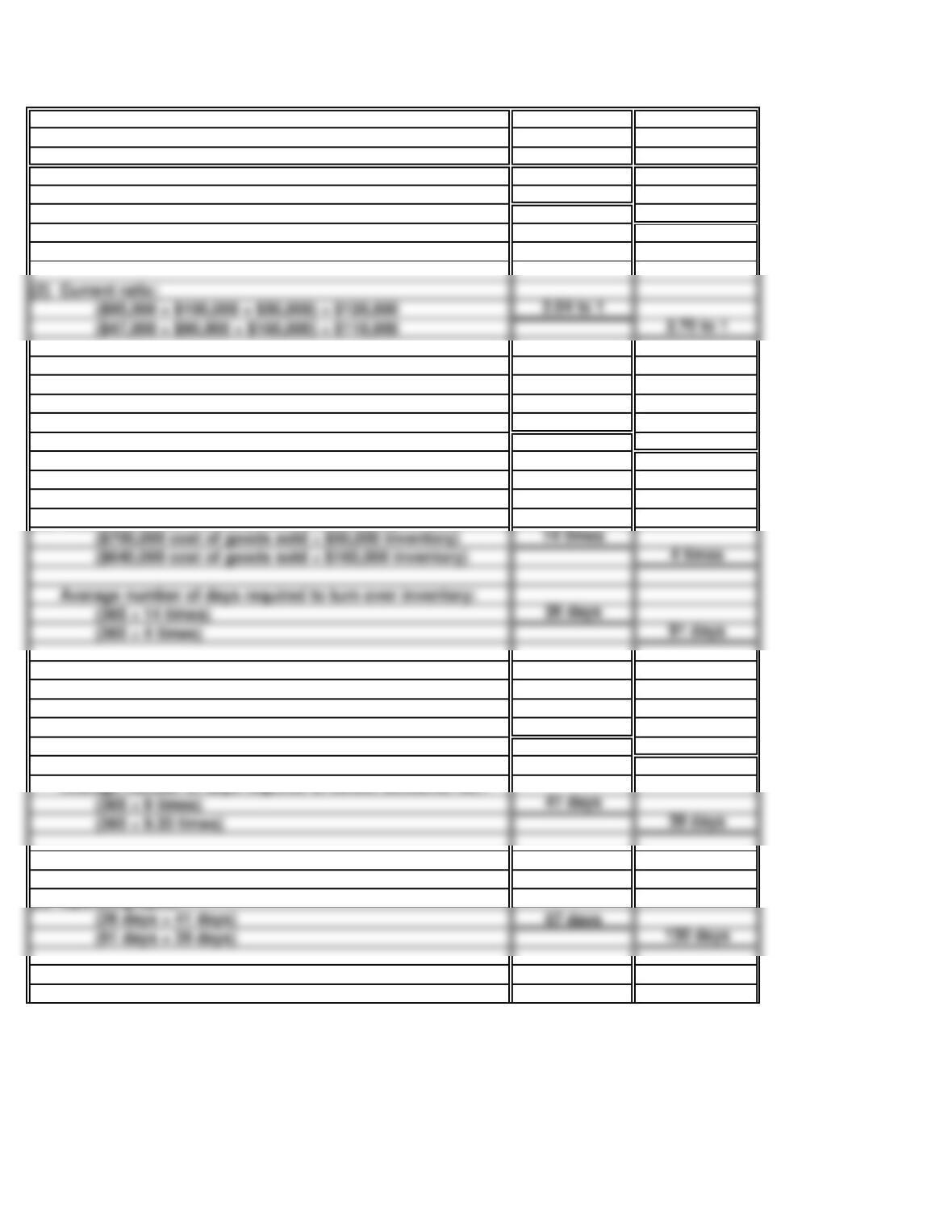
THIS THAT
STAR STAR
(1) Working capital:
($95,000 + $100,000 + $50,000 – $120,000) 125,000$
($47,000 + $90,000 + $160,000 – $110,000) 187,000$
(3) Quick ratio:
($95,000 + $100,000) ÷ $120,000 1.63 to 1
($47,000 + $90,000) ÷ $110,000 1.25 to 1
(4) Number of times inventory turned over during the year:
($700,000 cost of goods sold ÷ $50,000 inventory) 14 times
($640,000 cost of goods sold ÷ $160,000 inventory) 4 times
Average number of days required to turn over inventory:
(365 ÷ 14 times) 26 days
(365 ÷ 4 times) 91 days
(5) Number of times accounts receivable turned over:
($900,000 credit sales ÷ $100,000 accounts receivable) 9 times
($840,000 credit sales ÷ $90,000 accounts receivable) 9.33 times
Average number of days required to collect accounts rec.:
(365 ÷ 9 times) 41 days
(365 ÷ 9.33 times) 39 days
(6) Operating cycle:
(26 days + 41 days) 67 days
(91 days + 39 days) 130 days
PROBLEM 14.9B
THIS STAR, INC. AND
THAT STAR, INC.
(2) Current ratio:
($95,000 + $100,000 + $50,000) ÷ $120,000 2.04 to 1
($47,000 + $90,000 + $160,000) ÷ $110,000 2.70 to 1
b.
PROBLEM 14.9B
THIS STAR, INC. AND THAT STAR, INC. (concluded)
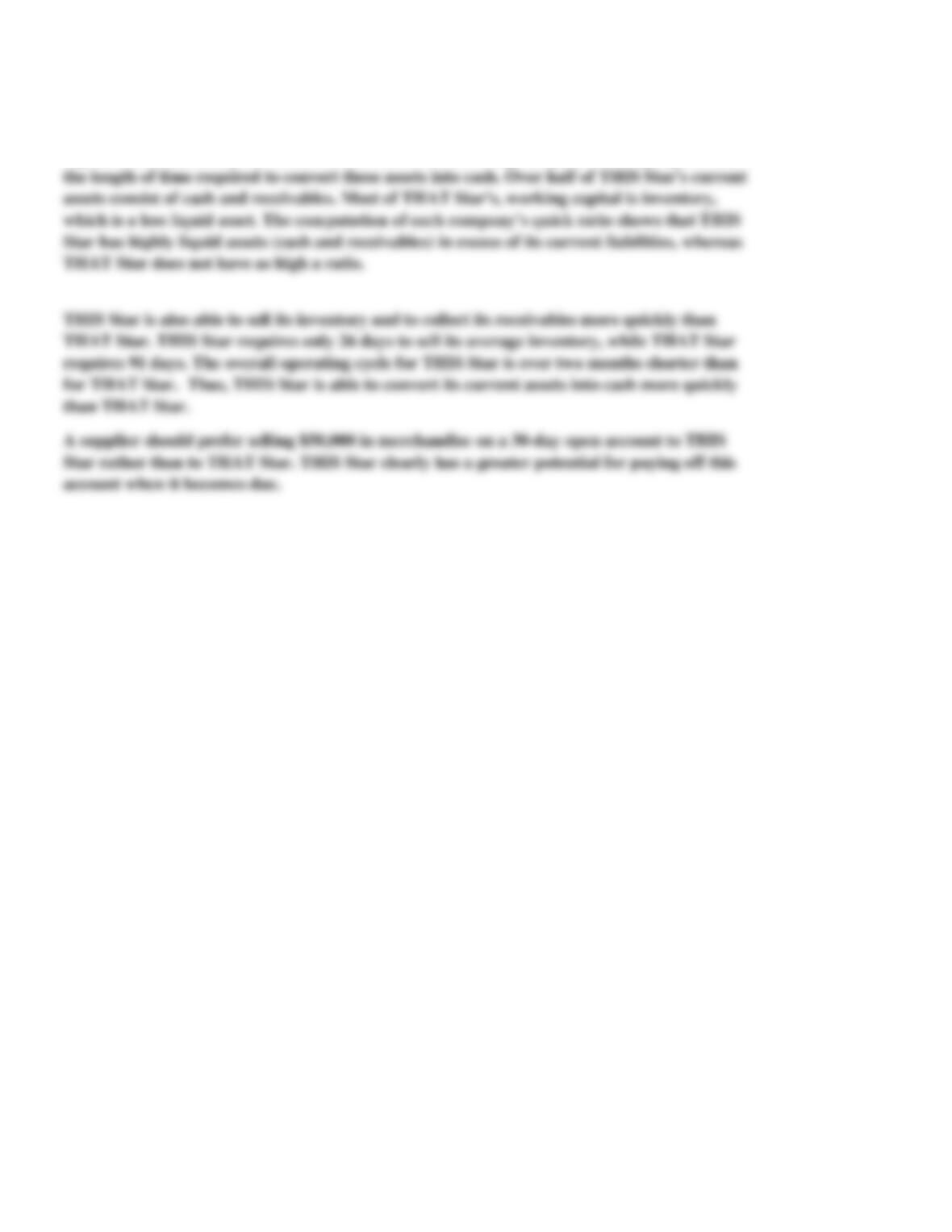
Although THAT Star, Inc., has a larger dollar amount of working capital and a higher
current ratio, THIS Star, Inc. has the higher-quality working capital. The quality of working
capital is determined by the nature of the current assets comprising the working capital and
25 Minutes, Medium
a.
b.
c.
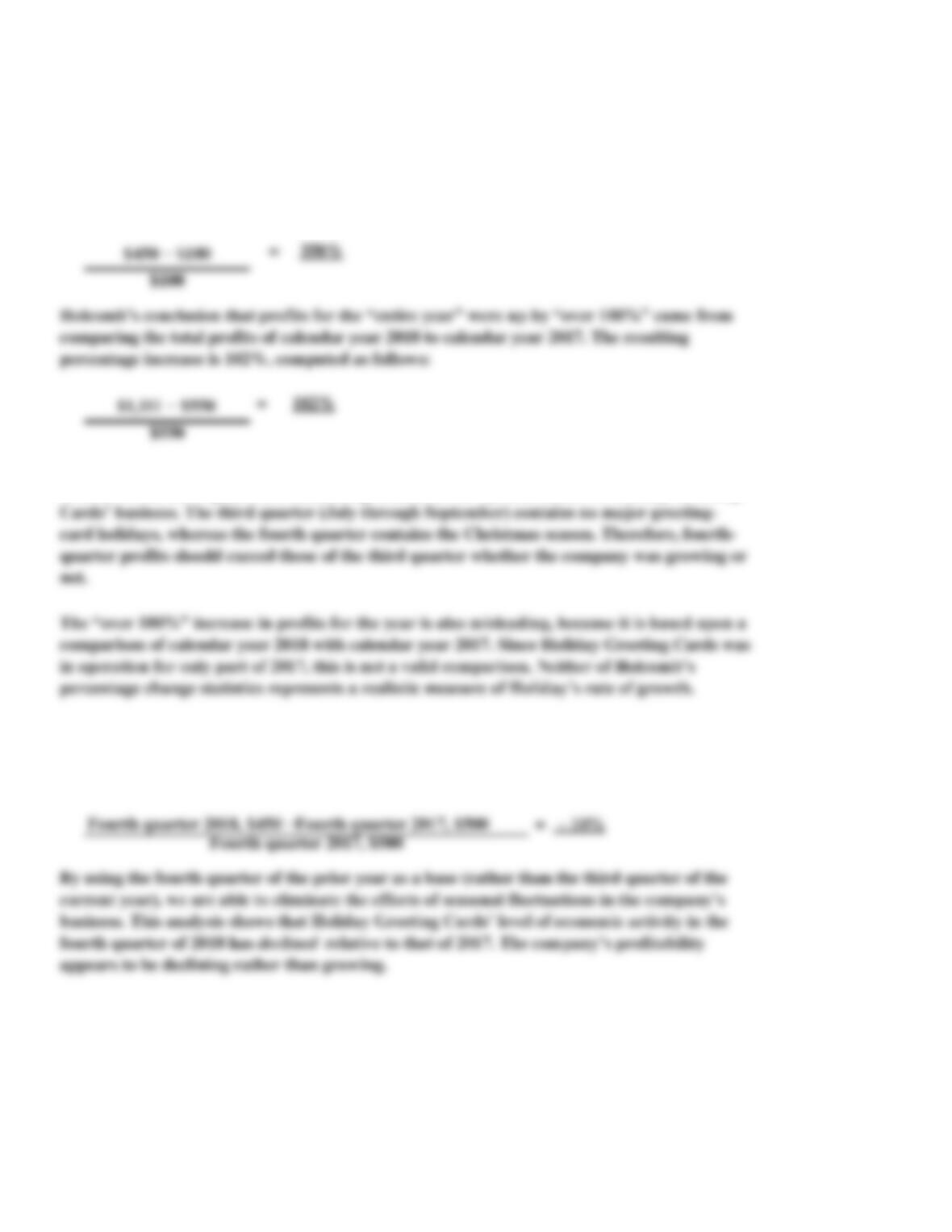
Holcomb computed the 350% increase in fourth-quarter profits by comparing the fourth-
quarter profits of 2018 to those of the third quarter. The computation is:
SOLUTIONS TO CRITICAL THINKING CASES
HOLIDAY GREETING CARDS
CASE 14.1
The 350% increase in fourth-quarter profits, developed by comparing fourth-quarter profits
to those of the third quarter, is misleading because of the cyclical nature of Holiday Greeting
The appropriate computation of the percentage change in Holiday’s fourth-quarter earnings
for 2018 is a decrease of 10%, computed as follows:
15 Minutes, Easy
Nebraska The
Steak Ranch Stockyards
a. $75,000 $24,000
Current liabilities ………………………………………..
$30,000 $30,000
b.
c.
Nebraska Steak Ranch would become as good a credit risk as The Stockyards if West
personally guarantees the loan to the corporation. This essentially removes the difference in
risk that the bank would be taking in loaning to the two companies.
Based solely upon the financial data presented here, neither restaurant appears to be a good
Considering the form of business organization, however, The Stockyards appears to be the
better credit risk. The reason is that this business is organized as a sole proprietorship. A loan
to this business is actually a loan to its owner, Joe West, because he is personally liable for the
Note to instructor: It is a common practice for wealthy individuals to organize businesses as
corporations for the specific purpose of limiting the owner’s personal liability.
CASE 14.2
THIRD NEBRASKA BANK
Current assets …………………………………………..
$45,000
($75,000 ÷ $30,000) ………………………………..
($24,000 ÷ $30,000) ………………………………..
a. (1)
(2)
(3)
b.
CASE 14.3
NASHVILLE DO-IT-YOURSELF
25 Minutes, Strong
Decrease. Offering customers a cash discount to speed up the collection of accounts
Note to instructor: This concept can be illustrated by assuming that all of the current liabilities were
paid. In this case, some current assets would remain, current liabilities would be reduced to zero,
and the current ratio would be infinite.
by the same amount. This tends to force the current ratio closer to 1 to 1 which, for
Nashville Do-It-Yourself Centers, would be a decline. In essence, purchasing inventory on
account has the opposite effect of paying current liabilities, discussed in part (1).
Decrease. Purchasing inventory on account increases current assets and current liabilities
Increase. Paying current liabilities reduces current assets and current liabilities by the
purchases of equipment or expenditures for repairs or maintenance, will improve the current
One means of improving the current ratio is to increase current assets without increasing
current liabilities. This could be done by selling noncurrent assets, by borrowing cash on a long-
term basis, or by the owners investing cash in the business. The increase in the current ratio
would be magnified if the proceeds from these transactions were used to reduce current
liabilities.
No time estimate, Strong
ETHICS, FRAUD & CORPORATE GOVERNANCE
Board Expertise — It is typically advantageous if board members have experience serving on the
CASE 14.4
Compensation committee — Companies should have a separate committee of the board to handle
Board structure — Shareholder activists prefer boards where directors stand for reelection each
Although there are many possible “solutions” to this case, depending on the companies that
students choose for analysis, students should talk about most of these factors in evaluating the
quality of a company’s board of directors.
Board composition — The board of directors should be comprised of a majority of independent
Nominating committee — Companies should have a separate committee of the board to handle
EVALUATING CORPORATE GOVERNANCE QUALITY
CASE 14.4
(concluded)
EVALUATING CORPORATE GOVERNANCE QUALITY
Chairman/CEO Separation — Shareholder activities prefer that the same individual who serves
the independent members of the board.
Response to Shareholder Proposals — Shareholders are able to put forth proposals for vote at
Board Attendance — A board cannot be effective if it never meets or if directors fail to attend the
meetings that are held. An effective board should normally meet at least six times per year, and
No time estimate, Strong
Current ratio
c.
Ease of transferring information and applying it to analytical techniques.
Availability of extensive amounts of information from a single source.
Technology-based access and ease of storing and printing information.
Again, student responses will likely vary, but reasons for the popularity of the Internet for
receiving financial information include the following:
Timeliness and ease and frequency with which information can be updated.
CASE 14.5
Student responses will vary, but they should indicate an understanding that companies have
unique operating characteristics, and understanding those before diving into financial
Because students can choose both the company and the ratios they compute, no set answer
can be given for this question. The following are probably the ratios in the categories of
liquidity and profitability that are most likely to be selected by students:
EVALUATING LIQUIDITY AND PROFITABILITY
Liquidity
INTERNET
a.
b.
Quick ratio
Inventory turnover
Receivables turnover
Profitability