
CHAPTER 14
Bonds and Long-Term Notes
Overview
This chapter continues the presentation of liabilities. Specifically, the discussion focuses on the
accounting treatment of long-term liabilities. Long-term notes and bonds are discussed, as well as
the extinguishment of debt and troubled debt restructuring.
Learning Objectives
LO14-1 Identify the underlying characteristics of debt instruments and describe the basic
approach to accounting for debt.
LO14-2 Account for bonds issued at par, at a discount, or at a premium, recording interest at the
effective rate or by the straight-line method.
LO14-3 Characterize the accounting treatment of notes, including installment notes, issued for
cash or for noncash consideration.
LO14-4 Describe the disclosures appropriate to long-term debt in its various forms.
LO14-5 Record the early extinguishment of debt and its conversion into equity securities.
LO14-6 Understand the option to report liabilities at their fair values.
LO14-7 Discuss the primary differences between U.S. GAAP and IFRS with respect to accounting
for bonds and long-term notes.
Lecture Outline
Part A: Bonds
I. Nature of Long-Term Debt (T14-1)
A. Liabilities signify creditors’ interest in a company’s assets.
B. Debt requires the future payment of cash in specified (or estimated) amounts, at specified
(or projected) dates.
C. As time passes, interest accrues on debt.
D. Periodic interest is the effective interest rate times the amount of the debt outstanding
during the interest period.
E. Reported at present value of its related cash flows (principal and/or interest payments),
discounted at the effective rate of interest at issuance.
II. Bonds
A. Divide a large liability into many smaller liabilities (usually $1,000 per bond).
B. Obligate a company to repay a stated amount at a specified maturity date and periodic
interest between the issue date and maturity.
C. Require periodic interest as a stated percentage of the face amount.
D. Pay interest semiannually (usually) on designated interest dates beginning six months after
the day the bonds are “dated”

14-2 Intermediate Accounting, 8/e
E. Make specific promises to bondholders who are described in a document called a bond
indenture. (T14-2)
F. Represent a liability to the corporation that issues the bonds and an asset to a company that
buys the bonds as an investment. (T14-3)
Issuer
Cash ………………………………………………………………………… xxx
Bonds payable (face amount)………………………………. xxx
Investor
Investment in bonds (face amount) ………………………………. xxx
Cash…………………………………………………………………. xxx
III. Pricing of Bonds (T14-4)
A. Supply and demand cause a bond to be priced to yield the market rate of interest for
securities of similar risk and maturity.
1. Price can be calculated as the present value of all the cash flows required (principal
and interest).
2. The discount rate is the market rate.
B. Other things being equal, the lower the perceived riskiness of the corporation issuing
bonds, the higher the price those bonds will command.
C. When bond prices are quoted in financial media, they typically are stated in terms of a
percentage of face amount. So, a price quote of 97 means a $1,000 bond will sell for
$970; a bond priced at 102 will sell for $1,020.
IV. Interest
A. Interest accrues at the effective market rate of interest multiplied by the outstanding
balance (during the interest period). (T14-5)
B. When only a portion of an expense is paid by the periodic cash interest payment, the
remainder becomes a liability (or an addition to the already outstanding liability). So the
difference increases the liability and is reflected as a reduction in the discount (a valuation
account). (T14-6)
C. Because the balance of the debt changes each period, the dollar amount of interest
(balance x rate) also will change each period. To keep up with the changing amounts, it
usually is convenient to prepare a schedule that reflects the changes in the debt over its
term to maturity. (T14-7)
D. If an accounting period ends between interest dates, it is necessary to record interest that
has accrued since the last interest date. (T14-8)
E. Alternatively, a company is permitted to allocate a discount or a premium equally to each
period over the term to maturity if doing so produces results that are not materially
different from the interest method. (T14-9)
V. Zero-Coupon Bonds
A zero-coupon bond pays no interest but, instead, offers a return in the form of a “deep
discount” from the face amount.

VI. Debt Issue Costs Are Incurred in Connection with Issuing Bonds or Notes (T14-10)
A. They include legal and accounting fees and printing costs in addition to registration and
underwriting fees.
B. Costs of issuing debt securities are recorded as a debit to an asset account, “debt issue
costs.”
C. The cost is amortized to expense over the term to maturity.
Part B: Long-Term Notes
I. Accounting for Notes
A. In concept, notes are accounted for in precisely the same way as bonds. (T14-11)
B. When a note is issued with an unrealistic interest rate, the effective market rate is used
both to determine the amount recorded in the transaction and to record periodic interest
thereafter. (T14-12)
1. Substance over form.
2. Accounting treatment is the same whether the amount is determined directly from the
market value of the asset acquired (and thus the note, also) or indirectly as the present
value of the note (and thus the value of the asset.
3. Also, both parties to the transaction should record periodic interest (interest expense
to the borrower, interest revenue to the lender) at the effective rate, rather than the
stated rate.
C. Installment notes are paid in installments, rather than by a single amount at maturity.
(T14-13)
1. Installment payments are equal amounts each period.
2. Each payment includes both an amount that represents interest and an amount that
represents a reduction of principal.
3. The periodic reduction of principal is sufficient that, at maturity, the note is
completely paid.
4. The installment amount is easily calculated by dividing the amount of the loan by the
appropriate discount factor for the present value of an annuity.
II. Financial Statement Disclosure (T14-14)
A. On the balance sheet, disclosure should include, for all long-term borrowings, the aggregate
amounts maturing and sinking fund requirements (if any) for each of the next five years.
B. Supplemental disclosures are needed for:
1. Off-balance-sheet credit or market risk.
2. Concentrations of credit risk.
3. The fair value of financial instruments.
Decision-Makers’ Perspective
A. Failure to properly consider risk in business decisions is one of the most costly, yet one of
the most common, mistakes investors and creditors can make.
B. Long-term debt is one of the first places decision makers should look when trying to get a
handle on risk.

14-4 Intermediate Accounting, 8/e
C. Generally speaking, debt increases risk.
1. The debt to equity ratio, total liabilities/shareholders’ equity, often is calculated to
measure the degree of risk.
2. Other things being equal, the higher the debt to equity ratio, the higher the risk.
D. Debt also can be an advantage by enhancing the return to shareholders.
1. This concept is known as leverage.
2. “Favorable financial leverage” occurs when a company earns a return on borrowed
funds in excess of the cost of borrowing the funds, shareholders are provided with a
total return greater than what could have been earned with equity funds alone.
E. Failure to pay interest as scheduled may cause several adverse consequences including
bankruptcy.
1. One way to measure a company’s ability to pay its obligations is by comparing interest
payments with income available to pay those charges.
2. The times interest earned ratio is determined by dividing income before subtracting
interest expense or income tax expense by interest expense.
F. “Off-balance-sheet” financing and other commitments can increase risk.
Part C: Debt Retired Early, Convertible into Stock, or Providing an Option to
Buy Stock
I. Early Extinguishment of Debt
A. A gain or loss on early extinguishment of debt should be recorded for the difference
between the reacquisition price and the book value of the debt.
B. The gain or loss should be classified on the income statement as an extraordinary item only
if it meets criteria for such reporting by being both (1) unusual and (2) infrequent.(T14-15)
II. Convertible Debt
A. Convertible bonds are accounted for as straight debt.
B. Stock or other financial instruments that a company is obligated to buy back (manditorily
redeemable), must be reported in the balance sheet as a liability, not as shareholders’
equity.
III. Bonds With Detachable Warrants
The value of the equity feature is recorded separately for bonds issued with detachable
warrants.
Part D: Fair Value Option
I. A company is not required to, but has the option to, value some or all of its
financial assets and liabilities, including bonds and notes, at fair value.
II. If a company chooses the option to report at fair value, then it reports changes in
fair value as OCI (net of tax) in its statement of other comprehensive income.
(T14-16)

IV. International Financial Reporting Standards
A. Differences in the definitions and requirements under these standards can result in the
same instrument being classified differently between debt and equity under IFRS and
U.S. GAAP. Most preferred stock (preference shares) is reported under IFRS as debt
with the dividends reported in the income statement as interest expense. Under U.S.
GAAP, that’s the case only for “manditorily redeemable” preferred stock. (T14-17)
B. Under IFRS, convertible debt is divided into its liability and equity elements. Under US
GAAP, the entire issue price is recorded as debt. (T14-18)
Appendix A: Bonds Issued between Interest Dates
A. All bonds sell at their price plus any interest that has accrued since the last interest date.
(T14-19)
B. face annual fraction of the accrued
value x rate x annual period = interest
Appendix B: Troubled Debt Restructuring
A. The way a troubled debt restructuring is recorded depends on whether
1. The debt is settled at the time of the restructuring, or (T14-20)
2. The debt is continued, but with modified terms where the total cash to be paid
a. Is less than the book value of the debt or (T14-21)
b. Exceeds the book value of the debt. (T14-22)

14-6 Intermediate Accounting, 8/e
PowerPoint Slides
A PowerPoint presentation of the chapter is available at the textbook website.
Teaching Transparency Masters
The following can be reproduced on transparency film as they appear here, or
you can use the disk version of this manual and first modify them to suit your
particular needs or preferences.

LONG-TERM DEBT
Signifies creditors’ interest in a company’s assets.
Requires the future payment of cash in specified (or
estimated) amounts, at specified (or projected) dates.
As time passes, interest accrues on debt.
Periodic interest is the effective interest rate times the
amount of the debt outstanding during the interest period.
Reported at present value of its related cash flows (principal
and/or interest payments), discounted at the effective rate of
interest at issuance.
T14-1

14-8 Intermediate Accounting, 8/e
BONDS
Debenture bond – secured only by the “full faith and credit” of
the issuing corporation. No specific assets are pledged as security.
Mortgage bond – backed by a lien on specified real estate
owned by the issuer.
Subordinated debenture – not entitled to receive any
liquidation payments until the claims of other specified debt issues
are satisfied.
Registered bond – interest checks are mailed directly to the
owner, who is “registered” with the issuing company.
Callable (or redeemable) bonds – the call feature allows the
issuing company to buy back, or “call”, outstanding bonds from
bondholders before their scheduled maturity date.
Serial bonds – retired in installments over all or part of the life
of the issue. Each bond has its own specified maturity date.
Convertible bonds – retired as a consequence of bondholders
choosing to convert them into shares of stock.
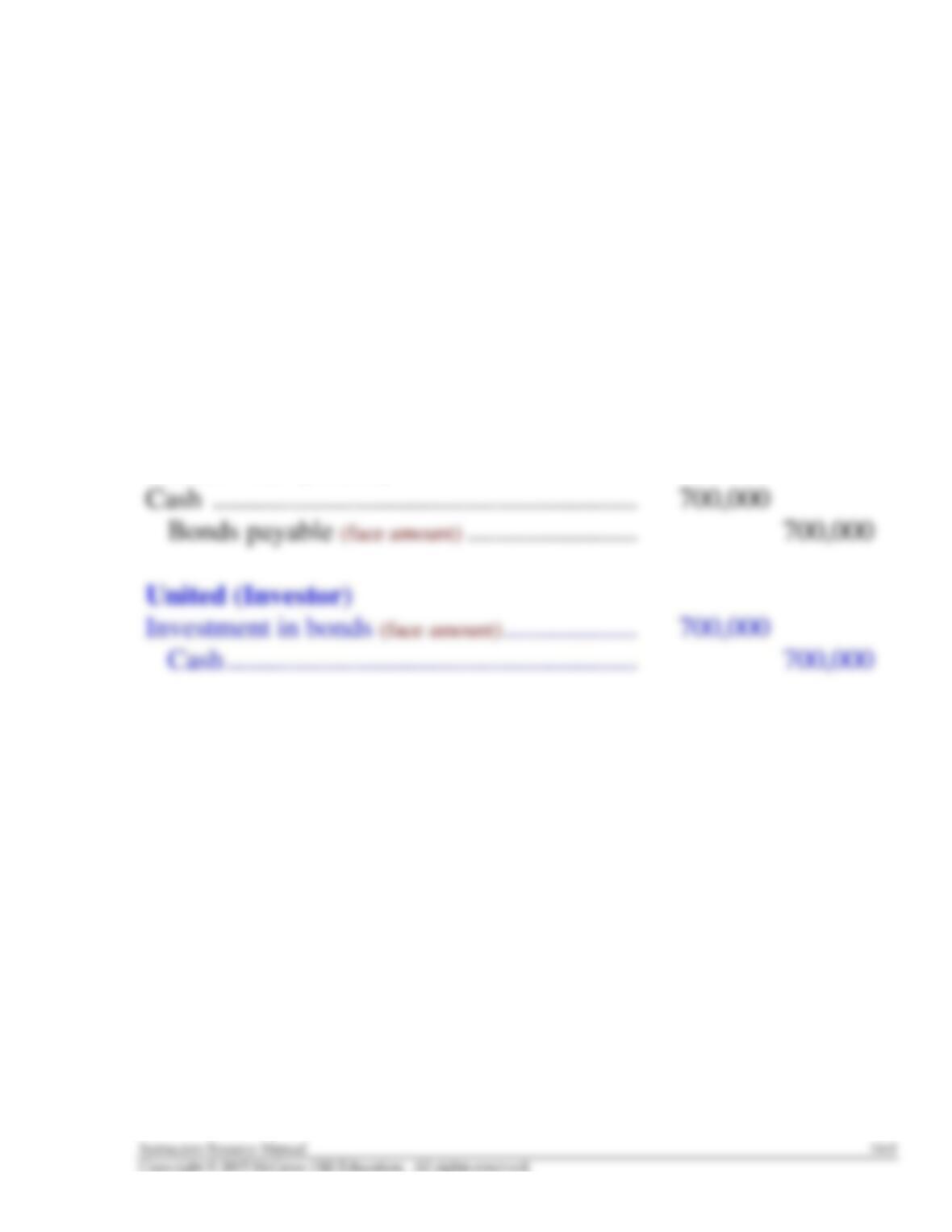
BONDS SOLD AT FACE AMOUNT
On January 1, 2016, Masterwear Industries issued $700,000
of 12% bonds. Interest of $42,000 is payable semiannually on
June 30 and December 31. The bonds mature in three years [an
unrealistically short maturity to shorten the illustration]. The
entire bond issue was sold in a private placement to United
Intergroup, Inc. at face amount.
At Issuance (January 1)
Masterwear (Issuer)
T14-3
14-10 Intermediate Accounting, 8/e
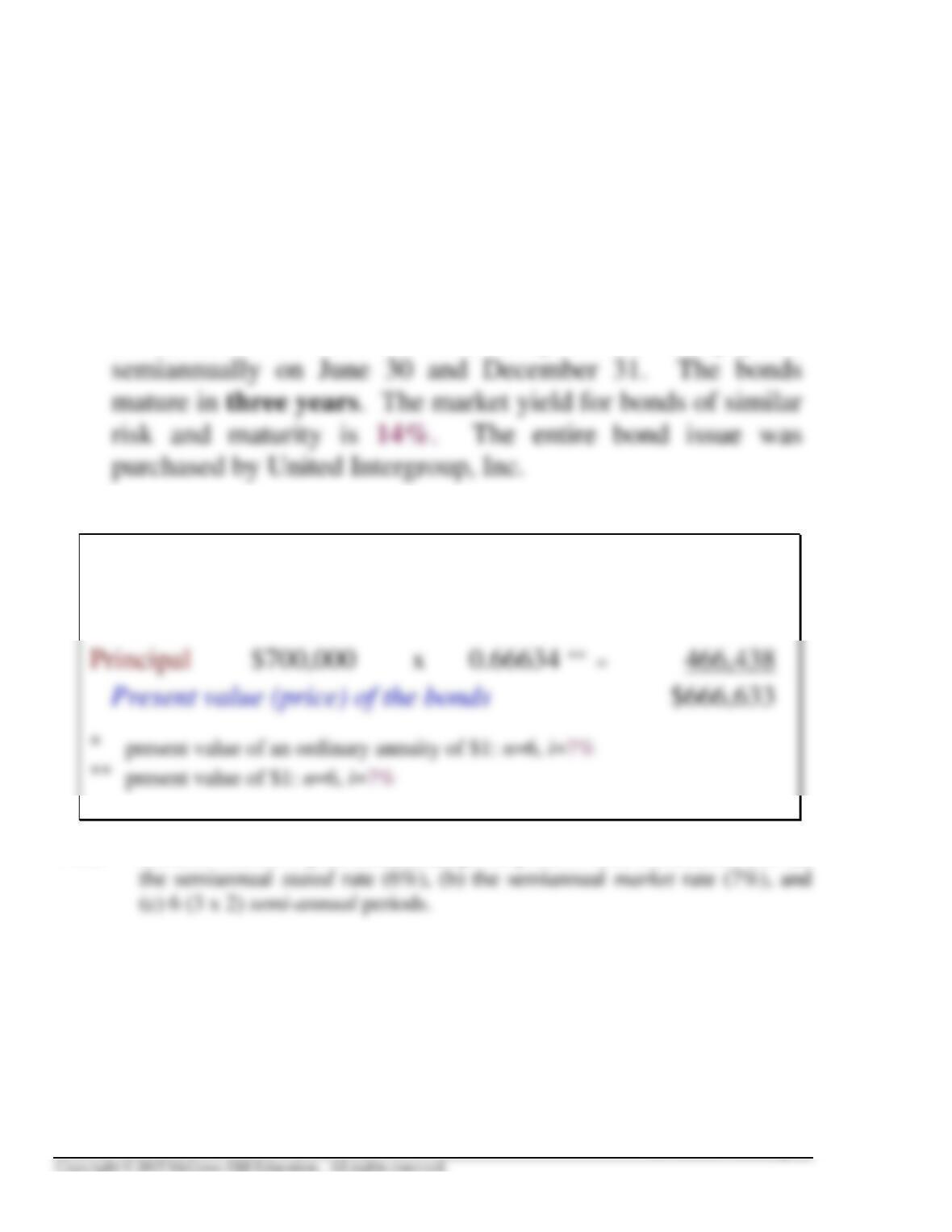
DETERMINING THE SELLING PRICE
A bond issue will be priced by the marketplace to yield the
market rate of interest for securities of similar risk and maturity.
Illustration – On January 1, 2016, Masterwear Industries issued
$700,000 of 12% bonds, dated January 1. Interest is payable
Present value (price) of the bonds:
Present Values
Interest $42,000 x 4.76654 * = $200,195
Note: Because interest is paid semiannually, the present value calculations use: (a)
T14-4

JOURNAL ENTRIES AT ISSUANCE –
BONDS SOLD AT DISCOUNT
Masterwear (Issuer)
Cash (price calculated above) …………………………. 666,633
T14-4 (continued)
14-12 Intermediate Accounting, 8/e
DETERMINING INTEREST –
EFFECTIVE INTEREST METHOD
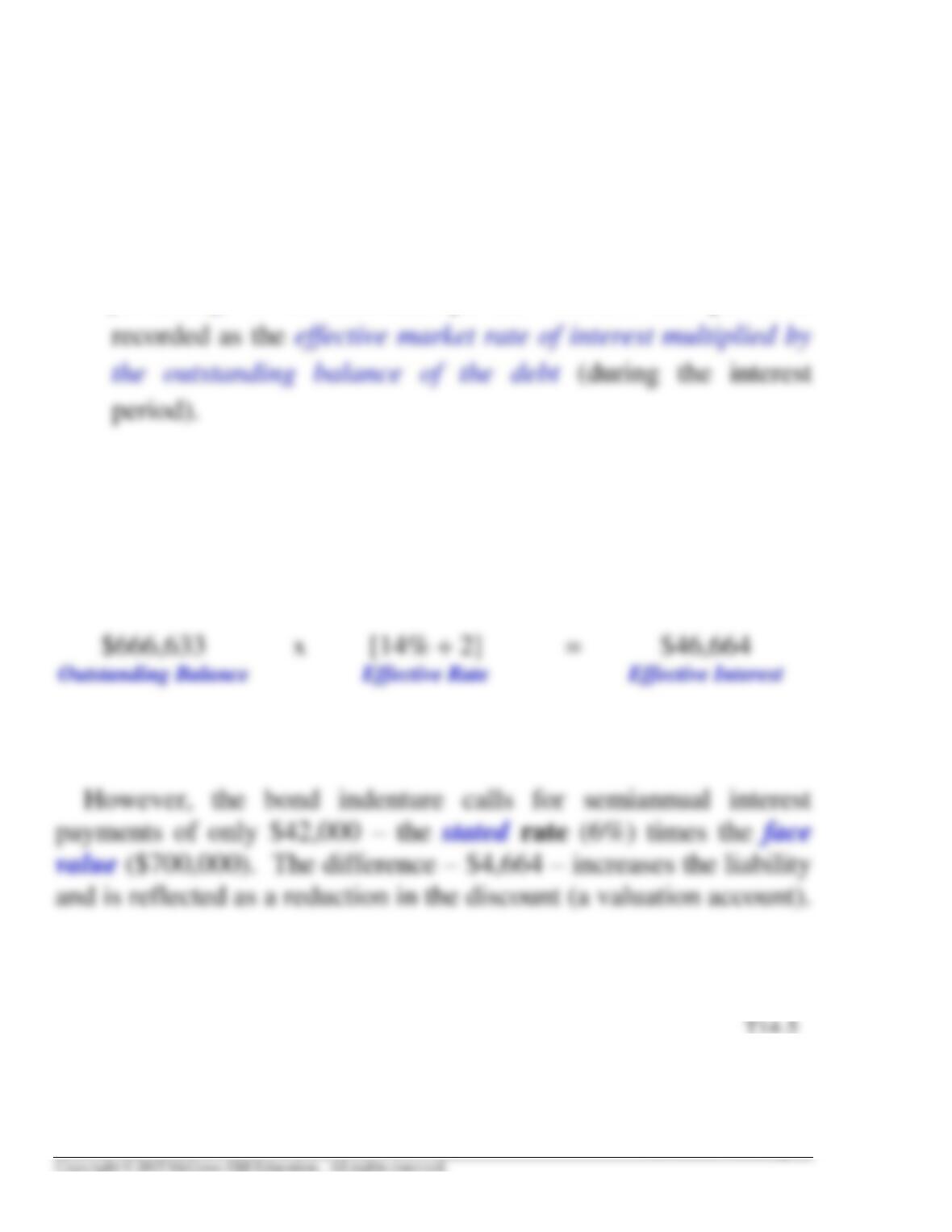
Interest accrues on an outstanding debt at a constant
percentage of the debt each period. Interest each period is
Continuing the previous example, interest recorded (as expense
to the issuer and revenue to the investor) for the first six-month
interest period is $46,664:
CHANGE IN DEBT WHEN
EFFECTIVE INTEREST EXCEEDS CASH PAID
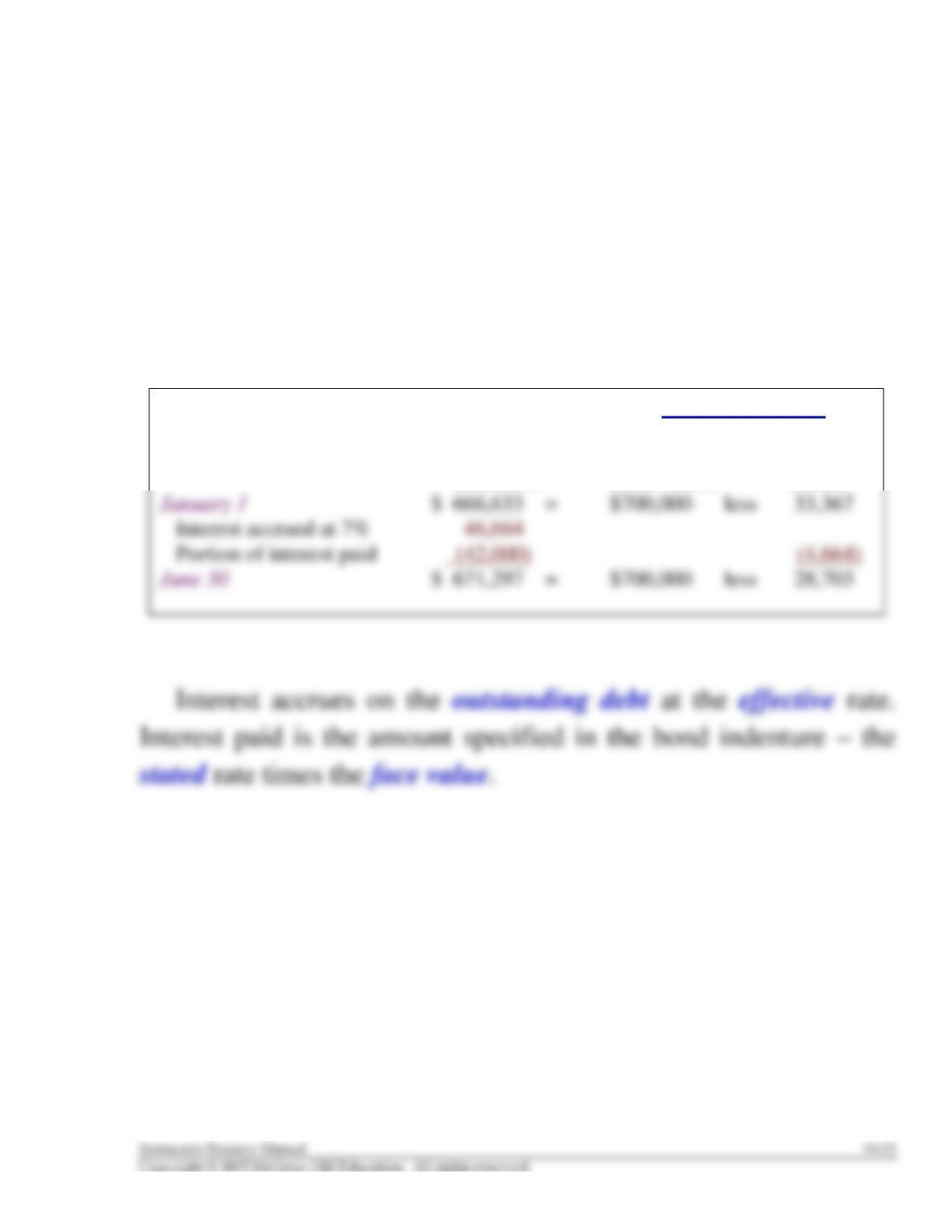
The “unpaid” portion of the effective interest increases the
existing liability.
ACCOUNT BALANCES
OUTSTANDING Bonds payable Discount on
BALANCE (face value) bonds
T14-6
14-14 Intermediate Accounting, 8/e
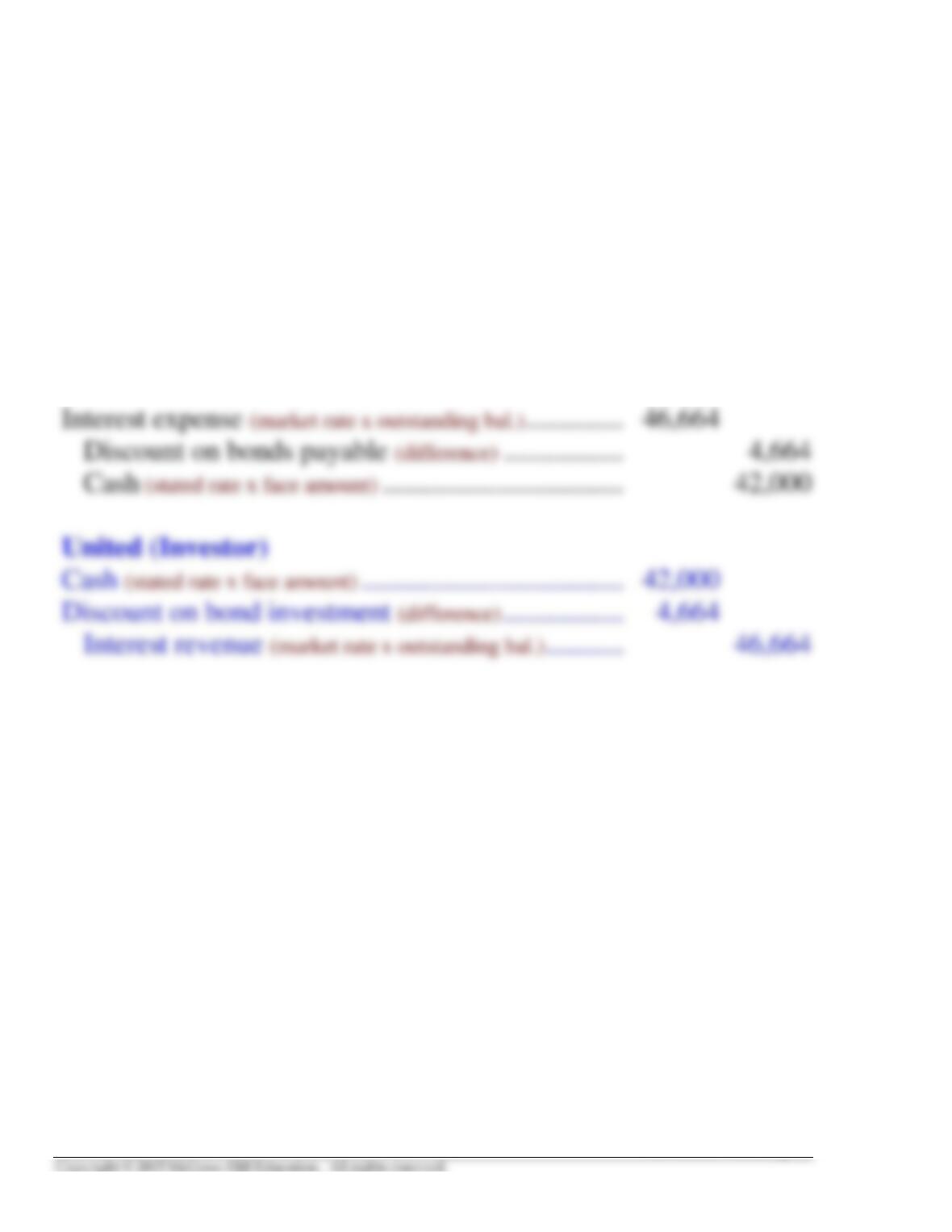
JOURNAL ENTRIES – THE INTEREST METHOD
The effective interest is calculated each period as the market
rate times the amount of the debt outstanding during the interest
period.
At the First Interest Date (June 30)
Masterwear (Issuer)
T14-6 (continued)

AMORTIZATION SCHEDULE – DISCOUNT
Since less cash is paid each period than the effective interest,
the unpaid difference increases the outstanding balance of the debt.
Cash Effective Increase in Outstanding
Interest Interest Balance Balance
6% x Face Value 7% x Outstanding Debt Discount Reduction
1/01/16 666,633
6/30/16 42,000 .07 (666,633) = 46,664 4,664 671,297
T14-7
14-16 Intermediate Accounting, 8/e
When Financial Statements Are Prepared
Between Interest Dates
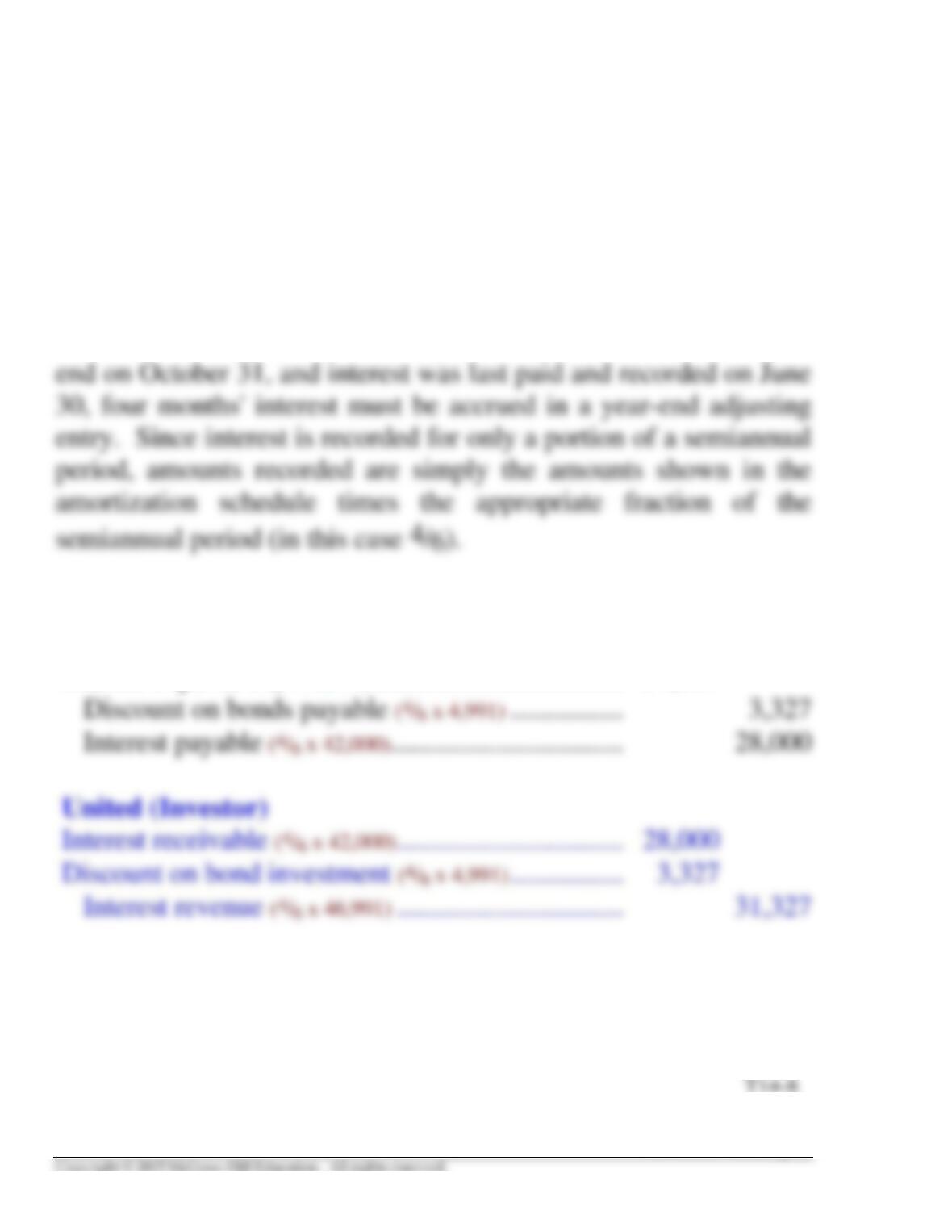
When an accounting period ends between interest dates, it is
necessary to record interest that has accrued since the last interest
date. For instance, if the fiscal years of Masterwear and United
At October 31
Masterwear (Issuer)
Interest expense (4/6 x 46,991) …………………………….. 31,327
When Financial Statements Are Prepared
Between Interest Dates
(continued)
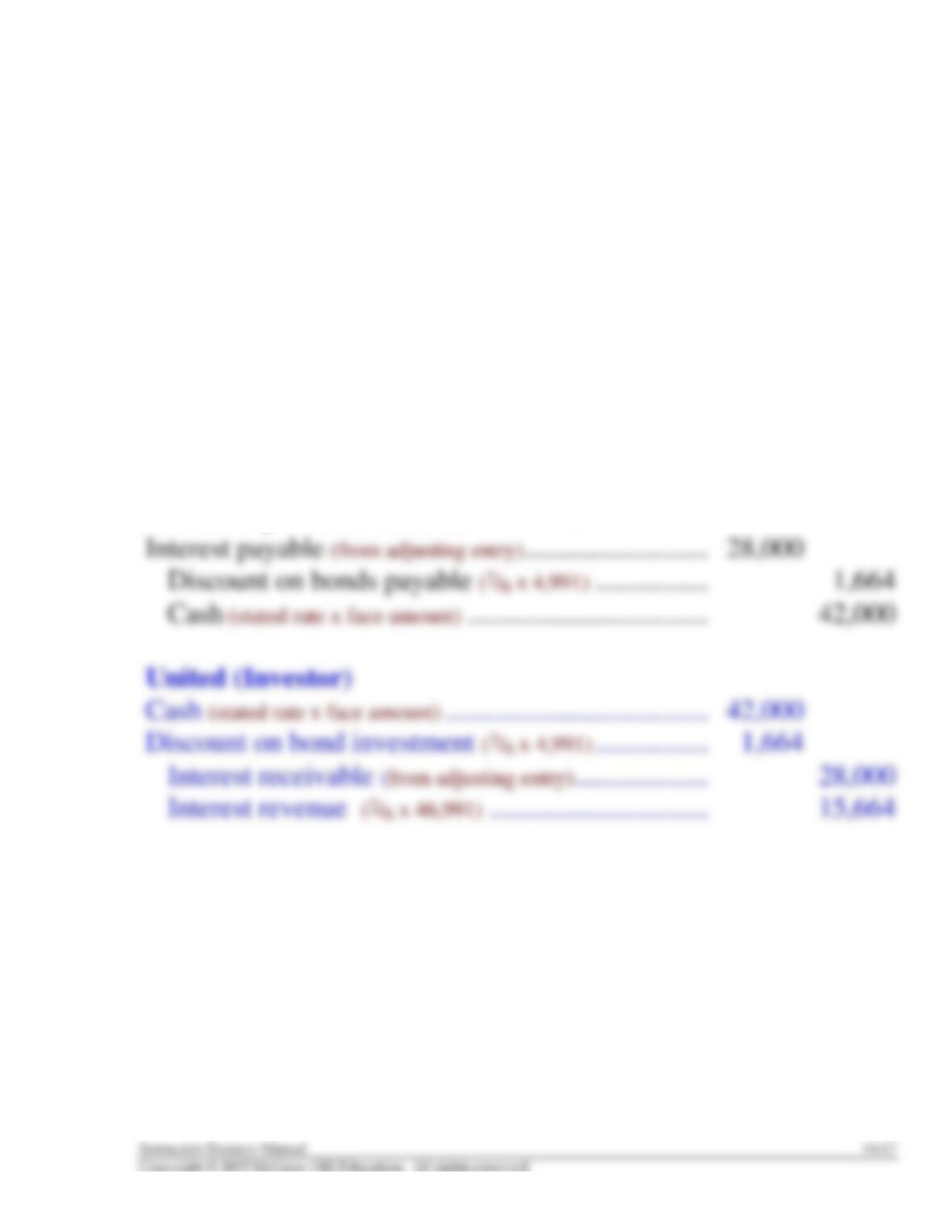
Two months later, when semiannual interest is paid next, the
remainder of the semiannual interest is allocated to the first two
months of the next accounting year – November and December:
At the December 31 Interest Date
Masterwear (Issuer)
Interest expense (2/6 x 46,991) …………………………….. 15,664
T14-8 (continued)

14-18 Intermediate Accounting, 8/e
THE STRAIGHT-LINE METHOD –
A PRACTICAL EXPEDIENCY
By the straight-line method, the discount in the earlier
illustration would be allocated equally to the 6 semiannual periods
(3 years):
At Each of the Six Interest Dates
Masterwear (Issuer)
Interest expense (to balance) ……………………………….. 47,561
T14-9
DEBT ISSUE COSTS
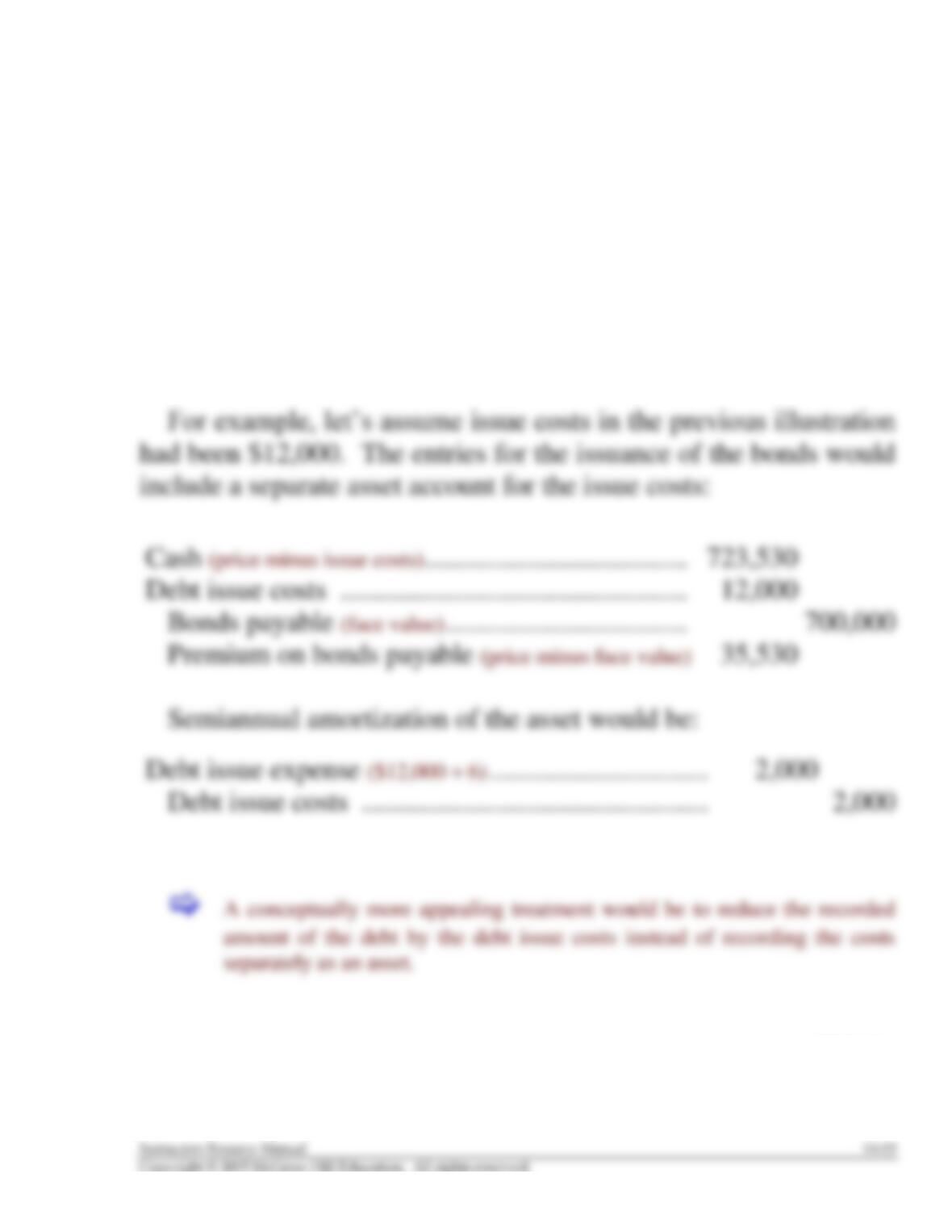
With either publicly or privately sold debt, the issuing
company will incur costs in connection with issuing bonds or
notes, such as legal and accounting fees and printing costs in
addition to registration and underwriting fees. These debt issue
costs are recorded separately and are amortized over the term of
the related debt.
T14-10
14-20 Intermediate Accounting, 8/e
Long-Term Notes
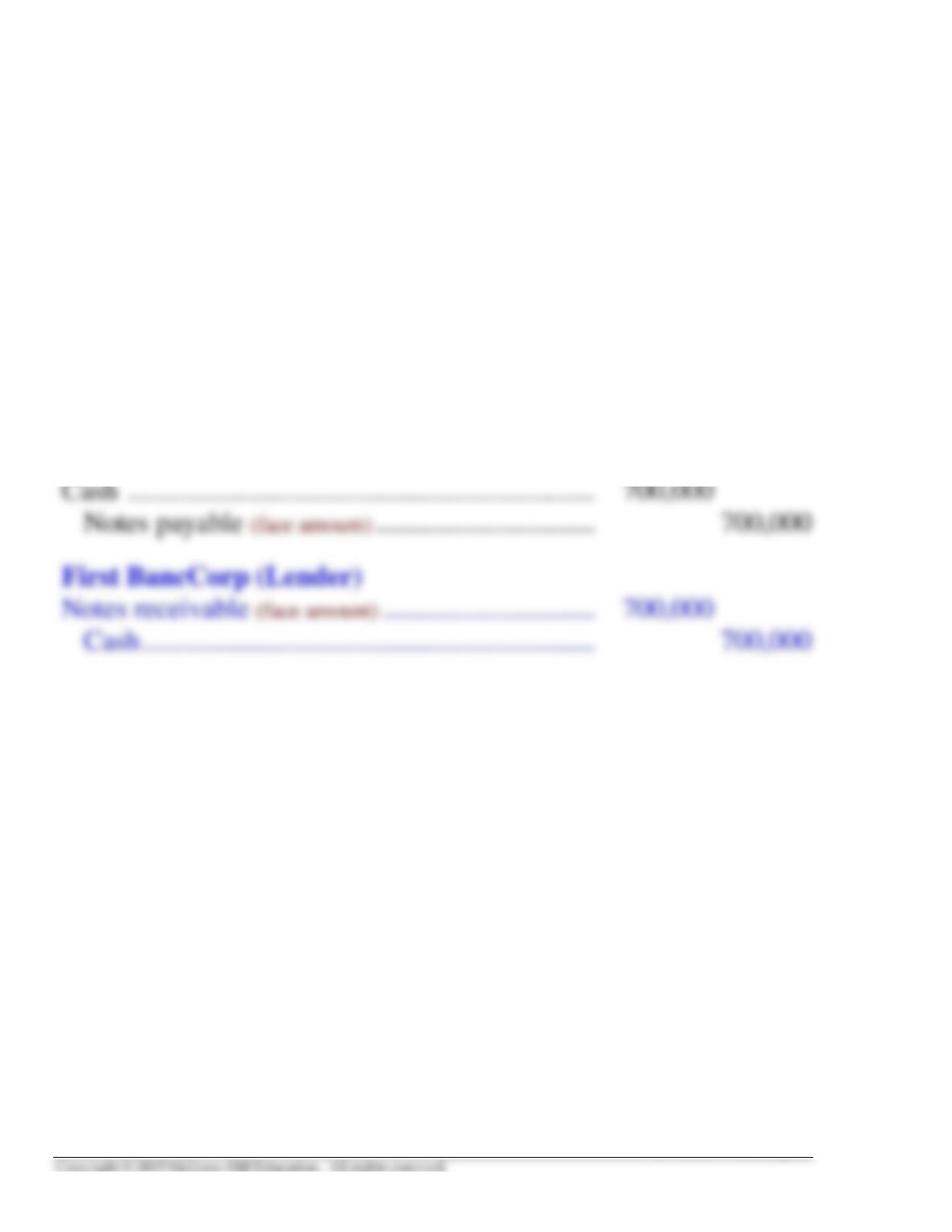
On January 1, 2016, Skill Graphics, Inc., a product labeling and
graphics firm, borrowed 700,000 cash from First BancCorp and
issued a 3-year, $700,000 promissory note. Interest of $42,000
was payable semiannually on June 30 and December 31.
At Issuance
Skill Graphics (Borrower)
T14-11