
Chapter 14: Income Taxes and Financial Accounting I
nstructor Manual
Accounting Theory (9
th
edition) Page
1 of 13
CHAPTER HIGHLIGHTS
Students should come away from this chapter with an appreciation of the complexities bearing upon
financial accounting stemming from the federal government’s role in the taxation process and fiscal policy.
It should also be clear that income tax allocation presents extremely difficult problems of allocation.
The investment tax credit, now on the internet, is largely of historical interest at the present time. Some
comparisons can be made between investment tax credit and income tax allocation approaches. For
example, the net-of-tax approach to income tax allocation and the reduction of asset cost approach for the
investment tax credit have the similarity of reducing the cost of the asset. The investment tax credit was
previously repealed two times, but it always seems to come back because it is a good macroeconomic tool
for stimulating economic investment.
QUESTIONS
Q-1 As a type of allocation, why is income tax allocation unique?
As Thomas has said, “. . . tax allocation may be perceived as an attempt to make allocation consistent, and its
allocation problems are the consequences of other arbitrary allocations.” In other words, using different
Q-2 Relative to depreciation, why is comprehensive allocation an example of rigid uniformity and
partial allocation an example of finite uniformity?
Q-3 Although net-of-tax depreciation gives the same bottom-line result as comprehensive allocation,
are there any financial ratios that would be affected by the choice between these methods?
Q-4 How do the deferral and liability methods of implementing comprehensive allocation differ?
They differ in two respects. The first is the designation of the account. It is referred to as a “deferred credit”
Chapter 14: Income Taxes and Financial Accounting I
nstructor Manual
Accounting Theory (9
th
edition) Page
2 of 13
Q-5 What is the rollover defense of the liability interpretation of deferred taxes, and how has it been
attacked?
The “rollover” defense views each asset separately. The benefits that are received in the early years of the
fixed asset’s existence resulting from excess tax depreciation relative to book depreciation are “paid back” in
later years when the relationship between book and tax depreciation reverses. Sometimes the rollover view
Q-6 What is the justification for discounting deferred tax liabilities under either comprehensive or
partial allocation?
Other long-term liabilities that bear interest, such as leases and bonds payable, are carried at their present
values. While there is no explicit interest on funds financed by deferred taxes, the opportunity cost concept
Q-7 What is the interpretation of income tax expenses under partial allocation?
Income tax expenses equal an amount paid for income taxes attributable to operations of the current year. In
addition, the expense will also include an amount attributable to the current year, which will not be paid until
Q-8 What is permanent deferral?
“Permanent deferral” refers to a situation in which the excess of tax depreciation (MACRS) over book
depreciation on newer assets exceeds the reversal (book depreciation exceeding tax depreciation) on older
Q-9 How did SFAS No. 96 differ from APB Opinion No. 11?
SFAS No. 96 tried to go from the revenue-expense approach of APB Opinion No. 11, which used deferred

Chapter 14: Income Taxes and Financial Accounting I
nstructor Manual
Q-10 How does SFAS No. 109 differ from SFAS No. 96?
The differences between SFAS Nos. 109 and 96 are less extreme than those between APB Opinion No. 11
and SFAS No. 96, but they are nevertheless important. First, SFAS No. 109 is much more liberal in
recognizing deferred tax assets than its predecessor. SFAS No. 109 simply requires reasonable certainty of
realization of deferred tax assets, whereas its predecessor required much more specificity (carryback against
Q-11 Refer to Exhibit 14.8. Under SFAS No. 96, there was a “conservative” recognition of deferred tax
assets. As a result, the $135 deferred tax asset in 1997 needs to be “carried back” to 1994. Why is
this result not conservative?
Q-12 If discounting were used in the area of deferred tax assets and liabilities (as this chapter
advocates), would there be any particular difficulty relative to tax-loss carryforwards?
The problem would be how to deal with the timing (present valuing) of when tax-loss carryforwards should
Q-13 Do you think that income tax allocation can improve the prediction of future tax payments in the
short-run?
Q-14 Do deferred tax liabilities arising from using tax depreciation for tax purposes and straight-line
depreciation for financial reporting lead to true future cash flows?
Q-15 What are the weaknesses of partial allocation?

Chapter 14: Income Taxes and Financial Accounting I
nstructor Manual
Accounting Theory (9
th
edition) Page
4 of 13
Q-16 How are valuation allowances used in income tax allocation?
The deferred tax asset measures potential benefits to be received in future years. Since future income may
Q-17 Should tax-loss carryforwards be booked? Explain.
Characteristics of an asset include: probable future benefit that it contributes to future net cash flows, the
firm receives the benefit and has control over its access, and the event must have already occurred. The first
Chapter 14: Income Taxes and Financial Accounting I
nstructor Manual
Accounting Theory (9
th
edition) Page
5 of 13
CASES, PROBLEMS, AND WRITING ASSIGNMENTS
1. Refer to Exhibit 14-8. Assume that in 1996 accounting income is $2,000. There is one new
temporary difference: installment sale income of $350 is recognized in 1996 but will not be taxed
until 1997 when the cash is collected.
Required: Prepare the tax entries for 1996 in accordance with SFAS No. 109.
Year 1996 1997 1998 1999 2003
Accounting Income 2,000
Temporary Differences
Depreciation (120) (60) 100 130
* 400-350 installment sale=50
The journal entry would be:
Account Debit Credit
Income Tax Expense ($2,000 × .34) 680
Current Deferred Tax Liability 17
Noncurrent Deferred Tax Asset 41
Current Deferred Tax Asset 76
Income Taxes Payable ($1,705 × .34) 580
Chapter 14: Income Taxes and Financial Accounting I
nstructor Manual
Accounting Theory (9
th
edition) Page
6 of 13
2. Nowell Company is experimenting with comprehensive-liability income tax allocation called for
in SFAS No. 109 but, in addition, they are employing discounting. No temporary differences exist
up to 2000. Shown here is a schedule of tax depreciation, book depreciation, and income before
depreciation.
Year Tax Depreciation Book Depreciation Income
Before
Depreciation
A1 A2 A1 A2
2005 $50,000
$35,000
$300,000
2006 40,000 $60,000
35,000 $50,000
400,000
2007 30,000 50,000 35,000 50,000 420,000
2008 20,000 40,000 35,000 50,000 440,000
The tax rate is 45 percent. The discount rate is 8 percent.
Required: Prepare income tax entries for 2005, 2006, 2007, and 2008 discounting deferred tax
liabilities at 8 percent. Why would using discounting be a stronger asset-liability orientation than
not discounting deferred tax liabilities?
2005
2006
Account Debit Credit
Income Tax Expense 140,787
Imputed Interest (5,501×.08) 440
Income Taxes Payable ($250,000×.45) 135,000
Noncurrent Deferred Tax Liability 6,227
Chapter 14: Income Taxes and Financial Accounting I
nstructor Manual
Accounting Theory (9
th
edition) Page
7 of 13
2007
Account Debit Credit
Income Tax Expense 150,750
Imputed Interest (11,728×.08) 938
Noncurrent Deferred Tax Liability 1,312
Income Taxes Payable ($340,000 × .45) 153,000
($5,000 × .45) – $938 = $1,312
3. Accounting income for the Kolbow Company for 2005 (its first year of operations) was
$1,700,000. Differences between book and income were as follows:
Municipal bond interest (permanent) $ 75,000
Excess of tax over book depreciation 240,000
Excess of installment sales over collections 30,000
Compensatory stock option expense 37,000
Scheduled temporary differences over the next several years are:
2006 2007 2008 2009
Depreciation ($160,000)
$100,000
$140,000
$160,000
Excess of installment
collections over sales
20,000 10,000
Compensatory stock option
expense
($37,000)
Parentheses indicate a deduction in the previous schedule. Enacted tax rates are as follows:
2005 40%
2006 40%
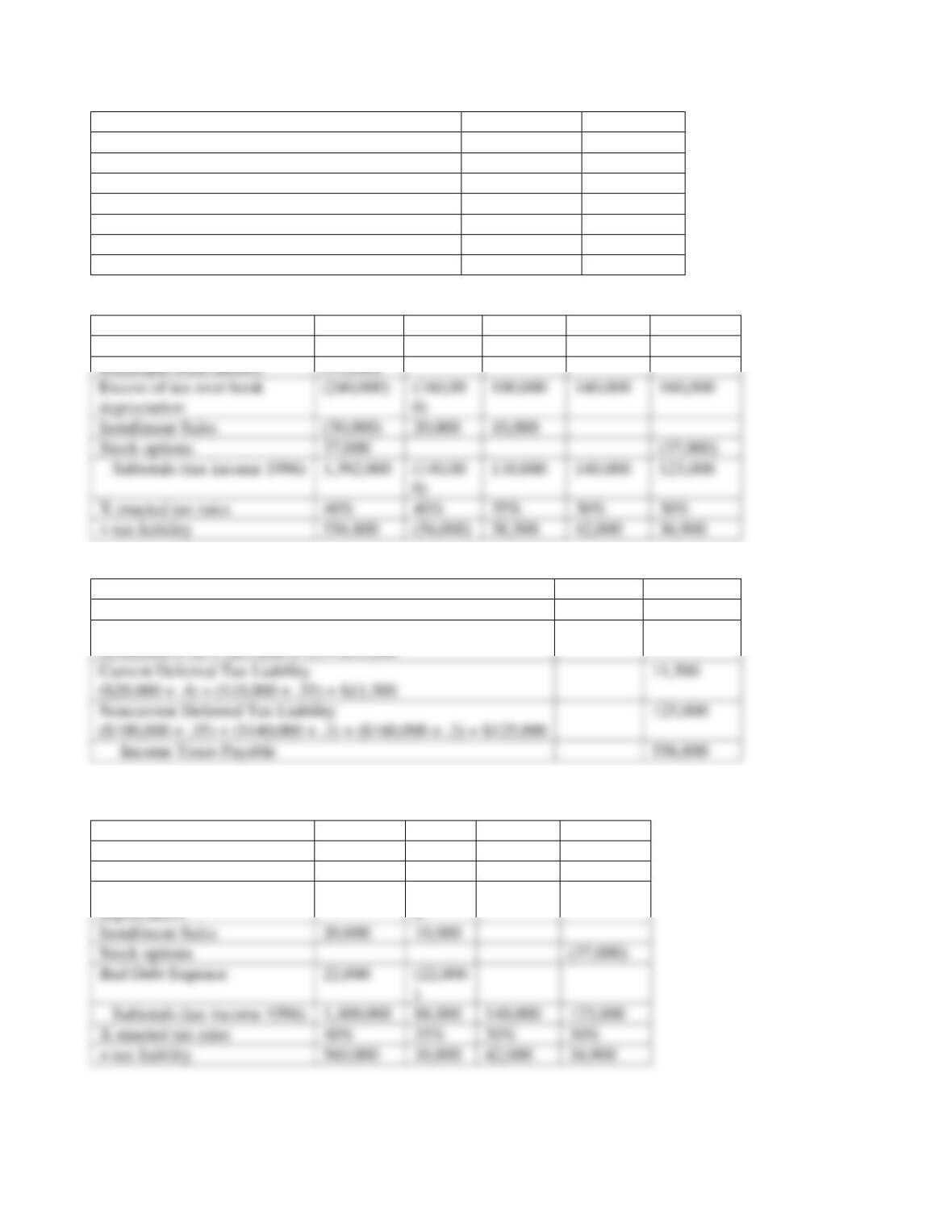
a.
Chapter 14: Income Taxes and Financial Accounting I
nstructor Manual
Accounting Theory (9
th
edition) Page
8 of 13
Accounting income for 2005 1,700,000
Expense not allowed for taxes 37,000
1,737,000
Less: Permanent differences
Municipal bond interest 75,000
Excess of tax over book depreciation 240,000
Excess of installment sales over collections 30,000 (345,000)
Taxable income 1,392,000
b.
Year 2005 2006 2007 2008 2009
Accounting Income 1,700,000
2005 journal entries
Account Debit Credit
Income Tax Expense 618,200
Noncurrent Deferred Tax Asset
75,100
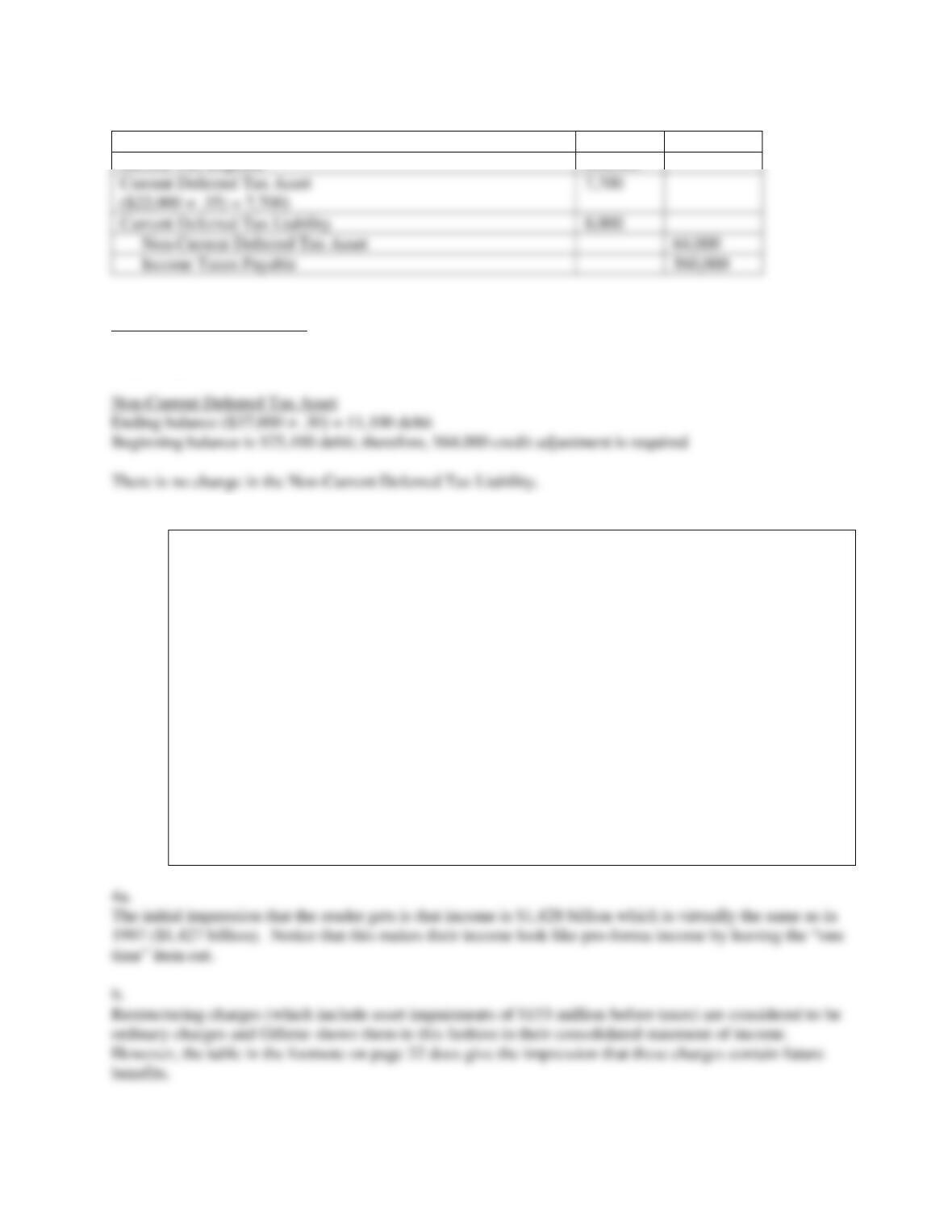
c.
Year 2006 2007 2008 2009
Accounting Income 1,518,000
Municipal bond interest
Excess of tax over book
(160,000) 100,00
140,000 160,000
Chapter 14: Income Taxes and Financial Accounting I
nstructor Manual
Accounting Theory (9
th
edition) Page
9 of 13
2006 journal entries
Account Debit Credit
Current deferred tax liability
Ending balance ($10,000 × .35) = $3,500 credit
Beginning balance is $11,500 credit; therefore, $8,000 debit adjustment is required
4. Gillette Company, maker of shaving products and many other personal products, showed a net
income of $1.428 billion in 1998 and $1.427 billion in 1997 on page one of its 1998 annual
report. A note to the 1998 income said that the 1998 income of $1.428 billion was to be reduced
$347 million due to reorganization and realignment expenses. Consistent with this, the net
income in the consolidated statement of income for 1998 was $1.081 billion.
In addition, following information appeared in the footnotes for the 1998 corporate annual report
(figures are in millions).
See text for remainder of the problem.
Required:
a. Why do you think Gillette initially showed its income for 1998 to be $1.428
billion? Discuss.
b. Is the expensing of the reorganization and realignment costs of $347 million after
taxes for 1998 correct? Explain.
c. What is the valuation allowance?
d. Why do you think Gillette maintains this account?
e. Do you think that earnings management is being used by Gillette?
Chapter 14: Income Taxes and Financial Accounting I
nstructor Manual
Accounting Theory (9
th
edition) Page
10 of 13
5. Worldcom in 2001 and 2002 capitalized basic switching costs from expenses to capital assets to
the tune of $3.8 billion dollars with approximately $3.04 billion occurring in 2001. The corporate
tax rate is 35 percent. For 2001, Worldcom’s income before taxes was $2.432 billion and its
income tax expense was $0.943 billion for 2001. Assume that Worldcom, on its tax return,
expenses the entire $3.04 billion.
Required:
a. Would Worldcom’s actions have led to a situation of income tax allocation?
Explain.
b. Do you think, based on the numbers shown above, that Worldcom allocated the
income taxes stemming from the incorrect capitalization of the switching
expenses?
a.
Assuming that Worldcom expensed the $3.04 billion there would be a situation of income tax allocation
because $3 billion of phony capitalized expenditures arose with the entire $3 billion taken for expense
purposes. We suspect that this is exactly what happened because we would not expect Worldcom to forego
$3 billion of tax deductions despite the false capitalization.
Chapter 14: Income Taxes and Financial Accounting I
nstructor Manual
Accounting Theory (9
th
edition) Page
11 of 13
6. Nortel Networks, the Canadian telecommunications equipment manufacturer has recently
suffered large losses, creating very large tax loss carryforwards. The company also has a very
sizable valuation allowance which it deducts from the tax loss carryforwards on the balance
sheet. During the last quarter of 2005, it reduced the valuation allowance by $111 million. In the
first quarter of 2006, however, it added back $90 million to the valuation allowance.
Required:
What do you think may have been the underlying reason for Nortel’s behavior relative to the
manipulation of the valuation allowance?
First, you must buy into the idea that a manipulation of the valuation allowance has occurred. Management
may have conducted an objective review of the deferred tax assets and genuinely determined that Nortel’s
•
CRITICAL THINKING AND ANALYSIS
1. What are the strengths and weaknesses of (1) no allocation, (2) comprehensive allocation with an
income statement orientation, (3) comprehensive allocation with a balance sheet orientation, and
(4) partial allocation. Which would you choose?
No allocation is tempting. It is a cash flow number and avoids the complexities of the allocation process and
might also be justified on the grounds of permanent deferral in many cases. (2) Comprehensive allocation
with an income statement orientation emphasizes the revenue-expense approach but that day appears to be
2. Is the deferred tax “liability” really a liability?
If it is a liability, it would embody a present obligation to the government in the future. If it is a liability, the
Chapter 14: Income Taxes and Financial Accounting I
nstructor Manual
Accounting Theory (9
th
edition) Page
12 of 13
3. Chludek (2011) finds that deferred tax components have little relevance when valuing a firm. If
so, why make the accounting differences so potentially complicated to report?
Chludek, Astrid K. (2011). “Perceived versus Actual Cash Flow Implications of Deferred Taxes: An
Analysis of Value Relevance and Reversal under IRFS,” Journal of International Accounting,” 1–25.
4. What are some challenges that are specific to a joint converged FASB/IASB Income Tax
standard?
Convergence of FASB/IASB standards is faced with numerous challenges including cultural,
political, and economical differences of the different nations. However, a converged standard on
income taxes would present a different set of challenges due to the nature and uniqueness of
taxation in different countries. Furthermore, the current IASB and FASB income taxes standards
already have some major differences that may present challenges in an attempt to come up with a
converged standard. Some of these differences include the use of the enacted tax rate under FASB
to calculate deferred taxes. Under IASB, either an enacted tax rate or a substantially enacted tax rate
can be used.
Recognizing these differences and challenges to a converged income taxes standard, FASB and
IASB are working towards bridging them. Just recently, FASB proposed eliminating the
current/noncurrent classification of deferred taxes and liabilities (FASB, 2015). This is consistent
with IASB’s noncurrent treatment of all deferred taxes (IAS 1, Para. 56).
Chapter 14: Income Taxes and Financial Accounting I
nstructor Manual
Accounting Theory (9
th
edition) Page
13 of 13
5. In the U.S. federal and state tax is based on taxable net income, excluding “not-for-profit entities.
What are the arguments for basing all organizational taxes on cash and cash equivalent receipts
rather than net income?
If there can be a “fun” question when discussing taxes, this has potential. Basing taxes on net income
encourages entities to minimize the bottom line to reduce its taxes. From managerial accounting, “What you
measure is what you get.” Current tax loss carryforwards subsidize companies, is that good? If so, should
individuals have the potential to carryforward cost of living losses?