
239
chapter
14
Long-Term Liabilities:
Bonds and Notes
______________________________________________
OPENING COMMENTS
The subject of long-term liabilities and bonds is a challenge for most students. This chapter requires
students to apply difficult concepts that most of them have not encountered before. For example, present
value and amortization of bond discounts and premiums are covered in the appendices to the chapter.
The chapter begins with a discussion of financing corporations and the nature of bonds payable. It
compares the options of issuing stock, bonds, and installment notes. There is a brief section on how to
report long-term liabilities followed by illustrations of how to compute number of times interest charges
are earned and why creditors in particular are interested in this indication of a company’s financial
condition.
Before attacking bond problems that require the use of present value tables, take the time to explain this
new concept thoroughly and to demonstrate several applications of present value techniques. This will
make present value meaningful and will ease its application to bonds.
After studying the chapter, your students should be able to:
2. Describe the characteristics and terminology of bonds payable.
4. Describe and illustrate the accounting for installment notes.
6. Describe and illustrate how the number of times interest charges are earned is used to evaluate a
company’s financial condition.

240 Chapter 14 Long-Term Liabilities: Bonds and Notes
STUDENT FAQS
• Why do we need to study bonds when 99.9 percent of us will never be dealing with bonds because
we are not accounting majors?
• Is the current interest rate on bonds going up or down now?
• Why would a company want to call bonds in and incur a loss?
• Which interest rate do we use when we go to the tables?
• What interest rate must always be used to pay interest?
• Why would a company issue bonds when it could just sell more stock to raise money?
• What advantage do bonds have over long-term notes?
• Why aren’t all bonds issued at par or stated valued? Wouldn’t that be a lot easier?
• Isn’t using two different interest rates manipulative?
• How can a bond issued by a company be a long-term debt but to the buyer of the bond it could be a
temporary investment?
• Why is the market rate of interest different from the stated rate of interest?
OBJECTIVE 1
Compute the potential impact of long-term borrowing on earnings per share.
KEY TERM
Bond Earnings Per Share (EPS)
SUGGESTED APPROACH
In this objective, you need to sensitize students to the trade-offs between equity and debt financing. Since
these terms are not explicitly stated in the text, be sure to clearly define equity financing and debt
financing. Notes to assist you with this discussion are included below.
It is also very useful to examine the financial impact of financing with debt and equity. The textbook
presents two exhibits (Exhibits 1 and 2) that compare three alternative financing plans under two different
income levels ($800,000 and $440,000). These exhibits are designed to illustrate the effect of leverage
(leverage is covered in Chapter 17). To expand this illustration, four additional exhibits examining
income levels of $200,000, $300,000, $1 million, and $1.5 million are included in Transparency Masters

Chapter 14 Long-Term Liabilities: Bonds and Notes 241
(TMs) 14-1 through 14-4. These should give your students a better picture of the power of leverage in
magnifying financial returns as profits increase and the risk of leverage as profits decrease.
In addition to earnings per share, corporations consider interest rates and stock prices when determining
whether to raise funds through debt or equity financing. For example, corporations often issue new stock
to finance operations when stock prices are high and debt securities when interest rates are low.
Point out that the U.S. government uses bonds to finance its operations. U.S. Treasury bonds and U.S.
savings bonds are debt securities issued by our government.
LECTURE AID — Risk and Return
This degree of detail regarding risk and return does not appear in the text for this objective, but you may
wish to elaborate on factors to consider that are implied in the text at this time.
Ask students the following questions to introduce the relationship between risk and return:
How many of you buy lottery tickets? Why do you buy them? By a show of hands, how
many of you would buy a $1 lottery ticket if the jackpot were $1 million? How many of
you would buy a $1 lottery ticket if the jackpot were $10 million? How many of you
would buy a $1 lottery ticket if the jackpot were $50 million? How many of you would
buy a $1 lottery ticket if the jackpot were $1.04? (You should get some strange looks but
no takers.)
Why wouldn’t you buy the lottery ticket that pays $1.04? That’s a 4 percent return on your
money if you win. Some folks keep money in savings accounts that earn less than 4
percent.
Hopefully, your students will point out that interest earned on a savings account is a sure bet, whereas
winning the lottery is a long shot. This story illustrates the relationship between risk and reward. The
riskier an investment, the greater the reward an investor expects if his or her investment pays off.
When a company is considering whether to raise funds by selling stock (equity) or issuing bonds (debt), it
must balance the following information:
1. Debt funding is cheaper than equity funding. Because shareholders accept more risk than creditors
2. Debt funding uses leverage to increase shareholder returns. Purchasing additional assets through debt
3. Debt funding is riskier than equity funding. When sales and profits drop, a corporation can cease
paying dividends. However, it cannot cease its debt payments.

242 Chapter 14 Long-Term Liabilities: Bonds and Notes
OBJECTIVE 2
Describe the characteristics and terminology of bonds payable.
KEY TERMS
Bond Indenture Face Amount
Contract Rate Market Rate of Interest
Discount Premium
Effective Rate of Interest
SUGGESTED APPROACH — Characteristics of Bonds
Use TMs 14-5 and 14-6 to review the characteristics of bonds and the types of bonds that may be issued.
Number 5 on TM 14-6 lists “Secured Bonds.” Note that while “secured” isn’t explicitly included in
Objective 2, it is implied in the first paragraph.
Although risk and return are not specifically discussed in the text, after reviewing TM 14-6 and the
following information concerning callable and convertible bonds, you may wish to ask your class to
evaluate which bond characteristics increase the risk assumed by the bondholder and which reduce the
bondholder’s risk.
Characteristics that increase Characteristics that decrease
the bondholder’s risk the bondholder’s risk
Term bonds Serial bonds
Callable bonds Convertible bonds
Debenture bonds Secured bonds
LECTURE AID — Convertible and Callable Bonds
Convertible bonds give the bondholder the right to exchange his or her bonds for shares of stock if certain
conditions exist. However, the bondholder chooses whether or not to convert. Bondholders convert bonds
only if it is to their benefit.
Callable bonds may be redeemed by the corporation at its option. Therefore, the corporation will redeem
bonds only if it will benefit the corporation. For example, if interest rates drop, the corporation may pay
off bonds that carry a high interest rate and issue bonds with a low rate. This hurts the bondholder because
he or she must turn in a bond that is paying a high interest rate and invest in a bond with a lower interest
rate. As a result, callable bonds are riskier for the investor.
LECTURE AID — Proceeds from Issuing Bonds
Pose the following question to your class:

Chapter 14 Long-Term Liabilities: Bonds and Notes 243
Assume that your bond has an interest rate of 10 percent when other bonds are paying 12
percent. Investors will not want to buy your bond if they can earn 12 percent elsewhere.
What can you do to get investors to buy your 10 percent bond? (Answer: lower the price)
You will need to drop the price of your bond so investors are really getting a 12 percent return. In other
words, you need to drop the price to the present value of the bond using a 12 percent interest rate. You
will need to sell the bond at a discount.
The selling price of a bond is determined by the relationship between the bond’s contract interest rate and
the market interest rate when the bond is sold.
If contract rate = market rate, bond sells at face value.
If contract rate > market rate, bond sells at a premium.
If contract rate < market rate, bond sells at a discount.
OBJECTIVE 3
Journalize entries for bonds payable.
KEY TERMS
Carrying Amount
Effective Interest Rate Method
DEMONSTRATION PROBLEM — Issuance of a Bond (Face Amount)
Using the following information, we can demonstrate the journal entries to record bonds issued at face
value, bonds issued at a premium, and bonds issued at a discount.
Assume that $1,000,000 five-year bonds paying an interest rate of 10% are issued when the market rate of
interest is also 10%. The journal entry to record this event would be:
Cash 1,000,000
Bonds Payable 1,000,000
244 Chapter 14 Long-Term Liabilities: Bonds and Notes
DEMONSTRATION PROBLEM — Issuance of a Bond (Discount)
The calculation for present value of bonds is covered in Appendix 1 of this chapter. If the instructor
chooses not to require students to calculate present value, the amounts can be provided to the students
with an explanation to complete the journal entries below.
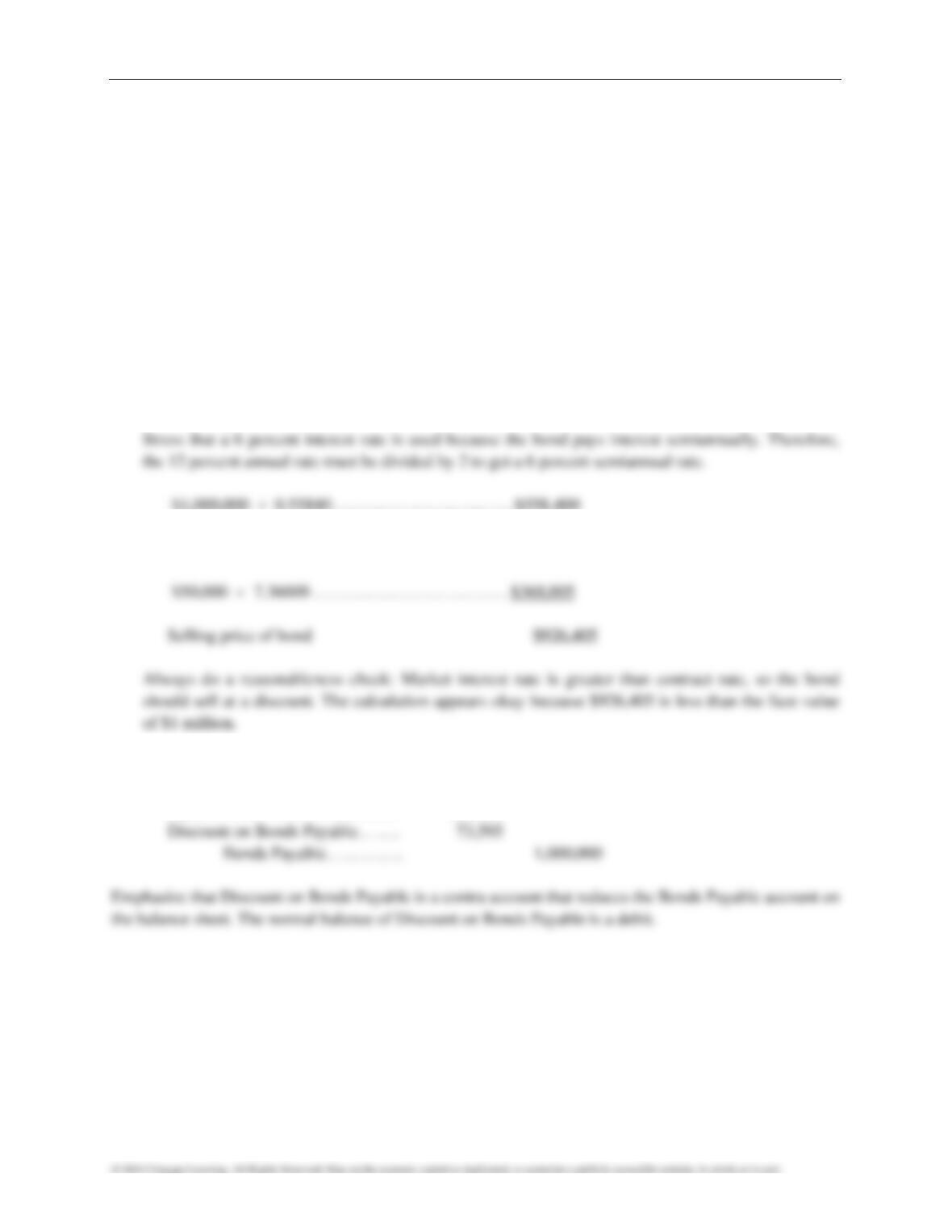
On January 1, a corporation issued a $1 million, five-year, 10 percent bond that pays interest
semiannually. The market interest rate on January 1 was 12 percent.
Principal = $1,000,000
Interest payments = $50,000 ([$1,000,000 10%]/2)
NOTE: Stress that interest payments are based on the bond’s contract interest rate.
1. PV of principal, i = 6%, n = 10
2. PV of interest payments, i = 6%, n = 10
The journal entry to record issuing the bond is:
Cash…………………………….. 926,405
DEMONSTRATION PROBLEM — Issuance of a Bond (Premium)
The calculation for present value of bonds is covered in Appendix 1 of this chapter. If the instructor
chooses not to require students to calculate present value, the amounts can be provided to the students
with an explanation to complete the journal entries below.
Chapter 14 Long-Term Liabilities: Bonds and Notes 245
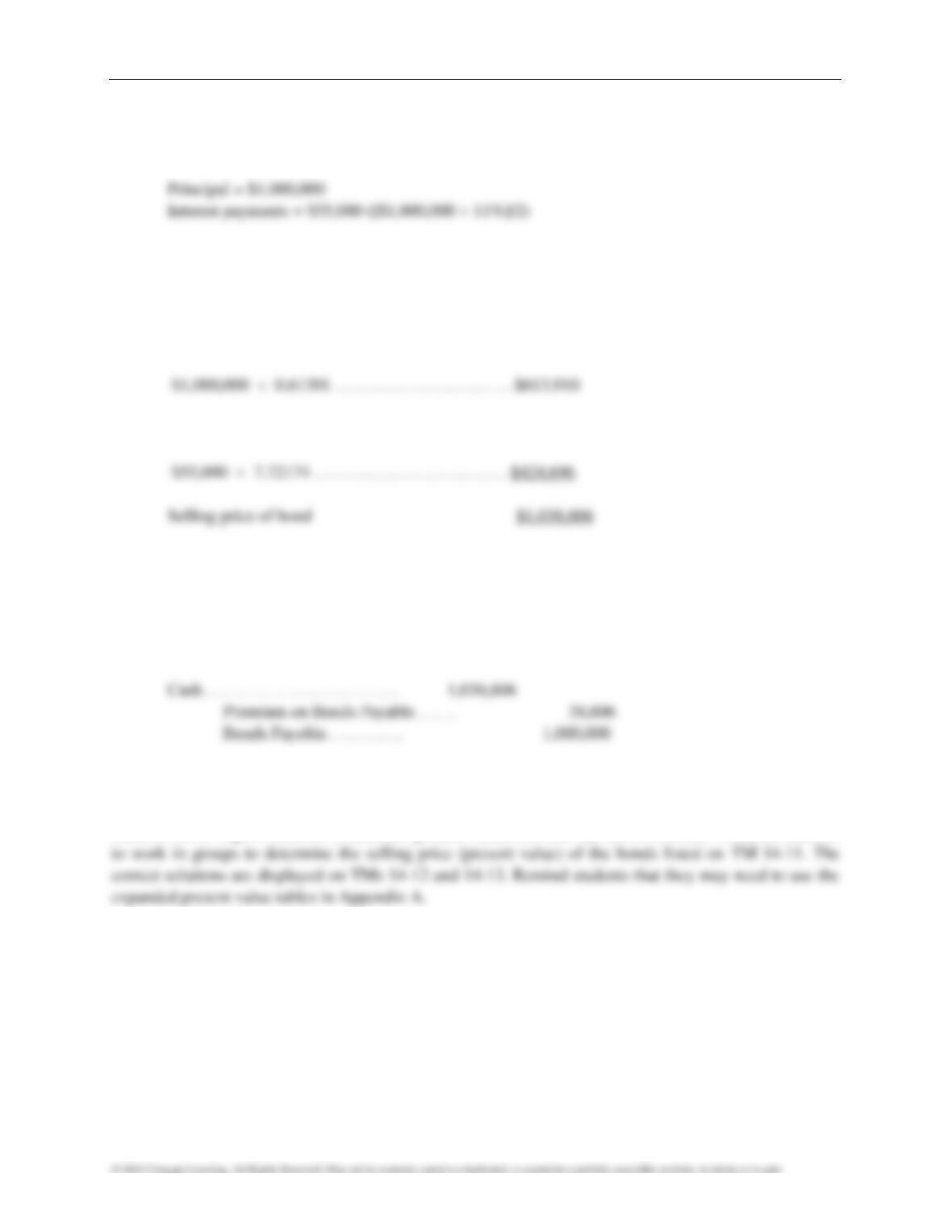
On January 1, a corporation issued a $1 million, five-year, 11 percent bond that pays interest
semiannually. The market interest rate on January 1 was 10 percent.
NOTE: Stress that interest payments are based on the bond’s contract interest rate.
1. PV of principal, i = 5%, n = 10
Stress that a 5 percent interest rate is used because the bond pays interest semiannually. Therefore,
the 10 percent annual rate must be divided by 2 to get a 5 percent semiannual rate.
2. PV of interest payments, i = 5%, n = 10
Always do a reasonableness check: Market interest rate is less than contract rate, so the bond should
sell at a premium. The calculation appears okay because $1,038,606 is more than the face value of $1
million.
The journal entry to record issuing the bond is:
GROUP LEARNING ACTIVITY — Issuance of a Bond
The calculation for present value of bonds is covered in Appendix 1 of this chapter. If the instructor
chooses not to require students to calculate present value, this activity can be omitted. Ask your students
LECTURE AID — Amortizing a Bond Discount Using the Straight-Line
Method
The calculation for amortization of bond discounts and premiums is covered in Appendix 1 of this
chapter. If the instructor chooses not to require students to calculate bond discounts and premiums, the
amounts can be provided with an explanation to complete the journal entries below. Refer to the previous
Demonstration Problem in which the $1 million, five-year, 10 percent bond that paid interest
1. The investor loans the company $926,405 by buying the bond.
3. Therefore, the investor gets $73,595 more at maturity than he or she paid for the bonds. The $73,595
4. Because the $73,595 discount is really just extra interest, it must be recorded as interest expense.
This interest must be spread across the five-year term of the bond. The process of recognizing a
portion of the discount as interest each time an interest payment is made to the bondholder is called
amortizing the discount.
Straight-line amortization of a bond discount is similar to straight-line depreciation. The discount is
amortized evenly over the bond’s life. The bond mentioned previously has a life of five years or a total of
ten semiannual interest payments. If the discount is spread over the ten semiannual interest payments,
$7,359.50 of the discount is amortized on each payment date ($73,595/10). Since the discount is
additional interest, the interest expense recognized is greater than the amount of interest paid.
The journal entry to record the interest payment and discount amortization is:
Interest Expense…………….……. 57,359.50
The process for straight-line amortizing the premium for bonds sold at a premium is to reduce the interest
expense each payment period. If we use the data from the Demonstration Problem above for bonds sold at
a premium we have the following information: The premium to be amortized is $38,606 for 10 payments
This Premium on Bonds Payable account is systematically reduced to zero balance as the bond is paid
down to the due date.
Review TM 14-15 to see the effect of amortization for discount and premium bonds.
DEMONSTRATION PROBLEM — Bond Redemption
Using the Demonstration Problems above, the journal entry to record the bond redemption would be:
Chapter 14 Long-Term Liabilities: Bonds and Notes 247
OBJECTIVE 4
Describe and illustrate the accounting for installment notes.
KEY TERMS
Installment Note Mortgage Notes
SUGGESTED APPROACH
A third means of financing operations for a corporation is through the use of installment notes.
Installment notes are familiar to most students. Ask students by a show of hands who has a student loan,
car loan, credit card balance, or mortgage on a house. Most will have one or more of these installment
notes. Next, enter into a discussion about principal and interest and payment calculations. It is worth
Demonstration Problem — Installment Notes
B & H Manufacturing is considering purchasing a new piece of equipment. The cost of the equipment is
$50,000. The vendor offers financing for 5 years at an interest rate of 7%. What are the annual payments
for the equipment?
Step One: Find the present value of an ordinary annuity for $1 where n = 5 and i = 7% in the table in
Appendix A of the textbook.
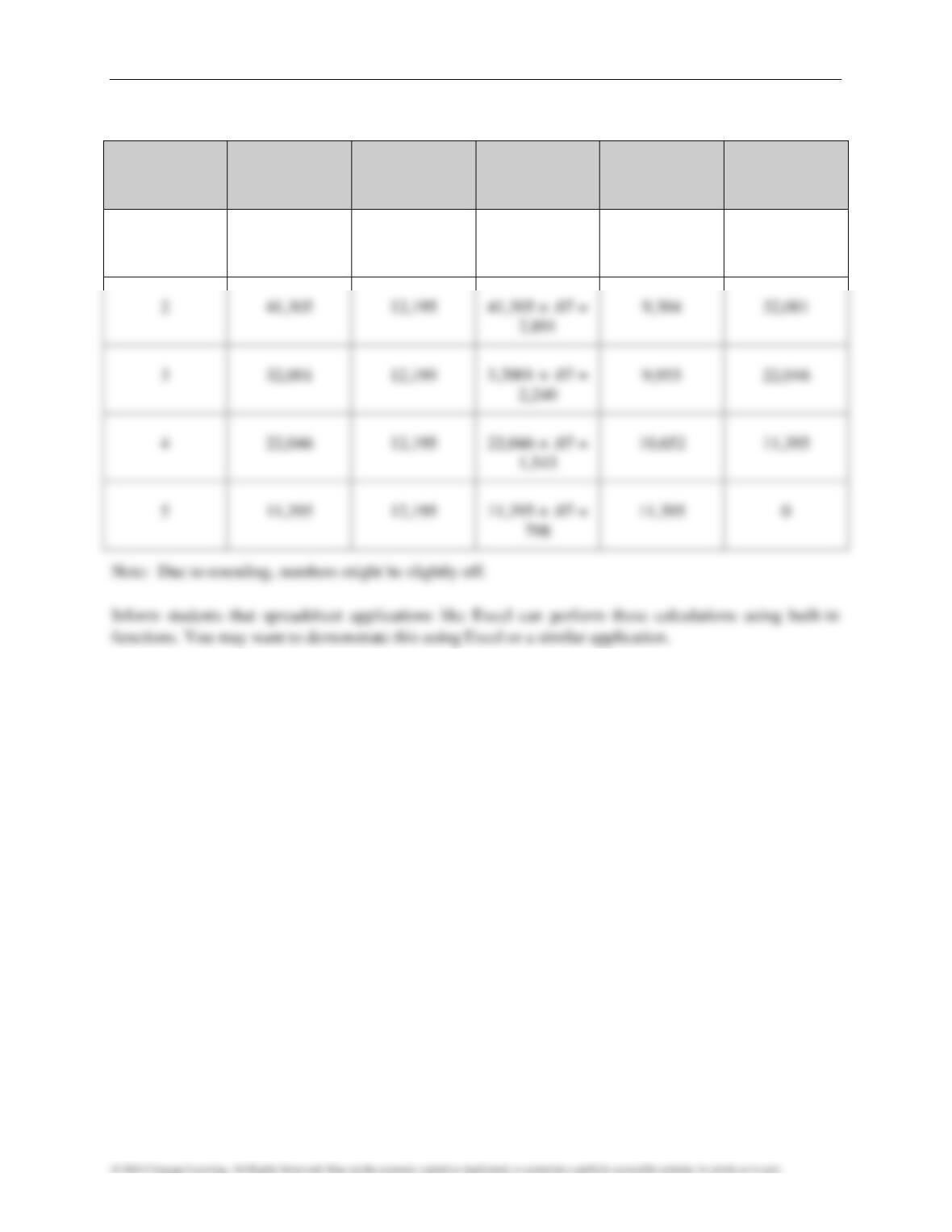
248 Chapter 14 Long-Term Liabilities: Bonds and Notes
Step Three: Set up a payment schedule.
Year
Beginning
Principal
Payment
Interest
Expense
Decrease in
Notes Payable
Ending
Principal
1
50,000
12,195
50,000 × .07 =
3,500
8,695
41,305
2
41,305
12,195
41,305 × .07 =
2,891
9,304
32,001
4
22,046
12,195
22,046 × .07 =
1,543
10,652
11,395
Group Learning Activity — Installment Notes
Ask your students to work in groups to determine the annual payment given the following conditions:
Principal amount: $30,000
Annual interest rate: 5%
Term: 3 years
Then, as an option, you can have them create an amortization schedule like the one in Exhibit 3. The
solution can be found in TM 14-14.
Chapter 14 Long-Term Liabilities: Bonds and Notes 249
OBJECTIVE 5
Describe and illustrate the reporting of long-term liabilities including bonds and notes
payable.
SUGGESTED APPROACH
Use the following notes to review the presentation of bonds payable and notes payable. Refer your
students to page 639, Mornin’ Joe balance sheet presentation for liabilities, in the text for an example of a
consolidated balance sheet that illustrates many of the accounting practices covered in Chapters 7–14.
LECTURE AID — Balance Sheet Presentation of Bonds Payable and Notes
Payable
Ask your students where bonds payable and notes payable are reported on a balance sheet. Unless bonds
and/or notes are due to mature within the next year, they are listed in the Long-Term Liabilities section of
the balance sheet.
Next, ask students to write in their notes how a $100,000 bond with a $7,000 unamortized discount and
notes payable of $12,000 should appear on the balance sheet of the issuing company. After a minute,
review the following solution with your students:
Long-term liabilities:
Bond payable $100,000