
14–41. (continued)
a.
Year 1
($22,000,000 – $9,000,000)
($22,000,000 – $9,000,000)
$90,000,000
$13,000,000
$13,000,000
b.
=
= 16.0%
=
= 14.4%
$81,000,000
$90,000,000
Year 2
($24,200,000 – $9,000,000)
($24,200,000 – $9,000,000)
[$90,000,000 – (2 × $9,000,000)]
$90,000,000
=
$15,200,000
= 21.1%
=
$15,200,000
= 16.9%
$72,000,000
$90,000,000
Year 3
($26,620,000 – $9,000,000)
($26,620,000 – $9,000,000)
[$90,000,000 – (3 × $9,000,000)]
$90,000,000
$17,620,000
$17,620,000
=
= 28.0%
=
= 19.6%
$63,000,000
$90,000,000
Year 4
($29,282,000 – $9,000,000)
($29,282,000 – $9,000,000)
[$90,000,000 – (4 × $9,000,000)]
$90,000,000
=
$20,282,000
= 37.6%
=
$20,282,000
= 22.5%
$54,000,000
$90,000,000

14–41. (continued)
c.
Current Cost
Net Book Value
d.
Current Cost
Gross Book Value
Year 1
($22,000,000 – $9,900,000)
($22,000,000 – $9,900,000)
($99,000,000 – $9,900,000)
$99,000,000
=
$12,100,000
= 13.6%
=
$12,100,000
= 12.2%
$89,100,000
$99,000,000
Year 2
($24,200,000 – $10,890,000)
($24,200,000 – $10,890,000)
[$108,900,000 – $21,780,000]
$108,900,000
$13,310,000
=
= 15.3%
=
= 12.2%
$87,120,000
$108,900,000
Year 3
($26,620,000 – $11,979,000)
($26,620,000 – $11,979,000)
[$119,790,000 – $35,937,000]
$119,790,000
=
$14,641,000
= 17.5%
=
$14,641,000
= 12.2%
$83,853,000
$119,790,000
Year 4
($29,282,000 – $13,176,900)
[$131,769,000 – $52,707,600]
$131,769,000
=
= 20.4%
=
= 12.2%
$79,061,400
$131,769,000

14–42. (25 min.) Effects Of Current Cost On Performance Measurements: Upper
Division.
a.
ROI
Year 1:
$225,000 – (.25 × $600,000)
=
= 12.5%
$600,000
$600,000
Year 2:
$105,000
$75,000
=
= 17.5%
$600,000
$600,000
Year 3:
$285,000 – (.25 × $600,000)
=
= 22.5%
$600,000
$600,000
Year 4:
$150,000
$135,000
=
= 25.0%
$600,000
$600,000
b.
ROI
Year 1:
$225,000 – (.25 × $600,000)
=
= 12.5%
$600,000
$600,000
$255,000 – (.25 × $660,000)
$75,000
=
= 13.6%
$660,000
$660,000
Year 3:
$285,000 – (.25 × $726,000)
=
$103,500
= 14.3%
$726,000
$726,000
Year 4:
=
$100,350
= 12.6%
$798,600
$798,600
Solutions to Problems
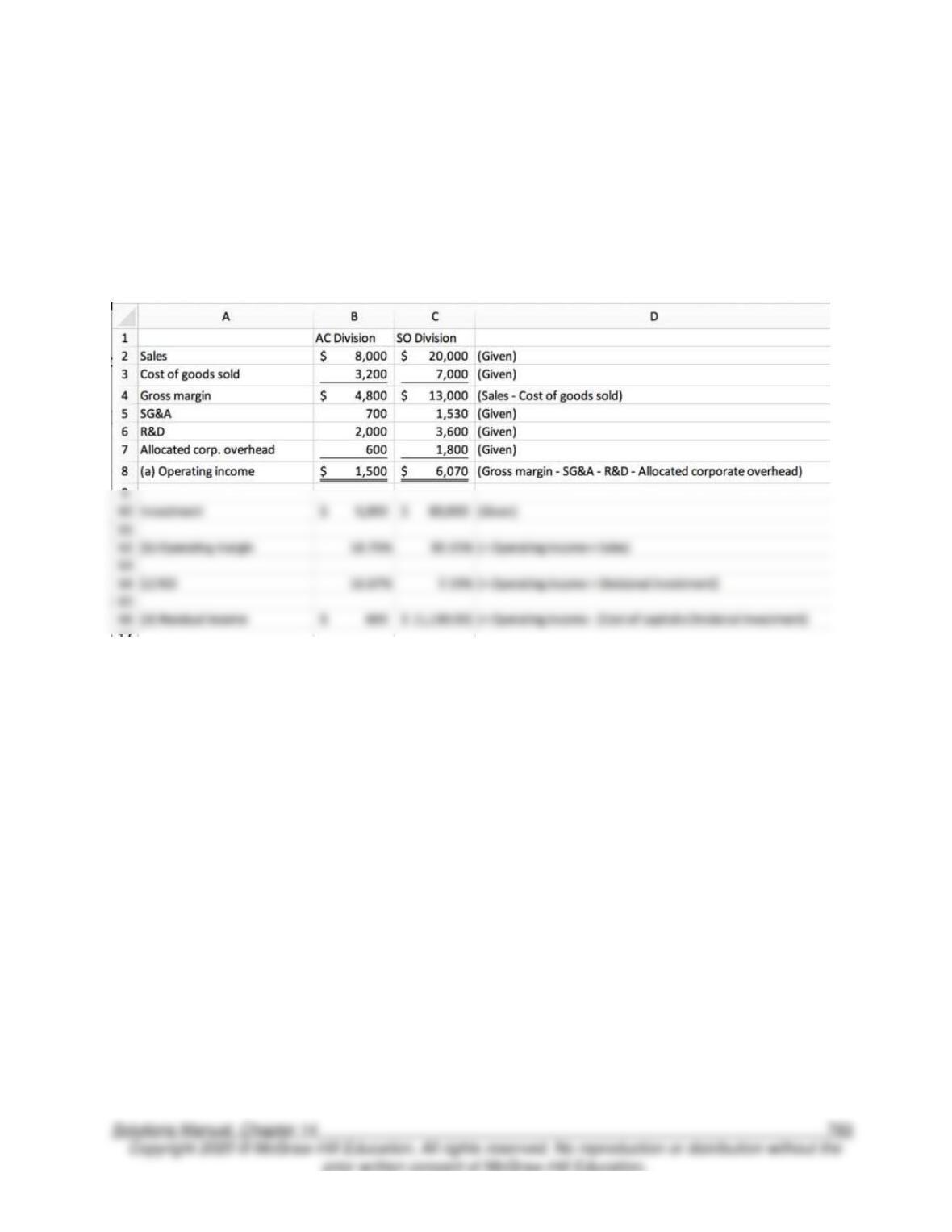
14–43. (30 min.) Comparing Business Units Using Divisional Income, ROI, and
Residual Income: Colonial Pharmaceuticals.
a. – d. Note that because we ignore income taxes, operating income is the same as net
income.
e. Answers will vary. SO Division is more profitable, based on income and operating
margin. However, it is also larger. It is less profitable, based on ROI. The residual income
for SO is negative, reflecting the relatively large investment in the division.
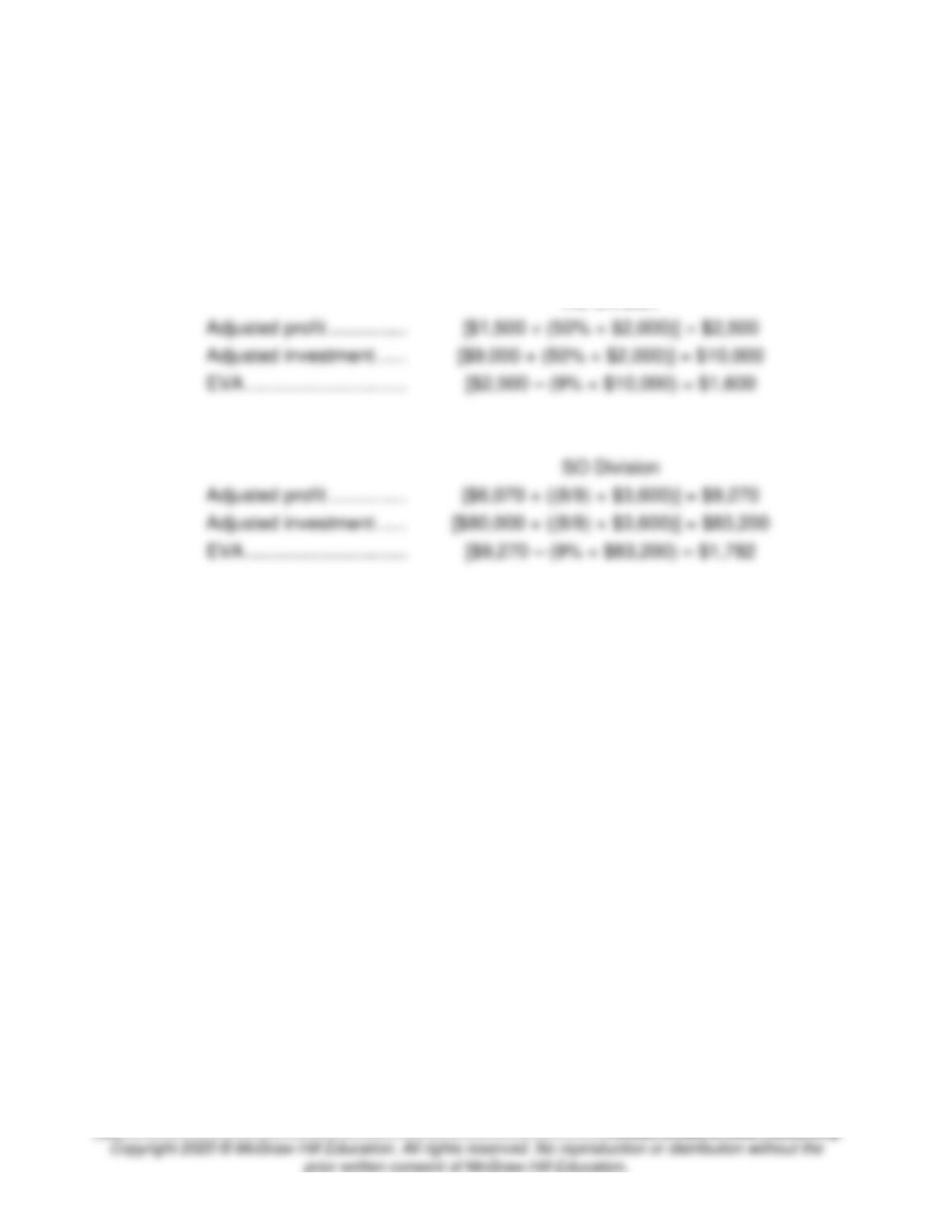
14–44. (20 min.) Comparing Business Units Using EVA: Colonial Pharmaceuticals.
a.
In computing EVAs, we need to adjust both income and investment (assets). The income
and investment adjustments are for R&D. For AC Division, R&D is assumed to benefit two
periods, we only expense 50% of R&D (it is assumed spent at the beginning of the year)
each year. For SO Division, we only expense (1/9), because it is assumed that R&D
benefits nine years.
b. Based on EVA, SO performed better than AC. The difference between the EVA result
and the residual income result is that EVA accounts for the fact that the investment in
R&D has a much longer life (at least that is the assumption) in SO Division than in AC
Division.
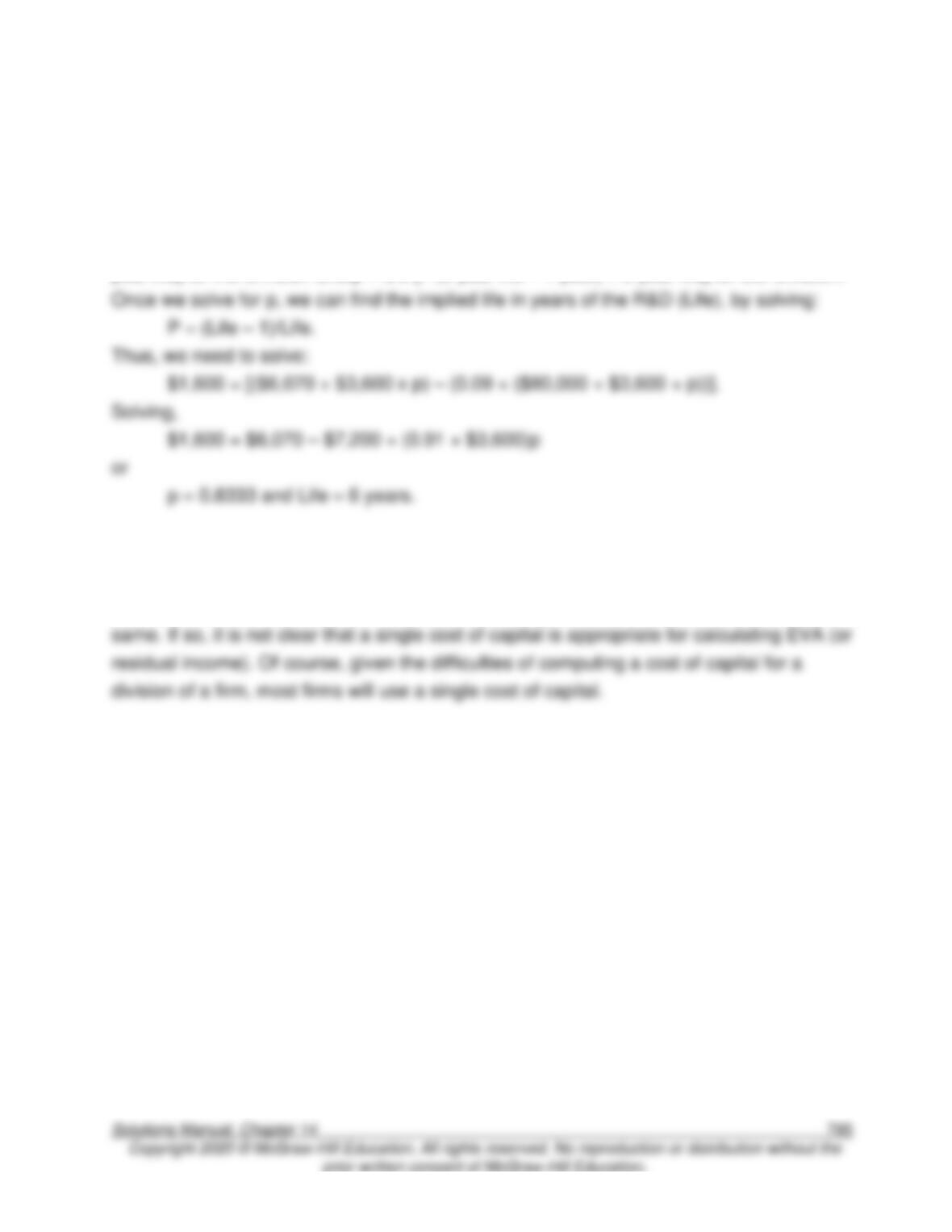
14–45. (20 min.) Comparing Business Units Using EVA: Colonial Pharmaceuticals.
a.
In solving this problem, we need to recognize that the same proportion of the R&D
investment is added to net (or in this case operating) income and divisional investment.
Let p = this proportion. For example, in Problem 4-41, p = 0.5 [= (2 year life – 1 year) ÷ 2
b. Answers will vary. From the discussion in the problem, it appears that the two divisions
make different products, sell in different markets, perhaps are subject to different
regulations, and so on. Therefore, it is unclear that the risk of the two divisions is the

14–46. (30 min.) Equipment Replacement And Performance Measures: Pitt, Inc.
ROI
a.
$3,750,000
= 60%
$4,000,000 + $5,000,000 – $1,500,000 – $1,250,000
b.
= 2.7%
c.
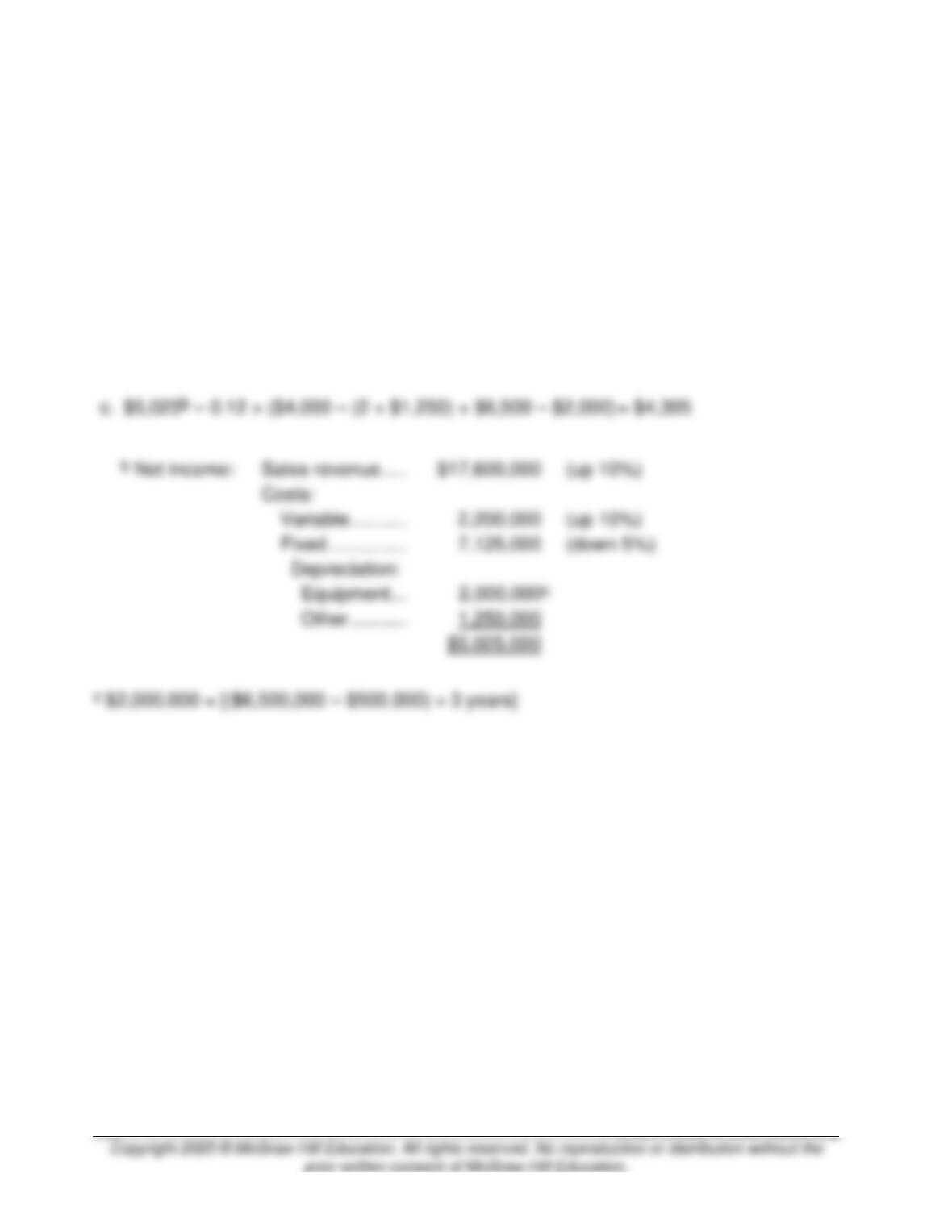
b Net income:
Sales revenue …..
$17,600,000
(up 10%)
Costs:
Variable ………..
2,200,000
(up 10%)
Fixed ……………
7,125,000
(down 5%)
Depreciation:
Equipment …
2,000,000c
Other ………..
1,250,000
$5,025,000
c $2,000,000 = [($6,500,000 – $500,000) ÷ 3 years]
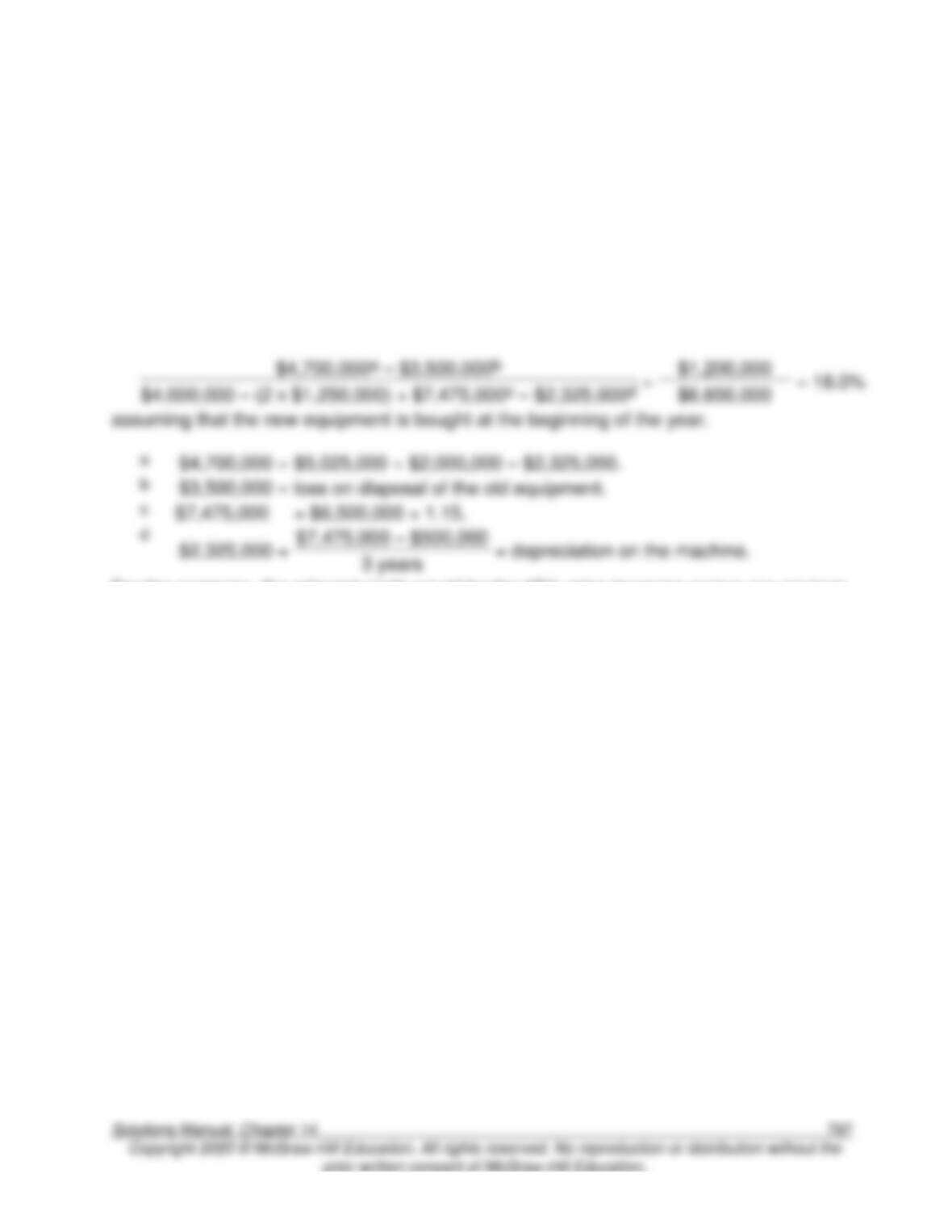
14–47. (20 min.) Evaluate Trade-Offs In Return Measurement: Pitt, Inc.
a. The machine is going to result in a positive net benefit, so he would want to acquire it
as early in the year as possible so he could obtain a full year’s benefits.
b. For the manager, the relevant cost is the lost bonus this year if the machine is
purchased this year versus the effect on the manager’s bonus that would arise from the
increased depreciation charge. If the manager waits until next year, then the return on
investment for this year would be the 60% as indicated in Problem 14-43, part a. For the
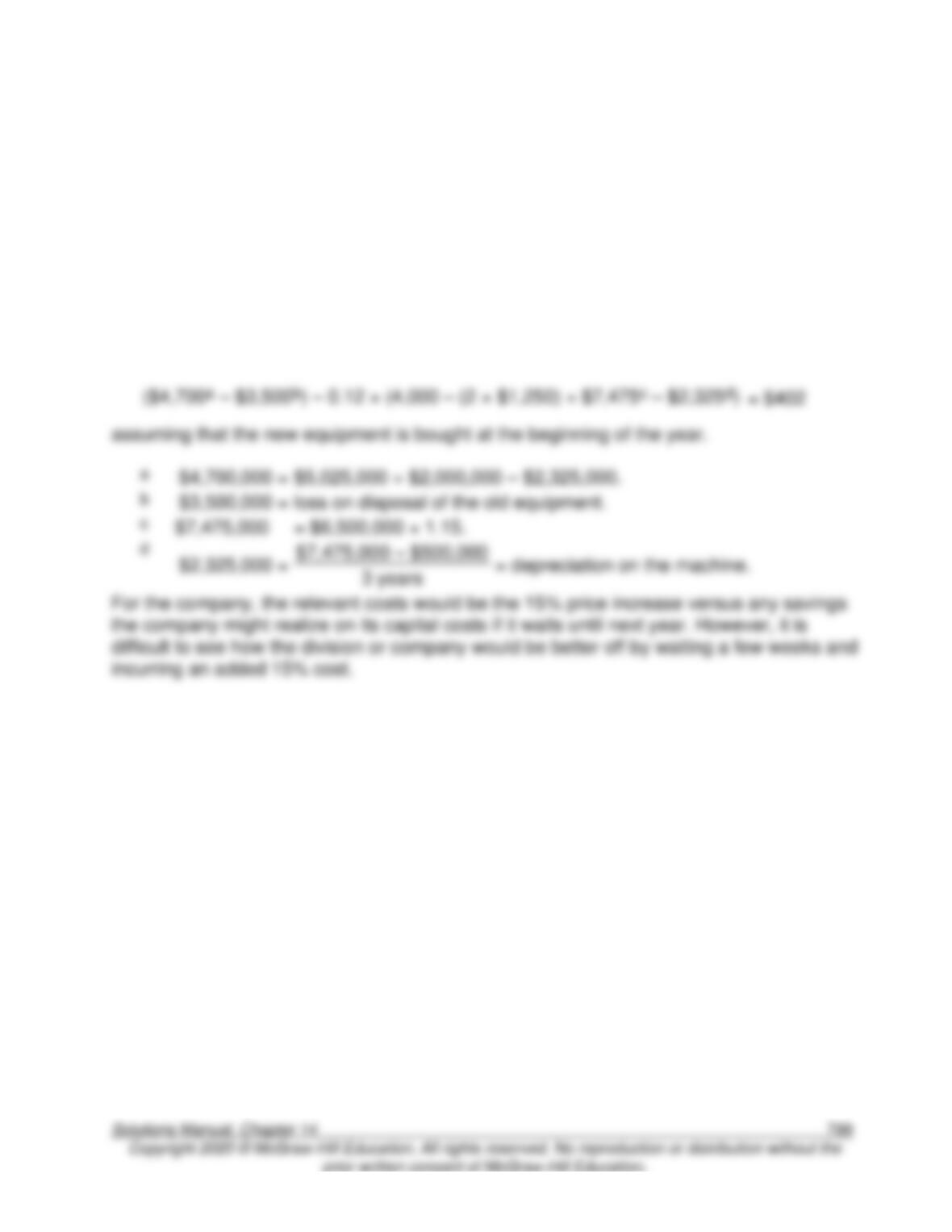
coming year, the ROI would be:
For the company, the relevant costs would be the 15% price increase versus any savings
the company might realize on its capital costs if it waits until next year. However, it is
difficult to see how the division or company would be better off by waiting a few weeks and
incurring an added 15% cost.
14–48. (30 min.) Economic Value Added: Pitt, Inc.
(In thousands of dollars)
a.
Residual Income
$3,750 – 0.12 × ($4,000 + $5,000 – $1,500 – $1,250)
= $3,000
b.
($3,750 – $3,500a) – 0.12 × ($4,000 – $1,250 + $6,500)
= $(860)
a Loss on old equipment equal to its $5 million cost less $1,500,000 depreciation.
= $4,305
Variable ………..
(up 10%)
14–49. (20 min.) Evaluate Trade-Offs In Performance Measurement and Decisions:
Pitt, Inc.
a. The machine is going to result in a positive net benefit, so he would want to acquire it
as early in the year as possible so he could obtain a full year’s benefits.
b. For the manager, the relevant cost is the lost bonus this year if the machine is
purchased this year versus the effect on the manager’s bonus that would arise from the
increased depreciation charge. If the manager waits until next year, then the residual
income for this year would be the $3 million as indicated in Problem 14-45, part a. For the
coming year, the residual income would be (in thousands of dollars):
14–50. (40 min.) ROI and Management Behavior—Ethical Issues: Asher Company.
a. Most of the specific actions that division managers can take that would result in
increasing division ROI and decreasing corporate ROI relate to investment proposals.
b. Asher’s corporate goals and goals for its divisions are not congruent. Improving the
division ROI does not automatically lead to improved corporate ROI. Certain actions
could be taken by a division that would improve its ROI, such as rejecting an
investment below its ROI but above the corporation ROI, but would not necessarily
c. The changes should be two-fold in character. The emphasis on a single measure for
performance evaluation should be eliminated. Additional factors important to division
and corporate goals should be included.
One approach would be to establish a target ROI, which would include allowances for
start-up costs of long-term projects. The company could consider the residual profits
14–50. (continued)
d. Answers will vary. Clearly, manipulating numbers at the division level is unethical (and
probably illegal). Taking actions, for example refusing to engage in interdivisional
sales, is more difficult to assess. The firm has essentially told the manager to
maximize divisional ROI. If, on the other hand, she engages in actions that reduce the
CMA adapted
14–51. (30 min.) Impact of Decisions to Capitalize or Expense on Performance
Measurement—Ethical Issues: Pharm-It.
a.
ROI
Base Year
This Year
If R&D is expensed:
(Used in base year)
$4,500,000
= 12.0%
($8,600,000 – $4,500,000)
= 10.0%
$37,500,000
($45,500,000 – $4,500,000)
(Used by new management team)
b. 10% × $4,100,000 = $410,000.
The team knows it is not contributing anything of value. The only purpose of changing
the accounting method is to increase the bonus. If the new management team believes
the new accounting method is better, it should renegotiate the bonus target.
14–52. (30 min.) Evaluate Performance Evaluation System—Behavioral issues:
Seville Products.
a. An answer that assumed that managers should only be held responsible for what they
control would make the following arguments:
The financial reporting and performance evaluation program of Seville Products is
inappropriate as a measure of the responsibilities of the Salvador Division. Salvador is
being evaluated as a profit or investment center when it has no control over pricing,
production, and investment decisions. Salvador is a cost center and the performance
report should only consider costs under the control of Salvador management.
b. Following the notion that managers should be held responsible only for what they
control, the answer to requirement b would be:
The following revisions should be made to Seville Products’ financial reporting and
performance evaluation system.
• Evaluate Salvador Division as a cost center and include in the analysis only those
• Corporate computer costs should be included on the report. The amount charged
should be based upon actual usage and a predetermined standard rate.
• Provided a flexible budget is used for the actual level of production activity, a
variance analysis can be included in the evaluation. The variances should be
identified as price or efficiency related.
CMA adapted.