Chapter 14
Capital Budgeting Decisions
Solutions to Questions
14-1 A capital budgeting screening decision is
concerned with whether a proposed investment
project passes a preset hurdle, such as a 15%
rate of return. A capital budgeting preference
decision is concerned with choosing from among
two or more alternative investment projects,
each of which has passed the hurdle.
14-2 The “time value of money” refers to the
fact that a dollar received today is more valuable
than a dollar received in the future simply
because a dollar received today can be invested
to yield more than a dollar in the future.
14-3 Discounting is the process of computing
the present value of a future cash flow.
Discounting gives recognition to the time value
of money and makes it possible to meaningfully
add together cash flows that occur at different
times.
14-4 Accounting net income is based on
accruals rather than on cash flows. Both the net
present value and internal rate of return
14-8 No. The cost of capital is not simply the
interest paid on long-term debt. The cost of
capital is a weighted average of the costs of all
sources of financing, both debt and equity.
14-9 The internal rate of return is the rate of
return on an investment project over its life. It is
computed by finding the discount rate that
results in a zero net present value for the
project.
14-10 The cost of capital is a hurdle that must
be cleared before an investment project will be
accepted. (a) In the case of the net present
value method, the cost of capital is used as the
discount rate. If the net present value of the
project is positive, then the project is acceptable
because its rate of return is greater than the
cost of capital. (b) In the case of the internal
rate of return method, the cost of capital is
compared to a project’s internal rate of return. If
the project’s internal rate of return is greater
than the cost of capital, then the project is
acceptable.
discount rate) is zero. The internal rate of return
would be less than 14% if the net present value
(evaluated using a 14% discount rate) is
negative.
14-13 The profitability index is computed by
dividing the present value of a project’s cash
inflows by its required investment. It helps
out of the cash receipts that it generates. The
payback method is used as a screening tool for
investment proposals. The payback method is
useful when a company has cash flow problems.
The payback method is also used in industries
where obsolescence is very rapid.
14-15 Neither the payback method nor the
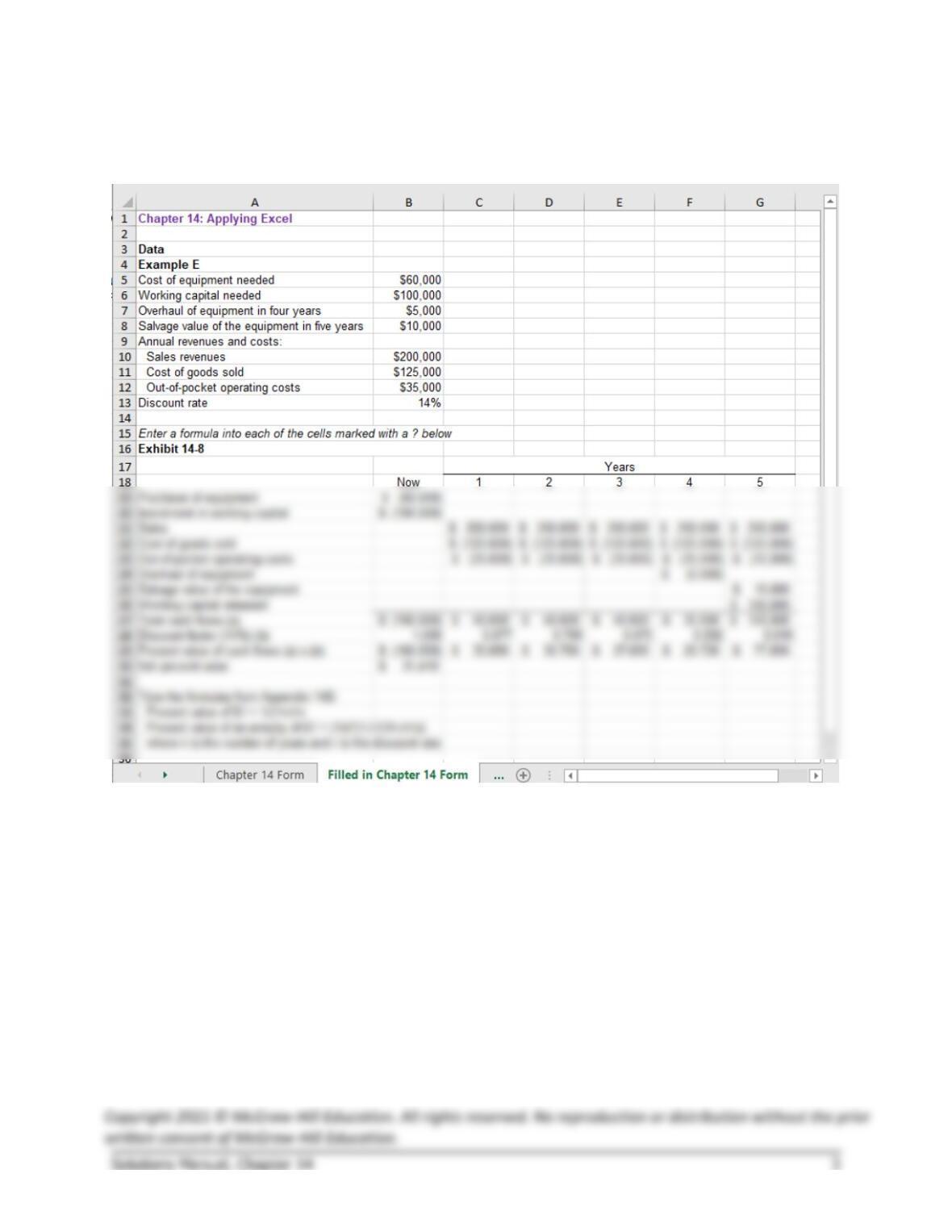
Chapter 14: Applying Excel
The completed worksheet is shown below.
Note: Your worksheet may differ from the above in rows 29 and 30. The
worksheet above has been set to use the rounded-off discount factors
rather than more exact factors without rounding. For example, the factor
0.519 is rounded off from 0.519368664. If the more exact factor is used to
calculate the present value of the $150,000 total cash flow at the end of
year 5, the answer is $77,905 rather than $77,850. These rounding errors
accumulate so that the more exact net present value is $31,493 rather
than the $31,410 as displayed. Either answer is okay.
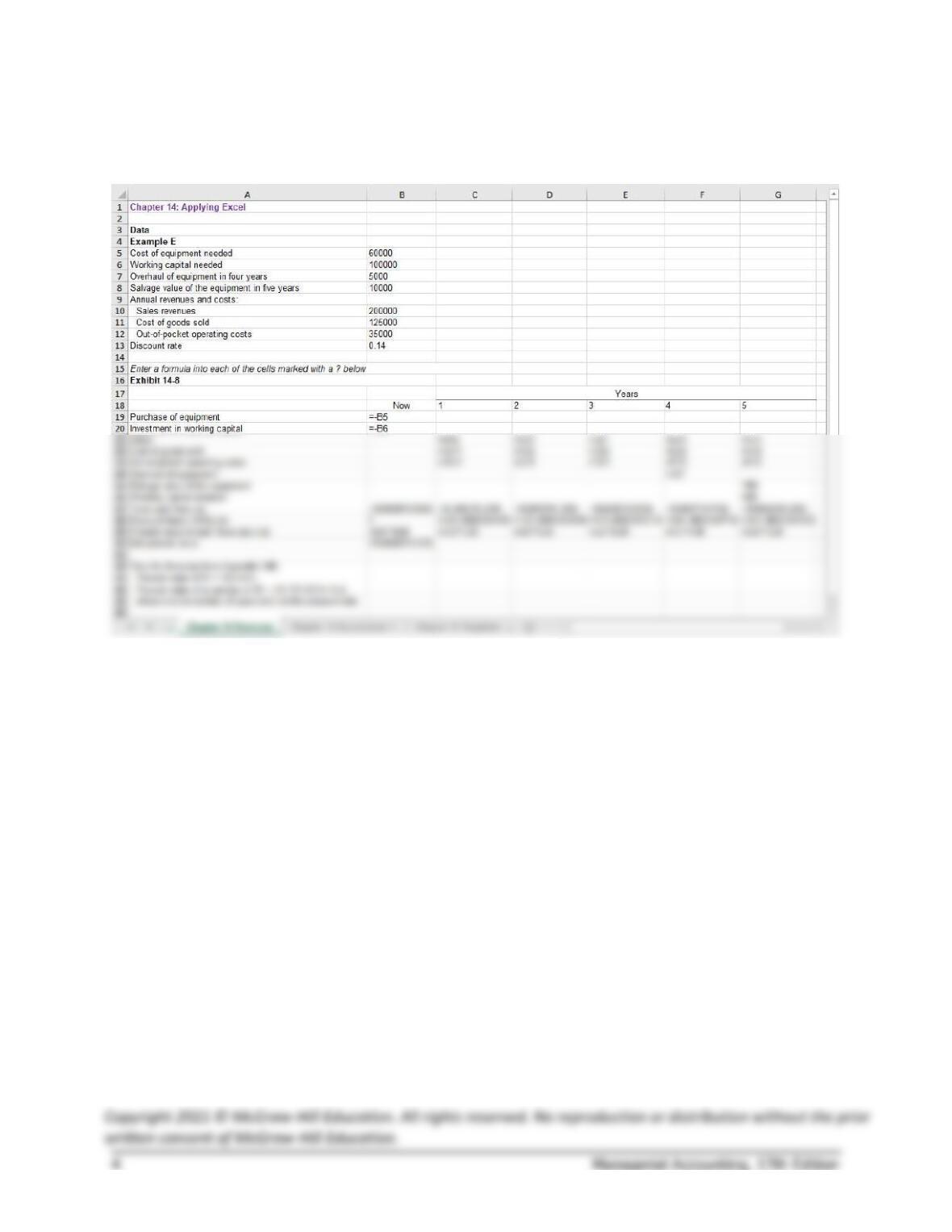
Chapter 14: Applying Excel (continued)
The completed worksheet, with formulas displayed, is shown below.
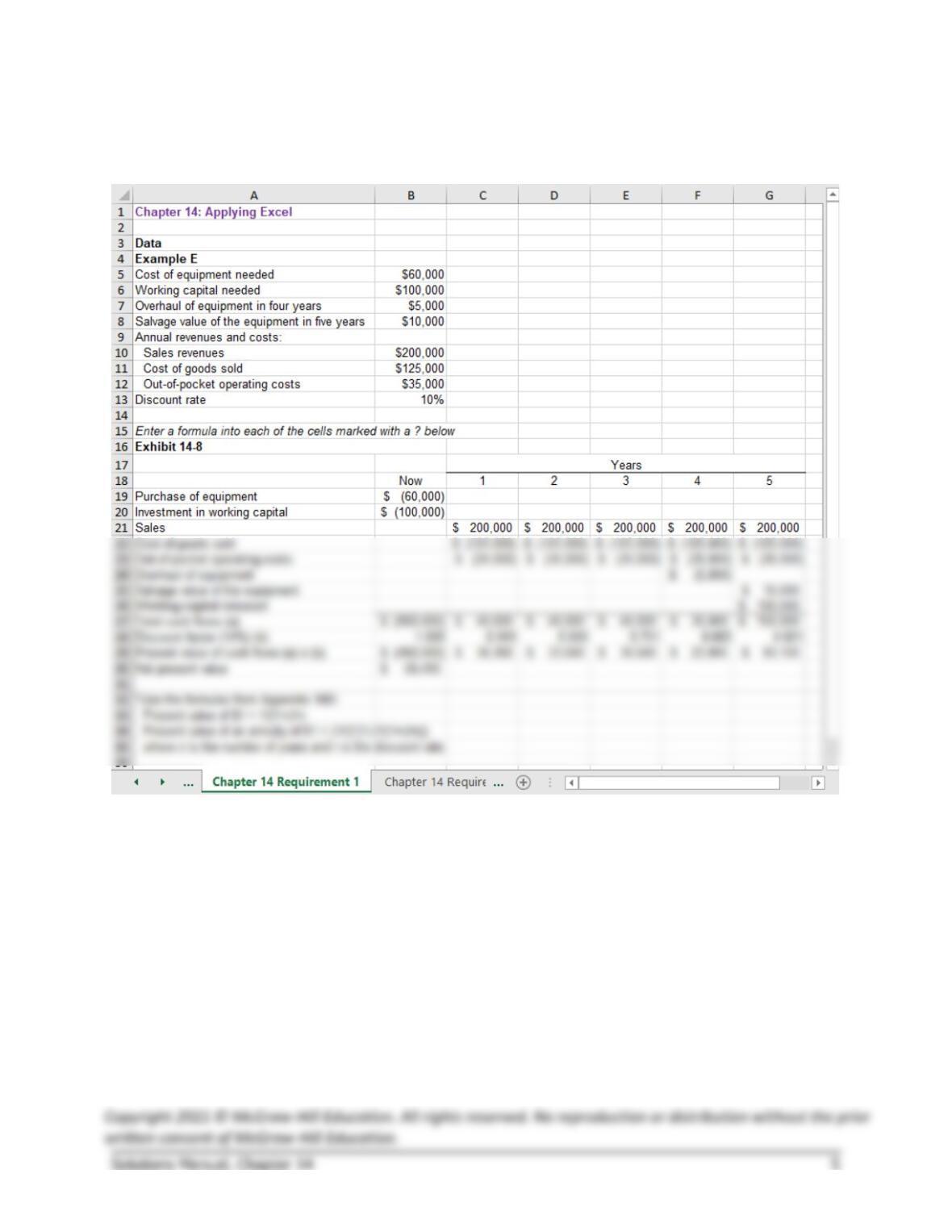
Chapter 14: Applying Excel (continued)
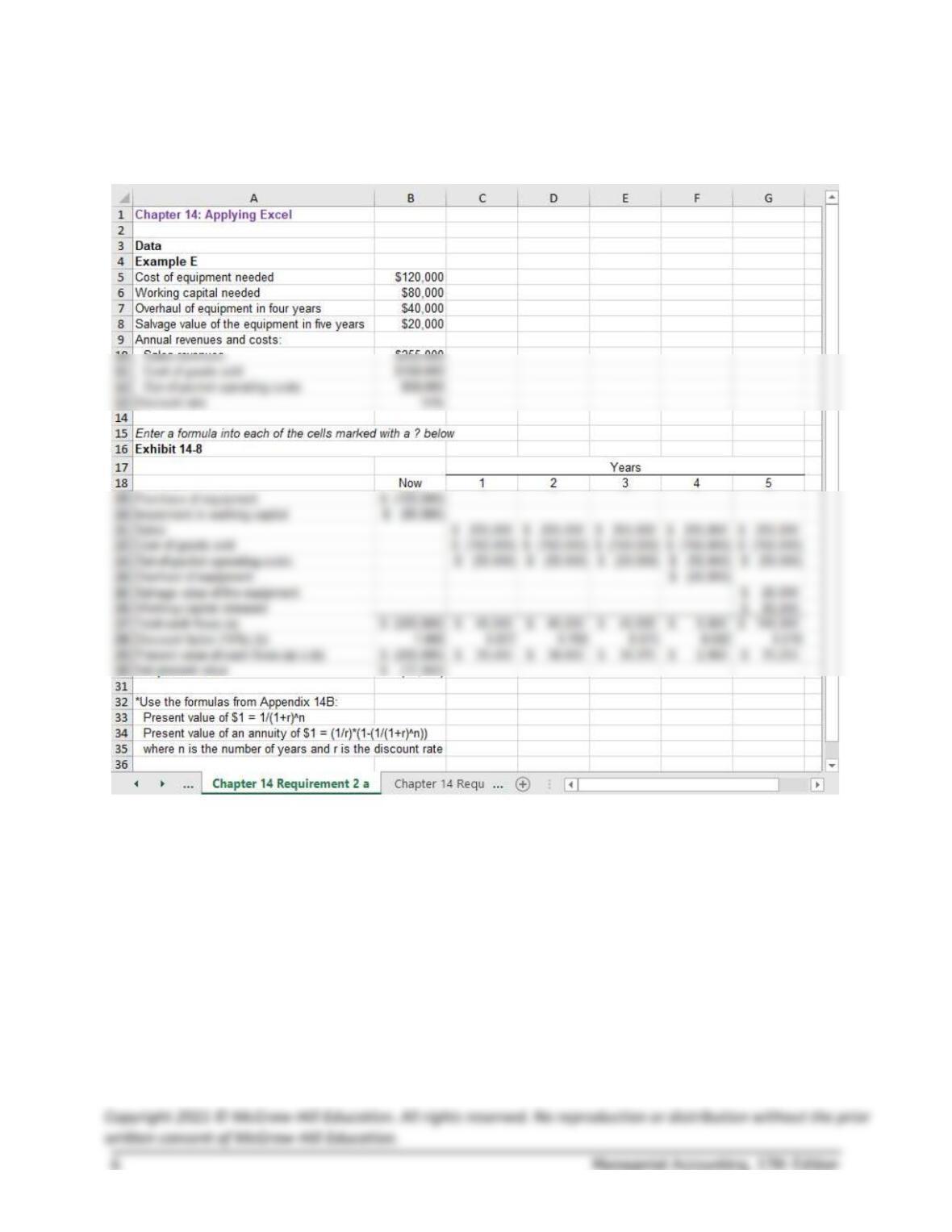
1. With the change in the discount rate, the result is:
The net present value increases because the positive cash inflows occur
in the future. When the discount rate decreases, the future cash flows
have a larger present value.
Chapter 14: Applying Excel (continued)
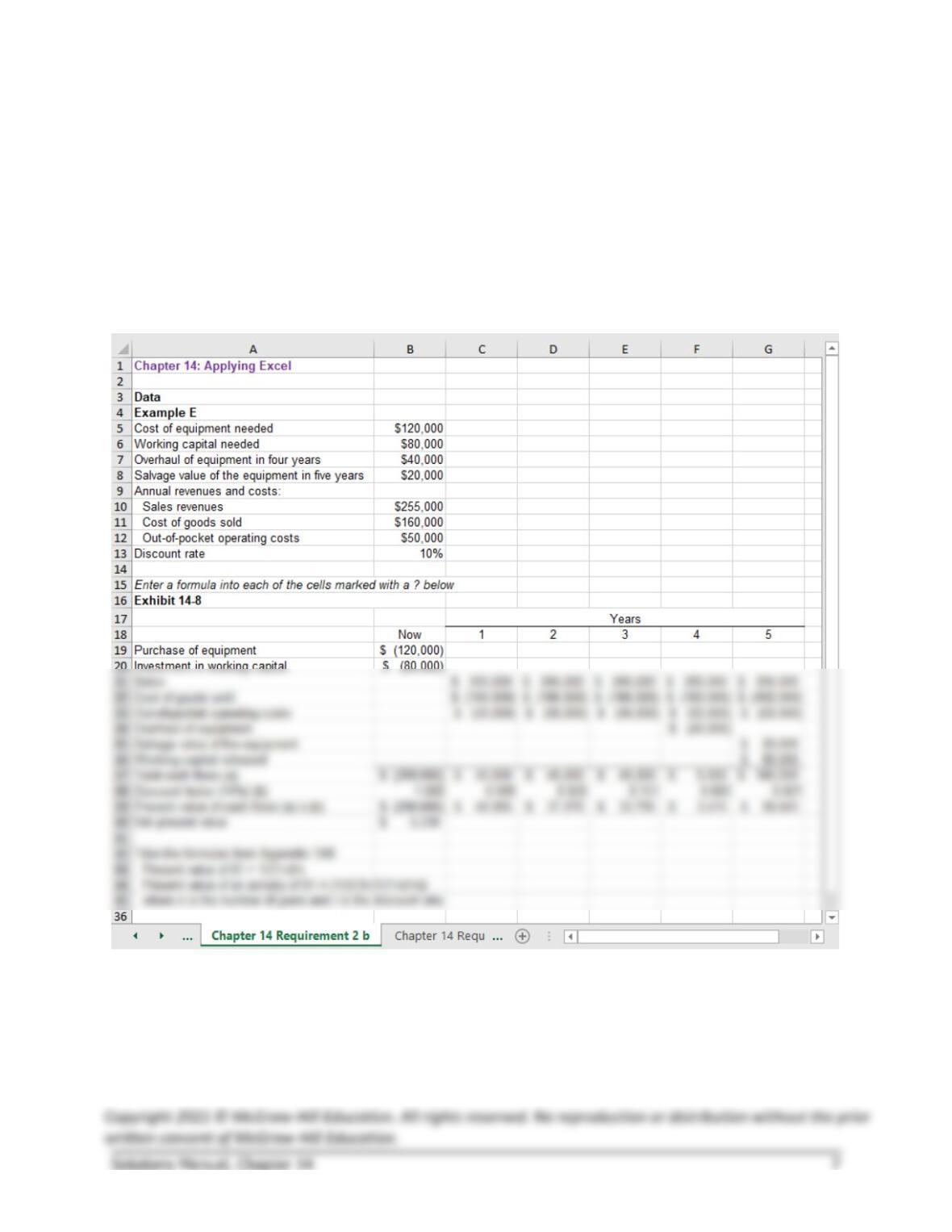
2. For the new project, the worksheet should look like this:
Chapter 14: Applying Excel (continued)
a. The net present value of the project is $(17,340). Again, your answer
may differ due to the precision of the calculations.
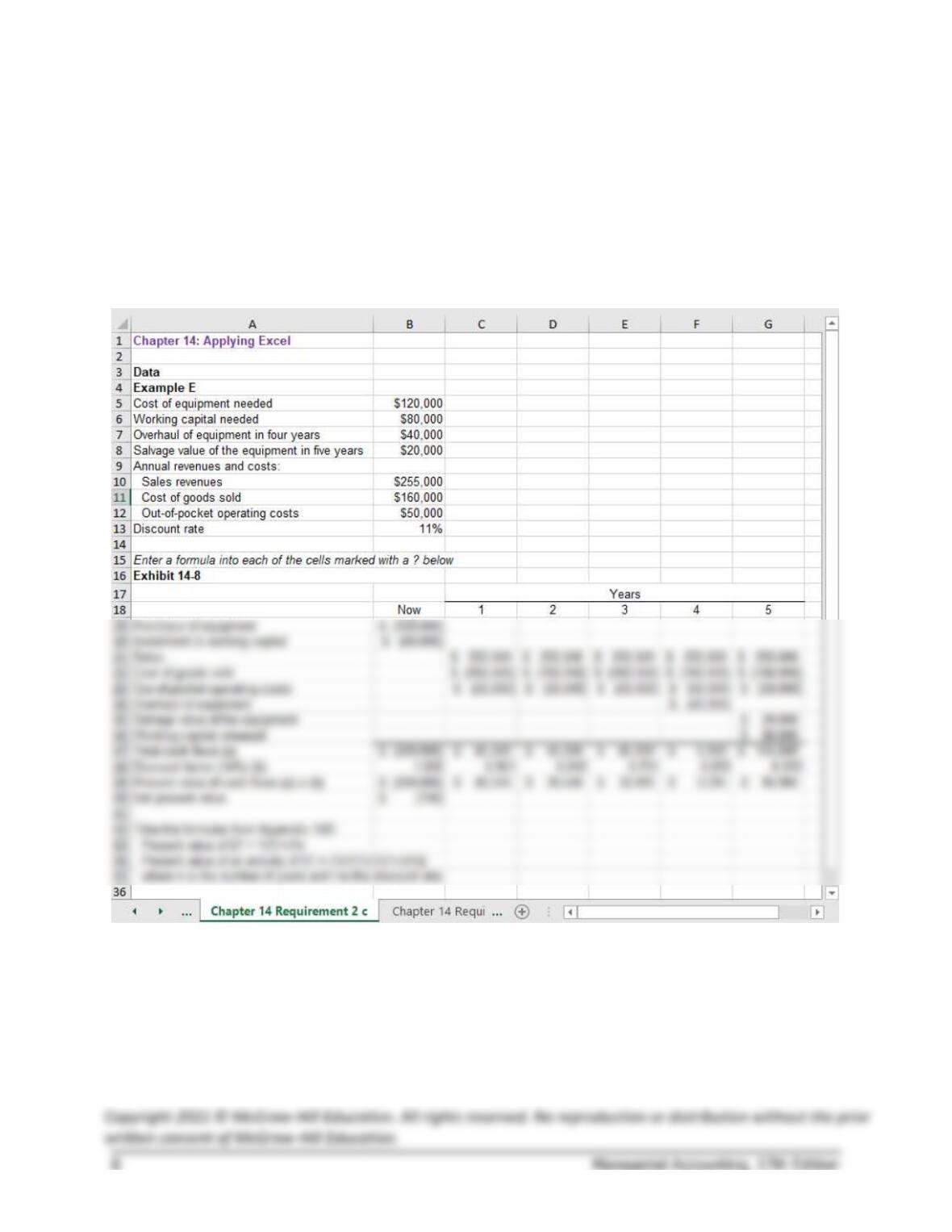
b. Increasing the discount rate results in making the negative net
present value even more negative. Decreasing the discount rate
improves the net present value. It turns positive when decreasing the
discount rate from 11% to 10% as shown below.
Chapter 14: Applying Excel (continued)
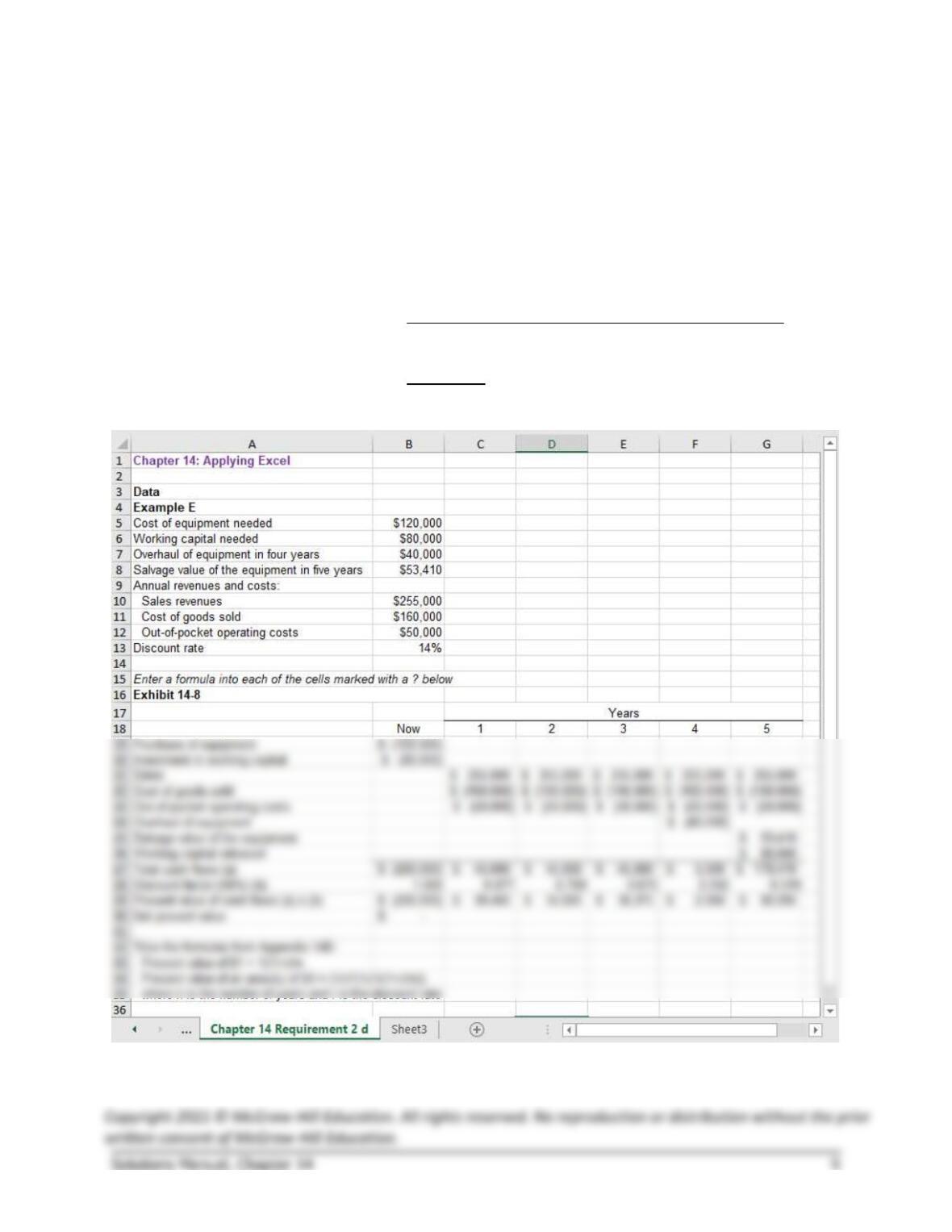
c. The internal rate of return is the discount rate at which the net
present value is zero. This occurs somewhere between the discount
rates 10% and 11%. The net present value at 10% is $5,330 as
shown above. The net present value at 11% is $(740) as shown
below. Therefore, the internal rate of return is between 10% and
11%.
Chapter 14: Applying Excel (continued)
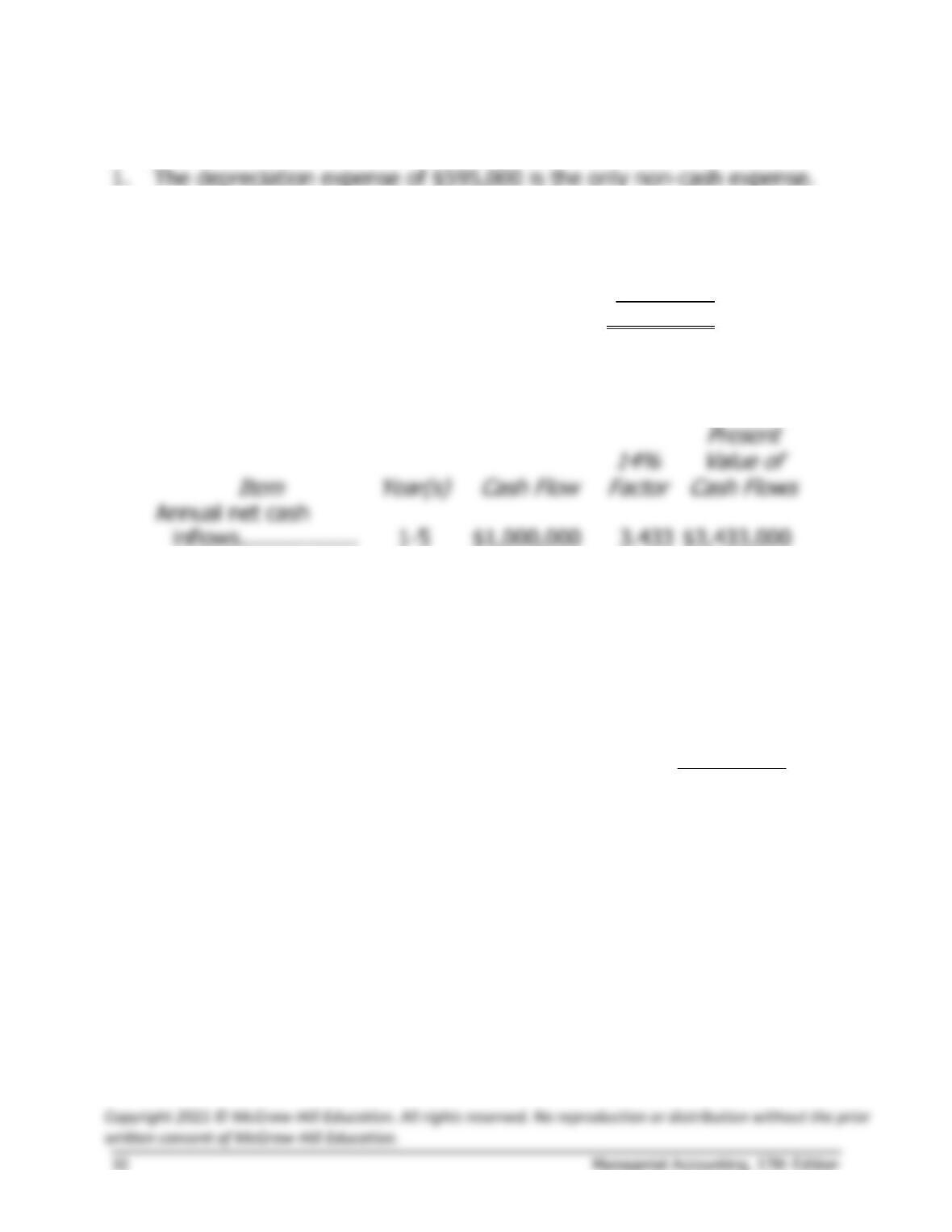
d. The amount of future uncertain salvage value that would be required
to make the net present value positive, which is $53,410 ($33,410 +
$20,000), can be found by experimenting with the salvage value in
the worksheet. It can also be computed using the formula from the
text as follows:
Negative net present value to be offset
Additional salvage =
value required Present value factor
$17,340
= = $33,410
0.519
The Foundational 15
2. The annual net cash inflows are computed as follows:
Net operating income …………………………..
$ 405,000
Add: Noncash deduction for depreciation ….
595,000
Annual net cash inflow………………………….
$1,000,000
3. The present value of the annual net cash inflows is computed as
follows:
$3,433,000
4. The project’s net present value is computed as follows:
Now
Years
1-5
Purchase of equipment ……….
$(2,975,000)
Sales ………………………………
$2,735,000
Variable expenses ………………
(1,000,000)
Out-of-pocket costs ……………
__________
(735,000)
Total cash flows (a) … ………..
$(2,975,000)
$1,000,000
Discount factor (b) …………….
1.000
3.433
Present value (a)×(b) …………
$(2,975,000)
$3,433,000
Net present value ………………
$458,000
The Foundational 15 (continued)
5. The profitability index for the project is:
Item
Present Value
of Cash
Inflows
(a)
Investment
Required
(b)
Profitability
Index
(a) ÷ (b)
Project
$3,433,000
$2,975,000
1.15*
* The answer of 1.1539 was rounded to 1.15.
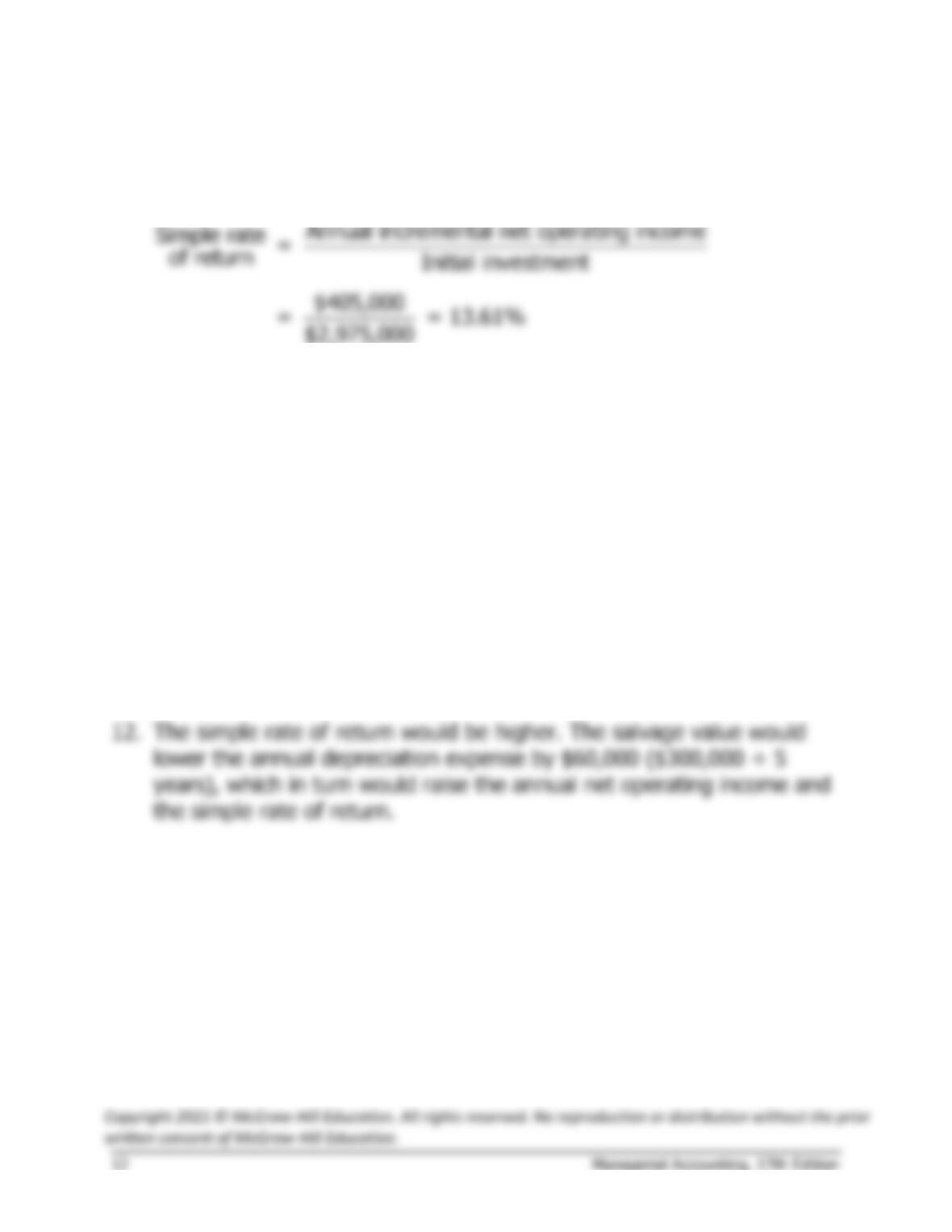
6. The project’s internal rate of return is:
7. The payback period is determined as follows:
Year
Investment
Cash
Inflow
Unrecovered
Investment
1
$2,975,000
$1,000,000
$1,975,000
2
$1,000,000
$975,000
3
$1,000,000
$0
4
$1,000,000
$0
The Foundational 15 (continued)
8. The simple rate of return is computed as follows:
9. If the discount rate was 16%, instead of 14%, the project’s net
present value would be lower because the discount factors would be
smaller.
10. The payback period would be the same because the initial investment
was recovered at the end of three years. The salvage value at the end
of five years is irrelevant to the payback calculation.
11. The net present value would be higher because a $300,000 salvage
value translates into a larger cash inflow in the fifth year. Although the
salvage value would need to be translated to its lesser present value, it
would still increase the project’s net present value.
The Foundational 15 (continued)
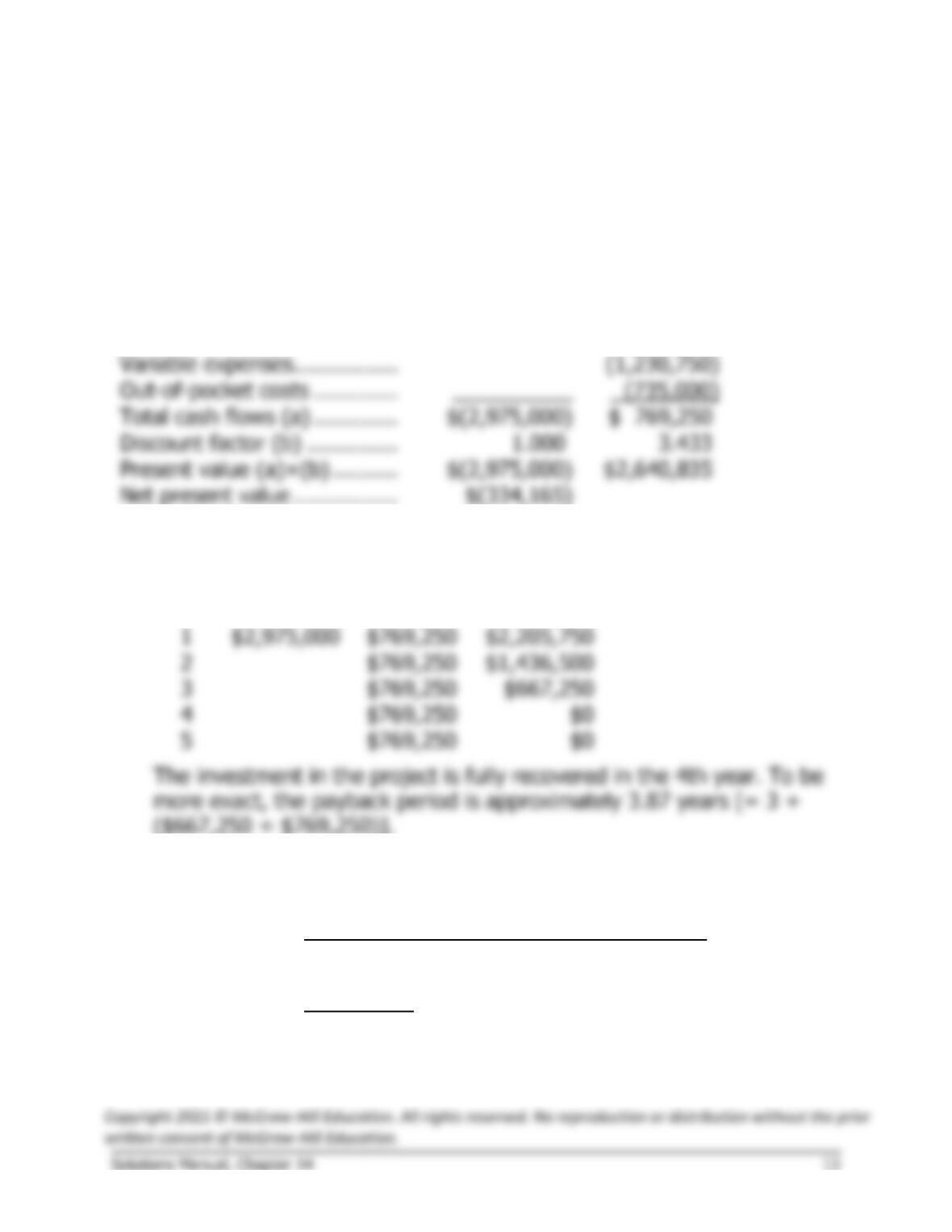
13. The new annual variable expense would be $1,230,750 ($2,735,000 ×
45%). The project’s actual net present value would be computed as
follows:
Now
Years
1-5
Purchase of equipment ……..
$(2,975,000)
Sales …………………………....
$2,735,000
Variable expenses …………….
Total cash flows (a) ………….
$(2,975,000)
Discount factor (b) …………..
Present value (a)×(b) ……….
$(2,975,000)
$2,640,835
Net present value …………….
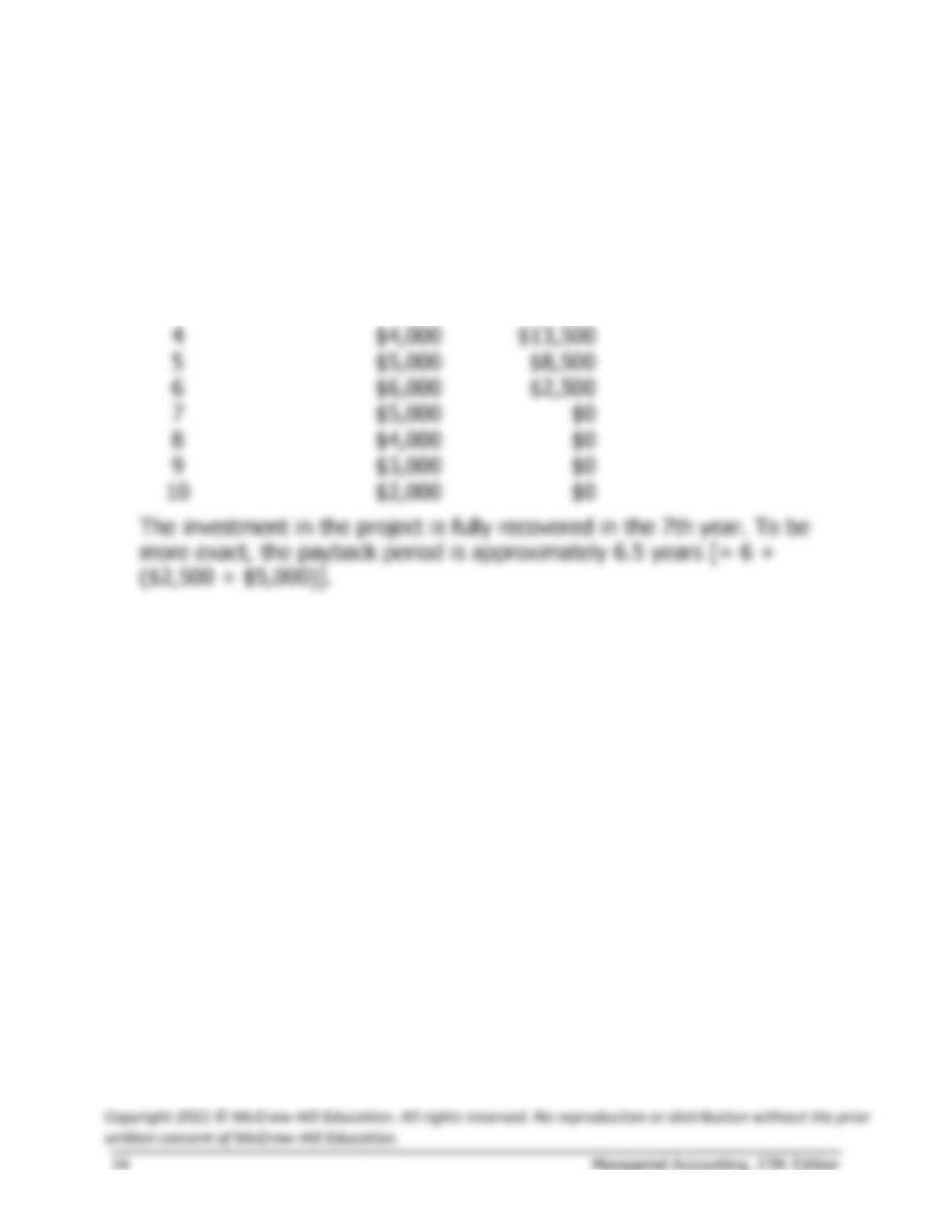
14. The payback period is computed as follows:
Year
Investment
Cash
Inflow
Unrecovered
Investment
15. The simple rate of return is computed as follows:
Annual incremental net operating income
Simple rate =
of return Initial investment
$174,250*
= = 5.86%
$2,975,000
* $2,735,000 – $1,230,750 – $735,000 – $595,000 = $174,250
Exercise 14-1 (10 minutes)
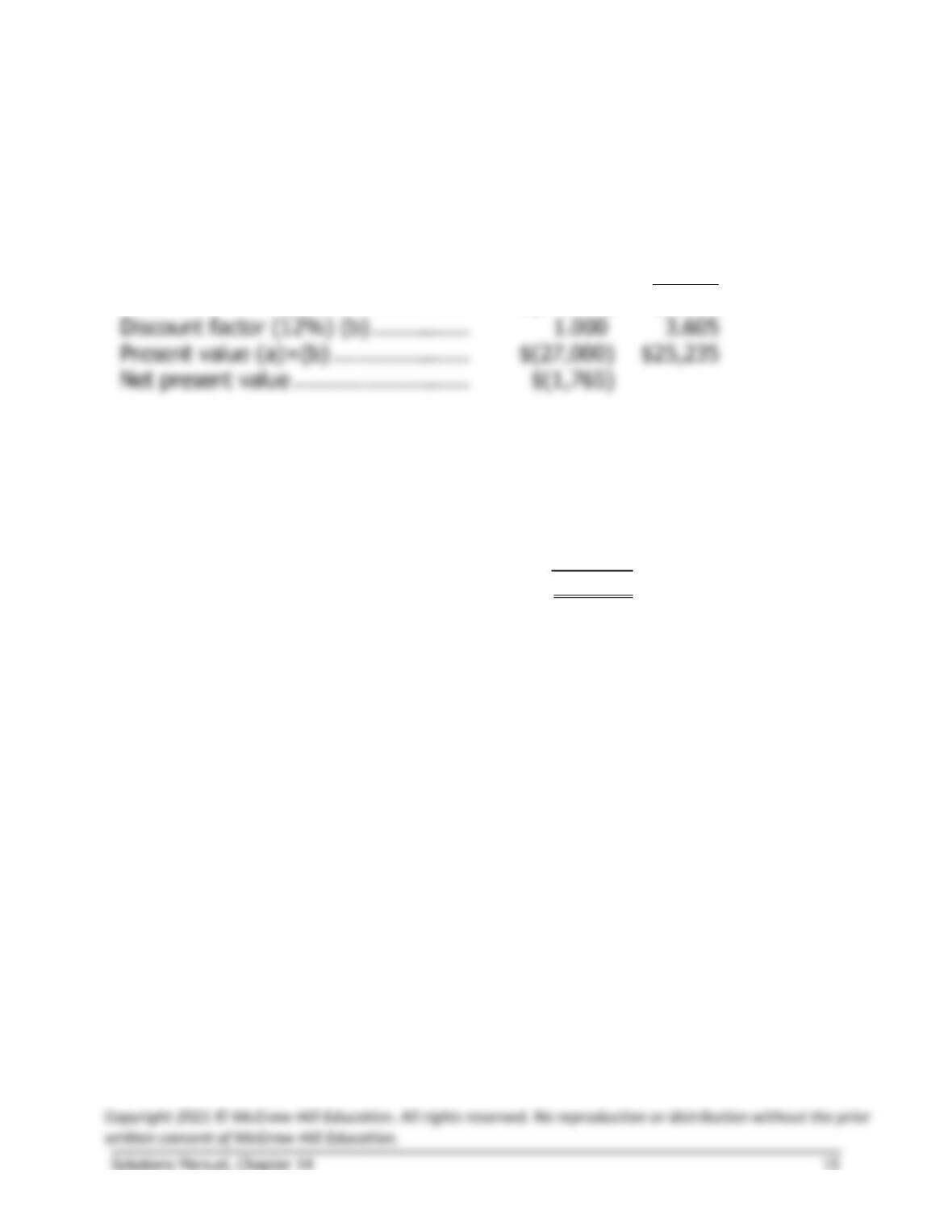
1. The payback period is determined as follows:
Year
Investment
Cash Inflow
Unrecovered
Investment
1
$15,000
$1,000
$14,000
2
$8,000
$2,000
$20,000
3
$2,500
$17,500
4
$4,000
$13,500
5
$5,000
6
$6,000
7
$5,000
8
$4,000
9
$3,000
$2,000
2. Because the investment is recovered prior to the last year, the amount
of the cash inflow in the last year has no effect on the payback period.
Exercise 14-2 (10 minutes)
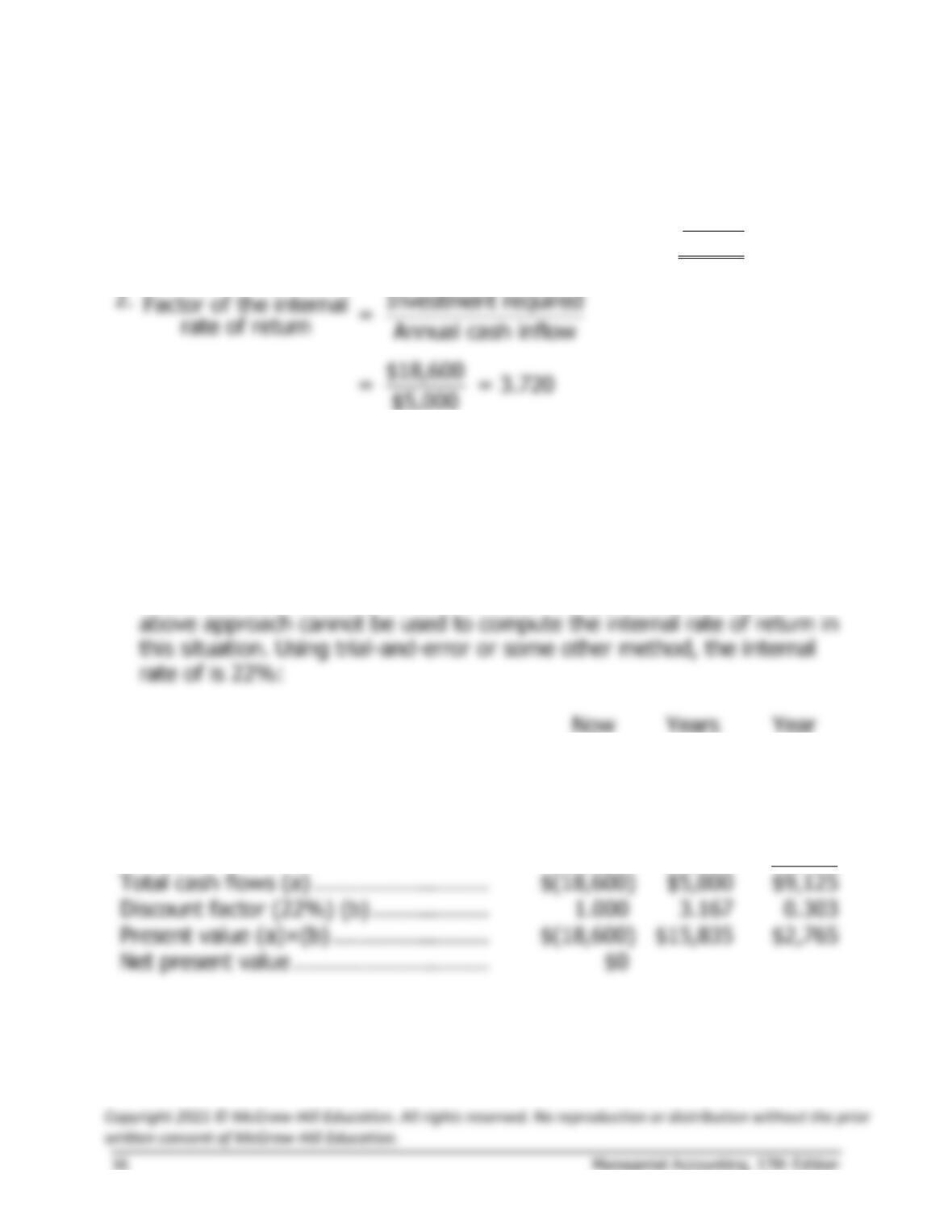
1.
Now
Years
1-5
Purchase of machine …………………..
$(27,000)
Reduced operating costs ……………..
________
$7,000
Total cash flows (a) ……………………
$(27,000)
$7,000
Discount factor (12%) (b) ……………
Present value (a)×(b) …………………
$(27,000)
2.
Item
Cash
Flow
Years
Total
Cash
Flows
Annual cost savings ..
$7,000
5
$ 35,000
Initial investment …..
$(27,000)
1
(27,000)
Net cash flow ………..
$ 8,000
Exercise 14-3 (20 minutes)
1.
Annual savings in part-time help ……………………….
$3,800
Added contribution margin from expanded sales
(1,000 dozen × $1.20 per dozen) ……………………
1,200
Annual cash inflows ………………………………………..
$5,000
3. Looking in Exhibit 14B-2, and scanning along the six-period line, we can
see that the factor computed above, 3.720, is closest to 3.685, the
factor for the 16% rate of return. Therefore, to the nearest whole
percent, the internal rate of return is 16%.
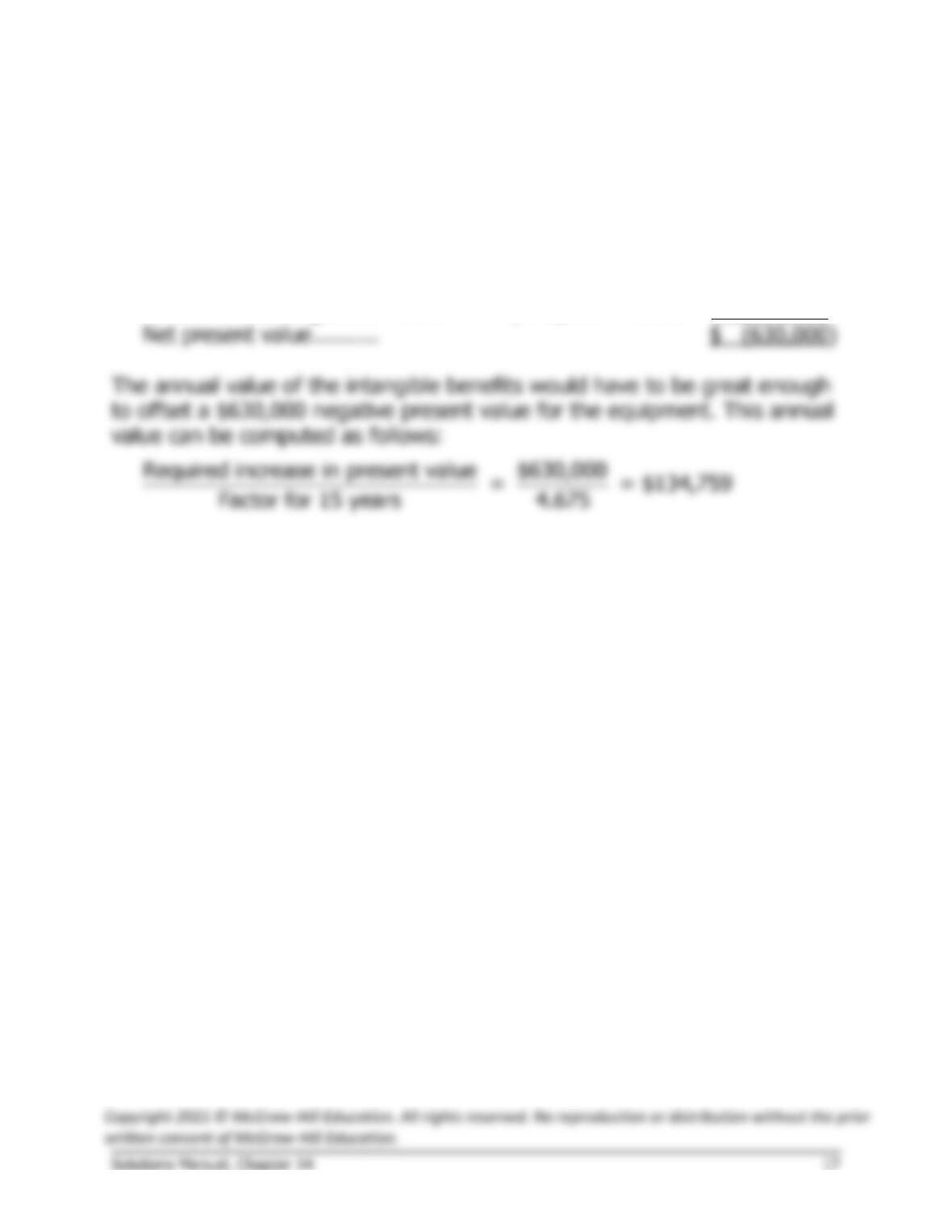
4. The cash flows will not be even over the six-year life of the machine
because of the extra $9,125 inflow in the sixth year. Therefore, the
1-6
6
Purchase of machine ……………………..
$(18,600)
Reduced part-time help ………………….
$3,800
Added contribution margin ……………..
1,200
Salvage value of machine ……………….
_______
______
$9,125
Total cash flows (a) ………………………
$(18,600)
$9,125
Discount factor (22%) (b) ………………
3.167
Present value (a)×(b) ……………………
$(18,600)
Net present value …………………………
Exercise 14-4 (15 minutes)
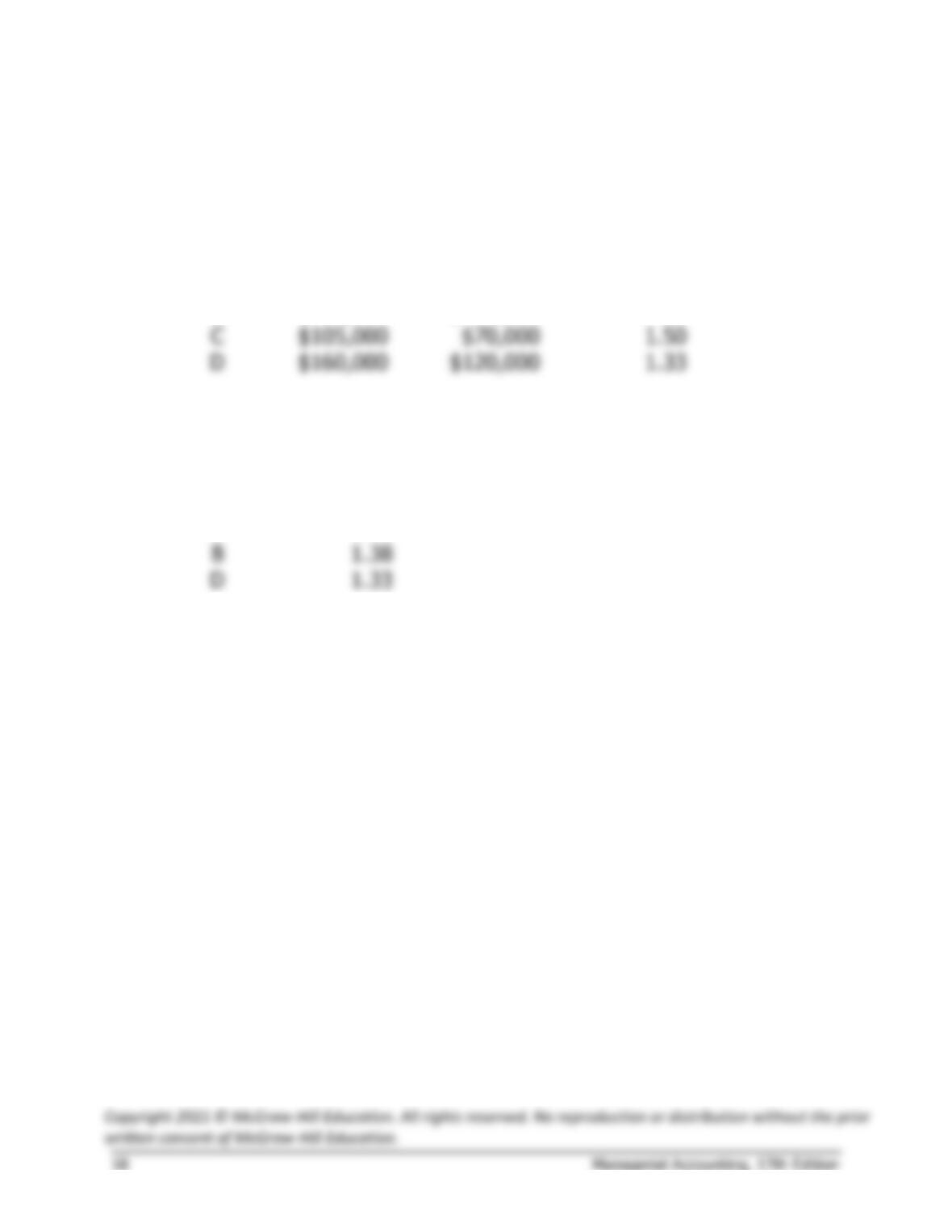
The equipment’s net present value without considering the intangible
benefits would be:
Item
Year(s)
Amount of
Cash Flows
20%
Factor
Present Value
of Cash Flows
Cost of the equipment …
Now
$(2,500,000)
1.000
$(2,500,000)
Annual cost savings …….
1-15
$400,000
4.675
1,870,000
Net present value ……….
Exercise 14-5 (10 minutes)
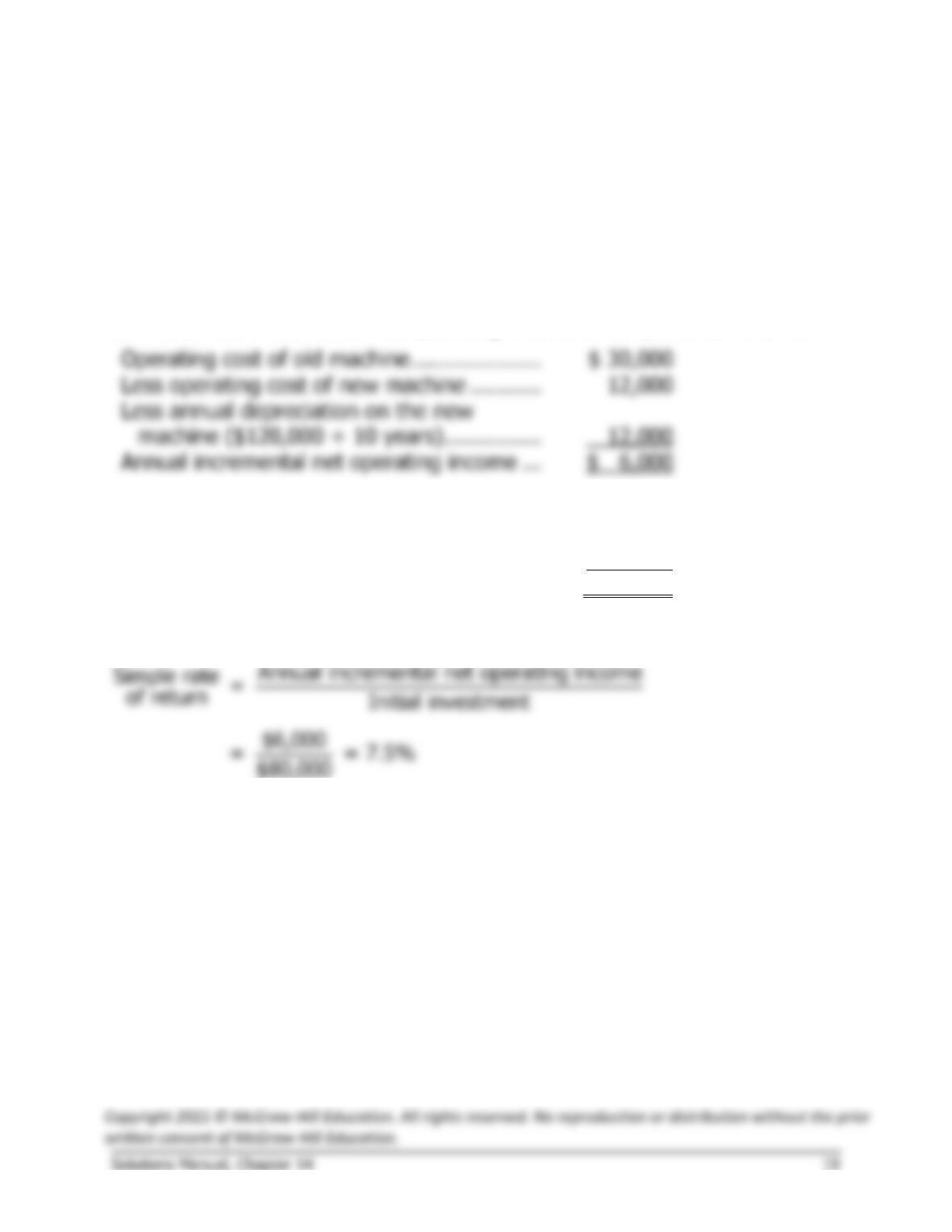
1. The profitability index for each proposal is:
Proposal
Number
Present Value
of Cash Inflows
(a)
Investment
Required
(b)
Profitability Index
(a) (b)
A
$126,000
$90,000
1.40
B
$138,000
$100,000
1.38
C
2. The ranking is:
Proposal
Number
Profitability Index
C
1.50
A
1.40
B
Note that proposal D has the highest net present value, but it ranks
lowest in terms of the profitability index.
Exercise 14-6 (10 minutes)
1. The annual depreciation expense is computed as follows:
Cost of the new machine (a) ………………….
$120,000
Useful life in years (b) ………………………….
10
Annual depreciation expense (a) ÷ (b) …….
$12,000
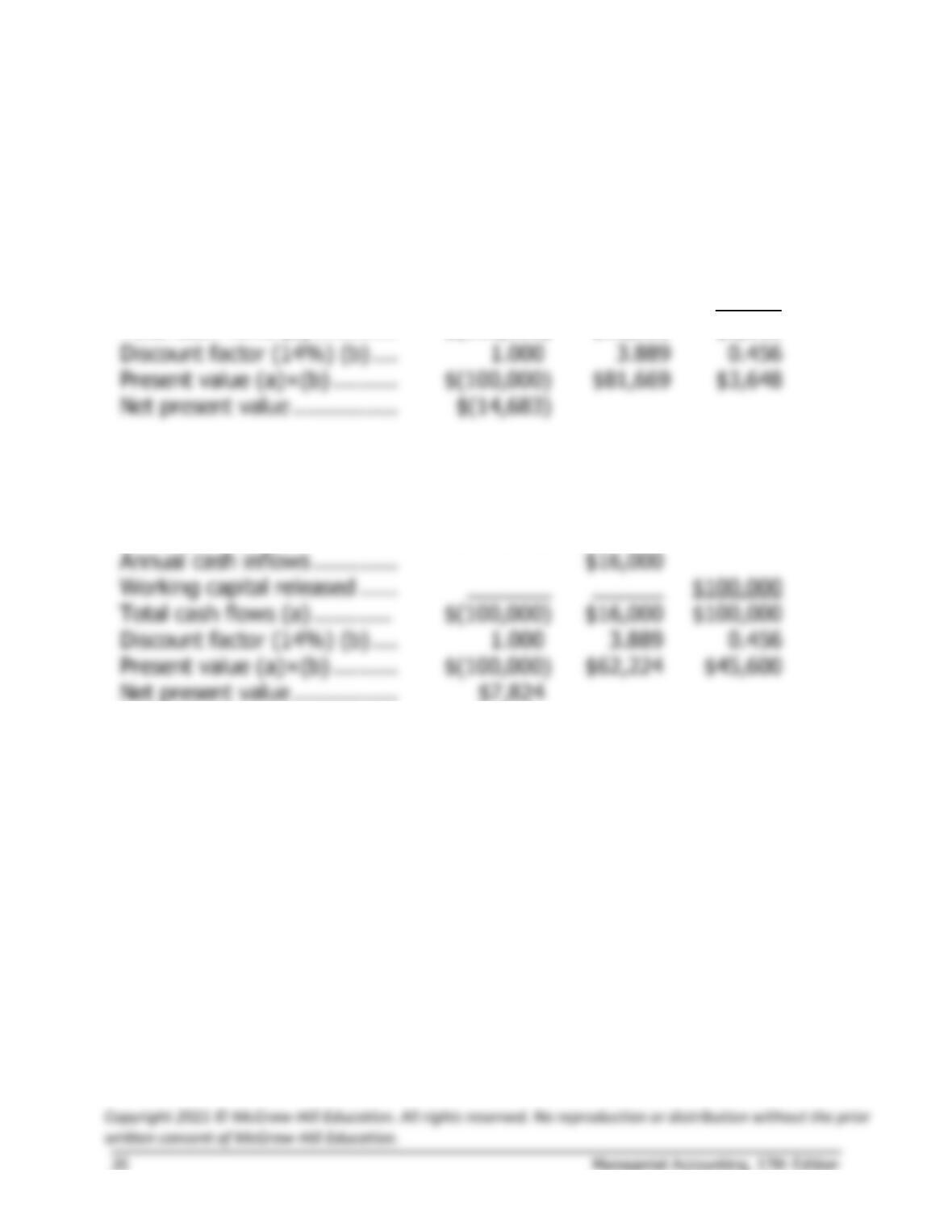
2. The annual incremental net operating income is computed as follows:
Operating cost of old machine ………………..
Less operating cost of new machine ………..
12,000
Annual incremental net operating income …
$ 6,000
3. The initial investment is computed as follows:
Cost of the new machine ………………………
$120,000
Less salvage value of old machine …………..
40,000
Initial investment ………………………………..
$ 80,000
4. The simple rate of return is computed as follows:
Exercise 14-7 (15 minutes)
1. Project A:
Now
Years
1-6
Year
6
Purchase of equipment ………….
$(100,000)
Annual cash inflows ………………
$21,000
Salvage value ………………………
_______
______
$8,000
Total cash flows (a) ………………
$(100,000)
$21,000
$8,000
Discount factor (14%) (b) ………
Net present value …………………
2. Project B:
Now
Years
1-6
Year
6
Working capital invested ……
$(100,000)
Annual cash inflows ………….
Working capital released ……
______
Total cash flows (a) …………
$(100,000)
Present value (a)×(b) ……….
$(100,000)
$45,600
Net present value …………….
3. The $100,000 should be invested in Project B rather than in Project A.
Project B has a positive net present value whereas Project A has a
negative net present value.