
E14-17 Compute earnings per share under different assumptions
At December 31, 2017, Millwood Corporation has 2,000 shares of $100 par value, 8% preferred stock
outstanding and 100,000 shares of $10 par value common stock issued. Millwood’s net income for the
year is $241,000.
Instructions
Compute the earnings per share of common stock under the following independent situations
(Round to two decimals).
(a) The dividend to preferred stockholders was declared. There has been no change in the
number of shares of common stock outstanding during the year.
(b) The dividend to preferred stockholders was not declared. The preferred stock is
cumulative. Millwood held 10,000 shares of common treasury stock throughout the year.
NOTE: Enter a number in cells requesting a value; enter either a number or a formula in cells with a “?” .
(a) Preferred shares outstanding Value
Par Value Value
Preferred dividend rate Value
Total preferred dividends ?
Net income Value
Less: total preferred dividends Value
Income available to common stockholders ?
Number of common shares outstanding Value
Earnings per share ?
(b) Preferred shares outstanding Value
Par Value Value
Preferred dividend rate Value
Total preferred dividends ?
Net income Value
Less: total preferred dividends Value
Income available to common stockholders ?
Number of common shares outstanding Value
Earnings per share ?
After you have completed the requirements of E14–7, consider the additional question.
Answers are on the other tab in this file.
1 Suppose dividend rate on preferred shares changed to 9%, number of treasury shares changed to 12,000,
and net income changed to $250,000. Recalculate earnings per share.
E14-17 Solution
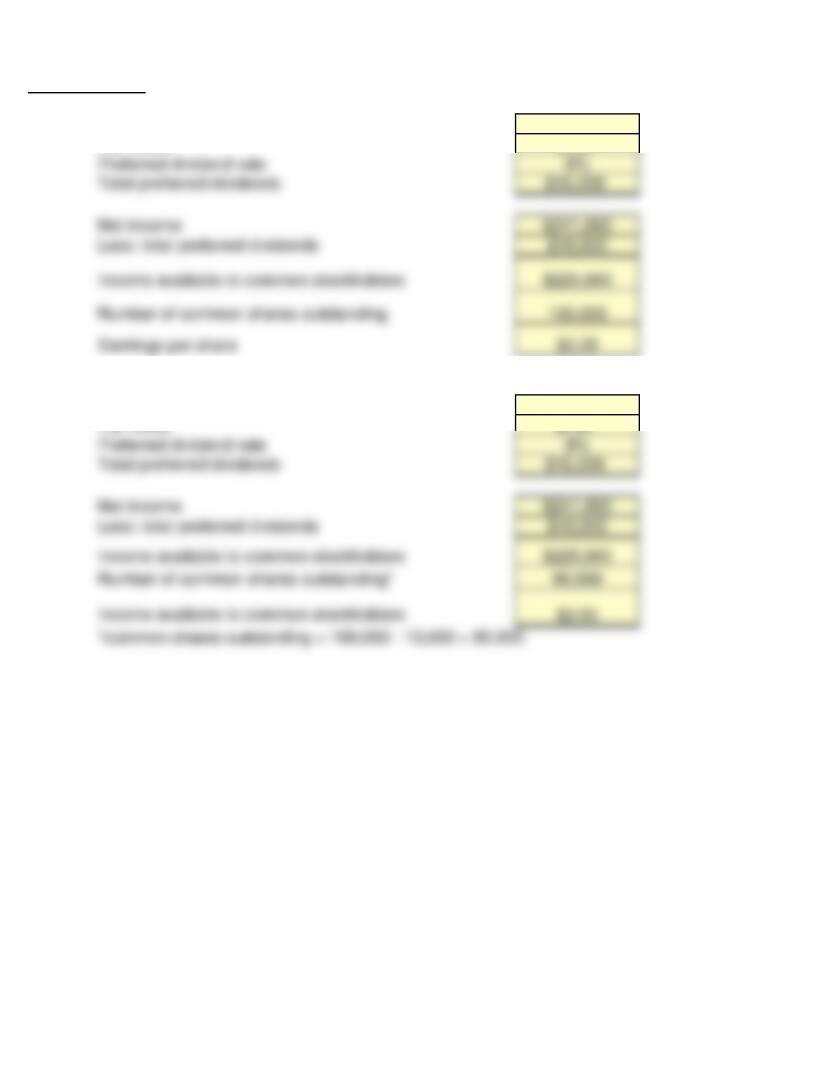
(a) Preferred shares outstanding 2,000
Par Value $100
Preferred dividend rate 8%
Total preferred dividends $16,000
Net income $241,000
Less: total preferred dividends $16,000
(b) Preferred shares outstanding 2,000
Par Value $100
Preferred dividend rate 8%
Total preferred dividends $16,000
E14-17 Solution to additional question
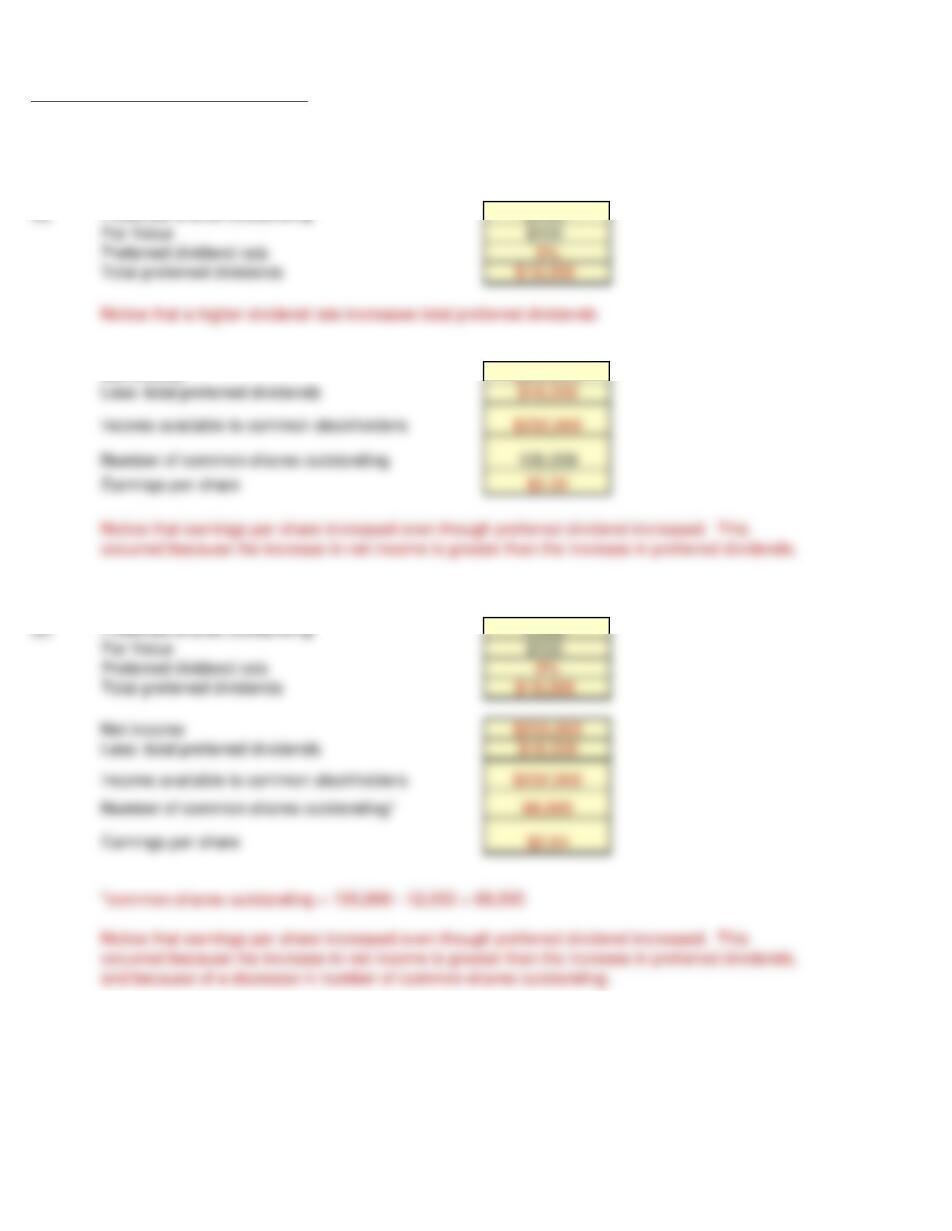
1 Suppose dividend rate on preferred shares changed to 9%, number of treasury shares changed to 12,000,
and Net income changed to $250,000. Recalculate earnings per share.
(a) Preferred shares outstanding 2,000
Par Value $100
Net income $250,000
Less: total preferred dividends $18,000
Income available to common stockholders $232,000
Number of common shares outstanding 100,000
Earnings per share $2.32
Income available to common stockholders $232,000
Number of common shares outstanding* 88,000
Income available to common stockholders
(b) Preferred shares outstanding 2,000
Par Value $100
Preferred dividend rate 9%