Chapter 14 – Decision Making: Relevant Costs and Benefits
14–21
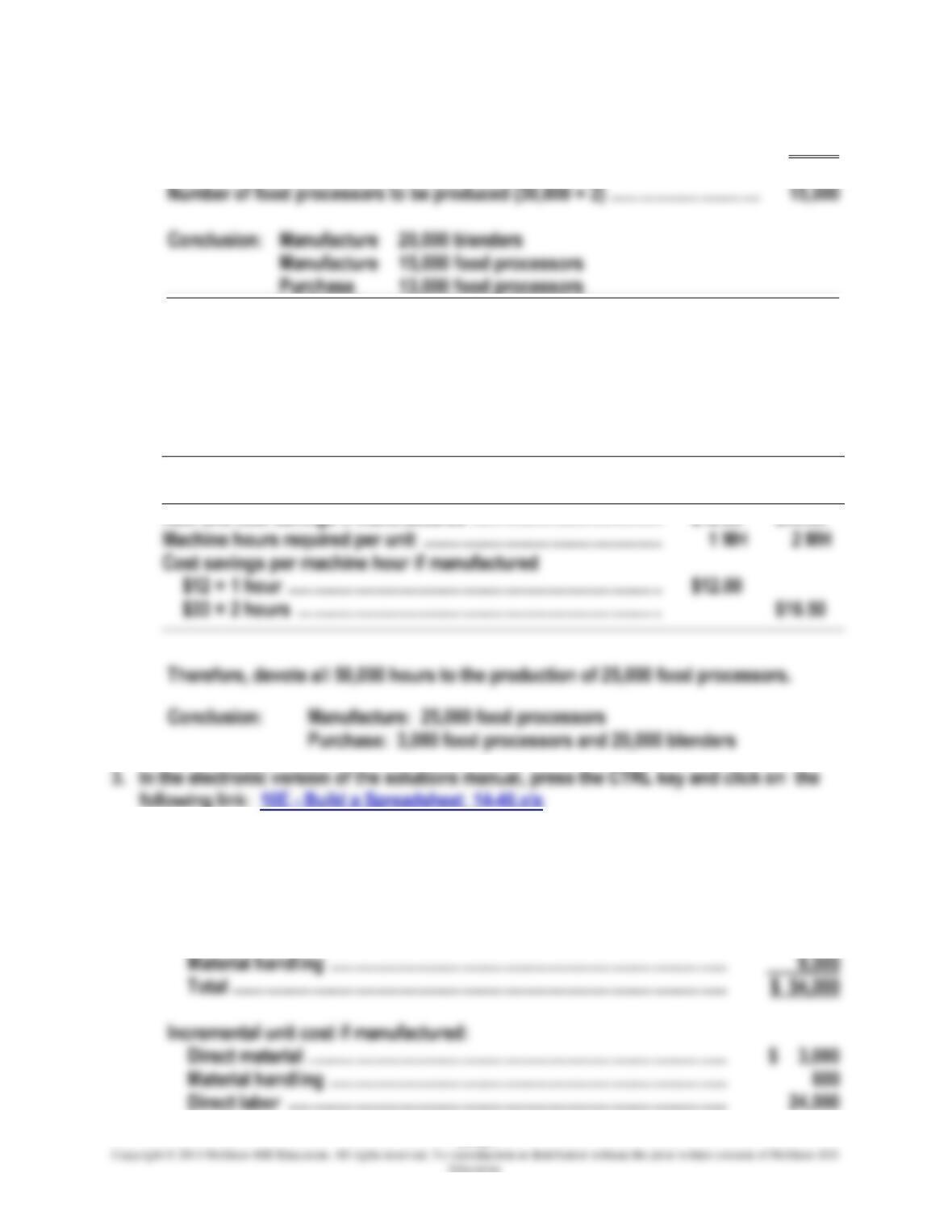
Remaining machine hours ………………………………………………………………………
30,000
Number of food processors to be produced (30,000 ÷ 2) …………………………..
15,000
PROBLEM 14-46 (CONTINUED)
2. If the company’s management team is able to reduce the direct material cost per
food processor to $18 ($15 less than previously assumed), then the cost savings
from manufacturing a food processor are $33 per unit ($18 savings computed in
requirement (1) plus $15 reduction in material cost):
Blender
Food
Processor
New unit cost savings if manufactured …………………………………..
$12.00
$33.00
Machine hours required per unit ……………………………………………
Cost savings per machine hour if manufactured
$12.00
PROBLEM 14-47 (25 MINUTES)
1.
Incremental unit cost if purchased:
Purchase price ……………………………………………………………………………..
$ 45,000
Material handling ………………………………………………………………………….
Total …………………………………………………………………………………………….
$ 54,000
Incremental unit cost if manufactured:
Direct material ………………………………………………………………………………
Direct labor ………………………………………………………………………………….
Chapter 14 – Decision Making: Relevant Costs and Benefits
14–22
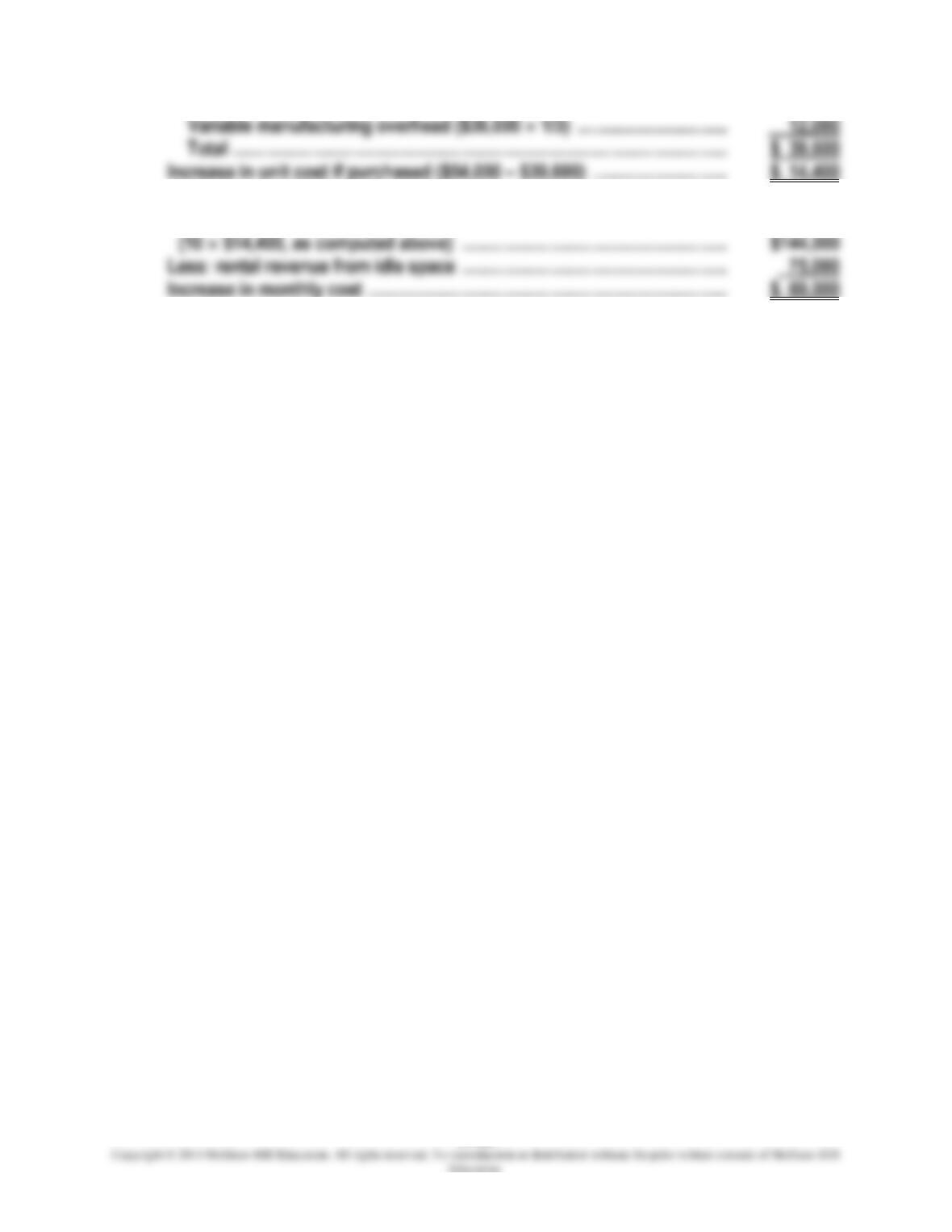
Increase in unit cost if purchased ($54,000 – $39,600) ………………………..
2.
Less: rental revenue from idle space …………………………………………………
Increase in monthly cost …………………………………………………………………..
Increase in monthly cost of acquiring part RM67 if purchased
Chapter 14 – Decision Making: Relevant Costs and Benefits
14–23
PROBLEM 14-47 (CONTINUED)
3.
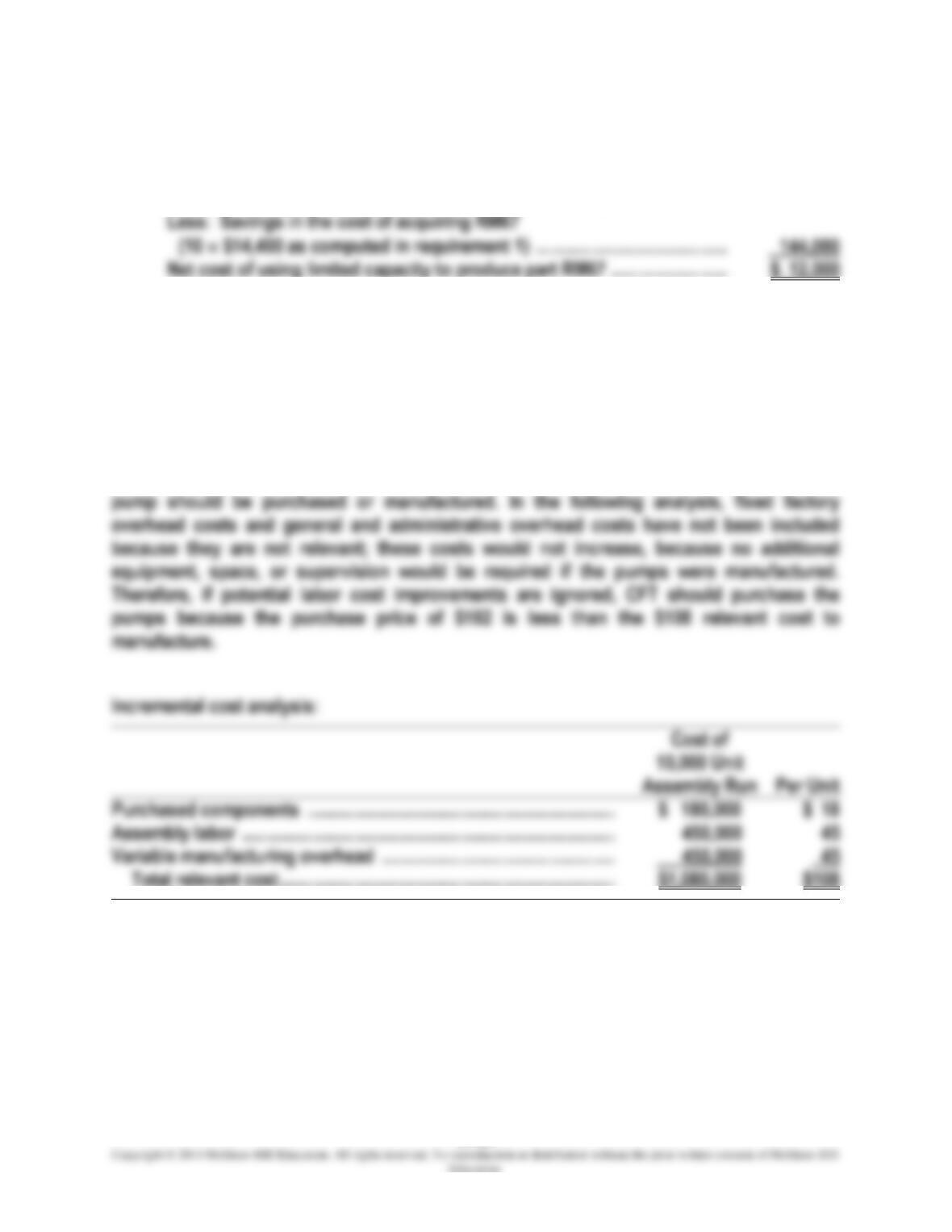
Contribution forgone by not manufacturing alternative product ………….
$156,000
Net cost of using limited capacity to produce part RM67 …………………….
$ 12,000
PROBLEM 14-48 (20 MINUTES)
The analysis prepared by the engineering, manufacturing, and accounting departments of
Cincinnati Flow Technology (CFT) was not correct. However, their recommendation was
correct, provided that potential labor-cost improvements are ignored. An incremental cost
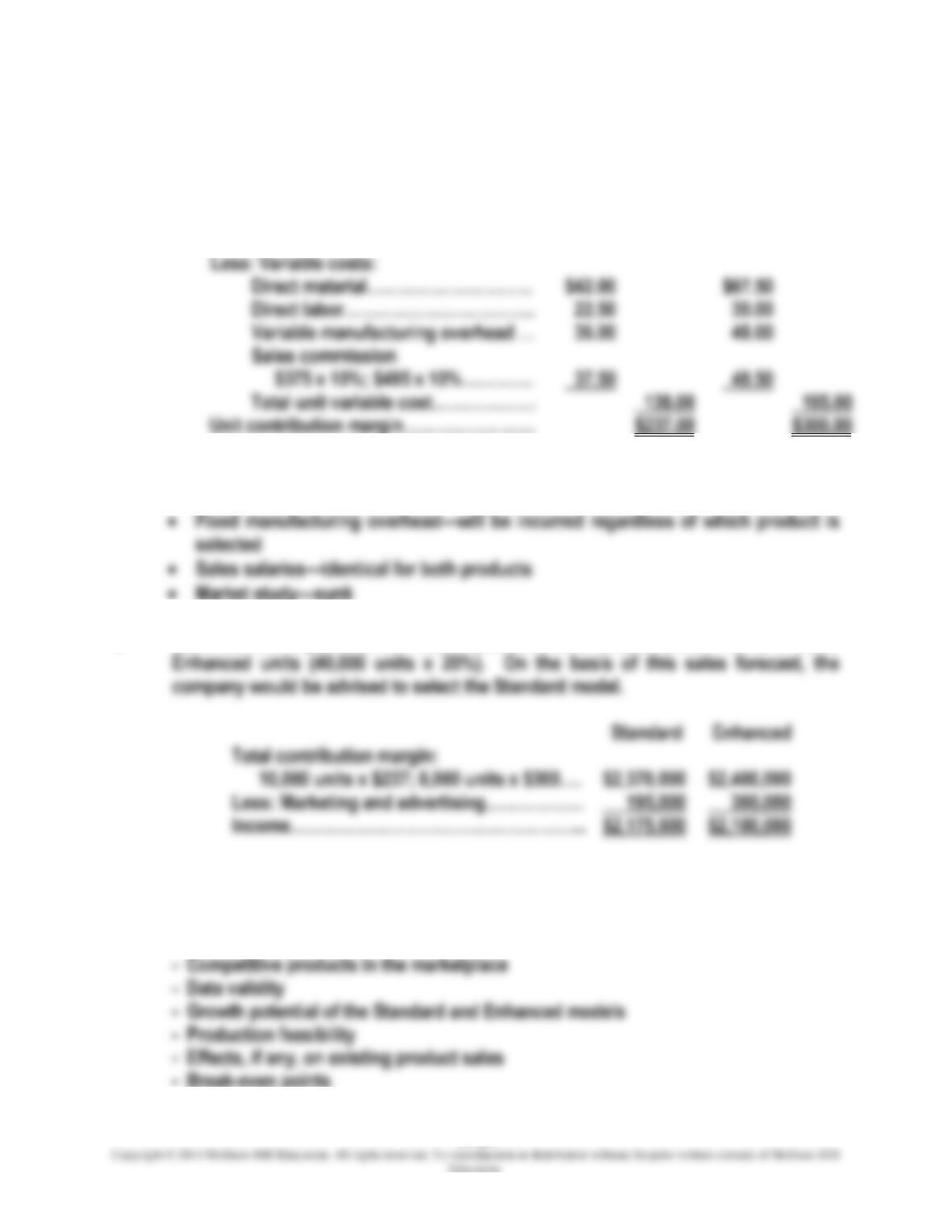
analysis similar to the following table should have been prepared to determine whether the
Purchased components …………………………………………………………
Assembly labor ……………………………………………………………………..
Variable manufacturing overhead …………………………………………..
Chapter 14 – Decision Making: Relevant Costs and Benefits
14–24
PROBLEM 14-49 (25 MINUTES)
1. Per-unit contribution margins:
Standard
Enhanced
Selling price…………………………………..
$375.00
$495.00
Less: Variable costs:
$237.00
$300.00
2. The following costs are not relevant to the decision:
• Development costs—sunk
3. Martinez, Inc. expects to sell 10,000 Standard units (40,000 units x 25%) or 8,000
Total contribution margin:
$2,370,000
$2,400,000
Less: Marketing and advertising………………
195,000
300,000
$2,175,000
$2,100,000
4. The quantitative difference between the profitability of Standard and Enhanced is
relatively small, which may prompt the firm to look at other factors before a final
decision is made. These factors include:
Chapter 14 – Decision Making: Relevant Costs and Benefits
14–25
PROBLEM 14-50 (20 MINUTES)
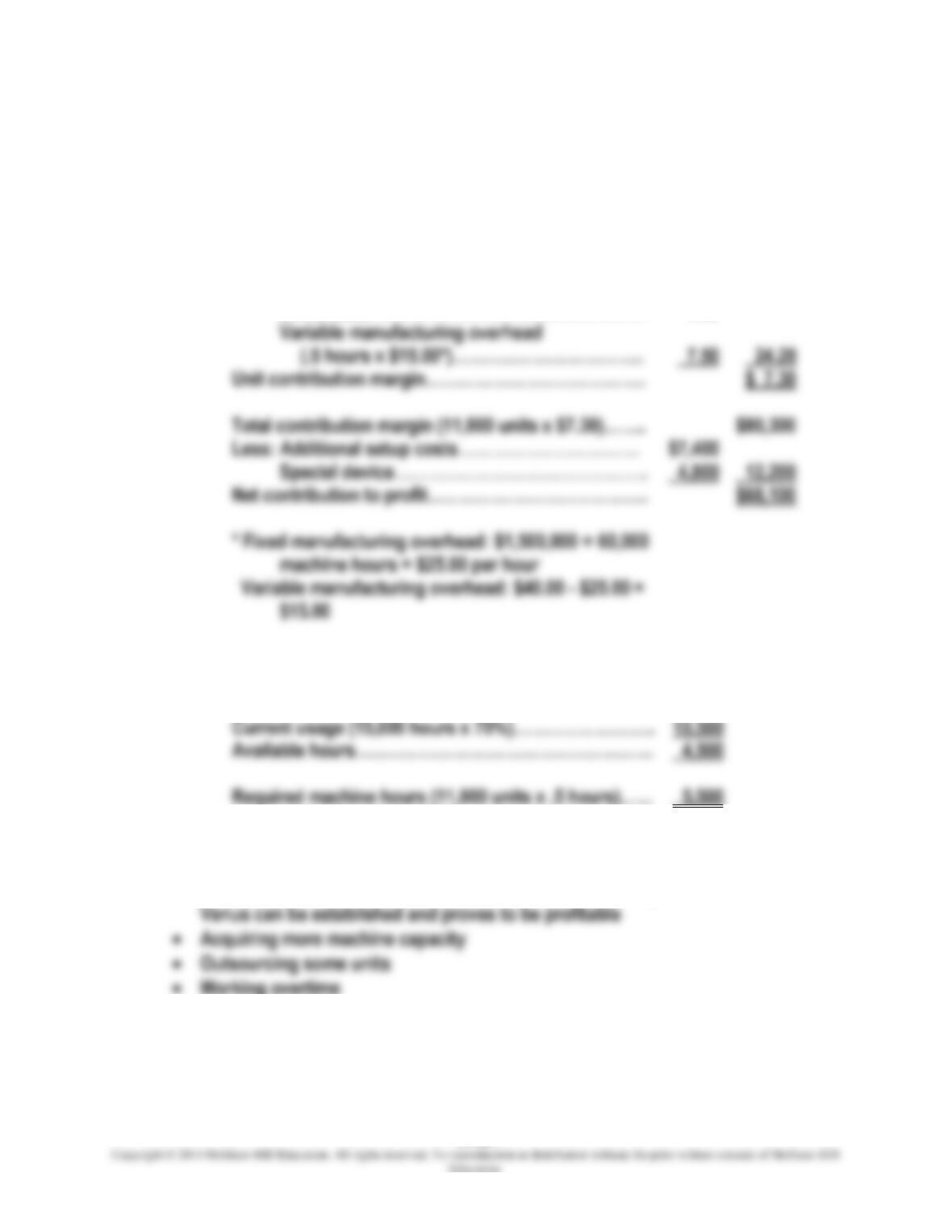
1. When there is no limit on production capacity the Pro model should be manufactured
since it has the highest contribution margin per unit.
Selling price ……………………………………………………………….
Direct material ……………………………………………………….……
Direct labor …………………………………………………………………
Variable overhead ……………………………………………………….
Total variable cost ………………………………………………………
Basic
Deluxe
Pro
2. When labor is in short supply the Basic model should be manufactured, since it has
the highest contribution margin per direct-labor hour.
Basic
Model
Deluxe
Model
Pro
Model
Contribution margin per unit ……………………………………….
Direct-labor hours required ………………………………………….
Chapter 14 – Decision Making: Relevant Costs and Benefits
14–26
PROBLEM 14-51 (25 MINUTES)
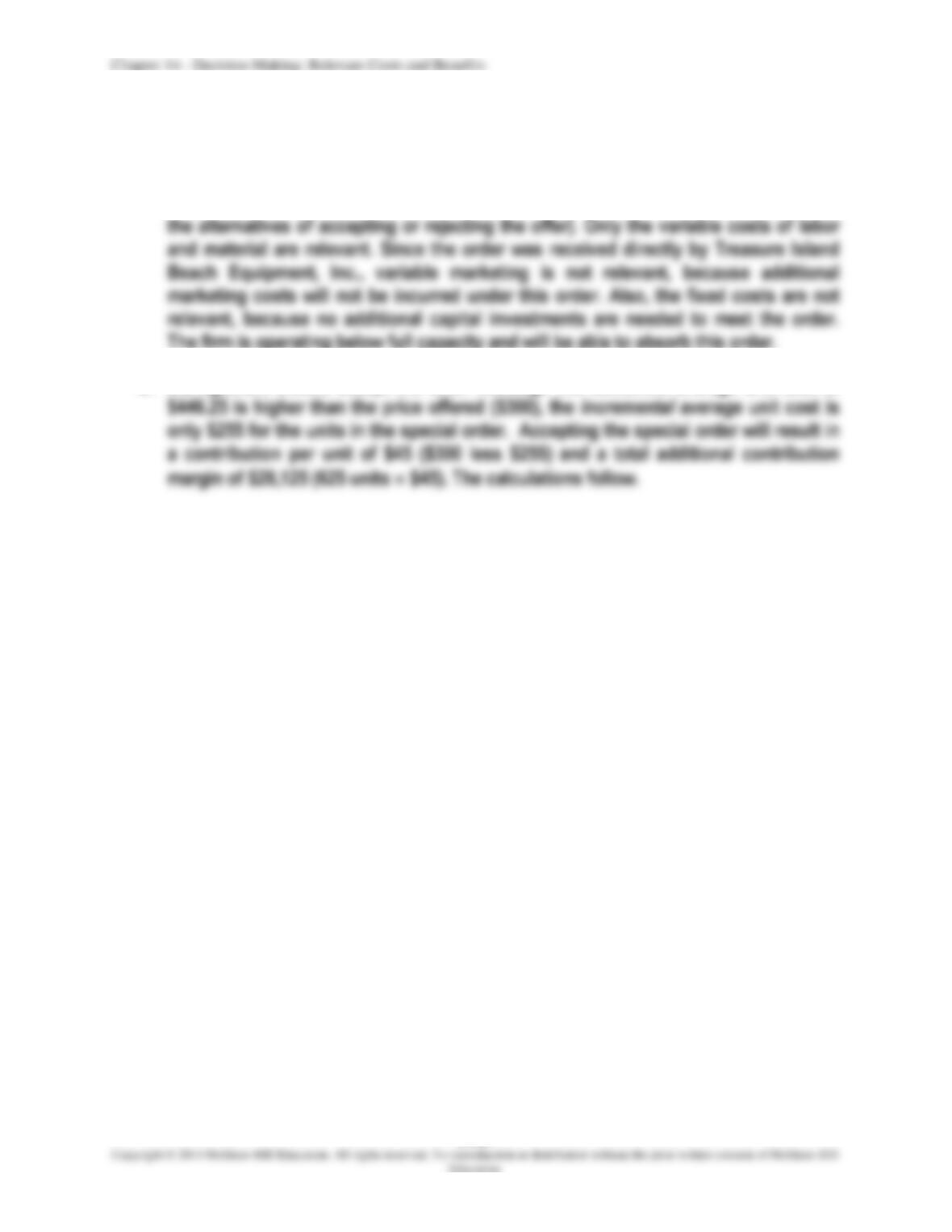
1. Yes, the order should be accepted because it generates a profit of $68,100 for the
firm. Note: The fixed administrative cost is irrelevant to the decision, because this
cost will be incurred regardless of whether Mercury accepts or rejects the order.
Selling price…………………………………………………
$31.50
Less: Direct material ($16.40 – $4.20)……………………
$12.20
Direct labor…………………………………………..
4.50
Unit contribution margin………………………………….
$ 7.30
Total contribution margin (11,000 units x $7.30)……..
$80,300
Less: Additional setup costs……………………………
$7,400
Special device……………………………………….
Net contribution to profit………………………………….
$68,100
2. No, Mercury lacks adequate machine capacity to manufacture the entire order.
Planned machine hours (5,000 hours x 3 months)……
15,000
Current usage (15,000 hours x 70%)……………………..
10,500
Available hours………………………………………………
Required machine hours (11,000 units x .5 hours)……
3. Options include the following:
• Sacrificing some current business in the hope that a long-term relationship with
14–27
PROBLEM 14-52 (40 MINUTES)
1. The costs that will be relevant in Peters’ analysis of the special order being
considered by Treasure Island Beach Equipment, Inc. are those expected future
costs that are applicable to a particular decision (the costs that will differ between
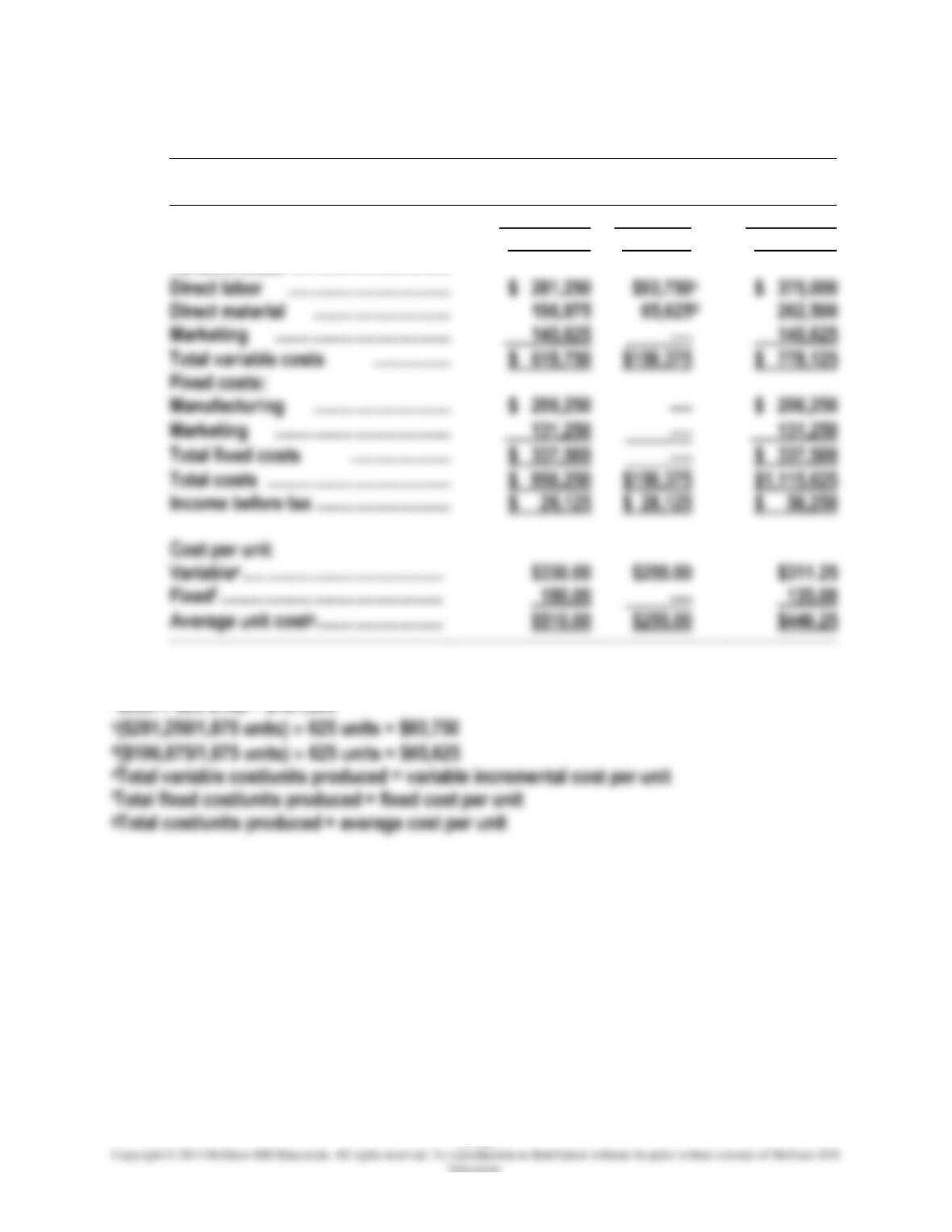
2. Management should accept the offer. Although the combined average unit cost of
Chapter 14 – Decision Making: Relevant Costs and Benefits
14–28
PROBLEM 14-52 (CONTINUED)
Current Monthly
Production
Special
Order
Combined
Production
Units produced ……………………………………………………….
1,875
625
2,500
Sales ……………………………………………………….
$ 984,375
a
$187,500
b
$1,171,875
Variable costs: ……………………………………………………….
Direct labor ……………………………………………………….
$ 281,250
Direct material …………………………..
Total variable costs …………………………..
$ 618,750
$159,375
$ 778,125
Fixed costs:
Total costs ……………………………………………………….
$ 956,250
$159,375
$1,115,625
Income before tax …………………………..
$ 28,125
$ 28,125
$ 56,250
Cost per unit
a$525 1,875 units = $984,375
b$300 625 units = $187,500
14–29
PROBLEM 14-52 (CONTINUED)
3. Other considerations that Samantha Peters should include in her analysis of the
special order include the following:
4. Samantha Peters could try to resolve the ethical conflict arising out of the
controller’s insistence that the company avoid competitive bidding by taking the
following steps:
• She should follow the company’s established policies on such matters.
Chapter 14 – Decision Making: Relevant Costs and Benefits
14–30
PROBLEM 14-53 (40 MINUTES)
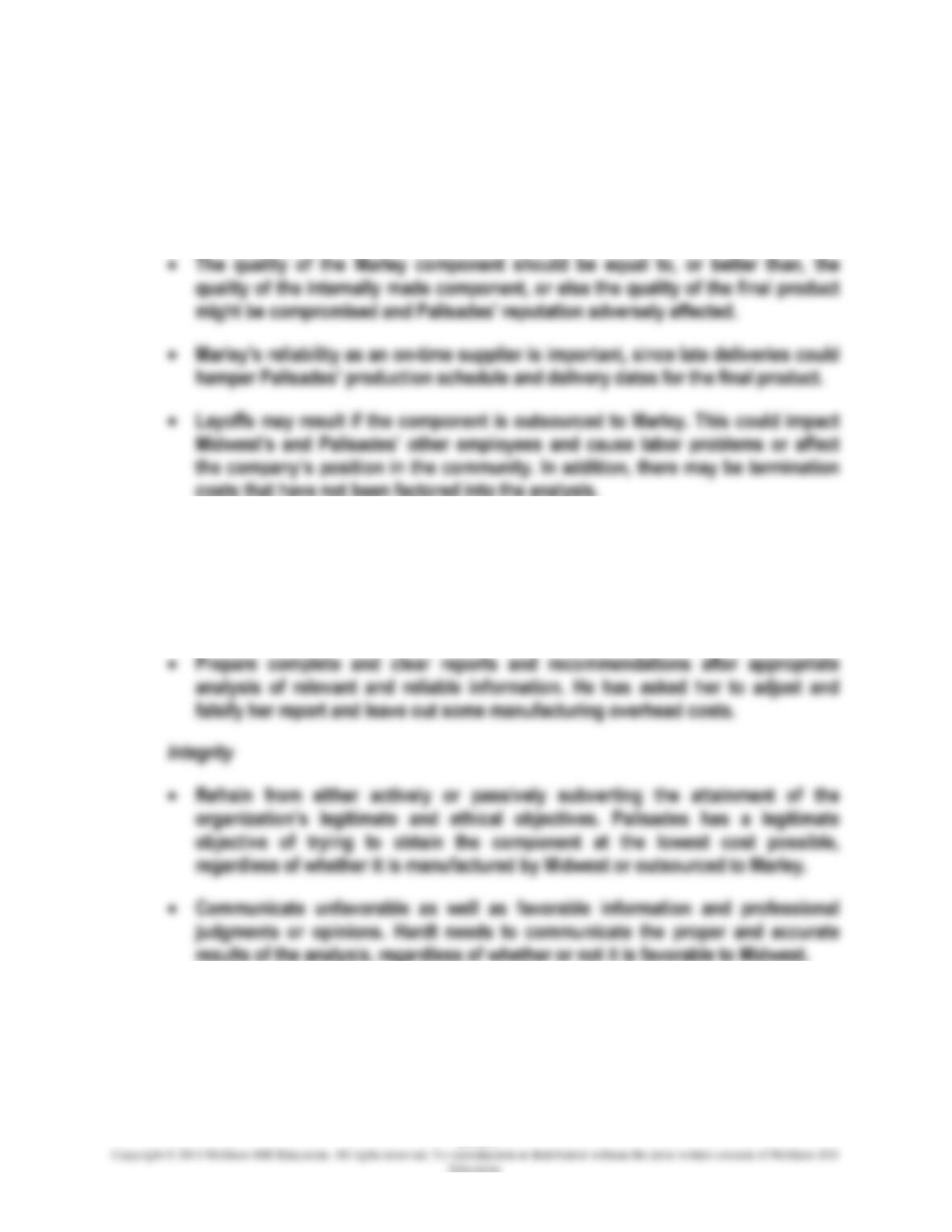
1. a. An analysis of the relevant costs that shows whether the Midwest Division of
Palisades Corporation should make JY–65 or purchase it from Marley Company is
as follows:
Amount
Per Unit
Total for
32,000
Units
Cost to purchase JY-65 from Marley:
Bid price from Marley …………………………………………………….
$8.65
276,800
Total cost to purchase …………………………………………………..
Cost for Midwest to make JY-65:
$3.51
Factory space rental ……………………………………………………..
Equipment leasing costs ……………………………………………….
Total cost to make ……………………………………………………….
Chapter 14 – Decision Making: Relevant Costs and Benefits
14–31
PROBLEM 14-53 (CONTINUED)
2. The qualitative factors that the Midwest Division and Palisades Corporation should
consider before agreeing to purchase JY-65 from Marley Company include the
following:
3. Lynn Hardt would consider the request of John Porter to be unethical for the
following reasons, which are based on the Standards of Ethical Conduct for
Management Accountants.
Competence
Chapter 14 – Decision Making: Relevant Costs and Benefits
14–32
PROBLEM 14-53 (CONTINUED)
• Refrain from engaging in or supporting any activity that would discredit the
profession. Falsifying the analysis would discredit Hardt and the profession.
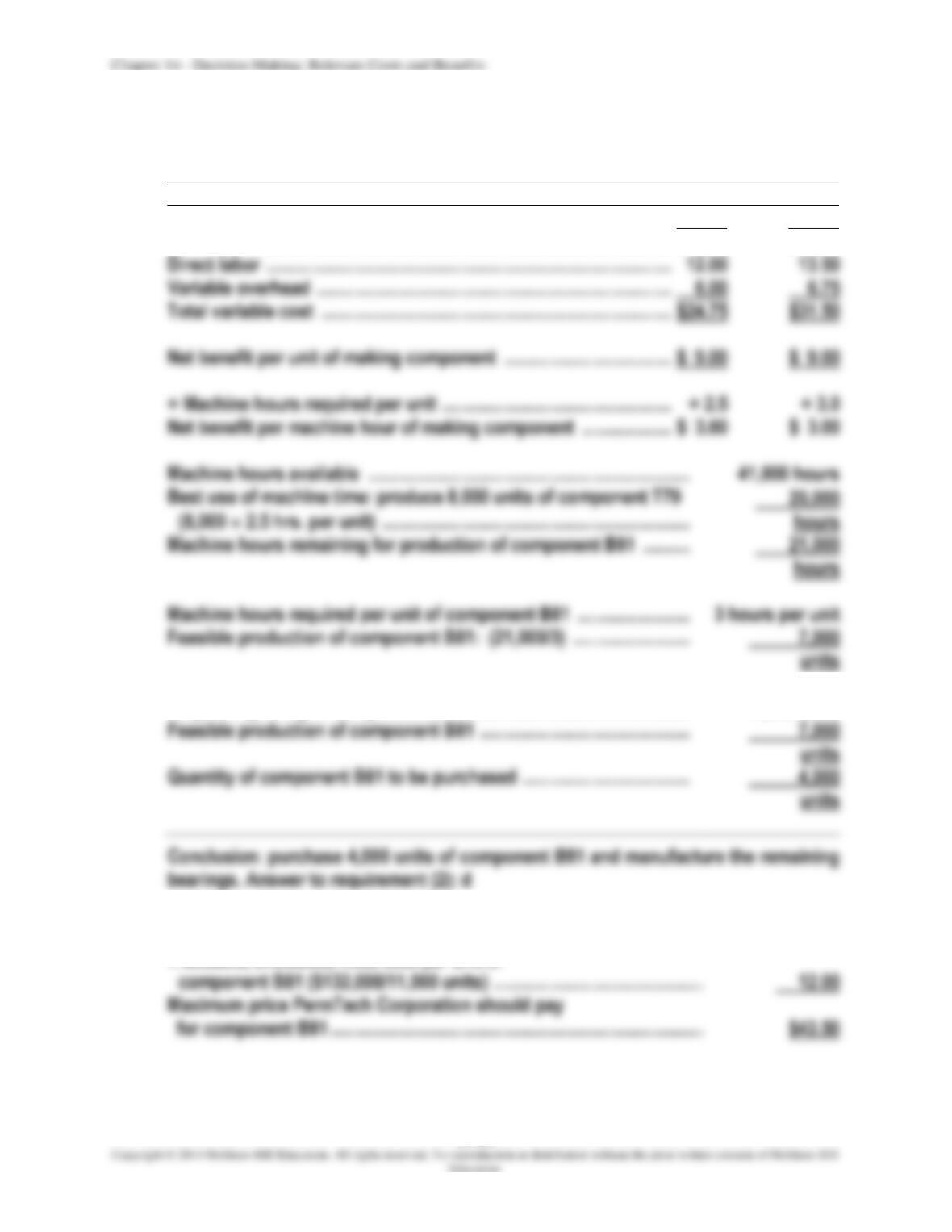
PROBLEM 14-54 (40 MINUTES)
1. The incremental cost of producing one unit of component B81 is computed as
follows:
Direct material ……………………………………………………….…………………………
$11.25
Variable overhead …………………………………………………………………………….
Total variable cost per unit …………………………..…………………………………..
Purchase price quoted for component B81 ………………………………………..
Incremental cost of production per unit …………………………………………….
14–33
PROBLEM 14-54 (CONTINUED)
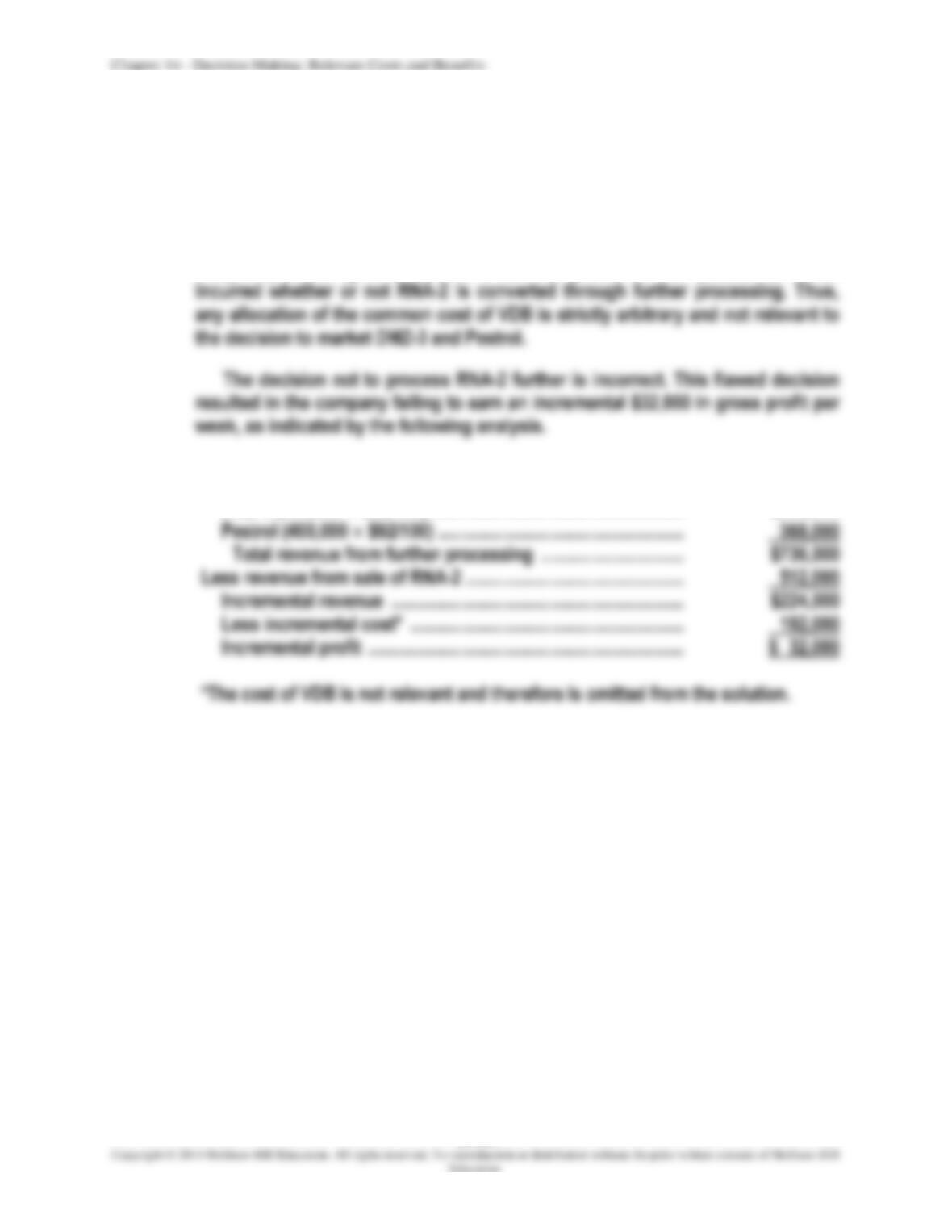
2.
T79
B81
Purchase price quoted …………………………………………………………………….
$33.75
$40.50
Direct material …………………………………………………………………………………
$ 6.75
$11.25
Direct labor ……………………………………………………………………………………
Variable overhead ……………………………………………………………………………
6.00
6.75
Total variable cost …………………………………………………………………………..
$24.75
$31.50
Net benefit per unit of making component ………………………………………..
$ 9.00
$ 9.00
÷ Machine hours required per unit ……………………………………………………
Net benefit per machine hour of making component …………………………
$ 3.60
$ 3.00
Machine hours available ……………………………………………………………
Machine hours remaining for production of component B81 ……….
Machine hours required per unit of component B81 ……………………
Required quantity of component B81 …………………………………………
11,000 units
3.
Variable cost per unit of component B81 …………………………………………..
$31.50
Maximum price PennTech Corporation should pay
$43.50
Traceable, avoidable, fixed cost per unit of
14–34
PROBLEM 14-55 (45 MINUTES)
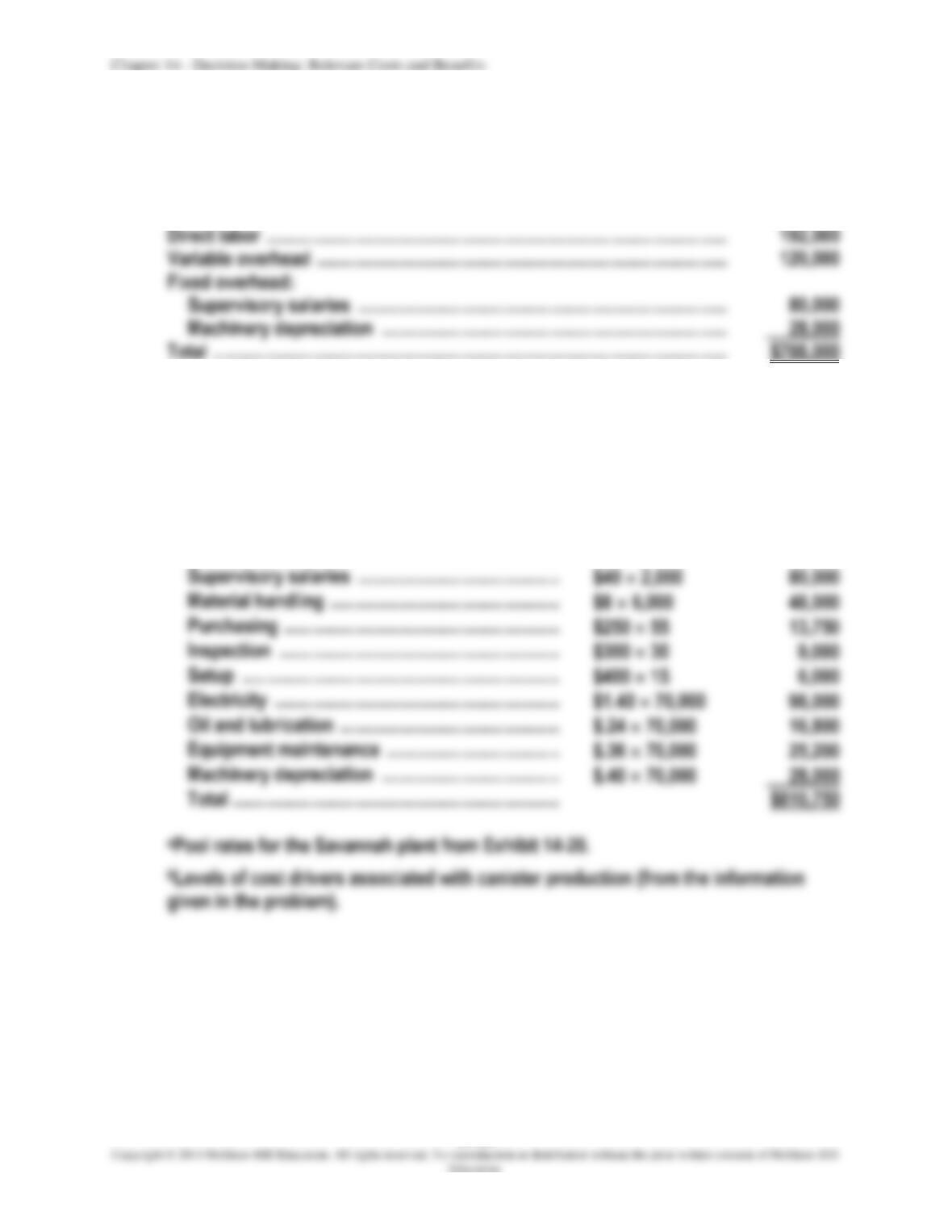
RNA-1 is converted into Fastkil. RNA-2 can be sold as is or converted into two new
products.
a. Management’s analysis is incorrect because it incorporates allocated portions of
the joint-processing costs of VDB. The weekly cost of VDB ($393,600) will be
b.
Revenue from further processing of RNA-2:
DMZ-3 (400,000 $92/100) ……………………………………………………….
$368,000
$736,000
Less revenue from sale of RNA–2 ………………………………………………………
$224,000
*The cost of VDB is not relevant and therefore is omitted from the solution.
14–35
PROBLEM 14-56 (30 MINUTES)
1. Costs to be avoided by purchasing (conventional analysis):
Direct material ……………………………………………………….…………………………
$288,000
Direct labor ………………………………………………………………………………………
192,000
Variable overhead …………………………………………………………………………….
120,000
Fixed overhead:
Total ………………………………………………………………………………………………..
$708,000
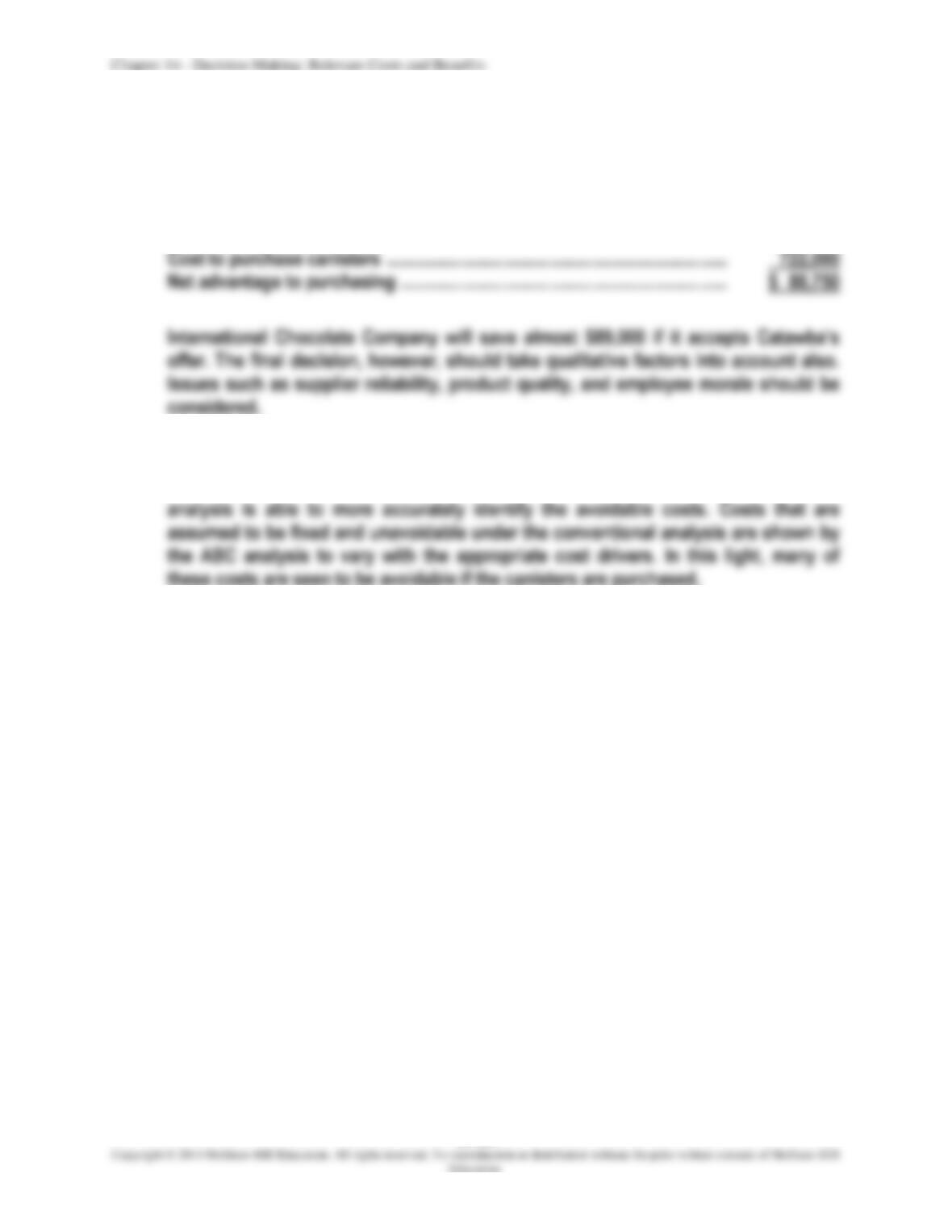
2. Costs to be avoided by purchasing (ABC analysis):
Direct material ……………………………………………………….…………………………
$288,000
Direct labor ………………………………………………………………………………………
192,000
Overhead:
Product development ……………………………………
$600a 10b
6,000
Supervisory salaries …………………………………….
Material handling ………………………………………….
Purchasing …………………………………………………..
Inspection ……………………………………………………
9,000
Setup …………………………………………………………..
6,000
Electricity …………………………………………………….
Oil and lubrication ………………………………………..
Equipment maintenance ……………………………….
$810,750
14–36
PROBLEM 14-56 (CONTINUED)
3. Make-or-buy analysis using ABC data:
Cost savings if canisters are purchased
(ABC analysis) ……………………………………………………………………………….
$810,750
4. The relevant costing approach remains valid when ABC data are used. The objective
is to determine what costs will be avoided if the canisters are purchased. The ABC
14–37
PROBLEM 14-57 (45 MINUTES)
1.
Sell to
Kaytell
as
Special
Order
Convert
to
Standard
Model
Sell as
Special
Order
as Is
Sales price ……………………………………………………….
$205,200
$187,500
$156,000
Less cash discount …………………………………………………
–—
3,750
—
Net price ……………………………………………………….
$205,200
$183,750
$156,000
Additional manufacturing costs
$ 18,600
$ 8,550
$ —
12,600
9,900
—
4,950
—
Total additional manufacturing costs ………………………
$ 37,500
$ 23,400
$ —
Commissions ……………………………………………………….
3,750
Total costs and expenses …………………………..
$ 43,656
27,150
4,680
Net contribution ……………………………………………………….
$161,544
$156,600
$151,320
2.
Contribution from sale to Kaytell …………………………………
$161,544
Contribution from next best alternative:
sell as standard model ……………………………………………..
156,600
Difference in contribution ……………………………………………
$ 4,944
%
Original price quote to Kaytell …………………………………….
$205,200
Acceptable reduction ………………………………………………….
Minimum acceptable price from Kaytell ……………………….
$200,103
Proof: Suppose Kaytell pays a price of $200,103:
Sales price ……………………………………………………………..
$200,103
Less: Sales commission (3%) ………………………………….
(rounded)
$194,100
Less: Additional manufacturing costs ……………………..
37,500
14–38
PROBLEM 14-57 (CONTINUED)
Therefore, at a price of $200,103 to Kaytell, Excalibur’s management would be
3. Fixed manufacturing overhead should have no influence on the sales price quoted
by Excalibur, Inc. for special orders. Management should accept special orders
whenever the firm is operating substantially below capacity, including below the