Case 14-31 (45 minutes)
1. Rachel Arnett’s revision of her first proposal can be considered a
violation of the IMA’s Statement of Ethical Professional Practice. She
discarded her reasonable projections and estimates after she was
2. Earle was clearly in violation of the Standards of Ethical Conduct for
Management Accountants because he tried to persuade a subordinate to
Case 14-31 (continued)
3. The internal controls Fore Corporation could implement to prevent
unethical behavior include:
approval of all formal capital expenditure proposals by the Controller
and/or the Board of Directors.
designating a non-accounting/finance manager to coordinate capital
expenditure requests and/or segregating duties during the preparation
and approval of capital expenditure requests.
Case 14–32 (45 minutes)
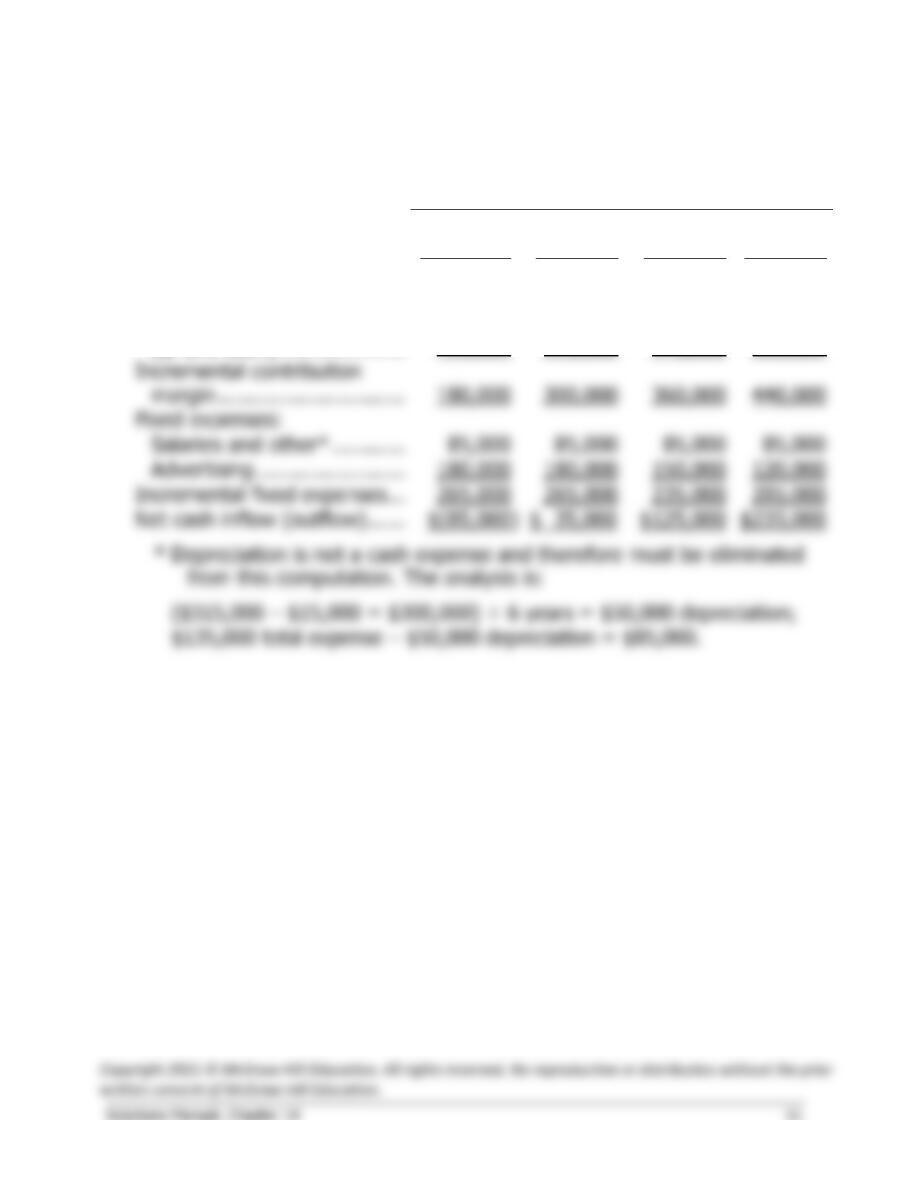
1. The net cash inflow from sales of the device for each year would be:
Year
1
2
3
4-6
Sales in units …………………..
9,000
15,000
18,000
22,000
Sales in dollars
(@ $35 each) ………………..
$315,000
$525,000
$630,000
$770,000
Variable expenses
Incremental contribution
margin …………………………
Depreciation is not a cash expense and therefore must be eliminated
from this computation. The analysis is:
$135,000 total expense – $50,000 depreciation = $85,000.
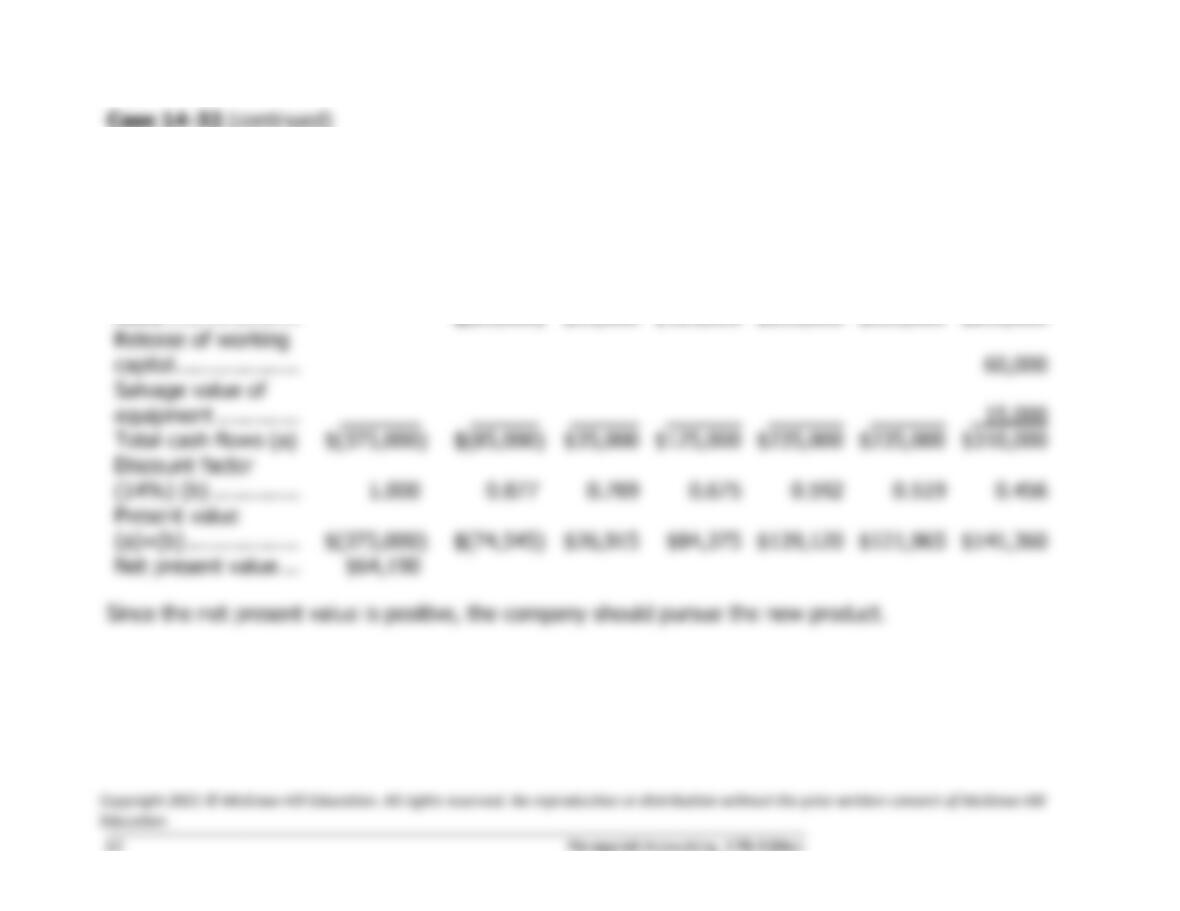
2. The net present value of the proposed investment would be:
Now
1
2
3
4
5
6
Cost of equipment ..
$(315,000)
Working capital ……
(60,000)
Yearly net cash
Salvage value of
Total cash flows (a)
$(375,000)
Present value
Net present value …
Appendix 14A
The Concept of Present Value
Exercise 14A-1 (10 minutes)
Amount of Cash Flows
18%
Present Value of Cash
Flows
Year
Investment
A
Investment
B
Factor
Investment
A
Investment
B
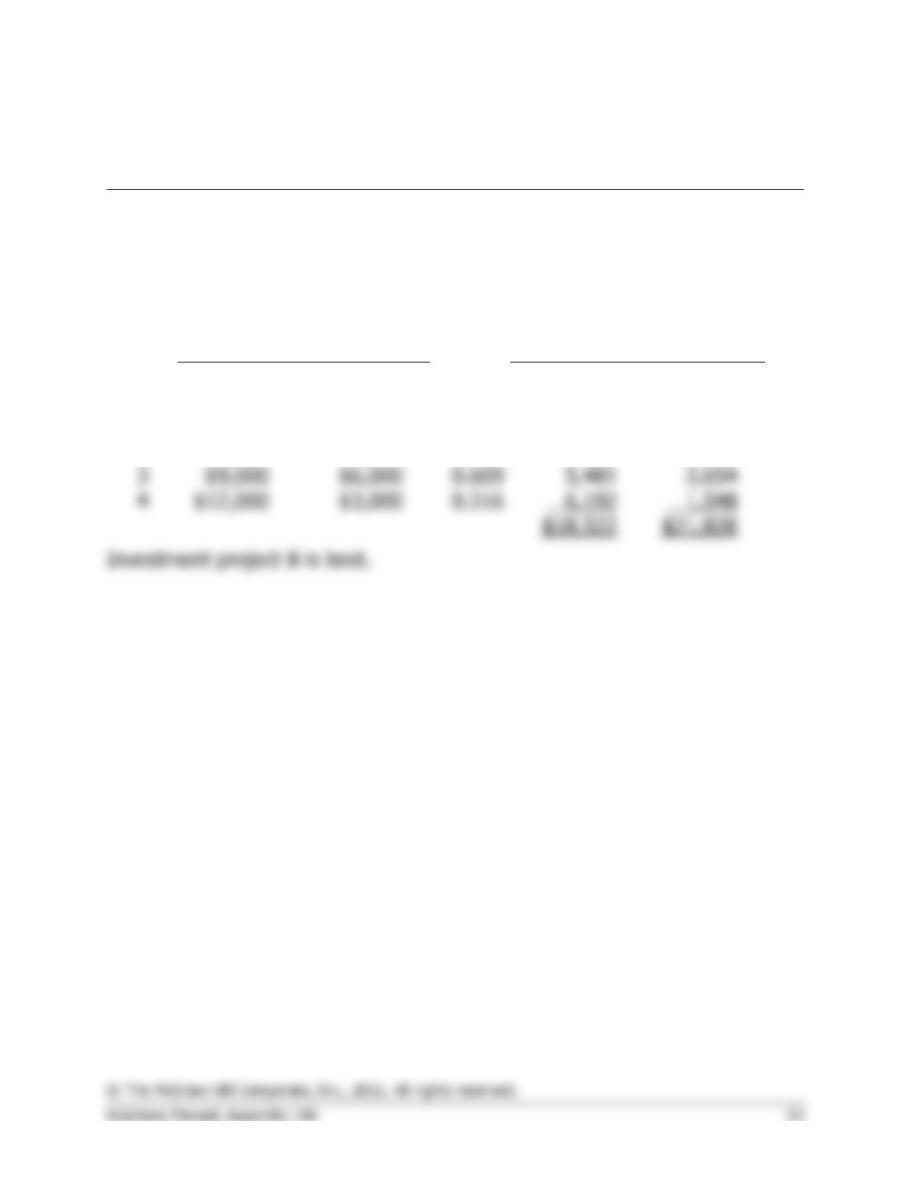
1
$3,000
$12,000
0.847
$ 2,541
$10,164
2
$6,000
$9,000
0.718
4,308
6,462
3
$9,000
$6,000
0.609
5,481
3,654
Exercise 14A-2 (10 minutes)
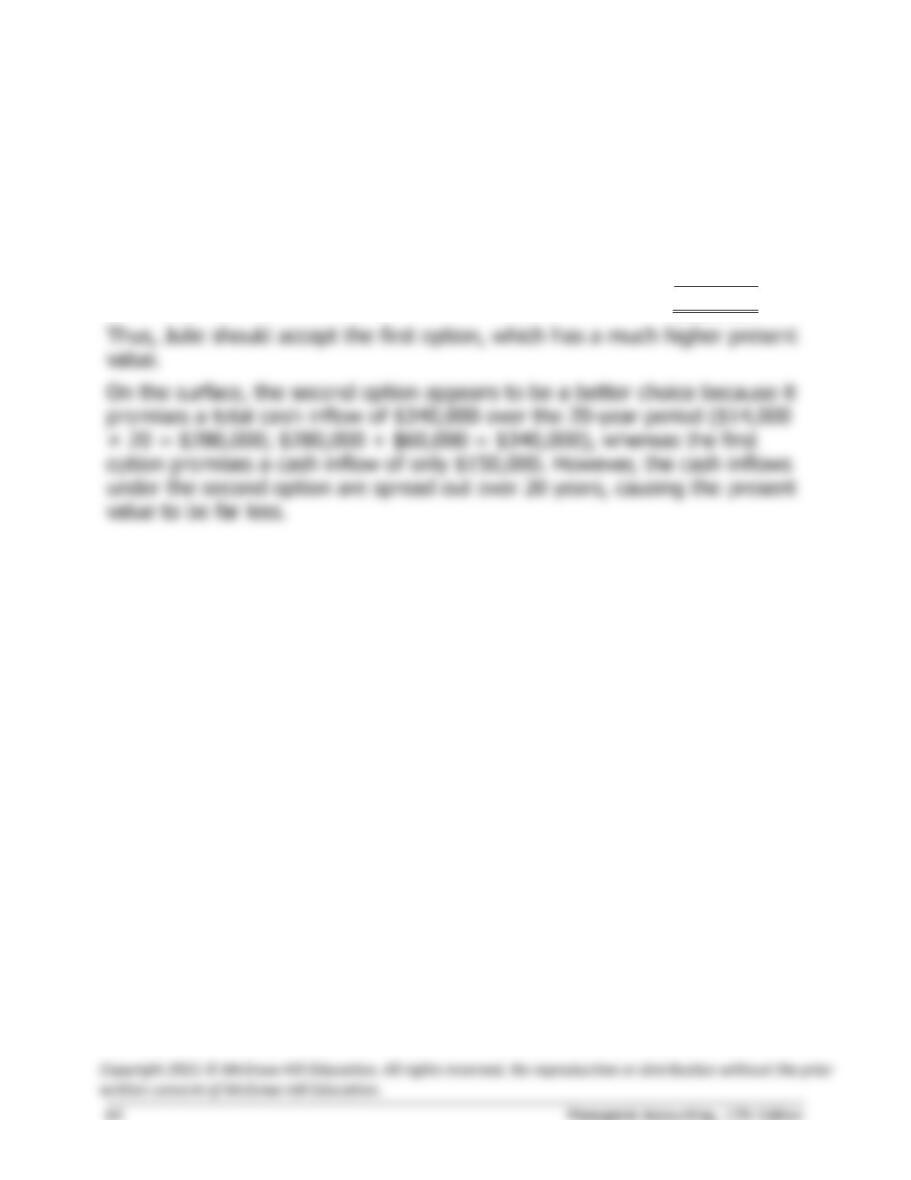
The present value of the first option is $150,000, since the entire amount
would be received immediately.
The present value of the second option is:
Annual annuity: $14,000 × 7.469 (Exhibit 14B-2) ………
$104,566
Lump-sum payment: $60,000 × 0.104 (Exhibit 14B-1) .
6,240
Total present value ……………………………………………..
$110,806
Exercise 14A-3 (10 minutes)
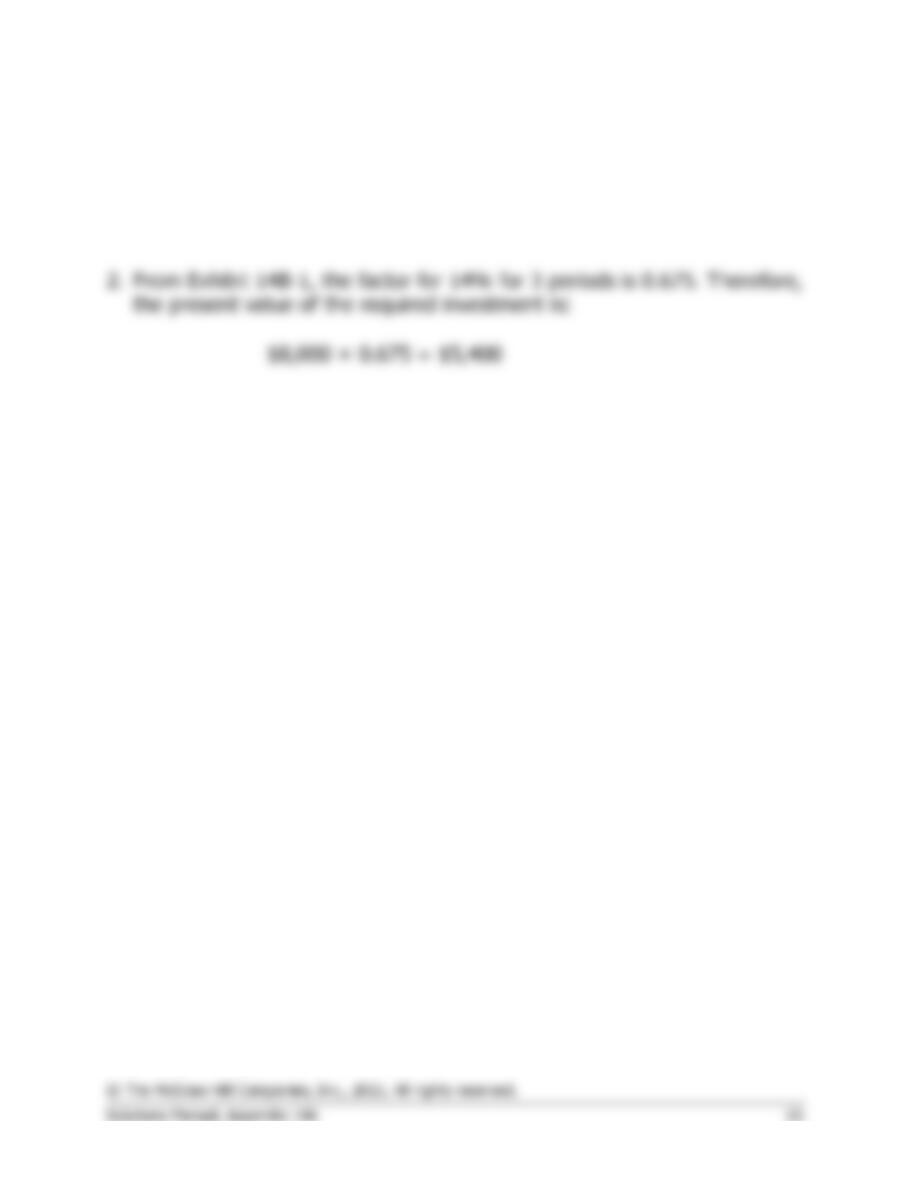
1. From Exhibit 14B-1, the factor for 10% for 3 periods is 0.751. Therefore,
the present value of the required investment is:
$8,000 × 0.751 = $6,008
Exercise 14A-4 (10 minutes)
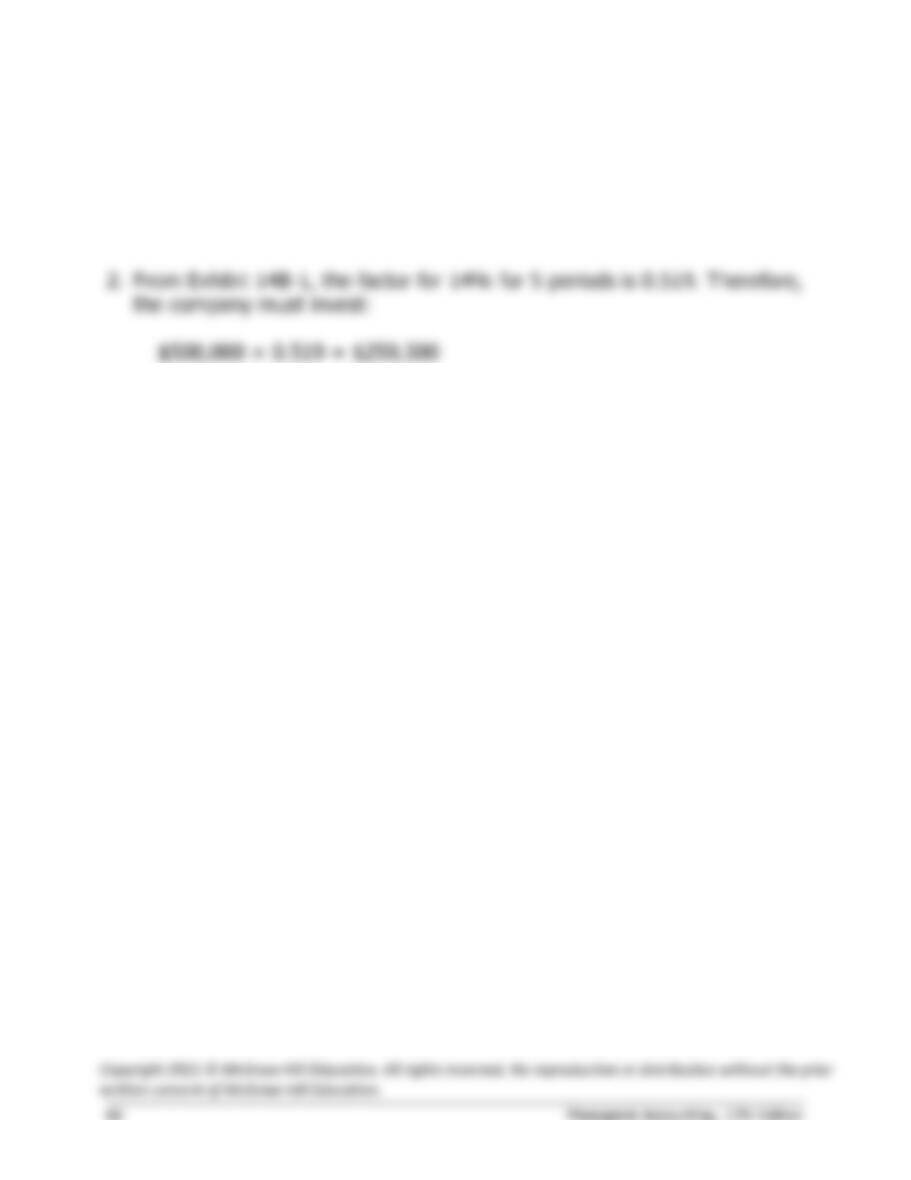
1. From Exhibit 14B-1, the factor for 10% for 5 periods is 0.621. Therefore,
the company must invest:
$500,000 × 0.621 = $310,500
Exercise 14A-5 (10 minutes)
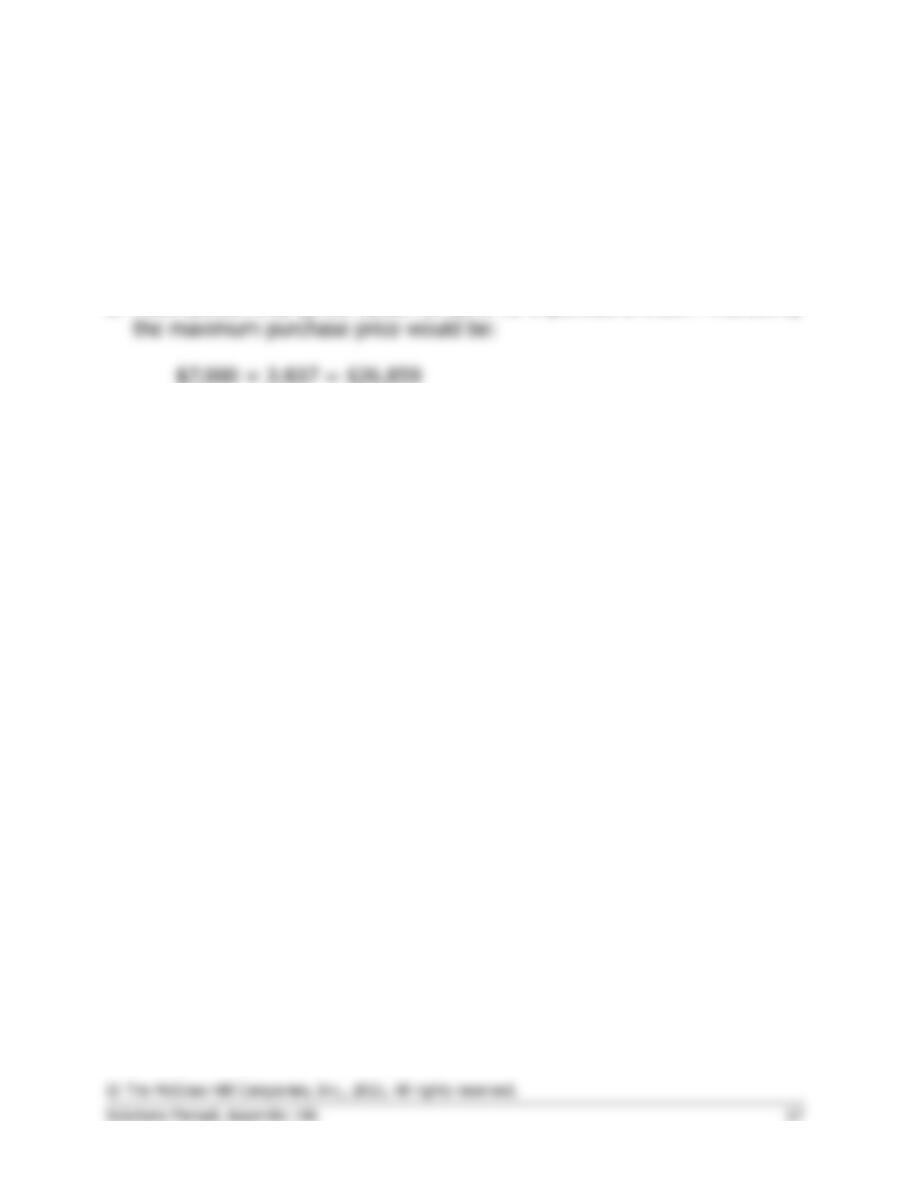
1. From Exhibit 14B-2, the factor for 16% for 8 periods is 4.344. The
computer system should be purchased only if its net present value is
positive. This will occur only if the purchase price is less:
$7,000 × 4.344 = $30,408
Exercise 14A-6 (10 minutes)
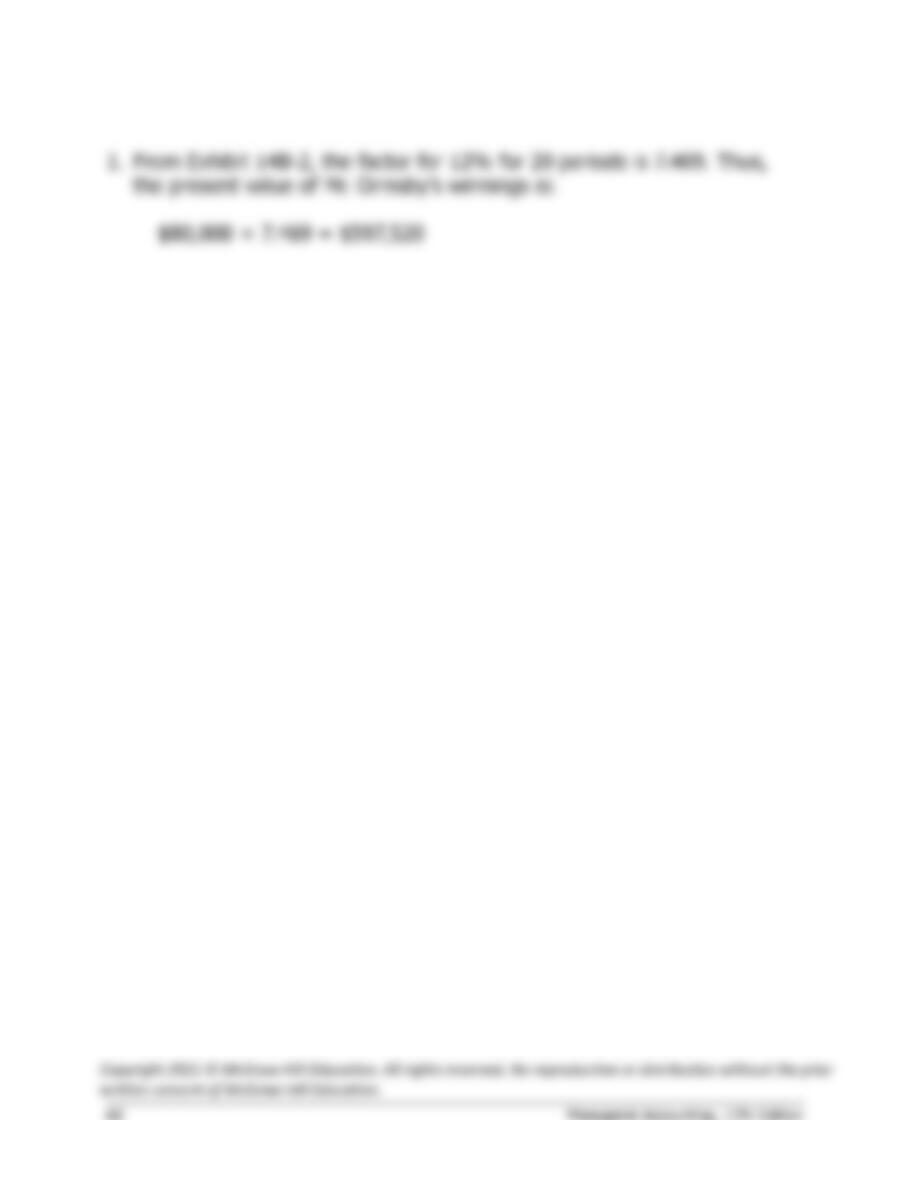
2. Whether or not it is correct to say that Mr. Ormsby is the state’s newest
millionaire depends on your point of view. He will receive more than a
million dollars over the next 20 years; however, he is not a millionaire as
shown by the present value computation above, nor will he ever be a
millionaire if he spends his winnings rather than investing them.
Appendix 14C
Income Taxes and Net Present Value
Analysis
Exercise 14C-1 (10 minutes)
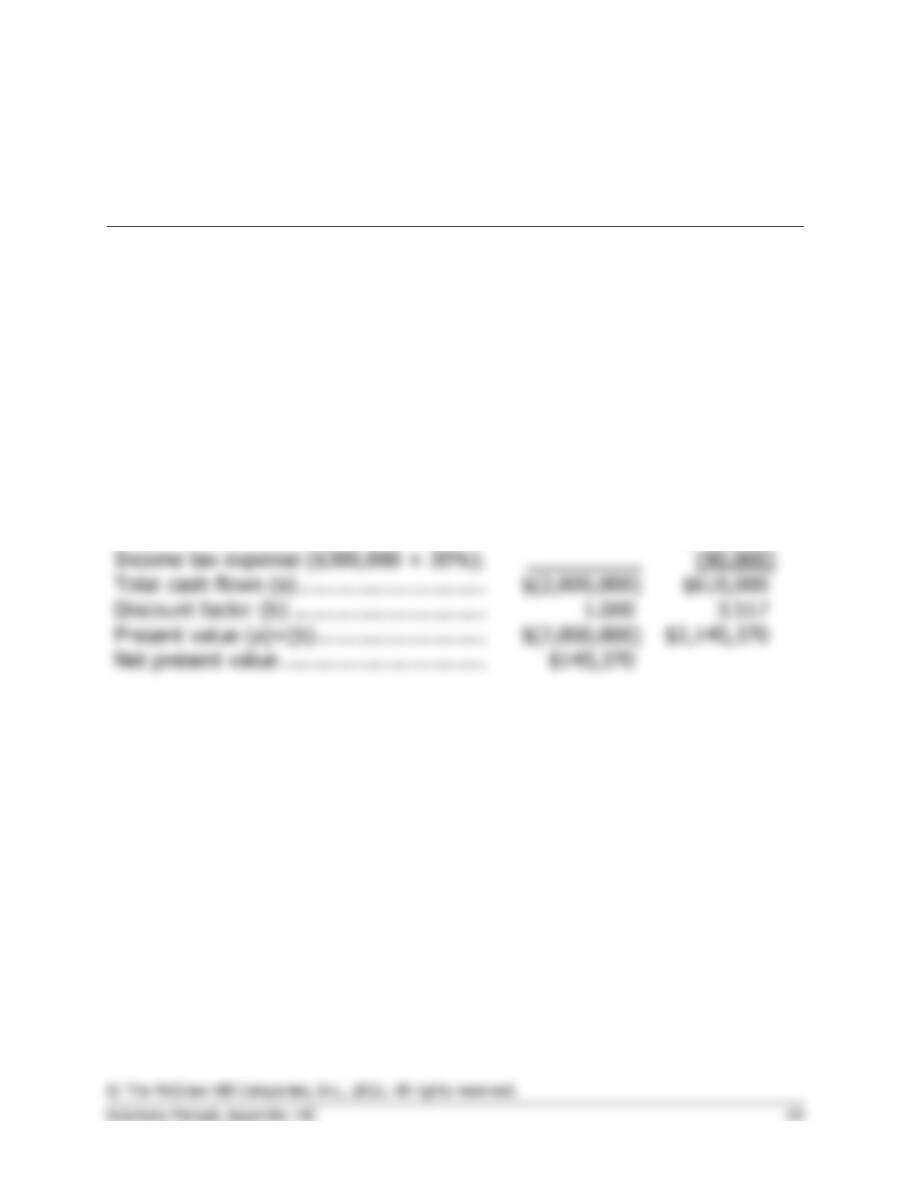
The project’s net present value is computed as follows:
Now
Years
1-5
Purchase of equipment …………………….
$(2,000,000)
Sales ……………………………………………
$2,800,000
Variable expenses …………………………...
(1,600,000)
Out-of-pocket costs …………………………
(500,000)
Income tax expense ($300,000 × 30%) .
Total cash flows (a) …………………………
$(2,000,000)
Discount factor (b) ………………………….
Present value (a)×(b) ………………………
$(2,000,000)
$2,145,370
Net present value …………………………...
Exercise 14C-2 (20 minutes)
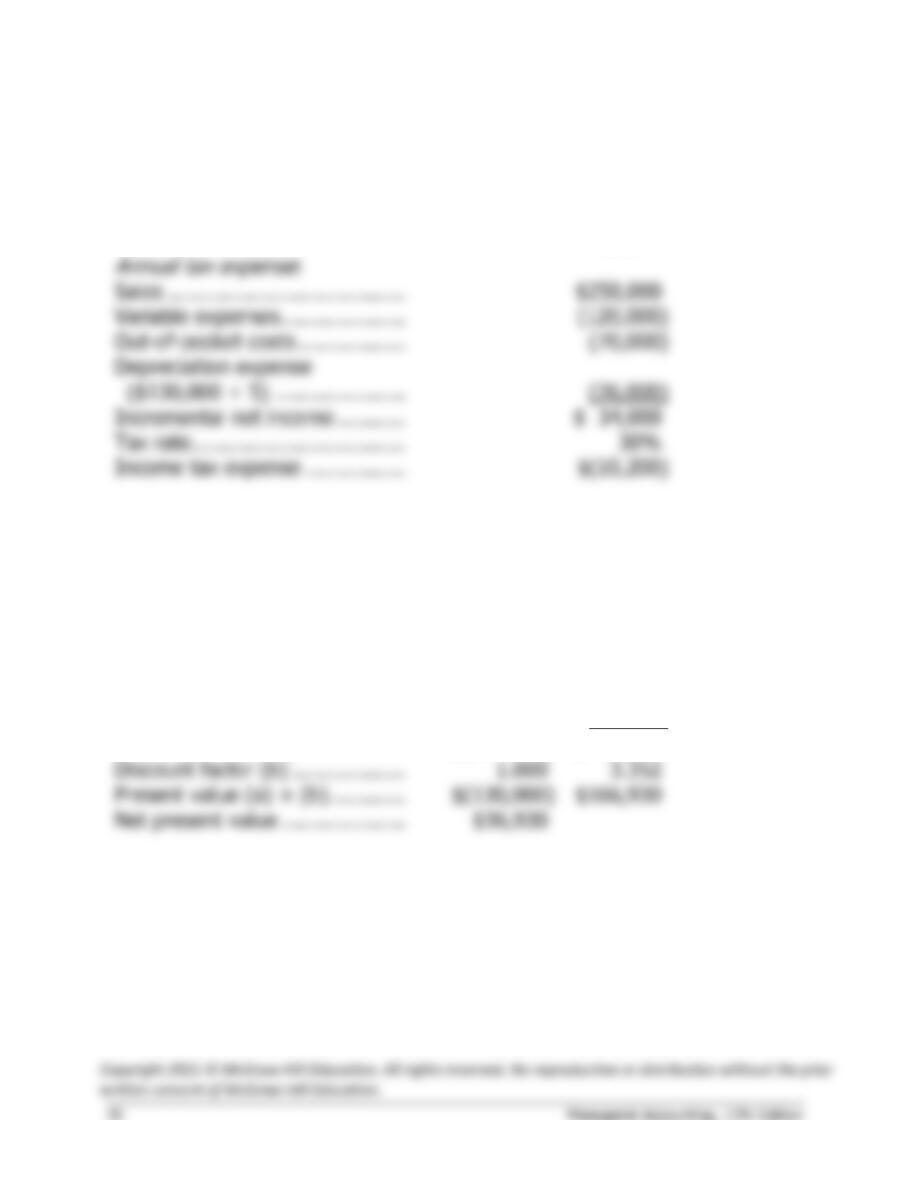
1. The annual income tax expense is computed as follows:
Years
1-5
Annual tax expense
Sales ………………………………..
$250,000
Variable expenses ………………..
(120,000)
Out-of-pocket costs ……………..
(70,000)
Depreciation expense
Incremental net income ………..
$ 34,000
Tax rate …………………………….
Income tax expense …………….
$(10,200)
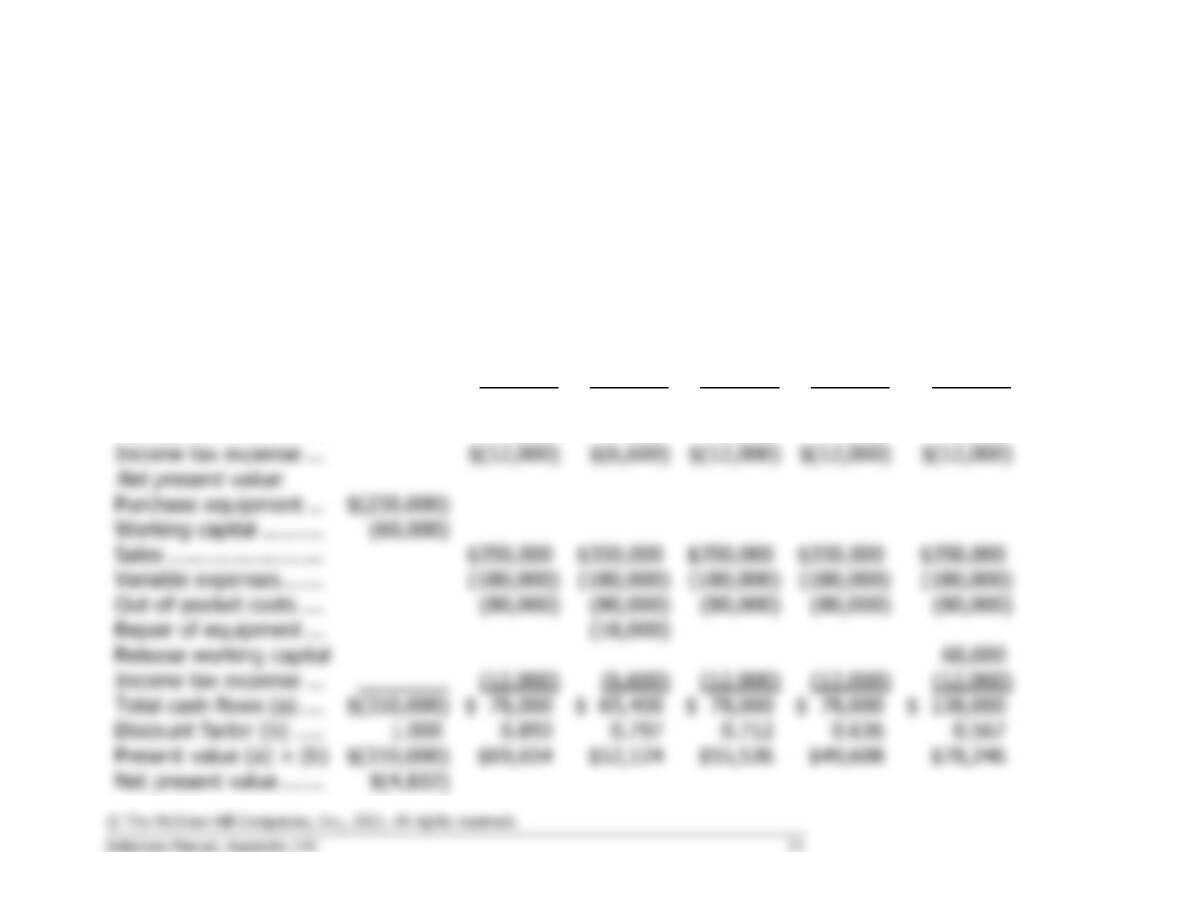
2. The net present value is computed as follows:
Now
Years
1-5
Net present value
:
Purchase equipment …………….
$(130,000)
Sales ………………………………..
$250,000
Variable expenses ………………..
(120,000)
Out-of-pocket costs ……………..
(70,000)
Income tax expense …………….
________
(10,200)
Total cash flows (a) ……………..
$(130,000)
$ 49,800
Discount factor (b) ………………
Present value (a) × (b) …………
$(130,000)
$166,930
Net present value ………………..
Problem 14C-3 (30 minutes)
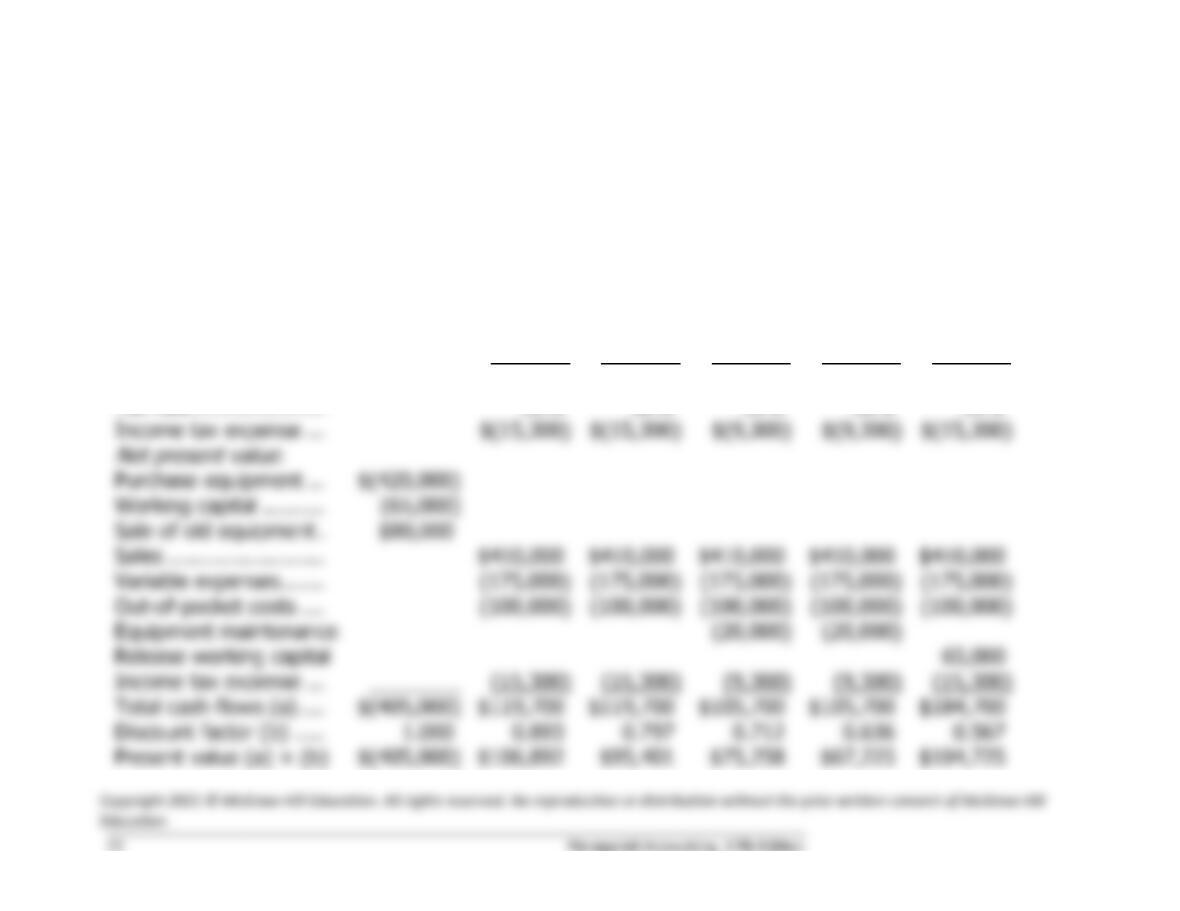
1. and 2. The annual income tax expense for each year and the net present value are computed as
follows:
Now
1
2
3
4
5
Annual tax expense
:
Sales …………………….
$350,000
$350,000
$350,000
$350,000
$350,000
Variable expenses …….
(180,000)
(180,000)
(180,000)
(180,000)
(180,000)
Out-of-pocket costs ….
(80,000)
(80,000)
(80,000)
(80,000)
(80,000)
Repair of equipment …
(18,000)
Depreciation expense ..
(50,000)
(50,000)
(50,000)
(50,000)
(50,000)
Incremental net income
$ 40,000
$ 22,000
$ 40,000
$ 40,000
$ 40,000
Tax rate …………………
30%
30%
30%
30%
30%
Income tax expense …
$(12,000)
$(6,600)
$(12,000)
$(12,000)
$(12,000)
Net present value
Purchase equipment …
Working capital ……….
Sales …………………….
Variable expenses …….
(180,000)
(180,000)
(180,000)
(180,000)
(180,000)
Out-of-pocket costs ….
(80,000)
(80,000)
(80,000)
(80,000)
(80,000)
Repair of equipment …
(18,000)
Release working capital
Income tax expense …
(6,600)
Total cash flows (a) ….
$ 78,000
$ 65,400
$ 78,000
$ 78,000
$ 138,000
Discount factor (b) …..
Problem 14C-4 (30 minutes)
1. and 2. The annual income tax expense and net present value are computed as follows:
Now
1
2
3
4
5
Annual tax expense
:
Sales …………………….
$410,000
$410,000
$410,000
$410,000
$410,000
Variable expenses …….
(175,000)
(175,000)
(175,000)
(175,000)
(175,000)
Out-of-pocket costs ….
(100,000)
(100,000)
(100,000)
(100,000)
(100,000)
Equipment maintenance
(20,000)
(20,000)
Depreciation expense ..
(84,000)
(84,000)
(84,000)
(84,000)
(84,000)
Incremental net income
$ 51,000
$ 51,000
$ 31,000
$ 31,000
$ 51,000
Tax rate …………………
Income tax expense …
Net present value
Purchase equipment …
$(420,000)
Working capital ……….
Sale of old equipment .
Sales …………………….
Variable expenses …….
Out-of-pocket costs ….
Equipment maintenance
(20,000)
(20,000)
Release working capital
Income tax expense …
(15,300)
(15,300)
(15,300)
Total cash flows (a) ….
$(405,000)
Discount factor (b) …..
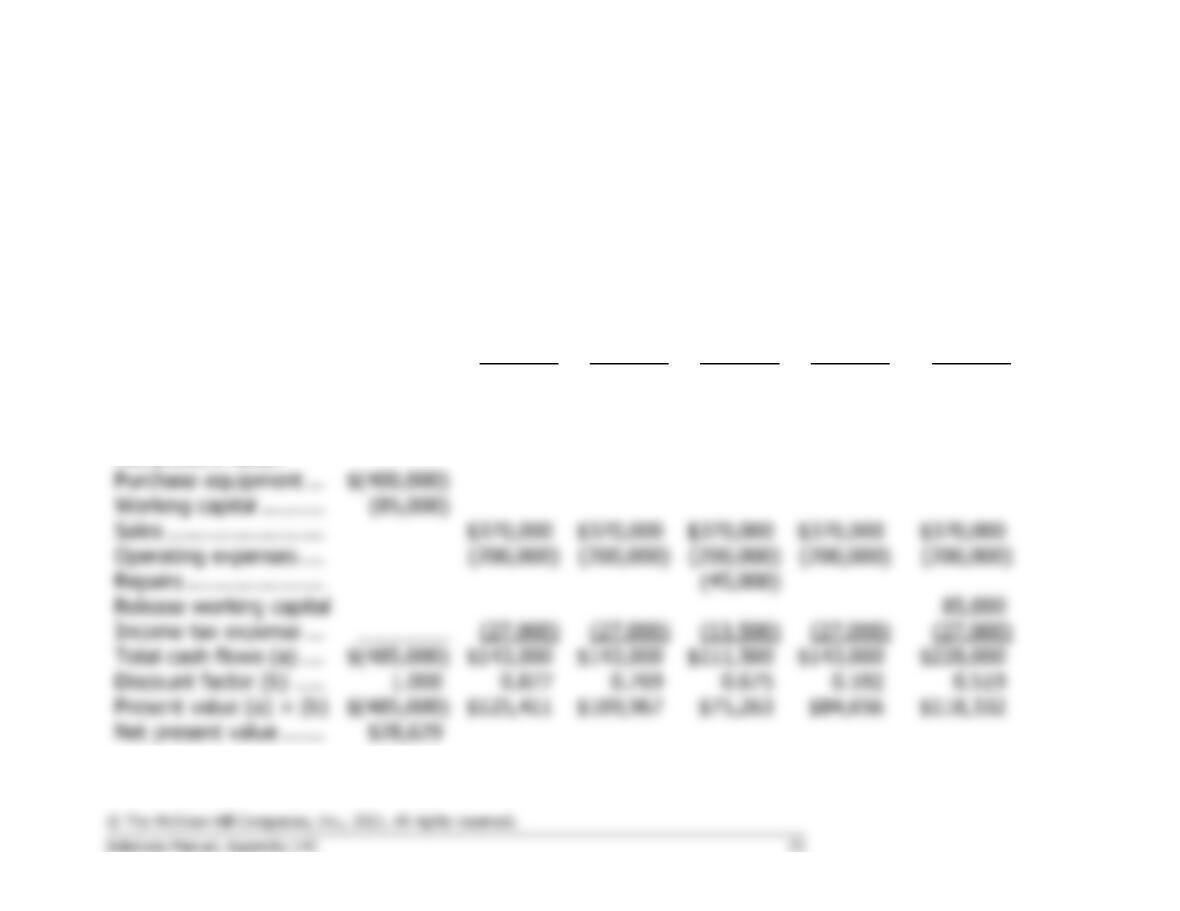
Net present value …….
$44,501
Problem 14C-5 (45 minutes)
1. and 2. The annual income tax expense and net present value of Product A are computed as follows:
Now
1
2
3
4
5
Annual tax expense
:
Sales …………………….
$370,000
$370,000
$370,000
$370,000
$370,000
Operating expenses ….
(200,000)
(200,000)
(200,000)
(200,000)
(200,000)
Repairs ………………….
(45,000)
Depreciation expense ..
(80,000)
(80,000)
(80,000)
(80,000)
(80,000)
Incremental net income
$90,000
$90,000
$ 45,000
$90,000
$90,000
Tax rate …………………
30%
30%
30%
30%
30%
Income tax expense …
$(27,000)
$(27,000)
$(13,500)
$(27,000)
$(27,000)
Net present value
Purchase equipment …
Working capital ……….
Sales …………………….
$370,000
Operating expenses ….
(200,000)
(200,000)
(200,000)
(200,000)
(200,000)
Repairs ………………….
(45,000)
Release working capital
Income tax expense …
________
(27,000)
(27,000)
(13,500)
(27,000)
(27,000)
Total cash flows (a) ….
Discount factor (b) …..
Present value (a) × (b)
$75,263
Net present value …….
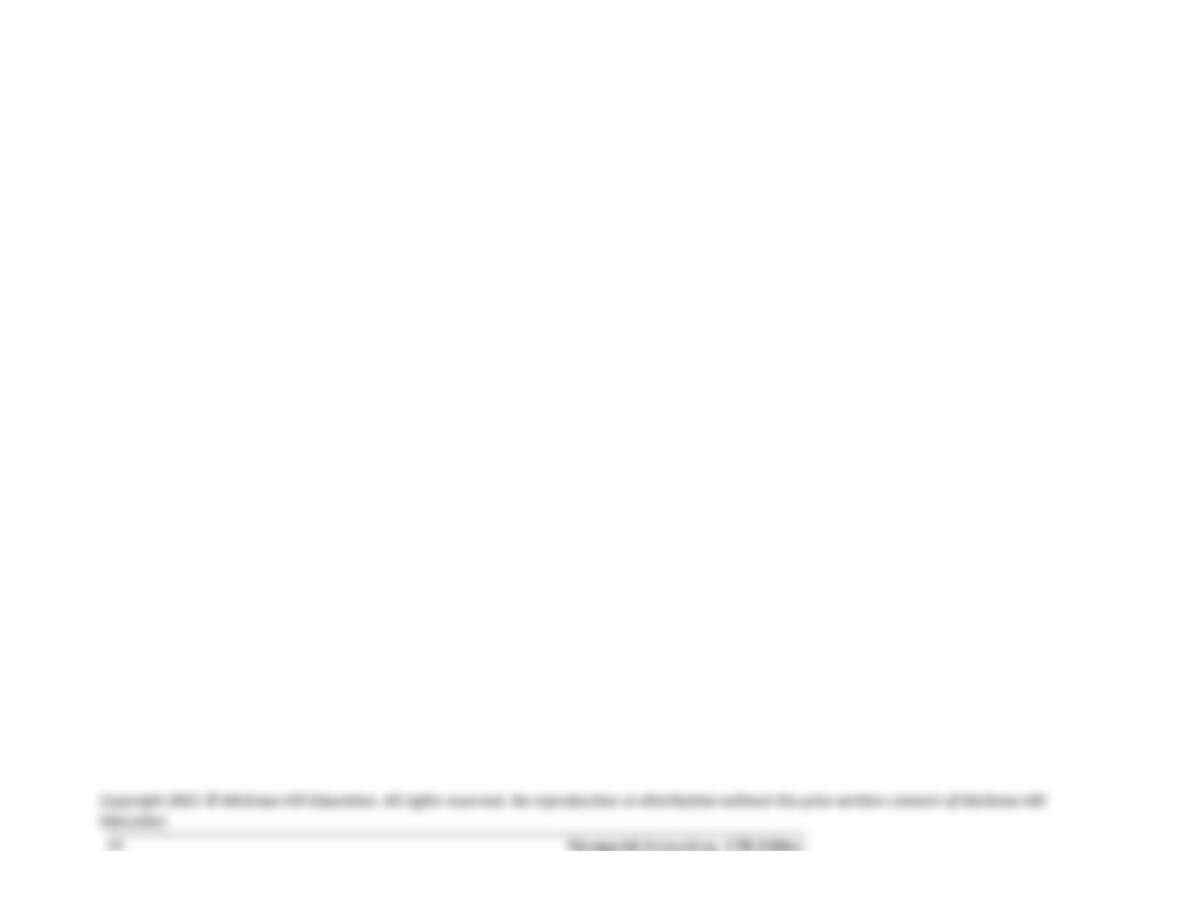
Note: The sales ($370,000) and operating expenses ($200,000) can also be discounted to their present
values using the appropriate discount factor (3.433) from Exhibit 14B-2 in Appendix 14B.
Problem 14C-5 (continued)
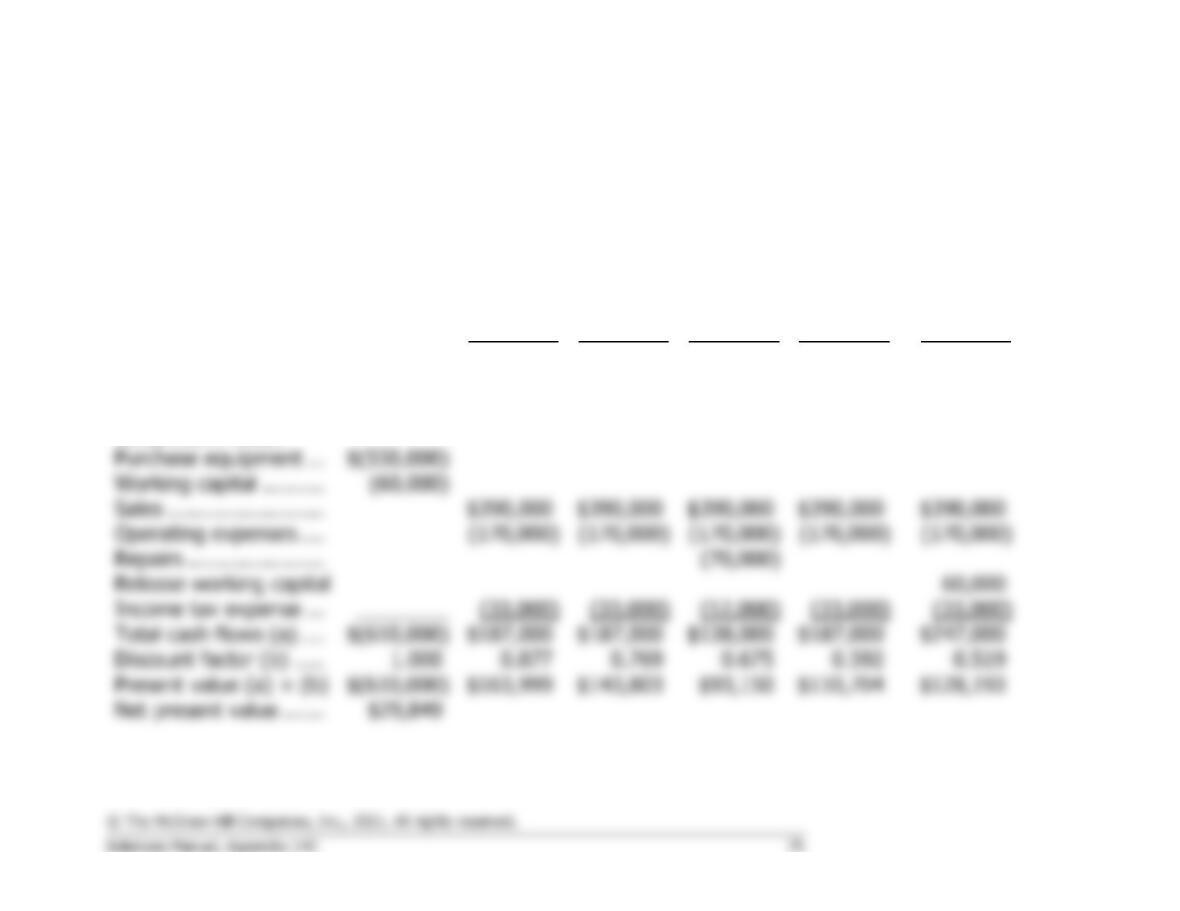
3. and 4. The annual income tax expense and net present value of Product B are computed as follows:
Now
1
2
3
4
5
Annual tax expense
:
Sales …………………….
$390,000
$390,000
$390,000
$390,000
$390,000
Operating expenses ….
(170,000)
(170,000)
(170,000)
(170,000)
(170,000)
Repairs ………………….
(70,000)
Depreciation expense ..
(110,000)
(110,000)
(110,000)
(110,000)
(110,000)
Incremental net income
$110,000
$110,000
$ 40,000
$110,000
$110,000
Tax rate …………………
30%
30%
30%
30%
30%
Income tax expense …
$(33,000)
$(33,000)
$(12,000)
$(33,000)
$(33,000)
Net present value
:
Purchase equipment …
$(550,000)
Working capital ……….
Sales …………………….
$390,000
$390,000
$390,000
$390,000
$390,000
Operating expenses ….
(170,000)
(170,000)
(170,000)
(170,000)
(170,000)
Repairs ………………….
(70,000)
Release working capital
Income tax expense …
________
(33,000)
(33,000)
(12,000)
(33,000)
Total cash flows (a) ….
$(610,000)
$187,000
$187,000
$138,000
$187,000
$247,000
Discount factor (b) …..
Present value (a) × (b)
$(610,000)
$163,999
$143,803
$93,150
$128,193
Net present value …….
Note: The sales ($390,000) and operating expenses ($170,000) can also be discounted to their present
values using the appropriate discount factor (3.433) from Exhibit 14B-2 in Appendix 14B.
Problem 14C-5 (continued)
5. Students should use the profitability index to answer this question as
follows:
Product A
Product B
Present value of cash inflows (a) ……………
$513,629
$639,849
Investment required (b) ……………………….
$485,000
$610,000
Profitability index (a) ÷ (b)……………………