Exercise 14-8 (15 minutes)
1. Computation of the annual cash inflow associated with the new
electronic games:
Net operating income ……………………………………
$40,000
Add noncash deduction for depreciation ……………
35,000
Annual net cash inflow…………………………………..
$75,000
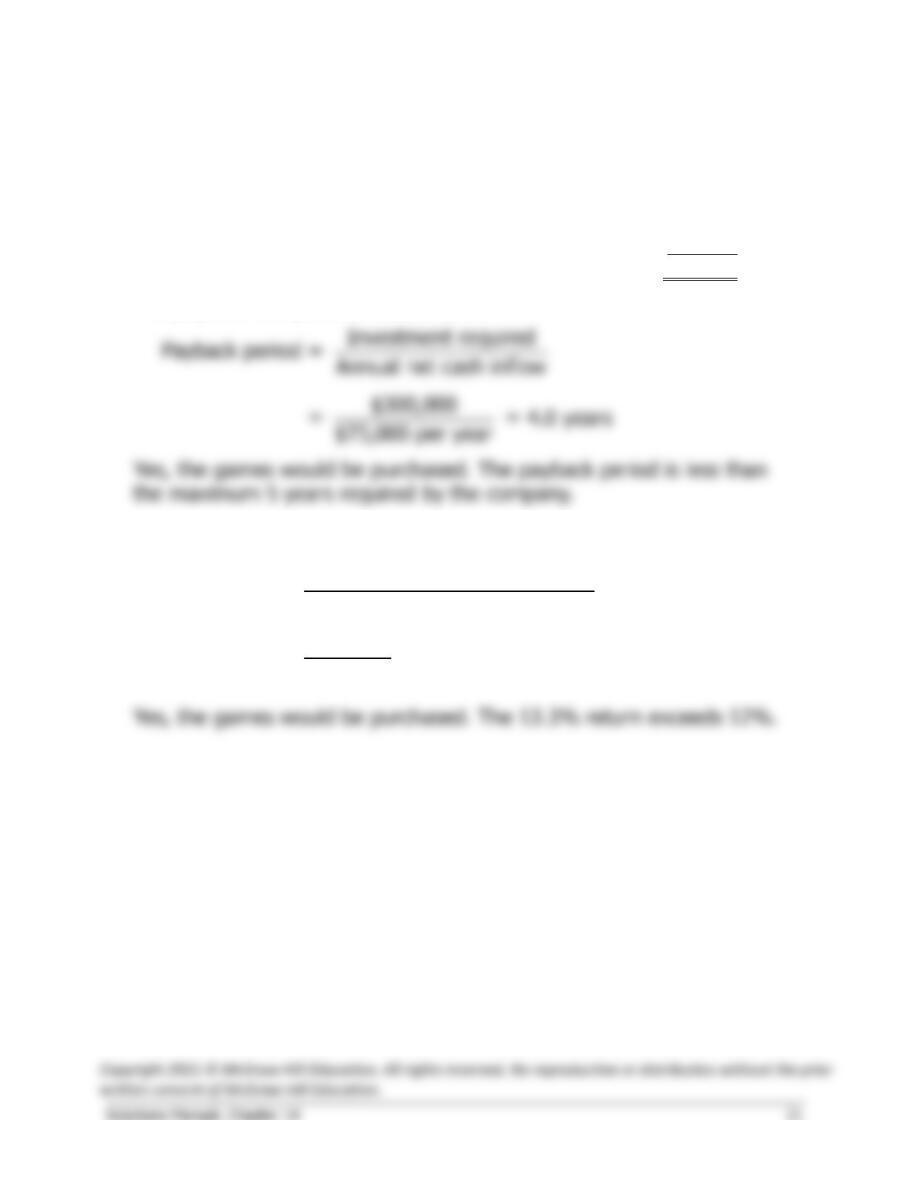
The payback computation would be:
2. The simple rate of return would be:
Annual incremental net income
Simple rate =
of return Initial investment
$40,000
= = 13.3%
$300,000
Exercise 14-9 (20 minutes)
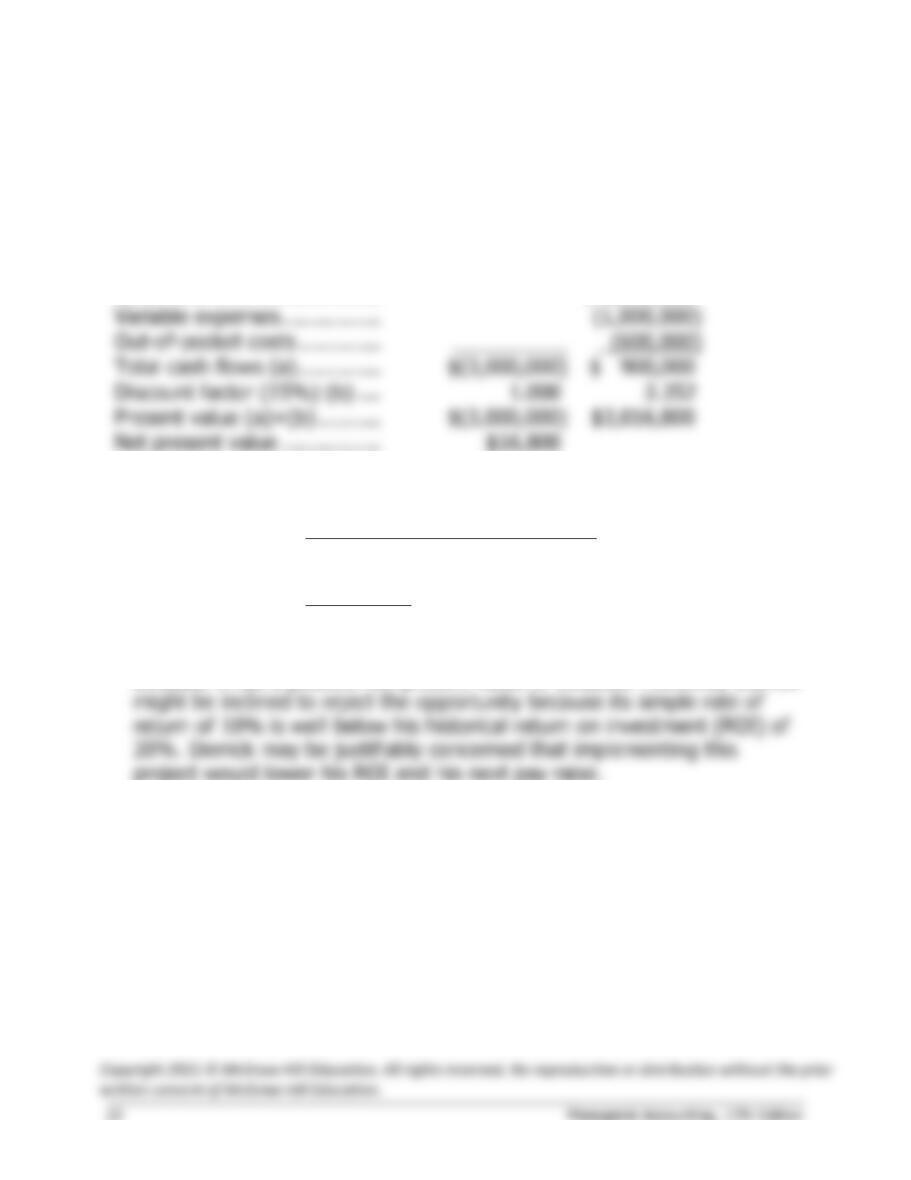
1. The net present value is computed as follows:
Now
Years
1-5
Purchase of equipment ……..
$(3,000,000)
Sales …………………………….
$ 2,500,000
Variable expenses …………….
Total cash flows (a) ………….
$(3,000,000)
Discount factor (15%) (b) ….
Present value (a)×(b) ……….
$(3,000,000)
Net present value …………….
2. The simple rate of return would be:
Annual incremental net income
Simple rate =
of return Initial investment
$300,000
= = 10.0%
$3,000,000
3. The company would want Derrick to pursue the investment opportunity
Exercise 14-10 (10 minutes)
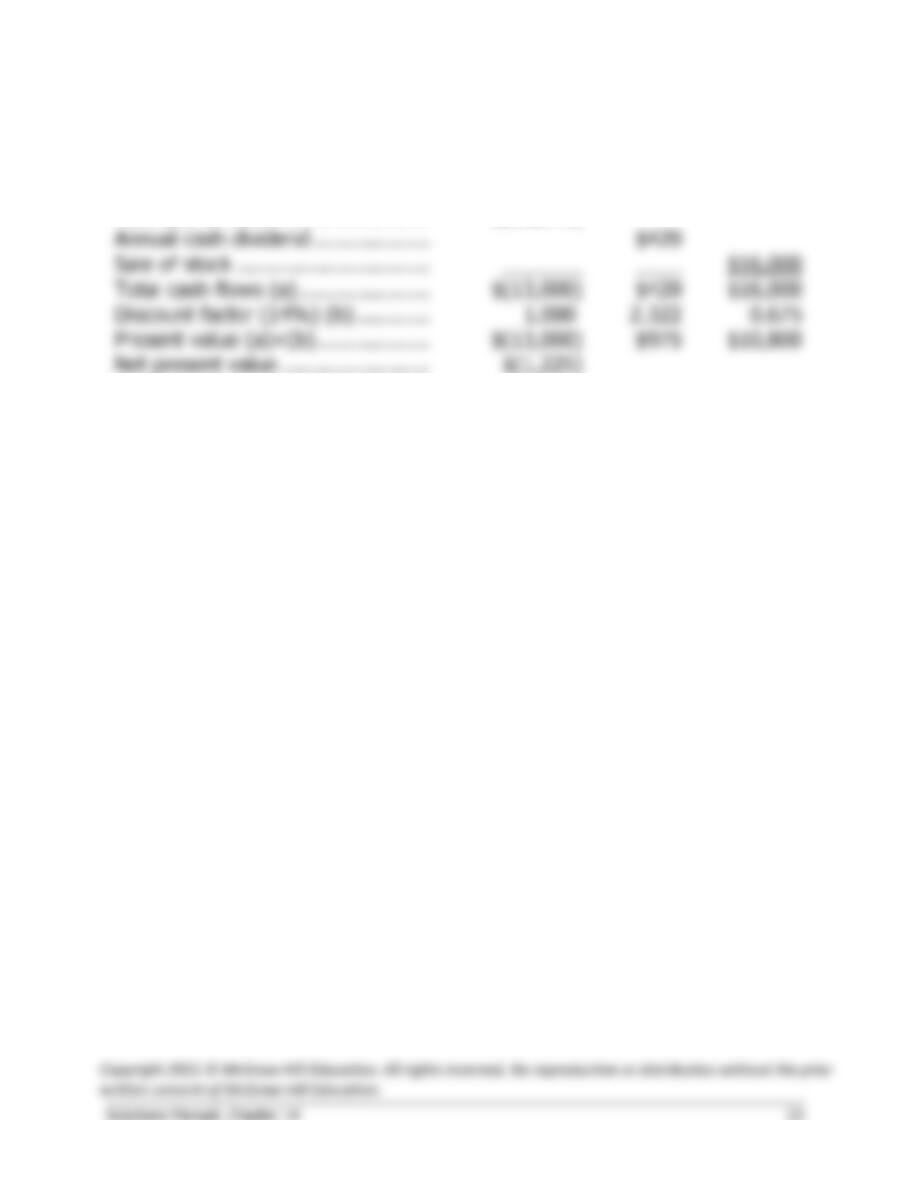
1.
Now
Years
1-3
Year
3
Purchase of stock ……………………
$(13,000)
Annual cash dividend ……………….
Sale of stock ………………………….
Total cash flows (a) …………………
$(13,000)
Discount factor (14%) (b) …………
Present value (a)×(b) ………………
$(13,000)
2. No, Kathy did not earn a 14% return on the Malti Company stock. The
negative net present value indicates that the rate of return on the
investment is less than the minimum required rate of return of 14%.
Exercise 14-11 (30 minutes)
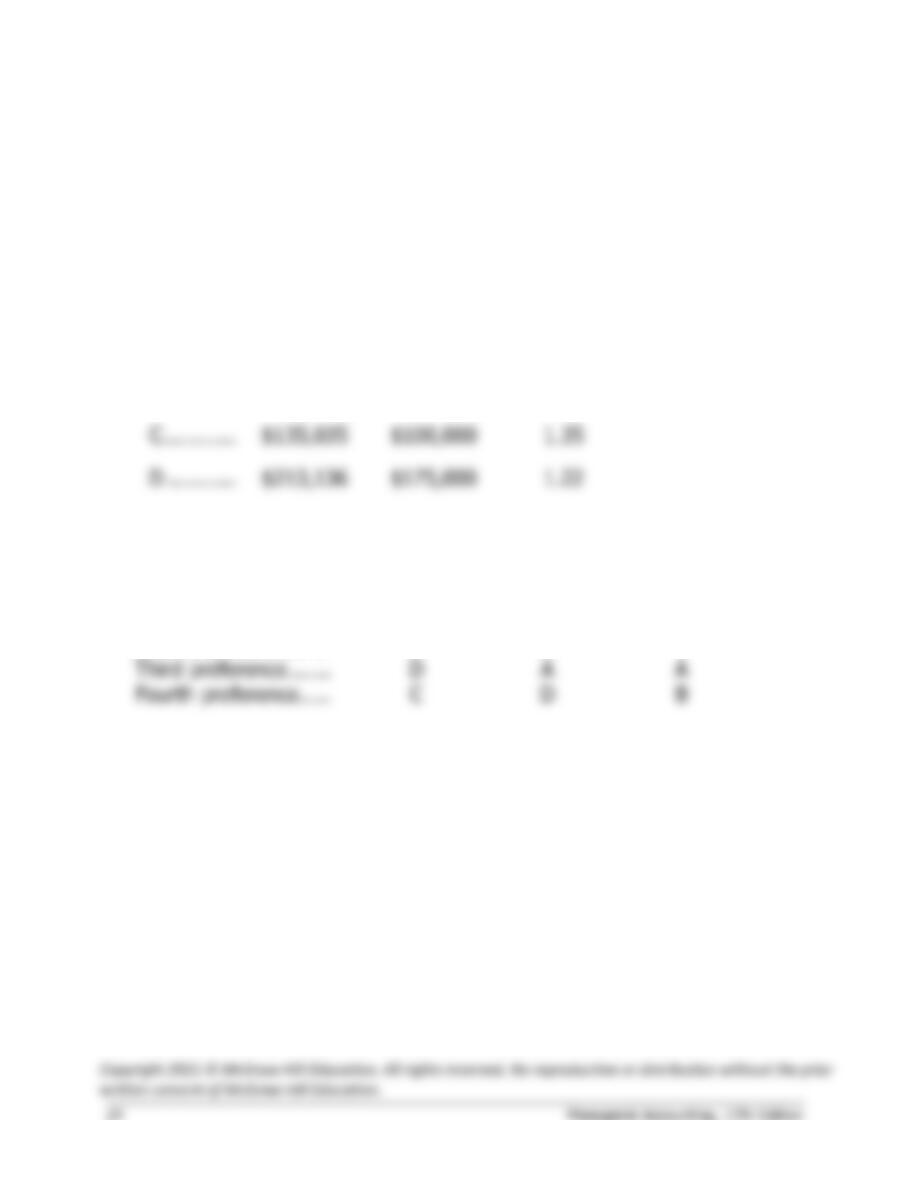
1. The profitability index is computed as follows:
Project
Present
Value of
Cash
Inflows
(a)
Investment
Required
(b)
Profitability
Index
(a) ÷ (b)
A…………
$204,323
$160,000
1.28
B …………
$177,000
$135,000
1.31
C…………
$100,000
1.35
D ………..
$213,136
$175,000
1.22
2. a., b., and c.
Net Present
Value
Profitability
Index
Internal Rate
of Return
First preference ……..
A
C
D
Second preference …
B
B
C
Third preference …….
D
A
A
Fourth preference …..
C
D
B
Exercise 14-11 (continued)
3. Oxford Company’s opportunities for reinvesting funds as they are
released from a project will determine which ranking is best. The
internal rate of return method assumes that any released funds are
reinvested at the rate of return shown for a project. This means that
funds released from project D would have to be reinvested in another
project yielding a rate of return of 22%. Another project yielding such a
high rate of return might be difficult to find.
Exercise 14-12 (10 minutes)
Note: All present value factors in the computation below have been taken
from Exhibit 14B-1 in Appendix 14B, using a 12% discount rate.
Amount of the investment ……………………….
$104,950
Less present value of Year 1 and Year 2
cash inflows:
Present value of Year 3 cash inflow …………..
Exercise 14-13 (15 minutes)
1. The payback period is:
Investment required
Payback period = Annual net cash inflow
$432,000
= = 4.8 years
$90,000
No, the equipment would not be purchased because the payback period
(4.8 years) exceeds the company’s maximum payback time (4.0 years).
2. The simple rate of return would be computed as follows:
Exercise 14-14 (10 minutes)
1. Project X:
Now
Years
1-6
Initial investment ………….
$(35,000)
Annual cash inflows ………
$12,000
Total cash flows (a) ………
$(35,000)
$12,000
Discount factor (18%) (b)
3.498
Present value (a)×(b) ……
$(35,000)
$41,976
Net present value …………
2. Project Y:
Now
Year
6
Initial investment ……………
$(35,000)
Single cash inflow …………..
_______
90,000
Total cash flows (a) ………..
$(35,000)
$90,000
Discount factor (18%) (b) ..
1.000
0.370
Present value (a)×(b) ……..
$(35,000)
$33,300
Net present value …………..
$(1,700)
Exercise 14-15 (30 minutes)
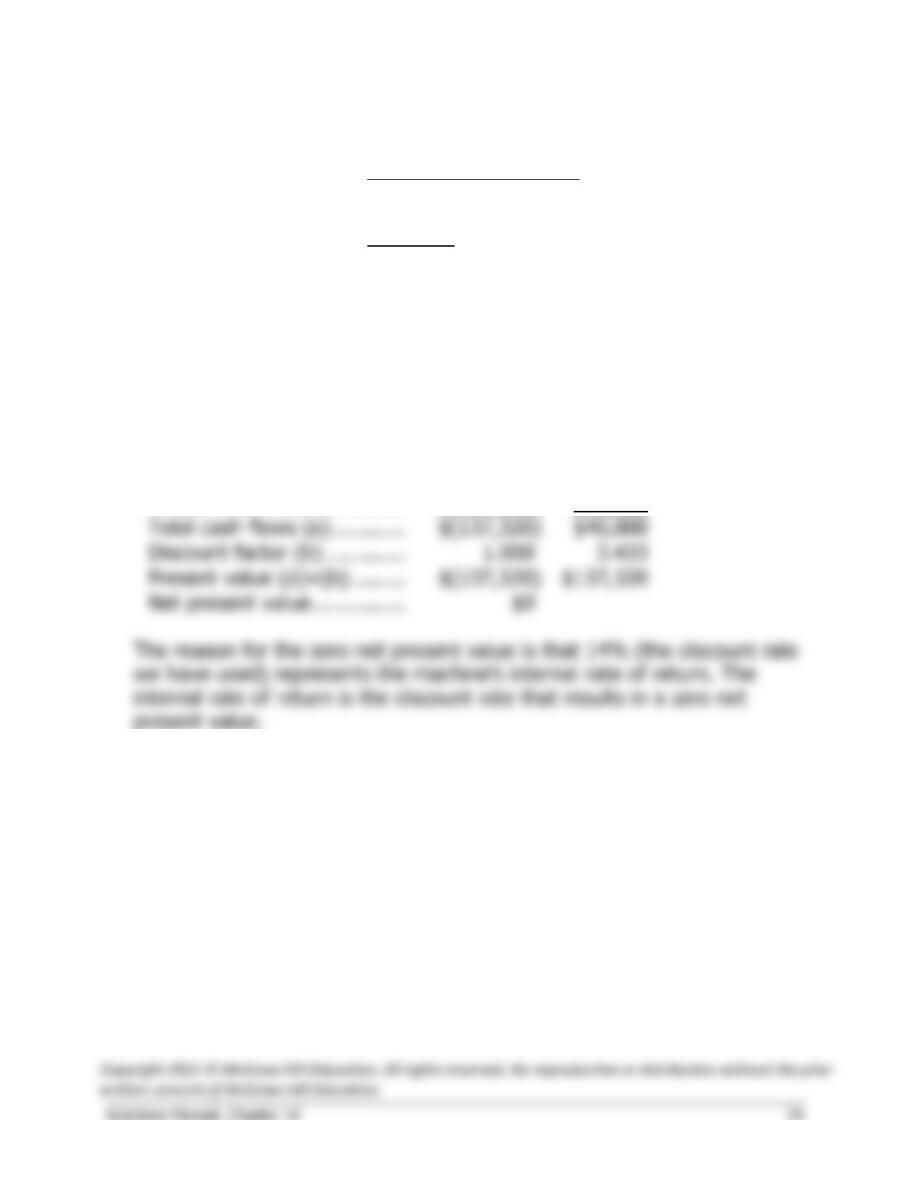
1.
Investment required
Factor of the internal =
rate of return Annual net cash inflow
$137,320
= = 3.433
$40,000
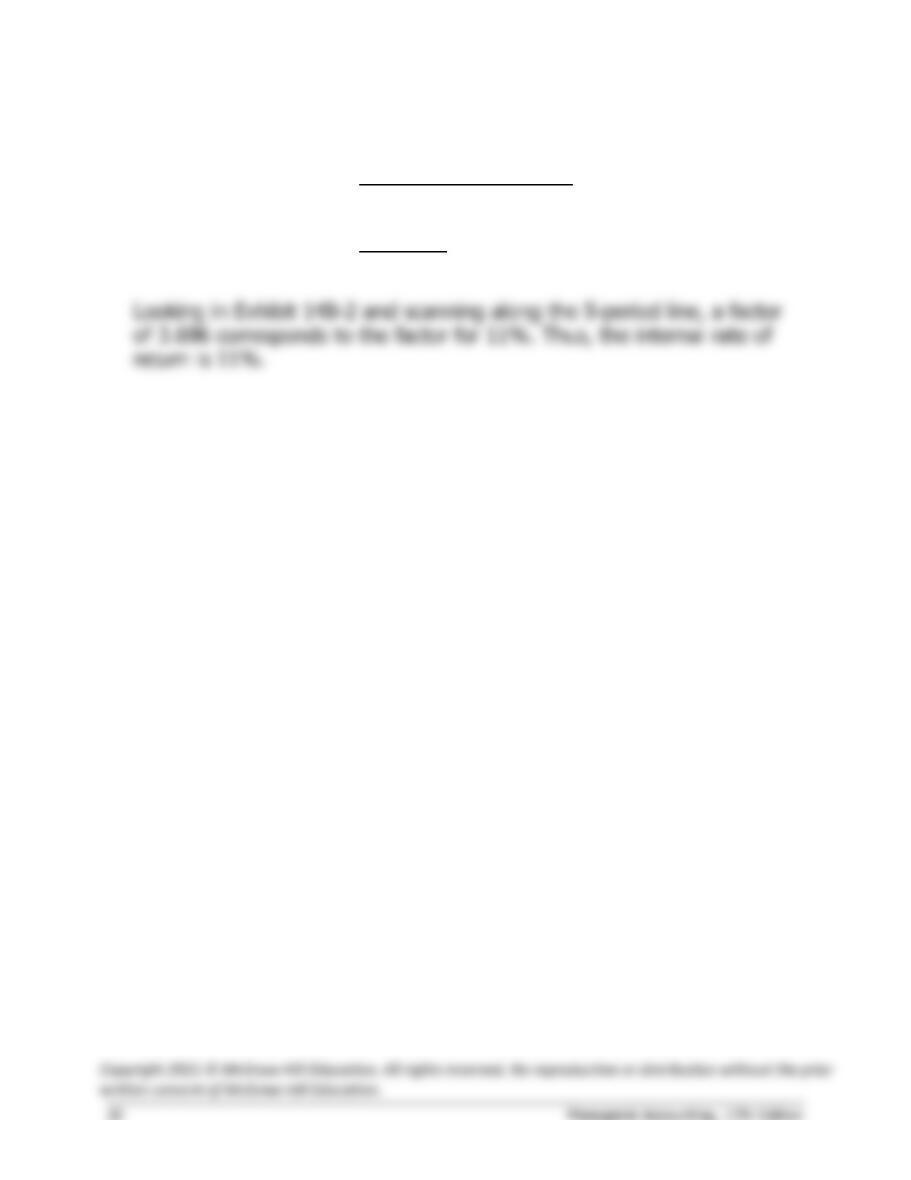
Looking in Exhibit 14B-2 and scanning along the 5-period line, a factor
of 3.433 represents an internal rate of return of 14%.
2. The machine’s net present value is computed as follows:
Now
Years
1-5
Purchase of machine ……….
$(137,320)
Annual cash inflows …………
_________
$40,000
Total cash flows (a) …………
$(137,320)
Discount factor (b) ………….
Present value (a)×(b) ………
$(137,320)
Net present value ……………
Exercise 14-15 (continued)
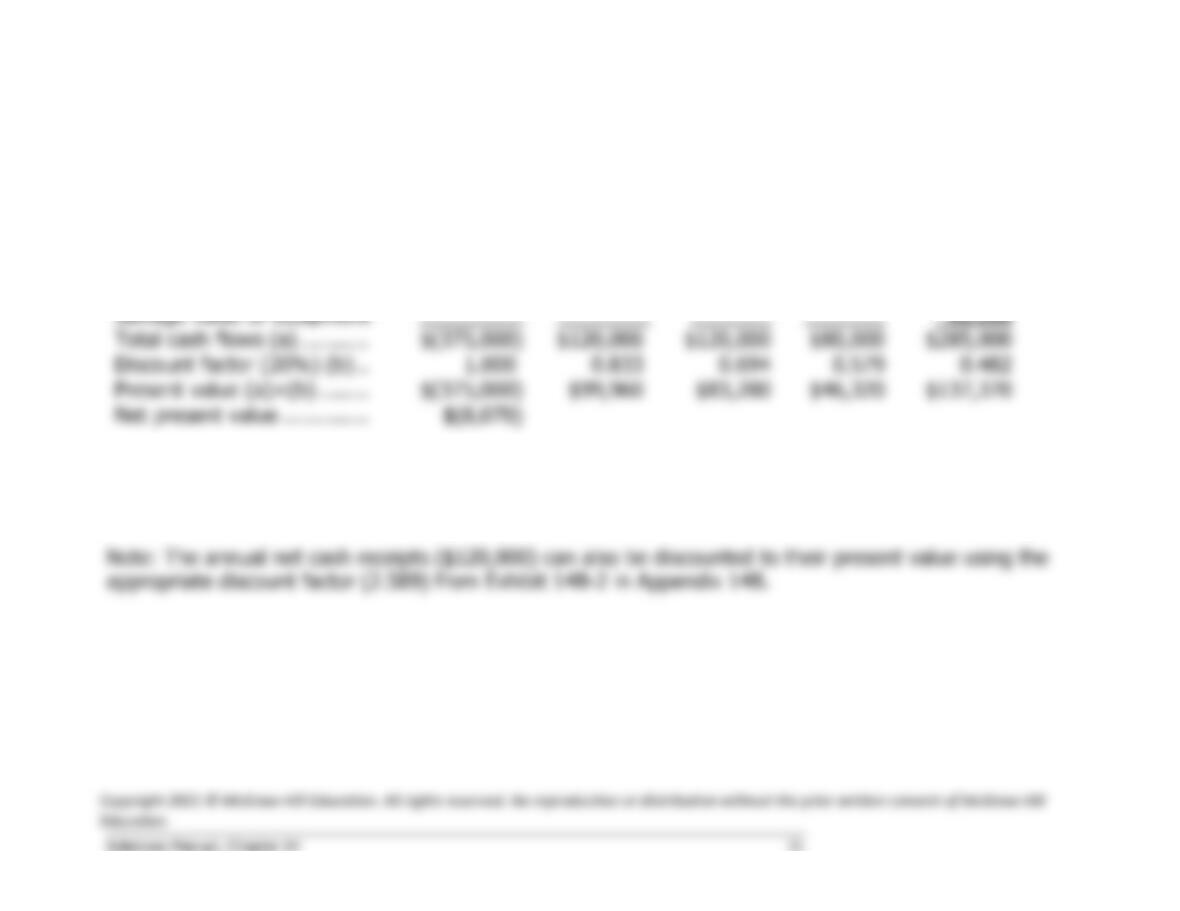
3.
Investment required
Factor of the internal=
rate of return Annual net cash inflow
$137,320
= = 3.696 (rounded)
$37,150
Problem 14-16 (20 minutes)
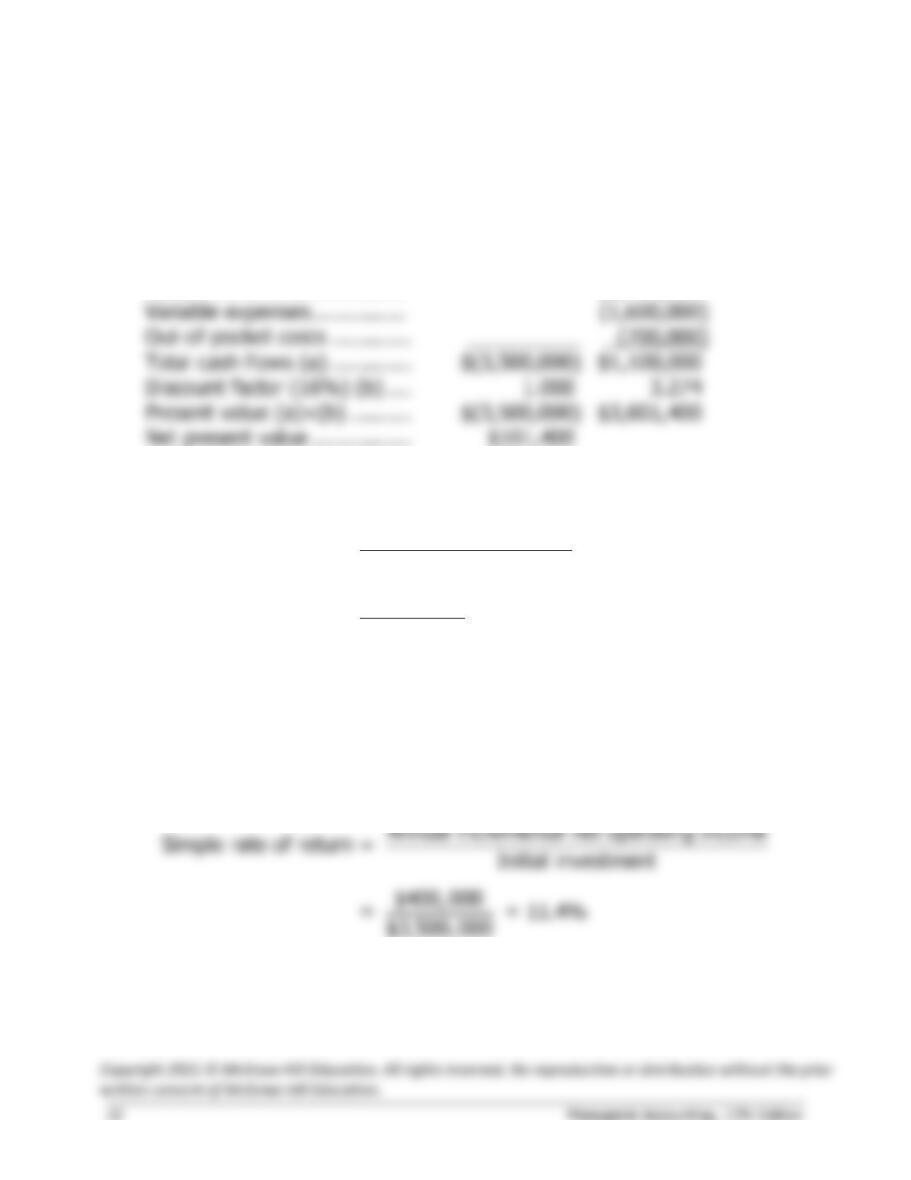
Now
1
2
3
4
Purchase of equipment ……
$(275,000)
Working capital investment
(100,000)
Annual net cash receipts ….
$120,000
$120,000
$120,000
$120,000
Road construction …………..
(40,000)
Working capital released ….
100,000
Salvage value of equipment
_________
________
_______
_______
Total cash flows (a) ………..
$(375,000)
$120,000
$120,000
$285,000
Discount factor (20%) (b) ..
Present value (a)×(b) ……..
$83,280
$137,370
Net present value …………..
No, the project should not be accepted; it has a negative net present value at a 20% discount rate. This
means that the rate of return on the investment is less than the company’s required rate of return of
20%.
Problem 14-17 (20 minutes)
1. The net present value is computed as follows:
Now
Years
1-5
Purchase of equipment ……..
$(3,500,000)
Sales …………………………….
$3,400,000
Variable expenses ……………
Discount factor (16%) (b) ….
Present value (a)×(b) ……….
$(3,500,000)
Net present value …………….
2. The internal rate of return is computed as follows:
Investment required
Factor of the internal=
rate of return Annual net cash inflow
$3,500,000
= = 3.182 (rounded)
$1,100,000
Looking in Exhibit 14B-2 and scanning along the five-period line, we can
see that the factor computed above, 3.182, is closest to 3.199, the factor
for the 17% rate of return. Therefore, to the nearest whole percent, the
internal rate of return is 17%.
3. The simple rate of return is computed as follows:

Problem 14-17 (continued)
4. The company would want Casey to invest in the project because it has a
positive net present value of $101,400 and an internal rate of return of
17%. However, Casey might be inclined to reject the project because its
simple rate of return of 11.4% is well below his historical return on
investment (ROI) of 20%. Casey may be justifiably concerned that
implementing this project would lower his ROI and his next pay raise.
Problem 14-18 (20 minutes)
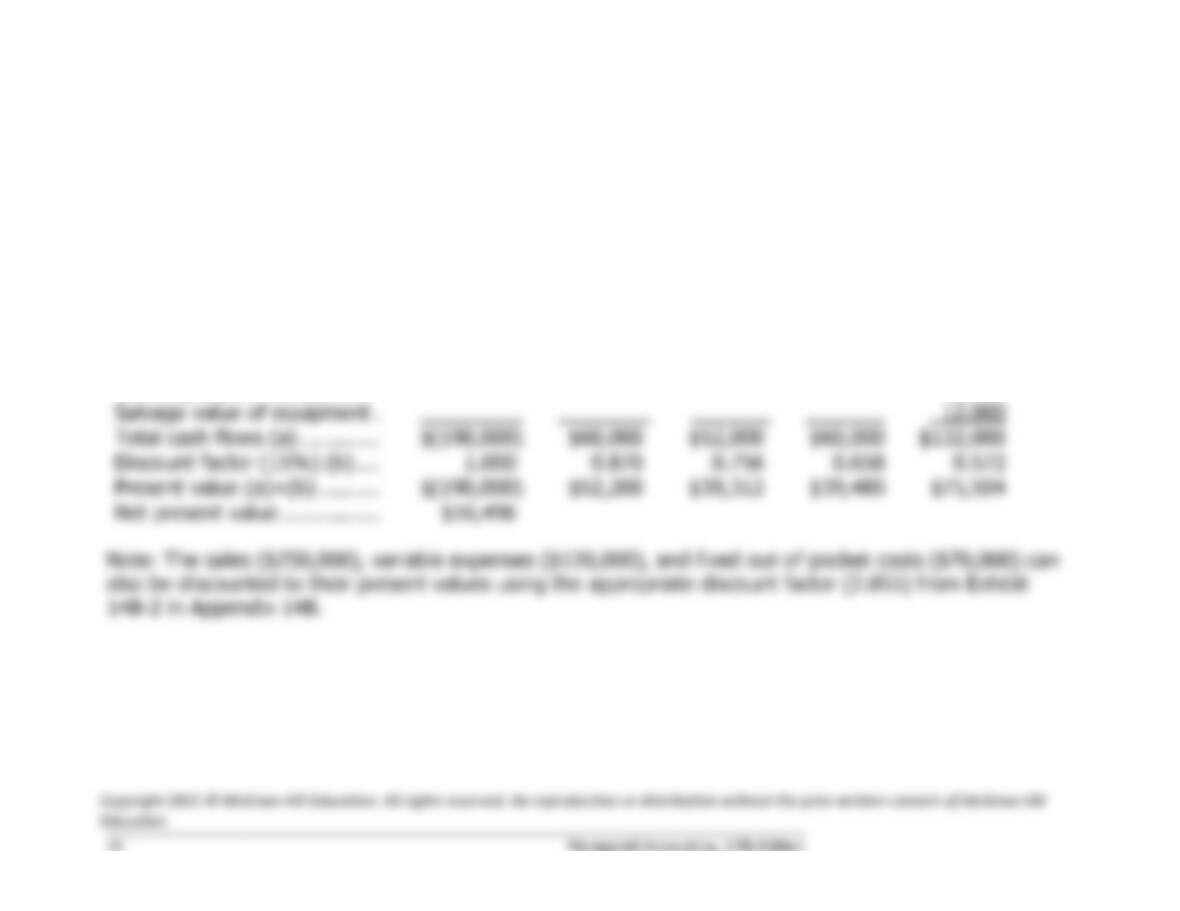
The net present value is computed as follows:
Now
1
2
3
4
Purchase of equipment ……..
$(130,000)
Working capital investment ..
(60,000)
Sales …………………………….
$250,000
$250,000
$250,000
$250,000
Variable expenses …………….
(120,000)
(120,000)
(120,000)
(120,000)
Fixed out–of-pocket costs …..
(70,000)
(70,000)
(70,000)
(70,000)
Overhaul of equipment ……..
(8,000)
Working capital released ……
60,000
Salvage value of equipment .
_______
Total cash flows (a) ………….
$(190,000)
Discount factor (15%) (b) ….
Present value (a)×(b) ……….
$(190,000)
Net present value …………….
$16,496
Problem 14-19 (30 minutes)
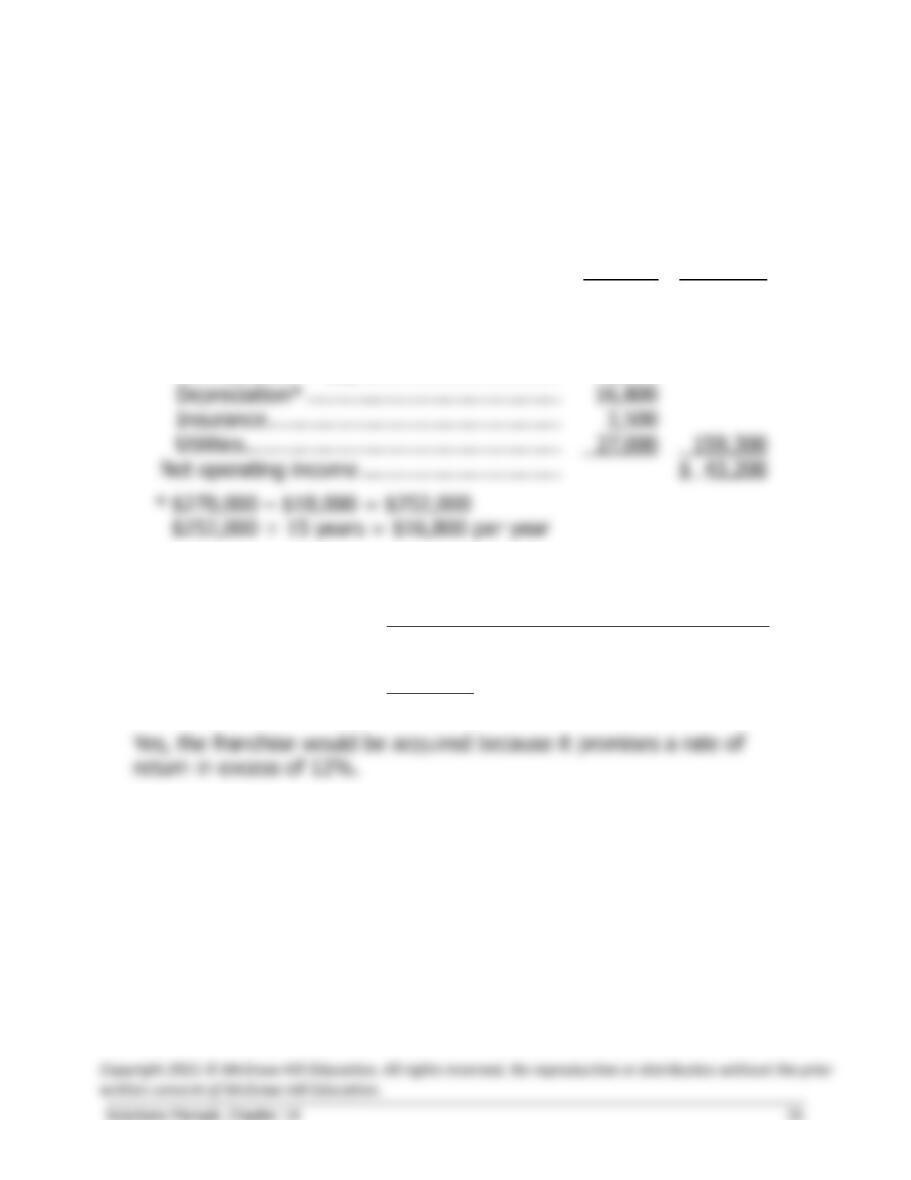
1. The income statement would be:
Sales ………………………………………………..
$300,000
Variable expenses:
Cost of ingredients (20% × $300,000) …..
$60,000
Commissions (12.5% × $300,000) ………..
37,500
97,500
Contribution margin ……………………………..
202,500
Fixed expenses:
Salaries …………………………………………..
70,000
Rent ($3,500 × 12) …………………………...
42,000
Depreciation* …………………………………..
Insurance ………………………………………..
Utilities ……………………………………………
Net operating income …………………………..
2. The formula for the simple rate of return is:
Annual incremental net operating income
Simple rate of return = Initial investment
$43,200
= = 16.0%
$270,000
Problem 14-19 (continued)
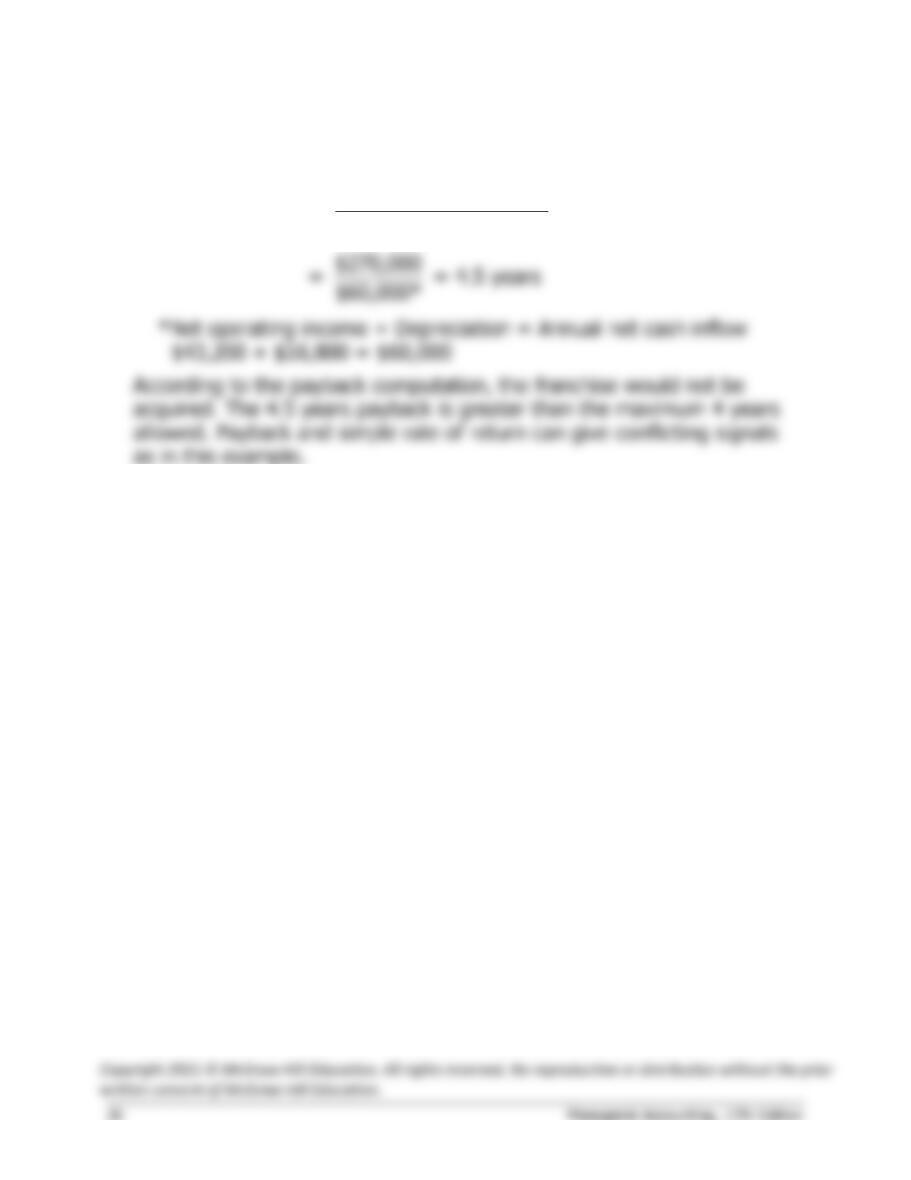
3. The formula for the payback period is:
Investment required
Payback period = Annual net cash inflow
Problem 14-20 (30 minutes)
1. The annual net cost savings would be:
Reduction in labor costs ……………………………………
$108,000
Reduction in material waste ………………………………
6,500
Total …………………………………………………………….
114,500
Less increased maintenance costs ………………………
36,000
Annual net cost savings ……………………………………
$ 78,500
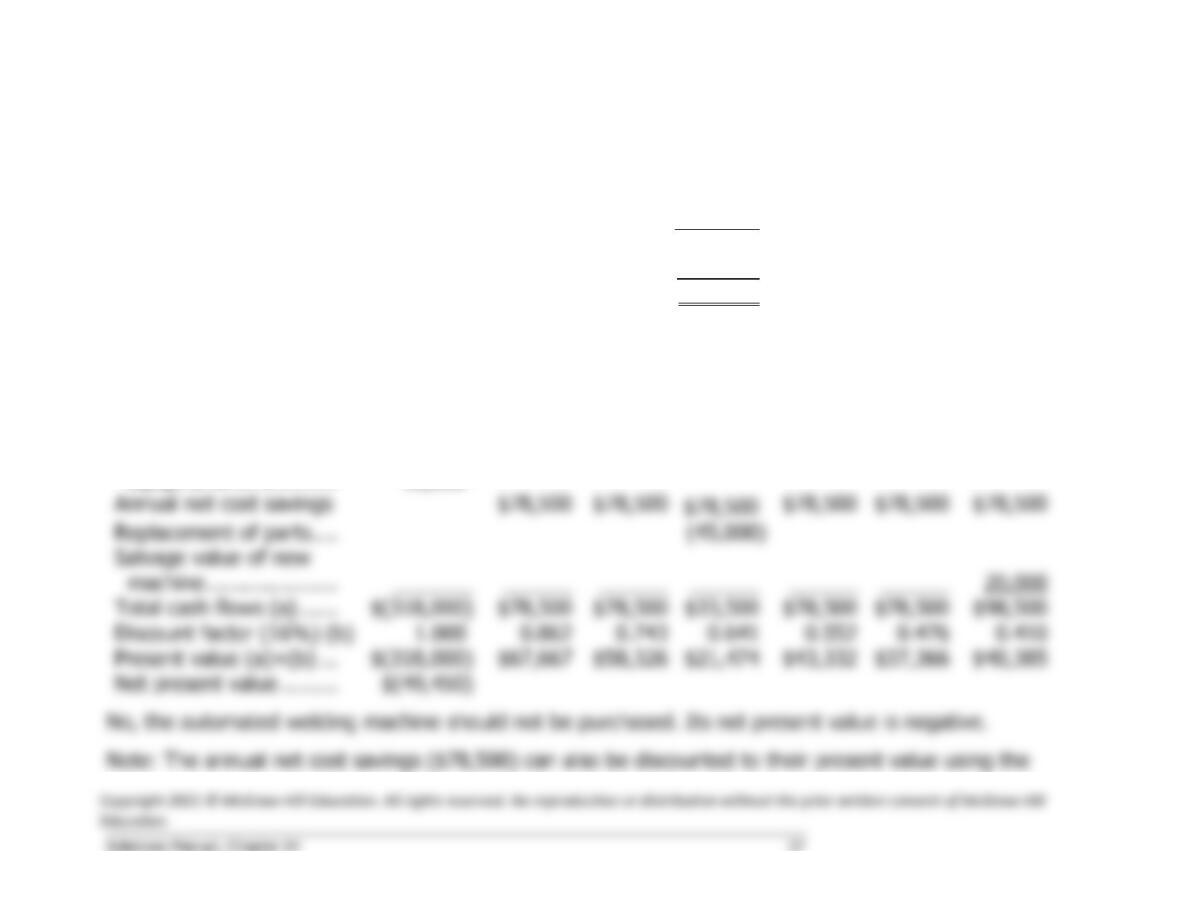
2. Using this cost savings figure, and other data from the text, the net present value analysis would be:
Now
1
2
3
4
5
6
Cost of machine ………..
$(250,000)
Software and installation
(80,000)
Salvage value of old
Replacement of parts ….
Total cash flows (a) ……
$(318,000)
Discount factor (16%) (b)
Present value (a)×(b) …
$(318,000)
$21,474
$43,332
$37,366
Net present value ………
appropriate discount factor (3.685) from Exhibit 14B-2 in Appendix 14B.
Problem 14-20 (continued)
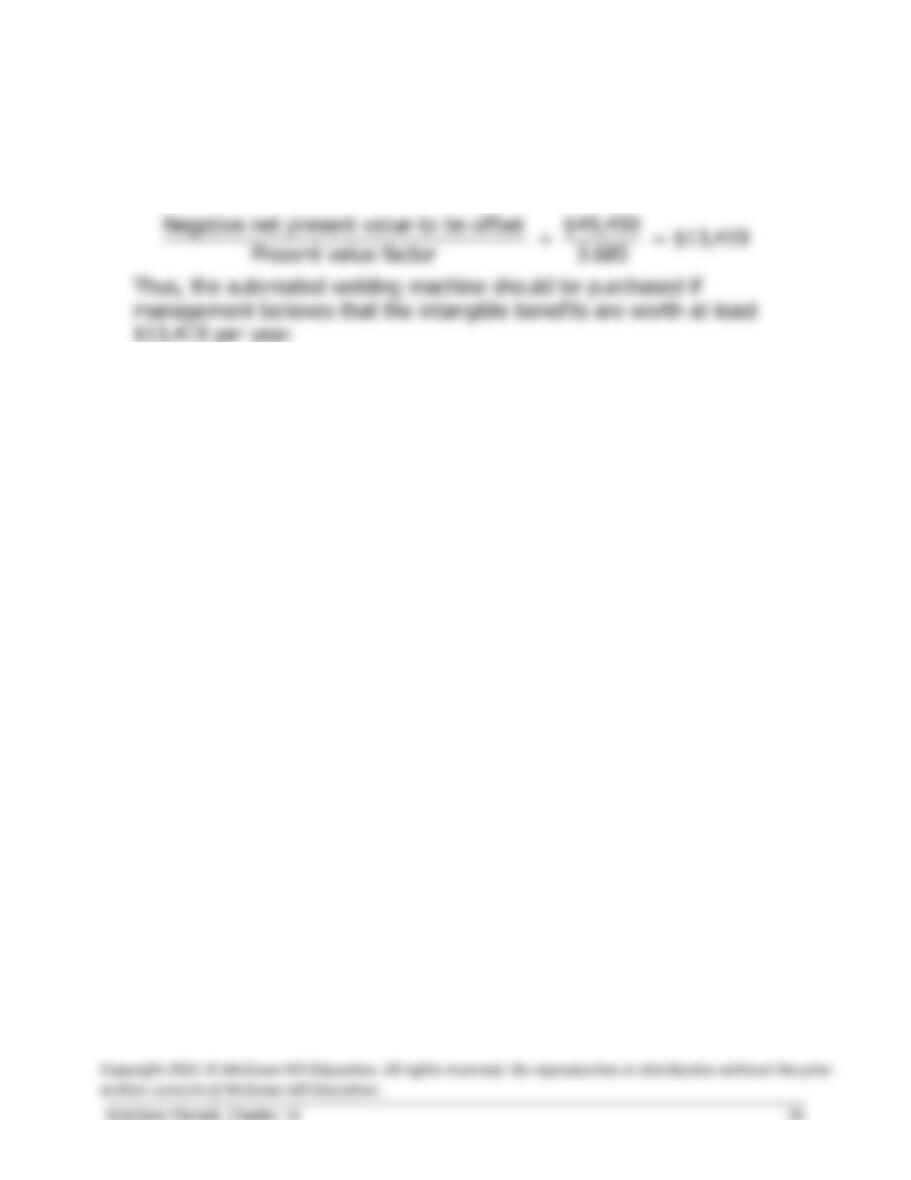
3. The dollar value per year that would be required for the intangible
benefits is:
Problem 14-21 (30 minutes)
1. The formula for the profitability index is:
Present value of cash inflows
Profitability index = Investment required by the project
The indexes for the projects under consideration would be:
Project 1:
$336,140 ÷ $270,000 = 1.24
Project 2:
$522,970 ÷ $450,000 = 1.16
Project 3:
$433,400 ÷ $360,000 = 1.20
Project 4:
$567,270 ÷ $480,000 = 1.18
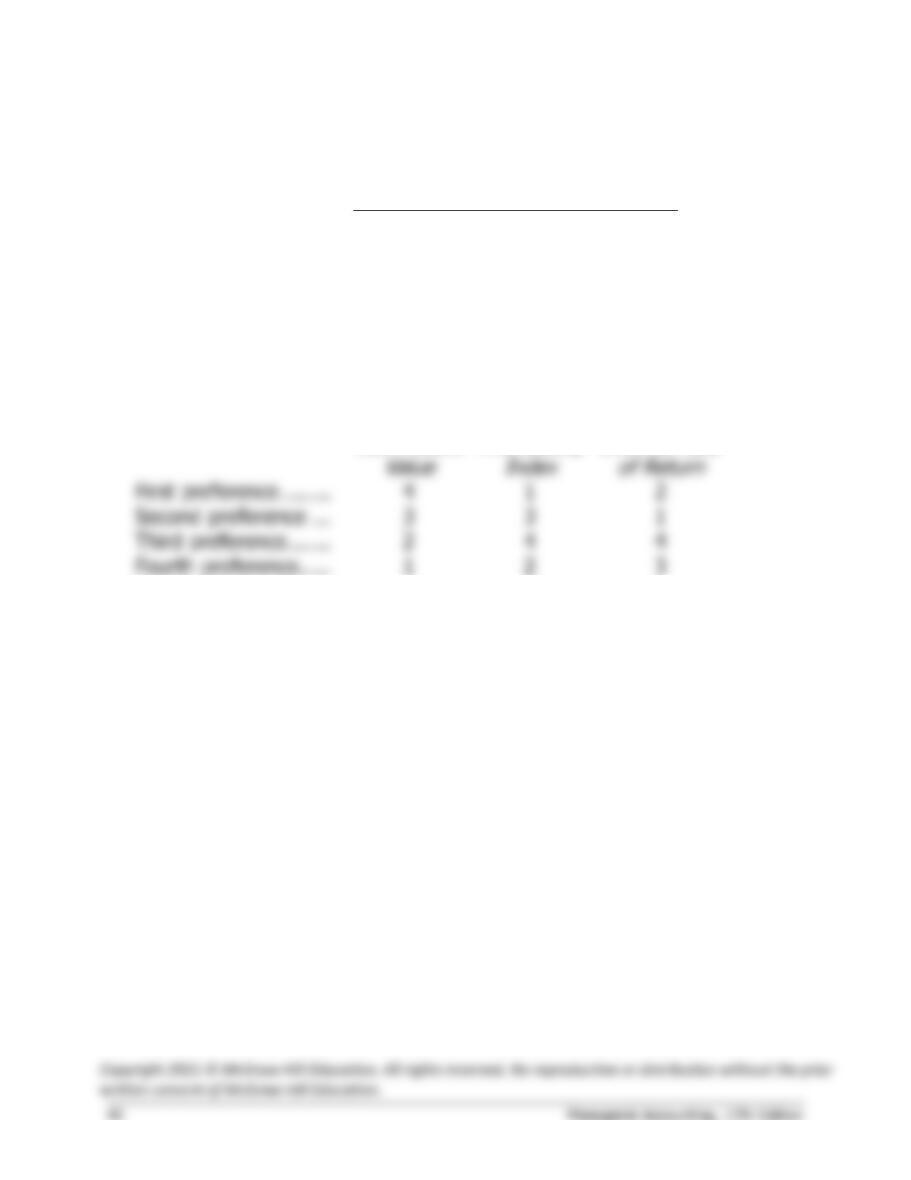
2. a., b., and c.
Third preference …….
Fourth preference …..
Net Present
Profitability
Internal Rate