
Chapter 14
Business Unit Performance Measurement
Learning Objectives
1. Evaluate divisional accounting income as a performance measure.
2. Interpret and use return on investment (ROI).
3. Interpret and use residual income (RI).
4. Interpret and use economic value added (EVA).
5. Explain how historical cost and net book value-based accounting measures can be misleading
in evaluating performance.
Chapter Overview
I. DIVISIONAL PERFORMANCE MEASUREMENT
II. ACCOUNTING INCOME
• Computing Divisional Income
• Advantages and Disadvantages of Divisional Income
• Some Simple Financial Ratios
III. RETURN ON INVESTMENT
IV. RESIDUAL INCOME MEASURES
• Limitations of Residual Income
V. ECONOMIC VALUE ADDED (EVA)
• Limitations of EVA
VI. DIVISIONAL PERFORMANCE MEASUREMENT: A SUMMARY
VII. MEASURING THE INVESTMENT BASE
VIII. OTHER ISSUES IN DIVISIONAL PERFORMANCE MEASUREMENT
Chapter Outline
LO 14-1 Evaluate divisional accounting income as a performance measure.
DIVISIONAL PERFORMANCE MEASUREMENT
• “Division” is a common term for an investment center (or a business unit) whose manager is
responsible for asset deployment, at least to some extent, in addition to revenue and cost
responsibility.
o What to consider when performance measures are developed?
o No performance measurement system perfectly aligns the manager’s and organization’s
interests. (See Business Application box “What Determines Whether Firms Use
Divisional Measures for Measuring Divisional Performance?”)
▪ Possible dysfunctional decisions made by managers must be considered when
designing the system.
ACCOUNTING INCOME
• Divisional income is an obvious performance measure when divisions have both revenue and
cost responsibility.
o The role of divisional measures decreased with the extent to which the manager’s
decisions affected the performance of other divisions.
• Computing Divisional Income
o The computation of divisional income follows that of accounting in general.
o Exhibit 14.1 shows an example of divisional income statements.
o Many firms are organized into geographical responsibility units. Another common basis
for organization is product line.
• Advantages and Disadvantages of Divisional Income
o Advantages of using after-tax income as a performance measure are:
▪ It is easy to understand, prepared in the same way as the firm’s income.
o Disadvantages of using divisional income as a performance measure are:
▪ While the results of the divisions can be compared, it is not clear that the comparison
reflects only the performance of the managers. The divisions may be of different sizes.

• Some Simple Financial Ratios
o When the divisions are different in sizes, the use of financial (profitability) ratios may
improve comparison. Three profitability ratios are suggested.
▪ Gross margin ratio =
Sales
margin Gross
• Gross margin = Revenues – Cost of goods sold
▪ Operating margin ratio =
Sales
income Operating
• The operating margin ratio is a more comprehensive performance measure
because it includes the effect of not only the cost of goods but also operating costs.
▪ Profit margin ratio =
After-tax income
Sales
See Demonstration Problem 1
LO 14-2 Interpret and use return on investment (ROI).
RETURN ON INVESTMENT
• Return on investment (ROI)
=
After-tax income
Divisional assets
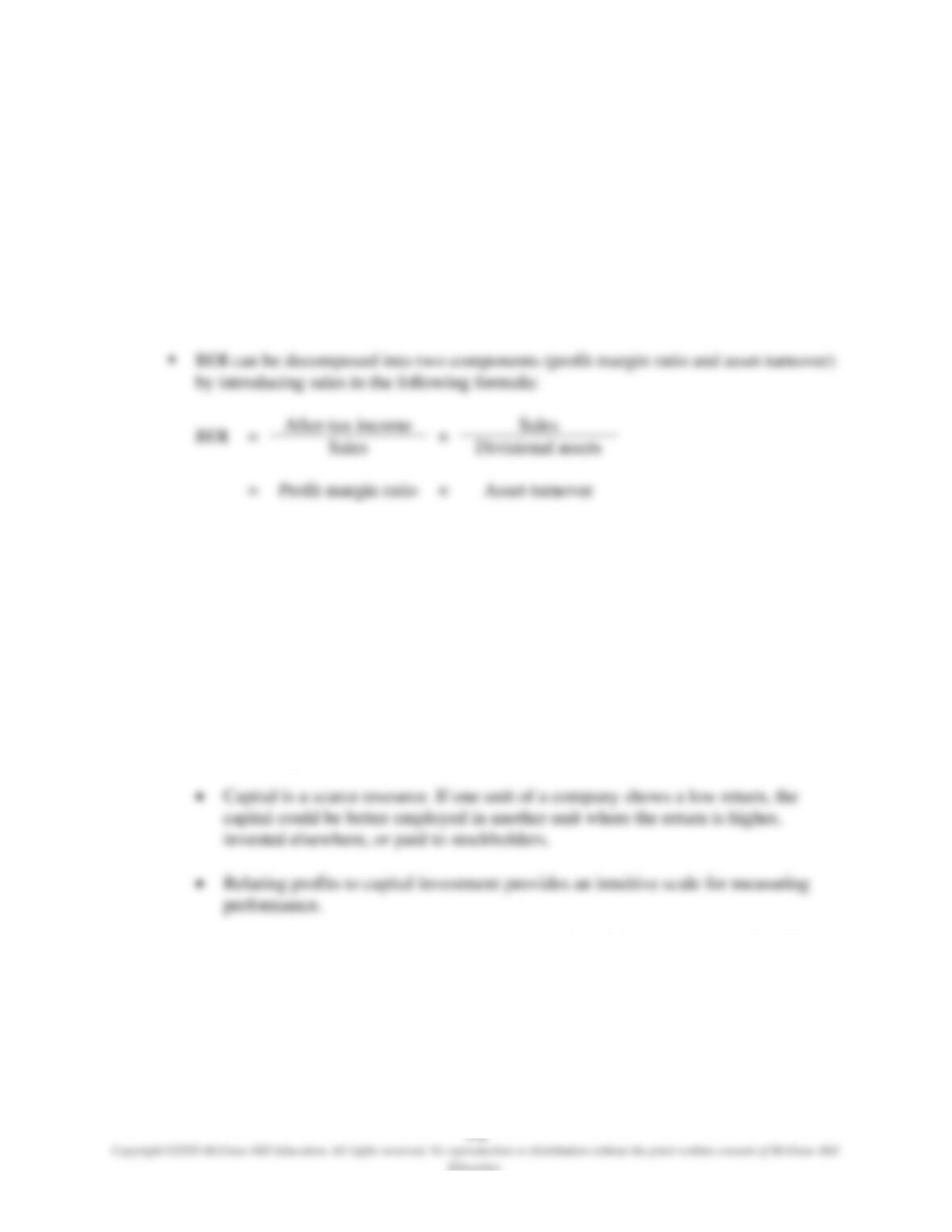
o Return on investment is an effective performance measure for managers with
responsibility for asset acquisition, usage, and disposal.
▪ Exhibit 14.4 shows the calculation of ROI based on information from Exhibit 14.1
(Divisional income statements) and Exhibit 14.3 (Divisional balance sheets).
• Performance Measures for Control: A Short Detour
o Return on investment can be used to highlight areas of the business that require attention.
That is, ROI can also play a role in the function of control.
• The profit margin ratio is a measure of the investment center’s ability to control
its costs for a given level of revenues.
• The asset turnover ratio is a measure of the investment center’s ability to generate
sales for each dollar of assets invested in the center.
• By decomposing ROI, managers can anticipate where problems will occur in
achieving acceptable ROIs and can take actions early.
▪ Declining profit margins suggest the need to implement cost controls; lower asset
turnover suggests the need to review asset utilization.
See Demonstration Problem 2
• Limitations of ROI include:
o Short-Term Focus (Myopia) From Accounting Information
▪ Short-term focus: Because accounting results are based on historical information,
measures of profit and investment base tend to focus on current activities, which are
myopic.
o Conflicting Incentives for Managers (Suboptimization)
• One advantage of using ROI is that the information needed to compute it already exists in the
accounting records.
o Accounting information, however, does not reflect the change in value as a result of the
division manager’s actions because of three general problems.
• A more serious problem with ratio-based measures is that managers can make decisions that
lower organizational performance, but increase the manager’s reported performance.
o As a performance measure, ROI (a ratio) is not consistent with the investment analysis
based on the net present value calculation (which generates absolute numbers). Therefore,
ROI does not provide a signal that is consistent with the decision criteria used for the
investment decision.
▪ A manager who considers adopting a new project will calculate the ROI as the
weighted average of the ROI of the project and the ROI of the division without the
project. The weights are the relative investments in the new project and the division
prior to the project.
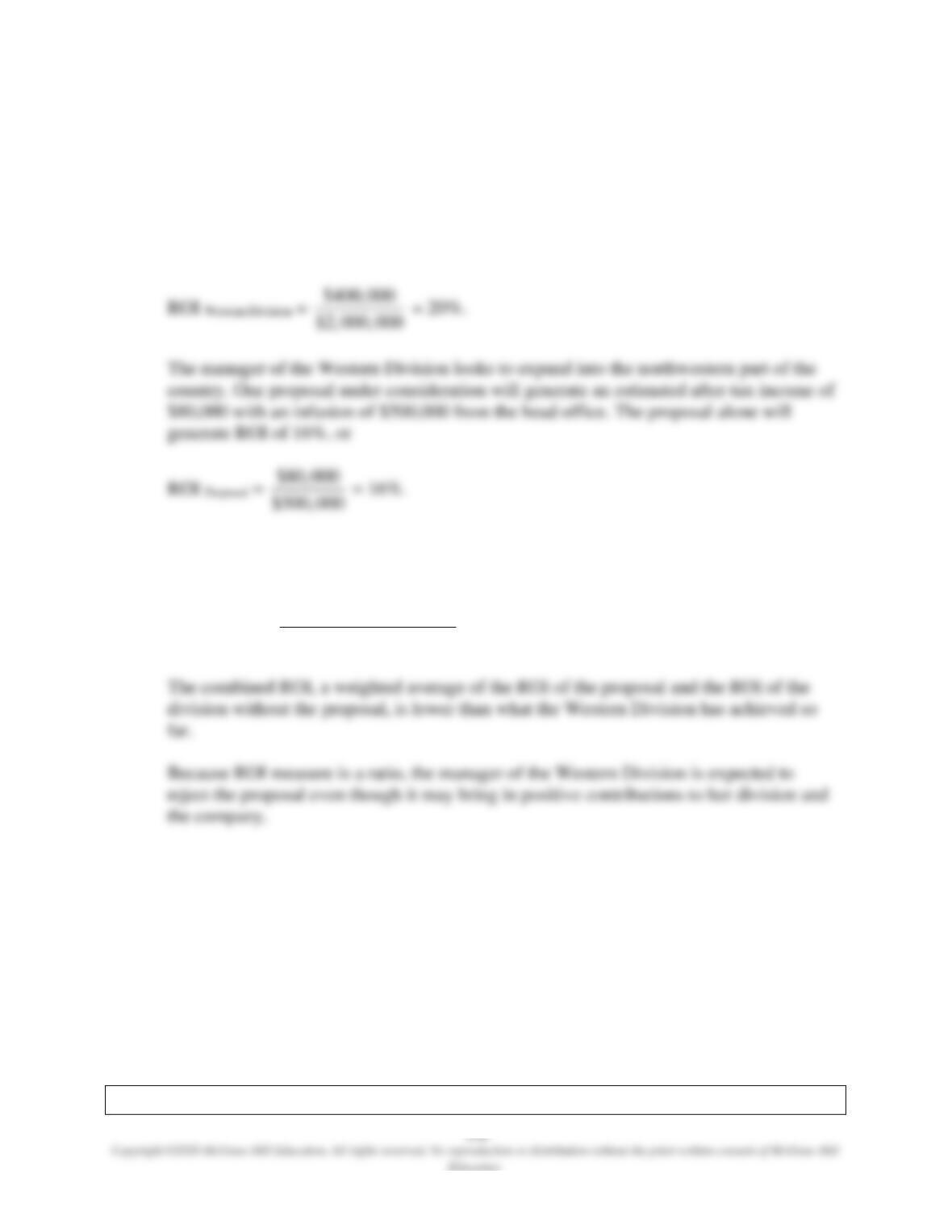
o Example 1: The Western Division of Health Quest currently enjoys a 20 percent ROI
based on after-tax income of $400,000 and invested assets of $2,000,000. That is,
The manager, whose bonus depends on maintaining or improving her division’s ROI, is
reluctant to proceed. Her concern is justified by the combined ROI, calculated below.
ROI Combined =
$400, 000 $80,000
$2, 000,000 $500,000
+
+
= 19.2%.
o Any project with an ROI below that of the division without the project will lower the
division’s reported performance.
▪ A manager compensated on annual ROI performance could choose not to adopt a
project that increases firm value.
o Many companies continue to use ROI despite its limitations.
▪ The potential for managers having incentives to take actions that are not in the
organization’s interest must be recognized in designing the performance measurement
system (See Business Application box “Performance Measurement at Walmart”).
LO 14-3 Interpret and use residual income (RI).
RESIDUAL INCOME MEASURES
• Cost of capital represents the opportunity cost of the resources invested (debt and equity
capital) in the business. It is the payment required to finance projects.
• Cost of invested capital = Cost of capital × Divisional assets
o Cost of invested capital measures the investment in the division. It is the cost of the
investment required to operate the division.
• Residual income is defined as the excess of actual profit over the cost of invested capital in
the unit. That is,
Residual income = After-tax income – Cost of invested capital
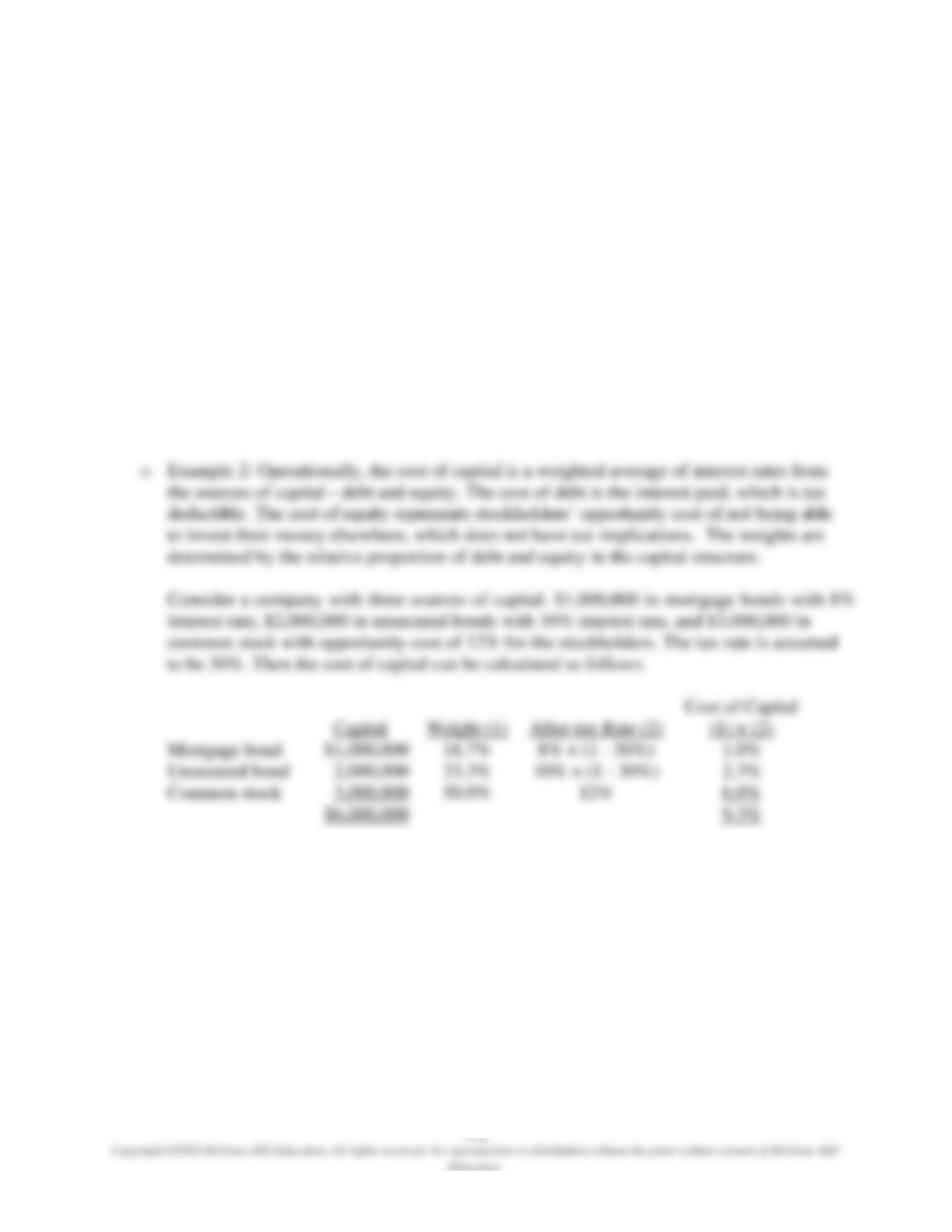
Mortgage bond
Unsecured bond
Common stock
o Residual income is similar to economist’s notion of profit as being the amount left over
after all costs, including the cost of the capital employed in the business unit, are
subtracted.
▪ Exhibit 14.7 shows a calculation of the residual income.
See Demonstration Problem 3
o One advantage of residual income over ROI is that it is not a ratio. Managers evaluated
using the residual income will invest only in projects that increase residual income.
▪ Residual income reduces the suboptimization problem, as seen in Exhibit 14.8.
▪ The residual income for the division is the sum of the residual income for the project
and the residual income for the division prior to the investment in the project.
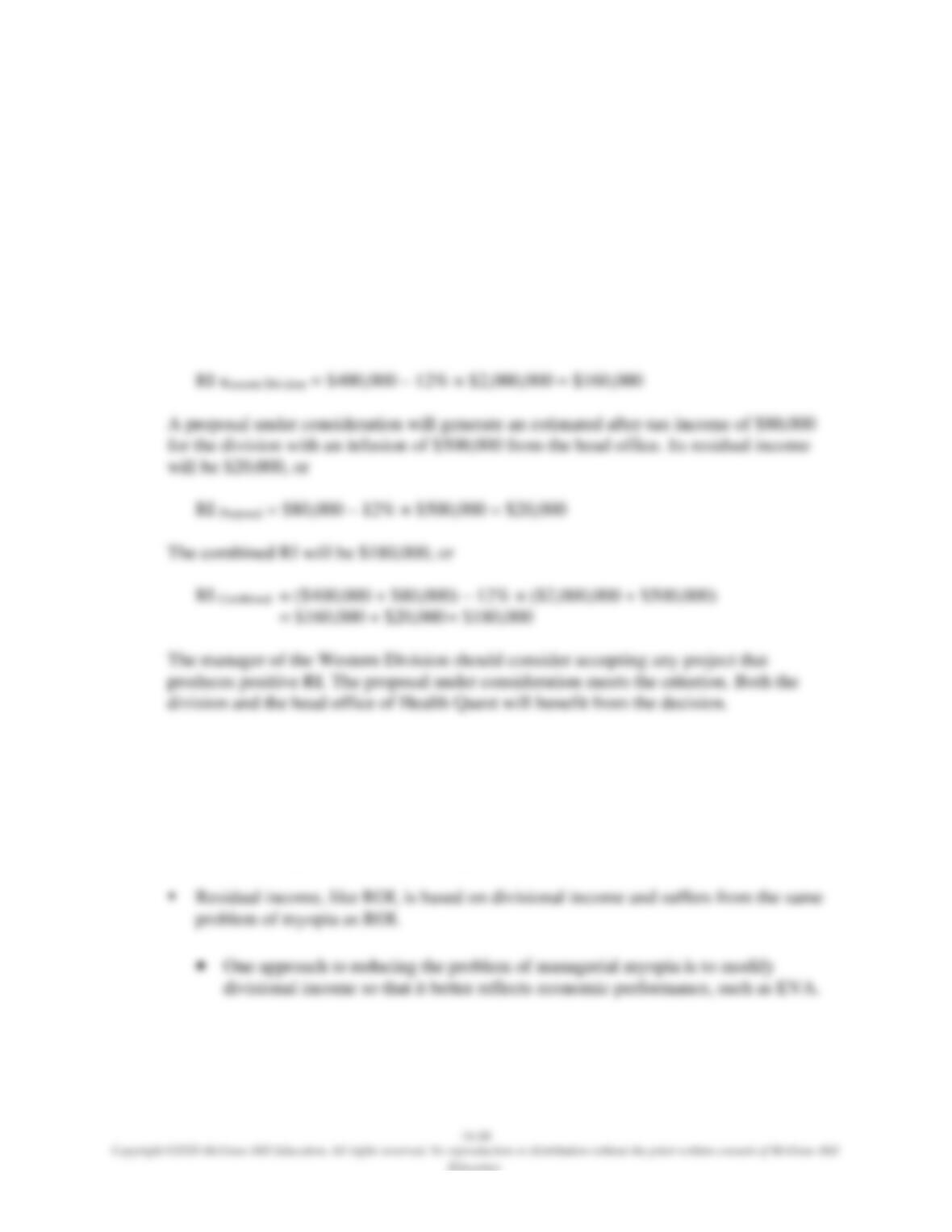
o Example 3 (Continued from Example 1): Health Quest faces 12% of cost of capital. The
Western Division of Health Quest currently earns an after-tax income of $400,000 based
on assets of $2,000,000. Its residual income can be calculated as follows.
• Limitations of Residual Income
o Residual income does not eliminate the suboptimization problem.
▪ The analysis in Exhibit 14.8 shows that there is still a conflict between the decision
criterion, net present value, and the performance measure, residual income.
LO 14-4 Interpret and use economic value added (EVA).
ECONOMIC VALUE ADDED (EVA)
• Economic value added (EVA) is defined as the annual after-tax (adjusted) divisional
income minus the total annual cost of (adjusted) capital.
o EVA = (After-tax income ± adjustments) – (Divisional investments ± adjustments).
▪ EVA is a concept closely related to residual income. However, it makes adjustments
to after-tax income and capital to eliminate accounting distortions, including the
treatment of inventory costs, the expensing of many intangibles, and so on. (See
Business Application box “EVA at Best Buy.”)
o Example 4: Generally accepted accounting principles require the expensing of research
and development (R&D) expenditures in the U.S. Managers who are evaluated using
accounting income-based measures are less motivated to invest in R&D. One adjustment
o The computations of EVA are exactly what would be made if the accountant mistakenly
recorded the entire cost of a machine as an expense instead of properly recording it as an
asset and then depreciating it over its useful life.
See Demonstration Problem 4
• Limitations of EVA
o Conceptually, EVA addresses problems associated with ROI and residual income.
▪ EVA also does not resolve the suboptimization problem. The fundamental issue is
that EVA is based on accounting income while the decision to invest is based on
present value of cash flows.
▪ There is very little systematic evidence on whether using EVA for evaluating
business unit managers affects decision making (See Business Application box “Does
Using Residual Income as a Performance Measure Affect Managers’ Decisions?”).
DIVISIONAL PERFORMANCE MEASUREMENT: A SUMMARY
LO 14-5 Explain how historical cost and net book value-based accounting can
be misleading in evaluating performance.
MEASURING THE INVESTMENT BASE
• Effective business unit performance assessment requires a measurement of the divisional
assets.
• Three general issues are frequently raised in measuring investment bases:
o Should gross book value be used?
o Should investment in assets be valued at historical cost or current value?
o Should investment be measured at the beginning or at the end of the year?
• Gross Book Value versus Net Book Value
• Historical Cost versus Current Cost
o Historical cost is the original cost to purchase or build an asset. Current cost is the cost
to replace or rebuild an existing asset.
o ROI increases each year under the historical cost method even though no operating
changes take place because the numerator is measured in current dollars to reflect current
cash transactions while the denominator and depreciation charges are based on historical
cost.
o The current cost method reduces the effect by adjusting both the depreciation in the
o A level ROI is derived in the current cost, gross book value method because the asset and
all other prices increased at the same rate.
• Beginning, Ending, or Average Balance
o Using the beginning balance of the investment base could encourage asset acquisitions
early in the year to increase income for the entire year. Asset dispositions would be
encouraged at the end of the year to reduce the investment base for next year.
OTHER ISSUES IN DIVISIONAL PERFORMANCE MEASUREMENT
• Divisional income, ROI, residual income, and EVA are all financial performance measures
that consider the activities of the business unit independently of other units in the firm.