————–———————-————–——CHAPTER 14——-————————————————
REVIEW QUESTIONS
Q14-1 The organization of the statement of net position helps the reader assess an entity’s financial
position because assets and liabilities are generally listed in order of liquidity. That is, assets are listed in
Q14-2 The statement of activities provides the reader with a measure of the entity’s performance. Showing
revenues by source gives the reader a clue regarding the volatility and reliability of the various revenue
Q14-3 Ratios relate one financial statement data element to another data element in order to provide an
Q14-4 Operating results, financial position, and financial condition cannot be assessed in a vacuum. Time–
Q14–5 Common size financial statements convert the elements to percentages of 100. This enables the
Q14–6 The current ratio (ratio of current assets to current liabilities) and the quick ratio (generally, the ratio
of cash and short-term investments to current liabilities) are indicators of an entity’s liquidity. They provide
Q14–7 The number of days’ revenues in accounts receivable is a measure of asset turnover or efficiency.
The fewer the number of days’ revenues in accounts receivable, the more rapidly is the entity collecting
Q14–8 The budgetary cushion is generally calculated as the ratio of “available” fund balance to total
revenues. Fund balance “available” for general purpose spending are resources classified as Unassigned
Q14–9 The program service ratio is the ratio of program expenses to total expenses. The greater the
program services ratio, the lower is the amount of resources spent on administrative and fund-raising
Q14-10 The most common methods for measuring debt burden are debt per capita and debt as a percentage
of full value of taxable real property. Using full value of taxable real property as a base provides a better
Q14–11 There is a trade–off between an entity’s debt service burden and the speed with which it redeems its
debt principal. To reduce interest costs, some communities have a policy of redeeming debt at a relatively
Q14-12 Debt service coverage is a calculation that provides a measure of the entity’s ability to pay back its
Q14-13 Pension expenditures (or expenses) represent a future obligation that must be met. The pension
funded ratio measures the relationship between the net assets available for pension benefits and the pension
Q14-14 A government’s financial condition depends heavily on its economic and demographic
environment. For example, the ability of a government to meet future service obligations to its citizenry
DISCUSSION SCENARIOS AND ISSUES
D14–1 A governmental entity’s Unassigned fund balance should not be looked on as a “slush fund.” The
Unassigned fund balance serves as a budget cushion, to help counter the effect on budgets of economic
contraction and future emergency needs. Hence, governments should maintain a reasonable Unassigned
D14-2 The CFO may be looking to “cook the books” to report a higher than warranted operating margin.
Calculating the provisions for uncollectible patient receivables and estimated third party settlements
EXERCISES
E14-1 (10 minutes)
1. c
E14-2 (10 minutes)
$30,000. To ensure that operating margin is not overstated, the analyst should adjust the net
E14-3 (10 minutes)
$65,000. The budgetary cushion represents the resources available to help balance future budgets.
E14-4 (15 minutes)
Computation of budgetary cushion
Budgetary cushion = Unassigned fund balance = 423,185 = 1.49%
Revenues + Transfers In 28,490,000
E14-5 (20 minutes)
Computation of debt burden:
Net direct and
Net direct debt overlapping debt
Chapter 14
4
E14-6 (20 minutes)
Computation of operating margin
Operating margin = Net change in fund balances
E14-7 (15 minutes)
1. Computation of current ratio
Current assets:
Cash and cash equivalents 5,432,000
Short-term investments 2,317,000
2. Computation of days’ revenue in patient receivables:
E14-8 (25 minutes)
Computation of operating margin:
Net patient service revenues 75,458,000

Chapter 14
5
Computation of total margin:
Computation of debt service coverage:
Excess of revenues over expenses, plus depreciation, plus interest expense
Principal payment plus interest expense
Computation of times interest earned:
Excess of revenues over expenses, plus interest expense
Interest expense
E14-9 (15 minutes)
Computation of days’ revenue in accounts receivable
Revenues per patient day = net patient service revenues (gross revenues minus provision for
Days’ revenue in accounts receivable = accounts receivable/revenues per patient day
E14-10 (10 minutes)
Computation of program service ratio
PROBLEMS
P14-1 (100 minutes)
a. Intermediate calculations
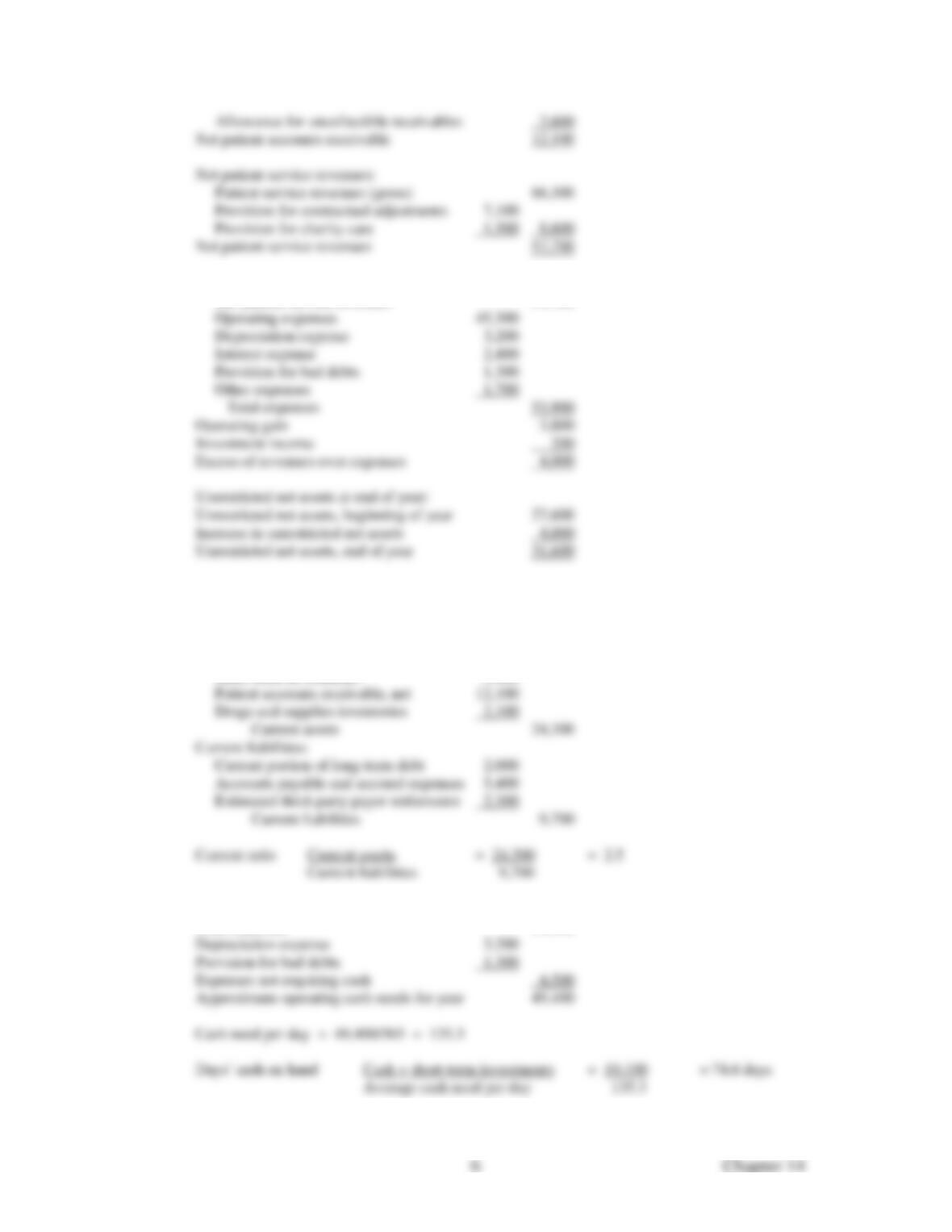
Excess of revenues over expenses:
Net patient service revenues 57,700
b. Current ratio:
Current assets:
Cash and cash equivalents 4,700
Short-term investments 5,400
Number of days’ cash on hand:
Total expenses 53,900
Chapter 14
7
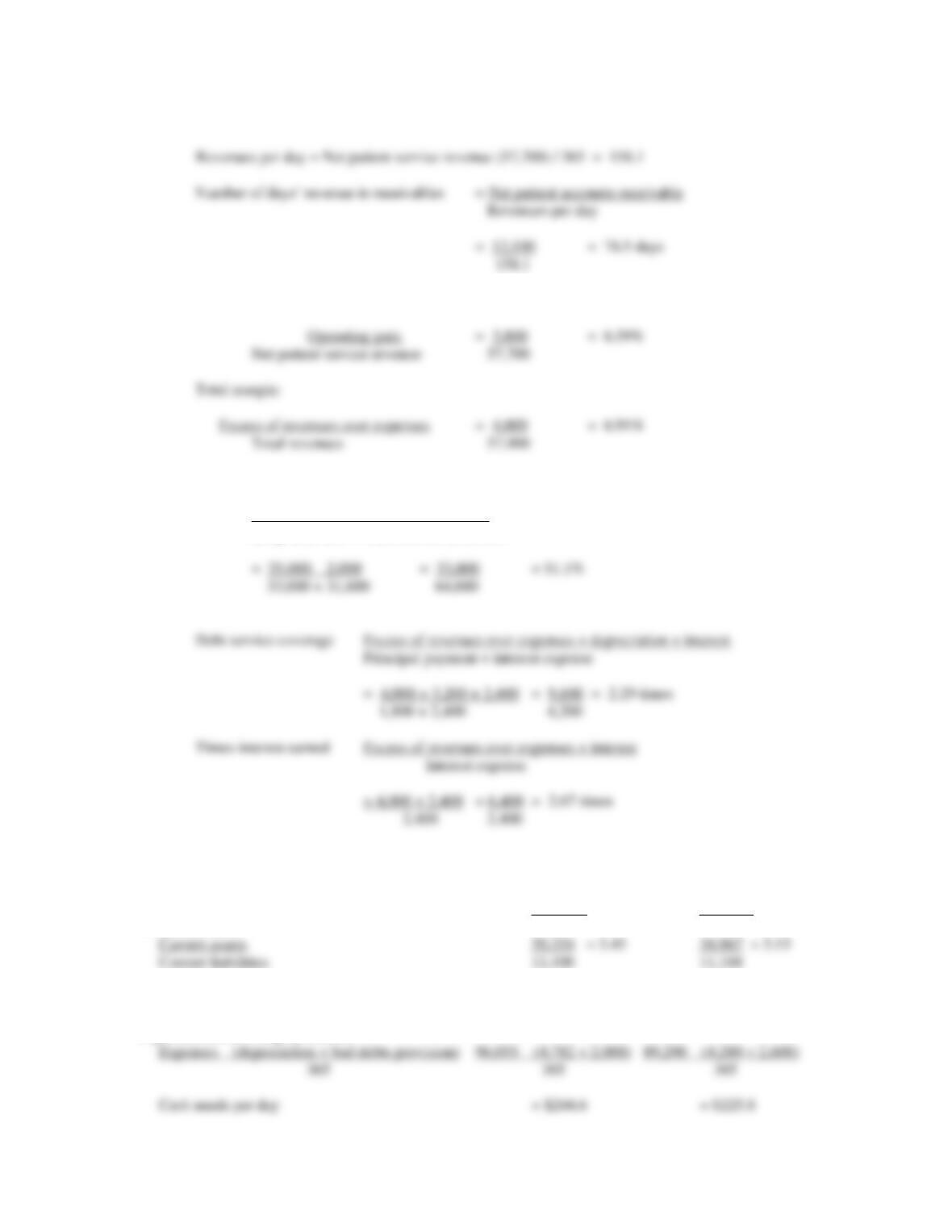
c. Days’ revenue in accounts receivable:
d. Operating margin:
e. Long-term Debt to capitalization ratio:
Long-term debt, net of current portion
Long-term debt + Unrestricted net assets
P14-2 (90 minutes)
Requirement a – ratios
2013 2012
1. Current ratio
2. Number of days’ cash on hand
First, calculate cash needs per day by removing depreciation and bad debts provision from total
expenses, and dividing by 365, so:
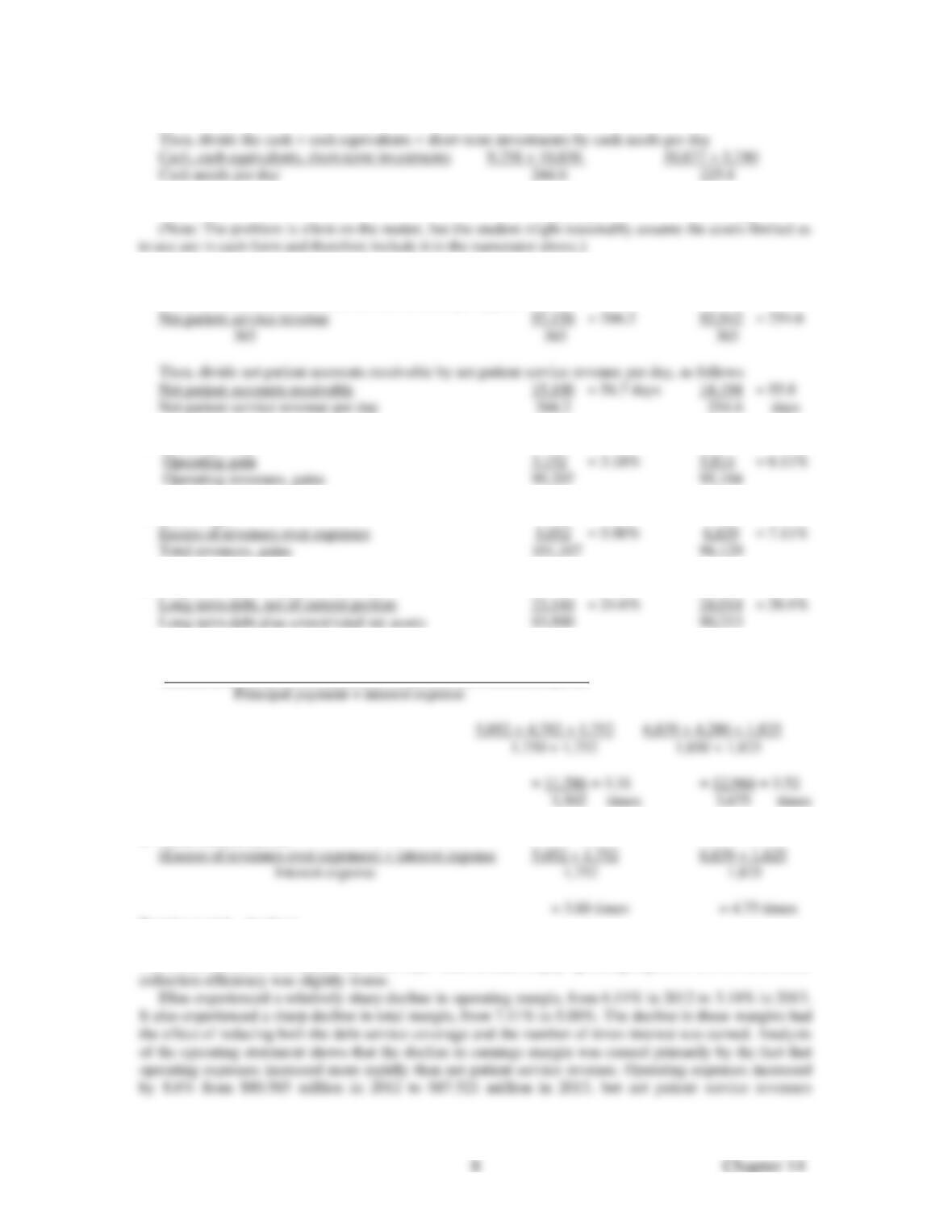
= 84.2 days 73.6 days
3. Number of days’ patient service revenue in receivables
First, determine the net patient service revenue per day, as follows
4. Operating margin
5. Total margin
6. Long-term debt to capitalization ratio
7. Debt service coverage
(Excess of revenues over expenses) + depreciation + interest expense
8. Times interest earned
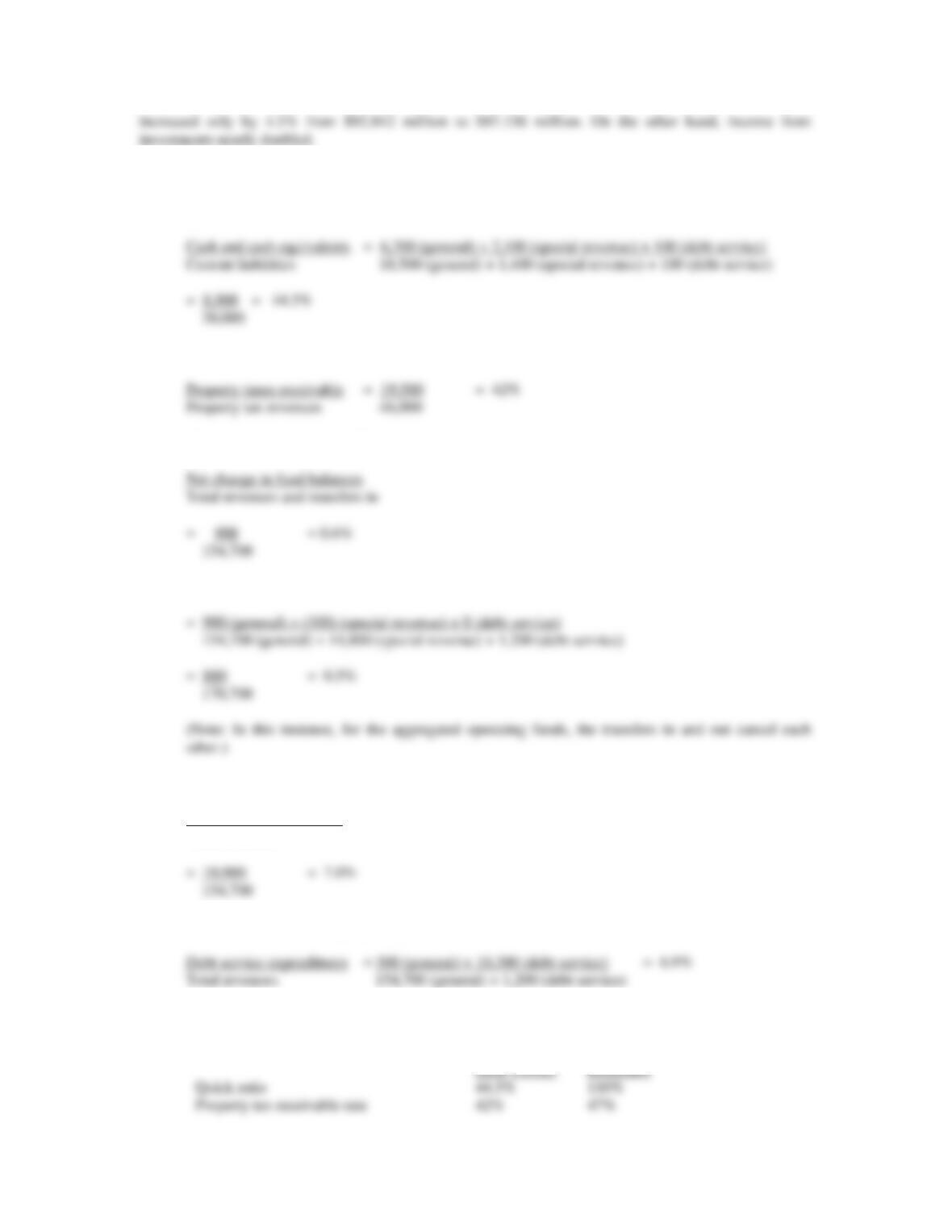
Requirement b – Analysis
Elias Hospital’s liquidity ratios were all somewhat better in 2013 compared with 2012. The current ratio
was better and there were relatively more days’ cash on hand to pay operating expenses. But its receivables
Chapter 14
9
P14-3 (60 minutes)
a. Quick ratio (aggregated governmental funds)
b. Property tax receivable rate
c. Operating margin – general fund
Net change in fund balances
Operating margin – aggregated operating funds
d. Budgetary cushion – general fund
Unassigned fund balance
Total revenues
e. Debt service burden – aggregated general and debt service funds
P14-4 (30 minutes)
Comparison of ratios
Chapter 14
10
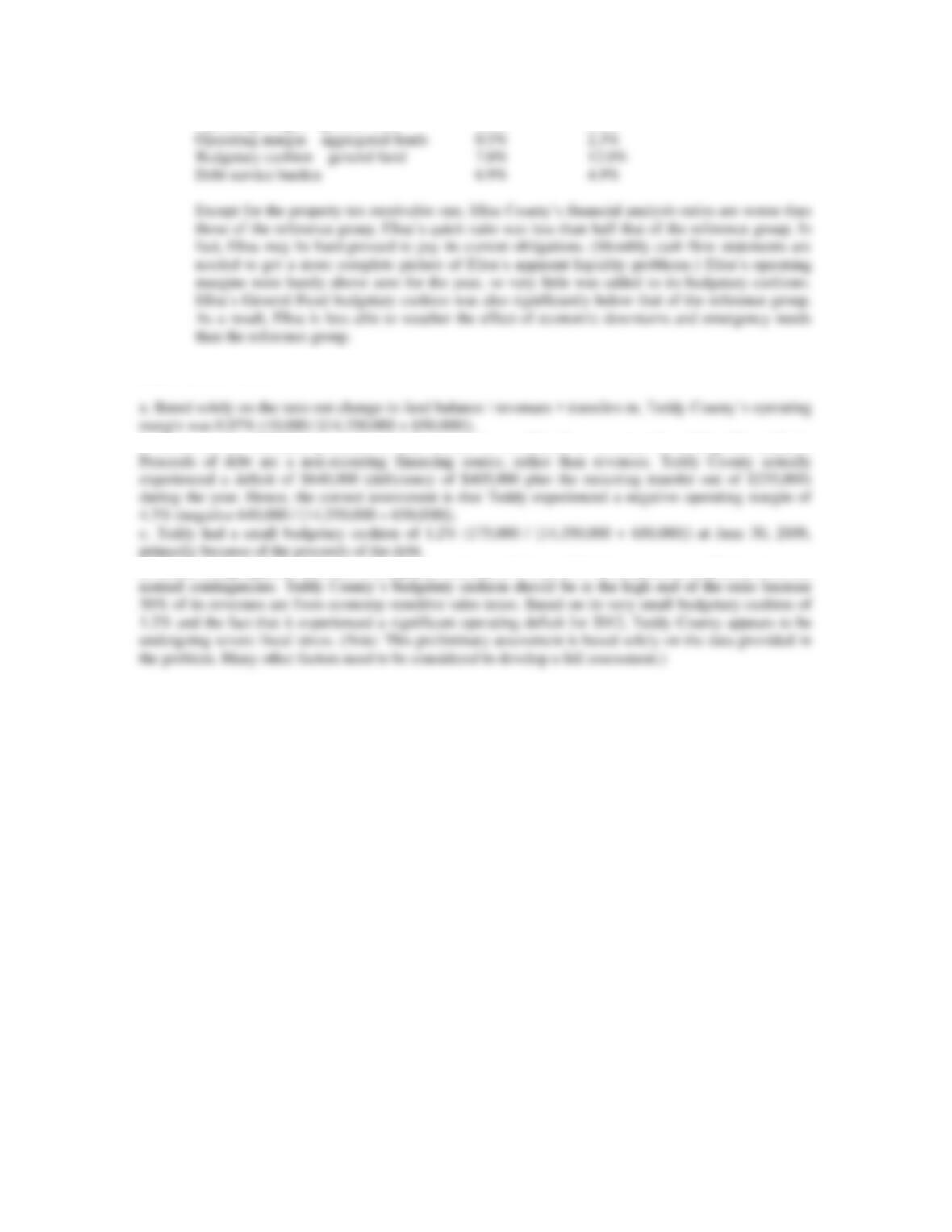
Operating margin – general fund 0.6% 2.4%
P14-5 (30 minutes)
b. However, the $650,000 proceeds of debt cannot be considered as revenues in making this analysis.
d. Credit-rating agencies consider a budgetary cushion of 5% to 10% of revenues as sufficient to cover