Financial and Managerial Accounting, 9th Edition
14-1
CHAPTER 14
MANAGERIAL ACCOUNTING CONCEPTS AND PRINCIPLES
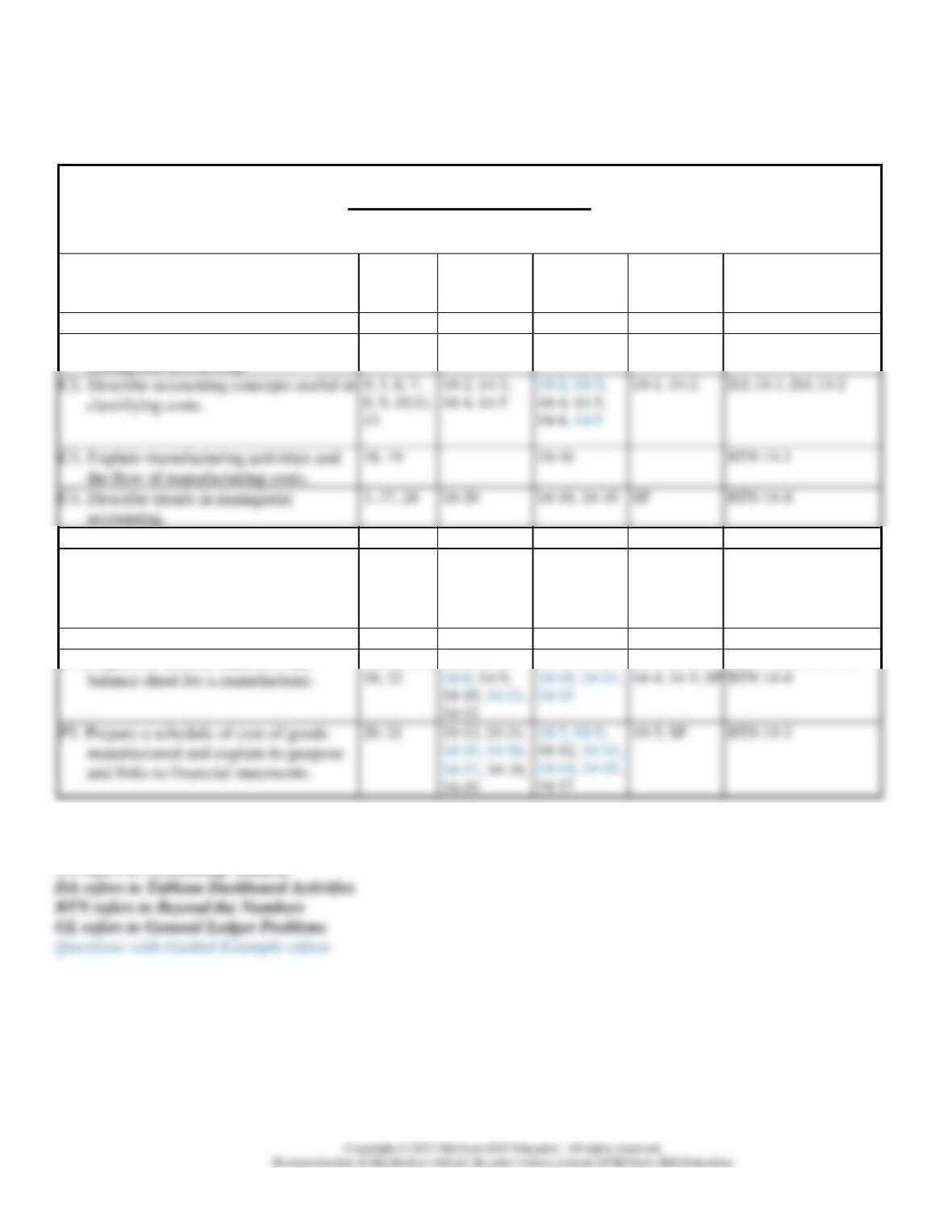
Related Assignment Materials
Student Learning Objectives
Questions
Quick
Studies*
Exercises*
Problems*
DA, AA and
BTN
Conceptual objectives:
C1. Explain the roles and ethics of
managerial accounting.
1, 2, 25
14-1
14-1
BTN 14-2, BTN 14-6
C2. Describe accounting concepts useful in
4, 5, 6, 7,
14-2, 14-3,
14-2, 14-3,
14-1, 14-2
DA 14-1, DA 14-2
the flow of manufacturing costs.
18, 19
14–16
BTN 14-1
accounting.
3, 17, 24
14–20
14-18, 14–19
SP
BTN 14-4
Analytical objectives:
A1 Assess raw materials inventory
management using raw materials
inventory turnover and days’ sales in
raw materials inventory.
23
14–21
14-5
AA 14-1, AA 14-2,
AA 14-3
Procedural objectives:
P1. Prepare an income statement and
12, 14, 15,
14-6, 14–7,
14-7, 14-8,
14-1, 14–3,
DA 14-2, BTN 14-3,
*See additional information on next page that pertains to these quick studies, exercises, and problems.
SP refers to the Serial Problem
AA refers to Accounting Analysis
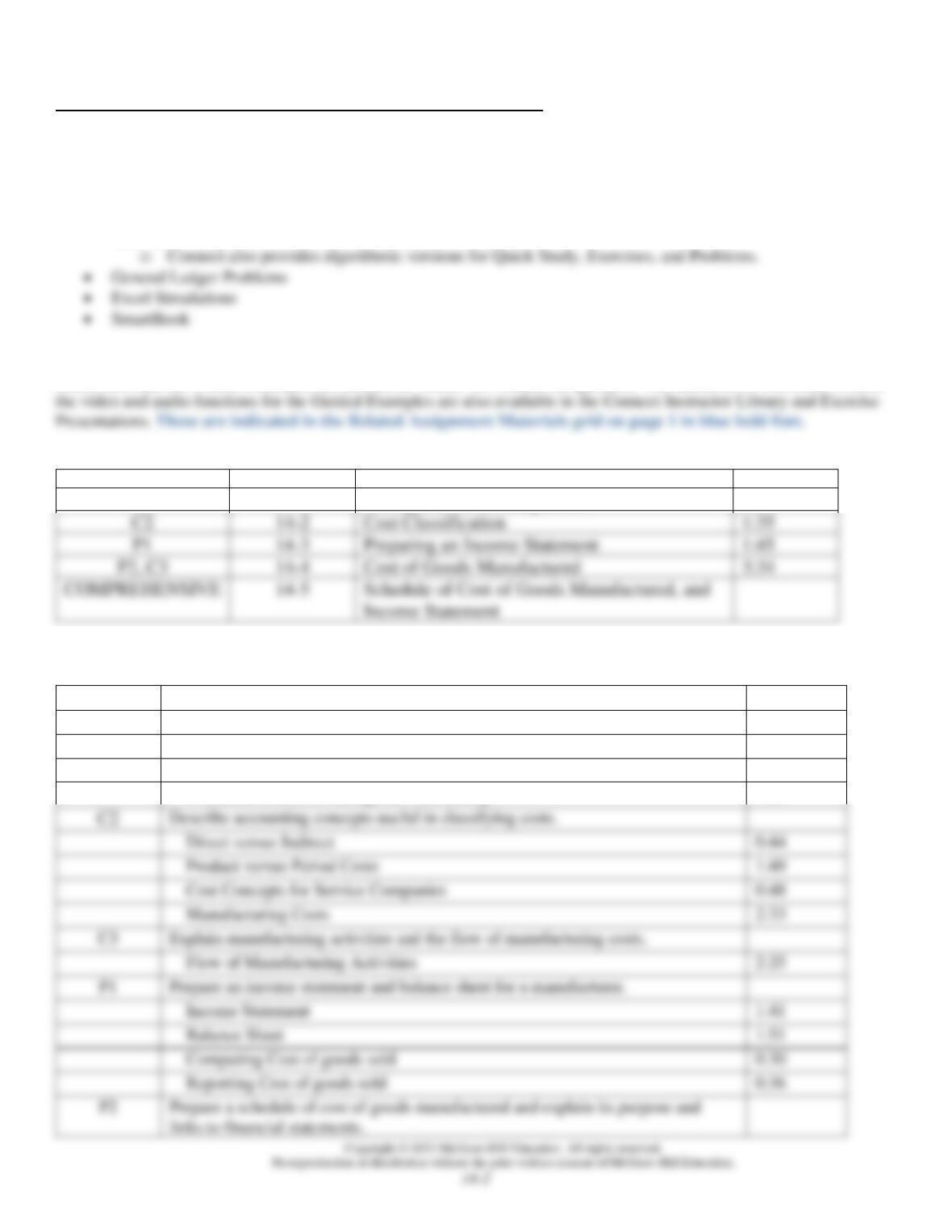
C2
Describe accounting concepts useful in classifying costs.
Direct versus Indirect
0:44
Product versus Period Costs
1:49
Manufacturing Costs
2:33
2:25
Prepare an income statement and balance sheet for a manufacturer.
Income Statement
1:41
Balance Sheet
1:51
Computing Cost of goods sold
0:30
Reporting Cost of goods sold
0:36
Financial and Managerial Accounting, 9th Edition
Additional Information on Related Assignment Material
See Chapter 1 of the Instructor’s Resource Manual for more information on materials for this text available in
Connect.
Connect
Available on the instructor’s course-specific website, Connect:
• All numerical Quick Studies, all Exercises and Problems Set A.
Hints/Guided Examples
Please note that the Guided Examples are labeled as “Hints” in Connect assignments. The animated PowerPoints without
Need-to-Know Videos
LO
Need–to-Know
Title
Time
C1
14-1
Managerial Accounting Basics
1:36
C2
14-2
Cost Classification
1:35
14-3
Preparing an Income Statement
1:45
14-4
Cost of Goods Manufactured
3:34
Income Statement
Concept Overview Videos
LO
Title
Time
C1
Explain the roles and ethics of managerial accounting.
Purpose of Managerial Accounting
1:49
Nature of Managerial Accounting
2:32
Fraud and Ethics in Managerial Accounting
1:07
Financial and Managerial Accounting, 9th Edition
14-3
Schedule of Cost of Goods Manufactured
2:26
C4
Describe trends in managerial accounting.
Trends in Managerial Accounting
1:55
Lean Principles
1:17
1:38
1:59
Days’ Sales in Raw Materials Inventory
1:19
Synopsis of Chapter Revisions
NEW Opener – Sweet Tea Cosmetics and entrepreneurial assignment.
Streamlined learning objectives.
NEW Analytics Insight on Kickstarter crowdfunding.
Postponed fixed vs variable cost classifications to later chapters.
NEW Exhibit 14.6 on prime and conversion costs.
Improved Exhibit 14.7 and 14.8 on product versus period costs.
Financial and Managerial Accounting, 9th Edition
14-4
Chapter Outline
I. Managerial Accounting Basics—managerial accounting provides financial and nonfinancial
information to an organization’s managers.
A. Purpose of Managerial Accounting—to provide useful information to aid in:
a. Determining the costs of an organization’s products and services.
1. Planning is the process of setting goals and making plans to achieve them.
a. Strategic plans usually set the long-term direction of a firm.
b. Short-term action plans include dollar amounts and are known as a budget.
B. Nature of Managerial Accounting—illustrated by comparing the seven key differences between
managerial and financial accounting:
1. Users of Accounting Information
a. In financial—investors, creditors and other users external to the organization.
b. In managerial—managers, executive employees internal to the organization.
2. Purpose of Information
3. Flexibility of Reporting
4. Timeliness of Information
5. Time Dimension
6. Focus of Information
7. Nature of Information
a. In financial—monetary information.
C. Fraud and Ethics in Managerial Accounting—affects all business and is costly.
1. Three factors that push a person to commit fraud (called the fraud triangle):
Financial and Managerial Accounting, 9th Edition
2. Implications for managerial accounting—key to stopping fraud is prevention. Less expensive
and more effective to prevent than to detect fraud. To help prevent fraud, managers set up
3. Ethics are beliefs that distinguish right from wrong. The IMA (Institute for Management
Accountants) requires that management accountants be competent, maintain confidentiality, act
with integrity, and communicate information in a fair and credible manner.
4. Career Paths – managerial accounting skills are highly valued and useful in many careers
including marketing, management, entrepreneurs, and decision making.
II. Cost Concepts
A. Direct vs. Indirect: a cost object is a product, process, department, or customer to which costs are
assigned. Cost is classified as either direct or indirect cost. To classify must identify the cost object.
B. Manufacturing Costs
1. Direct Materials—materials that are crucial parts of a finished product. Direct material costs are
the costs for direct materials that can be cost-effectively traced through the manufacturing
process to finished goods.
C. Prime and Conversion Costs
a. Prime costs—direct materials and direct labor.
b. Conversion costs—direct labor and factory overhead costs (costs incurred in the process of
converting raw materials to finished goods).
D. Product vs Period Costs:
1. Product costs—production costs necessary to create a product. Includes direct materials, direct
Financial and Managerial Accounting, 9th Edition
14-6
2. Period costs—nonproduction costs linked to a time period (not to specific products). Expensed
in period when incurred and reported on the income statement as either selling expenses or
3. Reporting Product and Period Costs:
a. Period costs go directly to the current income statement as expenses.
b. Product costs are first assigned to inventory. They move to cost of goods sold when
III. Reporting—financial statements for manufacturing companies have some unique features resulting
from their activity of producing goods from materials and labor.
A. Reporting Inventory on the Balance Sheet
1. Raw Materials Inventory—cost of materials a company acquires to use in making products
Raw materials that can be cost-effectively traced to a product are called direct materials and
included in raw materials inventory.
B. Reporting Cost of Goods Sold on the Income Statement—the main difference between the income
statement of a manufacturer and that of a merchandiser is the content of cost of goods sold.
1. A Merchandiser computes cost of goods sold as:
Beginning merchandise inventory
Cost of Goods Sold
2. A Manufacturer computes cost of goods sold as:
Beginning finished goods inventory
3. *Cost of goods manufactured is the sum of direct materials, direct labor, and overhead costs
incurred in production.
IV. Cost Flows and Cost of Goods Manufactured —the three manufacturing activities are:
Financial and Managerial Accounting, 9th Edition
14-7
1. Materials Activity
Raw materials inventory, beginning
2. Production Activity
Beginning work in process inventory—costs of partially complete products from prior period.
E. Schedule of Cost of Goods Manufactured (also called a manufacturing statement or a statement of
cost of goods manufactured)– summarizes the types and amounts of costs incurred in the
manufacturing process. Schedule is divided into four parts:
1. Compute direct materials used – beginning raw materials plus purchases minus ending raw
materials.
V. Trends in Managerial Accounting
1. Digital manufacturing – combines machines, computers, and human control to manufacture
products. Humans use data analytics – process of analyzing data to identify meaningful relations
and trends and data visualization – graphical depiction of data to help people interpret their
meaning.
5. Service economy – service companies include telecommunications and health care and
constitute an ever-growing part of the economy.
6. Lean principles – goal is to eliminate waste while satisfying the customer and providing a
positive return to the company. Includes total quality management (TQM) and just–in-time (JIT)
VI. Raw materials inventory turnover and Days’ Sales in Raw Materials Inventory
A. Raw materials inventory turnover helps managers assess how effectively a company manages its raw
materials inventory.
Financial and Managerial Accounting, 9th Edition
14-8
B. Days’ sales in raw materials inventory reveals how much raw materials inventory is available in
terms of the number of days’ sales.
1. Computed as (ending raw materials inventory divided by raw materials used) x 365.
Financial and Managerial Accounting, 9th Edition
14-9
Chapter 14 Alternate Demo Problem
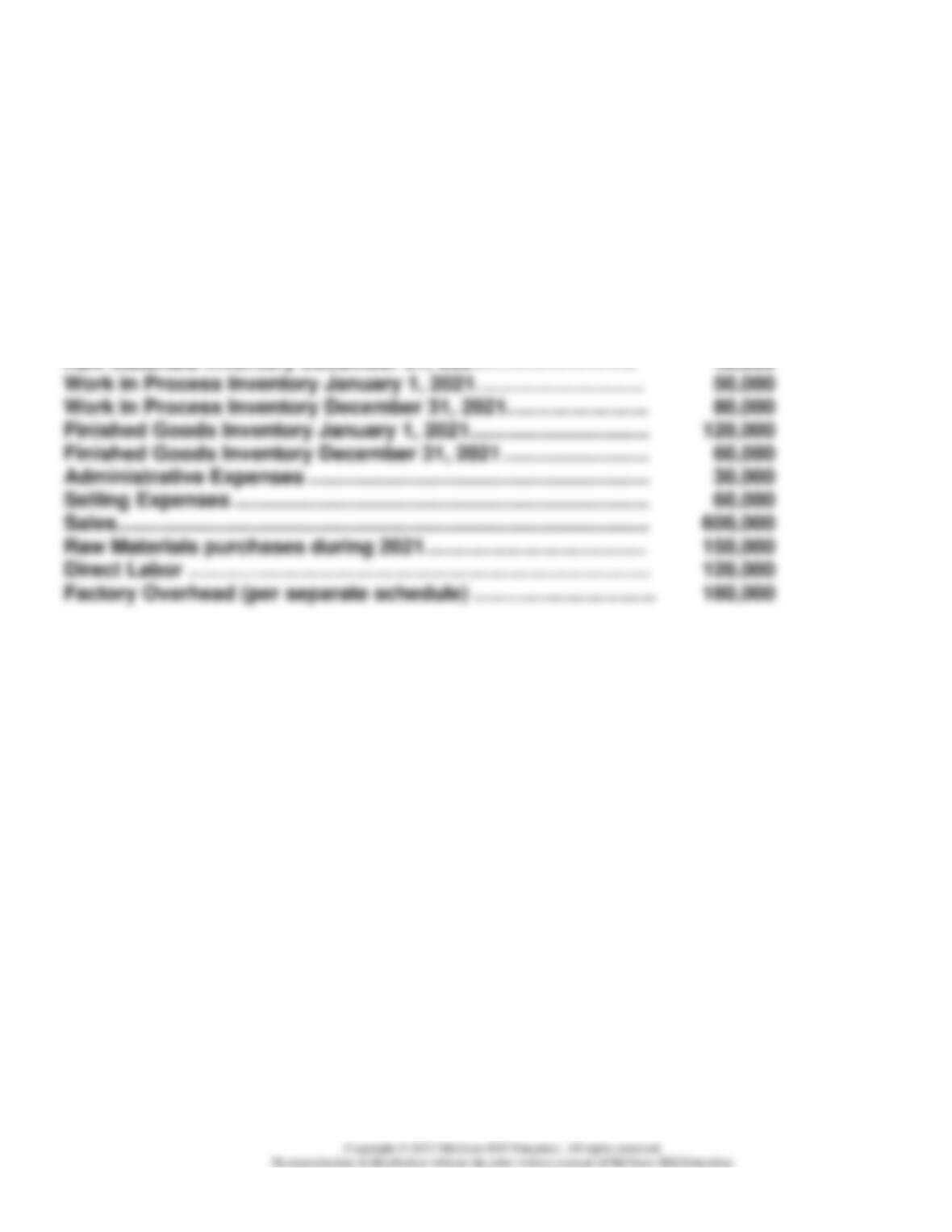
Using the following information for Superior Manufacturing Company, prepare a
manufacturing statement and an income statement for the year ended December 31,
2021. (Assume a 25% income tax.) Further assume that all raw materials used were
direct materials and the factory overhead costs were totaled for you on a separate
schedule.
Raw Materials Inventory January 1, 2021……………………….
$20,000
Raw Materials Inventory December 31, 2021…………………..
40,000
Work in Process Inventory January 1, 2021…………………….
50,000
Work in Process Inventory December 31, 2021…………………
80,000
120,000
60,000
60,000
600,000
Raw Materials purchases during 2021……………………………
150,000
120,000
Financial and Managerial Accounting, 9th Edition
Chapter 14 Solution: Alternate Demo Problem
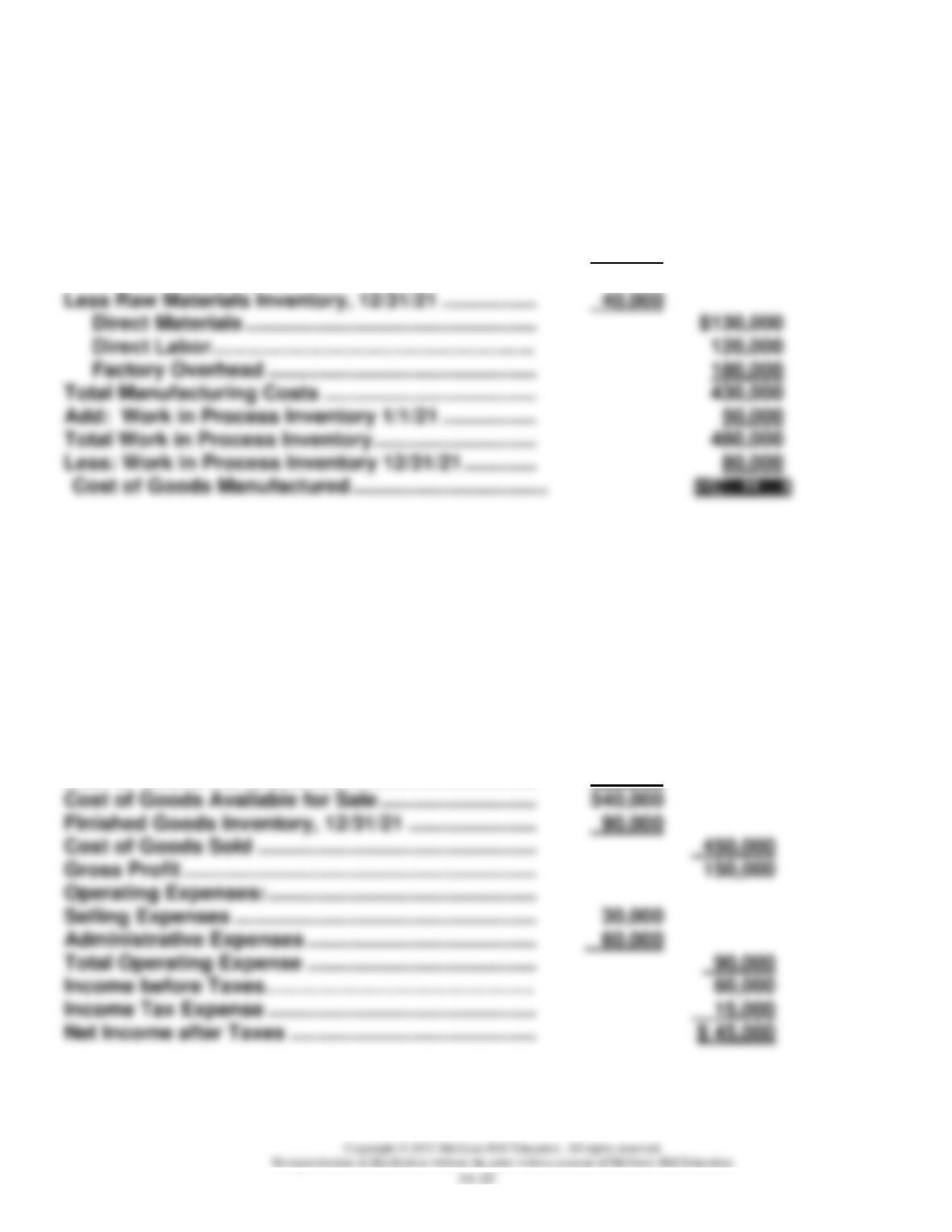
SUPERIOR MANUFACTURING COMPANY
Manufacturing Statement
For Year Ended December 31, 2021
Raw Materials Inventory, 1/1/21 ………………………….
$ 20,000
Raw Materials Purchases …………………………………..
150,000
Raw Materials Available for Use …………………………
170,000
Less Raw Materials Inventory, 12/31/21 ……………..
Total Manufacturing Costs ………………………………..
Add: Work in Process Inventory 1/1/21 ……………..
Total Work in Process Inventory ………………………..
Less: Work in Process Inventory 12/31/21 ………….
Cost of Goods Manufactured ……………………………..
SUPERIOR MANUFACTURING COMPANY
Income Statement
For Year Ended December 31, 2021
Sales
$ 600,000
Cost of Goods Sold:
Finished Goods Inventory, 1/1/21 ………………………
$140,000
Cost of Goods Manufactured …………………………….
400,000
Cost of Goods Available for Sale ……………………….
Cost of Goods Sold …………………………………………..
Gross Profit ………………………………………………………
Administrative Expenses …………………………………..
Total Operating Expense …………………………………..
Income before Taxes………………………………….
Net Income after Taxes ……………………………………..