Financial and Managerial Accounting, 8e
14-1
CHAPTER 14
MANAGERIAL ACCOUNTING CONCEPTS AND PRINCIPLES
Related Assignment Materials
Student Learning Objectives
Questions
Quick
Studies*
Exercises*
Problems*
AA and
BTN
Conceptual objectives:
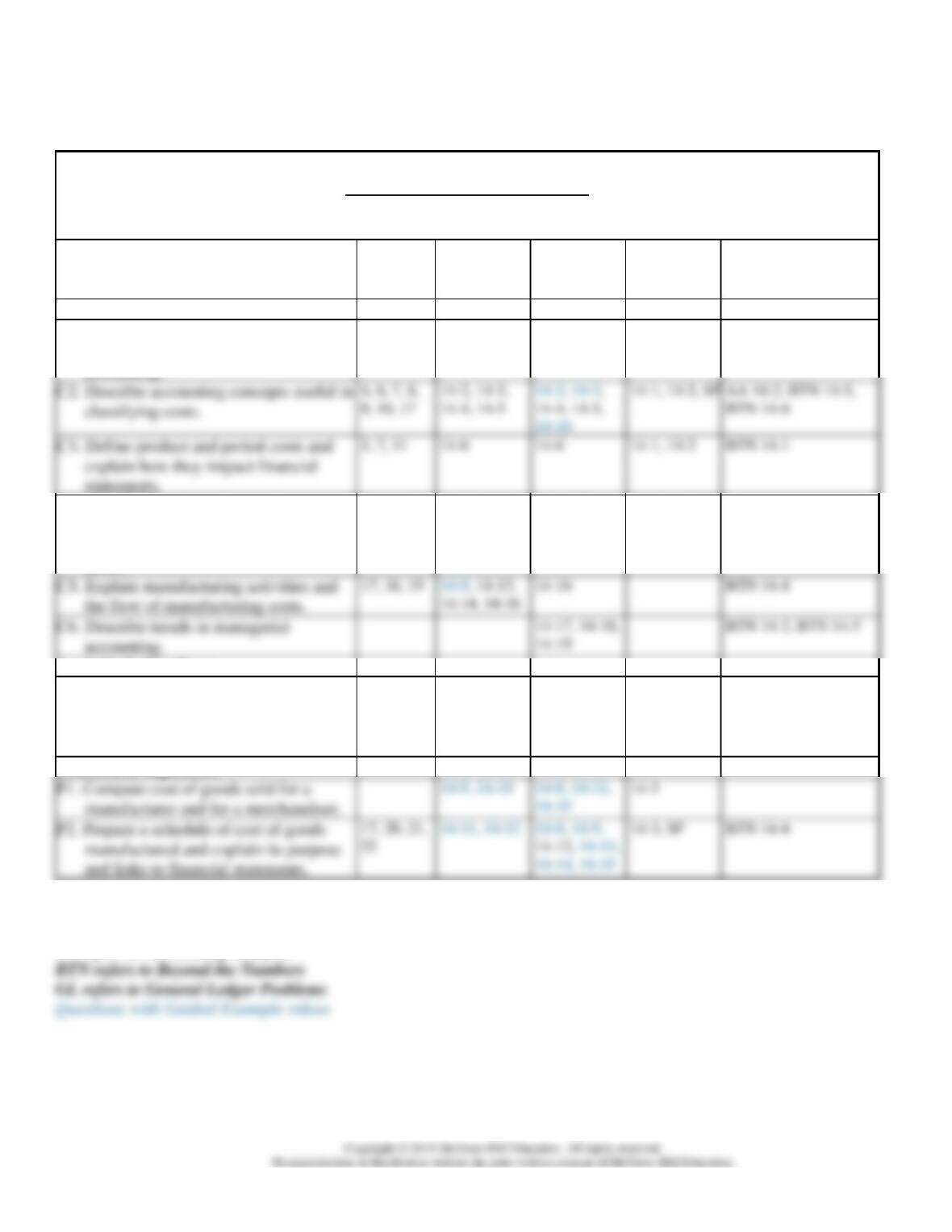
C1. Explain the purpose and nature of, and
the role of ethics in, managerial
accounting.
1, 2, 3, 13
14-1
14-1
AA 14-1, AA 14-3,
BTN 14-3, BTN 14-6
explain how they impact financial
statements.
5, 7, 11
14-6
14-6
14-1, 14-2
BTN 14-1
C4. Explain how balance sheets and income
statements for manufacturing,
merchandising, and service companies
differ.
12, 14, 15,
16
14-7
14-7, 14-9
14-4, 14-5, SP
the flow of manufacturing costs.
accounting.
Analytical objectives:
A1 Assess raw materials inventory
management using raw materials
inventory turnover and days’ sales in
raw materials inventory.
23, 24, 25
14-15, 14–17
14-3
Procedural objectives:
manufacturer and for a merchandiser.
P2. Prepare a schedule of cost of goods
manufactured and explain its purpose
and links to financial statements.
17, 20, 21,
14-3, SP
BTN 14-4
*See additional information on next page that pertains to these quick studies, exercises, and problems.
SP refers to the Serial Problem
AA refers to Accounting Analysis
Balance Sheet
1:48
Income Statement
Compute cost of goods sold for a manufacturer and a merchandiser.
0:27
Cost of goods sold computation
0:34
Explain manufacturing activities and the flow of manufacturing costs.
2:15
Flow of Manufacturing Activities
2:01
Financial and Managerial Accounting, 8e
Additional Information on Related Assignment Material
See Chapter 1 of the Instructor’s Resource Manual for more information on materials for this text available in
Connect.
Connect
Available on the instructor’s course-specific website, Connect:
• All numerical Quick Studies, all Exercises and Problems Set A.
Hints/Guided Examples
Please note that the Guided Examples are labeled as “Hints” in Connect assignments. The animated PowerPoints without
Need-to-Know Videos
LO
Need–to-Know
Title
Time
C1
14-1
Managerial Accounting Basics
1:36
14-2
Cost Classification
1:35
C4
14-3
Costs and Inventories for Different Businesses
1:45
14-4
Key Cost Measures
3:34
Concept Overview Videos
LO
Title
Time
C1
Explain the purpose and nature of, and the role of ethics in, managerial accounting.
2:01
Purpose of Managerial Accounting
3:16
Nature of Managerial Accounting
1:28
Fraud and Ethics in Managerial Accounting
C2
Describe accounting concepts useful in classifying costs.
0:32
Fixed versus Variable
0:47
Direct versus Indirect
C3
Define product and period costs and explain how they impact financial statements.
2:29
Product versus Period Costs
0:54
Identification of Cost Classifications
1:13
Cost Concepts for Service Companies
2:51
Manufacturing Costs
Financial and Managerial Accounting, 8e
14-3
P2
Prepare a schedule of cost of goods manufactured and explain its purpose and
links to financial statements.
Schedule of Cost of Goods Manufactured
2:48
Describe trends in managerial accounting.
Trends in Managerial Accounting
1:31
Lean Principles
1:25
1:17
1:59
Days’ Sales in Raw Materials Inventory
1:19
Synopsis of Chapter Revisions
NEW opener—Moringa Connect and entrepreneurial assignment.
Added discussion on role of managerial accounting for nonaccounting and nonbusiness majors.
Financial and Managerial Accounting, 8e
Chapter Outline
I. Managerial Accounting Basics—managerial accounting provides financial and nonfinancial
information to an organization’s managers.
A. Purpose of Managerial Accounting—to provide useful information to aid in three key managerial
tasks.
Managerial accounting collects cost information and assigns it to an organization’s products and
services. Cost information helps in making product pricing, profitability analysis and decisions as to
whether to make or buy a product or component.
1. Planning is the process of setting goals and making plans to achieve them.
a. Strategic plans usually set the long-term direction of a firm (considers potential opportunities
known as the budget.
2. Control is the process of monitoring planning decisions and evaluating the organization’s
activities and employees.
B. Nature of Managerial Accounting—illustrated by comparing the seven key differences between
managerial to financial accounting:
1. Users and decision makers
a. In financial—investors, creditors and other users external to the organization.
b. In managerial—managers, employees and decision makers internal to the organization.
2. Purpose of information
4. Timeliness of Information
b. In financial—often available only after the audit is complete.
c. In managerial—available quickly without the need to wait for an audit.
5. Time Dimension
b. In managerial—Emphasis on organization’s projects, processes and subdivisions.
Financial and Managerial Accounting, 8e
14-5
7. Nature of Information
C. Fraud and Ethics in Managerial Accounting—important factors in running business operations.
Fraud involves the deliberate misuse of one’s job for personal gain, through the deliberate misuse of
the employer’s assets.
1. Three factors must exit for a person to commit fraud (called the fraud triangle):
2. Implications for managerial accounting—fraud increases business costs and management must
therefore rely on and internal control systems that define policy and procedures to:
3. Ethics are beliefs that distinguish right from wrong. The IMA (Institute for Management
II. Managerial Cost Concepts—Costs can be classified based on any one or combination of the five
classifications listed below.
A. Fixed vs. Variable: A cost can be classified by how it changes, in total, with changed in the volume
of activity.
B. Direct vs. Indirect: a cost is traced to a cost object (a product, process, department, or customer to
which costs are assigned). Cost is classified as either a direct or indirect cost. To classify must
identify the cost object.
C. Product vs Period Costs: costs classified as capitalized inventory (product cost) or expensed as
incurred (period cost).
1. Product costs—expenditures necessary and integral to finished products. Include direct
materials, direct labor, and indirect manufacturing costs called overhead. First assigned to
D. Cost Concepts for Service Companies – cost concepts described also apply to service organizations.
III. Managerial Reporting—financial statements for manufacturing companies have some unique features
resulting from their activity of producing goods from materials and labor.
Financial and Managerial Accounting, 8e
A. Manufacturing Costs
1. Direct Materials—tangible components of a finished product; Direct Material Costs are the
2. Direct Labor—refers to employees who physically convert materials into finished products.
3. Factory Overhead (also called manufacturing overhead)—consists of all manufacturing
costs that are not direct materials or direct labor; costs are not separately or readily traced to
finished goods. Includes indirect materials, indirect labor and other indirect costs not
directly traceable to the product.
4. Prime and Conversion Costs
a. Prime costs—direct materials and direct labor.
b. Conversion costs—direct labor and overhead costs (expenditures incurred in the
process of converting raw materials to finished goods).
B. Manufacturer’s Balance Sheet—usually reports these three inventories:
1. Raw Materials Inventory—goods a company acquires to use in making products Includes
both direct and indirect materials.
C. Manufacturer’s Income Statement—the main difference between the income statement of a
manufacturer and that of a merchandiser is in the items that make-up cost of goods sold.
1. A Merchandiser computes cost of goods sold as:
Beginning merchandise inventory
2. A Manufacturer computes cost of goods sold as:
Beginning finished goods inventory
Financial and Managerial Accounting, 8e
14-7
Cost of Goods Sold
3. *Cost of goods manufactured is the sum of direct materials, direct labor, and overhead costs
D. Flow of Manufacturing Activities—the three manufacturing activities are:
1. Materials Activities
Beginning raw materials
2. Production Activities—Four factors come together in production:
a. Beginning Work in process inventory—consists of partly produced goods from the previous
period.
E. Schedule of Cost of Goods Manufactured – summarizes the types and amounts of costs incurred in
the manufacturing process. Schedule is divided into four parts:
1. Direct materials – beginning raw materials plus purchases minus ending raw materials.
F. Trends in Managerial Accounting
1. Customer orientation – managers and employees understand the changing needs and wants of
customers.
2. Global economy – expands competitive boundaries and provides customers many choices.
7. Triple bottom line – focuses on financial, social and environmental measures.
G. Raw materials inventory turnover – helps managers assess how effectively a company manages its
raw materials inventory.
1. Computed as raw materials used divided by average raw materials inventory.
Financial and Managerial Accounting, 8e
14-8
Chapter 14 Alternate Demo Problem
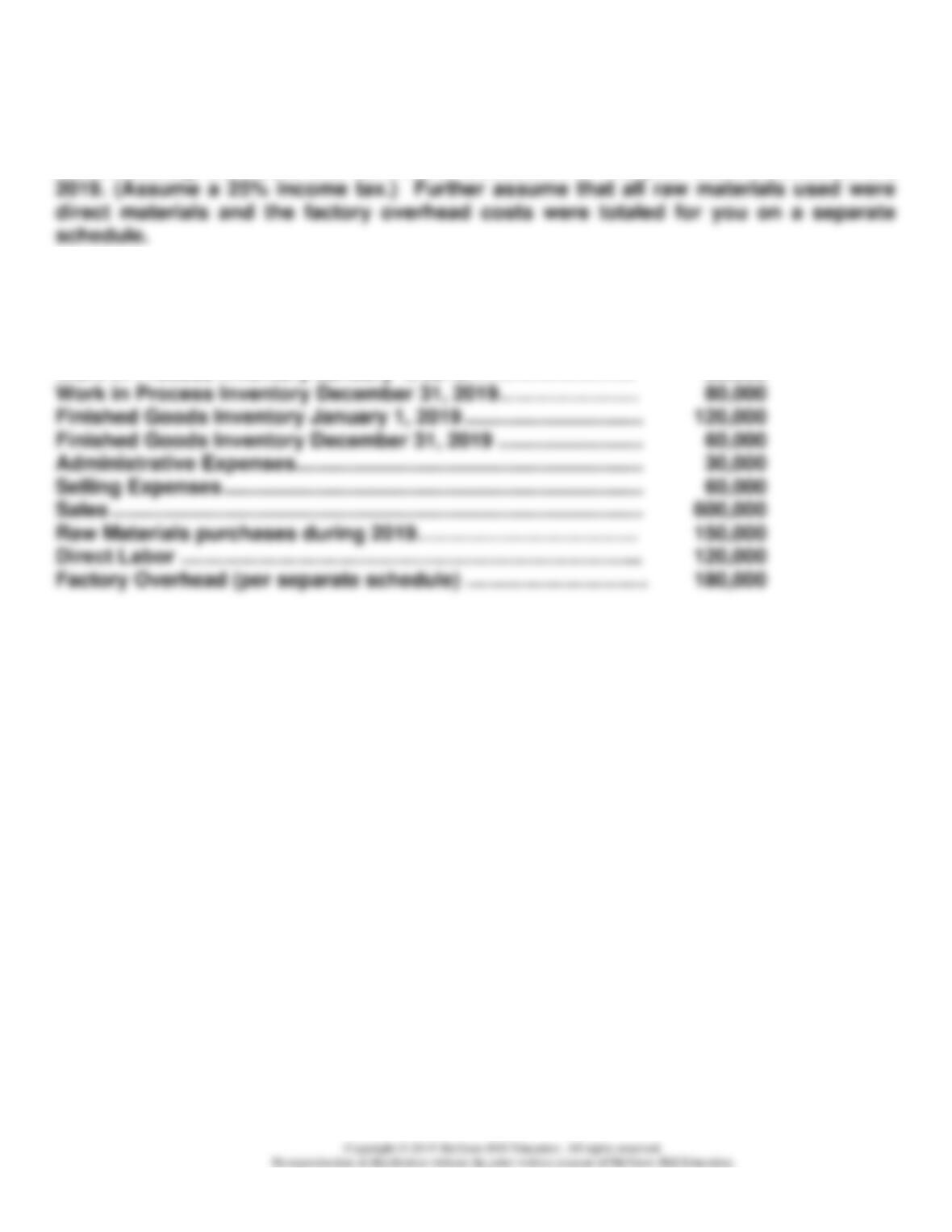
Using the following information for Superior Manufacturing Company, prepare a
manufacturing statement and an income statement for the year ended December 31,
Raw Materials Inventory January 1, 2019……………………….
$20,000
Raw Materials Inventory December 31, 2019…………………..
40,000
Work in Process Inventory January 1, 2019…………………….
50,000
Work in Process Inventory December 31, 2019…………………
80,000
120,000
60,000
60,000
600,000
Raw Materials purchases during 2019……………………………
150,000
120,000
Financial and Managerial Accounting, 8e
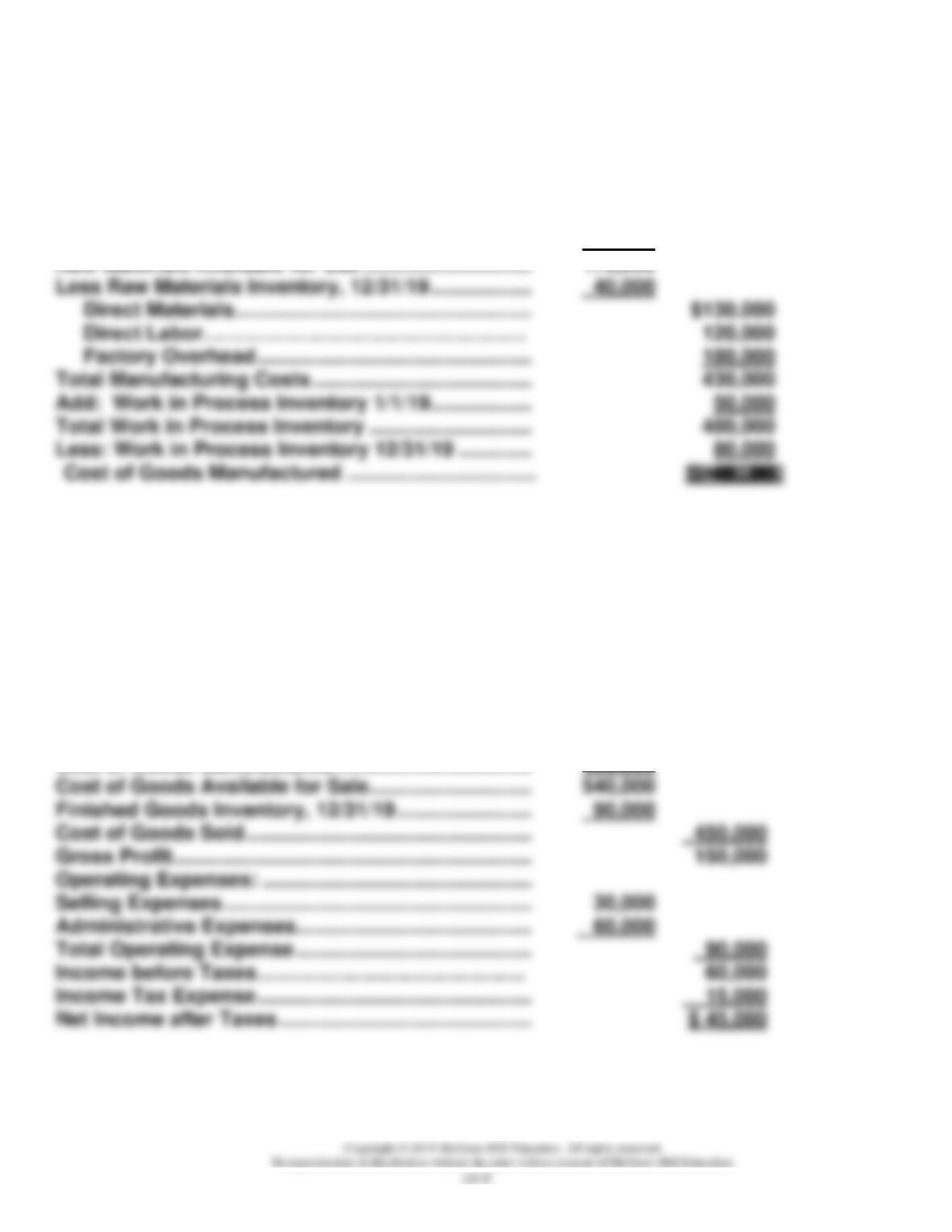
Chapter 14 Solution: Alternate Demo Problem
SUPERIOR MANUFACTURING COMPANY
Manufacturing Statement
For Year Ended December 31, 2019
Raw Materials Inventory, 1/1/19 ………………………….
$ 20,000
Raw Materials Purchases …………………………………..
150,000
Raw Materials Available for Use …………………………
170,000
Less Raw Materials Inventory, 12/31/19 ………………
Total Manufacturing Costs …………………………………
Add: Work in Process Inventory 1/1/19 ………………
Total Work in Process Inventory ………………………..
Less: Work in Process Inventory 12/31/19 ………….
Cost of Goods Manufactured …………………………….
SUPERIOR MANUFACTURING COMPANY
Income Statement
For Year Ended December 31, 2019
Sales
$ 600,000
Cost of Goods Sold:
Finished Goods Inventory, 1/1/19 ……………………….
$140,000
Cost of Goods Manufactured ……………………………..
400,000
Cost of Goods Available for Sale ………………………..
Cost of Goods Sold ……………………………………………
Gross Profit ……………………………………………………….
Administrative Expenses ……………………………………
Total Operating Expense ……………………………………
Income before Taxes………………………………….
Net Income after Taxes ………………………………………