CE13.1
Master Glossary
(a) An asset retirement is an obligation associated with the retirement of a tangible long-lived asset.
(b) Current liabilities is used principally to designate obligations whose liquidation is reasonably
expected to require the use of existing resources properly classifiable as current assets, or the
CE13.2
According to FASB ASC 410-20-50 (Asset Retirement and Environmental Obligations):
50-1 An entity shall disclose all of the following information about its asset retirement obligations:
(a) A general description of the asset retirement obligations and the associated long-lived
assets
50-2 If the fair value of an asset retirement obligation cannot be reasonably estimated, that
fact and the reasons therefor shall be disclosed.
CODIFICATION EXERCISES
CE13.3
According to FASB ASC 450-10-55 (Contingencies —Implementation Guidance and Illustrations):
Depreciation
55-2 The fact that estimates are used to allocate the known cost of a depreciable asset over the pe–
Estimates Used in Accruals
55-3 Amounts owed for services received, such as advertising and utilities, are not contingencies
Changes in Tax Law
55-4 The possibility of a change in the tax law in some future year is not an uncertainty.
CE13.4
According to FASB ASC 710-10–25-1 (Compensation Recognition—Compensated Absences), an
employer must accrue a liability for employees’ compensation for future absences if all of the following
conditions are met:
(a) The employer’s obligation relating to employees’ rights to receive compensation for future
absences is attributable to employees’ services already rendered.
CODIFICATION RESEARCH CASE
(a) FASB ASC 606-20–25-1 addresses how revenue and costs from a
separately priced extended warranty or product maintenance contract
should be recognized.
(b) According to FASB ASC 605-20–25 – Some products include warranty
obligations that are incurred in connection with the sale of the product,
(c) According to FASB ASC 606-10–65–1, a loss shall be recognized on
extended warranty or product maintenance contracts if the sum of the
expected costs of providing services under the contracts and any
asset recognized for the incremental cost of obtaining a contract
IFRS CONCEPTS AND APPLICATION
IFRS13.1
A company should exclude a short-term obligation from current liabilities
IFRS13.2
The ability to defer settlement of short-term debt may be demonstrated by
IFRS13.3
A provision is defined as a liability of uncertain timing or amount and is
IFRS13.4
A provision should be recorded and a charge accrued to expense only if:
(a) the company has a present obligation (constructive or legal) as
IFRS13.5
A current liability such as accounts payable is susceptible to precise
measurement because the date of payment, the payee, and the amount of
cash needed to discharge the obligation are reasonably certain. There is
IFRS13.6
Onerous contracts are ones in which the unavoidable costs of meeting the
IFRS13.7
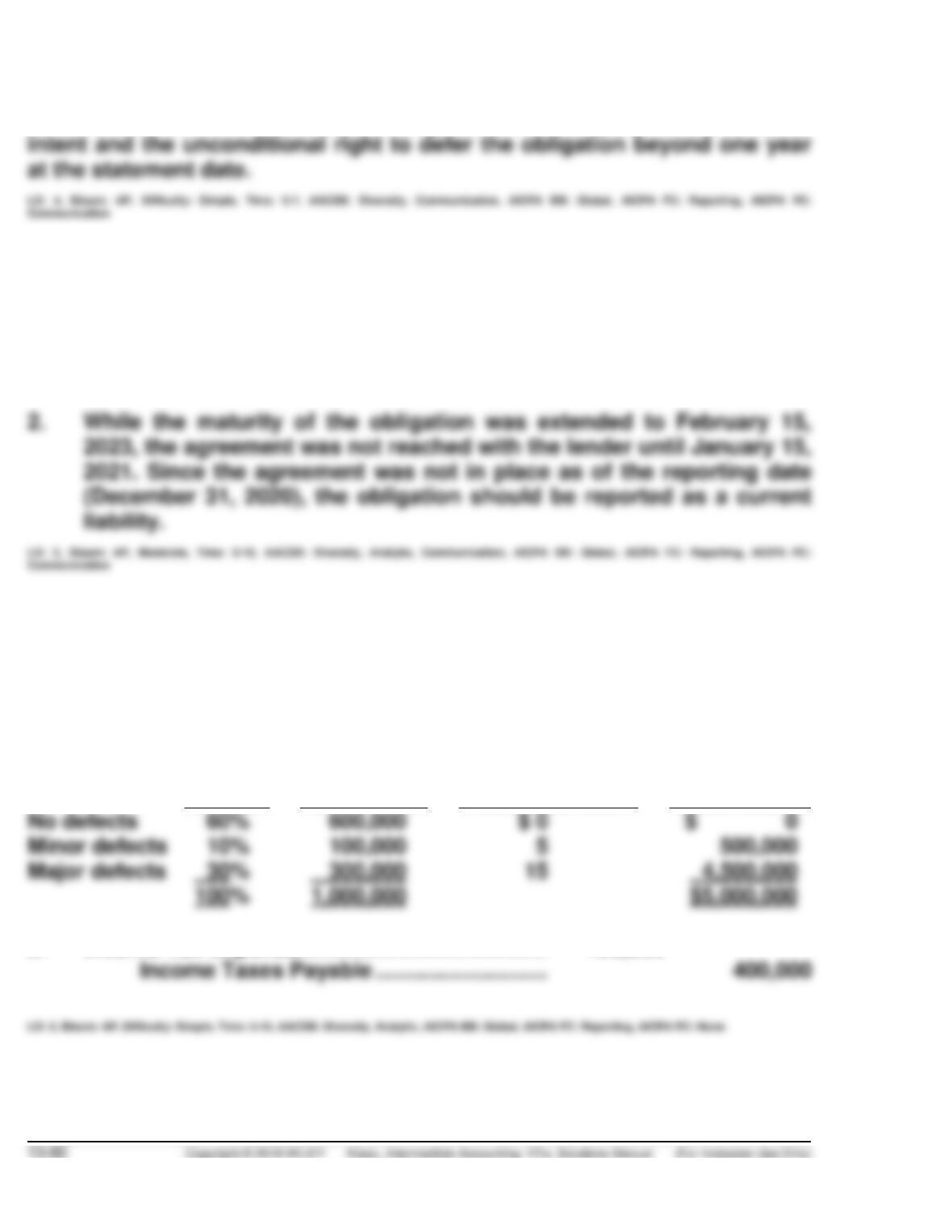
ALEXANDER COMPANY
Partial Statement of Financial Position
December 31, 2020
Current liabilities:
IFRS13.7 (Continued)
Note to Instructor: To classify as long-term, the company must have the
IFRS13.8
1. Mckee should classify $100,000 of the obligation as a current maturity
of long-term debt (current liability) and the $300,000 balance as a
noncurrent liability.
IFRS13.9
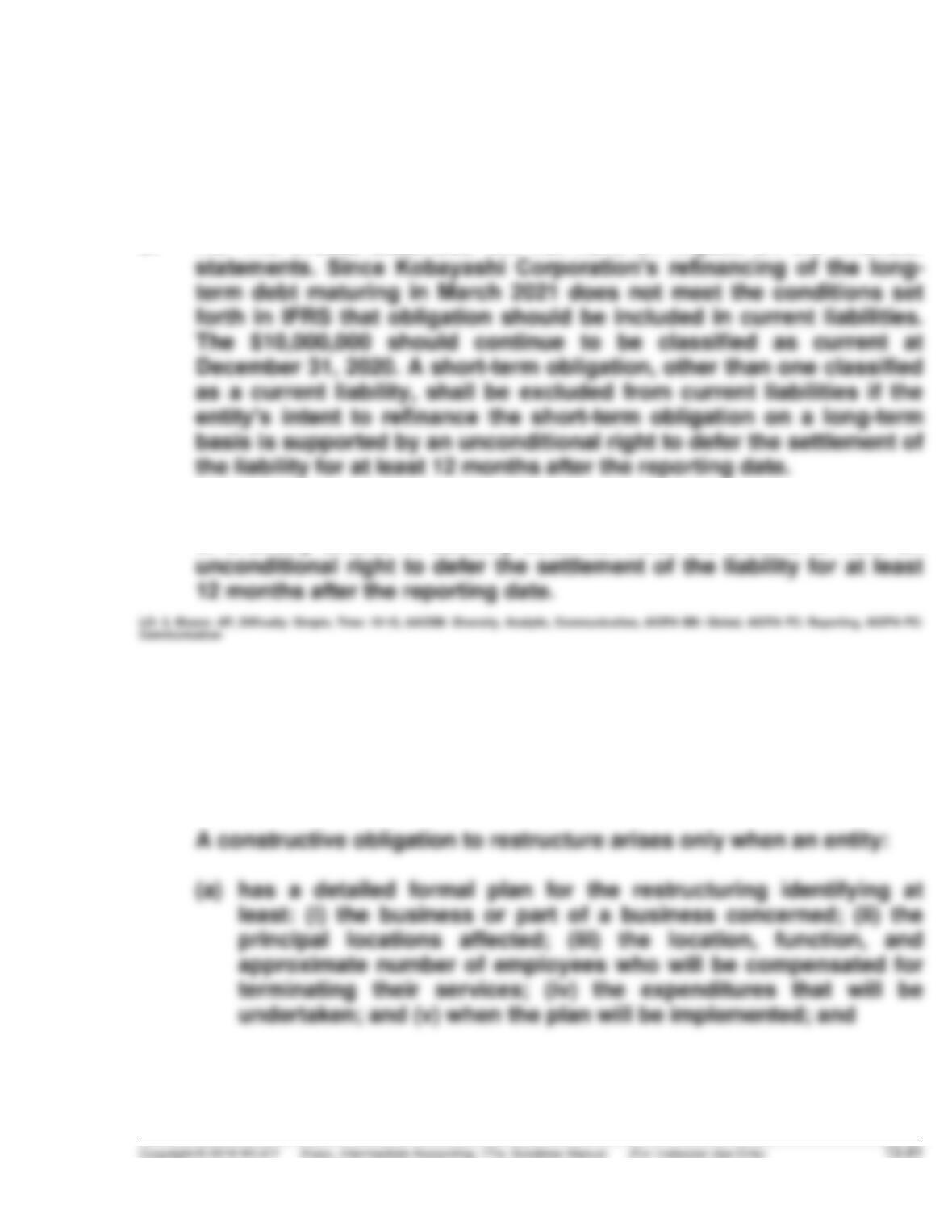
1.
Warranty Expense ……………………………………..
5,000,000*
Warranty Payable ………………………………
5,000,000
*Expected warranty costs:
%
Units
Costs per Unit
Total Costs
No defects
Minor defects
Major defects
2.
Income Tax Expense ………………………………….
400,000
Income Taxes Payable ……………………….
IFRS13.10
a. No. IFRS indicate that refinancing a short-term obligation on a long–
term basis also requires that a company have an unconditional right
to defer settlement of the liability for at least 12 months after the
reporting date.
b. No. The events described will not have an impact on the financial
c. Yes. The debt should be included in current liabilities. The issuance
of ordinary shares in January does not meet the criteria to have an
IFRS13.11
a. IAS 37, Provisions, Contingent Liabilities and Contingent Assets.
b. Recognizing a liability from restructuring (IAS 37, 72 – 79).
IFRS13-11 (Continued)
(b) has raised a valid expectation in those affected that it will carry
out the restructuring by starting to implement that plan or
announcing its main features to those affected by it.
Evidence that an entity has started to implement a restructuring plan
would be provided, for example, by dismantling plant or selling assets
For a plan to be sufficient to give rise to a constructive obligation
when communicated to those affected by it, its implementation needs
to be planned to begin as soon as possible and to be completed in a
A management or board decision to restructure taken before the end
of the reporting period does not give rise to a constructive obligation
at the end of the reporting period unless the entity has, before the end
of the reporting period: (a) started to implement the restructuring
plan; or (b) announced the main features of the restructuring plan to
IFRS13-11 (Continued)
Although a constructive obligation is not created solely by a manage–
ment decision, an obligation may result from other earlier events
together with such a decision. For example, negotiations with employee
No obligation arises for the sale of an operation until the entity is
committed to the sale, I.E. there is a binding sale agreement.
Even when an entity has taken a decision to sell an operation and
announced that decision publicly, it cannot be committed to the sale
until a purchaser has been identified and there is a binding sale
agreement. Until there is a binding sale agreement, the entity will be
Costs to include (IAS 37, 80)
A restructuring provision shall include only the direct expenditures
arising from the restructuring, which are those that are both:
(a) necessarily entailed by the restructuring; and (b) not associated
with the ongoing activities of the entity.
IFRS13-11 (Continued)
Identifiable future operating losses up to the date of a restructuring
are not included in a provision, unless they relate to an onerous
contract as defined in paragraph 10.
As required by paragraph 51, gains on the expected disposal of assets
are not taken into account in measuring a restructuring provision,
even if the sale of assets is envisaged as part of the restructuring.
c. The current warranty contract is considered an onerous contract. The
required accounting related to an onerous contract is in IAS 37, 81 – 82.
This Standard defines an onerous contract as a contract in which the
unavoidable costs of meeting the obligations under the contract
exceed the economic benefits expected to be received under it. The
unavoidable costs under a contract reflect the least net cost of exiting
from the contract, which is the lower of the cost of fulfilling it and any
compensation or penalties arising from failure to fulfil it.
IFRS13.12
(a) M&S’s short-term borrowings were £518 million at 30 April, 2017.
£m
Current
Bank loans and overdrafts
70.3
Finance lease liabilities
6.250% US$500m medium-term notes 2017
Interest accrued on medium-term notes
46.4
Revaluation of medium-term notes
The interest rate for medium-term notes is 6.25%.
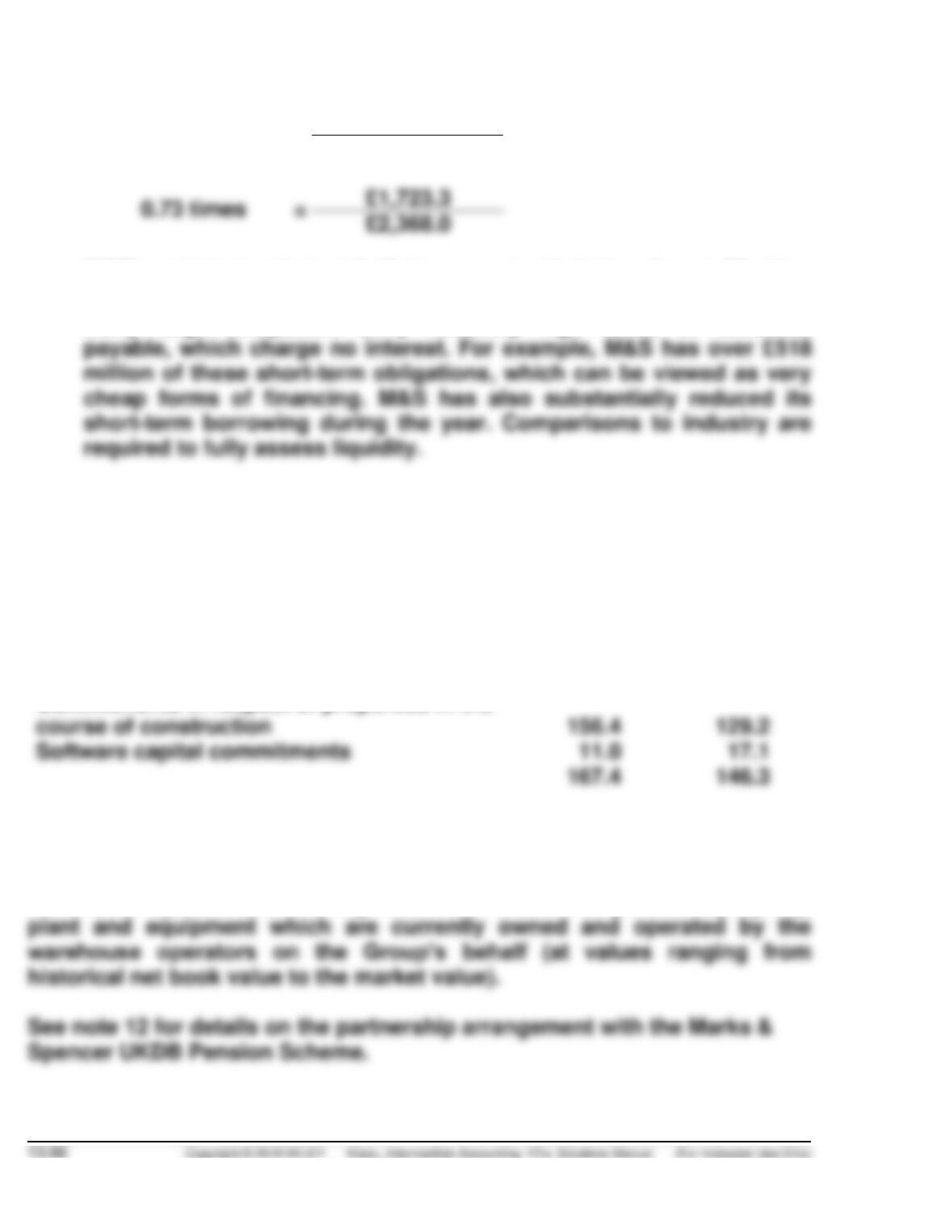
(b) 1. Working capital = Current assets less current liabilities.
IFRS13.12 (Continued)
3.
Current ratio =
Current assets
Current liabilities
M&S’s acid-test ratio is at 0.40, its current ratio is less than 1. Working
capital may appear. The lower liquidity ratios may not be a problem.
Many large companies carry relatively high levels of accounts
(c) M&S provided the following discussion related to commitments and
contingencies:
25 CONTINGENCIES AND COMMITMENTS
A. Capital commitments
2017
£m
2016
£m
Commitments in respect of properties in the
B. Other material contracts
In the event of a material change in the trading arrangements with certain
warehouse operators, the Group has a commitment to purchase property,
C. Commitments under operating leases
The Group leases various stores, offices, warehouses and equipment
2017
£m
2016
£m
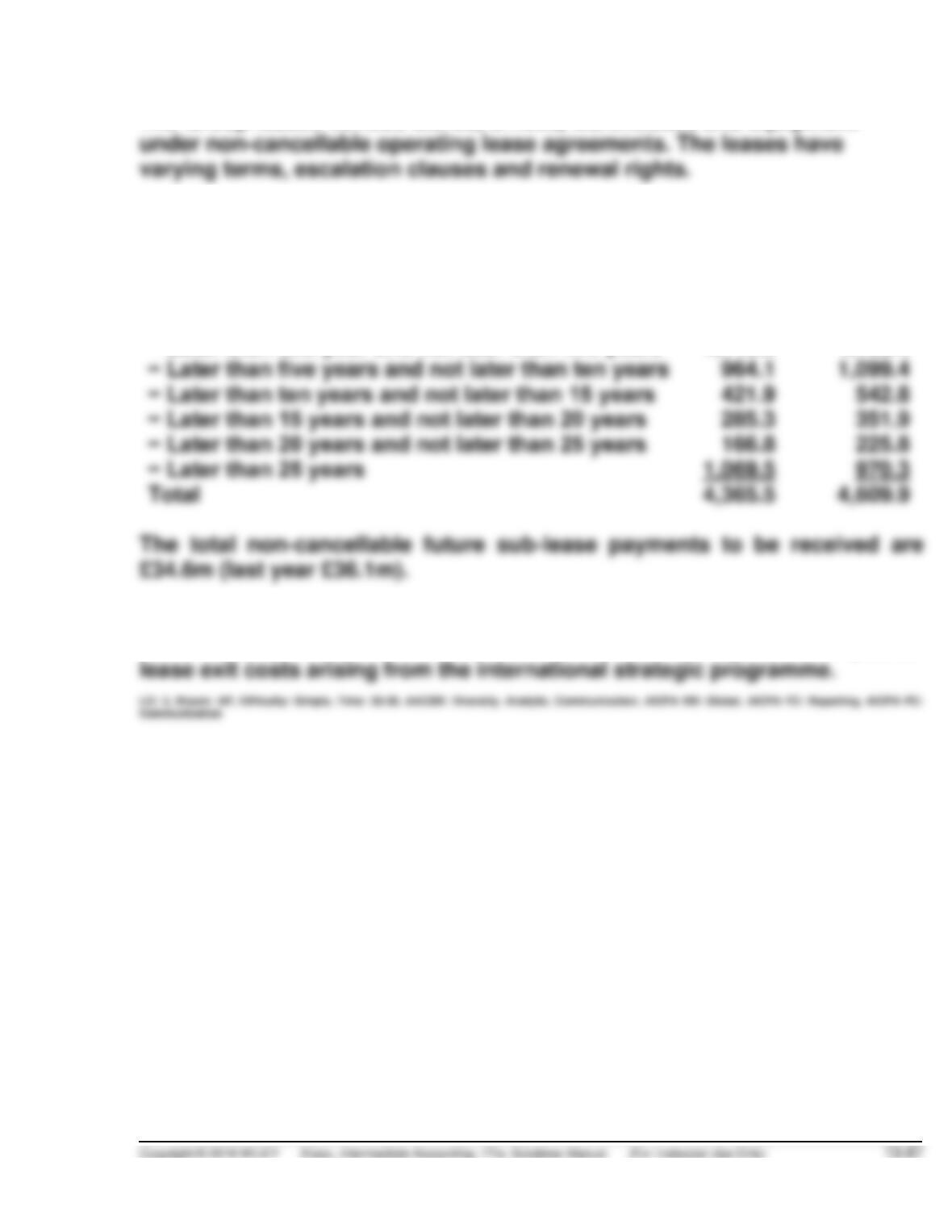
Total future minimum rentals payable under
non-cancellable operating leases are as follows:
Within one year
342.0
311.3
− Later than one year and not later than five years
1,115.9
1,108.4
− Later than five years and not later than ten years
964.1
1,099.4
− Later than ten years and not later than 15 years
421.9
542.8
− Later than 15 years and not later than 20 years
285.3
351.9
− Later than 20 years and not later than 25 years
166.8
225.8
Total
4,365.5
4,609.9
Of the total commitments under operating leases disclosed above, £70m
are already provided for on the balance sheet with regards to expected