CHAPTER 13
Current Liabilities and Contingencies
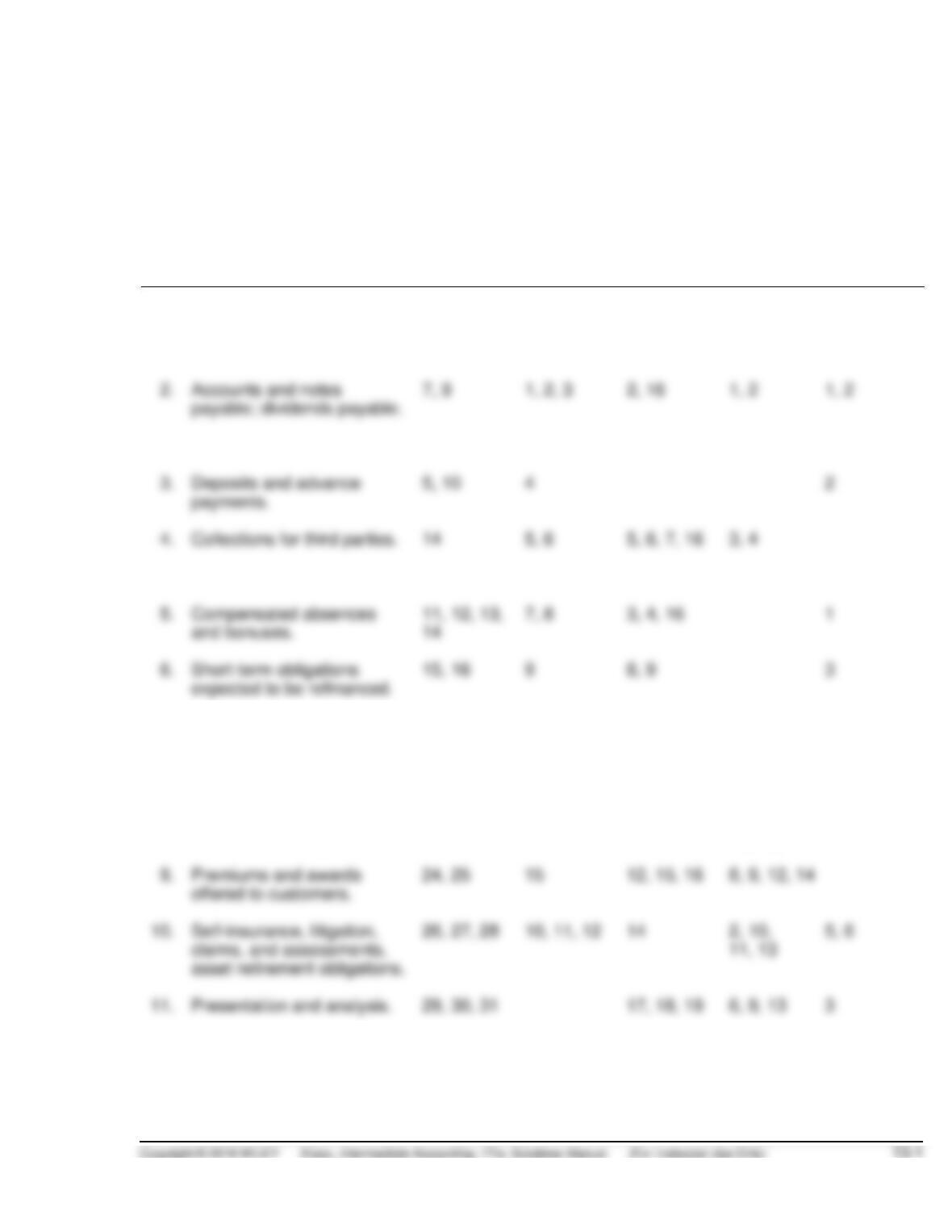
ASSIGNMENT CLASSIFICATION TABLE (BY TOPIC)
Topics
Questions
Brief
Exercises
Exercises
Problems
Concepts
for Analysis
1.
Concept of liabilities;
definition and classification
of current liabilities.
1, 2, 3,
4, 6, 8, 31
1, 16
1, 2
1, 2
2.
Accounts and notes
payable; dividends payable.
7, 9
1, 2, 3
2, 16
1, 2
1, 2
Deposits and advance
payments.
5, 10
4
2
Collections for third parties.
14
5, 6
5, 6, 7, 16
3, 4
5.
Compensated absences
and bonuses.
11, 12, 13,
7, 8
3, 4, 16
1
Short-term obligations
expected to be refinanced.
15, 16
9
3
7.
Contingent liabilities
(General).
17, 18, 19,
20, 21
10, 11
13, 16
10, 11, 13
4, 5, 6
8.
Guaranties and warranties.
22, 23
13, 14
10, 11, 16
1, 5, 6, 7,
12, 13, 14
6, 7
Self-insurance, litigation,
claims, and assessments,
asset retirement obligations.
26, 27, 28
10, 11, 12
2, 10,
11, 13
5, 6
Presentation and analysis.
29, 30, 31
17, 18, 19
6, 9, 13
3
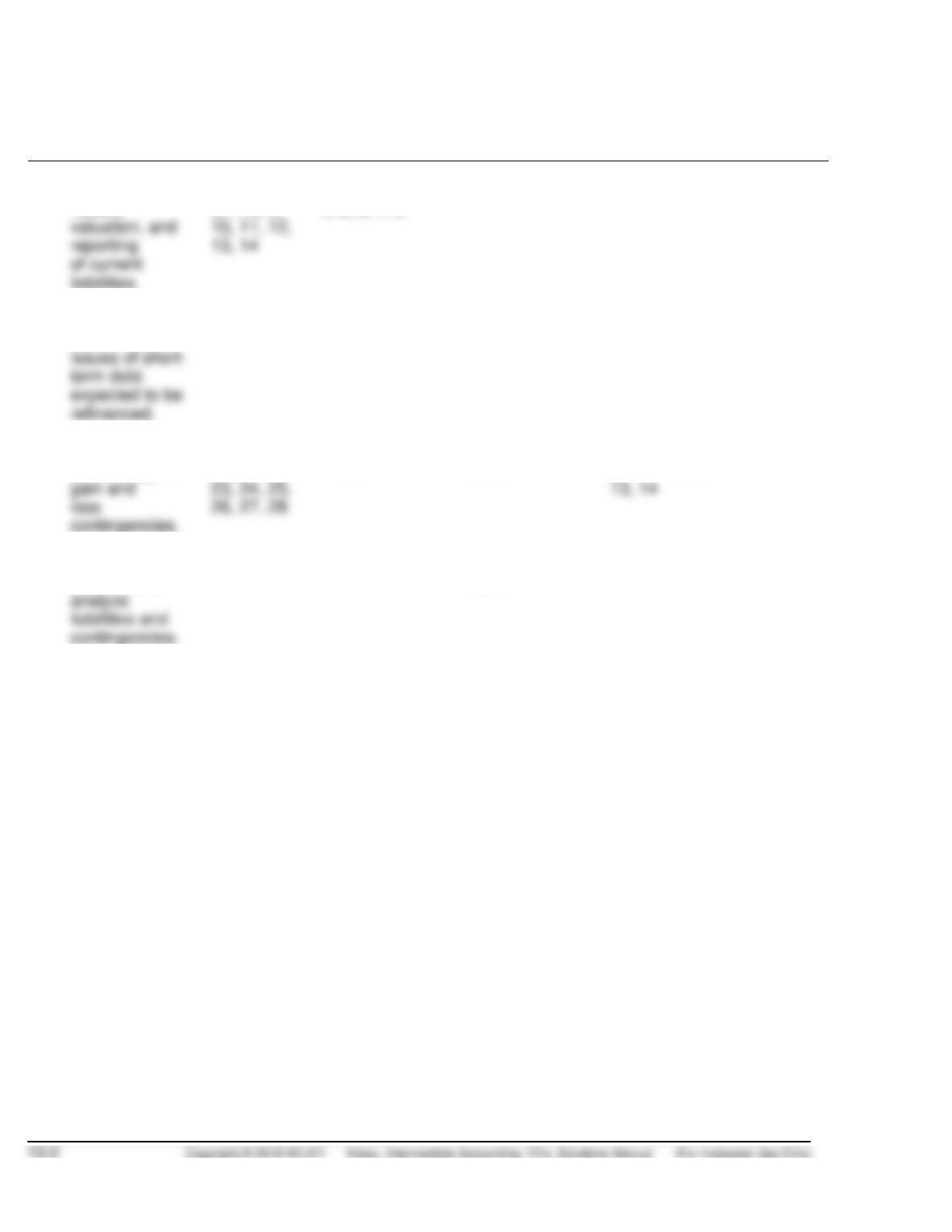
ASSIGNMENT CLASSIFICATION TABLE (BY LEARNING OBJECTIVE)
Learning Objectives
Questions
Brief Exercises
Exercises
Problems
Concepts
for
Analysis
valuation, and
10, 11, 12,
1. Describe the
nature,
liabilities.
1, 2, 3, 4, 5,
6, 7, 8, 9,
1, 2, 3,
4, 5, 6, 7, 8
1, 2, 3, 4, 5, 6, 7
1, 2, 3, 4
1
2. Explain the
classification
15, 16
9
8, 9
2, 3
contingencies.
3. Explain the
accounting for
17, 18,19,
20, 21, 22,
10, 11, 12, 13,
14, 15
10, 11, 12, 13,
14, 15
2, 5, 6, 7, 8,
9, 10, 11, 12,
4, 5, 6, 7
4. Indicate how to
present and
29, 30, 31
16, 17,
18, 19
9
5, 6
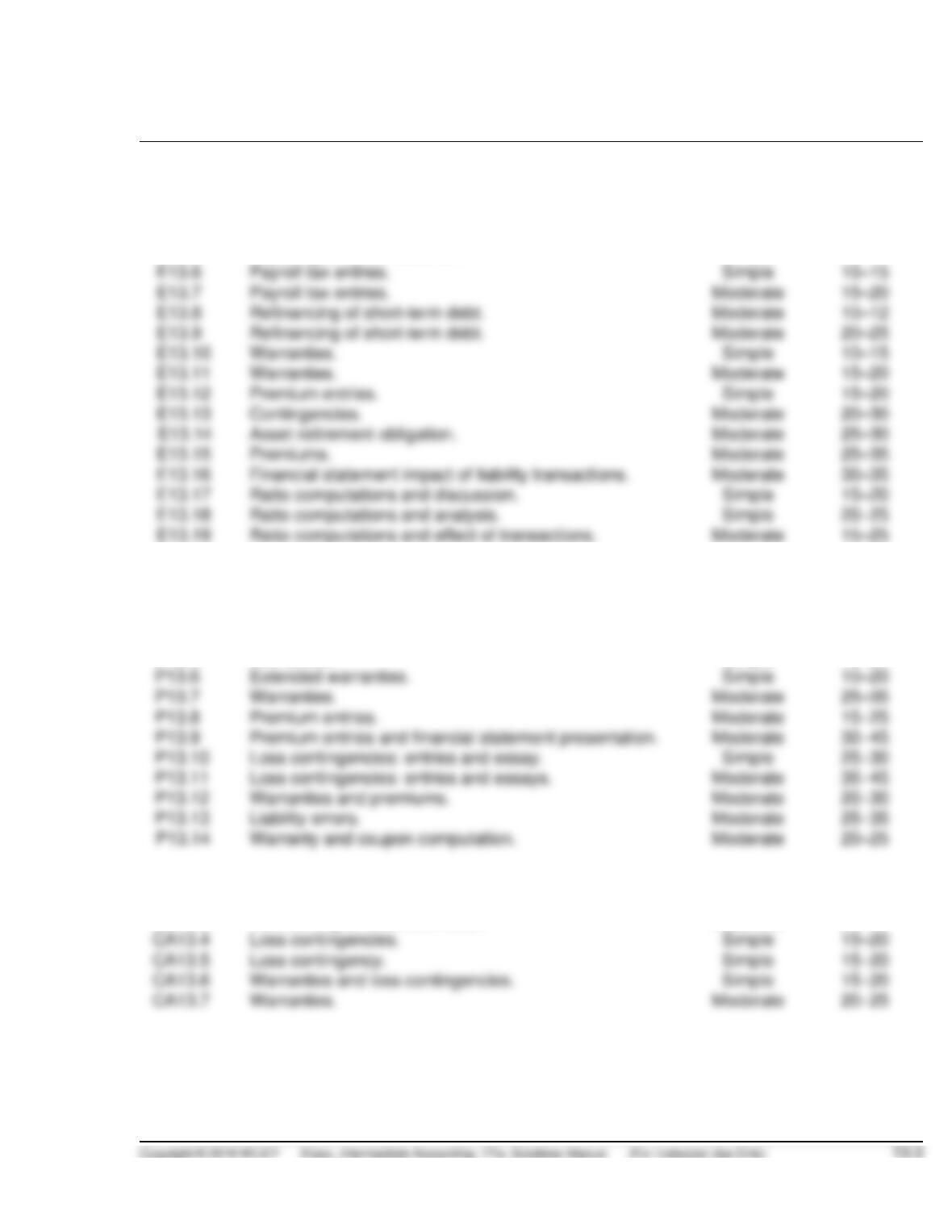
ASSIGNMENT CHARACTERISTICS TABLE
Item
Description
Level of
Difficulty
Time
(minutes)
E13.1
Balance sheet classification of various liabilities.
Simple
10–15
E13.2
Accounts and notes payable.
Moderate
15–20
E13.3
Compensated Absences
Moderate
25–30
E13.4
Compensated Absences
Moderate
25–30
E13.5
Adjusting entry for sales tax.
Simple
5–7
E13.6
Payroll tax entries.
Simple
10–15
E13.7
Payroll tax entries.
Moderate
15–20
E13.8
Refinancing of short-term debt.
Moderate
10–12
E13.9
Refinancing of short-term debt.
Moderate
20–25
E13.10
Warranties.
Simple
10–15
E13.12
Premium entries.
Simple
15–20
E13.13
Contingencies.
Moderate
20–30
Asset retirement obligation.
Moderate
25–30
E13.15
Premiums.
Moderate
25–35
E13.16
Financial statement impact of liability transactions.
Moderate
30–35
E13.17
Ratio computations and discussion.
Simple
15–20
E13.18
Ratio computations and analysis.
Simple
20–25
E13.19
Ratio computations and effect of transactions.
Moderate
15–25
P13.1
Current liability entries and adjustments.
Simple
25–30
P13.2
Liability entries and adjustments.
Simple
25–35
P13.3
Payroll tax entries.
Moderate
20–30
P13.4
Payroll tax entries.
Simple
20–25
P13.5
Warranties.
Simple
15–20
P13.6
Extended warranties.
Simple
10–20
P13.7
Warranties.
Moderate
25–35
P13.8
Premium entries.
Moderate
15–25
P13.9
Premium entries and financial statement presentation.
Moderate
30–45
P13.10
Loss contingencies: entries and essay.
Simple
25–30
P13.11
Loss contingencies: entries and essays.
Moderate
35–45
P13.12
Warranties and premiums.
Moderate
20–30
P13.13
Liability errors.
Moderate
25–35
P13.14
Warranty and coupon computation.
Moderate
20–25
CA13.1
Nature of liabilities.
Moderate
20–25
CA13.2
Current versus noncurrent classification.
Moderate
15–20
CA13.3
Refinancing of short-term debt.
Moderate
30–40
CA13.4
Loss contingencies.
Simple
15–20
CA13.5
Loss contingency.
Simple
15–20
CA13.6
Warranties and loss contingencies.
Simple
15–20
CA13.7
Warranties.
Moderate
20–25
ANSWERS TO QUESTIONS
1. Current liabilities are obligations whose liquidation is reasonably expected to require use of
2. You might explain to your friend that the accounting profession at one time prepared financial
statements somewhat in accordance with the broad or loose definition of a liability submitted by the
AICPA in 1953: “Something represented by a credit balance that is or would be properly carried
forward upon a closing of books of account according to the rules or principles of accounting,
provided such credit balance is not in effect a negative balance applicable to an asset. Thus the
3. As a lender of money, the banker is interested in the priority his/her claim has on the company’s
assets relative to other claims. Close examination of the liability section and the related footnotes
4. Current liabilities are obligations whose liquidation is reasonably expected to require the use of
existing resources properly classified as current assets, or the creation of other current liabilities.
5. Unearned revenue is a liability that arises from current sales but for which some services or
products are owed to customers in the future. At the time of a sale, customers pay not only for the
delivered product, but they also pay for future products or services (e.g., another plane trip, hotel
Questions Chapter 13 (Continued)
6. Payables and receivables generally involve an interest element. Recognition of the interest element
7. A discount on notes payable represents the difference between the present value and the face
value of the note, the face value being greater in amount than the discounted amount. It should be
8. Liabilities that are due on demand (callable by the creditor) should be classified as a current
liability. Classification of the debt as current is required because it is a reasonable expectation that
9. A cash dividend formally authorized by the board of directors would be recorded by a debit to
Retained Earnings and a credit to Dividends Payable. The Dividends Payable account should be
classified as a current liability.
10. Unearned revenue arises when a company receives cash or other assets as payment from a
customer before conveying (or even producing) the goods or performing the services which it has
committed to the customer.
Unearned revenue is assumed to represent the obligation to the customer to refund the assets
Unearned revenues arise from the following activities:
(1) The sale by a transportation company of tickets or tokens that may be exchanged or used to
Questions Chapter 13 (Continued)
11. Compensated absences are employee absences such as vacation, illness, and holidays for which
12. A liability should be accrued for the cost of compensated absences if all of the following conditions
are met:
(a) The employer’s obligation relating to employees’ rights to receive compensation for future
13. An employer is required to accrue a liability for “sick pay” that employees are allowed to accumu–
late and use as compensated time off even if their absence is not due to illness. An employer is
14. Employers generally withhold from each employee’s wages amounts to cover income taxes
(withholding), the employee’s share of FICA taxes, and other items such as union dues or health
15. An enterprise should exclude a short-term obligation from current liabilities if (1) the liability is
contractually due to be settled more than one year (or operating cycle, if longer) after the balance
16. The ability to consummate the refinancing may be demonstrated (i) by actually refinancing the short-
term obligation by issuing a long-term obligation before the date of the balance sheet, or (ii) by
17. (a) A contingency is defined as an existing condition, situation, or set of circumstances involving
uncertainty as to possible gain (gain contingency) or loss (loss contingency) to an enterprise
18. A contingent liability should be recorded and a charge accrued to expense only if:
(a) information available prior to the issuance of the financial statements indicates that it is probable
Questions Chapter 13 (Continued)
19. A determinable current liability is susceptible to precise measurement because the date of payment,
the payee, and the amount of cash needed to discharge the obligation are reasonably certain. There
is nothing uncertain about (1) the fact that the obligation has been incurred and (2) the amount of the
obligation.
20. The terms probable, reasonably possible, and remote are used in GAAP to denote the chances
of a future event occurring, the result of which is a gain or loss to the enterprise. If it is probable
that a loss has been incurred at the date of the financial statements, then the liability (if reasonably
21. Under U.S. GAAP, companies may not record provisions for future operating losses. Such provi-
sions do not meet the definition of a liability, since the amount is not the result of a past transaction
22. Companies do not record a separate performance obligation for assurance-type warranties. This
type of warranty is nothing more than a quality guarantee that the good or service is free from
defects at the point of sale. These types of obligations should be expensed in the period the goods
Questions Chapter 13 (Continued)
23. Companies record a service-type warranty as a separate performance obligation. For example, in
the case of the television, the seller recognizes the sale of the television with the assurance-type
warranty separately from the sale of the service-type warranty. The sale of the service-type warranty
24. Southeast Airlines Inc.’s award plan is in essence a discounted ticket sale. Therefore, the full-fare
ticket should be recorded as unearned transportation revenue (liability) when sold and recognized
25. In the case of a free ticket award, a portion of the ticket fares contributing to the accumulation of
the 50,000 miles (the free ticket award level) should be deferred as unearned transportation
26. An asset retirement obligation must be recognized when a company has an existing legal obligation
27. The absence of insurance does not mean that a liability has been incurred at the date of the financial
statements. Until the time that an event (loss contingency) occurs there can be no diminution in the
28. In determining whether or not to record a liability for pending litigation, the following factors must
be considered:
(a) The time period in which the underlying cause for action occurred.
Questions Chapter 13 (Continued)
29. There are several defensible recommendations for listing current liabilities: (1) in order of maturity,
(2) according to amount, (3) in order of liquidation preference. The authors’ recent review of pub–
lished financial statements disclosed that a significant majority of the published financial statements
30. The acid-test ratio and the current ratio are both measures of the short-term debt-paying ability of
the company. The acid-test ratio excludes inventories and prepaid expenses on the basis that these
31. (a) A liability for goods purchased on credit should be recorded when control passes to the
purchaser. If the terms of purchase are f.o.b. destination, title passes when the goods
purchased arrive; if f.o.b. shipping point, title passes when shipment is made by the vendor.
(b) Officers’ salaries should be recorded when they become due at the end of a pay period.
SOLUTIONS TO BRIEF EXERCISES
BRIEF EXERCISE 13.1
July 1
Purchases ……………………………………………………….
60,000
Accounts Payable …………………………………………..
60,000
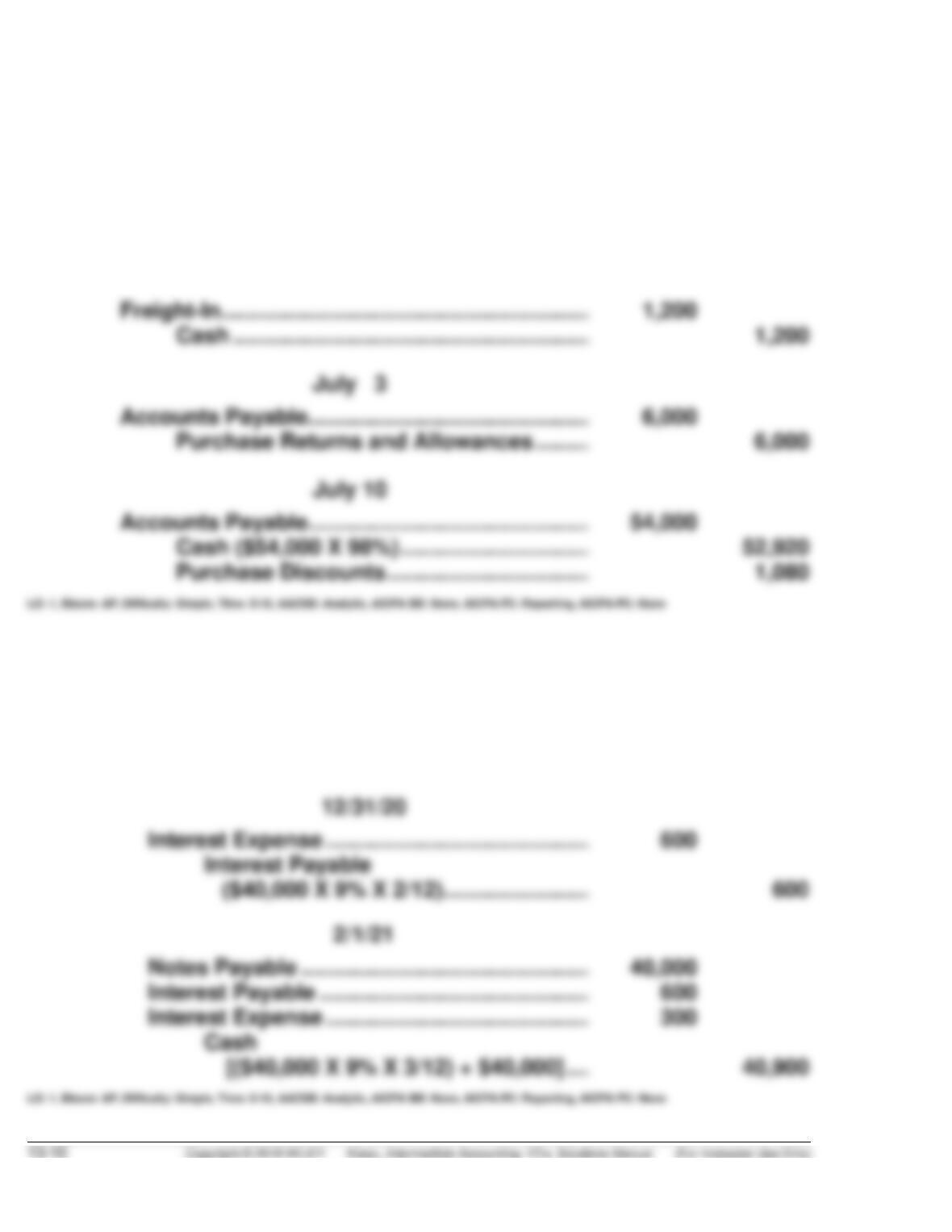
Freight-In ……………………………………………………….
Cash ………………………………………………………
Accounts Payable……………………………………………………
Purchase Returns and Allowances …………………..
Accounts Payable……………………………………………………
54,000
Cash ($54,000 X 98%) …………………………..
52,920
Purchase Discounts ………………………………………..
BRIEF EXERCISE 13.2
11/1/20
Cash ……………………………………………………….
40,000
Notes Payable …………………………………………………
40,000
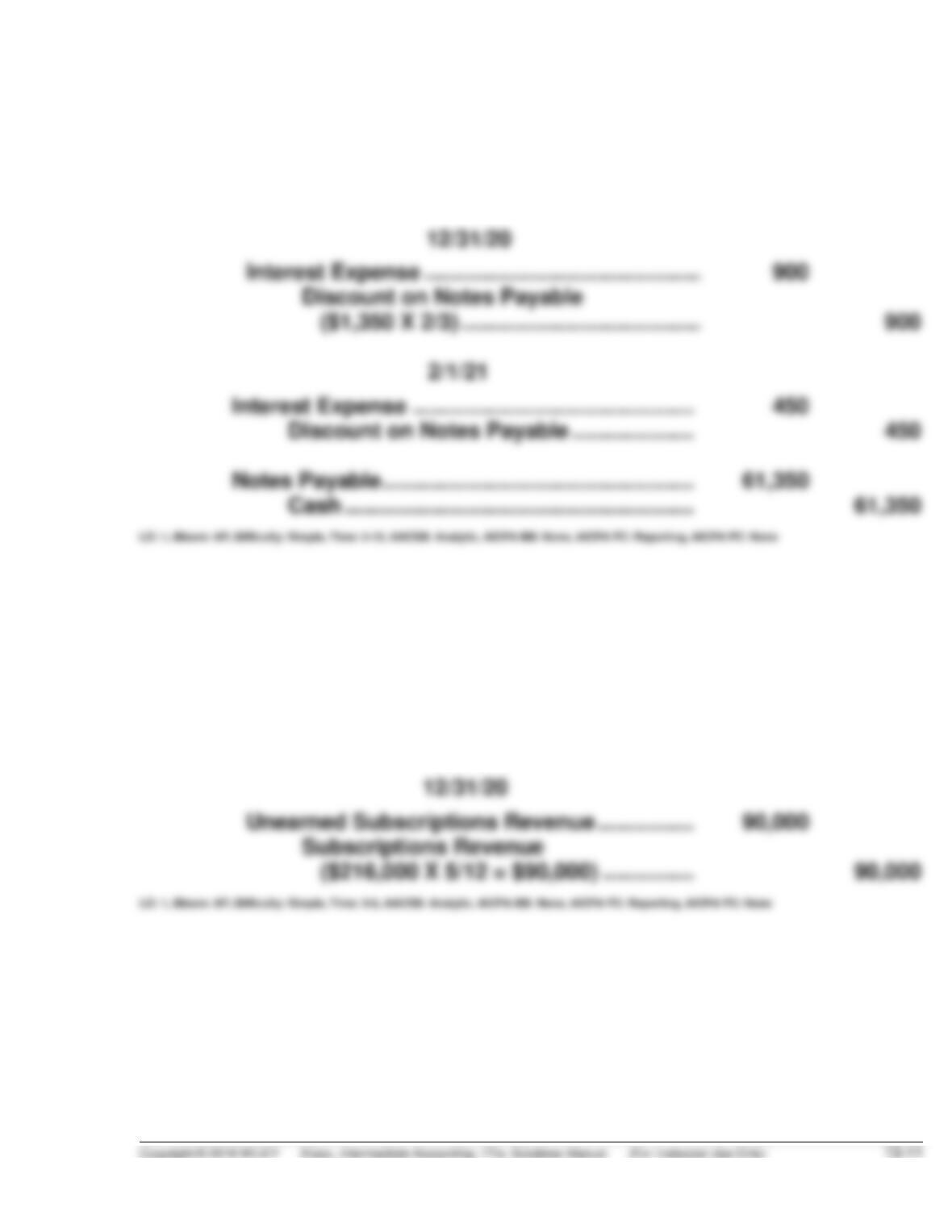
Interest Expense ……………………………………………………..
Interest Payable
($40,000 X 9% X 2/12) …………………………..
Notes Payable ……………………………………………………….
40,000
Interest Payable ………………………………………………………
Interest Expense ……………………………………………………..
Cash
BRIEF EXERCISE 13.3
11/1/20
Cash ………………………………………………………………………
60,000
Discount on Notes Payable …………………………..
1,350
Notes Payable ………………………………………………..
61,350
Interest Expense …………………………………………………….
Discount on Notes Payable
($1,350 X 2/3) ……………………………………………….
Interest Expense …………………………………………………….
Discount on Notes Payable …………………………..
Notes Payable ……………………………………………………….
Cash ……………………………………………………….
BRIEF EXERCISE 13.4
8/1/20
Cash ……………………………………………………….
216,000
Unearned Subscriptions Revenue
(12,000 X $18) ………………………………………………
216,000
Unearned Subscriptions Revenue …………………………..
Subscriptions Revenue
($216,000 X 5/12 = $90,000) …………………………..
BRIEF EXERCISE 13.5
(a)
Accounts Receivable ………………………………………………
31,800
Sales Revenue ………………………………………………..
30,000
Sales Taxes Payable
($30,000 X 6% = $1,800) ………………………………..
(b)
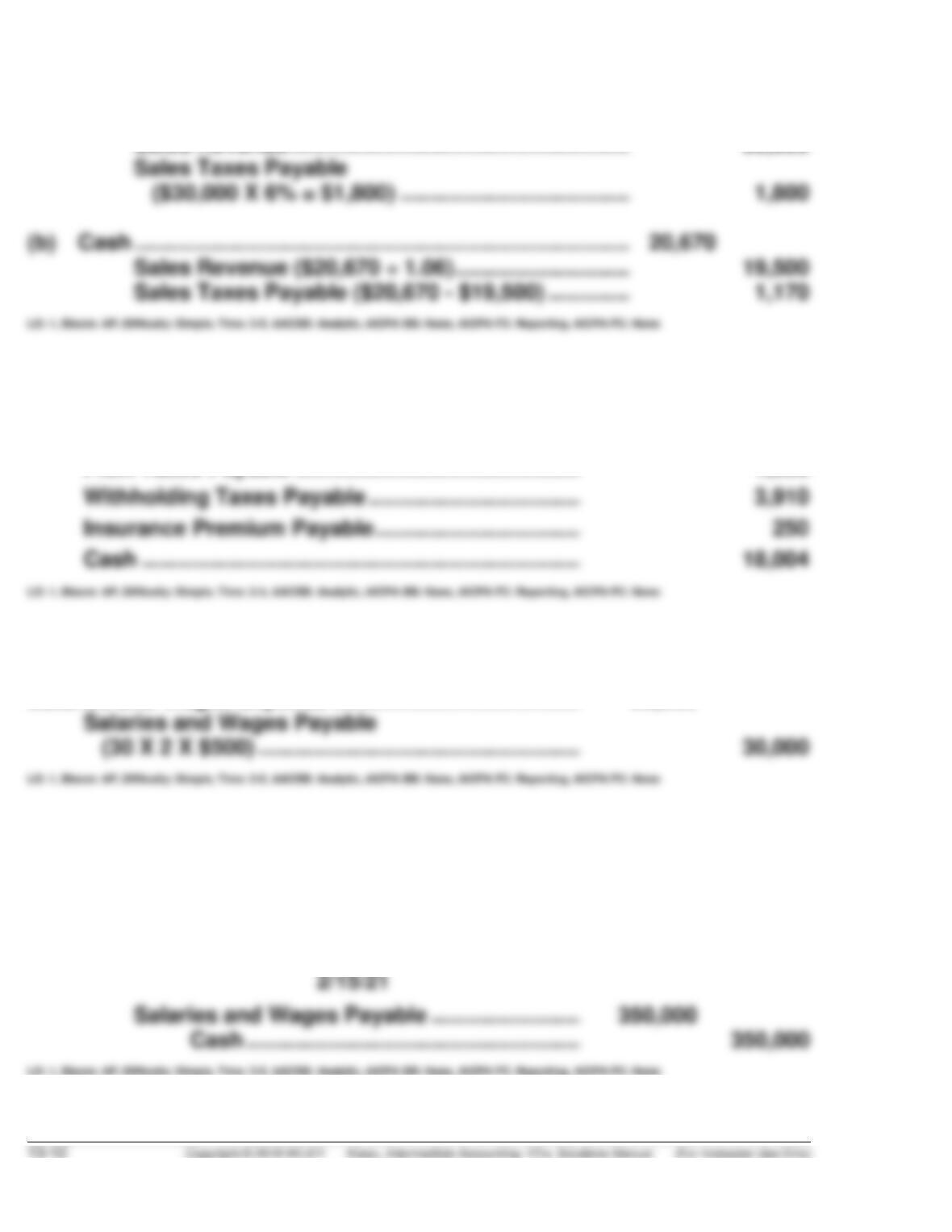
Cash ………………………………………………………………………
Sales Revenue ($20,670 ÷ 1.06) ………………………..
19,500
Sales Taxes Payable ($20,670 – $19,500) …………..
BRIEF EXERCISE 13.6
Salaries and Wages Expense …………………………………..
24,000
FICA Taxes Payable …………………………..……………
1,836
Withholding Taxes Payable ……………………………..
3,910
Insurance Premium Payable …………………………....
Cash ………………………………………………………………
BRIEF EXERCISE 13.7
Salaries and Wages Expense …………………………………..
30,000
Salaries and Wages Payable
(30 X 2 X $500) ……………………………………………..
BRIEF EXERCISE 13.8
12/31/20
Salaries and Wages Expense …………………………..
350,000
Salaries and Wages Payable …………………………..
350,000
Salaries and Wages Payable …………………………..
Cash ……………………………………………………….
350,000
BRIEF EXERCISE 13.9
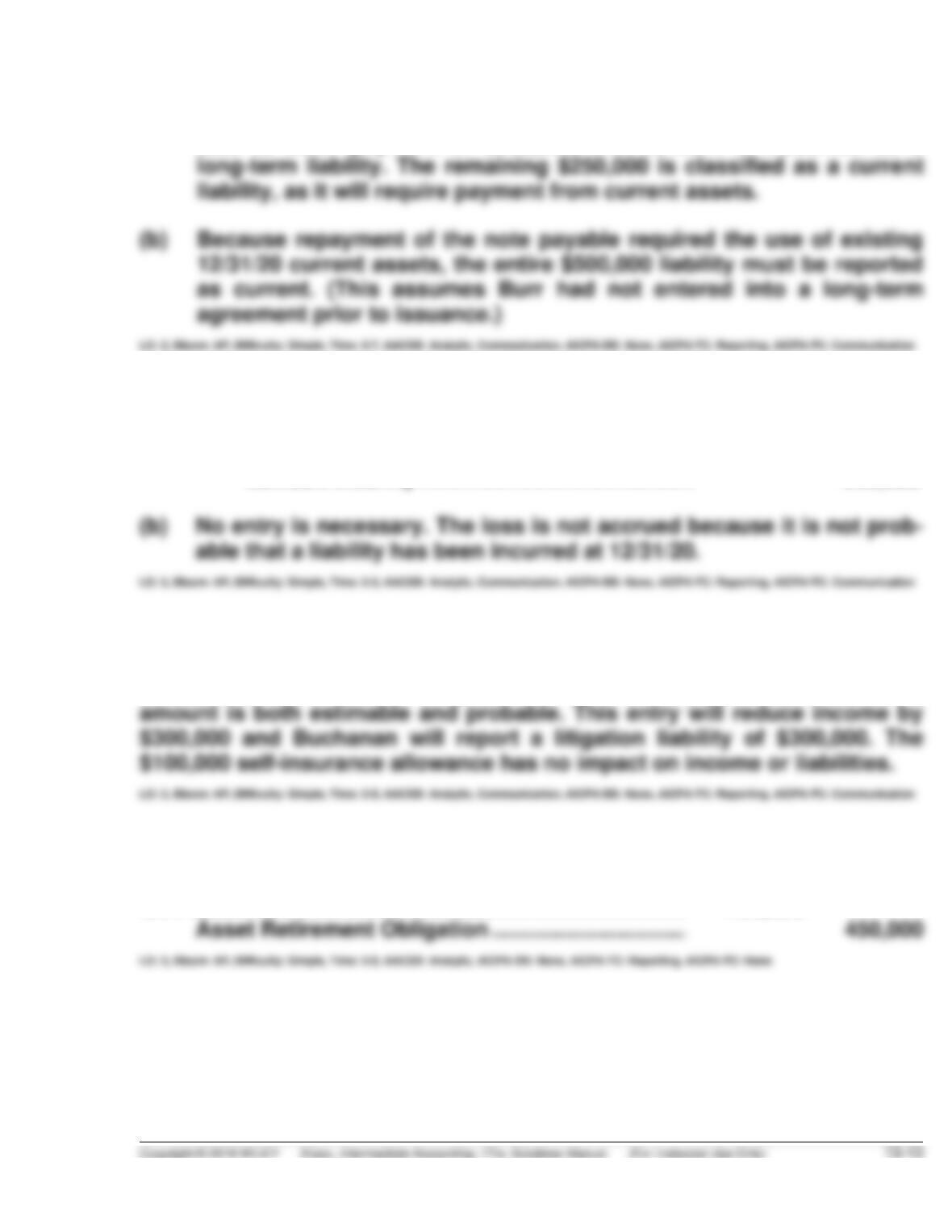
(a) $250,000. Since Burr has the contractual right at the balance sheet
date to defer payment of $250,000, that amount is classified as a
BRIEF EXERCISE 13.10
(a)
Lawsuit Loss ……………………………………………………….
900,000
Lawsuit Liability ……………………………………………..
900,000
BRIEF EXERCISE 13.11
Buchanan should record a litigation accrual on the patent case, since the
BRIEF EXERCISE 13.12
Oil Platform …………………………………………………………….
450,000
Asset Retirement Obligation …………………………..
450,000
BRIEF EXERCISE 13.13
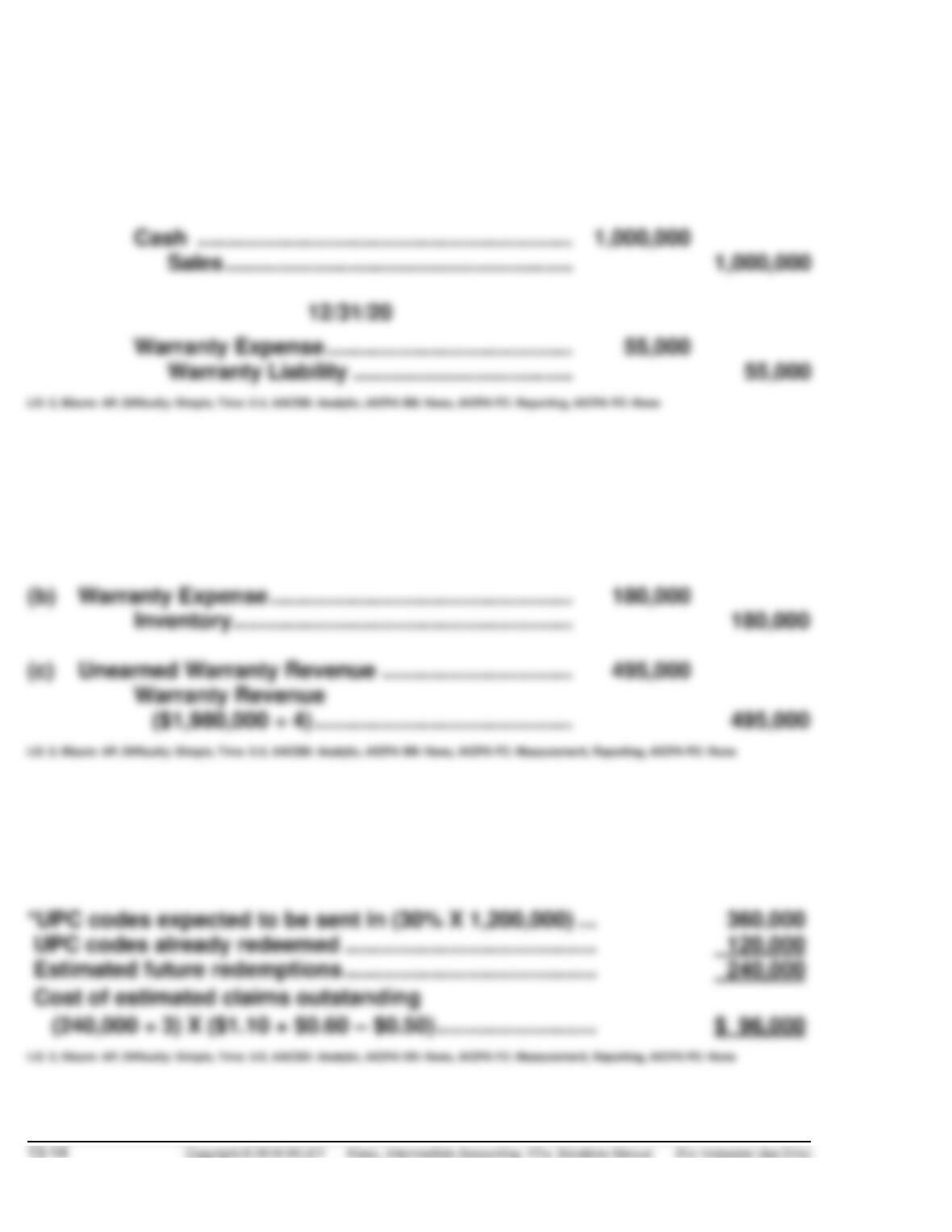
During 2020
Warranty Expense …………………………………………………..
70,000
Inventory ……………………………………………………….
70,000
Cash ……………………………………………………….
1,000,000
Sales ……………………………………………………….
Warranty Expense …………………………………………………..
BRIEF EXERCISE 13.14
(a)
Cash ………………………………………………………………………
1,980,000
Unearned Warranty Revenue
(20,000 X $99) ………………………………………………
1,980,000
(b)
Warranty Expense …………………………………………………..
Inventory ……………………………………………………….
(c)
Unearned Warranty Revenue …………………………..
Warranty Revenue
($1,980,000 ÷ 4) …………………………………………….
BRIEF EXERCISE 13.15
Premium Expense …………………………………………………….
96,000
Premium Liability ……………………………………………..
96,000*
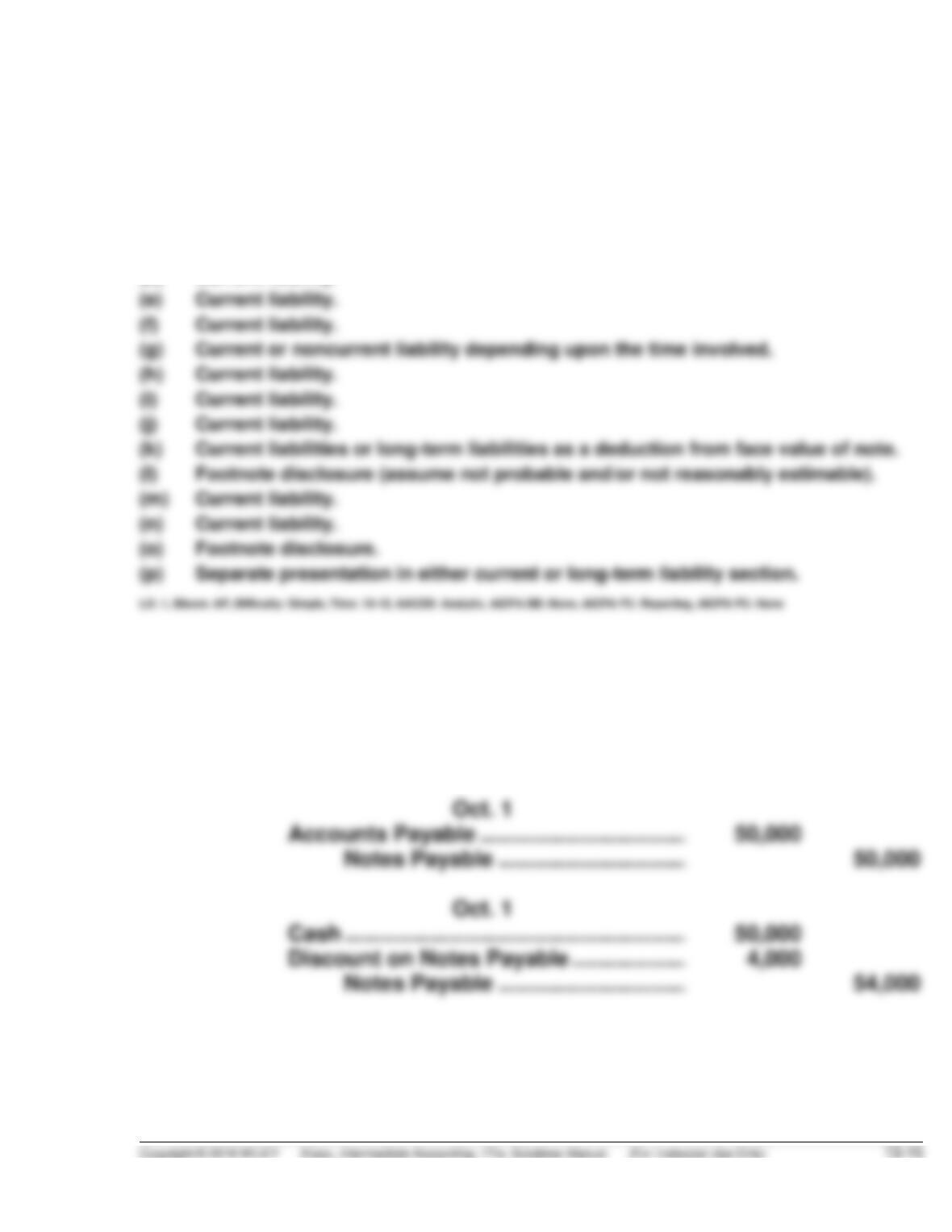
*UPC codes expected to be sent in (30% X 1,200,000) …
UPC codes already redeemed …………………………………..
(240,000 ÷ 3) X ($1.10 + $0.60 – $0.50) ……………………..
SOLUTIONS TO EXERCISES
EXERCISE 13.1 (10–15 minutes)
(a) Current liability.
(b) Current liability.
(c) Current liability or long-term liability depending on term of warranty.
(d) Current liability.
EXERCISE 13.2 (15–20 minutes)
Sept. 1
(a)
Purchases …………………………..…………………………..
50,000
Accounts Payable …………………………..
50,000
Accounts Payable …………………………………………………..
50,000
Notes Payable …………………………..
50,000
Cash ……………………………………………………….
50,000
Discount on Notes Payable …………………………..
Notes Payable …………………………..
54,000
EXERCISE 13.2 (Continued)
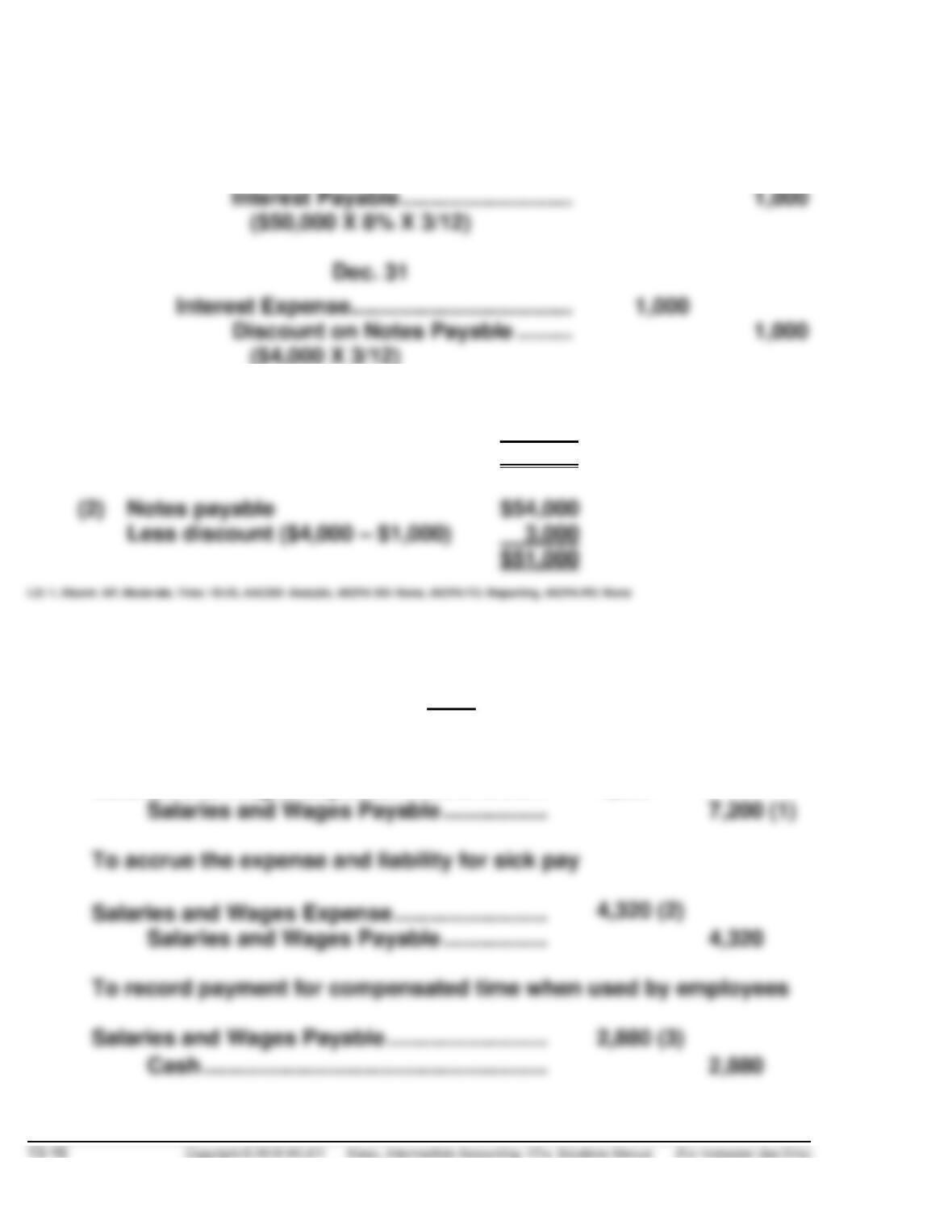
Dec. 31
(b)
Interest Expense ……………………………………………………..
1,000
Interest Payable …………………………..
($50,000 X 8% X 3/12)
Dec. 31
Interest Expense ……………………………………………………..
Discount on Notes Payable …………………………..
1,000
($4,000 X 3/12)
(c)
(1)
Notes payable
$50,000
Interest payable
1,000
$51,000
(2)
Notes payable
$54,000
Less discount ($4,000 – $1,000)
3,000
$51,000
EXERCISE 13.3 (25–30 minutes)
(a)
2019
To accrue expense and liability for vacations
Salaries and Wages Expense ………………………
7,200
Salaries and Wages Payable ……………….
(1)
Salaries and Wages Expense ………………………
(2)
To record payment for compensated time when used by employees
Salaries and Wages Payable ……………………….
(3)
EXERCISE 13.3 (Continued)
2020
To accrue the expense and liability for vacations
Salaries and Wages Expense ………………………
7,920
Salaries and Wages Payable ……………….
7,920
(4)
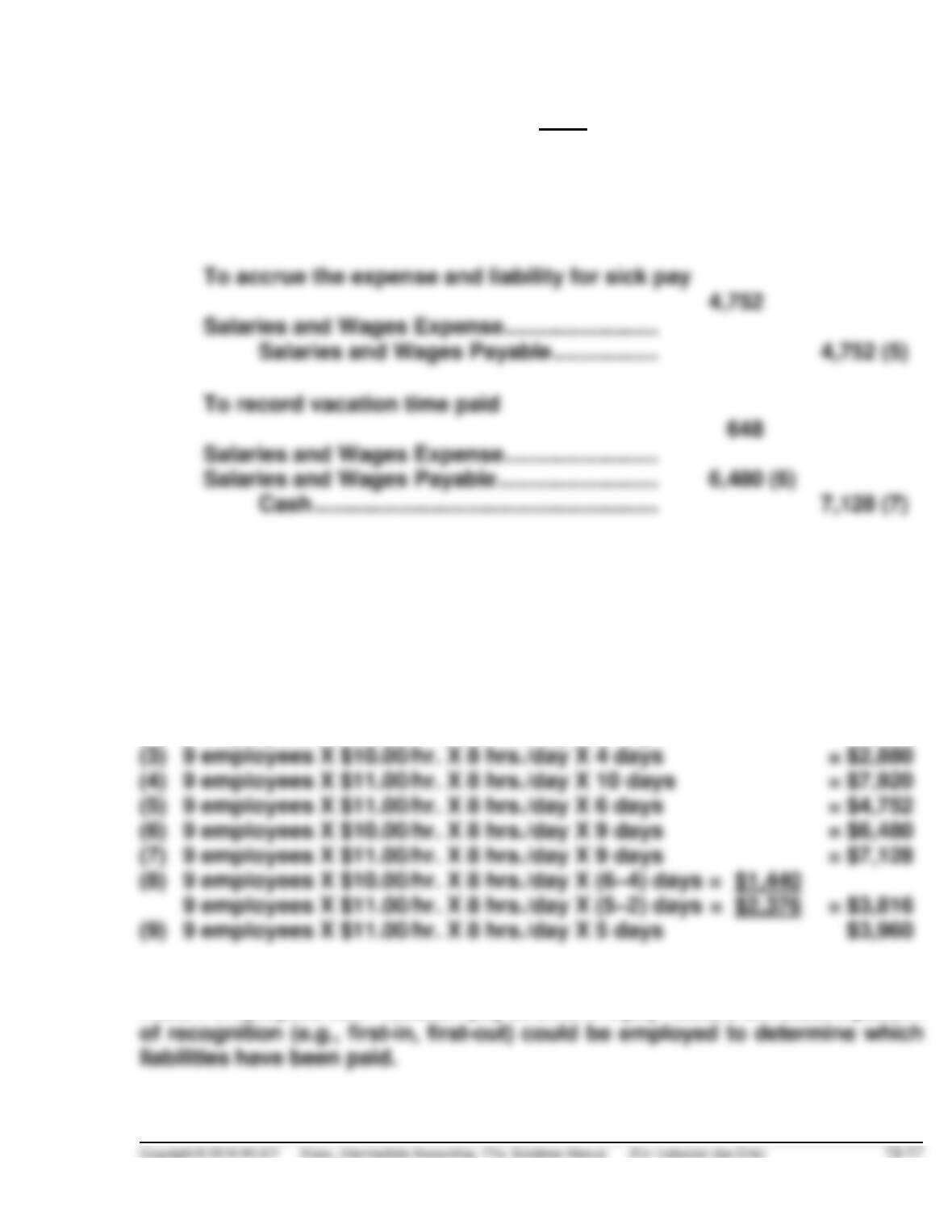
To accrue the expense and liability for sick pay
Salaries and Wages Expense ………………………
Salaries and Wages Payable ……………….
4,752
(5)
To record vacation time paid
648
Salaries and Wages Payable ……………………….
(6)
Cash ………………………………………………….
7,128
(7)
To record sick leave paid
Salaries and Wages Expense ………………………
144
Salaries and Wages Payable ……………………….
3,816
(8)
Cash ………………………………………………….
3,960
(9)
(1)
9 employees X $10.00/hr. X 8 hrs./day X 10 days
= $7,200
(2)
9 employees X $10.00/hr. X 8 hrs./day X 6 days
= $4,320
(3)
9 employees X $10.00/hr. X 8 hrs./day X 4 days
(4)
9 employees X $11.00/hr. X 8 hrs./day X 10 days
= $7,920
(5)
9 employees X $11.00/hr. X 8 hrs./day X 6 days
= $4,752
(6)
9 employees X $10.00/hr. X 8 hrs./day X 9 days
(7)
9 employees X $11.00/hr. X 8 hrs./day X 9 days
= $7,128
(8)
9 employees X $10.00/hr. X 8 hrs./day X (6–4) days =
$1,440
9 employees X $11.00/hr. X 8 hrs./day X (5–2) days =
(9)
Note: Vacation days and sick days are paid at the employee’s current wage.
Also, if employees earn vacation pay at different pay rates, a consistent pattern
EXERCISE 13.3 (Continued)
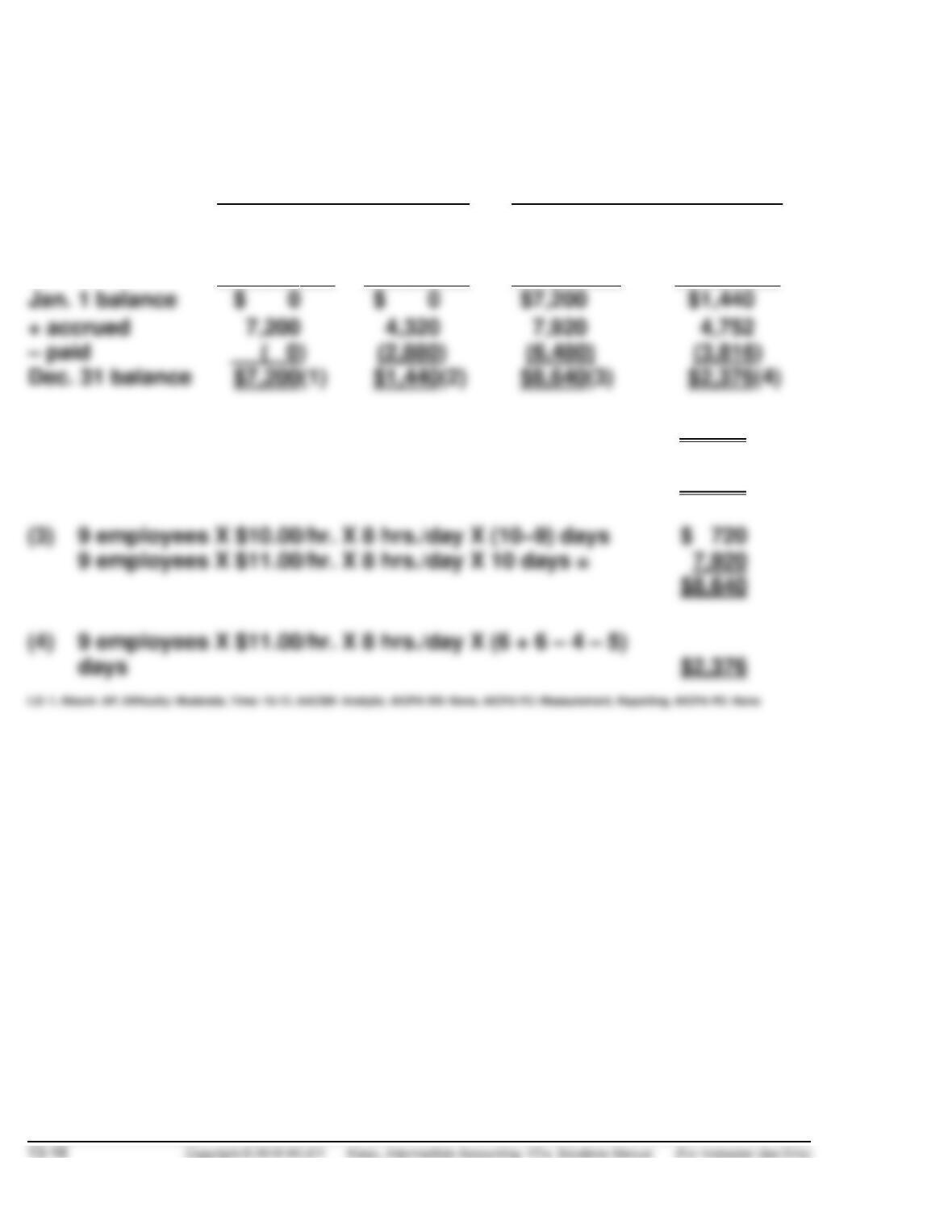
(b) Accrued liability at year-end:
2019
2020
Vacation
Wages
Payable
Sick Pay
Wages
Payable
Vacation
Wages
Payable
Sick Pay
Wages
Payable
Jan. 1 balance
Dec. 31 balance
(1)
(2)
(3)
(4)
(1)
9 employees X $10.00/hr. X 8 hrs./day X 10 days =
$7,200
(2)
9 employees X $10.00/hr. X 8 hrs./day X (6–4) days =
$1,440
9 employees X $11.00/hr. X 8 hrs./day X 10 days =
$8,640
EXERCISE 13.4 (25–30 minutes)
(a)
2019
To accrue the expense and liability for vacations
Salaries and Wages Expense …………….
7,740
(1)
Salaries and Wages Payable ………
7,740
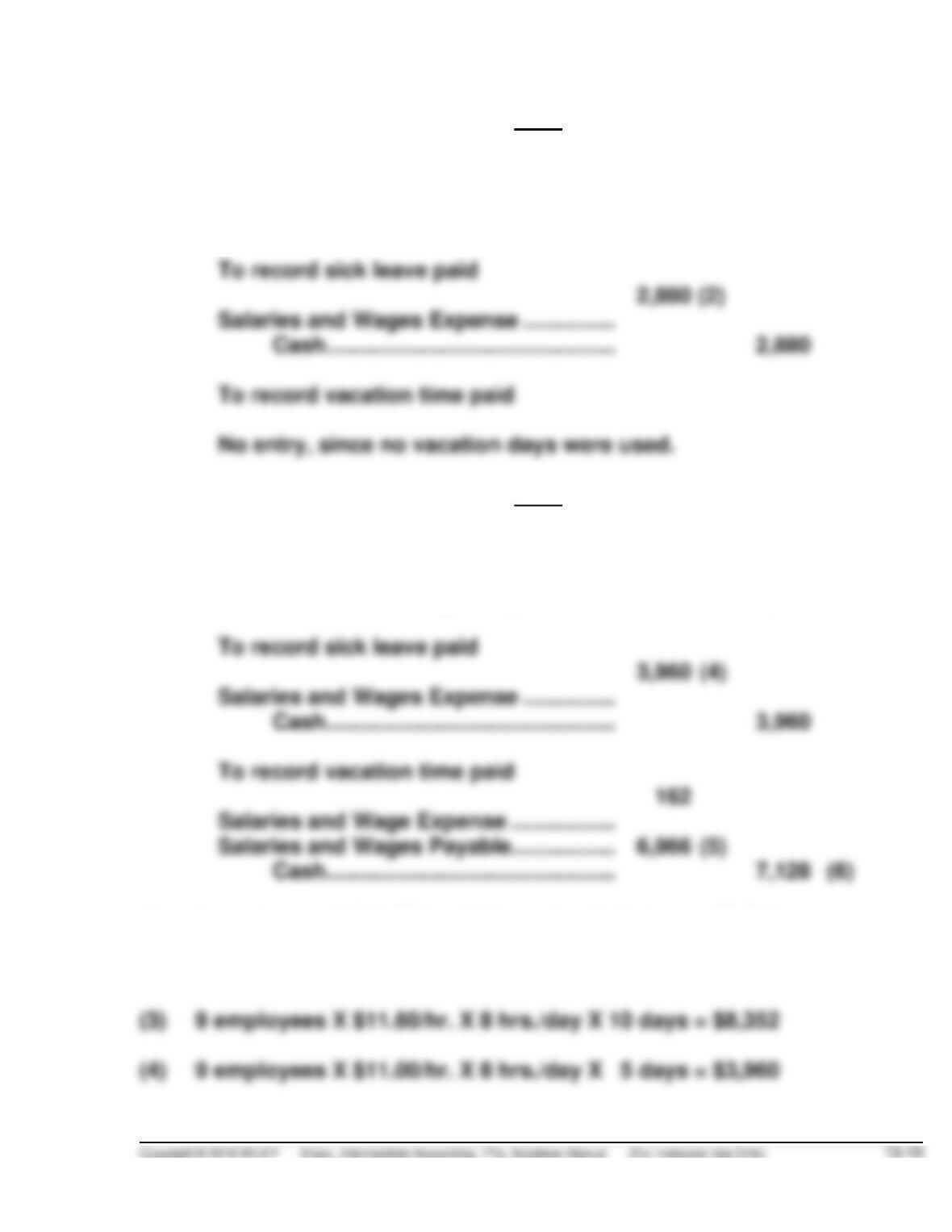
To record sick leave paid
Cash …………………………………………
2,880
To record vacation time paid
2020
To accrue the expense and liability for vacations
Salaries and Wages Expense …………….
8,352
(3)
Salaries and Wages Payable ………
8,352
To record sick leave paid
Cash …………………………………………
3,960
To record vacation time paid
Salaries and Wages Payable………………
6,966
(5)
Cash …………………………………………
7,128
(6)
(1) 9 employees X $10.75/hr. X 8 hrs./day X 10 days = $7,740
(2) 9 employees X $10.00/hr. X 8 hrs./day X 4 days = $2,880
EXERCISE 13.4 (Continued)
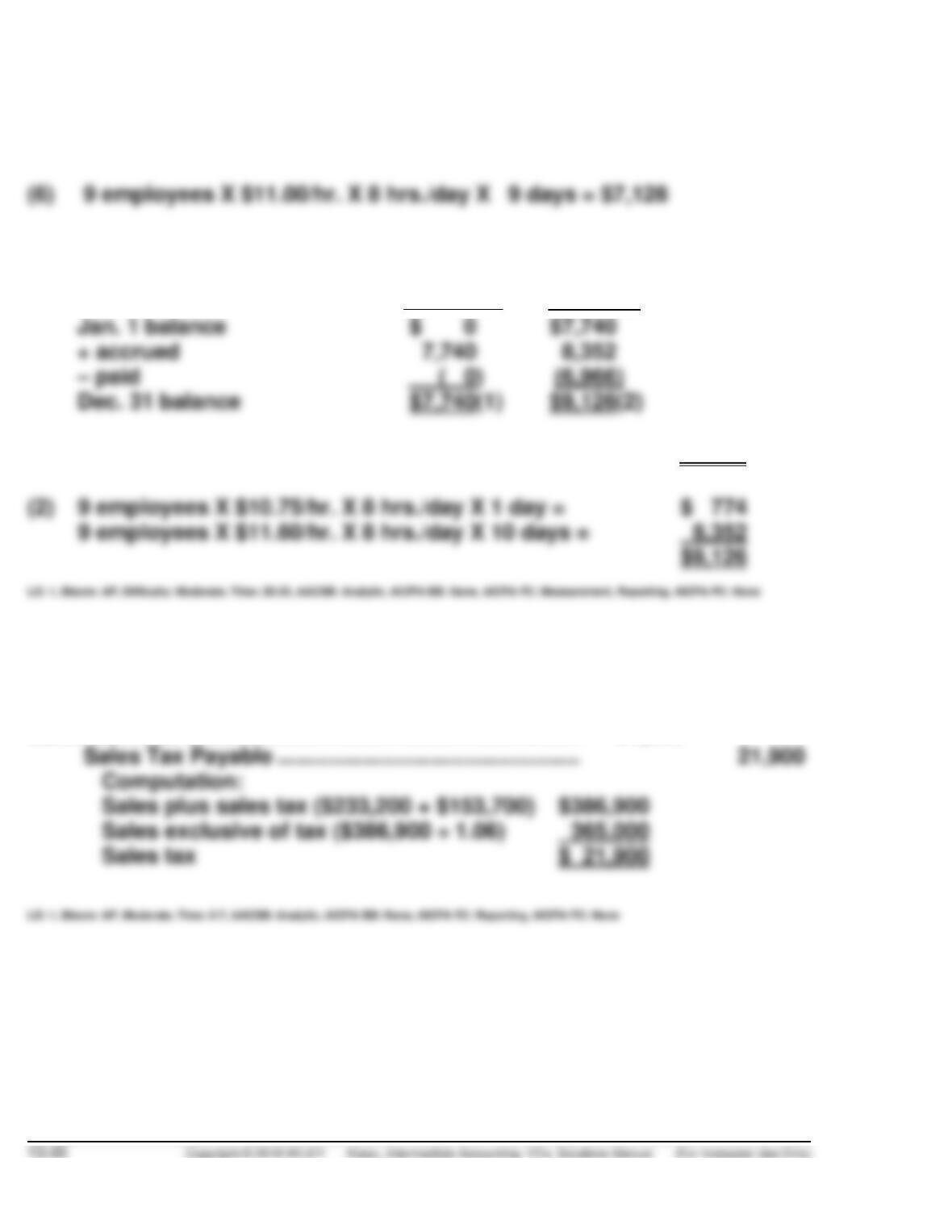
(5) 9 employees X $10.75/hr. X 8 hrs./day X 9 days = $6,966
(b)
Accrued liability at year-end:
2019
2020
Dec. 31 balance
(1)
(2)
(1)
9 employees X $10.75/hr. X 8 hrs./day X 10 days =
$7,740
(2)
9 employees X $10.75/hr. X 8 hrs./day X 1 day =
9 employees X $11.60/hr. X 8 hrs./day X 10 days =
$9,126
EXERCISE 13.5 (5–7 minutes)
June 30
Sales Revenue ………………………………………………………..
21,900
Computation:
Sales plus sales tax ($233,200 + $153,700)
Sales tax