Problem 13-18A (continued)
b.
Sabin Electronics
Common-Size Income Statements
This Year
Last Year
Sales ……………………………………………..
100.0
%
100.0
%
Cost of goods sold …………………………….
77.5
79.3
Gross margin …………………………………..
Selling and administrative expenses ……..
12.6
Net operating income ………………………..
Interest expense ………………………………
Net income before taxes …………………….
Income taxes …………………………………..
Net income ……………………………………..
%
%
3. The following points can be made from the analytical work in parts (1)
and (2) above:
a. The company’s current position has deteriorated significantly since
last year. Both the current ratio and the acid-test ratio are well below
the industry average and are trending downward. At the present rate,
Problem 13-18A (continued)
c. The inventory turned only five times this year as compared to over six
times last year. It takes nearly two weeks longer for the company to
turn its inventory than the average for the industry (73 days as
Problem 13-19A (45 minutes)
This Year
Last Year
1.
a.
Net income (a) ……………………………….
$280,000
$196,000
Average number of common shares (b) .
50,000
50,000
Earnings per share (a) ÷ (b) ……………..
$5.60
$3.92
b.
Dividends per share (a) ……………………
$2.20
$1.90
Market price per share (b) ………………..
Dividend yield ratio (a) ÷ (b)……………..
Dividends per share (a) ……………………
$1.90
Earnings per share (b) ……………………..
$5.60
$3.92
Dividend payout ratio (a) ÷ (b) ………….
Market price per share (a)…………………
Earnings per share (b) ……………………..
$5.60
$3.92
Price-earnings ratio (a) ÷ (b) …………….
Problem 13-19A (continued)
This Year
Last Year
e.
Total stockholders’ equity (a) ………………..
$1,600,000
$1,430,000
Book value per share (a) ÷ (b) ………………
Number of common shares outstanding
This Year
Last Year
2.
a.
Gross margin (a) ……………………………..
$1,125,000
$900,000
Sales (b) ………………………………………..
$5,000,000
$4,350,000
Gross margin percentage (a) ÷ (b) ………
22.5%
20.7%
Net income (a) ………………………………..
$196,000
Sales (b) ………………………………………..
$5,000,000
Net profit margin percentage (a) ÷ (b) …
c.
Net income …………………………………….
$ 196,000
Add after-tax cost of interest paid:
Total (a) …………………………………………
Average total assets (b) …………………….
$2,730,000
Return on total assets (a) ÷ (b) …………..
d.
Net income (a) ………………………………..
$ 280,000
$ 196,000
Average stockholders’ equity (b) ………….
$1,515,000
$1,425,000
Return on equity (a) ÷ (b) …………………
18.5%
13.8%
Problem 13-19A (continued)
e. Financial leverage is positive in both years because the return on
3. All profitability measures and the earnings per share are trending
upwards, which is a good sign. However, the price-earnings ratio has
dropped from 9.18 to 7.14. This decline indicates investor concerns
Ethics Challenge (45 minutes)
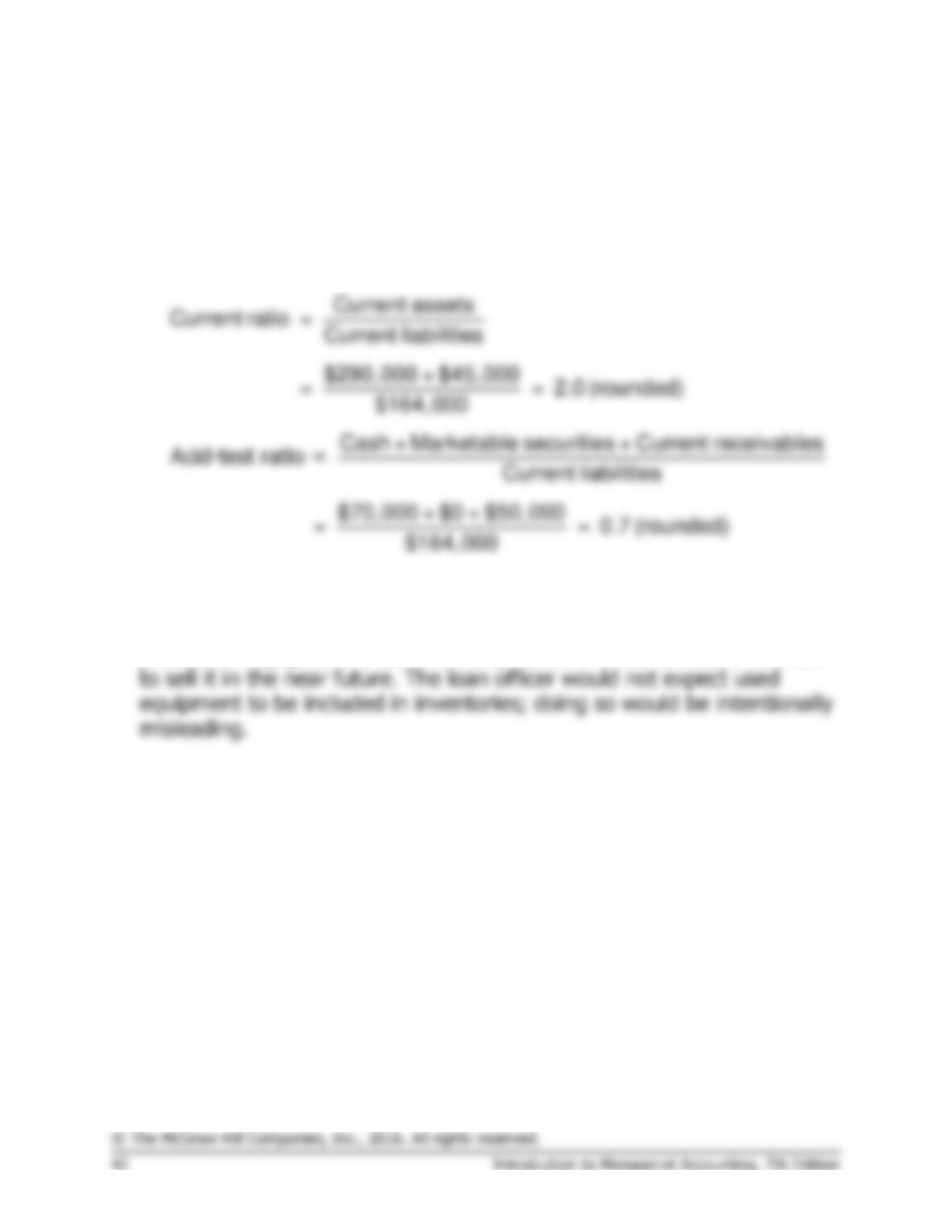
1. The loan officer stipulated that the current ratio prior to obtaining the
loan must be higher than 2.0, the acid-test ratio must be higher than
1.0, and the interest on the loan must be less than four times net
operating income. These ratios are computed below:
Ethics Challenge (continued)
2. By reclassifying the $45 thousand net book value of the old machine as
inventory, the current ratio would improve, but the acid-test ratio would
be unaffected. Inventory is considered a current asset for purposes of
computing the current ratio, but is not included in the numerator when
computing the acid-test ratio.
Even if this tactic had succeeded in qualifying the company for the loan,
we strongly advise against it. Inventories are assets the company has
acquired to sell to customers in the normal course of business. Used
production equipment is not inventory—even if there is a clear intention
Ethics Challenge (continued)
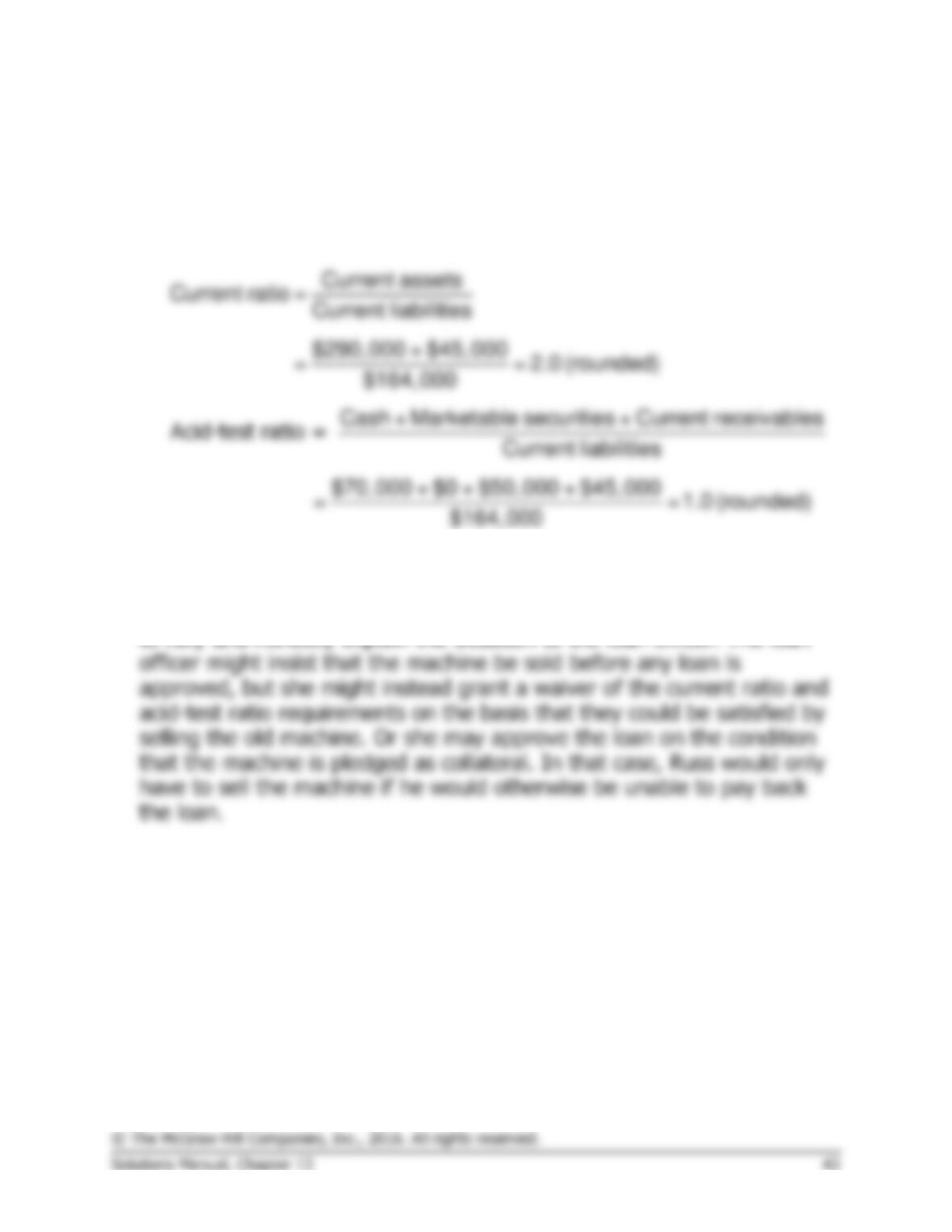
Nevertheless, the old machine is an asset that could be turned into
cash. If this were done, the company would immediately qualify for the
loan because the $45 thousand in cash would be included in the
numerator in both the current ratio and in the acid-test ratio.
However, other options may be available. The old machine is being used
to relieve bottlenecks in the plastic injection molding process and it
would be desirable to keep this standby capacity. We would advise Russ
Analytical Thinking (60 minutes or longer)
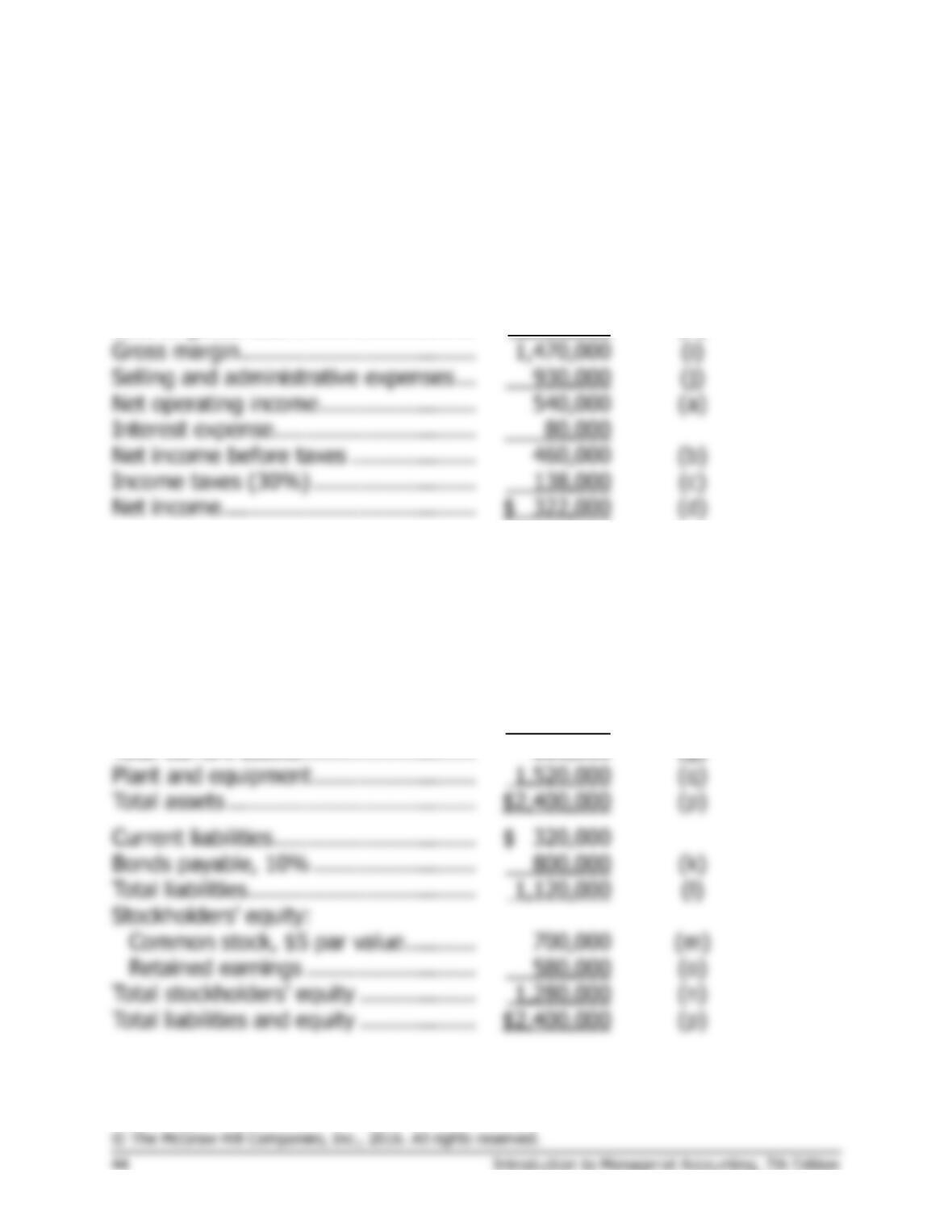
Pepper Industries
Income Statement
For the Year Ended March 31
Key to
Computation
Sales …………………………………………
$4,200,000
Cost of goods sold ……………………….
2,730,000
(h)
Gross margin …………………………..….
Selling and administrative expenses …
Net operating income ……………………
540,000
(a)
Interest expense ………………………….
Net income before taxes ……………….
460,000
(b)
Income taxes (30%) …………………….
138,000
Net income …………………………………
Pepper Industries
Balance Sheet
March 31
Current assets:
Cash ……………………………………….
$ 70,000
(f)
Accounts receivable, net ……………..
330,000
(e)
Inventory …………………………………
480,000
(g)
Total current assets ………………………
880,000
(g)
Plant and equipment …………………….
1,520,000
(q)
Total assets …………………………..……
Current liabilities ………………………….
Bonds payable, 10% …………………….
Total liabilities ……………………………..
1,120,000
Common stock, $5 par value ………..
700,000
Retained earnings ……………………..
Total liabilities and equity ………………
$2,400,000
(p)
Analytical Thinking (continued)
Computation of missing amounts:
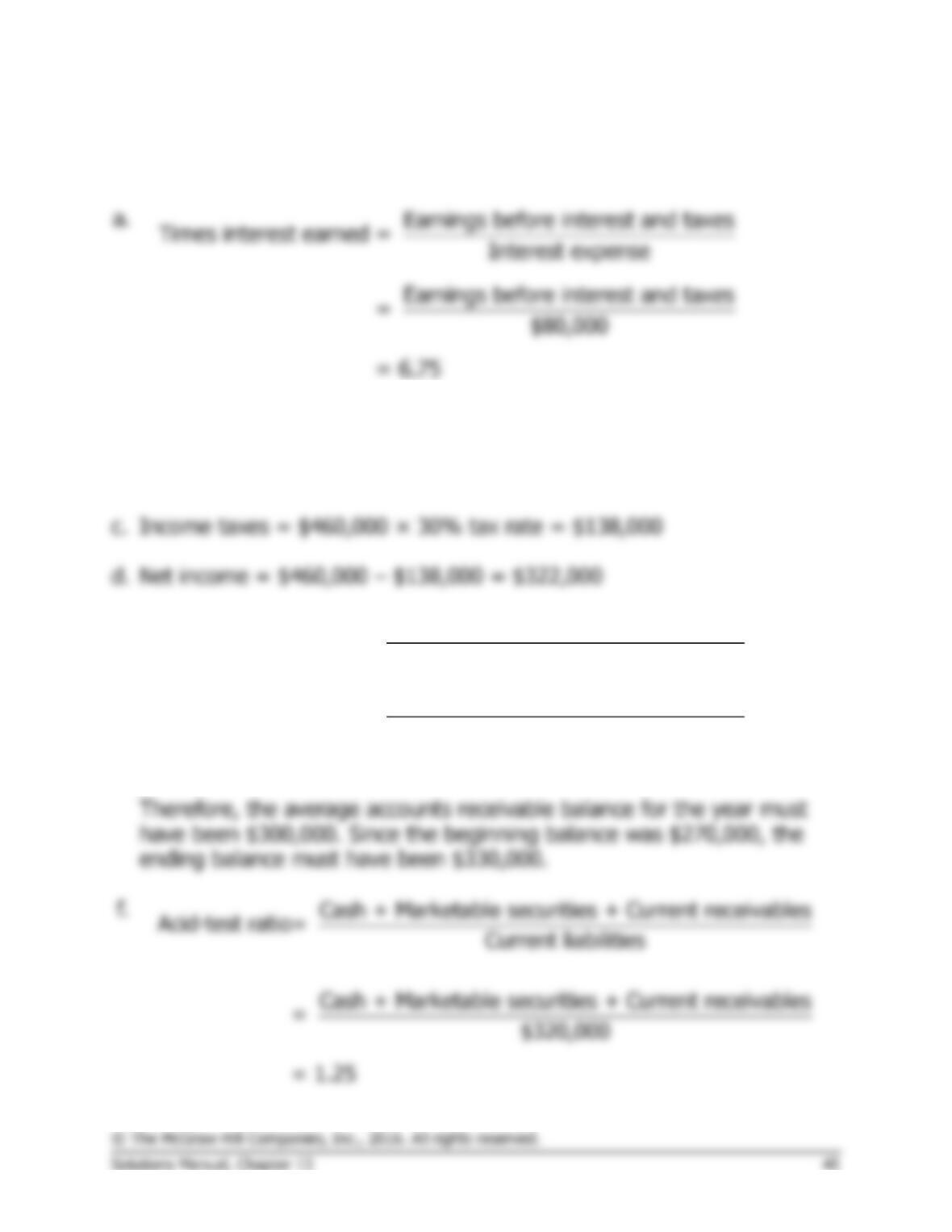
Therefore, the earnings before interest and taxes for the year must be
$540,000.
b. Net income before taxes = $540,000 – $80,000 = $460,000
e.
Sales on account
Accounts receivable =
turnover Average accounts receivable balance
$4,200,000
=
Average accounts receivable balance
= 14.0
Analytical Thinking (continued)
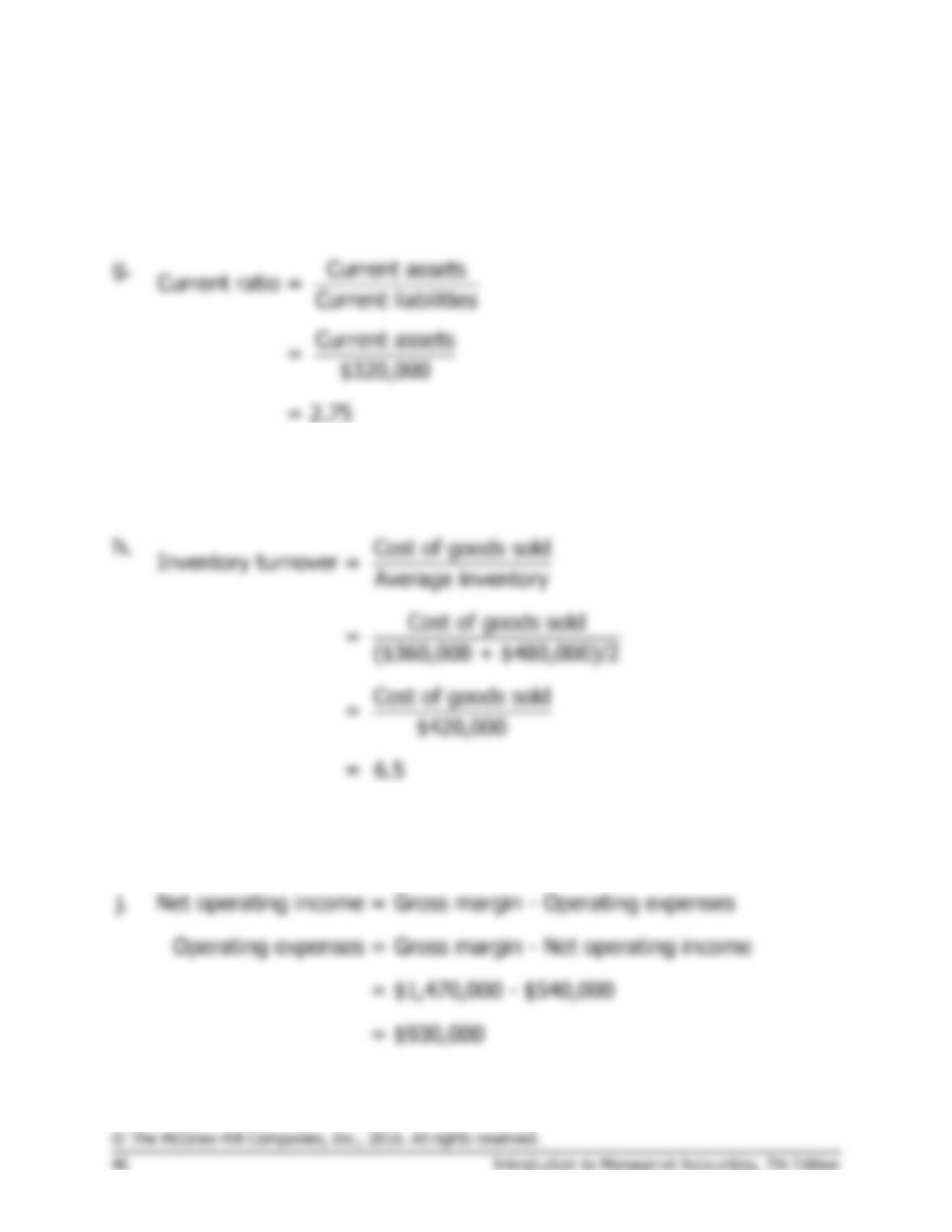
Therefore, the total quick assets must be $400,000. Because there are
no marketable securities and the accounts receivable are $330,000, the
cash must be $70,000.
Therefore, the current assets must total $880,000. Because the quick
assets (cash and accounts receivable) total $400,000 of this amount, the
inventory must be $480,000.
Therefore, the cost of goods sold for the year must be $2,730,000.
i. Gross margin = $4,200,000 – $2,730,000 = $1,470,000.
Analytical Thinking (continued)
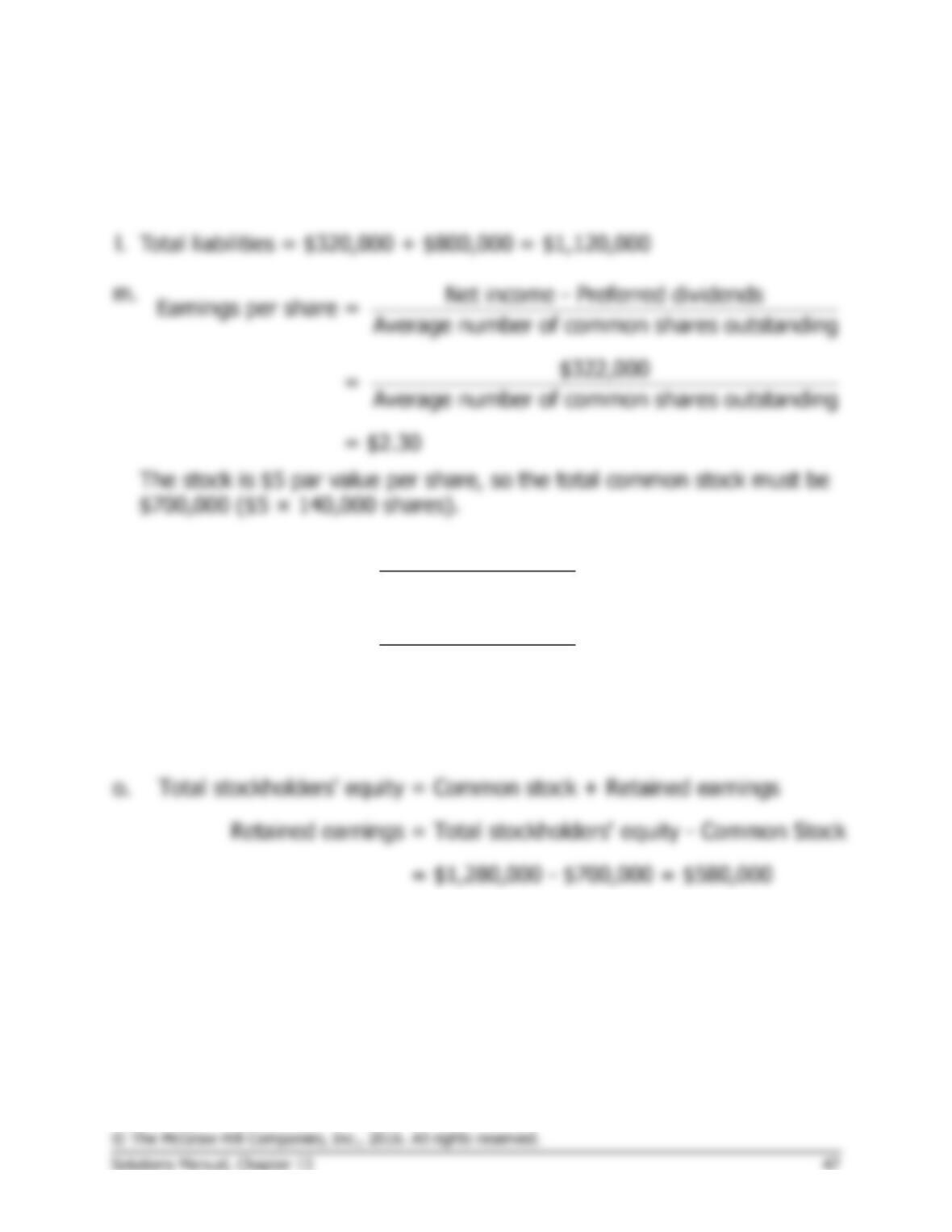
k. The interest expense for the year was $80,000 and the interest rate was
10%, the bonds payable must total $800,000.
n.
Total liabilities
Debt-to-equity ratio = Stockholders’ equity
$1,120,000
= Stockholders’ equity
= 0.875
Therefore, the total stockholders’ equity must be $1,280,000.
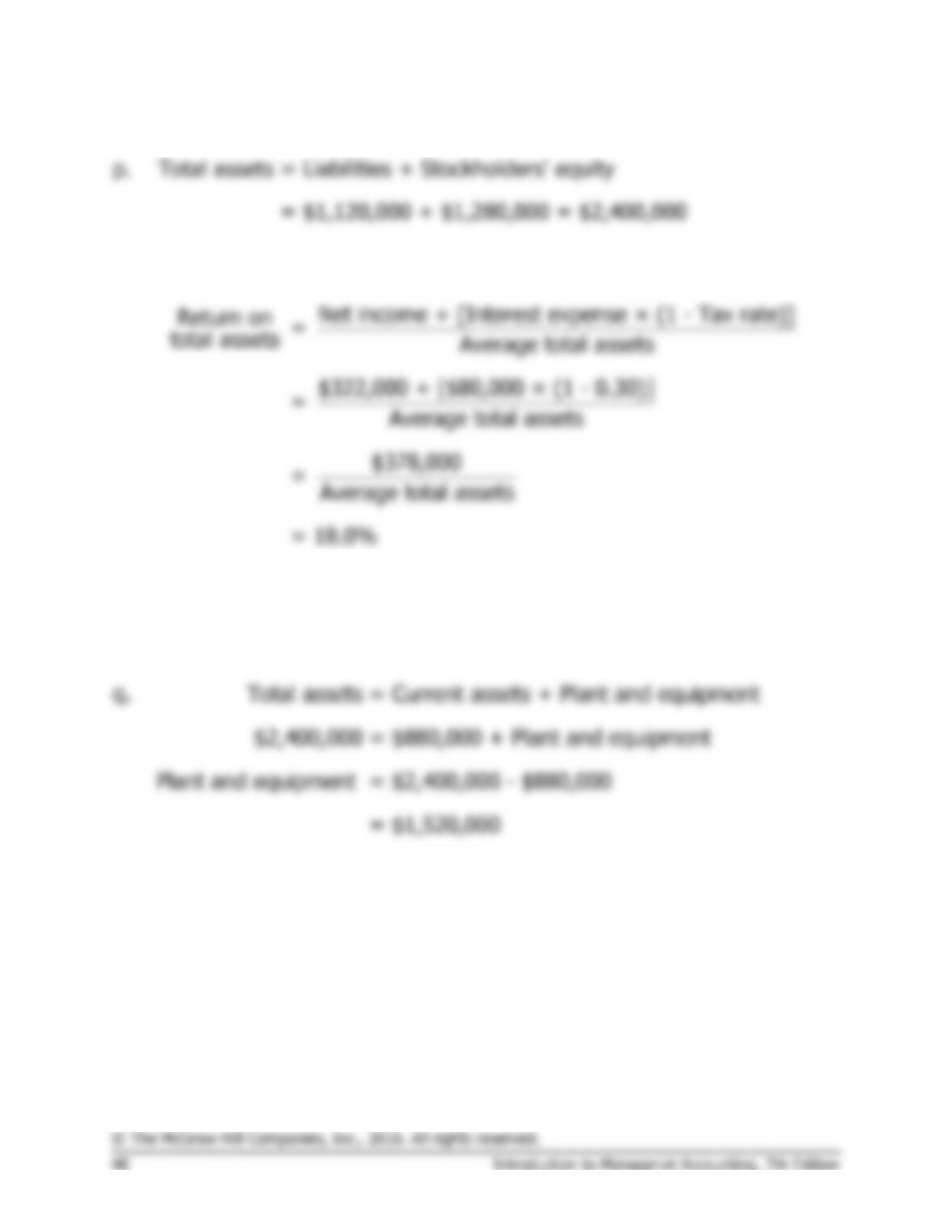
Analytical Thinking (continued)
This answer can also be obtained using the return on total assets:
Therefore the average total assets must be $2,100,000. Since the total
assets at the beginning of the year were $1,800,000, the total assets at
the end of the year must have been $2,400,000 (which would also equal
the total of the liabilities and the stockholders’ equity).

Teamwork in Action
The answer to this question will depend on the company that the students
analyze.