FINANCIAL REPORTING PROBLEM
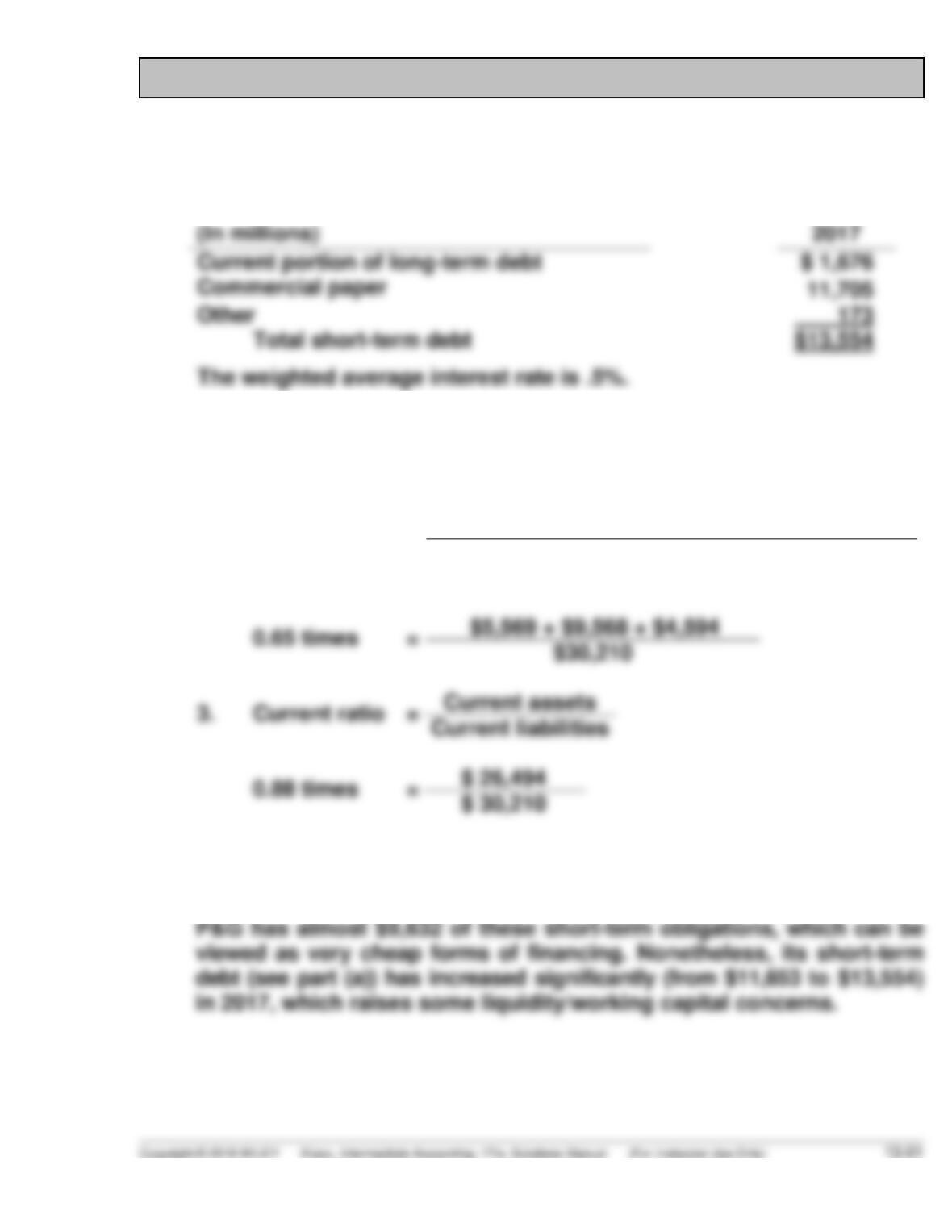
(a) P&G’s short-term borrowings were $13,554 at June 30, 2017. (in
$ millions)
SHORT-TERM DEBT
(In millions)
Commercial paper
Total short-term debt
(b) 1. Working capital = Current assets less current liabilities.
($3,716) = ($26,494 – $30,210)
2.
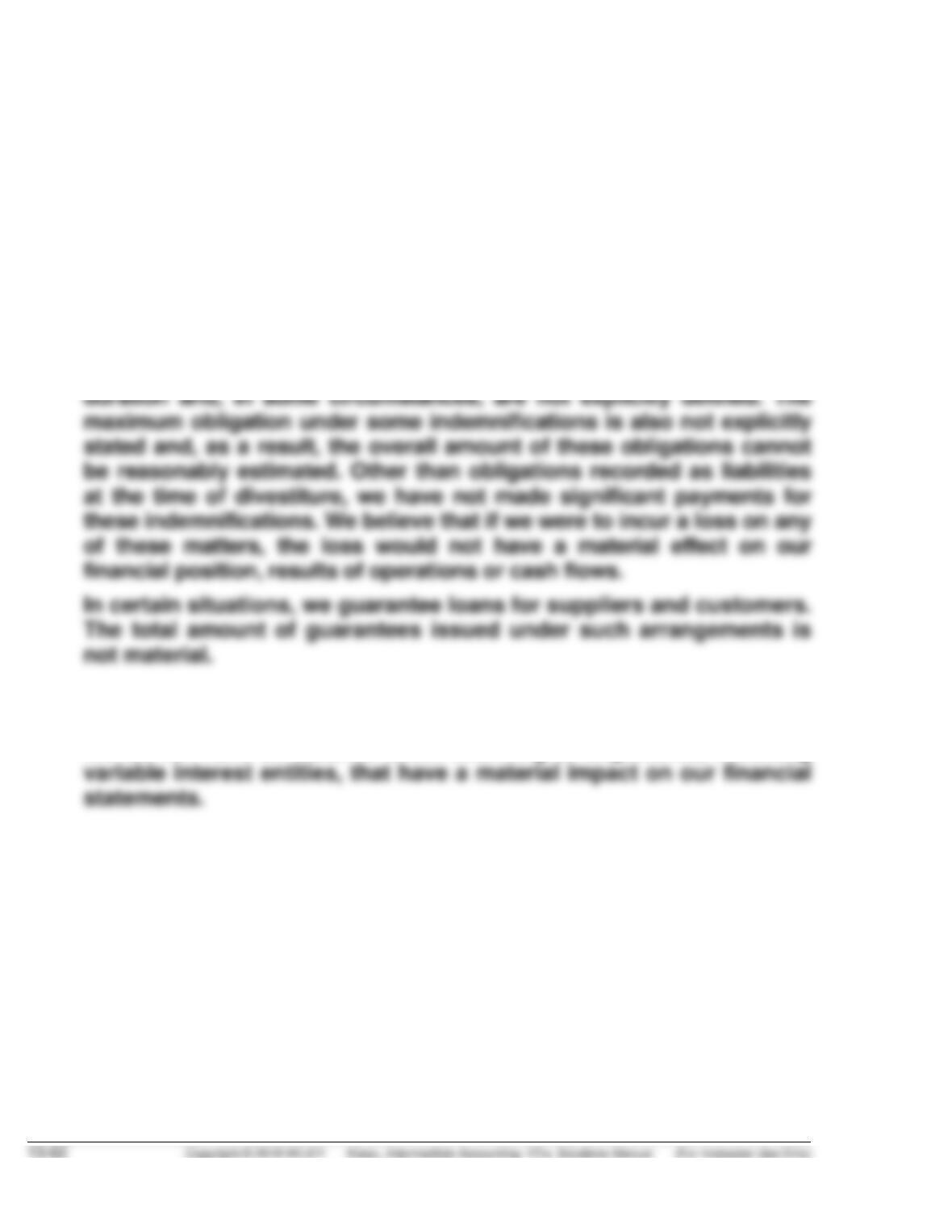
Acid-test ratio =
Cash + short-term investments + net receivables
Current liabilities
While P&G’s current and acid-test ratios are below one, this may not
indicate a weak liquidity position. Many large companies carry relatively
high levels of accounts payable, which charge no interest. For example,
FINANCIAL REPORTING PROBLEM (Continued)
(c) P&G provided the following discussion related to commitments and
contingencies:
NOTE 12
COMMITMENTS AND CONTINGENCIES
Guarantees
In conjunction with certain transactions, primarily divestitures, we may
provide routine indemnifications (e.g., indemnification for
representations and warranties and retention of previously existing
environmental, tax and employee liabilities) for which terms range in
Off-Balance Sheet Arrangements
We do not have off-balance sheet financing arrangements, including
FINANCIAL REPORTING PROBLEM (Continued)
Purchase Commitments and Operating Leases
We do not have off-balance sheet financing arrangements, including
variable interest entities, that have a material impact on our financial
statements.
Purchase Commitments and Operating Leases
We have purchase commitments for materials, supplies,
services and property,
Years ending June 30
2018
2019
2020
2021
2022
There after
Purchase
obligations
$ 843
$ 225
$ 168
$ 99
$ 70
$ 202
Such amounts represent minimum commitments under take-
or-pay agreements
with suppliers and are in line with expected
usage. These amounts include
We also lease certain property and equipment for varying
periods. Future
minimum rental commitments under non– cancelable operating leases, net of
guaranteed sublease
income, are as follows:
2018
2019
2020
2021
2022
There after
Operating leases
$ 261
$ 273
$ 237
$ 160
$ 368
FINANCIAL REPORTING PROBLEM (Continued)
Litigation
We are subject, from time to time, to certain legal proceedings
and claims arising
out of our business, which cover a wide
range of matters, including antitrust
and trade regulation,
product liability, advertising, contracts, environmental,
COMPARATIVE ANALYSIS CASE
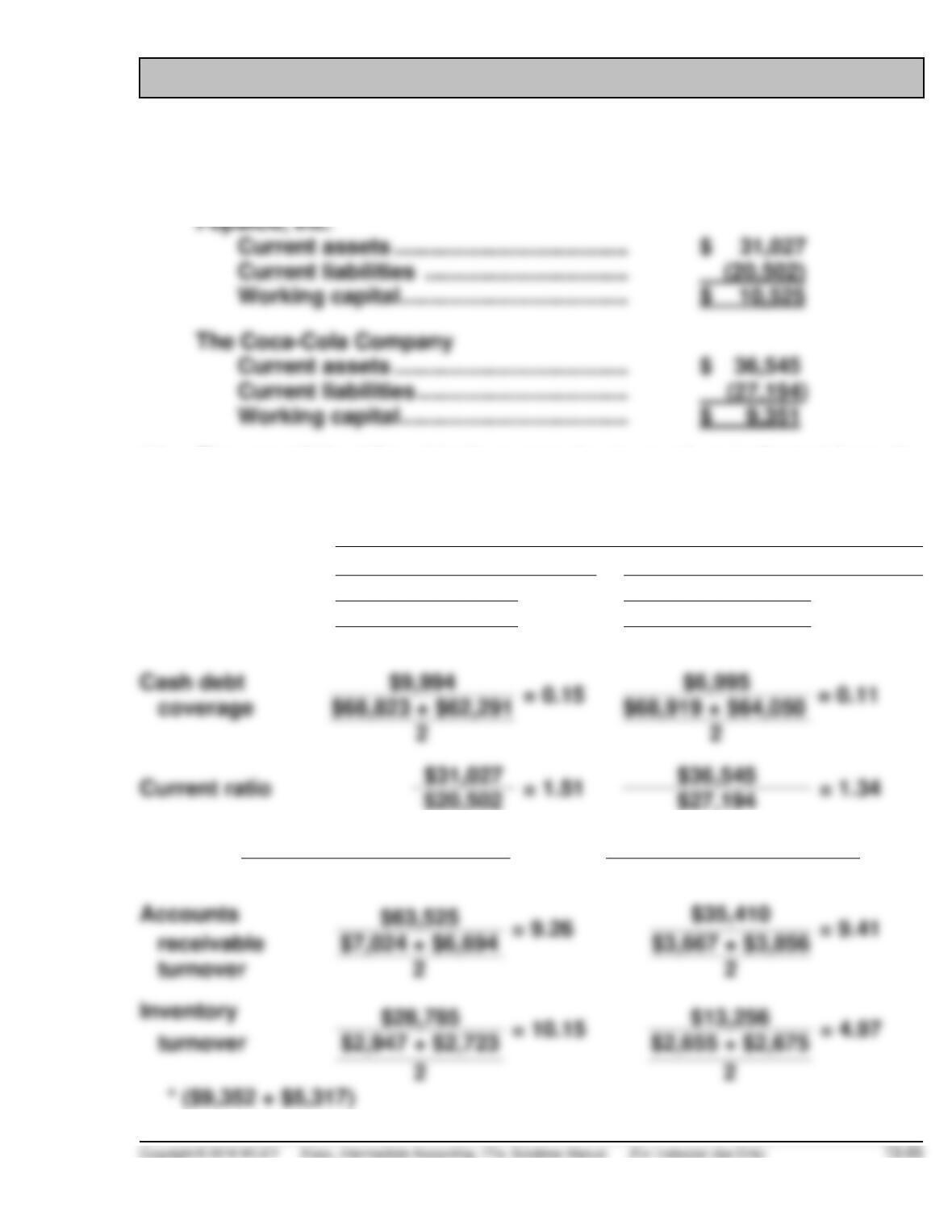
(a) The working capital position of the two companies is as follows:
($ millions)
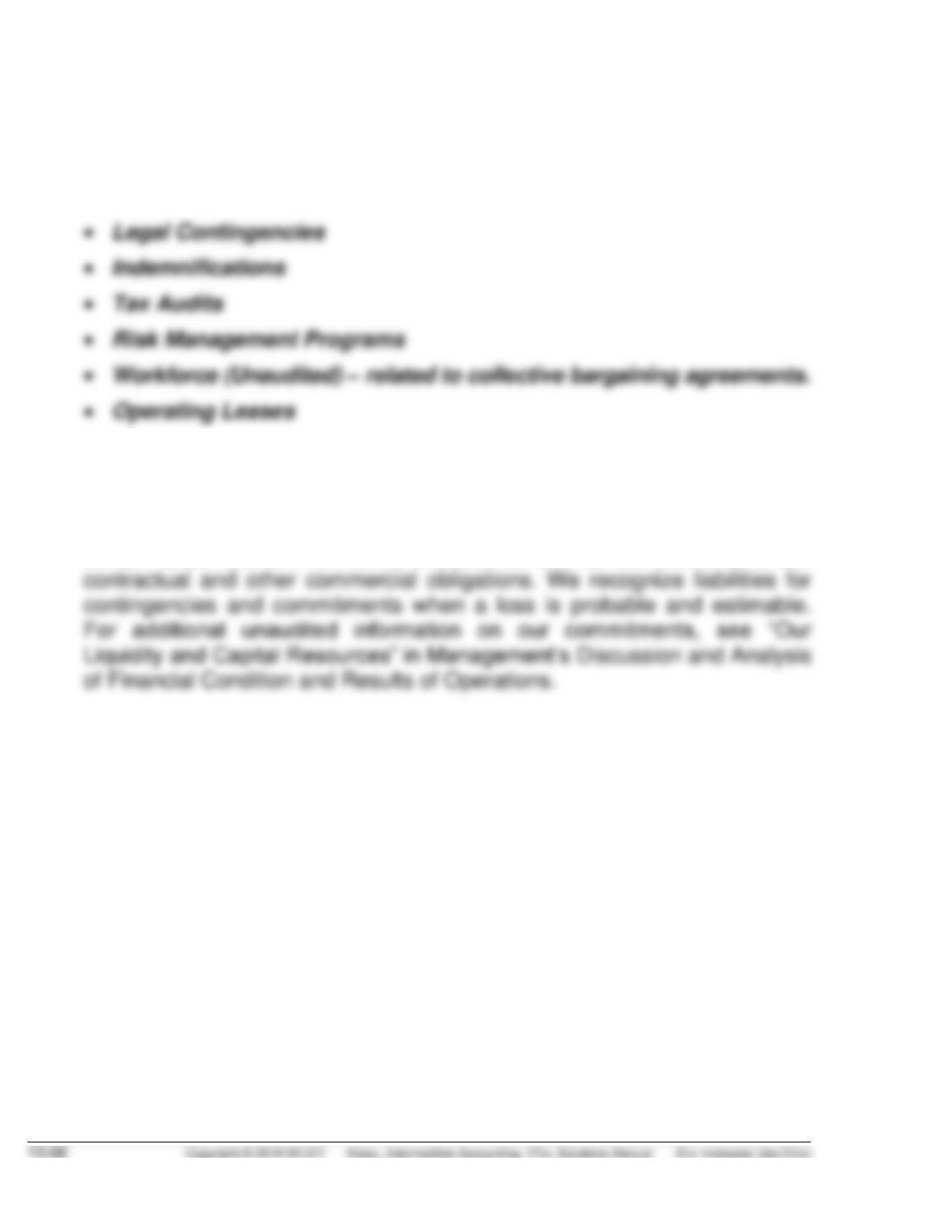
(b) The overall liquidity of both companies is good as indicated from the
ratio analysis provided below:
(all computations in millions)
PepsiCo, Inc.
Coca-Cola
Current cash debt
$9,994
= 0.48
$6,995
= 0.26
coverage
$20,502 + $21,135
$27,194 + $26,532
2
2
Cash debt
= 0.15
= 0.11
coverage
$68,919 + $64,050
Current ratio
= 1.51
= 1.34
Acid-test
$10,610 + $8,900 + $7,024
= 1.29
$6,006 + $14,669*+ $3,667
= 0.90
ratio
$20,502
$27,194
receivable
turnover
COMPARATIVE ANALYSIS CASE (Continued)
(c) Coca-Cola discusses its contingencies in NOTE 11: COMMITMENTS
AND CONTINGENCIES. It provides discussions of:
• Guarantees
PepsiCo refers to its contingencies in Note 2 –
Commitments and Contingencies
We are subject to various claims and contingencies related to lawsuits,
certain taxes and environmental matters, as well as commitments under
COMPARATIVE ANALYSIS CASE (Continued)
Credit Facilities and Long-Term Contractual Commitments
See Note 8 to our consolidated financial statements for a description
of our credit facilities.
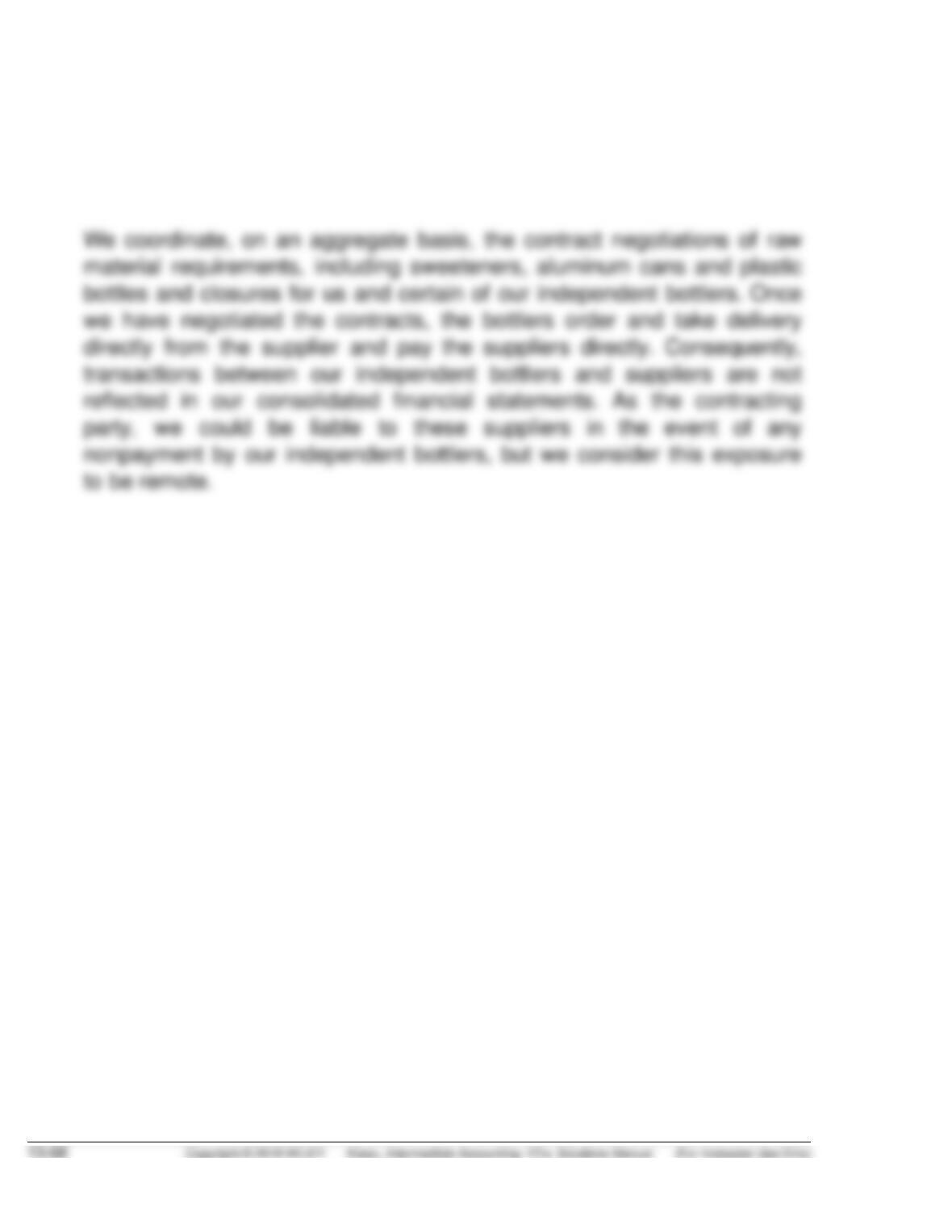
The following table summarizes our long-term contractual commitments by
period:
Payments Due by Period(a)
Total
2018
2019 –
2020
2021 –
2022
2023 and
beyond
Long-term debt obligations (b)
$ 33,793
$ —
$ 7,803
$ 7,209
$ 18,781
$ 53,854
$ 12,657
$ 10,043
$ 28,102
(a) Based on year-end foreign exchange rates. Reserves for uncertain tax positions are excluded from the
table above as we are unable to reasonably predict the ultimate amount or timing of any such
settlements. However, under the provisions of the TCJ Act, our provisional transition tax liability of
approximately $4 billion, recorded in other liabilities on our balance sheet, must be paid over eight
years. We expect to pay approximately $0.3 billion per year in 2019-2023, $0.6 billion in 2024, $0.9
billion in 2025 and $1.0 billion in 2026 and these amounts are excluded from the table above.
(b) Excludes $4,020 million related to current maturities of debt, $3 million related to the fair value
adjustments for debt acquired in acquisitions and interest rate swaps and payments of $155 million
COMPARATIVE ANALYSIS CASE (Continued)
Off-Balance-Sheet Arrangements
We do not have guarantees or other off-balance-sheet financing
arrangements, including variable interest
entities, that we believe could
have a material impact on our financial condition or liquidity.
FINANCIAL STATEMENT ANALYSIS CASE 1
NORTHLAND CRANBERRIES
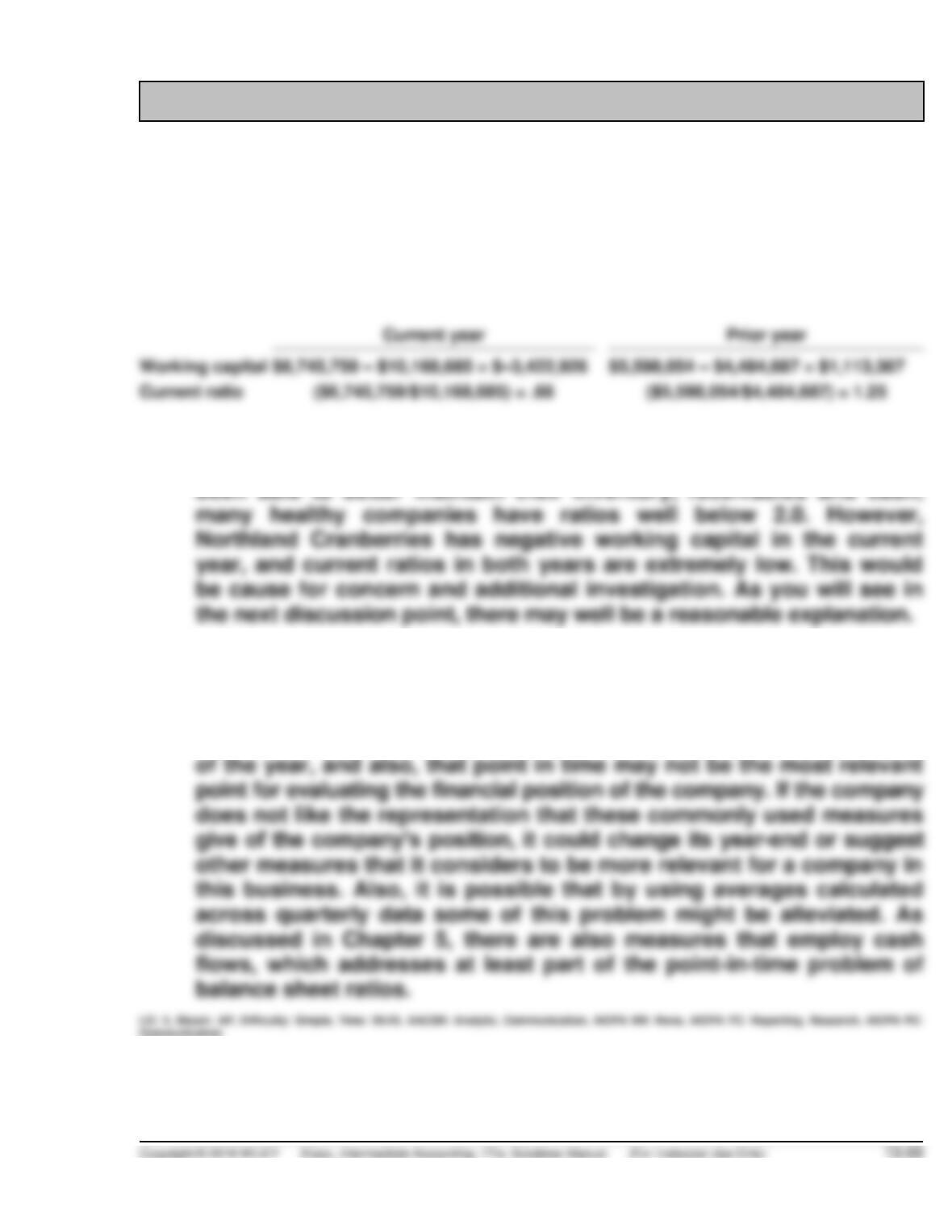
(a) Working capital is calculated as current assets – current liabilities, while
the current ratio is calculated as current assets/current liabilities. For
Northland Cranberries these ratios are calculated as follows:
Historically, it was generally believed that a company should maintain
a current ratio of at least 2.0. In recent years, because companies have
(b) This illustrates a potential problem with ratios like the current ratio,
that rely on balance sheet numbers that present a company’s finan–
cial position at a particular point in time. That point in time may not be
representative of the average position of the company during the course
FINANCIAL STATEMENT ANALYSIS CASE 2
MOHICAN COMPANY
(a) Under the cash basis, warranty costs are charged to expense as they
are paid; in other words, warranty costs are charged in the period in
costs is recorded at year-end.
(b) When the warranty is sold separately from the product, the sales war–
(c) The general approach is to use the straight-line method to recognize
deferred revenue on warranty contracts. If historical evidence indicates
that costs incurred do not follow a straight-line approach, then revenue
FINANCIAL STATEMENT ANALYSIS CASE 3
(a) BOP’s working capital and current ratio have declined in 2020
compared to 2019. While this would appear to be bad news, the acid-
(b) Answers will vary depending on the companies selected. This activity
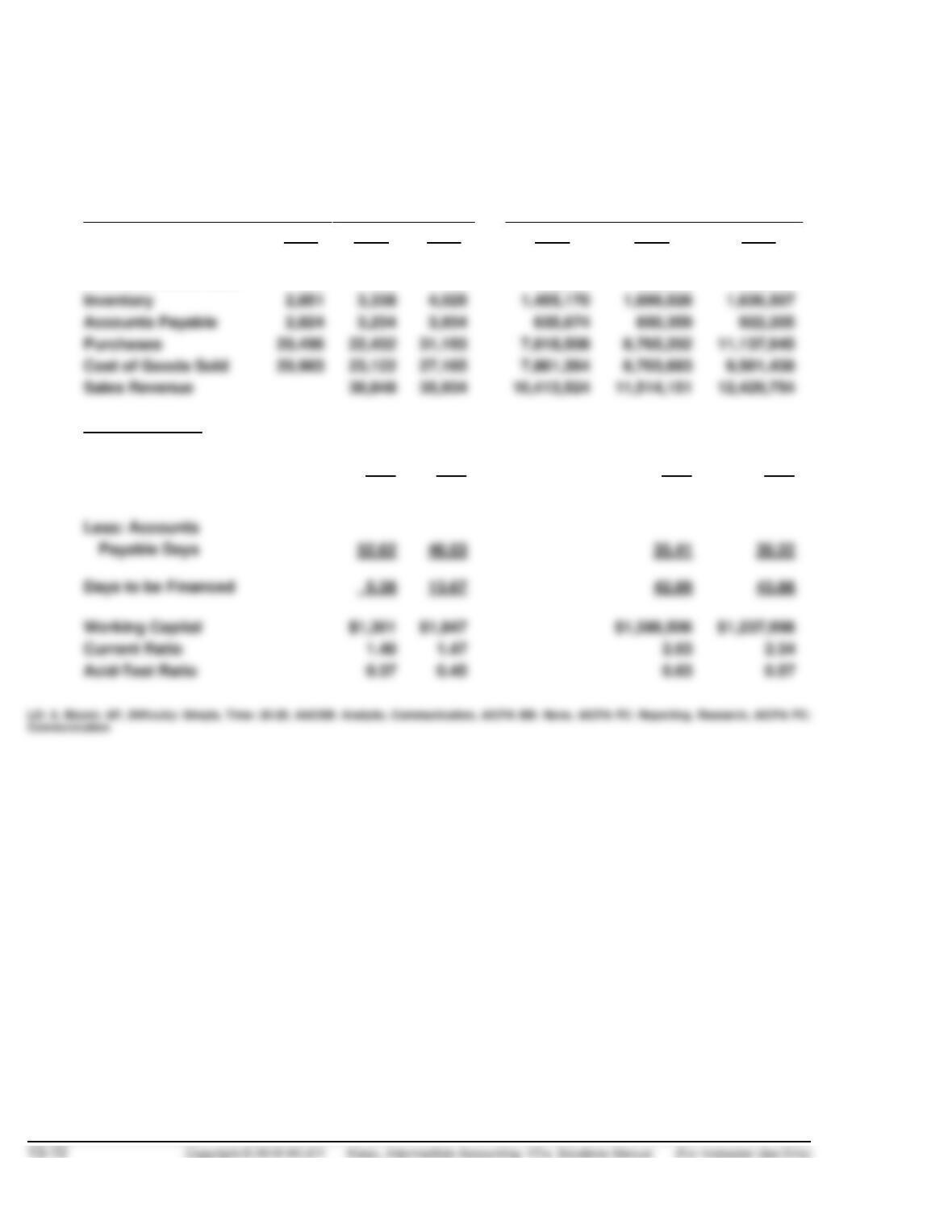
is a great spreadsheet exercise. As an example, the analysis for Best
FINANCIAL STATEMENT ANALYSIS CASE 3 (Continued)
Note to Instructor: Although the analysis below is for 2005 – 2007,
this analysis is particularly useful as Circuit City subsequently filed
for bankruptcy.
Best Buy (in millions)
Circuit City (in thousands)
2005
2006
2007
2005
2006
2007
Cash
$ 470
$748
1,205
879,660
315,970
141,141
Accounts Receivable
375
449
548
230,605
222,869
382,555
Inventory
2,851
4,028
Accounts Payable
2,824
3,934
635,674
850,359
922,205
Purchases
Cost of Goods Sold
Sales Revenue
Operating Cycle
Receivable Days
5.3
5.6
7.1
11.2
Inventory Days
52.7
54.1
71.2
62.9
Operating Cycle
58.0
59.7
78.3
74.1
Days to be Financed
13.67
Working Capital
Current Ratio
1.40
2.63
2.34
Acid-Test Ratio
0.37
0.45
0.63
0.57
ACCOUNTING, ANALYSIS, AND PRINCIPLES
Accounting
(1)
During 2020
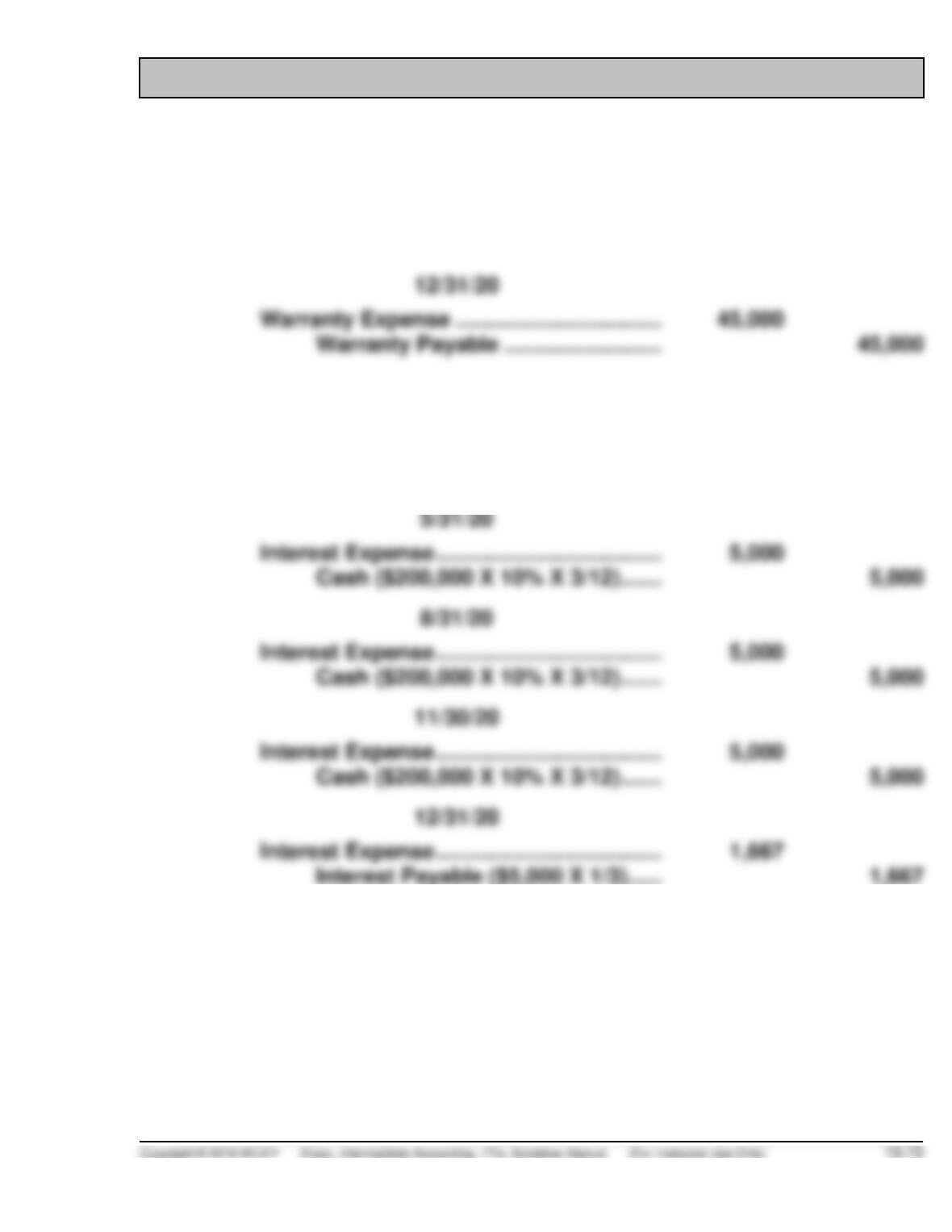
Warranty Expense …………………………………….
6,000
Cash…………………………………………………
6,000
Warranty Expense …………………………………….
Warranty Payable …………………………..
(2)
2/28/20
Interest Expense ($5,000 X 2/3) …………………..
3,333
Interest Payable ($5,000 X 1/3) ……………………
1,667
Cash ($200,000 X 10% X 3/12) …………….
5,000
5/31/20
Interest Expense ……………………………………….
5,000
Cash ($200,000 X 10% X 3/12) …………….
8/31/20
Interest Expense ……………………………………….
5,000
Cash ($200,000 X 10% X 3/12) …………….
5,000
Interest Expense ……………………………………….
5,000
Cash ($200,000 X 10% X 3/12) …………….
5,000
Interest Expense ……………………………………….
1,667
Interest Payable ($5,000 X 1/3) ……………
(3)
1/1/20
Plant Assets ……………………………………………..
5,000,000
Cash…………………………………………………
5,000,000
1/1/20
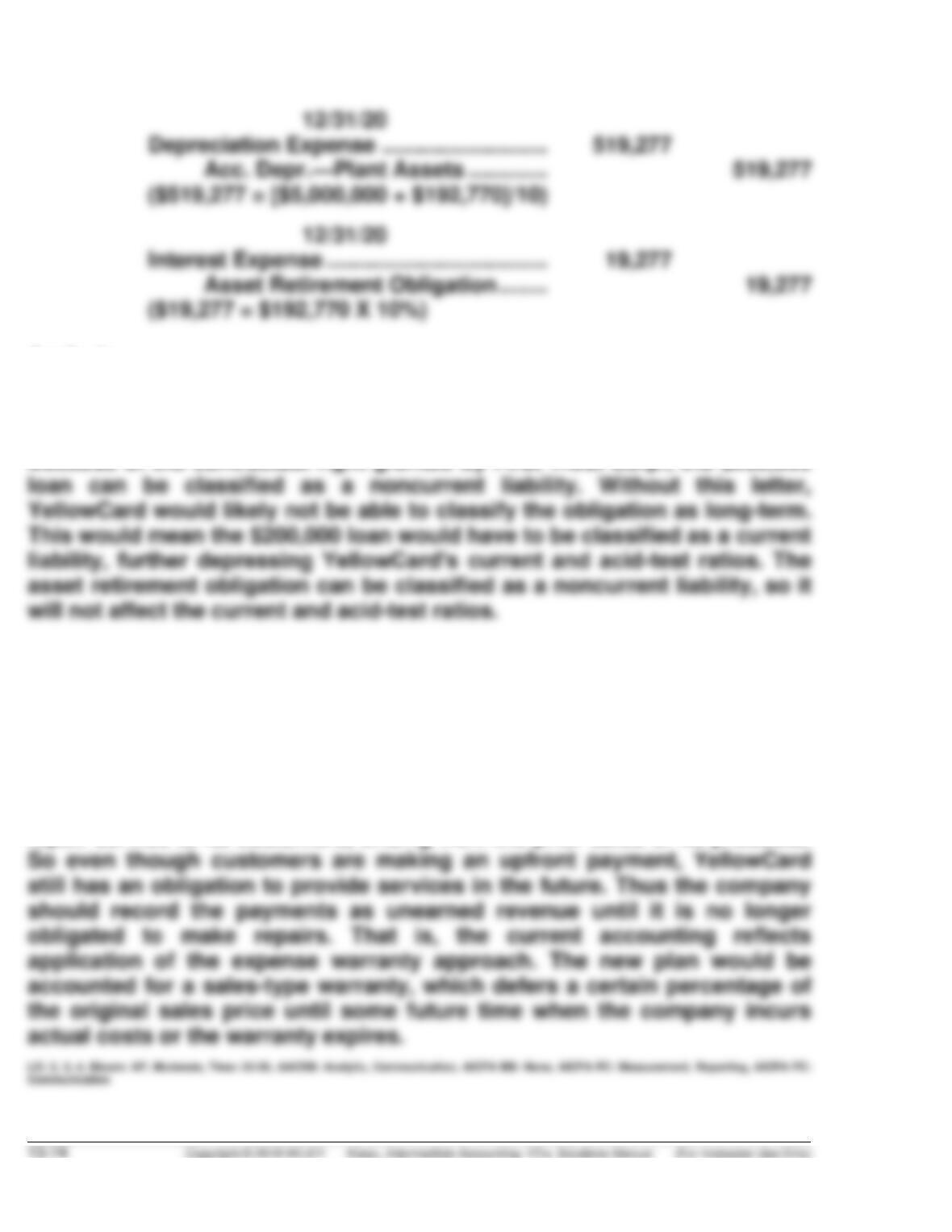
Plant Assets ……………………………………………..
192,770
Asset Retirement Obligation ………………
192,770
($192,770 = $500,000 X 0.38554)
ACCOUNTING, ANALYSIS, AND PRINCIPLES (Continued)
Analysis
The warranty payable and the interest payable are current liabilities, so all
else equal, these will decrease both the current and acid-test ratios.
Because of the contractual right granted by First Trust Corp., the $200,000
Principles
According to FASB Concepts Statement No. 6, liabilities are probable
future sacrifices of economic benefits arising from present obligations of a
particular entity to transfer assets or provide services to other entities in
the future as a result of past transactions or events. With respect to the
new warranty plan, YellowCard would be currently obligated to provide
repair service to its customers, arising from the prior sales of its products.