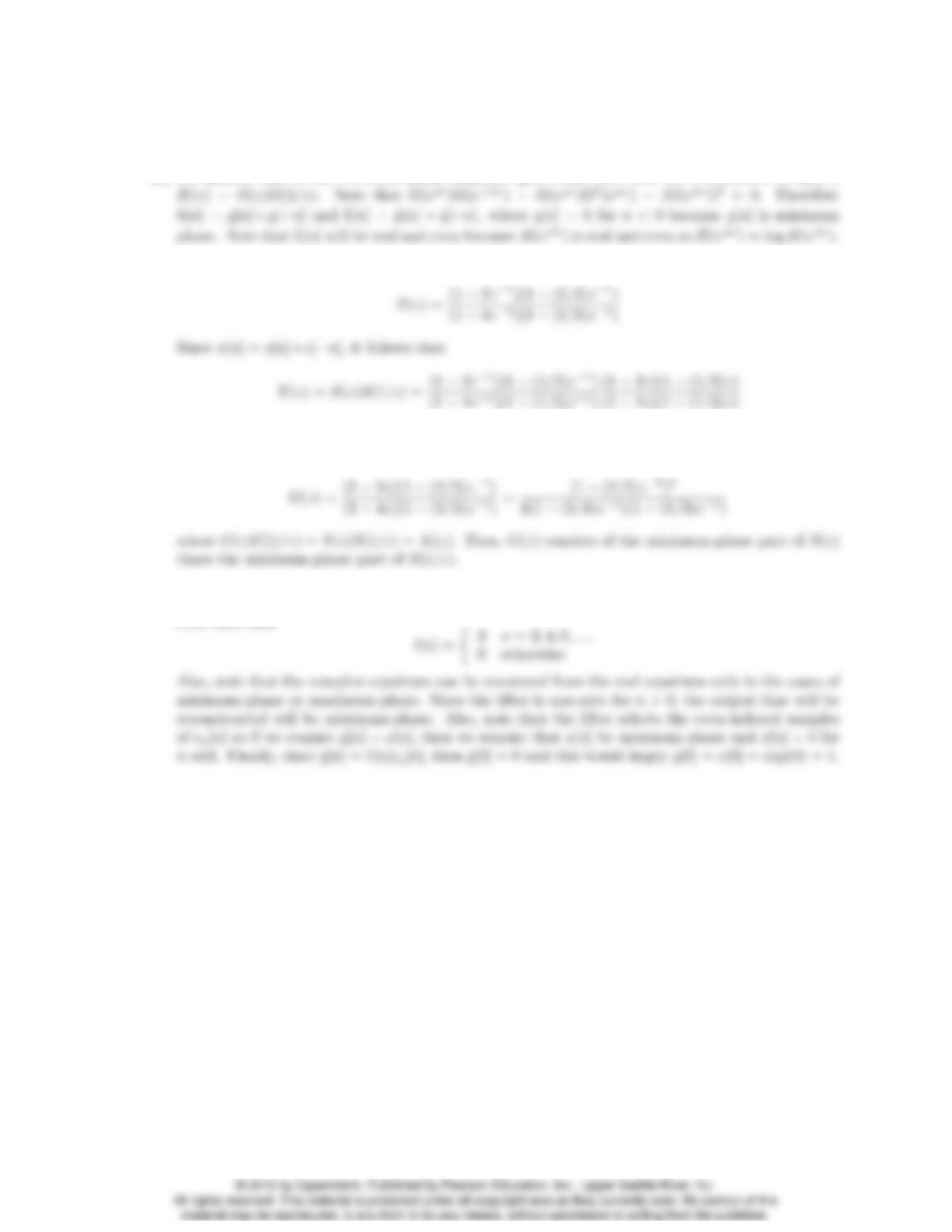
13.17. Since h[n] is real, two-sided, even, and stable, H(ejω) will be real and an even function of ω. Fur-
thermore it is stated that H(ejω)>0. In other words, h[n] has all the properties of an autocorrelation
function.
(a) We assume that a real minimum-phase sequence g[n] exists such that the z-transform of h[n] is
(b) We are given a stable signal s[n] with z-transform
Now we want to represent x[n] as x[n] = g[n]∗g[−n] where g[n] is minimum-phase. To do this, we
group all the poles and zeros that are inside the unit circle into G(z), we get
(c) Figure P13.17 computes the real cepstrum, cx[n], lifters it with ℓ[n] = u[n−1] + (−1)nu[n−1],
and then computes y[n] as the output of the inverse characteristic system for convolution, D−1
∗[ ].
First note that
19
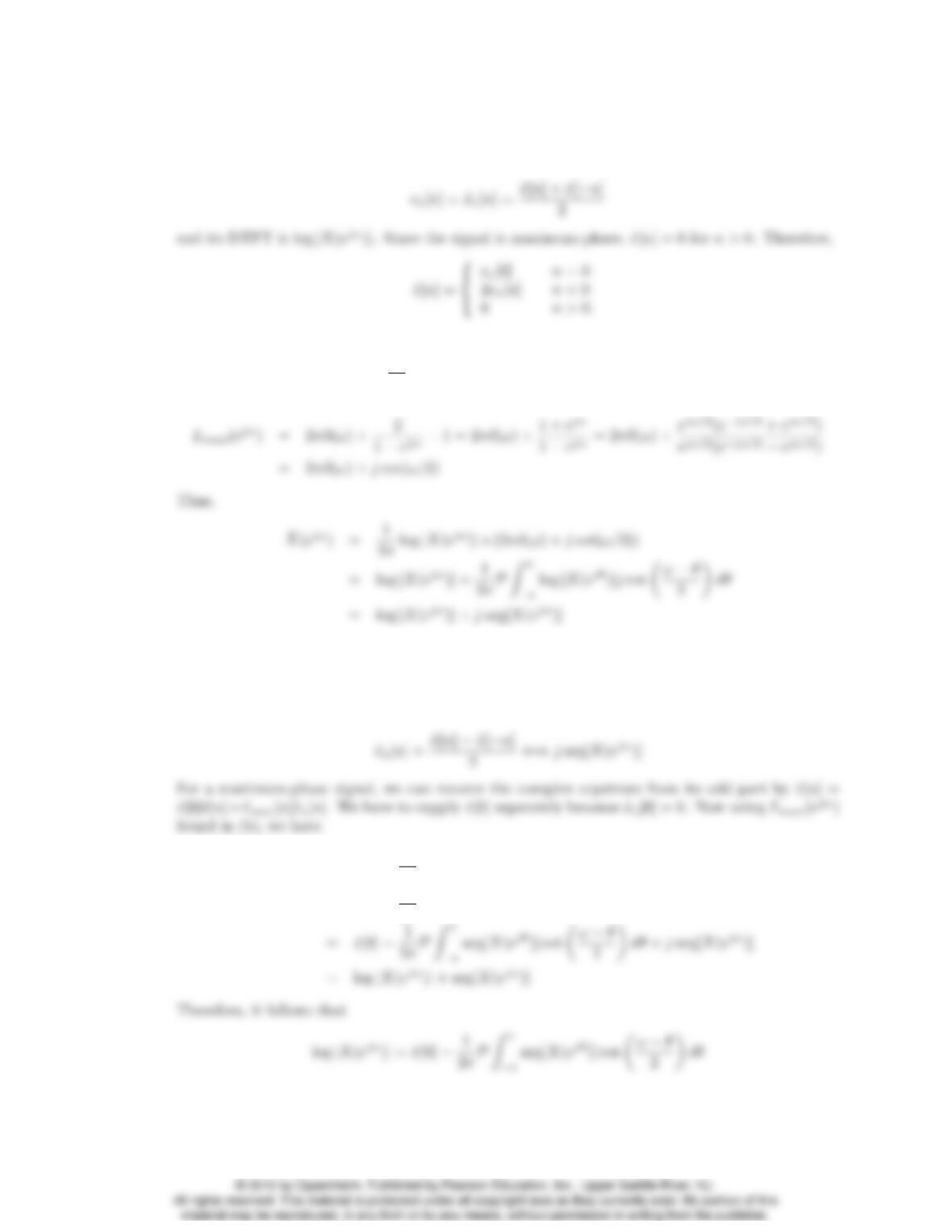
13.18. This problem shows how Hilbert transforms are related to cepstrum concepts for the maximum-phase
case.
(a) Recall that the real cepstrum is the even part of the complex cepstrums; i.e.,
Thus ˆx[n] = cx[n]ℓmax[n], where ℓmax[n] = 2u[−n]−δ[n].
(b) From (a) we have, ˆ
X(ejω) = 1
2πlog |X(ejω )| ∗ Lmax(ejω ) where ∗denotes periodic continuous-
variable convolution of DTFTs. The DTFT of the lifter is
where the symbol Pby the integral sign signifies that the care must be taken in evaluating the
integral in the interval around the singularity of cot( ). From the above analysis we see that for
minimum-phase signals the phase angle can be reconstructed from the log magnitude
(c) Now consider the odd part of the complex cepstrum
ˆ
X(ejω) = ˆx[0] + 1
2πˆ
Xo(ejω)∗Lmax(ejω )
= ˆx[0] + 1
2πjarg[X(ejω)] ∗(2πδ(ω) + jcot(ω/2))
20
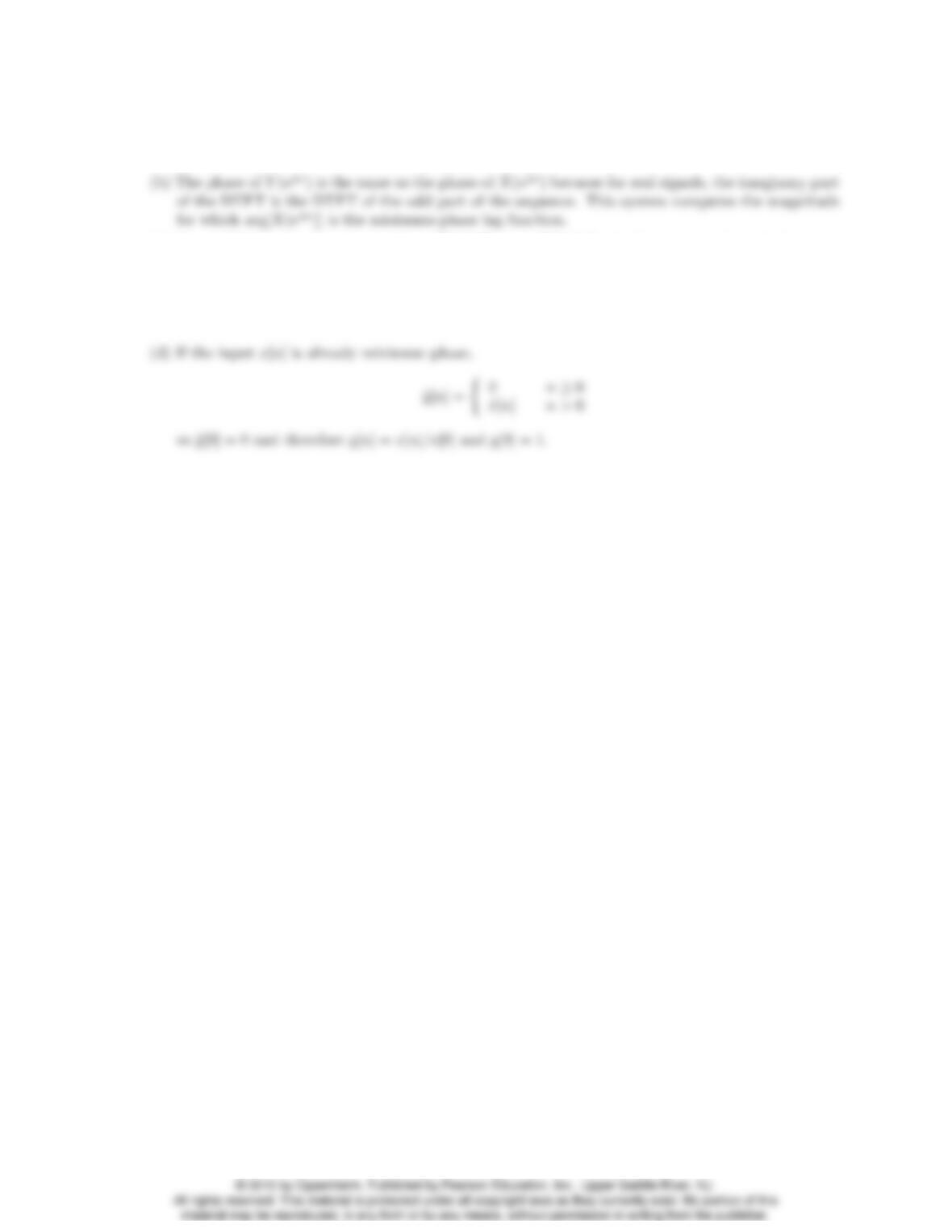
13.19. A signal with complex cepstrum ˆx[n] is liftered by ˆy[n] = (ˆx[n]−ˆx[−n])u[n−1]. That is ˆy[n] is twice
the odd part of the complex cepstrum of x[n].
(a) The signal y[n] is minimum-phase since ˆy[n] = 0 for n < 0.
(c) Since y[n] is minimum-phase and arg[Y(ejω )] = arg[X(ejω )], the log magnitude and phase are
related by the Hilbert transform
log |Y(ejω )|=1
2πPZπ
−π
arg[X(ejθ)] cot ω−θ
2dθ
21
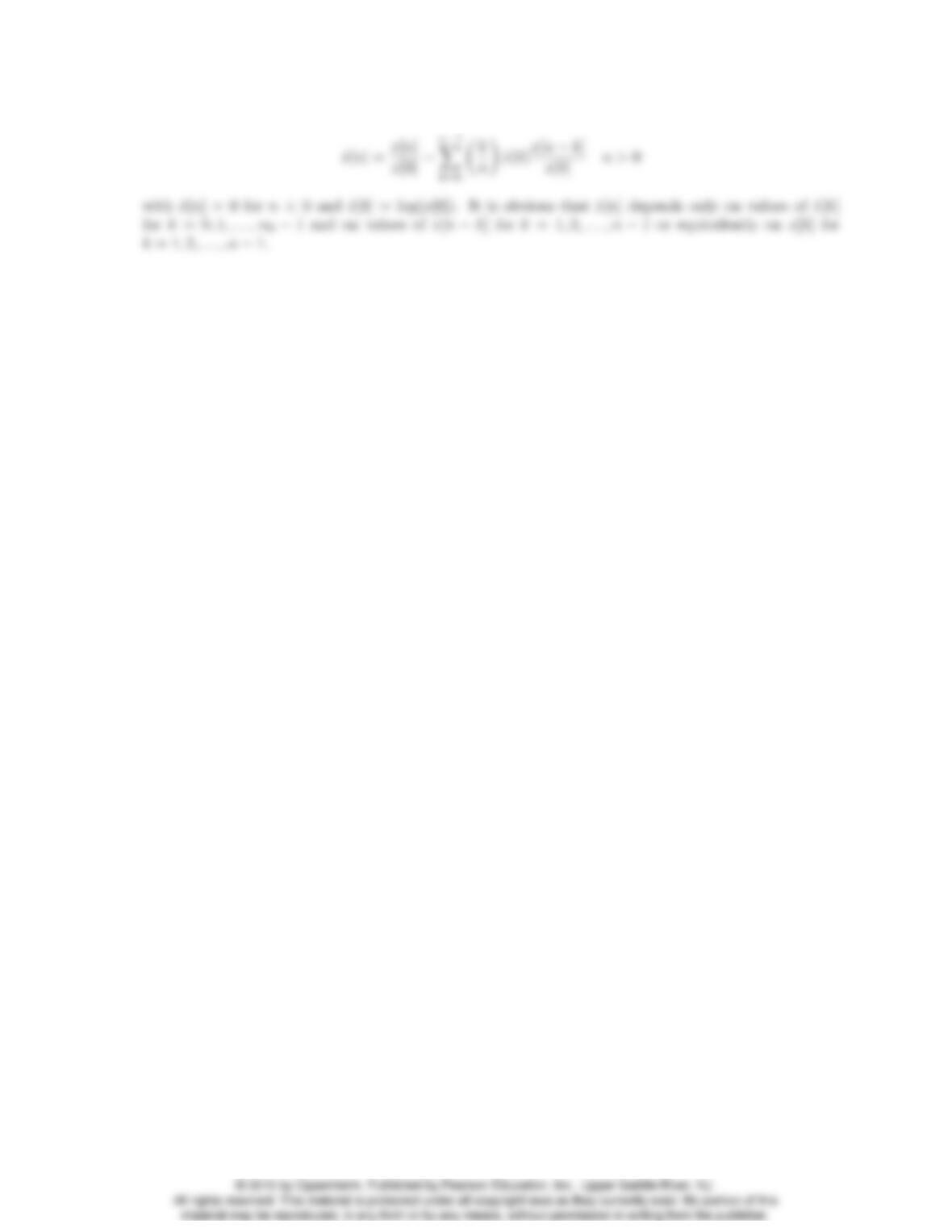
13.20. If x[n] is minimum-phase, the complex cepstrum satisfies the recursion
22
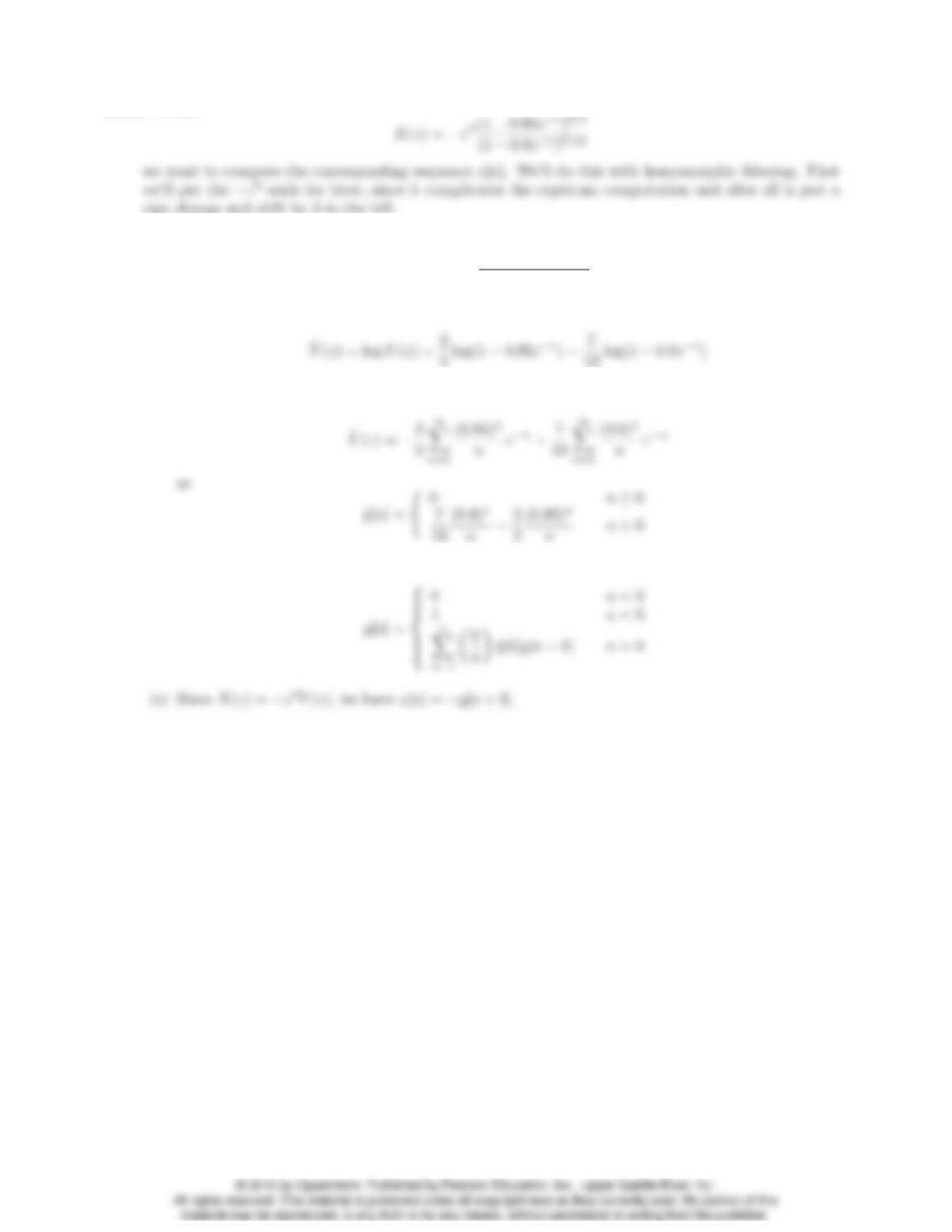
13.21. Given
(a) So let
Y(z) = (1 −0.95z−1)2/5
(1 −0.9z−1)7/13
(b) Now compute the complex logarithm of Y(z);
(c) Then the complex cepstrum is obtained from the power series expansion
(d) From ˆy[n] we can use the minimum-phase recursion to compute y[n].
23
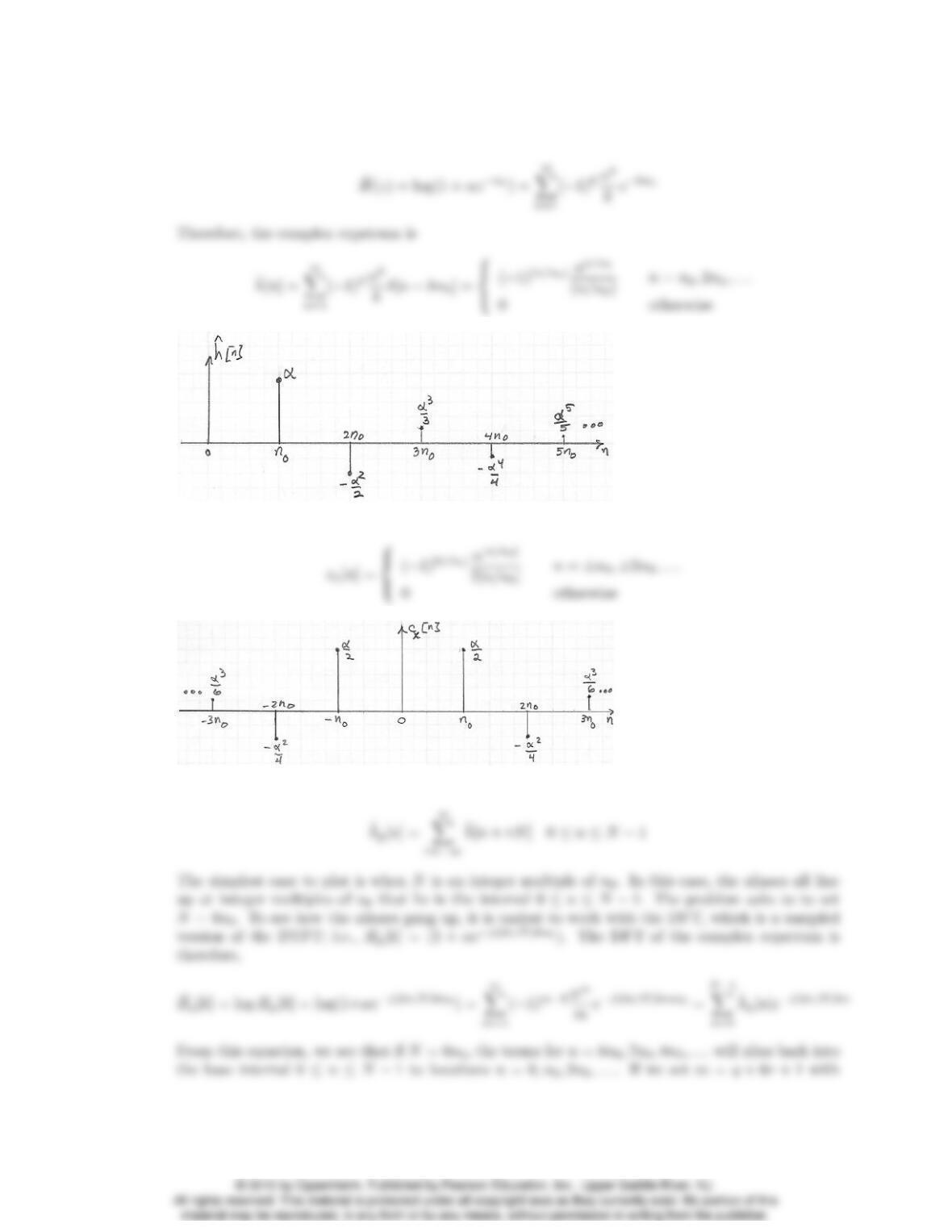
13.22. Echo is modeled by h[n] = δ[n] + αδ[n−n0].
(a) The system function is H(z) = 1 + αz−n0so the z-transform of the complex cepstrum is
(b) The real cepstrum is the even part of the complex cepstrum; i.e., cx[n] = (x[n] + x[−n])/2 so
(c) If we use an N-point DFT to compute the cepstrum, we will get
24
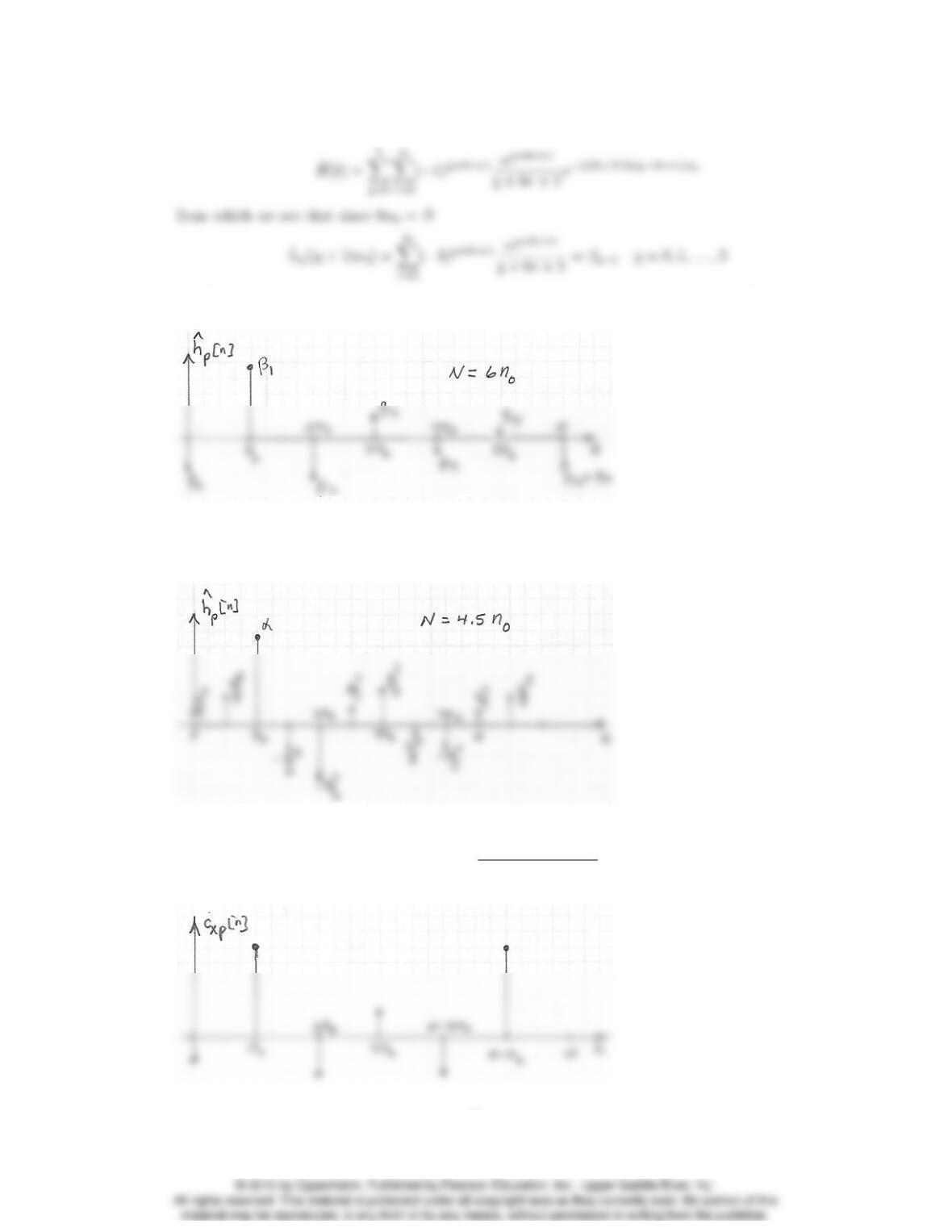
q= 0,1,…,5 and r= 0,1, . . ., the combinations of qand rcover the entire range 0 ≤m < ∞.
With this change we have
and ˆ
hp[n] = 0 otherwise. Note that for q= 5 we obtain ˆ
hp[6n0], which is identical to ˆ
hp[0] because
N= 6n0for the DFT.
If Nis not an integer multiple of n0, the aliases do not gang up at multiples of n0. The following
figure illustrates the case N= 4.5n0showing the first 9 complex cepstrum components, with the
aliases indicated by an open circle. In a practical application, Nwould be chosen to be much larger
than n0so that the aliasing effect would be negligible.
(d) When the DFT is used to compute the real cepstrum the even part relation is
cxp[n] = ˆxp[n] + ˆxp[N−n]
2
so the real cepstrum will exhibit even symmetry in the DFT sense.
25

When Nis not an integer multiple of n0, the components will not line up at multiples of n0so the
26
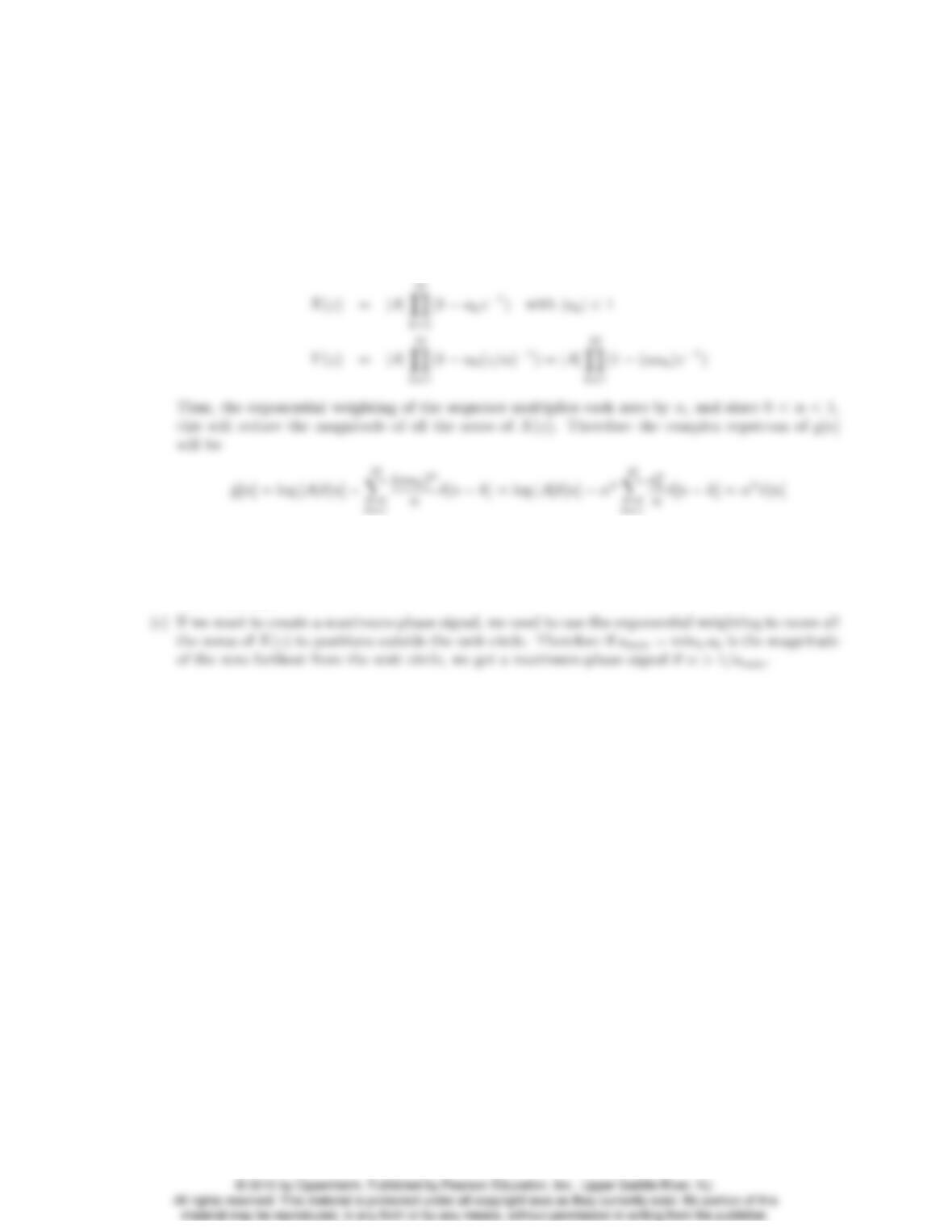
13.23. Given x[n] a minimum-phase, finite-length sequence and y[n] = αnx[n], it follows that
Y(z) =
M
X
n=0
αnx[n]z−n=
M
X
n=0
x[n](α−1z)−n=X(z/α)
This result holds for any exponentially weighted sequence αnx[n], but we should note that the poles
and zeros as well as the region of convergence will shift.
(a) For a finite-length minimum-phase sequence,
(b) From part (a) we see that the zero locations of Y(z) are αak. If we want y[n] to be non-minimum-
phase, we simply need to choose αso that at least one zero moves outside the unit circle. If
amax = maxk|ak|is the magnitude of the zero closest to the unit circle, then we want αamax >1
or α > 1/amax.
27
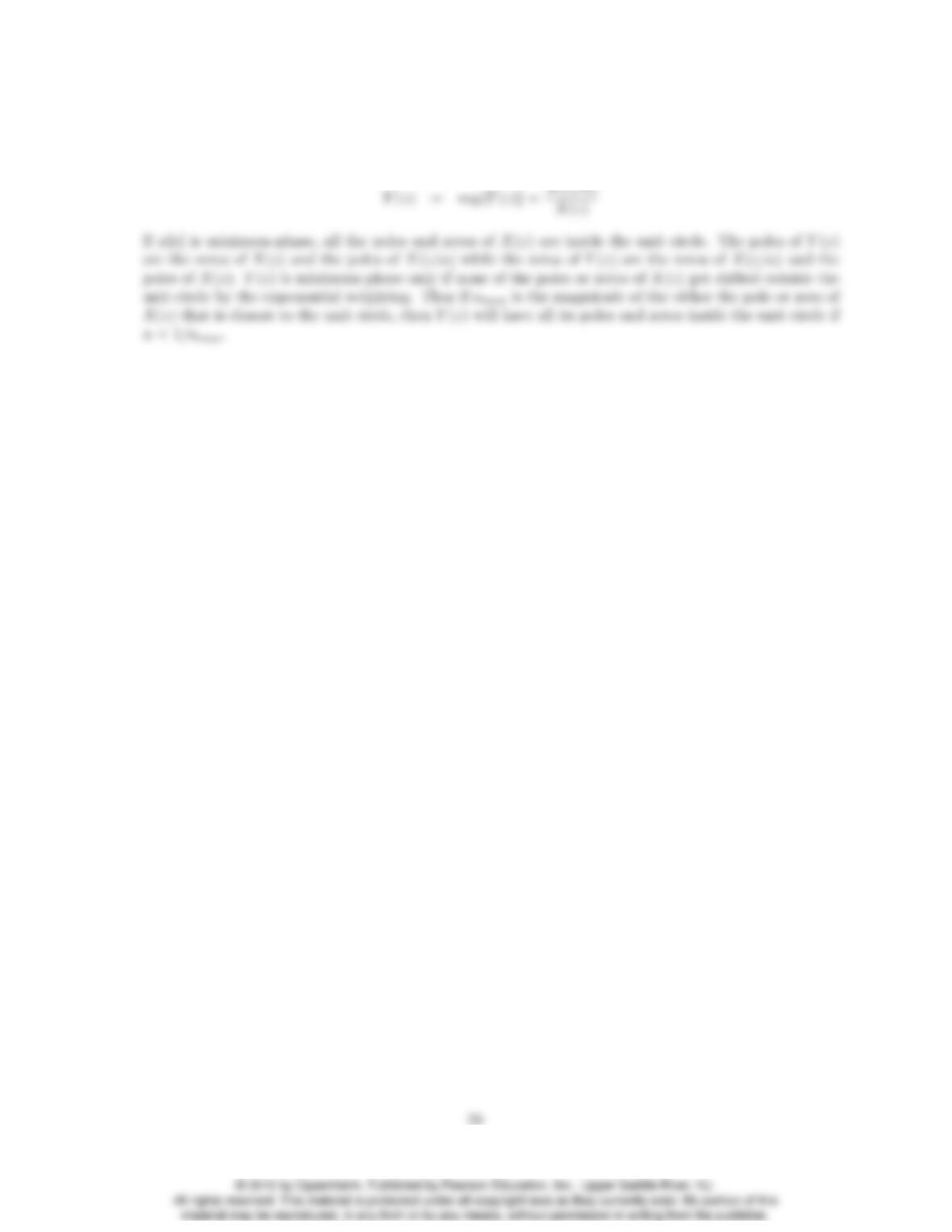
13.24. We are given a relation between ˆy[n] and ˆx[n].
ˆy[n] = (αn−1)ˆx[n]
ˆ
Y(z) = ˆ
X(z/α)−ˆ
X(z)
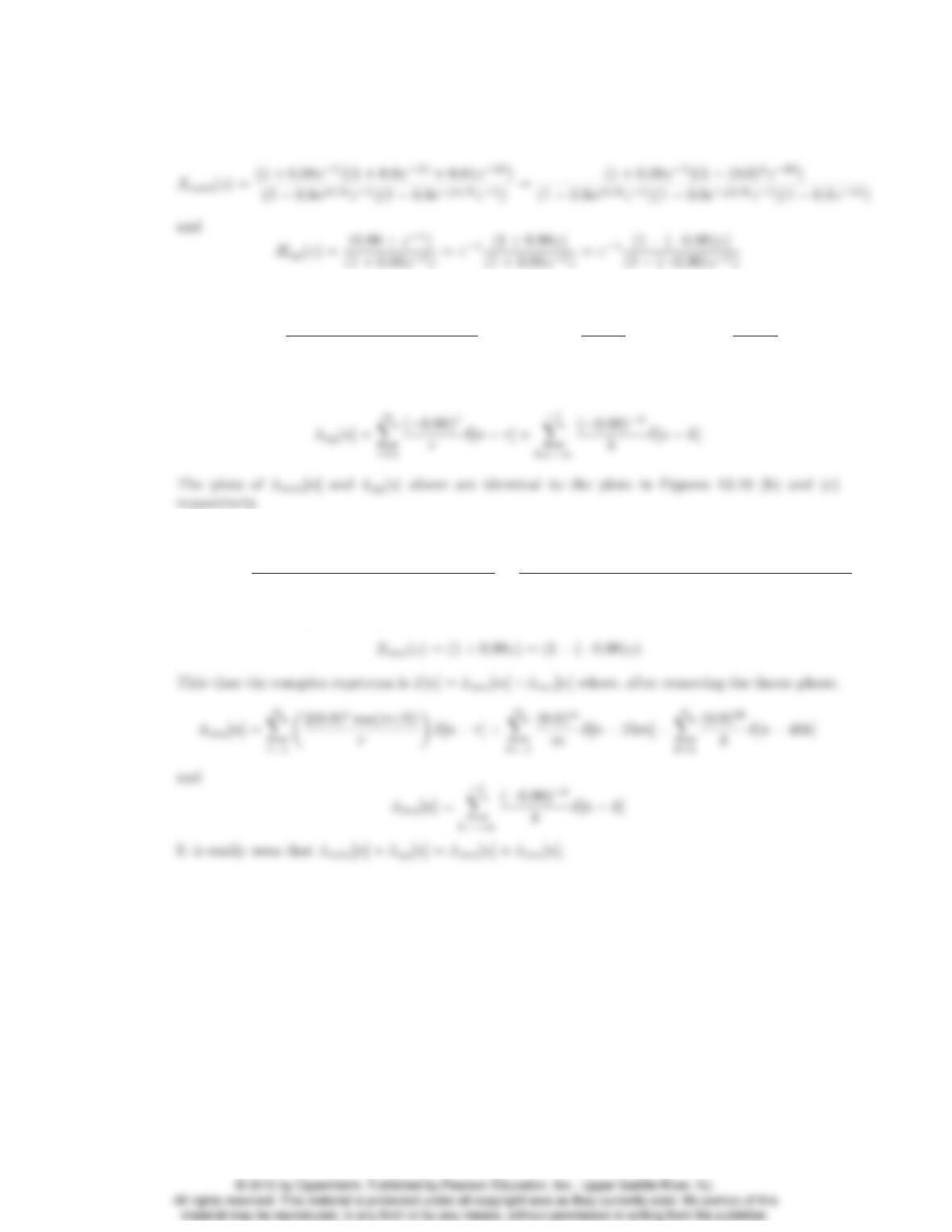
13.25. This problem looks at two different decompositions of a rational z-transform, X(z).
(a) X(z) = Xmin(z)Xap(z) where
The complex cepstrum is ˆx[n] = ˆxmin[n] + ˆxap[n] where
ˆxmin[n] =
∞
X
r=1 2(0.9)rcos(πr/6) −(−0.98)r
rδ[n−r]+
∞
X
m=1
(0.9)m
mδ[n−15m]−
∞
X
k=1
(0.9)3k
kδ[n−45k]
and after removing the linear phase component z−1in Xap(z), we have
(b) We can also represent X(z) as X(z) = Xmn(z)Xmx(z) where the minimum-phase component is
Xmn(z) = z−1(1 + 0.9z−15 + 0.81z−30)
(1 −0.9ejπ/6z−1)(1 −0.9e−jπ/6z−1)=z−1(1 −(0.9)3z−45)
(1 −0.9ejπ/6z−1)(1 −0.9e−jπ/6z−1)(1 −0.9z−15)
and the maximum-phase component is
29
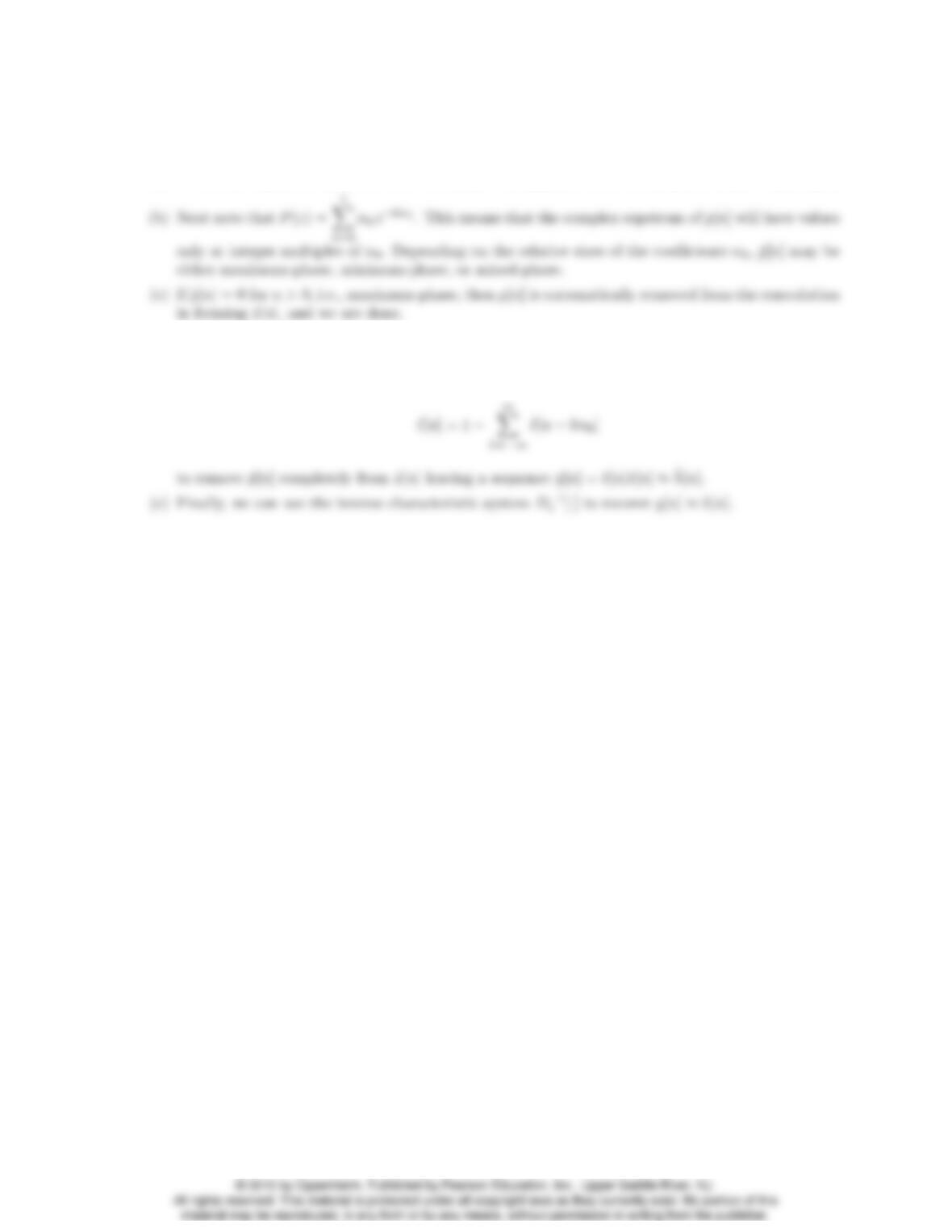
13.26. Given s[n] = h[n]∗g[n]∗p[n], where h[n] is minimum-phase, g[n] is maximum-phase, and p[n] is an
impulse train with spacing n0. Then the complex cepstrum is ˆs[n] = ˆ
h[n] + ˆg[n] + ˆp[n] where ˆx[n] = 0
for n < 0, ˆg[n] = 0 for n > 0 and ˆp[n] = 0 except at integer multiples of n0.
(a) To extract h[n] from s[n], first note that ˆx[n] = ˆs[n]u[n] defines a new sequence x[n] = h[n]∗p[n].
(d) More generally, we know that both ˆ
h[n] and ˆp[n] die out faster than 1/n as n→ ±∞. Since the
non-zero samples of ˆp[n] are located at integer multiples of n0, they will stand out from the samples
of ˆ
h[n] and we can estimate the value of n0. Then we can use a lifter
30
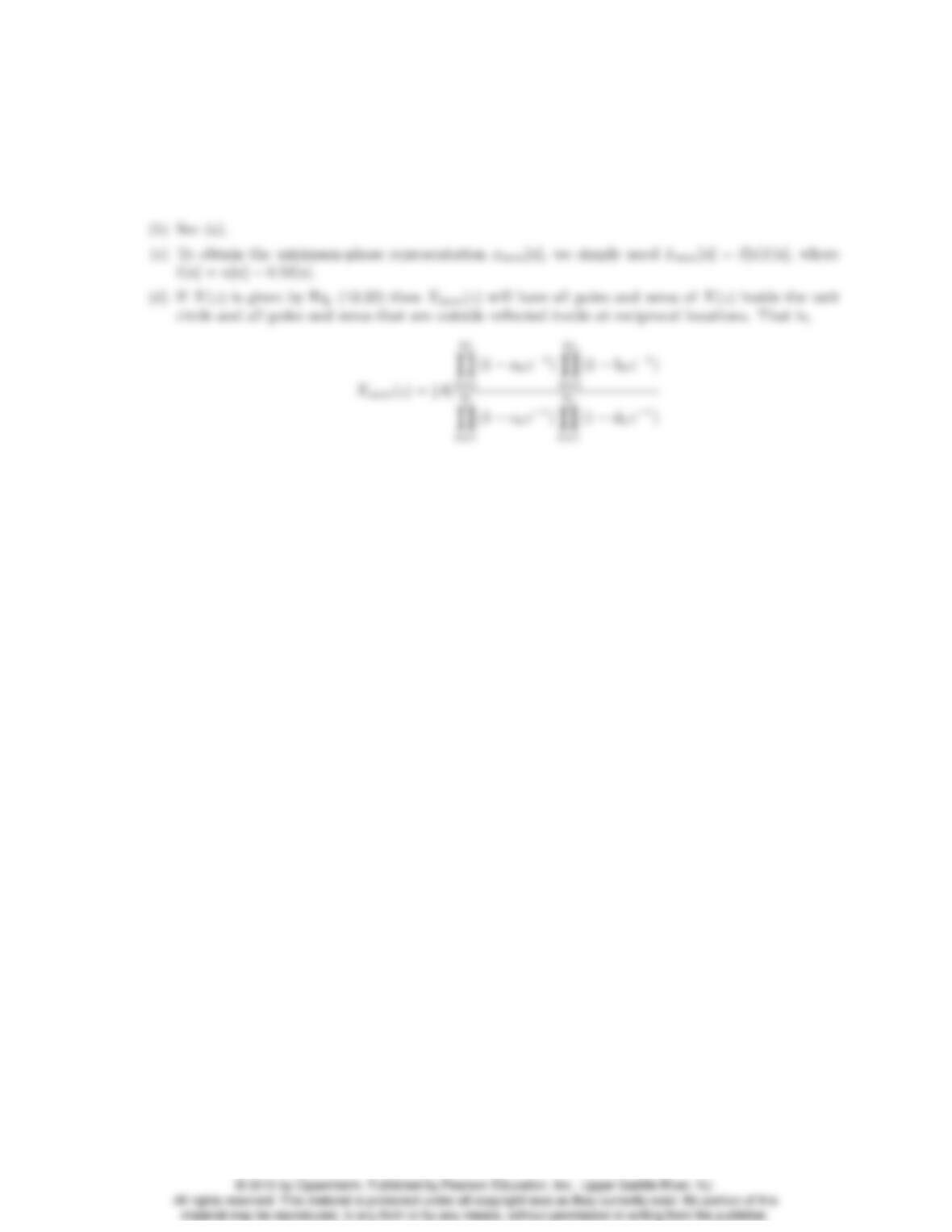
13.27. In this problem, we deal with a signal whose z-transform has the form V(z) = X(z)X(1/z) or
V(ejω) = |X(ejω)|2.
(a) The DTFT of the complex cepstrum is ˆ
V(ejω) = log V(ejω) = 2 log |X(ejω)|. Therefore,
ˆv[n] = 2cx[n] = ˆx[n] + ˆx[−n]
31
13.28. If x[n] is upsampled by N,
xe[n] = x[n/N]n= 0,±N, ±2N, . . .
0 otherwise
32
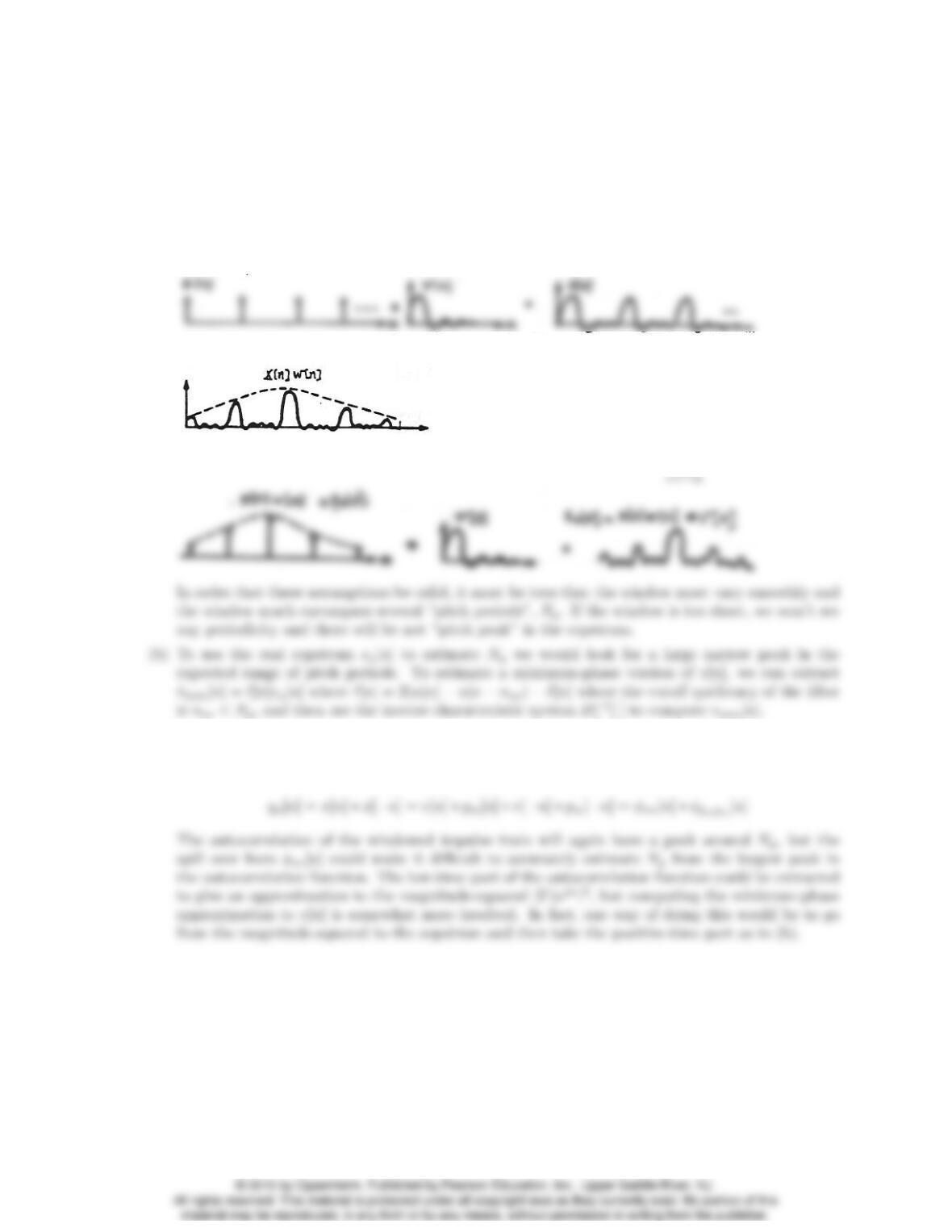
13.29. This problem explores how the complex cepstrum can be used in short-time analysis (deconvolution)
of speech signals. The model for a segment of voiced speech is a window times the convolution of a
vocal tract/glottal pulse v[n] with a periodic impulse train p[n]; i.e.,
x[n] = (v[n]∗p[n])w[n]≈v[n]∗pw[n]
where pw[n] = p[n]w[n].
(a) To understand the approximation, this figure shows how x[n] is formed from v[n] and p[n] by
convolution
Windowing with a typical tapered window gives
Assuming that the windowing is absorbed into the impulse train p[n] =
∞
X
δ[n−rNp] gives
(c) If, instead of the logarithm, we square the DTFT of x[n], we get the autocorrelation function
instead of the real cepstrum. The autocorrelation function behaves similarly to the real cepstrum
except the vocal tract and pitch components are not as clearly separated. The quantity qx[n] is
33
13.30. We want to determine the complex cepstrum from a parametric signal model
k=1
where, if the coefficients akare obtained by linear predictive analysis, all poles are inside the unit circle.
(a) First, since G > 0, ˆ
h[0] = log G.
(b) We can derive a recursion formula for ˆ
h[n] by considering the inverse system
Since hi[n] is minimum-phase, we can compute the complex cepstrum with the recursion
ˆ
hi[n] =
0n < 0
−log G n = 0
hi[n]
hi[0] −
n−1
X
k=1 k
nˆ
hi[k]hi[n−k]
hi[0] n > 0
34
13.31. This problem considers a somewhat realistic model for echo with h[n] = δ[n] + αg[n−n0].
(a) The DTFT of the impulse response is H(ejω) = 1 + αG(ejω)e−jωn0and therefore,
ˆ
H(ejω) = log H(ejω) = log(1 + αG(ejω)e−jωn0)
where gk[n]) = g[n]∗g[n]∗. . . g[n] (i.e., k−1 convolutions of g[n] with itself).
(b) If g[n] = δ[n], we have the simpler model of Problem 13.22, and
ˆ
h[n] =
∞
X
n=1
(−1)n+1 αk
kδ[n−k]
which simply has impulses of decreasing size at integer multiples of n0.
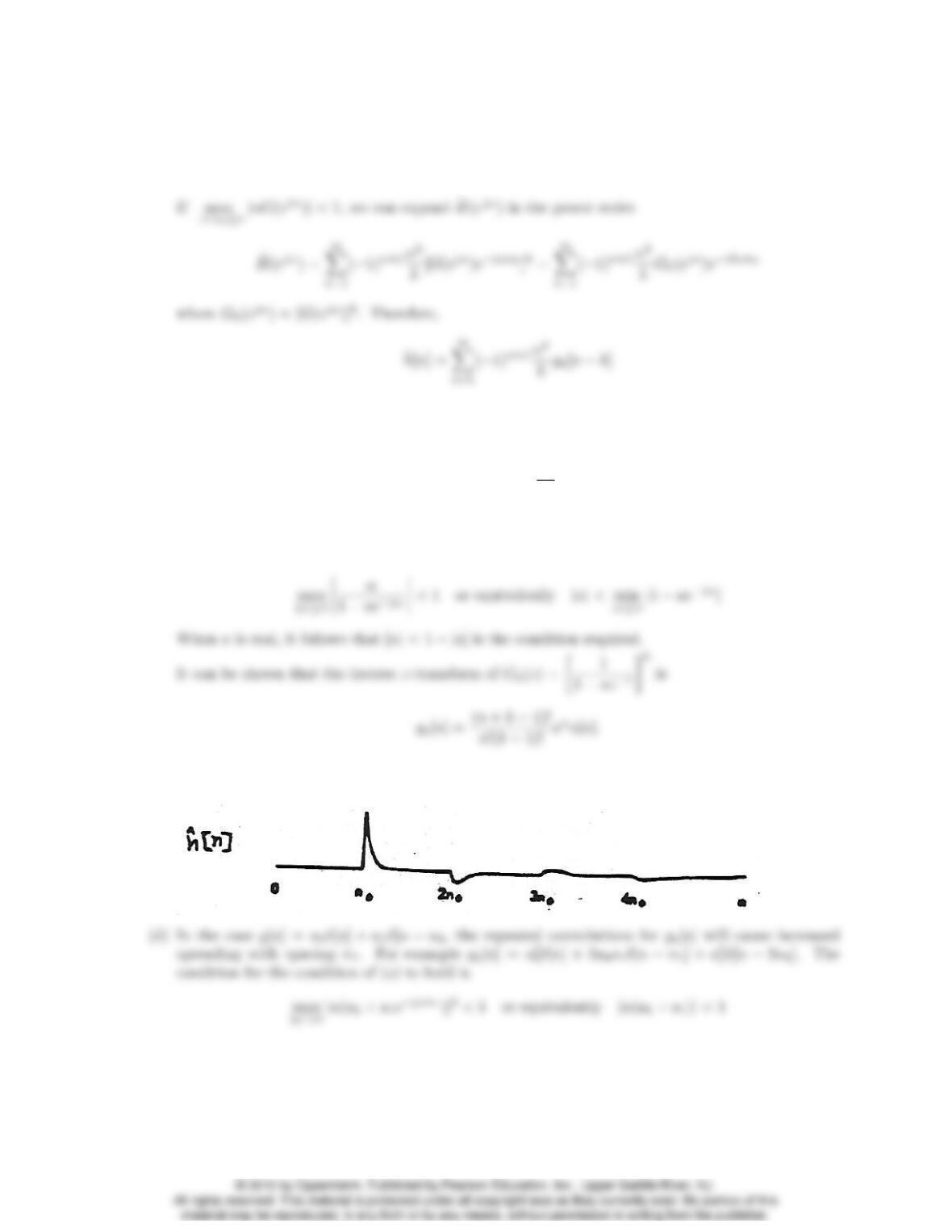
(c) Now g[n] = anu[n] with |a|<1 for stability. The condition of (a) holds if
Therefore, the complex cepstrum of the echo system impulse response will look like the following,
with the repeated convolutions spreading out with increasing n.
35
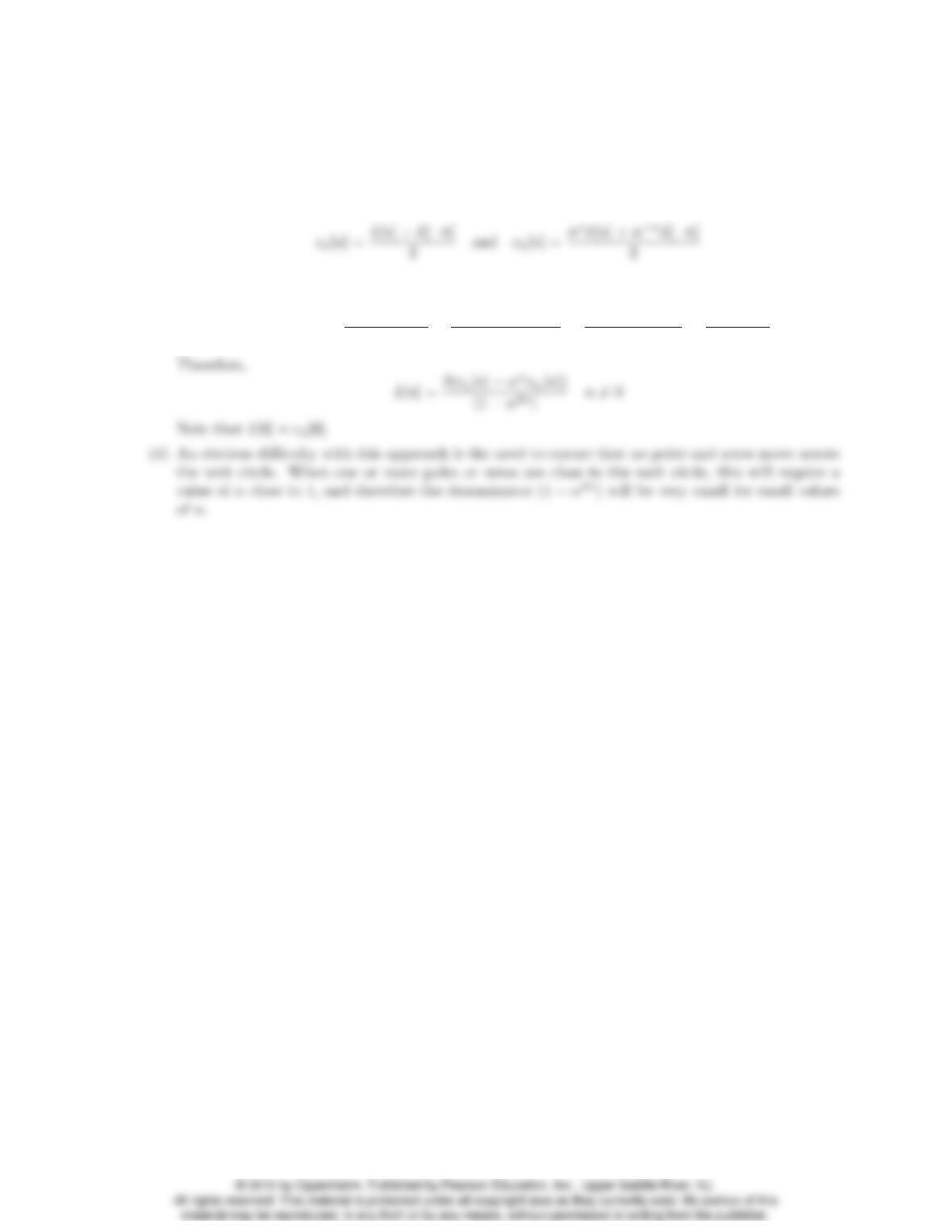
13.32. This problem discusses a way of computing the complex cepstrum without phase unwrapping.
(a) Recall that if w[n] = αnx[n], then W(z) = X(1/z. This holds for any z-transform. Therefore
if no poles or zeros of X(z) shift across the unit circle with the exponential weighting, we get
ˆ
W(z) = ˆ
X(1/z) with the region of convergence including the unit circle. Therefore, ˆw[n] = αnˆx[n].
(b)
(c)
cx[n]−αncw[n] = ˆx[n] + ˆx[−n]
2−α2nˆx[n] + ˆx[−n]
2=ˆx[n]−α2nˆx[n]
2=(1 −α2n)
2ˆx[n]
36