Exercise 13-5 (continued)
5. The Fishing Guard product has the largest unit contribution margin, but
it is not the most profitable use of the constrained resource in either
case above. This happens because the Fishing Guard uses more of the
Exercise 13-6 (20 minutes)
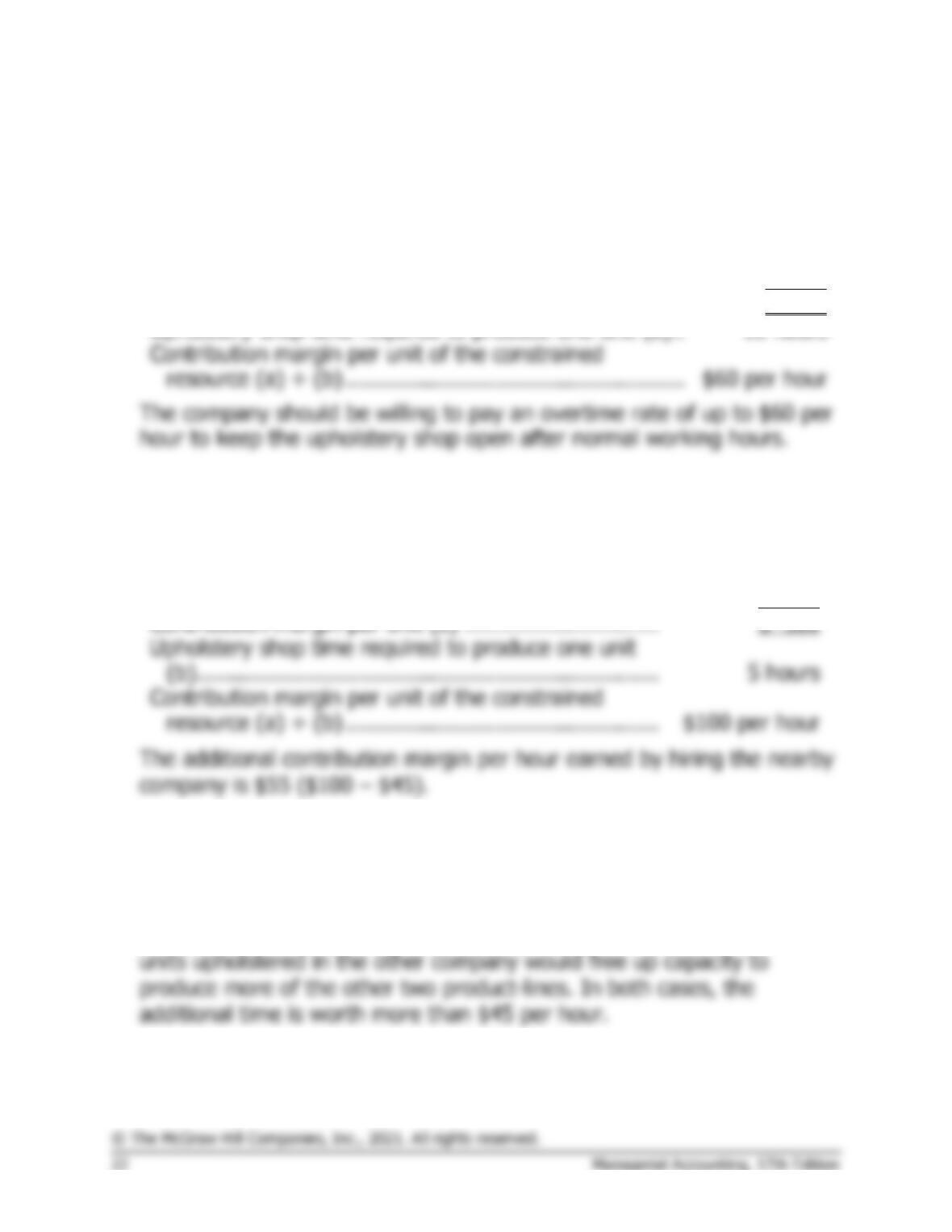
1. The value of relaxing the constraint can be determined by computing
the contribution margin per unit of the constrained resource:
Sofa
Selling price per unit ……………………………………………
$1,800
Variable cost per unit …………………………………………..
1,200
Contribution margin per unit (a) …………………………….
$ 600
Upholstery shop time required to produce one unit (b) ..
2. To answer this question, it is desirable to compute the contribution
margin per unit of the constrained resource for the Love Seat:
Love Seat
Selling price per unit ………………………………………..
$1,500
Variable cost per unit ……………………………………….
1,000
Contribution margin per unit (a) …………………………
3. The offer by the nearby upholstering company to upholster furniture for
$45 per hour should be accepted. The time would be used to upholster
Loveseats. If this increases the total production and sales of Loveseats,
the time would be worth $100 per hour—a net gain of $55 per hour. If
Loveseats are already being produced up to demand, then having these
Exercise 13–7 (10 minutes)
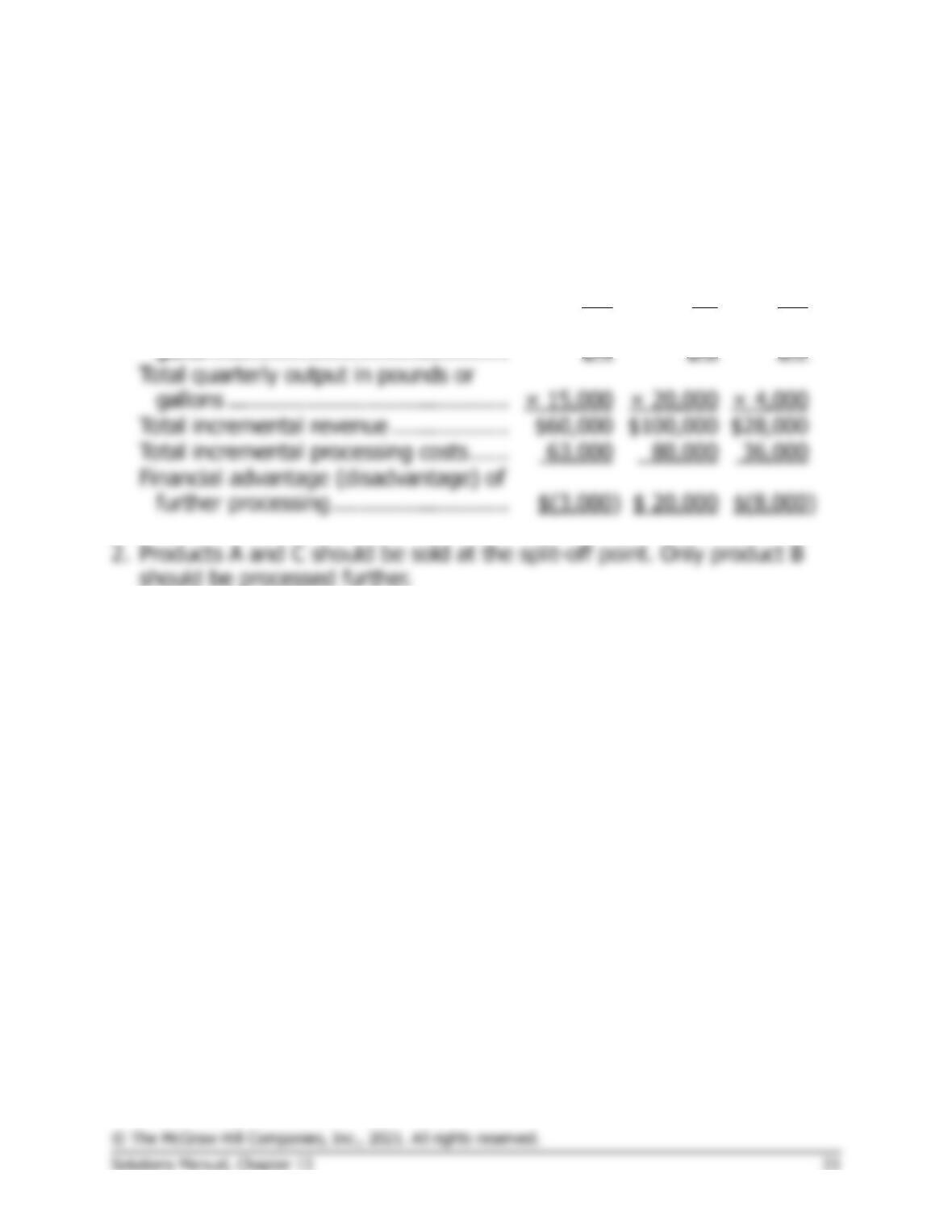
1. The financial advantage (disadvantage) of further processing each
product is calculated as follows:
A
B
C
Selling price after further processing …
$20
$13
$32
Selling price at the split-off point ……..
16
8
25
Incremental revenue per pound or
× 15,000
Total incremental revenue ………………
Total incremental processing costs ……
Exercise 13–8 (30 minutes)
1.
A
B
C
(1)
Contribution margin per unit ………………………
$54
$100
$60
(2)
Direct material cost per unit ………………………
$24
$32
(3)
Direct material cost per pound ……………………
$8
$8
$8
(4)
Pounds of material required per unit (2) ÷ (3) .
10
(5)
Contribution margin per pound (1) ÷ (4) ………
$18
$10
$15
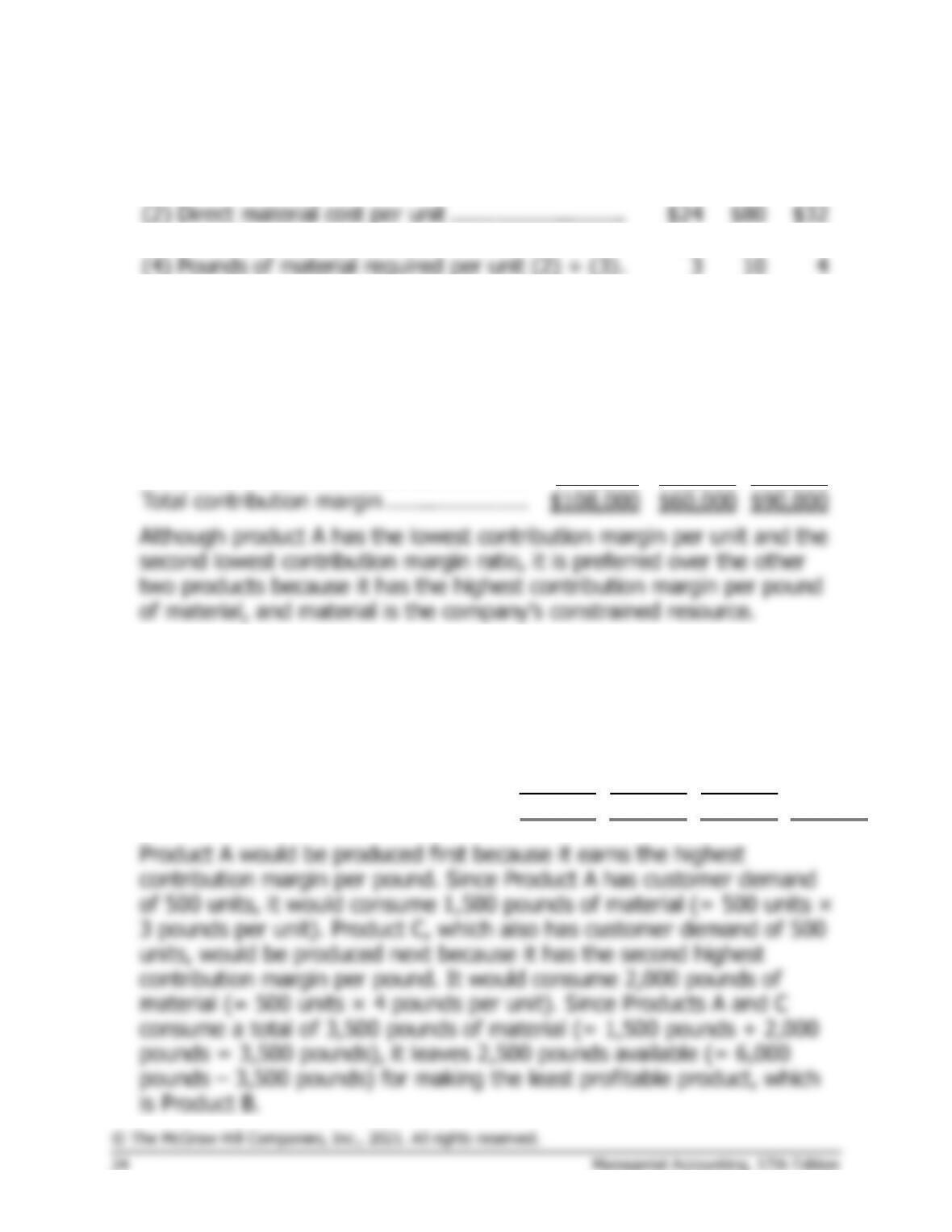
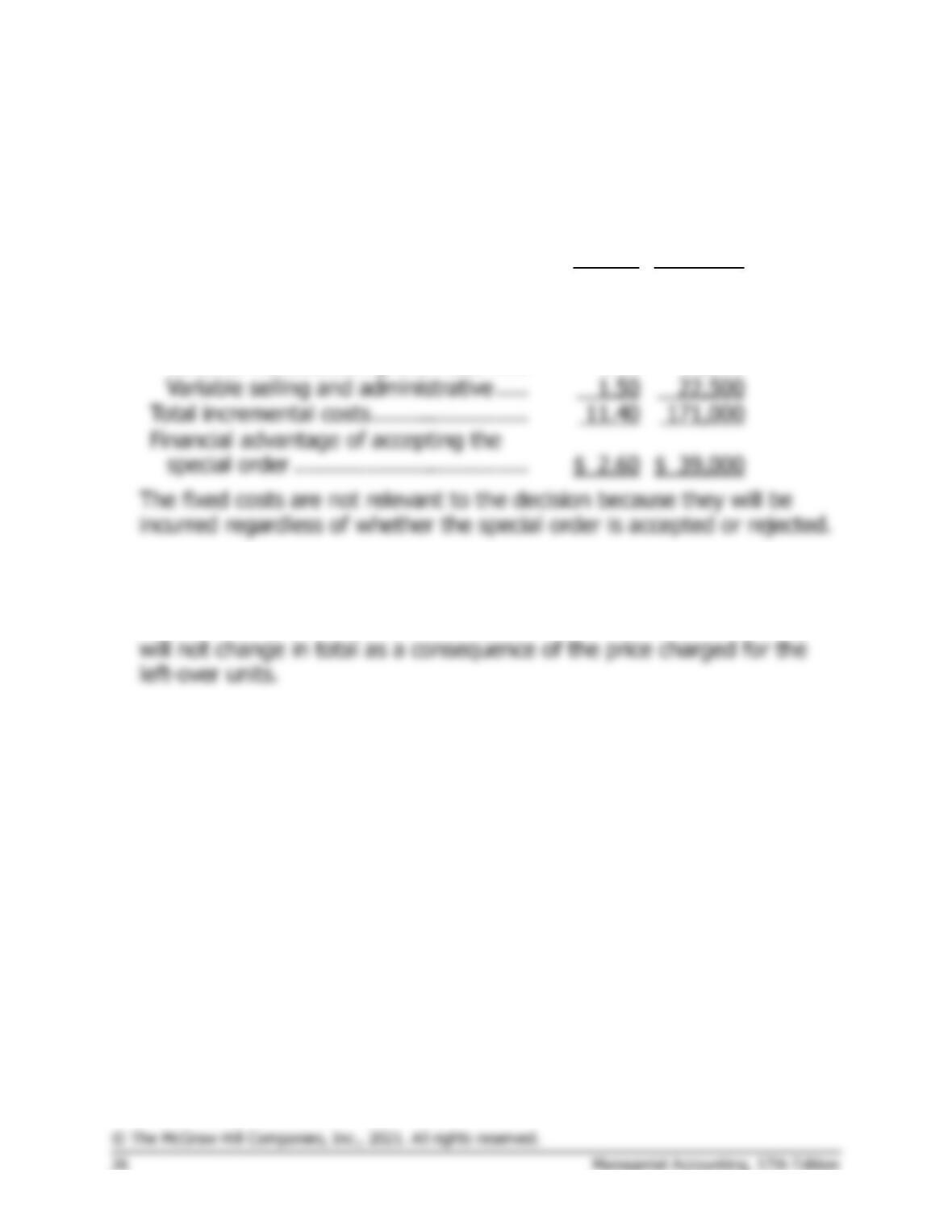
2. If the company has unlimited demand for all three products, it should
concentrate all of its available material on product A, which would yield the
highest total contribution margin of $108,000 computed as follows:
A
B
C
Contribution margin per pound (above) .
$ 18
$ 10
$ 15
Pounds of material available ………………
× 6,000
× 6,000
× 6,000
Total contribution margin ………………….
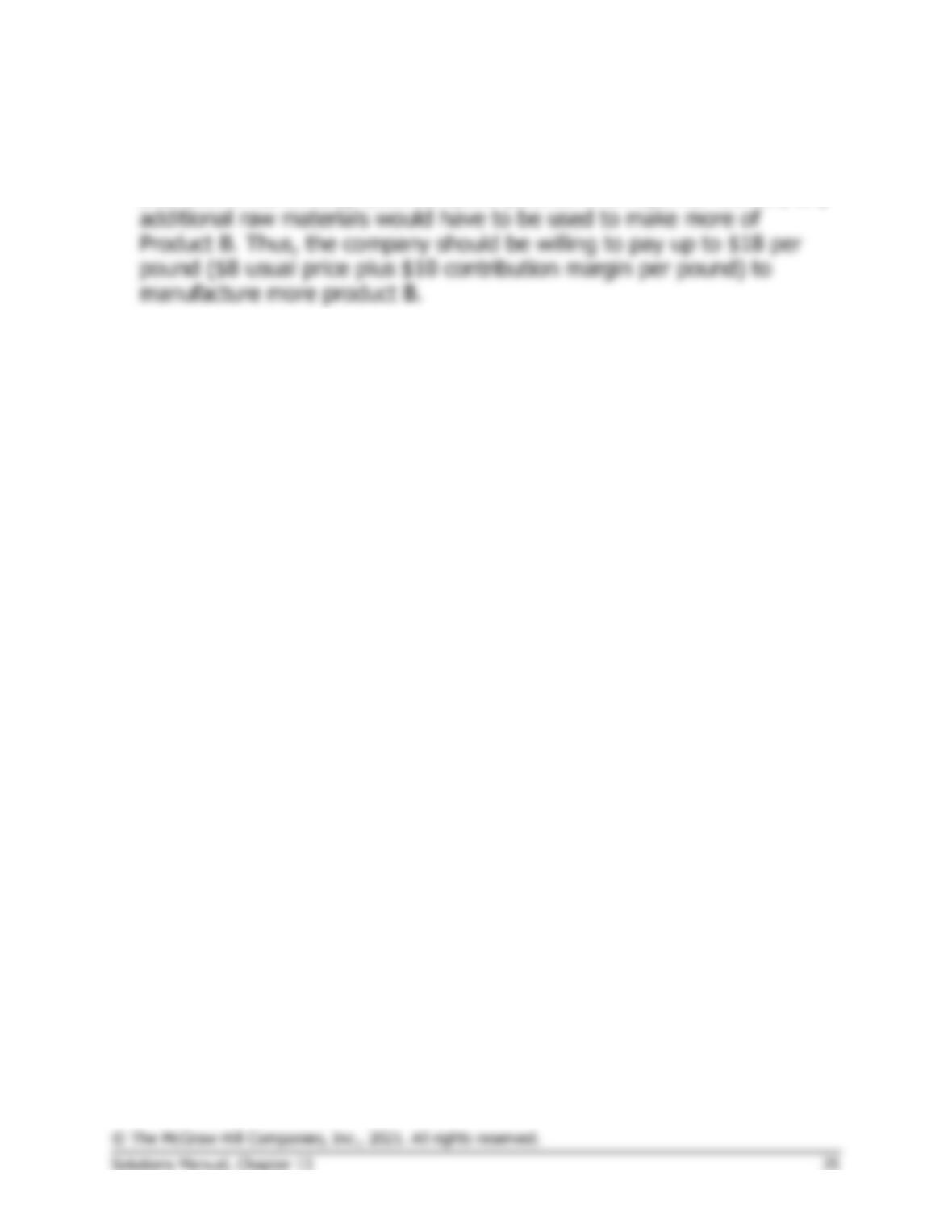
3. If customer demand is limited to 500 units per product the maximum
contribution margin of $82,000 is computed as follows:
A
B
C
Total
Contribution margin per pound
(above) …………………………………
$ 18
$ 10
$ 15
Pounds of material used ……………..
× 1,500
× 2,500
× 2,000
Total contribution margin …………….
$27,000
$25,000
$30,000
$82,000
Exercise 13–8 (continued)
4. Assuming Barlow has customer demand of 500 units per product line
and that it has already used its 6,000 pounds in an optimal fashion, any
Exercise 13–9 (15 minutes)
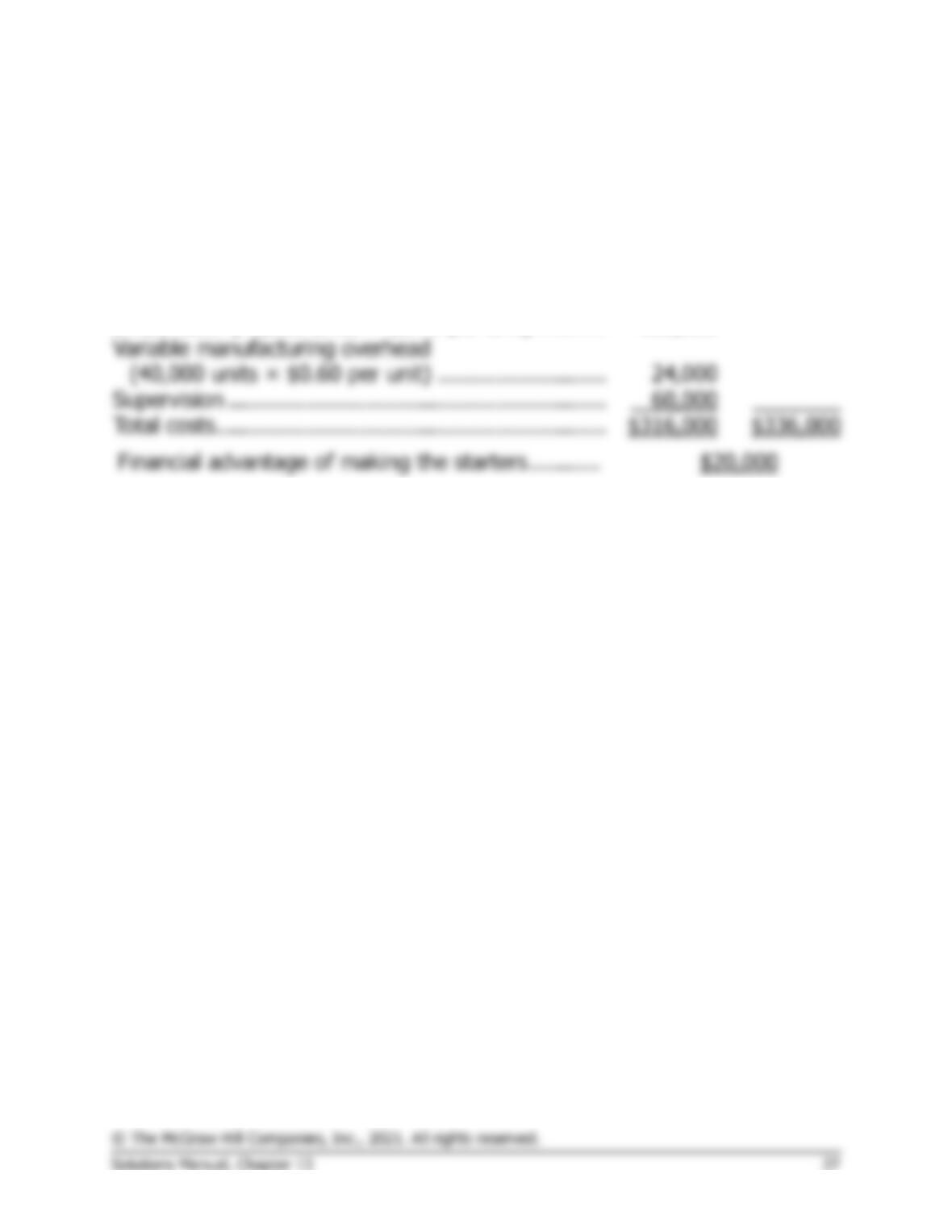
1. The financial advantage is computed as follows:
Per Unit
15,000
Units
Incremental sales …………………………..
$14.00
$210,000
Incremental costs:
Direct materials …………………………..
5.10
76,500
Direct labor ………………………………..
3.80
57,000
Variable manufacturing overhead ……
1.00
15,000
Total incremental costs ……………………
2. The relevant cost is $1.50 (the variable selling and administrative
expenses). All other variable costs are sunk because the units have
already been produced. The fixed costs are not relevant because they
Exercise 13–10 (15 minutes)
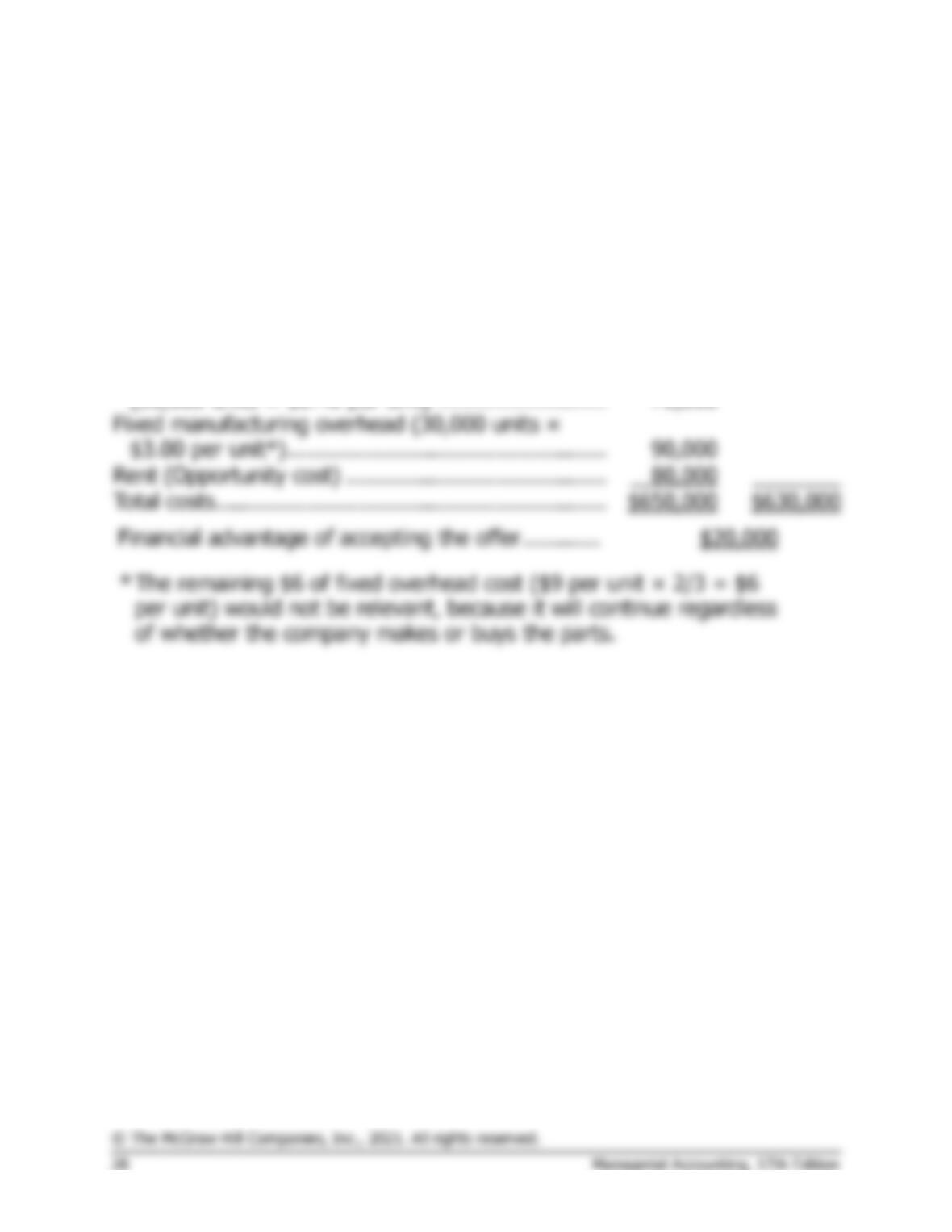
The financial advantage of making the 40,000 starters is computed as
follows:
Make
Buy
Cost of purchasing (40,000 units × $8.40 per unit) .
$336,000
Direct materials (40,000 units × $3.10 per unit) …..
$124,000
Direct labor (40,000 units × $2.70 per unit) ………..
108,000
Variable manufacturing overhead
Supervision ………………………………………………….
Total costs ……………………………………………………
$316,000
$336,000
$20,000
Exercise 13–11 (20 minutes)
The financial advantage of accepting the supplier’s offer is computed as
follows:
Make
Buy
Cost of purchasing (30,000 units × $21.00 per
unit) …………………………………………………………
$630,000
Direct materials (30,000 units × $3.60 per unit) …..
$108,000
Direct labor (30,000 units × $10.00 per unit) ………
300,000
Variable manufacturing overhead
(30,000 units × $2.40 per unit) ……………………..
Fixed manufacturing overhead (30,000 units ×
$630,000
$20,000
Exercise 13–12 (15 minutes)
1. The contribution margin per pound of the constraining resource for each
product is computed as follows:
Product
A
Product
B
Product
C
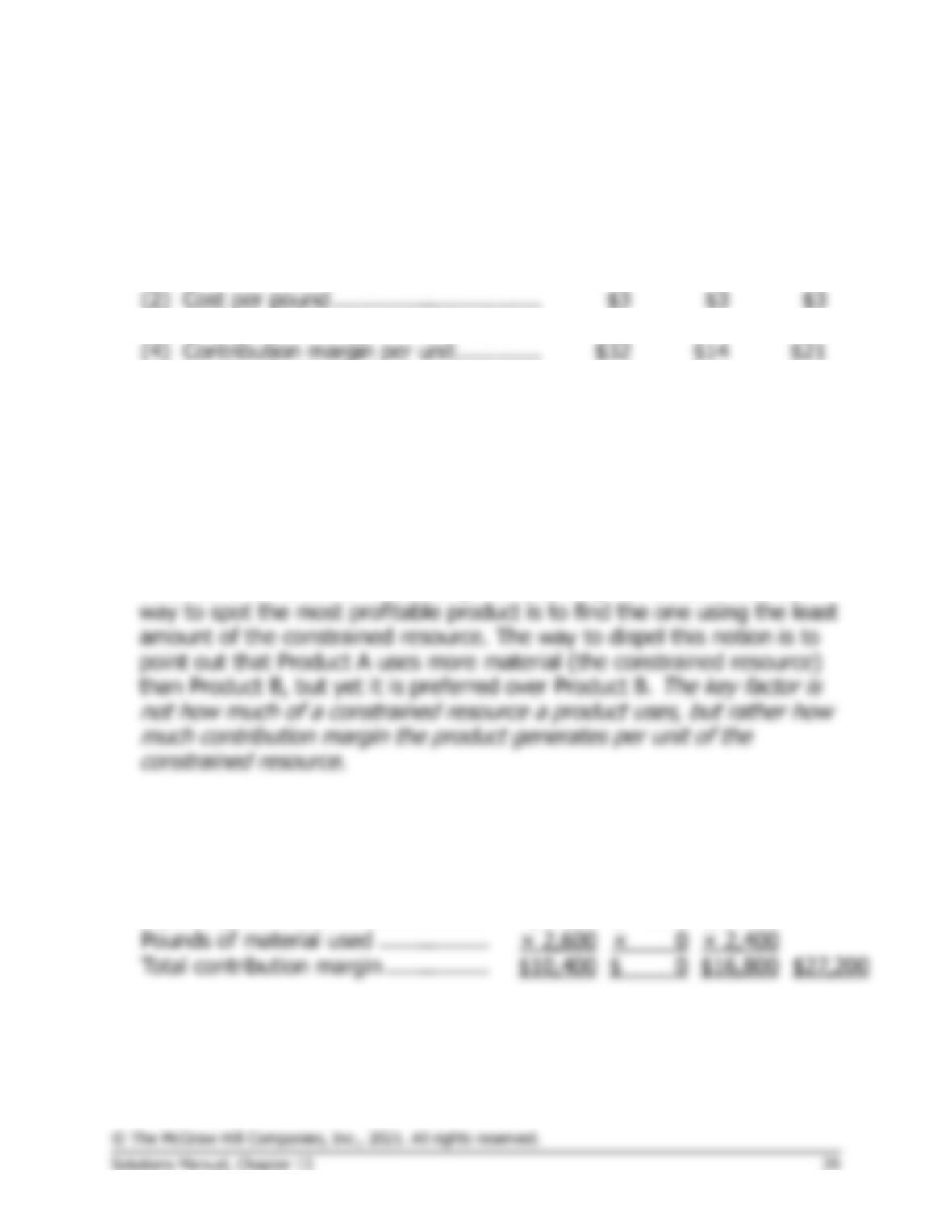
(1)
Direct materials required per unit ……
$24
$15
$9
(2)
Cost per pound …………………………..
$3
(3)
Pounds required per unit (1) ÷ (2) ….
8
5
3
(5)
Contribution margin per pound of
materials used (4) ÷ (3) …………….
$4.00
$2.80
$7.00
2. The company should accept orders first for Product C, second for
Product A, and third for Product B.
Because Product C uses the least amount of material per unit of the
three products, and because it is the most profitable of the three in
terms of its use of materials, some students will immediately assume
that this is an infallible relationship. That is, they will assume that the
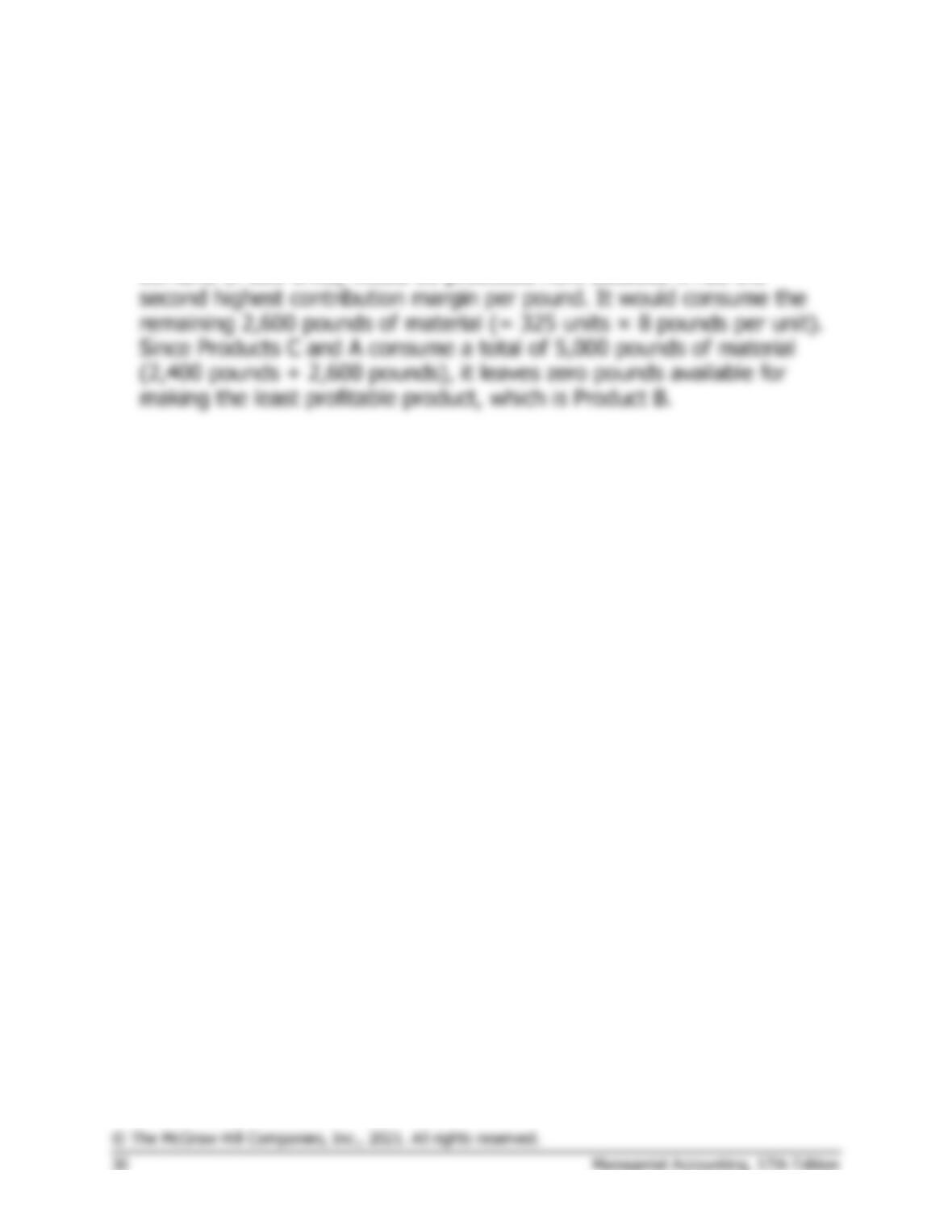
3. If customer demand is limited to 800 units per product, the maximum
contribution margin of $27,200 is computed as follows:
A
B
C
Total
Contribution margin per pound
(above) …………………………………
$ 4.00
$ 2.80
$ 7.00
Pounds of material used ……………..
Total contribution margin …………….
Exercise 13-12 (continued)
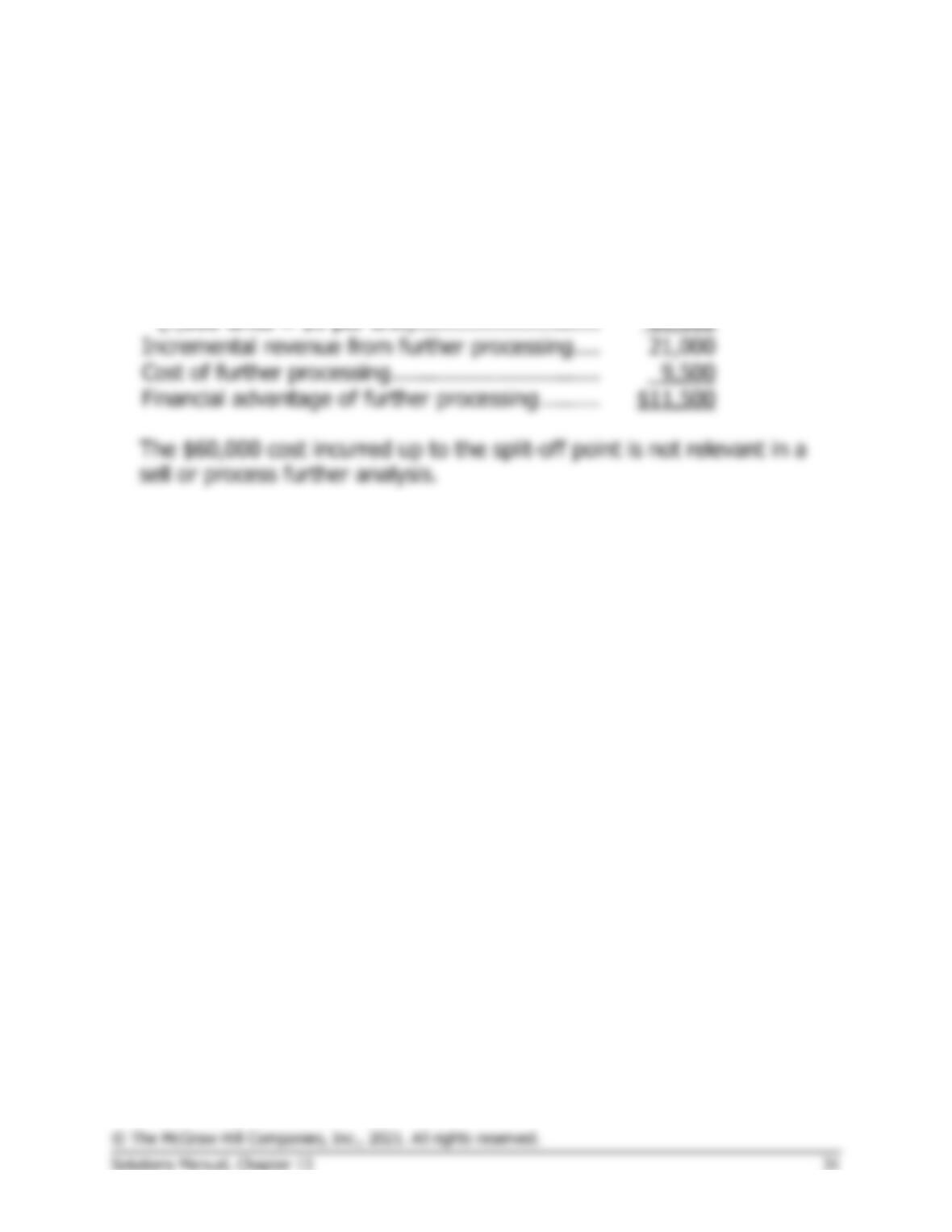
3. Product C would be produced first because it earns the highest
contribution margin per pound. Given that Product C has customer
demand of 800 units, it would consume 2,400 pounds of material (=
800 units × 3 pounds per unit). Product A, which also has customer
Exercise 13–13 (10 minutes)
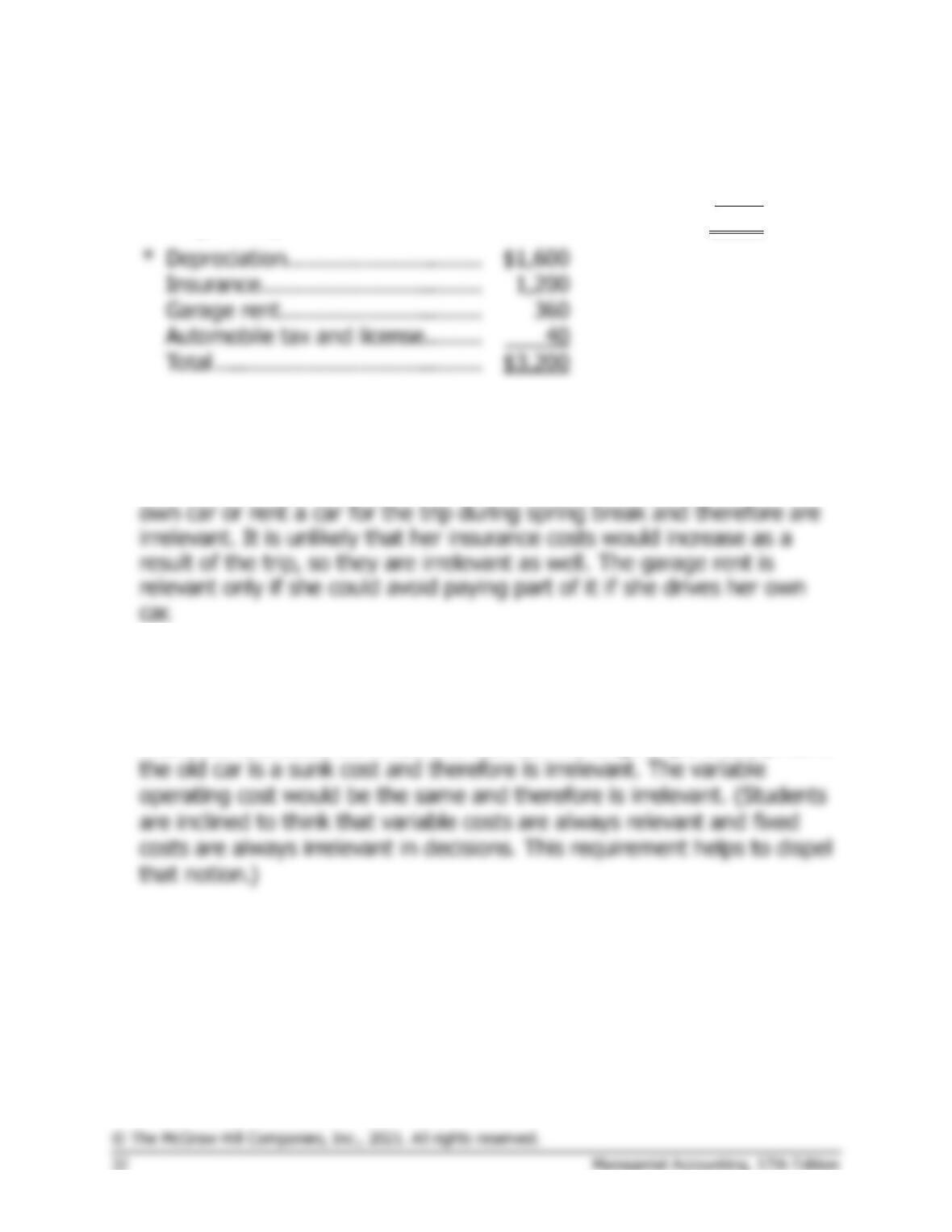
1. The financial advantage of further processing X15 is computed as
follows:
Sales value after further processing
(7,000 units × $12 per unit) ……………………..
$84,000
Sales value at the split-off point
$11,500
2. Yes, the company should process product X15 beyond the split-off point.
Exercise 13–14 (20 minutes)
1.
Average fixed cost per mile ($3,200* ÷ 10,000 miles) …..
$0.32
Variable operating cost per mile ……………………………….
0.14
Average cost per mile …………………………………………….
$0.46
*
2. The variable operating cost is relevant in this situation. The depreciation
is not relevant because it is a sunk cost. However, any decrease in the
resale value of the car due to its use is relevant. The automobile tax and
license costs would be incurred whether Kristen decides to drive her
3. When figuring the incremental cost of the more expensive car, the
relevant costs include the purchase price of the new car (net of the
resale value of the old car) and the increases in the fixed costs of
insurance and automobile tax and license. The original purchase price of
Exercise 13–15 (30 minutes)
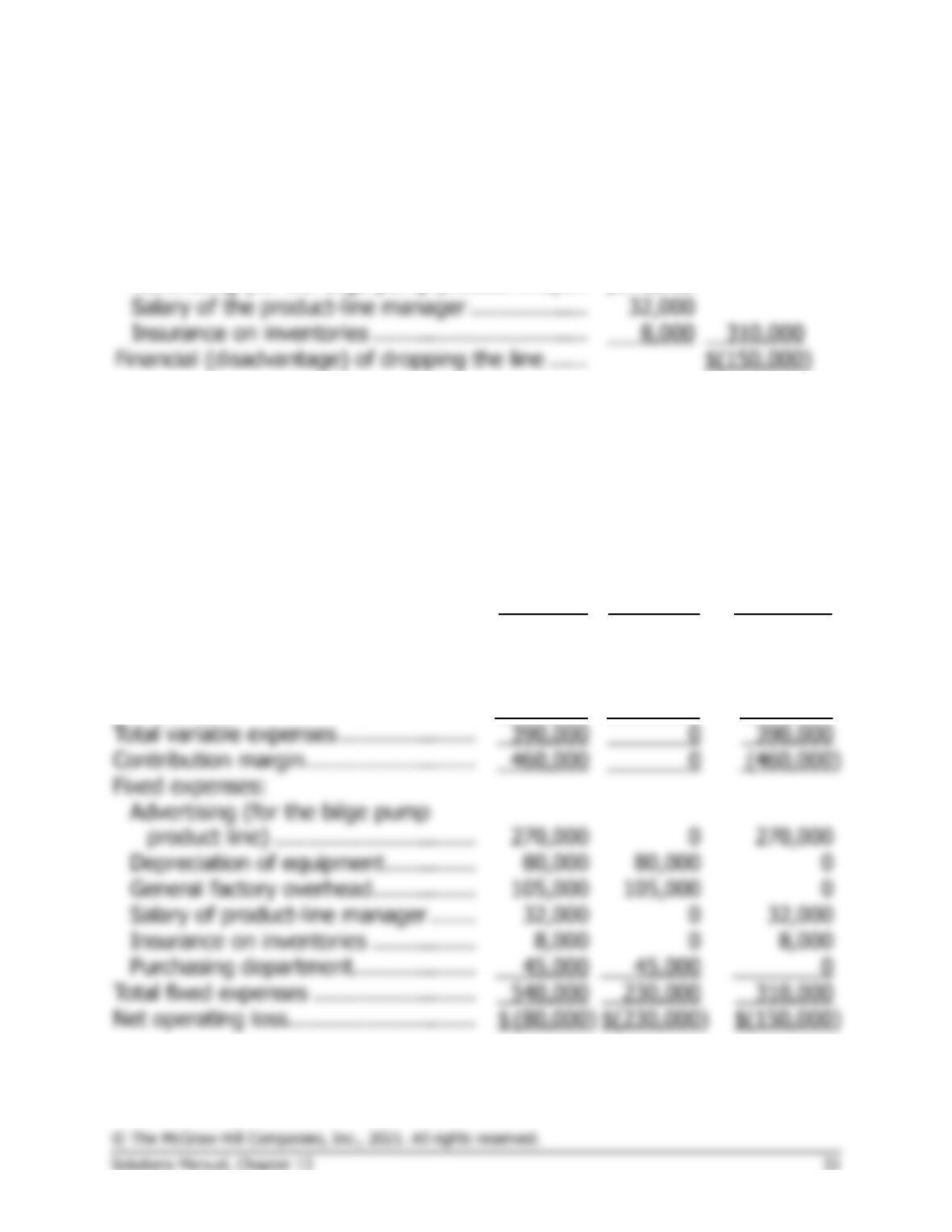
The financial (disadvantage) of discontinuing the bilge pump product line is
computed as follows:
Contribution margin lost if the line is dropped …..
$(460,000)
Fixed costs that can be avoided:
Advertising (for the bilge pump product line) ….
Salary of the product-line manager ………………
Insurance on inventories …………………………...
Financial (disadvantage) of dropping the line ……
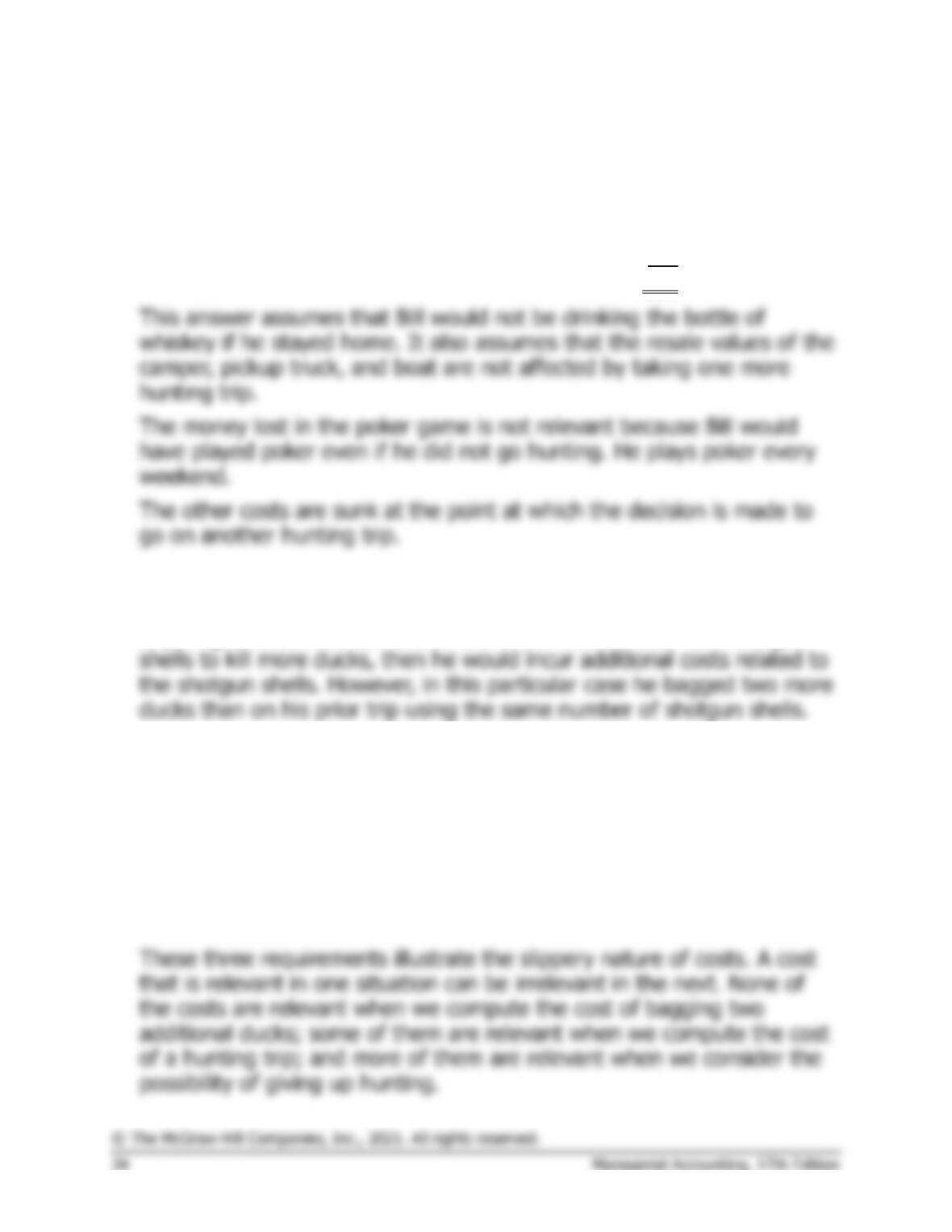
The same solution can be obtained by preparing comparative income
statements:
Keep
Product
Line
Drop
Product
Line
Difference:
Net
Operating
Income
Increase or
(Decrease)
Sales…………………………………………
$850,000
$ 0
$(850,000)
Variable expenses:
Variable manufacturing expenses ….
330,000
0
330,000
Sales commissions …………………….
42,000
0
42,000
Shipping …………………………..……..
18,000
0
18,000
Total variable expenses …………………
0
Contribution margin ……………………..
(460,000)
Fixed expenses:
0
Depreciation of equipment …………..
80,000
General factory overhead …………….
105,000
Salary of product-line manager …….
32,000
0
32,000
Insurance on inventories …………….
0
Purchasing department……………….
Total fixed expenses …………………….
Net operating loss………………………..
$(230,000)
Exercise 13–16 (30 minutes)
1. The relevant costs of a hunting trip would be:
Travel expense (100 miles @ $0.21 per mile) .
$21
Shotgun shells ………………………………………
20
One bottle of whiskey …………………………....
15
Total …………………………………………………..
$56
2. If Bill gets lucky and bags another two ducks, all of his costs are likely to
be the same as they were on his last trip. Therefore, it doesn’t cost him
anything to shoot the last two ducks. If he were to use more shotgun
3. In a decision of whether to give up hunting entirely, more of the costs
listed by John are relevant. If Bill did not hunt, he would not need to
pay for: gas, oil, and tires; shotgun shells; the hunting license; and the
whiskey. In addition, he would be able to sell his camper, equipment,
boat, and possibly pickup truck, the proceeds of which would be
considered relevant in this decision. The original costs of these items are
not relevant, but their resale values are relevant.
Exercise 13–17 (10 minutes)
Contribution margin lost if the Linens Department is dropped:
Lost from the Linens Department …………………………..……..
$(600,000)
Lost from the Hardware Department (10% × $2,100,000) ….
(210,000)
Total lost contribution margin …………………………………………
$(350,000)
Problem 13-18 (60 minutes)
1.
Selling price per unit …………………………………….
$32
Variable expenses per unit ……………………………..
18
*
Contribution margin per unit …………………………..
$14
*$10.00 + $4.50 + $2.30 + $1.20 = $18.00
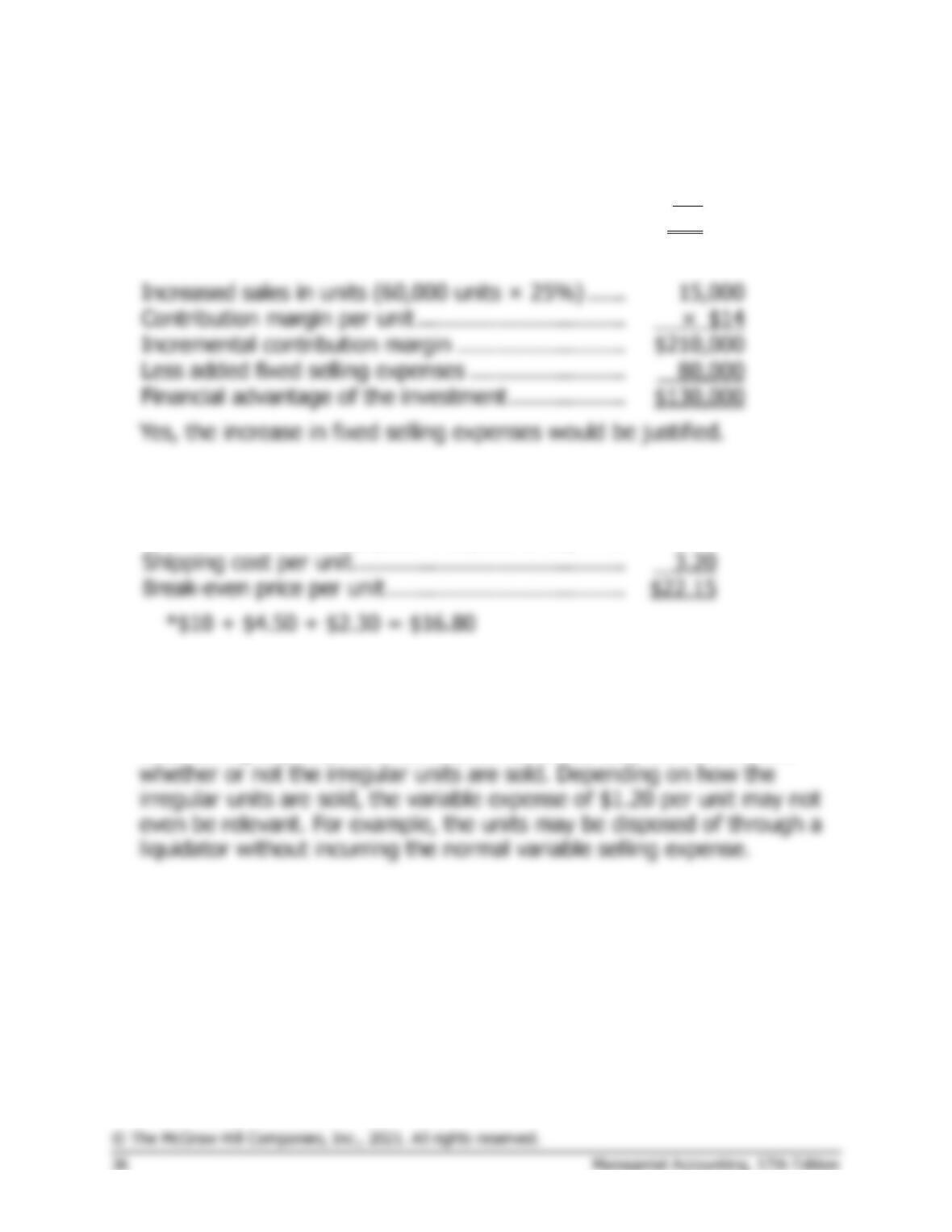
Increased sales in units (60,000 units × 25%) ……
Contribution margin per unit …………………………..
Incremental contribution margin ……………………..
Less added fixed selling expenses ……………………
Financial advantage of the investment ………………
2.
Variable manufacturing cost per unit ………………..
$16.80
*
Import duties per unit …………………………………..
1.70
Permits and licenses ($9,000 ÷ 20,000 units) …….
0.45
Shipping cost per unit ……………………………………
Break-even price per unit ……………………………….
3. The relevant cost is $1.20 per unit, which is the variable selling expense
per Dak. Because the irregular units have already been produced, all
production costs (including the variable production costs) are sunk. The
fixed selling expenses are not relevant because they will be incurred
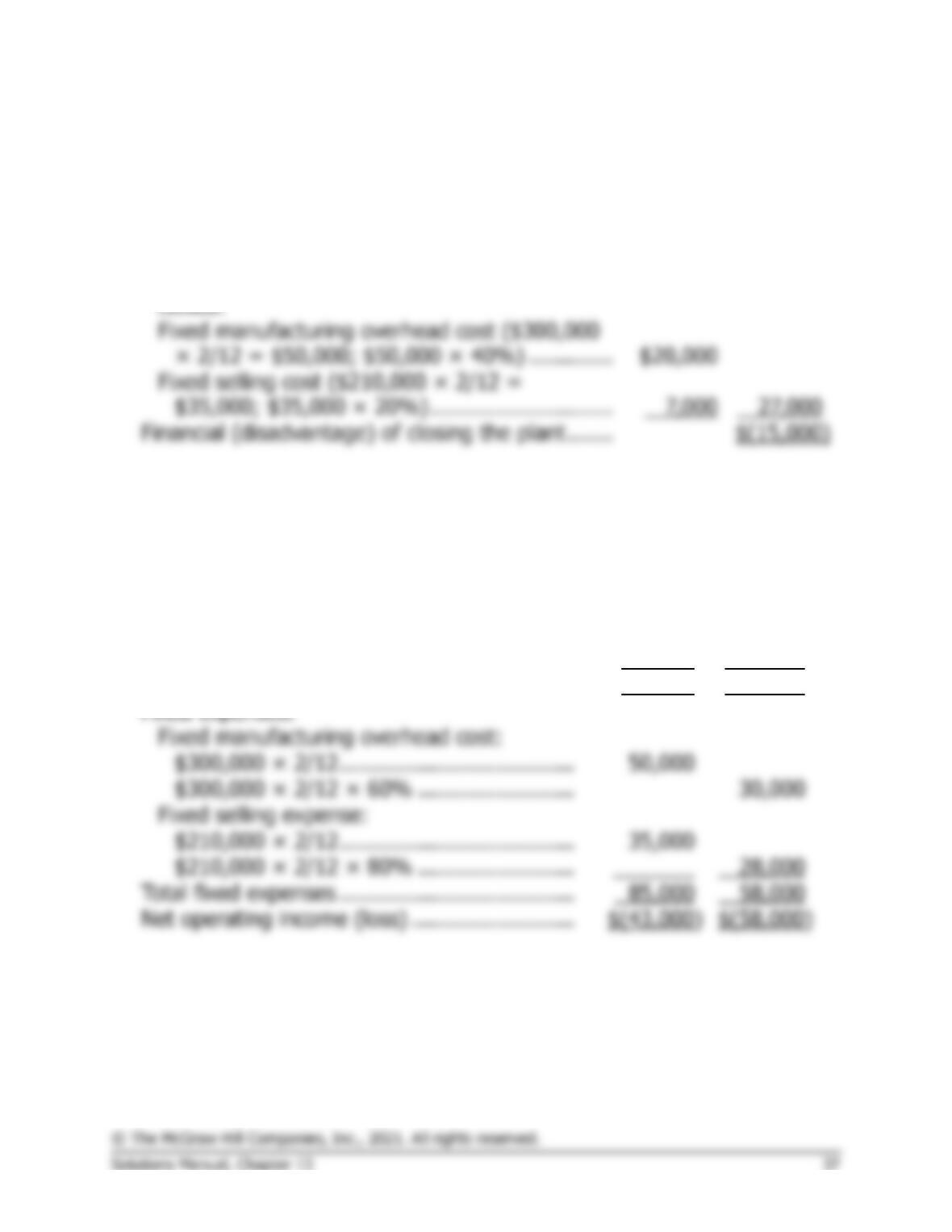
4. If the plant operates at 30% of normal levels, then only 3,000 units will
be produced and sold during the two-month period:
60,000 units per year × 2/12 years = 10,000 units
10,000 units × 30% = 3,000 units produced and sold
Problem 13-18 (continued)
Given this information, the simplest approach to solving 4a, 4b, and 4c
is:
Contribution margin lost if the plant is closed
(3,000 units × $14 per unit) ……………………….
$(42,000)
Fixed costs that can be avoided if the plant is
Financial (disadvantage) of closing the plant …….
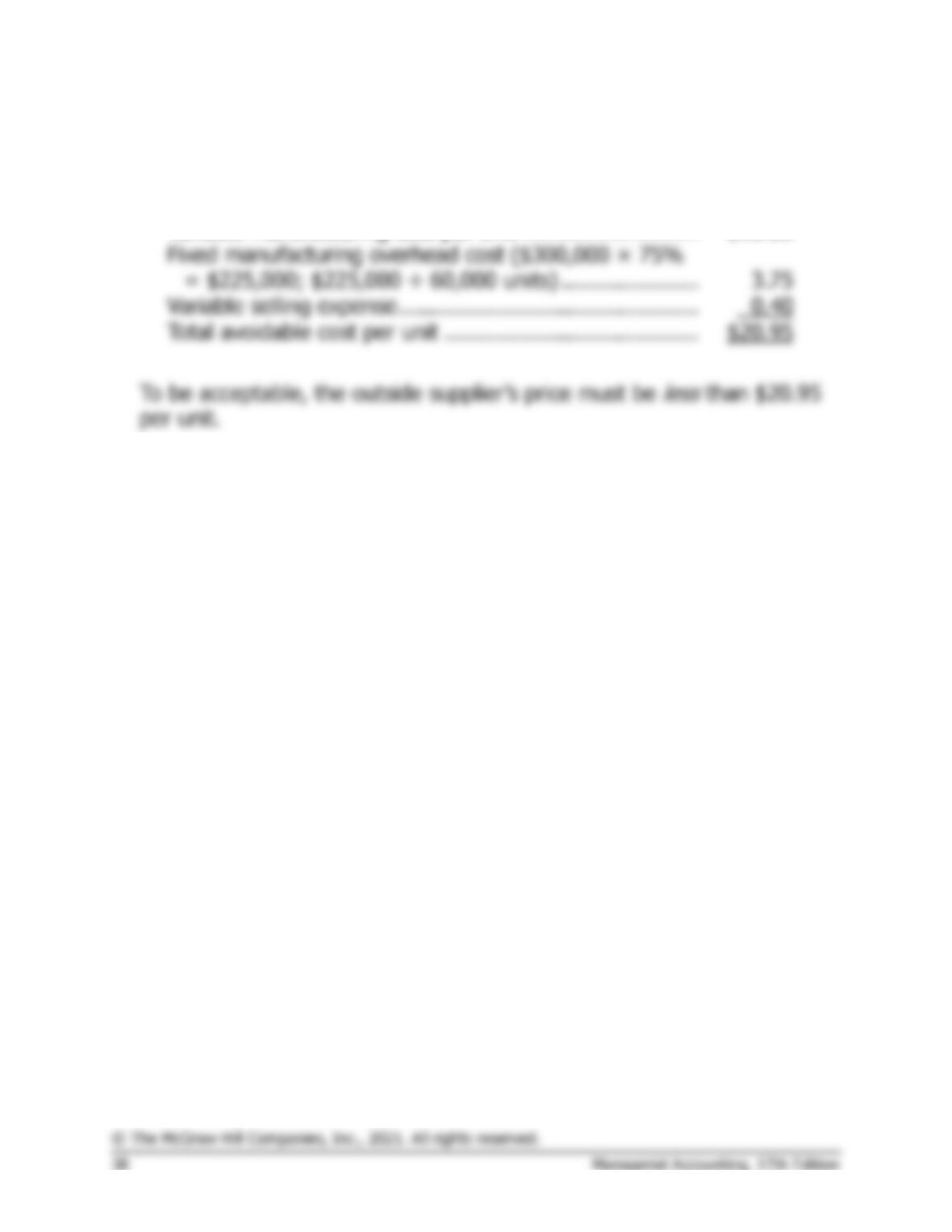
Some students will take a longer approach such as that shown below:
Continue
to
Operate
Close the
Plant
Sales (3,000 units × $32 per unit) …………….
$ 96,000
$ 0
Variable expenses (3,000 units × $18 per
unit) ………………………………………………..
54,000
0
Contribution margin ……………………………….
42,000
0
Fixed expenses:
Fixed manufacturing overhead cost:
Fixed selling expense:
Total fixed expenses ………………………………
Net operating income (loss) …………………….
$(43,000)
4d. The company should not close the plant for two months because it will
be $15,000 worse off if it closes.
Problem 13-18 (continued)
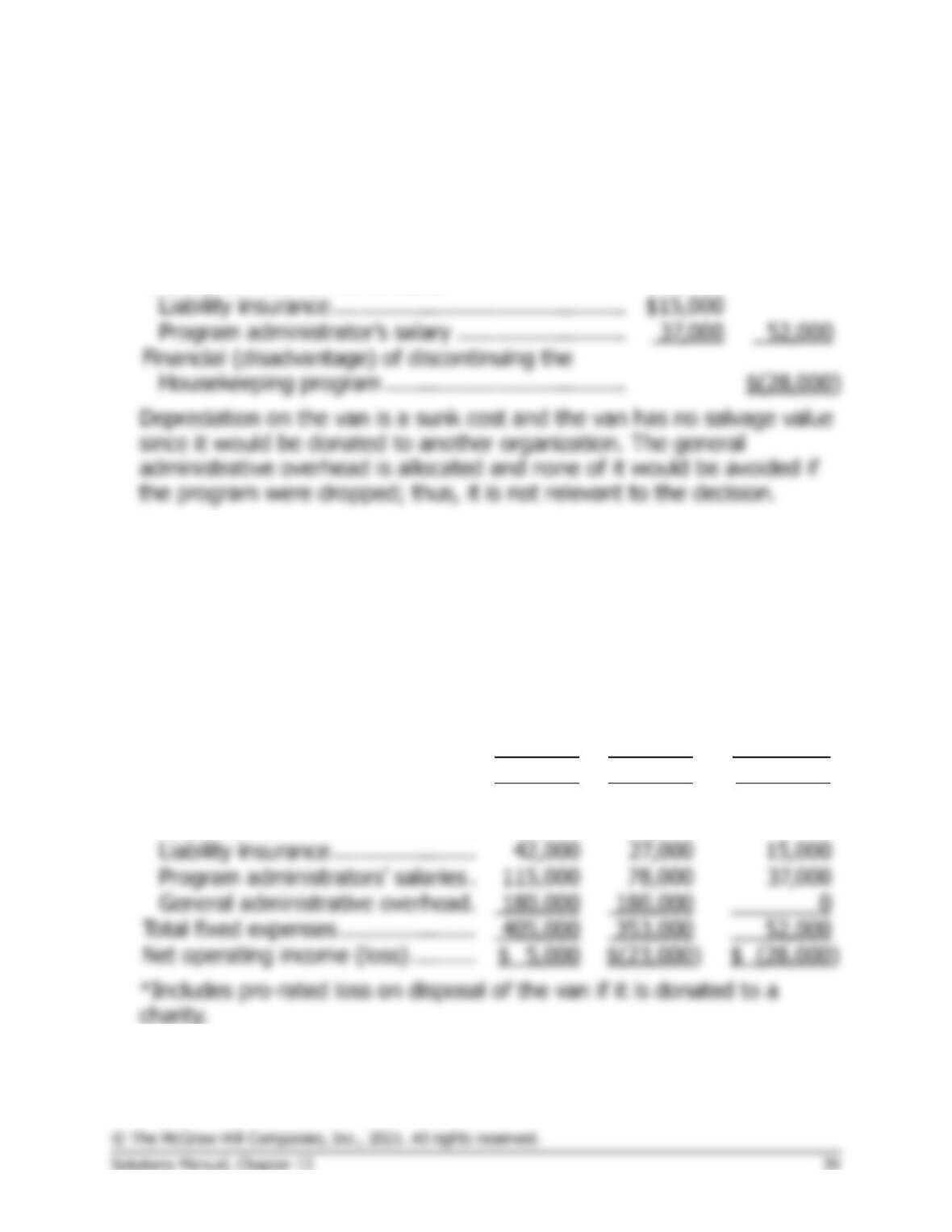
5. The relevant costs are those that can be avoided by purchasing from the
outside supplier. These costs are:
Problem 13-19 (60 minutes)
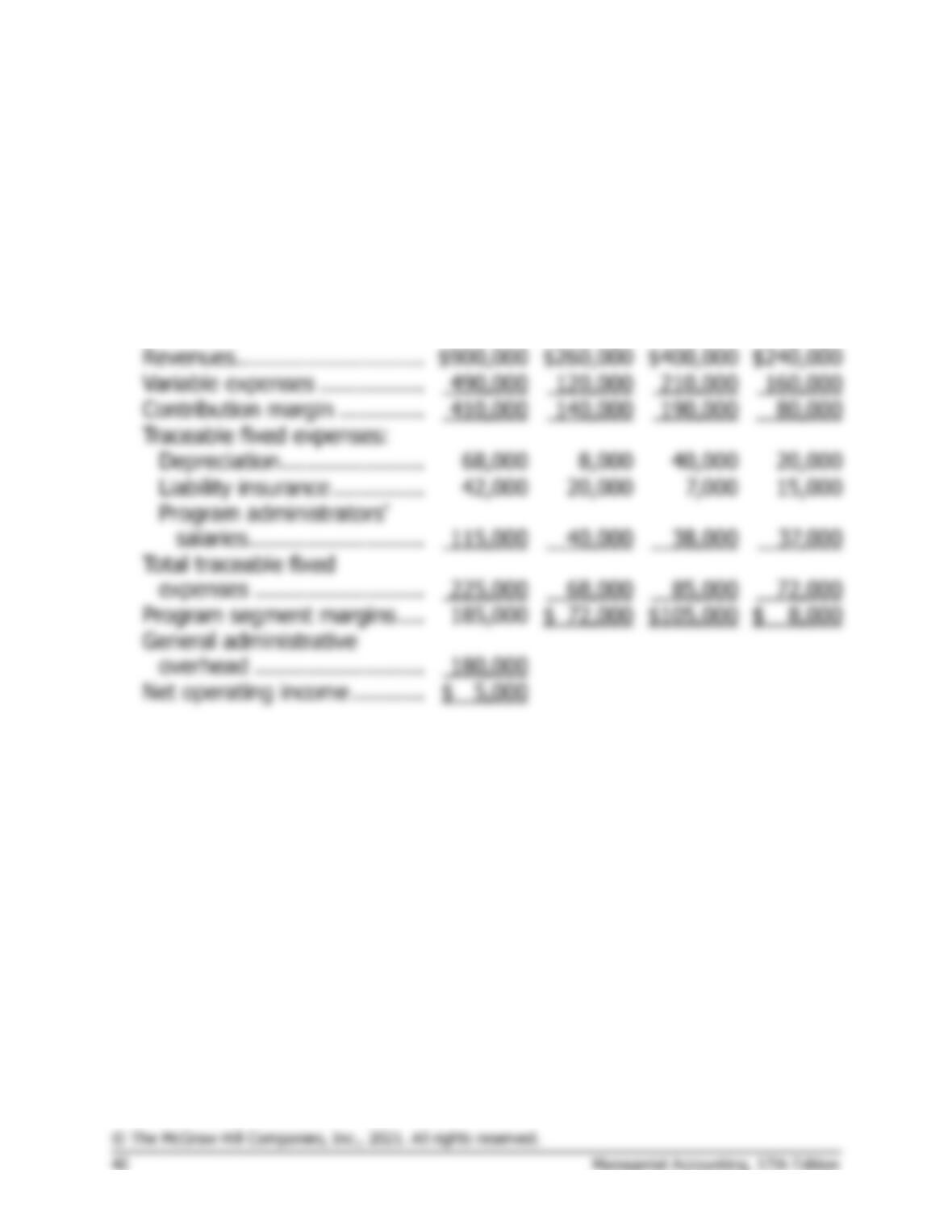
1. The financial (disadvantage) of discontinuing the Housekeeping program
is calculated as follows:
Contribution margin lost if the Housekeeping
program is dropped ……………………………………
$(80,000)
Fixed costs that can be avoided:
Liability insurance ………………………………………
Program administrator’s salary ……………………..
$(28,000)
The same result can be obtained with the alternative analysis below:
Current
Total
Total If
House-
keeping Is
Dropped
Difference:
Net
Operating
Income
Increase or
(Decrease)
Revenues ……………………………….
$900,000
$660,000
$(240,000)
Variable expenses ……………………
490,000
330,000
160,000
Contribution margin …………………
410,000
330,000
(80,000)
Fixed expenses:
Depreciation* ……………………….
68,000
68,000
0
Liability insurance ………………….
42,000
78,000
Total fixed expenses …………………
405,000
353,000
Net operating income (loss) ……….
Problem 13-19 (continued)
2. To give the administrator of the entire organization a clearer picture of
the financial viability of each of the organization’s programs, the general
administrative overhead should not be allocated. It is a common cost
that should be deducted from the total program segment margin. A
better income statement would be:
Total
Home
Nursing
Meals On
Wheels
House-
keeping
Revenues ………………………..
Variable expenses …………….
Contribution margin ………….
Program segment margins ….